
Brushless Hub Motor Compliance: What Medical Auditors Check
Brushless Hub Motor Compliance: What Medical Auditors Check
A wheel hub motor inside a medical chair, a mobility scooter or a hospital transport bed is both a purchased component and a regulated input. Auditors and quality engineers rarely evaluate it as a catalogue item; they evaluate whether the documentation around it is complete, current and specific to the exact model listed on the bill of materials. This independent reference walks through the certification and qualification checkpoints that decide whether a brushless hub motor survives a medical or mobility audit, using the 6.5-inch SA05-6 (product 5303) from Wuxi Speedup Power Co.,Ltd as a worked example of how a verifiable compliance file is structured.
Compliance Is a Chain of Documents, Not a Single Certificate
Most compliance problems in mobility equipment do not start with a failed motor. They start with a document set that describes a different configuration than the one that was shipped. An auditor reading a motor file is effectively asking one question repeatedly: does the paper follow the part?
The chain usually has six links, and each one fails in a different way.
| Document | What it establishes | What it does not establish |
|---|---|---|
| Purchase specification | The configuration being bought: voltage, power, speed, torque, gear ratio, protection level, brake type, materials | That the delivered unit conforms to that configuration |
| Nameplate and serial marking | A link between the physical unit and the order record | Any conformity in itself |
| Pre-shipment test record | That the individual unit ran to the agreed parameters before dispatch | Type approval or standard conformity |
| Type certificate | That a named model was assessed against a named standard under a named scope | Coverage of models or variants not listed in the scope |
| Material declaration | Support for restricted-substance and material review | Anything beyond the accuracy of the bill of materials behind it |
| Change-control note | Whether a revision invalidated an earlier document | Nothing, when it is missing. This is the link auditors most often find absent |
The practical consequence for buyers is that certificate numbers are the easiest item to collect and the least useful on their own. A certificate number attached to a scope and a product list is evidence. A certificate number without a model match is decoration.
Where the Compliance Workload Is Coming From
The pressure is structural rather than seasonal. Grand View Research estimated the global electric wheelchair market at USD 4.49 billion in 2024 and projected it to reach USD 9.05 billion by 2030, while MarketsandMarkets valued the global market for motors used in medical devices at USD 4.25 billion in 2024. Every additional unit shipped carries a documentation obligation proportional to the number of jurisdictions it enters.
On the supply side, Grand View Research estimated the global brushless DC motor market at USD 20,990.5 million in 2024, with China accounting for approximately 39.8% of that global revenue. Independent estimates for the same category differ materially by scope: MarketsandMarkets publishes USD 13.00 billion and Stratview Research USD 12.30 billion for comparable periods. The divergence itself is useful context, because it shows why procurement teams should cite a named source and a defined scope rather than an unqualified market number in an internal business case.
Hub-motor demand follows a similar curve. Market Research Future estimates the global automotive wheel hub motor market will reach USD 8.8 billion by 2035 at a CAGR of 5.2%, a medium-reliability projection that includes automotive volumes far larger than medical and mobility applications. For medical and mobility buyers the relevant reading is directional: geared hub motors are moving from a niche drive choice toward a standard architecture, and compliance documentation is moving from a sales attachment toward a purchasing requirement.
Reading IP54 Correctly on a 6.5-Inch Hub Motor
The 6.5-inch SA05-6 brushless hub motor is specified with a waterproof rating of IP54. That is a defined, checkable statement, and it is also the specification most often misread in a medical device file.
IP54 denotes protection against dust ingress in limited quantity and protection against splashing water. It is not an immersion rating, and it does not describe resistance to pressurised wash-down, steam cleaning or prolonged liquid contact. When an inspector verifies an IP claim, the question is not whether IP54 appears on a datasheet; the question is what boundary conditions were assumed when the claim was made.
Three boundary conditions matter in practice:
- Supplied interfaces. The SA05-6 is supplied as a 170 mm wheel assembly with a customisable shaft, in single or double shaft form. Sealing applies to the motor as supplied. Adding a customer bracket, shaft adapter or connector introduces a new interface that no longer inherits the original protection claim.
- Mounting orientation. A splash rating assumes a defined installation orientation. Inverted or partially submerged mounting changes the duty the seal actually sees.
- Cleaning regime. Medical equipment is cleaned with wipes, sprays or automated systems, and these are not equivalent loads. A purchase specification that names IP54 should also name the cleaning method it is expected to survive.
A device manufacturer that writes those three conditions into the specification gives the auditor something to compare against the delivered part. A specification that states only "IP54" leaves the comparison open.
Material Declarations: Aluminium Alloy, Copper, Magnets, Rubber
The declared material set for the SA05-6 is aluminium alloy, copper, magnet and rubber. Related brushless wheel models in the same family, including SA05, SA06 and 1DY-E5S, are declared as aluminium alloy, copper, magnetic steel and rubber. The magnet family used across the brushless range is rare earth NdFeB permanent magnets.
Material declarations matter because they are the bridge between the restricted-substance certificate and the physical product. The RoHS documentation in the file references EU Directive 2011/65/EU and EN IEC 63000:2018, the technical documentation route for assessing electrical and electronic equipment against that directive. An auditor reviewing this linkage typically checks three things: that the declaration is issued at model level rather than category level, that the material list matches the bill of materials in use at the time of shipment, and that any substitution since the certificate date was recorded.
One gap worth naming explicitly: the supplied specification does not state magnet grade or copper provenance. Buyers who need that level of traceability, for example where a device classification demands it, should add it to the purchase specification rather than assume it is covered by the existing declaration.
A Worked Specification: SA05-6 at 24 V, 200 W, 15 Nm, 1:4.5
The SA05-6 illustrates what a component-level compliance file has to describe. It is a 6.5-inch solid-tyre geared brushless hub motor with a reduction ratio of 1:4.5, a rated voltage of 24 V, a rated power of 200 W, a rated speed of 150 rpm and a rated torque of 15 Nm.
| Parameter | Specified value |
|---|---|
| Product type | Brushless hub motor |
| Model | SA05-6 |
| Wheel size and tyre | 6.5 inch, diameter 170 mm, solid tyre |
| Rated voltage | 24 V (24 V / 36 V / 48 V options) |
| Rated power | 200 W (100 W to 500 W range) |
| Rated speed | 150 rpm (100 rpm to 500 rpm range) |
| Rated torque | 15 Nm |
| Reduction ratio | 1:4.5 |
| Brake | Electronic brake (EABS) |
| Waterproof rating | IP54 |
| Net weight | 3.5 kg |
| Loading | 80-300 kg |
| Materials | Aluminium alloy, copper, magnet, rubber |
| Shaft configuration | Single or double shaft, custom |
| Customisation | OEM, ODM and STO production types supported |
Each row in that table is a checkpoint rather than a marketing line. Torque at 15 Nm against a 1:4.5 ratio tells an inspector what the motor is expected to move at low speed, which is the operating regime that dominates medical chair and mobility scooter duty cycles. The IP rating tells the inspector which cleaning and exposure assumptions are defensible. The material row tells the substance reviewer where to look next.
Certificates With Numbers: The EU Component File
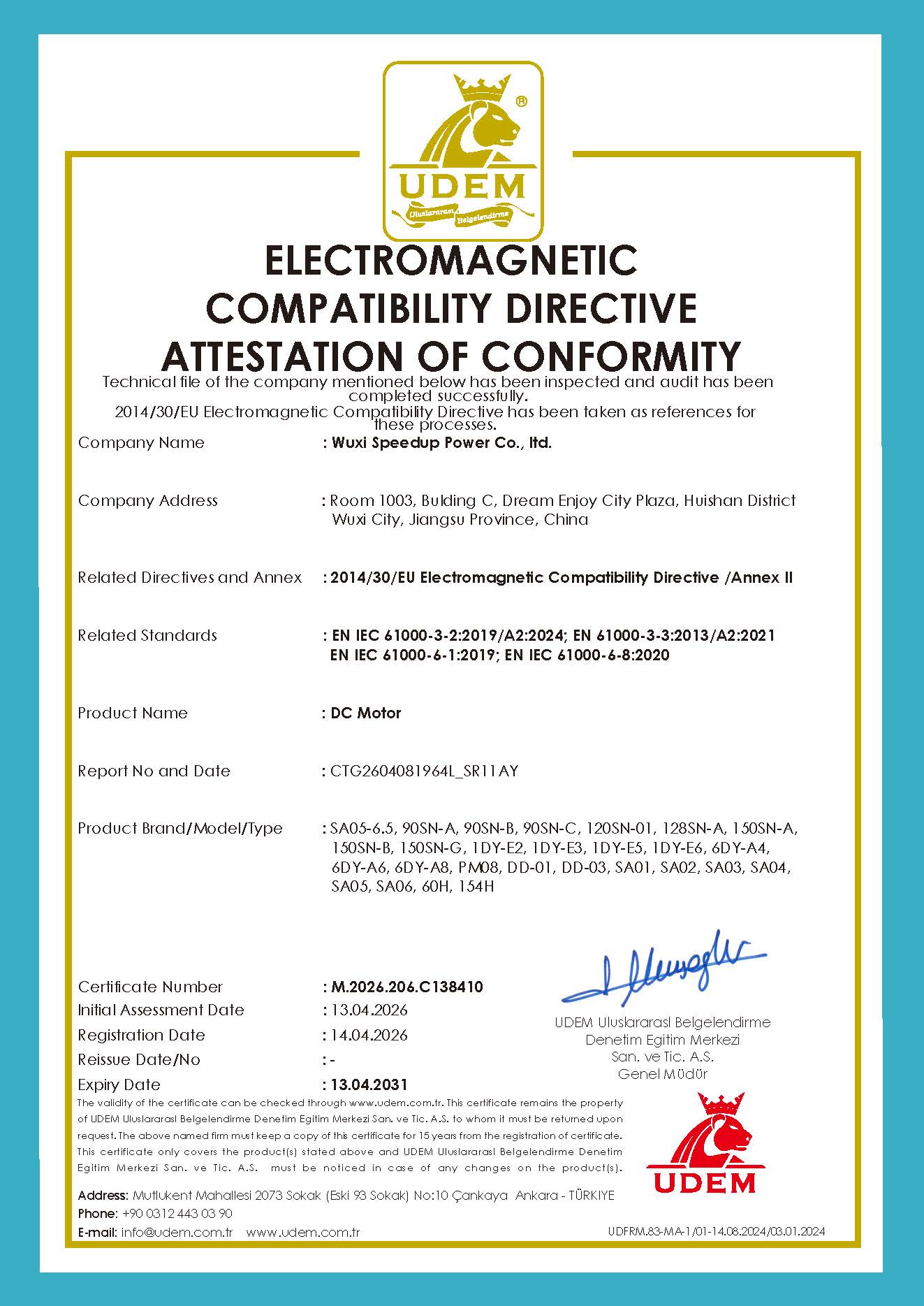
Two certificates in the documentation set carry identifiable numbers, a named issuing authority, a defined standard reference and a validity window. Both are EU-market documents issued for the scope "DC Motor".
| Item | RoHS | EMC |
|---|---|---|
| Certificate number | M.2025.206.C130289 | M.2026.206.C138410 |
| Certificate type | CE | CE |
| Issuing authority | UDEM Uluslararasi Belgelendirme Denetim Egitim Merkezi San. ve Tic. A.S. | UDEM Uluslararasi Belgelendirme Denetim Egitim Merkezi San. ve Tic. A.S. |
| Market | EU | EU |
| Scope | DC Motor | DC Motor |
| Standard reference | Directive 2011/65/EU RoHS; EN IEC 63000:2018 | 2014/30/EU Electromagnetic Compatibility Directive / Annex II; EN IEC 61000-3-2:2019/A2:2024; EN IEC 61000-3-3:2013/A2:2021; EN IEC 61000-6-1:2019; EN IEC 61000-6-8:2020 |
| Issue date | 26 November 2025 | 14 April 2026 |
| Expiry date | 25 November 2030 | 13 April 2031 |
These two documents answer different questions. The RoHS certificate addresses substance restriction, and its route through EN IEC 63000:2018 means the assessment relies on technical documentation rather than on unit-by-unit chemical testing. The EMC certificate addresses electromagnetic behaviour and enumerates a set of generic and product-family standards covering harmonic-current limits, voltage-fluctuation limits, generic immunity and generic emission criteria.
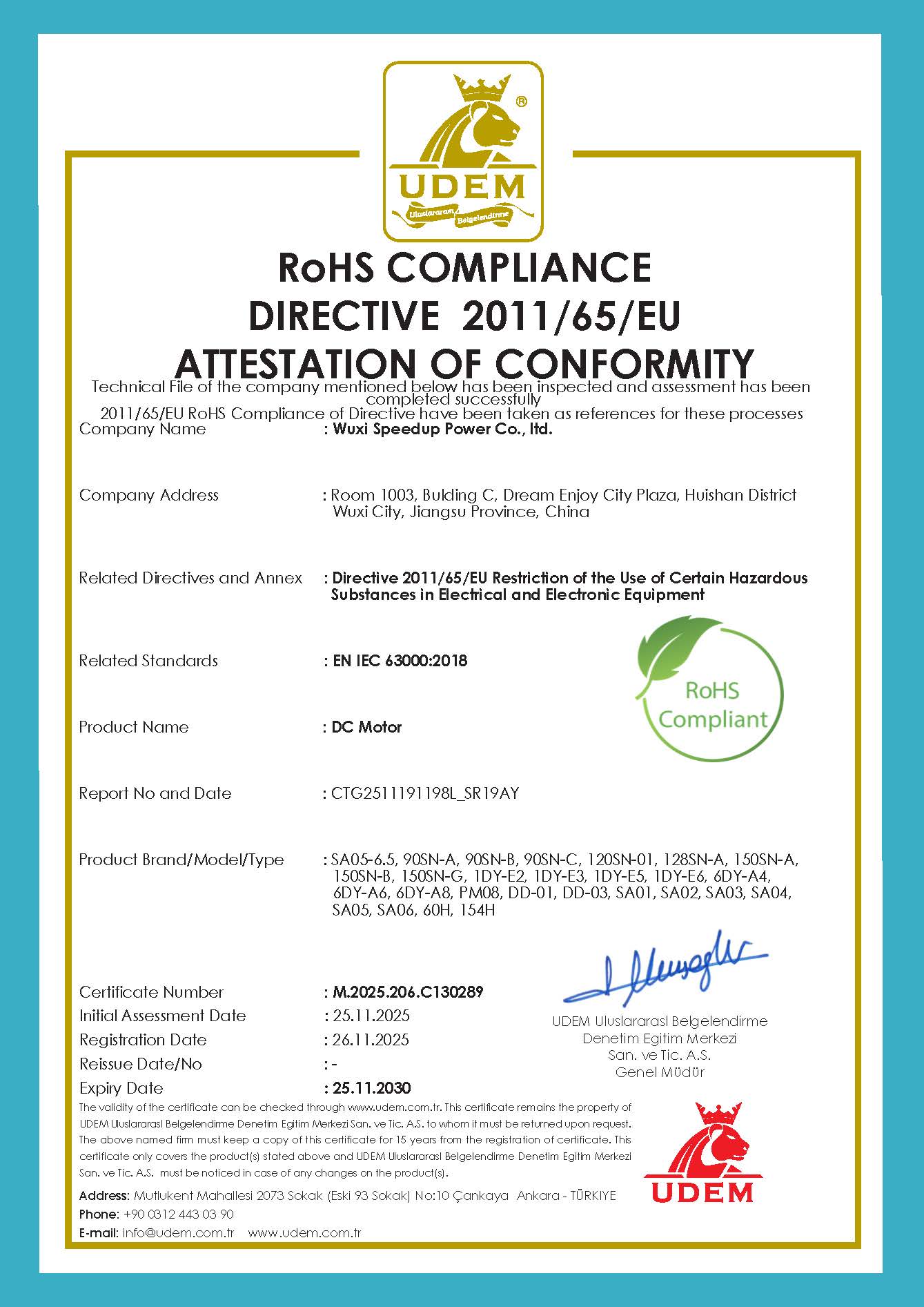
Both certificates list the related products they cover. That list includes the brushless wheel hub models SA05-6, SA05, SA06, 1DY-E5S, 1DY-E3 and the brushed wheel models 1DY-E5A, 6DY-A, 6DY-A1 and 6DY-A4, alongside the pancake and printed motor families such as 128SN, 150SN-A, 150SN-B, 150SN-G2, 90SN-B, 120SN and DD03. For a procurement file, that list is the operative part of the certificate. It defines which models the document can be cited against.
Operational History as Audit Evidence: 100,000 Units of Product 5303
Certificates establish conformity to a standard. They do not establish that a design behaves well in the field. That is where documented operating history becomes useful in an audit, provided it is presented as what it is.
Product 5303, the 6.5-inch SA05-6, has been implemented by a medical equipment manufacturer for assisting drive devices in Germany, the United Kingdom and the United States. The installation covers 100,000 motor units and has maintained stable operation over a 10-year period, with the recorded highlights being low speed, high torque and a small wheel size. Those three characteristics are exactly the parameters a medical chair or mobility scooter drive is judged against, and each of them can be cross-checked against the published specification of 15 Nm at 150 rpm in a 170 mm wheel.
Comparable records exist elsewhere in the same family. An 8-inch brushless wheel hub motor, product 5307, has been used by a medical bed manufacturer in the Czech Republic for bed wheel drive, covering 3,000 wheel motors with stable operation for more than 10 years and recorded characteristics of low speed running and good commutation ability. The electric wheelchair application of product 5287 in the Netherlands, Germany, Australia, Denmark and the USA covers 3,000 wheel motors over 10 years, with a built-in brake using an electromagnetic clutch and manual clutch support. Product 5307 also appears in electric cart wheel drive, where 30,000 hub motors were installed across the Netherlands, Germany, the UK, Spain and the US over a 10-year period with low speed, high torque and electromagnetic brake as the recorded highlights.
The correct use of this material in an audit is as substantiation of durability, low-speed torque delivery and design repeatability. It is not a substitute for a certificate, and it should never be written into a file as though it were one. Its value is that it turns a claim like "suitable for medical assist drive" into a verifiable statement about units in service, in named countries, over a stated period.
Brushed Versus Brushless Hub Motors: Where the Compliance Burden Shifts
The same supplier builds both architectures, and the compliance profile is genuinely different rather than uniformly better in one direction.
| Dimension | Brushed wheel hub motors (6DY-A, 6DY-A1, 6DY-A4, 1DY-E5A, 1DY-E3) | Brushless wheel hub motors (SA05-6, SA05, SA06, 1DY-E5S) |
|---|---|---|
| Typical configuration | 24 V, 200 W to 300 W, 65 to 130 rpm, 20 to 40 Nm, gear ratios from 1:20 to 1:40 | 24 V / 36 V / 48 V, 100 W to 500 W, 100 to 500 rpm, 15 to 20 Nm, gear ratio 1:4.5 to 1:20 |
| Brake architecture | Electromagnetic brake, with electromagnetic clutch and manual clutch support on several models | Electronic brake (EABS) on SA05-6; electromagnetic brake on 1DY-E5S |
| Documentation emphasis | Mechanical wear, brush service life, brake and clutch behaviour | Controller matching, EMC behaviour, protection rating, electronics reliability |
| Commissioning consideration | Simpler drive electronics, fewer configuration variables to freeze | The drive electronics define part of the compliance outcome |
The limitation that buyers most often underestimate sits on the brushless side. An EMC certificate is issued against a configuration, and the switching behaviour of a brushless hub motor is determined partly by the controller, the harness length and the braking scheme used in the finished device. Changing any of those elements after qualification can move the electromagnetic profile outside the conditions under which the component was assessed. The consequence is not that brushless is non-compliant; it is that a valid component certificate does not automatically transfer to a reconfigured device, and the device manufacturer carries the re-verification obligation.
A second boundary is simpler and equally real. IP54 is a splash and limited-dust rating. Any medical or mobility application that involves immersion, steam or pressurised wash-down falls outside it, and no amount of documentation changes the physical seal.
Boundary Conditions: What This Documentation Does Not Cover
- The protections described are component-level: EU RoHS and EU EMC conformity plus recorded operating history. Approvals that apply to a finished medical device belong to the device manufacturer's technical file, not to the motor supplier's certificate set.
- Certificate coverage follows the listed product scope. A custom variant with different voltage, power, speed, torque, shaft geometry or branded marking is a configuration change, and the buyer should confirm in writing whether the existing certificates still apply or whether re-assessment is required.
- Operating-history figures are project records from named markets. They support claims about durability and low-speed behaviour; they do not extend any regulatory approval to additional markets or models.
- The documentation reviewed here does not state magnet grade, insulation class or bearing specification, so a device file that depends on those parameters must obtain them as a separate written declaration.
What to Put in the Purchase Specification
The most effective way to pass an audit is to define the evidence before the order is placed. A workable specification for a medical or mobility hub motor includes the model code and wheel size, rated voltage, power, speed and torque, gear ratio, tyre type, brake type and fail-safe behaviour, the protection rating together with the interfaces and cleaning regimes it is expected to cover, the material declaration, the certificate numbers with their validity dates, and the acceptance method. On that last point, the documented commercial framework for these motors covers delivery terms of EXW, FOB or CIF, acceptance based on pre-shipment testing with third-party inspection such as SGS available, and a documented after-sales structure spanning official quality warranty service, remote fault diagnosis, installation and commissioning instructions, original spare parts supply, repair and replacement service, and lifetime online technical support.
Production parameters belong in the same document rather than in a separate email thread. The manufacturer operates as an OEM and ODM producer with customisation available on voltage, power, speed, torque, shaft and logo, and quotes a lead time of 30 to 45 working days. A change-notification requirement, stating that any revision to materials, magnets or electronics must be declared before shipment, closes the loop that auditors most often find open.
Future Outlook
Three shifts are visible in how medical and mobility buyers handle hub motor compliance. First, documentation is being requested at model level with certificate numbers and product lists attached, rather than as a general statement that a supplier is certified. Second, change control is becoming a purchasing term instead of a quality-department afterthought, because a substitution in magnet grade or winding is exactly the kind of event that invalidates an earlier file. Third, field history is being read more carefully but more narrowly: as substantiation of durability and low-speed performance, never as a proxy for a standard that was not assessed.
None of these shifts requires a different motor. They require a file that matches the part, and a supplier that can produce the match on request.
FAQ
What does an IP54 rating on a hub motor actually cover?
On the 6.5-inch SA05-6, IP54 means protection against limited dust ingress and against splashing water. It does not cover immersion, steam cleaning or pressurised wash-down. The claim applies to the motor as supplied, so adding a customer bracket, shaft adapter or connector creates a new sealing interface that is not automatically covered.
Which certifications appear in the documentation for these hub motors, and what is their scope?
Two EU certificates are documented for the scope "DC Motor". The RoHS certificate is numbered M.2025.206.C130289, references Directive 2011/65/EU and EN IEC 63000:2018, and is valid from 26 November 2025 to 25 November 2030. The EMC certificate is numbered M.2026.206.C138410, references the 2014/30/EU EMC Directive along with EN IEC 61000-3-2, EN IEC 61000-3-3, EN IEC 61000-6-1 and EN IEC 61000-6-8, and is valid from 14 April 2026 to 13 April 2031. Both were issued by UDEM Uluslararasi Belgelendirme Denetim Egitim Merkezi San. ve Tic. A.S.
Do those certificates apply to every model and every custom version?
No. Each certificate carries a related-product list, and coverage follows that list. It includes brushless wheel hub models such as SA05-6, SA05, SA06 and 1DY-E5S, brushed wheel models such as 1DY-E5A, 6DY-A, 6DY-A1 and 6DY-A4, and pancake or printed motor models such as 128SN, 150SN-A, 150SN-B, 150SN-G2, 90SN-B, 120SN and DD03. A version customised for voltage, power, speed, torque, shaft or logo is a configuration change, and coverage should be confirmed in writing rather than assumed.
Which materials are declared in these hub motors, and why does that matter for RoHS review?
The SA05-6 is declared as aluminium alloy, copper, magnet and rubber. Related brushless wheel models including SA05, SA06 and 1DY-E5S are declared as aluminium alloy, copper, magnetic steel and rubber, and the brushless range uses rare earth NdFeB permanent magnets. These declarations are what connects the restricted-substance certificate to the physical product, so an auditor will normally check that the declaration is model-specific and that the bill of materials in use at shipment matches it.
What documented operating history exists for the 6.5-inch SA05-6?
Product 5303, the 6.5-inch SA05-6, has been used by a medical equipment manufacturer for assisting drive devices in Germany, the United Kingdom and the United States. The installation covers 100,000 motor units with stable operation maintained over a 10-year period, and the recorded performance highlights are low speed, high torque and a small wheel size. This history supports claims about durability and low-speed driving behaviour; it is not a regulatory approval.
What acceptance evidence should be agreed before shipment?
The documented commercial framework for these motors uses delivery terms of EXW, FOB or CIF, with acceptance based on pre-shipment testing and the option of third-party inspection such as SGS. Supporting evidence includes the model-level certificate numbers with validity dates, the material declaration and the change-control record. Buyers preparing a device technical file should also request any parameters the standard documentation does not state, such as magnet grade, rather than treating the absence as an implicit approval.
Company reference: the manufacturer profile for Wuxi Speedup Power Co.,Ltd can be reviewed at www.upsmotor.com, and the full company brochure is available as a PDF download: SPEEDUP COMPANY profile.