
Brushless Motor Fit for Infusion Pumps: TWG3246-TEC2430
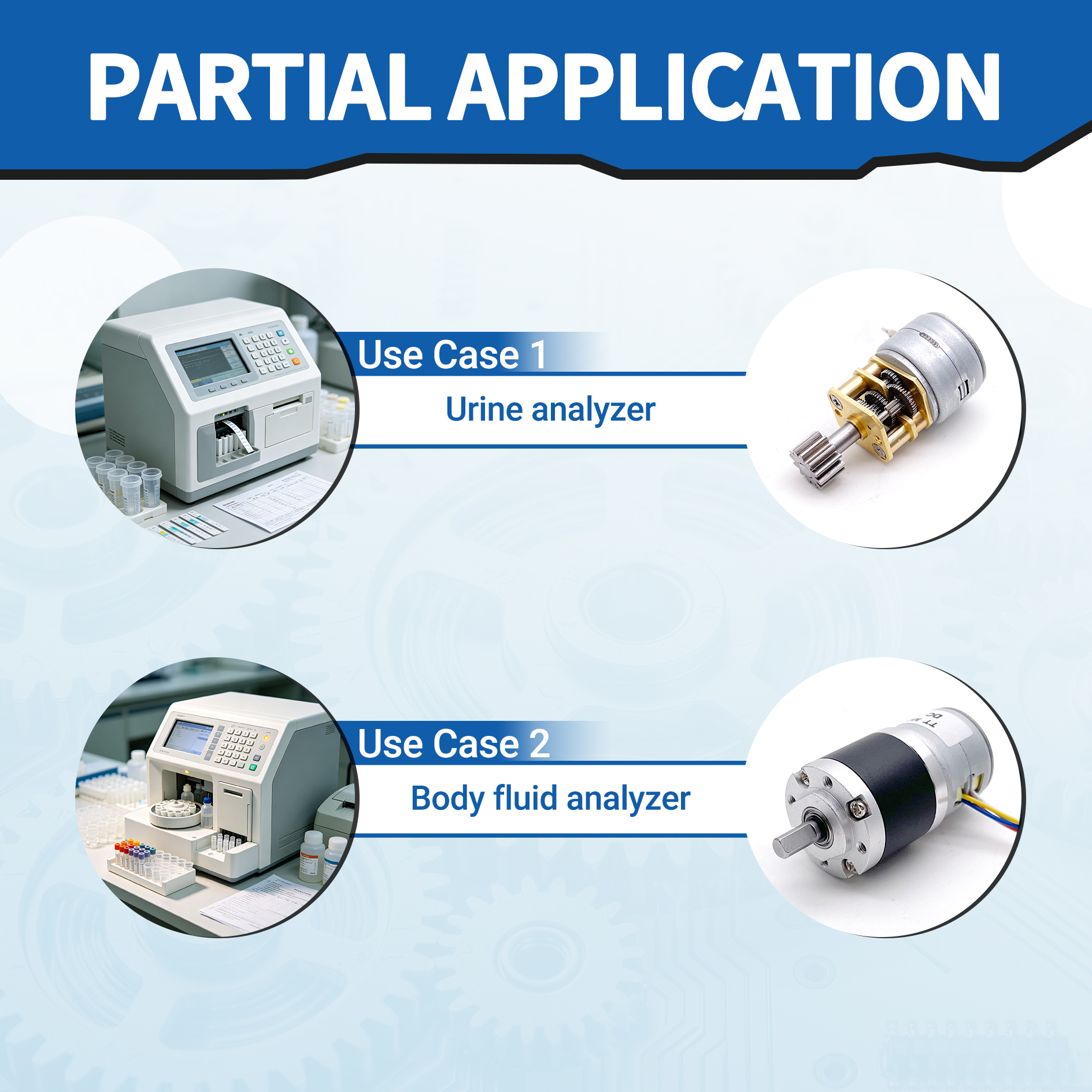
Medical equipment is one of the scenario categories TT Motor documents for low-speed precision drive applications.
An infusion pump is a flow-control instrument before it is a motor application. Inside a volumetric infusion pump or an infusion syringe pump, the drive motor rarely needs speed — it needs to hold a very low rotation rate, repeat it across a long operating period, stop in a defined position, and do all of that quietly. That requirement set, not headline torque, is what decides whether a given gearmotor is a fit.
In TT Motor's medical equipment scenario data, infusion pump and infusion syringe pump projects sit inside a category defined as low-speed precision motion with long-term operation, running in a low-speed, intermittent, positioning mode, with special requirements of low noise, low vibration and stable operation. Measured against that description, the TWG3246-TEC2430 — a DC brushless worm gear motor with a 3–35 rpm output window, up to 8.0 kg.cm rated torque and DC 12V–24V operation — lands close to the centre of the requirement, with a few clearly bounded exceptions.
TT Motor (Shenzhen) Industrial Co., Limited is a miniature DC motor manufacturer founded in 2006, headquartered in Bao'an District, Shenzhen, operating a manufacturing area of approximately 9,000 m² with more than 300 employees and an annual output of 8,000,000 pieces. Its product range covers brushless motors, coreless motors, gear motors, stepper motors and DC motors, with an export share of about 70% and main markets in the EU and USA.
Why the pump drive is a low-speed positioning problem
Flow rate in an infusion device is a displacement-per-unit-time value. The motor's contribution is a controlled, repeatable angular displacement delivered through a lead screw, a peristaltic rotor or a similar mechanism. Three consequences follow directly, and each one narrows the motor shortlist.
First, the useful output speed is low, often very low, and it must stay stable rather than merely average out correctly. Second, the drive runs for long periods, so any wear mechanism inside the motor becomes a maintenance event in a clinical environment. Third, positioning matters: the mechanism has to hold or return to a defined position rather than drift between commands. The scenario data adds the environmental dimension — audible noise and vibration are treated as design constraints, not side effects.
| Pump requirement | What it changes in motor selection |
|---|---|
| Low, stable output speed | Gear reduction ratio becomes the primary specification; the motor is chosen for its behaviour at the bottom of its speed band, not its maximum. |
| Long-term operation | Wear parts and maintenance intervals move up the evaluation list; brush wear becomes a service consideration. |
| Positioning without drift | Holding behaviour with power removed becomes a design question, and often a separate brake component in conventional layouts. |
| Low noise and low vibration | Gear type, gear material and meshing quality matter as much as the motor's electrical design. |
| Operation near fluids and sensing electronics | Spark-free commutation and electromagnetic interference behaviour become relevant selection criteria. |
What the TWG3246-TEC2430 actually is
The TWG3246-TEC2430 is a DC brushless worm gear motor built for miniature medical devices, precision automated instruments and electrically adjustable supports. Its distinguishing feature is the gearbox architecture: a worm stage delivers a right-angle output and a high reduction ratio inside a compact envelope, with 3, 4 or 5 gear stages available and a gearbox length of 46 mm.
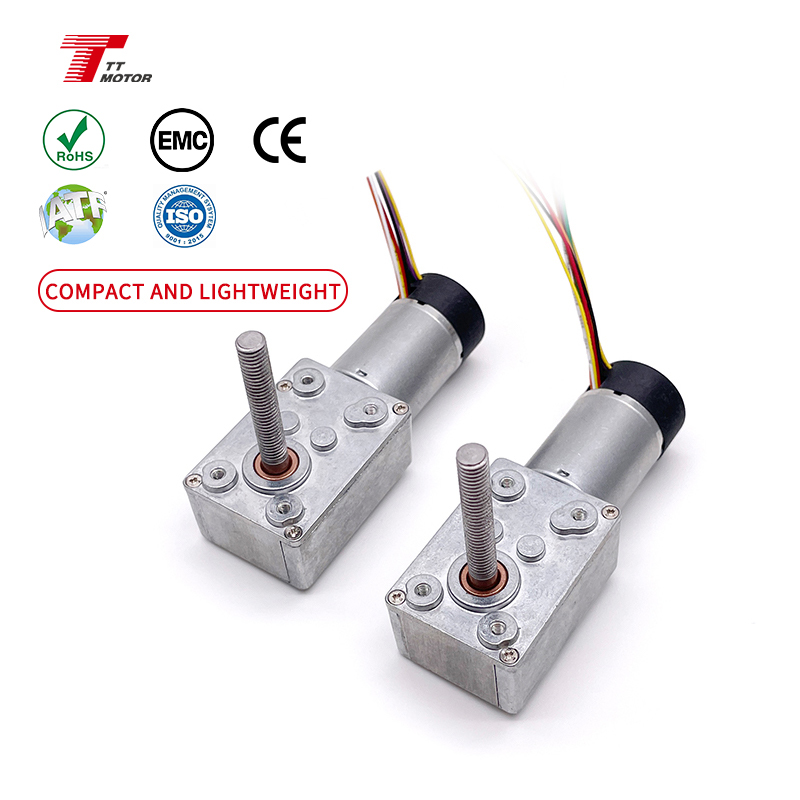
The TWG3246-TEC2430 combines a brushless DC motor with a right-angle worm gearbox rated to 8.0 kg.cm.
| Parameter | Published specification |
|---|---|
| Model | TWG3246-TEC2430 |
| Type | DC brushless worm gear motor |
| Rated voltage | DC 12V–24V |
| Output speed | 3–35 rpm |
| Rated torque | 8.0 kg.cm maximum |
| Number of gear stages | 3 / 4 / 5 |
| Gearbox length | 46 mm |
| Module | 0.5 / 0.6 |
| Material | Stainless steel, iron, copper |
| Documented applications | Miniature medical devices, precision automated instruments, electrically adjustable supports |
How the worm stage changes pump packaging and control
Most miniature pump designs inherit a layout problem before they inherit a motor problem: the drive has to sit in line with the lead screw or the peristaltic head, and that straight line is usually the scarcest dimension in a handheld or benchtop enclosure. A worm gearbox turns the output 90 degrees, so the motor body can run parallel to the fluid path rather than extending it. In a syringe pump format, that single geometric difference can decide whether the drive fits inside the housing at all.
The second consequence is self-locking. In a worm drive the output cannot easily back-drive the input, which is the mechanical reason the TWG3246-TEC2430 is specified as typically requiring no additional braking device. For a pump, this is not a convenience feature. It determines what happens to the mechanism when power is removed mid-delivery, and it removes a component — and a failure mode — from the bill of materials.
The third consequence is ratio. A worm stage produces a very high reduction inside a short gearbox, which is how a family like this reaches a 3–35 rpm output band. Because 3, 4 and 5 stage variants exist, a project selects the stage count that lands on the required output speed rather than accepting a single fixed ratio.
There is a trade-off embedded in this architecture, and buyers should price it in. Worm gearing generally runs at lower mechanical efficiency than spur or planetary trains of comparable size, because the sliding contact between worm and wheel dissipates more energy. In a low-speed, intermittent pump drive the absolute loss is small, but it is not zero, and it belongs in the power budget rather than outside it.
Matching the 3–35 rpm window and 8.0 kg.cm rating to a pump design
The published speed window describes the family, not a single build. A 3 rpm output and a 35 rpm output are the ends of a range produced by different stage counts, and the number a pump programme will actually specify sits somewhere inside it, derived from the required flow rate and the screw or rotor geometry. Two engineering checks follow from that.
The first is the bottom-of-range behaviour. At the low end, a pump drive is judged on smoothness and repeatability rather than on speed, and the mechanical design of the gearbox — stainless steel, iron and copper components in a wear-resistant, impact-resistant arrangement with low operating noise — is what carries that behaviour over a long operating period.
The second is torque margin. The 8.0 kg.cm figure is a maximum rated torque for the model, not a universal answer for every pump. Required torque depends on lead screw pitch and friction, seal drag, fluid back pressure and the size of the syringe or the compliance of the infusion set. A programme running a large syringe against elevated back pressure is a different torque problem from a low-pressure microfluidic line, and the specification has to be validated on the actual mechanism. Where that calculation returns a figure well above 8.0 kg.cm, the model is simply the wrong selection rather than a marginal one.
Selection rule of thumb: treat the published rated torque as a ceiling for continuous operation, not as a design target. If the calculated worst-case torque approaches the ceiling, the gear stage choice and the drive electronics should be reviewed before the mechanical design is frozen.
Brushless construction in a clinical enclosure
The brushless structure removes the two component-level characteristics that make brushed motors awkward in medical housings: spark generation and brush wear. The published description of the TWG3246-TEC2430 states no spark generation and minimal electromagnetic interference, together with low power consumption and a long lifespan. For a pump that shares an enclosure with sensing electronics and sits close to the fluid path, both points are directly relevant — one to interference behaviour, the other to particulate generation and service intervals.
It is worth stating the boundary clearly: a brushless topology is an engineering property, not a compliance status. The mechanical and electrical parameters summarised here do not constitute a certification package, and documentation for a regulatory file is a project-level item that has to be confirmed for the specific build, voltage variant and gear stage ordered.
Where the scenario fit is strongest
Reading the motor against TT Motor's documented medical equipment scenarios produces a short list of good fits and a shorter list of poor ones.
| Application | Scenario condition | Fit assessment |
|---|---|---|
| Infusion pump | Low-speed precision motion, long-term operation, low noise and low vibration, stable operation | Strong. The right-angle, self-locking worm stage matches the positioning requirement and removes brake hardware. |
| Infusion syringe pump | Same medical equipment category; low-speed, intermittent, positioning operation | Strong where lead screw torque demand stays under the rated ceiling; verify occlusion and worst-case back pressure. |
| Microfluidic dispenser / pipetting equipment | Low-speed precision motion with drive regulation and delivery | Good for slow, fine dosing; the 35 rpm ceiling makes it unsuitable where rapid aspiration is also required from the same motor. |
| Precision automated instruments | Documented application category for the model | Good. Self-locking holds an adjustment position without continuous power. |
| Electrically adjustable supports | Documented application category for the model | Good for slow, smooth fine adjustment where the right-angle layout helps packaging. |
Evidence from an existing medical pump programme
Medical pump work is not a hypothetical category for this product family. In a recorded case, a medical device manufacturer in the United Kingdom drives a medical pump with a project scale of 500 to 2,000 units per year and a duration of three years or more. The stated result is stable output under long-term operating conditions with reduced equipment maintenance frequency, and the stated highlights are low noise, low vibration and long lifespan.
The TWG3246-TEC2430 appears among the motors associated with that case record, alongside the GMP12T-TDC1215 coreless gear motor and the GMP36-TEC3650 brushless planetary gear motor — which is the honest reading of the data: the case documents a medical pump application served by this motor family, and the specific model-to-mechanism assignment is a per-programme engineering decision rather than a published pairing.
Comparison with alternative drive architectures
Three other TT Motor models appear repeatedly in medical and precision instrument contexts, and comparing them on published specifications shows exactly where the worm gear unit wins and where it does not.
| Model | Architecture | Voltage | Speed | Max rated torque | Gearbox length |
|---|---|---|---|---|---|
| TWG3246-TEC2430 | Brushless worm gear motor | DC 12V–24V | 3–35 rpm | 8.0 kg.cm | 46 mm |
| GMP36-TEC3650 | Brushless planetary gear motor | DC 12V–24V | 4–1600 rpm | 30.0 kg.cm | 26 / 33.5 / 40.5 / 47.5 mm |
| GM37-555PM | Brushed spur gear motor | DC 12V–24V | 5–800 rpm | 8.0 kg.cm | 19 / 21.5 / 24 / 26.5 / 29 mm |
| GMP12T-TDC1215 | Coreless brushed gear motor | DC 4.5V–12V | 8–5000 rpm | 2.0 kg.cm | 14.9 / 19.7 / 24.5 / 29.3 mm |
Figures are taken from TT Motor's published product specification units for each model. They describe model-level capability, not a validated performance curve for any specific pump design.
The GMP36-TEC3650 offers roughly four times the rated torque and a much wider speed span in a planetary layout, which suits robot joints and heavier mechanisms — a pump needing high thrust against a large syringe is closer to that profile. The GM37-555PM matches the 8.0 kg.cm figure with a brushed spur gearbox and a shorter first-stage gearbox length, but it introduces brush wear into a long-term clinical application. The GMP12T-TDC1215 trades torque for speed and compactness, which suits pipetting and precision instrument motion rather than a pump lead screw.
Where the TWG3246-TEC2430 is the wrong choice
Four boundaries are worth stating plainly, because a procurement decision that ignores them will surface as a redesign later.
- The speed ceiling is 35 rpm. A pump that needs fast priming, rapid bolus delivery or a wide dynamic range from a single motor path will exceed this window. Either a different ratio or a second drive path is required.
- Self-locking is a constraint as well as a benefit. A mechanism designed to be back-driven manually — for occlusion release, manual override or priming by hand — will work against the worm stage rather than with it.
- Efficiency is lower than spur or planetary equivalents. In a low-speed intermittent duty cycle this is small, but it belongs in the power and thermal budget, particularly on battery-powered designs.
- 8.0 kg.cm is a real ceiling. High-back-pressure lines and large-syringe formats may need the 30.0 kg.cm class, and no amount of gear stage selection changes the motor's rated torque.
Procurement checklist for a pump drive programme
For engineering and sourcing teams moving from research into evaluation, the specification table is the starting point rather than the answer. The following checks convert it into a decision.
- Speed at load, not at no load. Confirm the delivered output speed at the actual mechanism torque for the chosen stage count.
- Self-locking verification. Test holding behaviour at maximum rated load and at the temperature extremes the device will see, rather than on a bare motor.
- Noise and vibration at the operating point. Audit at the speed actually used, not at a convenient mid-band figure.
- Interference behaviour in the final enclosure. Brushless commutation reduces but does not eliminate the need to verify the drive electronics together with the pump controller.
- Duty profile and life expectation. Map the intermittent positioning cycle against the stated long-lifespan brushless construction and agree a test protocol.
- Customisation scope. Shaft, encoder, gearbox, voltage, logo and speed are all listed as configurable, so the interface can be adapted to the pump rather than the pump to the motor.
- Supply parameters. Minimum order quantity is 2 pieces, sample lead time is 15–25 days and bulk lead time is 30–45 days, with 100% testing and monthly capacity of 800,000 pieces.
An encoder is available as a customisation option, which matters for a pump that needs closed-loop confirmation of delivered volume: the published base specification does not list an integrated encoder, so feedback architecture should be agreed at the enquiry stage rather than assumed.
Market context: why brushless and self-locking are converging in medical drives
The commercial backdrop supports the technical direction. Grand View Research sizes the global brushless DC motor market at USD 22.2–22.33 billion in 2025, a baseline on which several research houses broadly agree. Separately, OEC reports global trade in electric motors with an output below 37.5 W (HS 850110) at USD 16.3 billion in 2024, a category that contains the miniature gearmotors used in infusion equipment.
Regulatory pressure on efficiency is moving in the same direction. IEC 60034-30-1:2025 introduced the IE5 ultra-premium efficiency class, extending a framework that has progressively raised expectations across motor families. Those classes are written around industrial motor families rather than miniature medical drives, but the direction of travel is unambiguous: spark-free, low-loss commutation is being normalised rather than treated as a premium option.
Within pump design specifically, two quieter trends are visible. Self-locking worm gearing is attractive because it deletes a brake from the bill of materials and simplifies the fail-safe argument when power is interrupted. And right-angle layouts solve a packaging constraint that planar gearboxes cannot address, which matters as pump housings shrink while fluid-path complexity grows.
Future outlook
The next phase of this category is less about motor topology, which is mature, and more about integration. Feedback is the obvious step: pairing a self-locking worm drive with an encoder moves a pump from open-loop timing assumptions to confirmed delivered volume, which is where the customisation list already points. The second step is documentation depth — the mechanical and electrical specification is a starting point, and programme-specific evidence packages increasingly decide supplier selection in medical procurement. The third is small-batch configuration economics: a minimum order quantity of 2 pieces and a 15–25 day sample cycle make it practical to validate a stage count and voltage variant on a real mechanism before committing tooling budget.
For pump designers, the practical conclusion is that architecture choice precedes model choice. A worm-driven brushless layout with 3–35 rpm and 8.0 kg.cm solves a specific, common infusion problem: slow, quiet, self-holding delivery in a compact right-angle envelope. Where the requirement departs from that — higher thrust, faster priming, manual override — the specification answers the question honestly, and a different model in the same family is the correct response.
FAQ
Can the TWG3246-TEC2430 drive both a volumetric infusion pump and an infusion syringe pump?
Both infusion pump and infusion syringe pump appear in TT Motor's medical equipment scenario data, which defines the category as low-speed precision motion with long-term operation, low-speed intermittent positioning operation, and special requirements of low noise, low vibration and stable operation. The motor's 3–35 rpm output and 8.0 kg.cm maximum rated torque fall inside that description. Because the two pump types load the motor differently — a peristaltic head versus a lead screw and syringe plunger — the torque and self-locking behaviour have to be validated on the specific mechanism rather than inferred from the category.
Is 8.0 kg.cm of rated torque sufficient for an infusion pump drive?
It depends on the mechanism. Required torque is a function of lead screw pitch and friction, seal drag, fluid back pressure and syringe size, so there is no single answer independent of the design. What the specification does establish is the ceiling: 8.0 kg.cm is the maximum rated torque for this model, and a programme whose calculated worst case approaches or exceeds that figure should move to a higher-torque model such as the GMP36-TEC3650, which is rated to 30.0 kg.cm, rather than attempting to compensate with gear stage selection.
Does the 3–35 rpm speed range cover priming and bolus delivery?
The 3–35 rpm window is narrow by design and suits slow, continuous or intermittent delivery. It does not cover applications that require fast priming or rapid bolus delivery through the same motor path; those functions either need a different reduction ratio or a separate drive path. Stage count selection — 3, 4 or 5 stages — sets where inside the range a given build operates, but it does not extend the range itself.
What does the brushless design contribute beyond the absence of sparks?
The published description of the model states that the brushless structure produces no spark generation and minimal electromagnetic interference, together with low power consumption and a long lifespan. In a pump enclosure that also houses sensing electronics and sits near the fluid path, spark-free commutation removes an ignition and interference source, and the absence of brushes removes a wear item from the maintenance plan. These are engineering properties and are separate from any regulatory certification, which is a project-level documentation item.
What customisation is available for a specific pump design?
TT Motor lists shaft, encoder, gearbox, voltage, logo and speed as customisable parameters under an OEM/ODM production model. Minimum order quantity is 2 pieces, sample lead time is 15–25 days and bulk lead time is 30–45 days, with 100% testing and a monthly capacity of 800,000 pieces.
Has this motor family been used in medical pump applications before?
TT Motor's case data records a medical device manufacturer in the United Kingdom driving a medical pump at a project scale of 500 to 2,000 units per year over three years or more, with a stated result of stable output under long-term operating conditions and reduced equipment maintenance frequency, and stated highlights of low noise, low vibration and long lifespan. The TWG3246-TEC2430 is listed among the motors associated with that record, alongside the GMP12T-TDC1215 and GMP36-TEC3650.
Reference material
Detailed model specifications, configuration options and the wider miniature motor range are collected in TT Motor's product brochure, available for download: TT Motor product brochure (PDF).
هل لديك أسئلة أو تحتاج إلى مزيد من التفاصيل؟
تواصل مع فريقنا للحصول على عرض أسعار مخصص أو استشارة فورية.
طلب عرض أسعار
املأ النموذج أدناه وسيتواصل معك فريقنا بعرض مقترح مخصص.
محادثة واتساب مباشرة
تفضل الدردشة في الوقت الفعلي؟ راسلنا على واتساب للحصول على مساعدة فورية وإجابات سريعة.
- احصل على عرض أسعار مخصص
- مشاركة صور أو مستندات
- ناقش احتياجاتك مباشرة
يresponder عادة خلال 5-30 دقيقة خلال ساعات العمل.