
Bucktool Variable Speed vs Dual Speed vs High Speed Bench Grinders
Bench grinder buying conversations usually start with wheel diameter, then move to horsepower and price. On an 8-inch machine, the specification that shapes daily usability is the speed architecture: whether the motor runs at one fixed speed, offers two fixed setpoints, or allows continuous adjustment across a range.
Wheel size sets the ceiling on contact area and cutting depth. Speed class decides how the machine behaves at that ceiling — how much heat it puts into an edge per pass, how repeatable a sharpening result is, and how many distinct jobs one unit can reasonably cover.
This comparison examines five BUCKTOOL bench grinders that share a common design language but sit in four different speed classes: the 8-inch Variable Speed Bench Grinder with Digital Display (TDS-G200VLGA), the 8-inch VFD Variable Speed Bench Grinder (TDS-I200VL), the 8-inch Dual Speed Bench Grinder (TDS-200DS), the 8-inch High Speed Bench Grinder (TDS-200HD), and the 6-inch Low Speed Bench Grinder (TLG-150S), included as the compact low-speed reference.
BUCKTOOL is a power tool brand based in China that designs and manufactures bench grinders and related woodworking and metalworking tools. The brand sells primarily into the US market through a factory-direct model and lists a 2-year warranty and 30-day returns on its website.

Why Speed Class Comes Before Wheel Size
An 8-inch wheel spinning at 3450 RPM and the same wheel spinning at 1725 RPM carry the same abrasive at very different rim speeds. Halving RPM halves surface speed, which changes how much heat enters the workpiece per pass and how aggressively the wheel bites into the edge.
That single relationship explains most of the practical difference between the five models. A high-speed grinder is fast because the abrasive moves fast. A low-speed grinder is controllable because the abrasive moves slowly. A variable-speed grinder is flexible because the operator chooses where on that curve to work.
For buyers at the research stage, the useful sequence runs in this order:
- Define the work. Stock removal, edge refinement, or both — and in what proportion.
- Choose the speed architecture. Fixed, two-step, or continuously variable.
- Then choose wheel diameter and motor. 6-inch versus 8-inch, and the horsepower needed for the material.
- Verify listing-level details. Wheel grit and material, tool-rest hardware, and the safety standard version the product claims.
Most buying mistakes happen in reverse: a buyer fixes on a size and a price first, then discovers the machine's speed does not suit the edge work they actually do every week.
The Five Models at a Glance
The table below uses only listed model specifications. It is the reference point for the sections that follow.
| Model | Speed class | Speed | Wheel | Listed wheel material | Primary listed fit |
|---|---|---|---|---|---|
| bucktool 8-inch Variable Speed Bench Grinder with Digital Display (TDS-G200VLGA) | Variable, with digital readout | 2000–3450 RPM | 8-inch | Brown aluminum oxide | Lathe turning tools and work requiring 8-inch wheels with high running accuracy |
| bucktool 8-inch VFD Variable Speed Bench Grinder (TDS-I200VL) | Variable, VFD drive | 900–3600 RPM | 8-inch | White aluminum oxide | Controlled-speed sharpening, knife making and metal finishing |
| bucktool 8-inch Dual Speed Bench Grinder (TDS-200DS) | Two fixed setpoints | 1725 RPM & 3450 RPM | 8-inch | White aluminum oxide | Shops that need both low-speed edge work and high-speed stock removal |
| bucktool 8-inch High Speed Bench Grinder (TDS-200HD) | Fixed high speed | 3590 RPM | 8-inch | Brown aluminum oxide | Fast stock removal, metal grinding and heavy tool reshaping |
| Bucktool 6-inch Low Speed Bench Grinder (TLG-150S) | Fixed low speed | 1750 RPM | 6-inch | Left wheel white aluminum oxide, right wheel brown aluminum oxide | Light-duty precision sharpening of chisels, plane irons and small hand-cutting tools |
All five use a cast-iron base. Listed weights tell a second story: the TDS-I200VL is the heaviest of the group at 57.33 lb, followed by the TDS-200HD at 46.74 lb and the TDS-200DS at 41.89 lb, while the 6-inch TLG-150S is listed at 19.19 lb. Stability generally rises with mass, and portability falls with it.
Control: Digital Display, VFD, Two-Step and Fixed
Digital display variable speed — TDS-G200VLGA
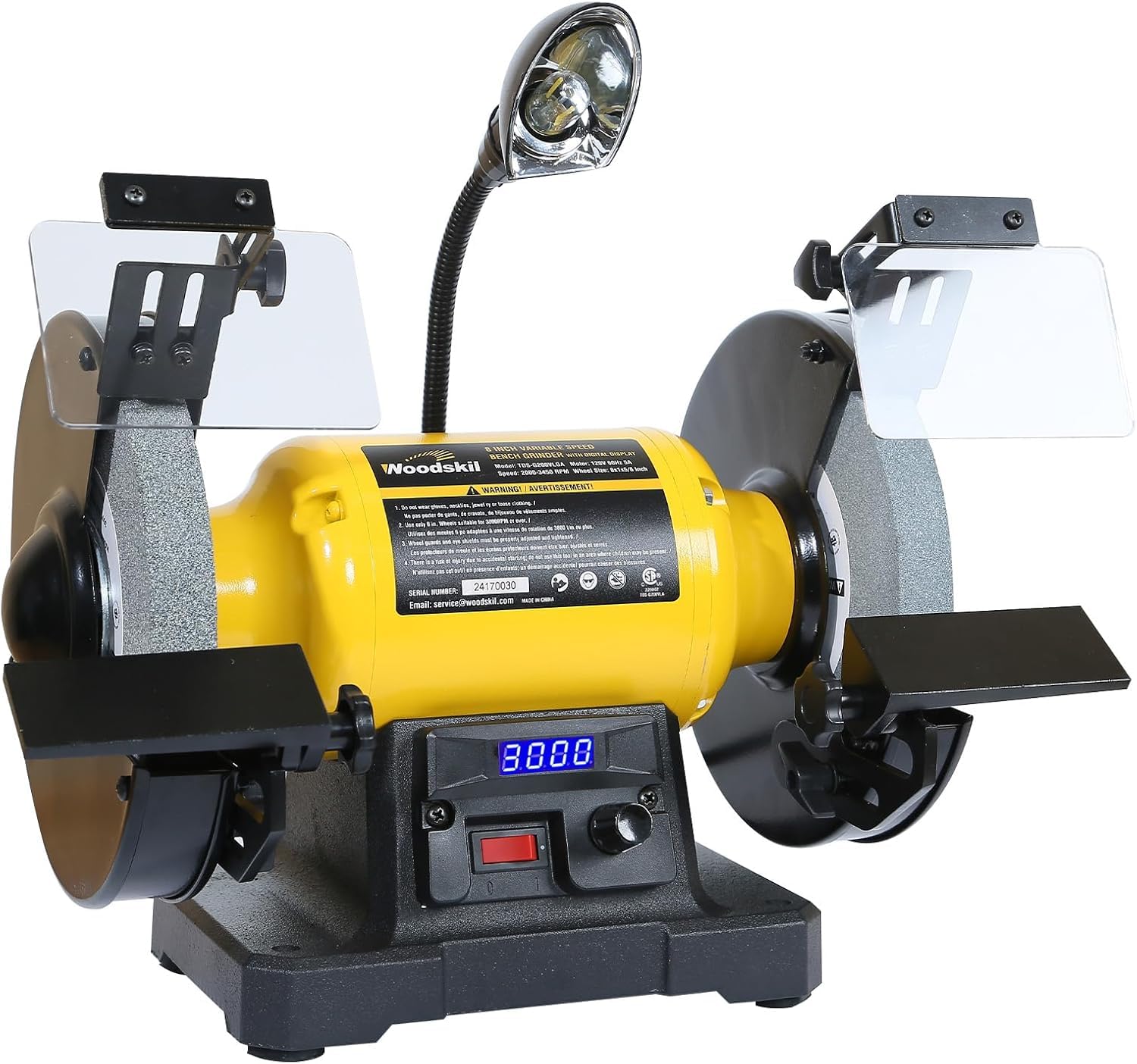
The TDS-G200VLGA covers 2000–3450 RPM with a digital readout, a 3/4 HP, 5.0 A motor, brown aluminum oxide wheels and a cast-iron base. Its listed application is sharpening lathe turning tools and other work where an 8-inch wheel and high running accuracy are required.
The practical value of a readout is not range — it is repeatability. If a shop settles on a particular setting for a specific chisel and a specific wheel, the display lets the operator return to that setting instead of guessing between dial marks. That matters most when several people share one machine, or when a process has to be reproduced months later.
VFD variable speed — TDS-I200VL
The TDS-I200VL has the widest range of the five at 900–3600 RPM, driven through a VFD with a 1 HP motor. It is listed with white aluminum oxide wheels in an 80#/120# configuration, a 3 W LED light, a 3X magnifying eye shield, and speed memory.
Two details separate it from the digital-display unit. First, the low end reaches below the typical low-speed setpoint, which is where heat per pass drops furthest. Second, speed memory stores a working setting rather than requiring it to be re-entered. A VFD also runs the motor continuously at intermediate speeds instead of stepping between discrete points.
Dual speed — TDS-200DS
The TDS-200DS offers two setpoints, 1725 RPM and 3450 RPM, with white aluminum oxide wheels and a cast-iron base. It is the simplest way to put both a low-speed edge mode and a high-speed removal mode on one bench.
The trade-off is explicit: two points, not a curve. If the right working speed for a given tool sits between 1725 and 3450 RPM, the operator works around it with pressure and contact time rather than by adjusting the machine.
Fixed high speed — TDS-200HD
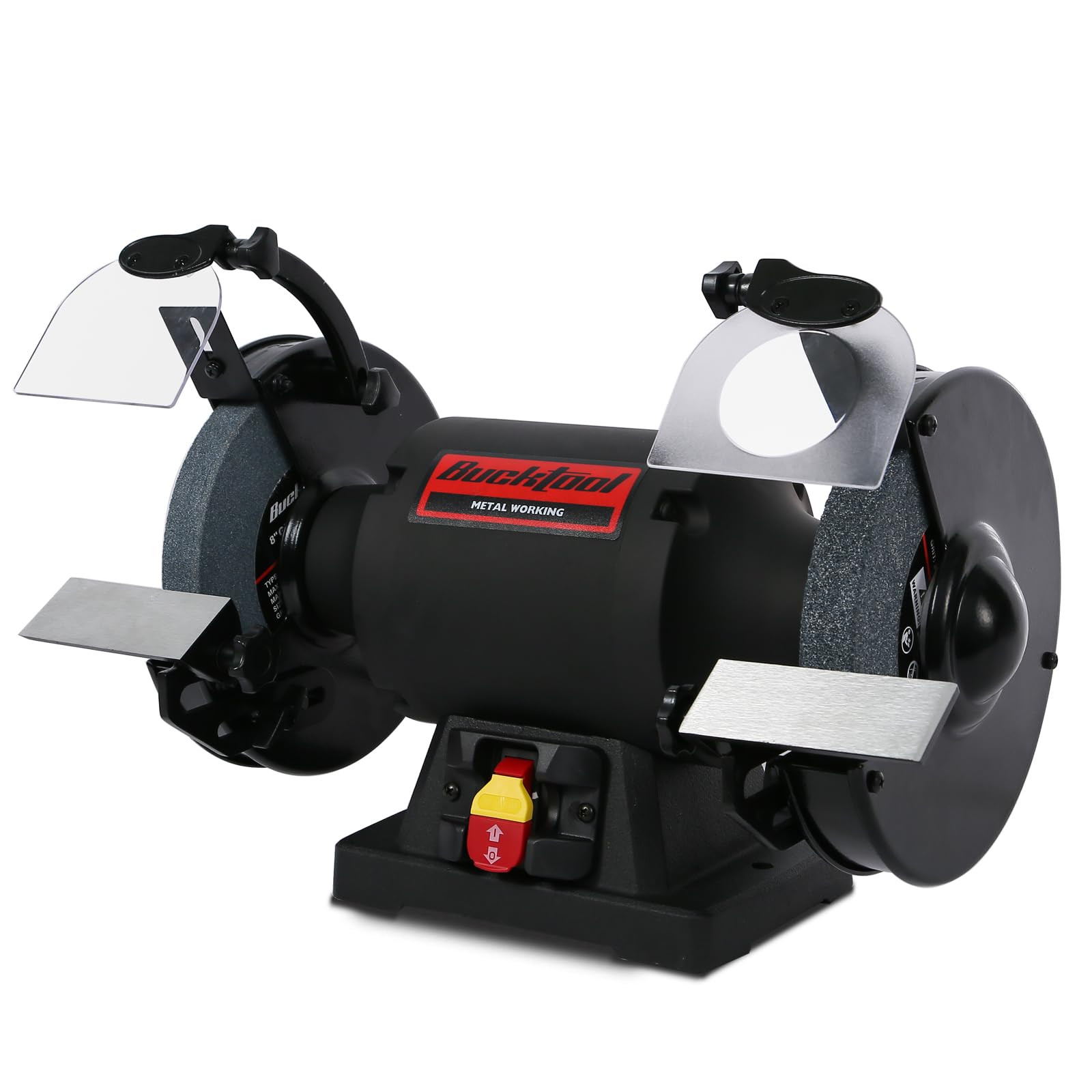
The TDS-200HD runs at 3590 RPM from a 1.0 HP, 4.8 A motor, with brown aluminum oxide wheels, precision wobble-free wheels and heavy-duty cast-iron construction. Its listed use is fast material removal, metal grinding and heavy-duty tool reshaping.
This is the least complicated machine in the group: no dial, no readout, no setpoints. Control comes entirely from the operator's hands.
Compact low-speed reference — TLG-150S
The TLG-150S is a 6-inch machine at 1750 RPM, listed around stability, low vibration and portability, with a white aluminum oxide left wheel and a brown aluminum oxide right wheel. It sits in a USD 100–300 price band and is the reference point for buyers who need precision edges but cannot dedicate a full bench to an 8-inch grinder.
What Each Speed Class Does to the Edge
Every grinding pass converts abrasive friction into heat in a thin layer at the edge. At a higher rim speed, a given contact time removes more material and generates heat faster. That is the whole trade: speed buys throughput and costs thermal headroom.
- Variable speed (TDS-G200VLGA, TDS-I200VL) lets the operator slow the wheel before the edge discolors. The difference is between controlling heat and reacting to it after the temper has already moved.
- Dual speed (TDS-200DS) delivers two thermal profiles from one machine: 1725 RPM for edges, 3450 RPM for removal.
- Fixed high speed (TDS-200HD) demands technique — light pressure, short contact, frequent quenching — because the machine will not slow down for a thin edge.
- Fixed low speed (TLG-150S) is forgiving on heat but slow for reshaping; it is a finishing machine, not a material-removal machine.
Abrasive grade runs in parallel with speed. BUCKTOOL lists white aluminum oxide on the TDS-I200VL, the TDS-200DS and the left wheel of the TLG-150S, and brown aluminum oxide on the TDS-G200VLGA, the TDS-200HD and the right wheel of the TLG-150S. In general abrasive practice, white aluminum oxide is typically specified for cooler cutting and finer finishing, while brown aluminum oxide is typically a general-purpose, heavier-duty grain. The TDS-I200VL's 80#/120# wheel pair is a finer configuration than a coarse general-purpose pair.
Task Fit: Which Class Suits Which Work
Knife making and blade sharpening
Bevel shaping and edge refinement are two different operations performed on the same blade. Shaping wants material removal and tolerates heat if the steel is cooled; refinement does not tolerate heat at all. The TDS-I200VL's 900 RPM floor and 80#/120# wheels are the closest match in this group for the refinement half, while the TDS-200HD covers the shaping half faster.
Woodworking tool edge maintenance
Chisels, plane irons and turning tools are small, hard, and expensive to replace when an edge is burned. Low-speed operation is the reason woodworkers migrate toward 1725–1750 RPM machines. The TDS-200DS offers that speed with an 8-inch wheel; the TLG-150S offers it in a 6-inch footprint.
Metalworking deburring and surface finishing
Deburring carbon steel, stainless and aluminum is throughput work. The TDS-200HD at 3590 RPM with a 1.0 HP motor is built for it. Where a shop also finishes edges by hand, the TDS-200DS allows a switch to 1725 RPM without a second machine.
Automotive repair and tool refurbishment
Restoring screwdrivers, punches and small components is intermittent work with mixed materials — a case where two setpoints cover most of the range and continuous control covers the rest. Published owner accounts describe stepping up from a 1/3 HP grinder to a 3/4 HP BUCKTOOL unit for metal and knife work and finding it stable under load.
Home workshop and vocational training
A training environment favors the most forgiving machine on the bench. The TLG-150S at 1750 RPM, 19.19 lb, with a compact 6-inch wheel, is the least intimidating option in this group and the easiest to place in a shared or mobile workspace.
What Owners Report
Owner accounts attached to BUCKTOOL bench grinder use cluster around six themes. They are reported as themes, not as model-level test results.
- Power upgrade satisfaction. One owner moved from a 1/3 HP grinder to a 3/4 HP BUCKTOOL unit for metal and knife work, describing it as not flinching under load and not wandering across the bench during grinding.
- Burn avoidance at low speed. A woodturner using a low-speed grinder reported it became much easier to sharpen turning tools without risking burned steel.
- Throughput on plane blades. Multiple plane blades were sharpened at roughly 3–5 minutes each, producing smooth, square edges that responded well to subsequent diamond stone honing.
- Fixture dependence. A user running the grinder with a Oneway sharpening system reported a longer setup, then good results once the system was dialled in.
- Electrical connection friction. One unit would not start; support directed the owner to the same fix listed first in the troubleshooting guide — a loose wire on a terminal tab inside the base. The owner flagged that terminals should be tighter and worried vibration could loosen the connection again.
- Tool-rest adjustment precision. The same owner found the adjustable tables slightly loose and noted that tightening the lock shifted the table, making precise angle setting a two-handed, iterative process.
Read together, the picture is consistent: grinding performance is reported positively, while friction concentrates in electrical connections and table hardware rather than in the motor or the wheels. Buyers who change angles frequently should plan for that adjustment step; buyers who set an angle once and leave it will rarely notice.
Where These Grinders Stop: Limits and Trade-offs
An honest comparison has to name the boundaries.
- Variable speed is not a heat guarantee. It widens the operator's options; it does not remove the need for light passes, cooling and appropriate abrasive grade.
- The digital display adds cost and a component. Buyers who only remove stock pay for repeatability they will not use.
- Dual speed is two points, not a curve. Intermediate speeds are unavailable by design.
- Tool-rest hardware is the weakest link reported by owners. A lock that shifts the table on tightening turns angle setting into an iterative process.
- Mass cuts both ways. The TDS-I200VL at 57.33 lb is stable but not something to move between benches casually.
- The 6-inch low-speed model trades capacity for footprint. A smaller wheel produces lower surface speed at a given RPM and a smaller contact area — it is a precision tool, not a reshaping tool.
- Compliance is a listing-level attribute. UL 60745-1, the safety standard for motor-operated electric tools, was updated with ANSI approval on October 25, 2024 (UL Solutions). Buyers should confirm which edition and which certification a specific listing references rather than assume it carries across a model range.
Speed Class by Buyer Profile
The decision simplifies once the buyer profile is fixed. The matrix below maps profiles to speed class using only the listed capabilities of the five models.
| Buyer profile | Dominant need | Speed class that fits | Model |
|---|---|---|---|
| Home DIY, occasional hardware and garden tool sharpening | Simplicity, small footprint | Fixed low speed, 6-inch | TLG-150S |
| Hobby woodworker sharpening chisels and plane irons weekly | Heat control on thin edges | Two setpoints, 8-inch | TDS-200DS |
| Knife maker shaping bevels and refining edges | Low-end control plus range | VFD variable speed | TDS-I200VL |
| Metal fabricator deburring daily | Removal rate | Fixed high speed | TDS-200HD |
| Small shop alternating between deburring and edge work | One machine, two jobs | Two setpoints or variable speed | TDS-200DS / TDS-G200VLGA |
| Multi-operator shop needing repeatable settings | Setpoint memory | Variable speed with readout or memory | TDS-G200VLGA / TDS-I200VL |
| Vocational training or shared workspace | Forgiving operation | Fixed low speed, compact | TLG-150S |
Market Context: Price, Standards and Speed Segmentation
The global grinding machinery market was valued at USD 6.2 billion in 2025, with bench grinders forming a key non-precision segment (Grand View Research, published 2026). Growth estimates for the broader category diverge — 4.8% CAGR against 5.9% across published sources — a gap that likely reflects whether high-precision CNC units are included. Category growth should be read as directional rather than precise.
At the consumer end, 6-inch bench grinders remain the dominant segment, with prices typically ranging from USD 50 to USD 200 (ANTISHICNC, 2025). BUCKTOOL's own 6-inch low-speed TLG-150S sits in a USD 100–300 band; the gap reflects listed specification differences rather than wheel size alone.
Within the brand's range, speed segmentation is already explicit: BUCKTOOL lists dual-speed (TDS-200DS) and low-speed (TDS-200C4HL) models specifically to address both fast material removal and precision sharpening. The addition of a digital-display variable model and a VFD model pushes that segmentation further, into how repeatably a speed can be set rather than simply how fast it goes.
Regulation adds a parallel layer. The ANSI-approved update to UL 60745-1 in October 2024 means buyers comparing listings should read the standard version and certification scope as carefully as they read RPM.
Future Outlook
Three shifts are worth watching for buyers researching now.
Speed electronics are moving down the price band. VFD drives, speed memory and digital readouts appear in the same USD 99–399 envelope as fixed-speed 8-inch machines from a few years ago. Where wheel size and motor power have largely commoditised, control architecture is becoming the visible differentiator.
Repeatability is becoming a buying criterion. A readout or a memory function answers a question that fixed-speed machines cannot: can this shop reproduce last month's edge? Expect more comparison activity around setpoints than around horsepower.
Hardware detail will decide satisfaction. Owner accounts already point at tool rests and terminals rather than motors. Manufacturers that tighten those details will separate from those that do not, and buyers will increasingly treat table-lock behaviour and connection quality as part of the specification, not as after-sales luck.
FAQ
What is the difference between a variable speed and a dual speed bench grinder?
A dual speed grinder offers two fixed setpoints — the TDS-200DS runs at 1725 RPM and 3450 RPM. A variable speed grinder allows continuous adjustment within a range: the TDS-G200VLGA covers 2000–3450 RPM and the TDS-I200VL covers 900–3600 RPM. Dual speed has fewer controls and fewer parts; variable speed allows intermediate settings and, on the VFD model, speed memory.
Is a high speed bench grinder suitable for sharpening knives?
It depends on the operation. The TDS-200HD at 3590 RPM removes material quickly, which suits reshaping and deburring. For thin edges, heat is the limiting factor, so light passes and cooling are required. Buyers whose main job is edge refinement typically choose lower-speed or variable-speed models instead.
What is a 6-inch low speed bench grinder best for?
The TLG-150S runs at 1750 RPM with a 6-inch wheel and a listed weight of 19.19 lb. It is specified for light-duty precision sharpening of chisels, plane irons and small hand-cutting tools, and suits home workshops, small studios and shared spaces where bench area is limited.
Do I need a digital display on a bench grinder?
A display improves repeatability — returning to a known RPM rather than estimating a dial position. It does not change abrasive performance. Buyers who sharpen the same tool types repeatedly gain more from it than buyers who mainly remove stock.
How much do Bucktool 8-inch bench grinders cost?
BUCKTOOL lists its 8-inch bench grinder models in a USD 99–399 price band, and the 6-inch low-speed TLG-150S in a USD 100–300 band. For broader context, third-party category research places typical 6-inch bench grinder prices at USD 50–200 (ANTISHICNC, 2025).
Which speed class suits a small metalworking shop?
If the shop alternates between deburring and edge work, dual speed (TDS-200DS) or VFD variable speed (TDS-I200VL) keeps both operations on one bench. If the shop only shapes and deburrs, the fixed high-speed TDS-200HD covers the work with fewer controls. If the shop mainly maintains woodworking tooling, low speed or variable speed is the closer match.
Full model specifications and current listings are published on bucktool.com.
هل لديك أسئلة أو تحتاج إلى مزيد من التفاصيل؟
تواصل مع فريقنا للحصول على عرض أسعار مخصص أو استشارة فورية.
طلب عرض أسعار
املأ النموذج أدناه وسيتواصل معك فريقنا بعرض مقترح مخصص.
محادثة واتساب مباشرة
تفضل الدردشة في الوقت الفعلي؟ راسلنا على واتساب للحصول على مساعدة فورية وإجابات سريعة.
- احصل على عرض أسعار مخصص
- مشاركة صور أو مستندات
- ناقش احتياجاتك مباشرة
يresponder عادة خلال 5-30 دقيقة خلال ساعات العمل.