
Build Your Own Scorecard: GZKEDRO KD-WM vs KD-ISS Screens
Build Your Own Scorecard: GZKEDRO KD-WM vs KD-ISS Screens
Build Your Own Scorecard: Comparing GZKEDRO Wall-Mounted and Slider Screens
In indoor commercial display procurement, the wall-mounted display and the interactive slider screen are routinely shortlisted against each other because both are flat, high-resolution, network-connected units that appear interchangeable on a quotation. They are not interchangeable in operation. The practical solution is not to pick the higher headline specification, but to build a weighted scorecard that reflects what the installation has to achieve. This guide sets out that scorecard and uses two GZKEDRO series as worked examples: the KD-WM Series wall-mounted display and the KD-ISS Series interactive slider screen.
GZKEDRO is the commercial display brand of Guangzhou Kedro Electronics Technology Co., Ltd., a manufacturer founded in 2013 with facilities in Guangzhou, producing commercial displays, smart advertising machines and interactive devices, with an export share of 80% of total sales and a manufacturing facility reported at 50,000 m³, more than 200 staff and an R&D team of over 100 people. The two series discussed here sit inside that portfolio, and the comparison below is limited to what the two products are designed to do.
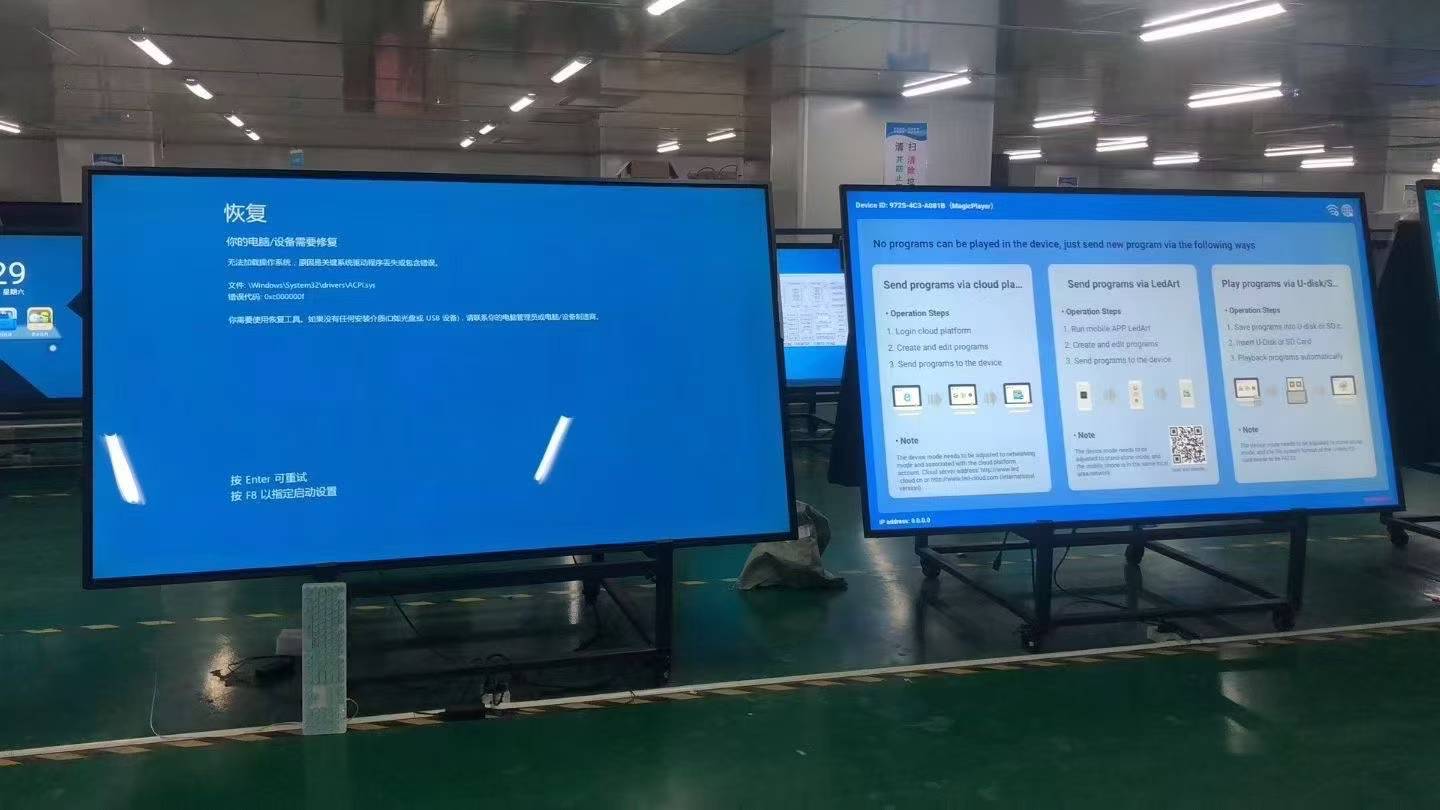
Buyer evaluation of commercial display formats: the decision hinges on the interaction model, not on the catalogue category.
Two compliant products, two different jobs
The first thing a scorecard should establish is which criteria actually separate the two candidates. Compliance is not one of them. Both the KD-WM Series and the KD-ISS Series appear on the same conformity records held by the manufacturer: the FCC SDoC record MAX26060195P01-E01 issued by MAXLAB Testing Co.,Ltd under FCC Part 15, Subpart B ANSI C63.4:2014; the EU LVD verification MK25100089P01-S01 issued by TMC Testing Services (Shenzhen) Co., Ltd. to EN IEC 62368-1:2024/A11:2024; the EMC verification MK25100089P01-E01; and the RoHS 2.0 verification MK25100089P01-C01. Both series are also inside the scope of the manufacturer's ISO 9001 certification, 25020021R0S.
That means a buyer comparing KD-WM against KD-ISS is not choosing between a compliant product and a non-compliant one. The decision rests on brightness, resolution, interaction, installation and service access — the criteria that change from site to site. A scorecard exists to make those weights explicit and auditable, so the recommendation can be defended to a facilities team, a brand owner or a finance approver who was not in the room.
Define both formats before assigning a single point
KD-WM Series — Wall Mounted Display
A fixed wall-mounted high-definition display intended for continuous, hands-off viewing: brand messaging, product information, wayfinding or public information. The series offers 3840×2160 resolution as an optional configuration, which matters only where the content pipeline and viewing distance can actually use it. As a fixed panel, its operational profile is simple — one mounting plane, one viewing direction, no interaction layer to maintain.
KD-ISS Series — Interactive Slider Screen
An interactive, touch-capable display in a slider form factor, specified at 1500 cd/m² brightness. Its value in a deployment is not that it shows content, but that it supports a hands-on exchange — product exploration, guided selection, registration or attraction in a bright environment. Because the format is described as a slider rather than a static panel, buyers should confirm the mechanical configuration, duty cycle and service access with the supplier during sampling rather than infer them from the product name.
The six criteria that belong on every scorecard
Most failed display comparisons fail at the weighting stage, not the specification stage. Six criteria cover the decision space for both formats:
- Ambient brightness fit. Score the measured brightness against the light level at the installation point, not against the other product. A screen that is too dim for a glazed storefront is a failure; a screen far brighter than the room needs is a cost with no return.
- Resolution and content readiness. Resolution earns points only where the content is produced natively at that resolution and the player or CMS can deliver it without downscaling.
- Interaction requirement. Score interaction only if the deployment objective depends on dwell time, hands-on exploration or data capture at the screen.
- Installation and service access. Wall-mounted panels need a suitable substrate and a clean cable route; slider formats need access space and a defined maintenance path.
- Content management and network. Remote deployment, monitoring and scheduled playback decide the operating cost of a multi-site rollout far more than the panel specification does.
- Compliance and lifecycle evidence. Certificate scope per SKU, quality-control records and expected service horizon.
Scoring brightness: what 1500 cd/m² actually changes
1500 cd/m² on the KD-ISS Series is a high output for an indoor-oriented panel and moves the unit into bright-ambient territory — glazed retail frontage, atrium positions, exhibition halls with mixed daylight and spot lighting. That is a genuine capability difference, but it is only worth points where ambient light competes with the screen.
In a dim corridor, a hotel lift lobby or a controlled-lighting showroom, the extra brightness delivers no visible benefit and should carry a low weight. Buyers should also ask the supplier to confirm the power and thermal profile at the brightness setting actually being ordered, because brightness is a system-level specification rather than a single number on a panel.
Scoring resolution: 3840×2160 is an option, not a default
The KD-WM Series offers 3840×2160 as an optional resolution. In a scorecard, that option should be scored under content readiness rather than under raw specification. Three conditions decide whether it converts into value: the brand supplies 4K-native assets on an ongoing basis; the installed viewing distance is short enough for the additional detail to be perceptible; and the CMS or media player can push 4K without transcoding delays across a multi-site fleet.
Where any of those conditions fails, a 4K configuration adds cost and file weight without changing what the viewer perceives. The honest scoring rule is to award the points only if the content roadmap, not the specification sheet, justifies them.
Scoring interaction: the criterion most often mis-weighted
Interaction is the criterion where buyers most frequently over-commit. An interactive slider screen creates value when the deployment objective includes attraction, exploration or capture — a retail product showcase where shoppers compare configurations, an exhibition booth where visitors self-navigate a product range, a showroom where staff run guided sessions.
It creates cost in four places that rarely appear on the quotation: content authoring for interactive flows, staff training, screen cleaning and hygiene routine in public spaces, and uptime management for a unit that visitors are expected to touch. Where the site is a pass-by corridor with no dwell intention, interaction should be weighted close to zero and the wall-mounted format wins on total operating simplicity.
A worked scorecard for KD-WM versus KD-ISS
The table below is a starting template for a bright indoor retail deployment where dwell time matters. Weights should be rewritten for each project; the point of the exercise is that the numbers are written down before the products are compared.
| Criterion | Weight (retail example) | KD-WM Series | KD-ISS Series | What to verify |
|---|---|---|---|---|
| Ambient brightness fit | 20% | Brightness to be confirmed per ordered configuration | 1500 cd/m² specified | Measured value at installation height under real lighting |
| Resolution readiness | 15% | 3840×2160 optional | Confirm per configuration | Native 4K assets and player capability |
| Interaction | 25% | Not the design purpose of the format | Interactive touch format | Touch test, multi-touch behaviour, gesture response |
| Installation and service access | 15% | Flat wall mount, minimal footprint | Slider format — service path to be confirmed | Site survey, substrate, access clearance |
| Content management | 10% | Remote cloud control, split-screen, scheduled playback, data statistics | Same management platform | Network provisioning, fleet device count |
| Compliance and lifecycle | 15% | CE, FCC, RoHS, ISO 9001 on record | Same records, same scope | Certificate scope mapped to the exact SKU |
Worked scorecard template. Weights are illustrative for a bright indoor retail environment and should be re-set per project.
Re-weighting the same scorecard by deployment type
The same two products produce different rankings once the weights move. This is the reason a borrowed scorecard is worse than no scorecard at all.
| Deployment | Brightness weight | Interaction weight | Resolution weight | Practical consequence |
|---|---|---|---|---|
| Retail storefront or product showcase | High | High | Medium | Interactive slider format gains points on dwell and engagement |
| Corporate lobby or public information | Medium | Low | Low to medium | Fixed wall-mounted format gains on simplicity and service |
| Exhibition or event booth | Medium to high | High | High | Interactive format plus 4K content where viewing distance is short |
| Multi-site chain rollout | Medium | Medium | Medium | Management platform and supply continuity outweigh panel differences |
Verify before you lock the scores
A scorecard built on marketing descriptions is only a preference document. Two categories of evidence convert it into a procurement record.
Quality control evidence. The manufacturer states 100% ageing test and functional inspection before shipment, with brightness testing, touch testing, temperature testing and continuous-operation testing performed as part of the control process. For a comparison between a passive panel and an interactive unit, the touch test and the continuous-operation test are the two records that matter most, because they address the failure modes that differ between the formats.
Certificate scope. Certificate numbers should be checked against the exact SKU being ordered: FCC SDoC MAX26060195P01-E01, EU LVD verification MK25100089P01-S01, EMC verification MK25100089P01-E01, RoHS 2.0 verification MK25100089P01-C01 and ISO 9001 certificate 25020021R0S. For deployments in the United States that fall under retail fixture or merchandise display categories, UL 970 is a relevant standard reference; UL Solutions describes UL 970 as covering commercial displays as well as retail fixtures, showcases and temporary displays.

Brightness, touch and continuous-operation testing are the records that actually differentiate a passive panel from an interactive unit.
What the two formats cannot tell you
A scorecard is only as good as the honesty of its boundary conditions, and this comparison has four.
- Both products are configurable, so the scorecard requires a fixed configuration. Screen size, brightness, housing and system configuration can be customised, which means the same model name can describe two different units. The scorecard must state the exact configuration being scored, or the comparison is not repeatable.
- The slider format introduces a mechanism the wall-mounted format does not have. Buyers should treat the mechanical duty cycle as an open question until it is confirmed in a pilot unit under realistic daily use.
- Higher brightness is not automatically better indoors. The 1500 cd/m² figure earns points in bright environments and close to none in controlled lighting; scoring it as an unconditional advantage distorts the result.
- Certification is not performance. Shared compliance records confirm that both series meet the same safety and electromagnetic requirements. They say nothing about which product will perform better in a given room.
Procurement parameters belong on the same page as the scorecard
The commercial terms determine whether the technically correct choice is also a deliverable one. Reported figures for the manufacturer are a monthly capacity of 2000–5000 units, a lead time of 15–30 days with a maximum of 30 days, and a minimum order quantity of 2–5 units depending on product size. Customisation covers logo, colour, software, UI interface, packaging and voltage, with screen size, brightness, housing and system configuration adjustable at product level.
For a multi-site rollout, these numbers belong in the scorecard as a supply criterion, because a format that scores well on interaction but cannot be resupplied on a consistent lead time will erode the deployment after the pilot.
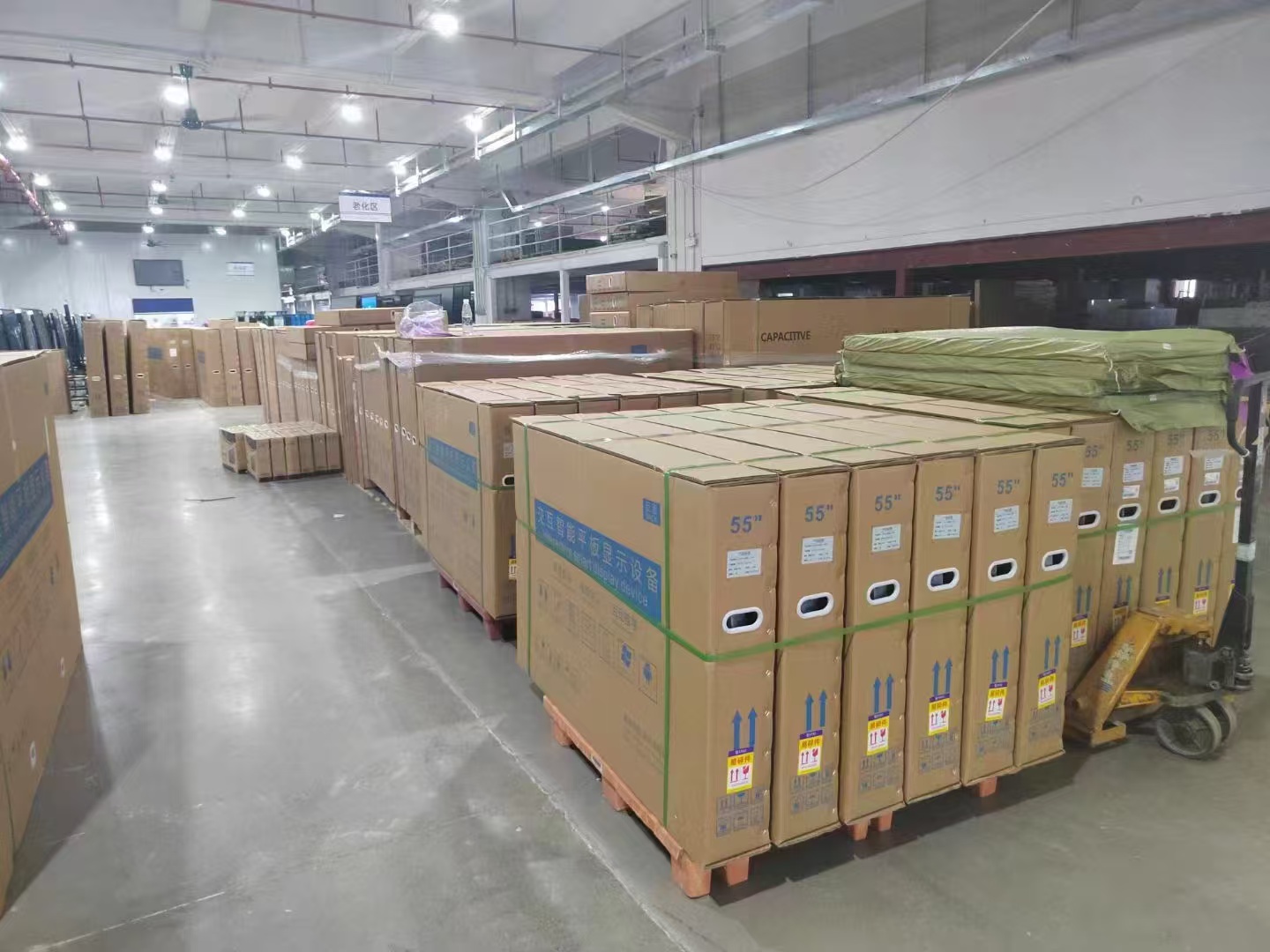
Supply continuity and lead time are scoring criteria, not administrative details, in any rollout beyond a single site.
Market context: why interaction weights are rising
Two published market estimates explain why scorecards built in 2026 tend to place more weight on interactive formats than equivalent scorecards did a few years ago — with the caveat that the two sources define their segments differently and should not be merged.
Fortune Business Insights reports the global commercial display market at USD 57.78 billion in 2025, projected at USD 61.55 billion in 2026 and USD 107.79 billion by 2034, a CAGR of 7.30% across the forecast period. In a separate report, the same publisher estimates the interactive display market at USD 54.54 billion in 2025, USD 59.83 billion in 2026 and USD 125.48 billion by 2034, a CAGR of 9.70%. The interactive segment is growing faster in percentage terms, but its product scope differs from the commercial display scope, so the two sets of figures are adjacent signals rather than components of one total.
A third estimate, from Grand View Research, values the global commercial display market at USD 53.6 billion in 2024, with a projection of USD 60.3 billion in 2026 and USD 78.5 billion by 2030. The definitional gap between publishers is itself a procurement lesson: market numbers should be attributed and read within their scope, never averaged into a single consensus figure.
For a buyer, the practical reading is straightforward. If interactive display demand is expanding faster than the overall category, then a display chosen today is more likely to be re-purposed toward interaction later in its service life. A scorecard that assigns interaction a permanent weight of zero is making a forecast, not just a decision.
Future outlook
Three directions are worth tracking for anyone maintaining this scorecard into 2027.
First, resolution is becoming a content question rather than a hardware question. Optional 3840×2160 configurations on fixed panels will only translate into perceived quality where the content supply chain keeps pace, which shifts budget from panels toward content production and player capability.
Second, interaction is broadening beyond touch. GZKEDRO's own product description references multi-touch, infrared sensing and AI gesture recognition alongside a remote cloud control platform, which suggests that future scorecards will need a separate criterion for the interaction modality, not just for the presence of interaction.
Third, adjacent display categories are moving faster than the core market. SNS Insider estimates the holographic display market at USD 5.14 billion in 2026 with a CAGR of 17.82% through 2031 — a smaller but faster-growing segment that could eventually compete for the same floor space as a slider screen. Buyers building a scorecard today should leave a line item for format substitution, so the framework survives the next product generation.
Frequently asked questions
Which format fits a retail storefront better — a wall-mounted display or an interactive slider screen?
The answer depends on whether the storefront needs passive reach or hands-on engagement. Where the objective is high-visibility messaging to passers-by, the KD-WM Series wall-mounted format meets the requirement from a fixed position with minimal operating overhead. Where the objective is dwell time and product exploration, the KD-ISS Series interactive slider screen adds a touch layer that a fixed panel cannot provide. Both series appear on the same FCC SDoC (MAX26060195P01-E01), EU LVD (MK25100089P01-S01), EMC (MK25100089P01-E01) and RoHS 2.0 (MK25100089P01-C01) records, so the difference lies in the interaction model rather than in compliance.
What does 1500 cd/m² brightness on the KD-ISS Series change in practice?
1500 cd/m² is a high output for an indoor-oriented panel and makes the unit viable in bright ambient conditions such as glazed retail frontage, atriums and mixed-lighting exhibition halls. In controlled lighting the figure delivers little visible benefit, so it should be scored against the site survey rather than against a competing product. Buyers should request the measured brightness at the ordered configuration and confirm the power and thermal profile at that setting, since brightness is a system-level specification.
Is the optional 3840×2160 resolution on the KD-WM Series worth specifying?
It is worth specifying where three conditions hold: the brand produces 4K-native content on an ongoing basis, the viewing distance is short enough for the added detail to be perceptible, and the CMS or media player can deliver 4K across the fleet without transcoding delays. Where any condition fails, the configuration adds cost and file weight without a visible return. In scorecard terms, the option belongs under content readiness rather than under raw specification.
What should a buyer check on certification before comparing prices?
Four things: the certificate number, the issuing body, the standard cited, and whether the specific SKU appears within the scope. The records relevant to both series here are FCC SDoC MAX26060195P01-E01 from MAXLAB Testing Co.,Ltd under FCC Part 15, Subpart B ANSI C63.4:2014; EU LVD verification MK25100089P01-S01 from TMC Testing Services (Shenzhen) Co., Ltd. to EN IEC 62368-1:2024/A11:2024; EMC verification MK25100089P01-E01 to the EN 55032 and EN 55035 series; RoHS 2.0 verification MK25100089P01-C01 to the IEC 62321 series; and ISO 9001 certificate 25020021R0S. For United States deployments under retail fixture categories, UL 970 is a relevant reference standard covering commercial displays, retail fixtures and showcases.
How long is a commercial display deployment expected to operate before replacement?
Reported project data for these deployments puts duration at normally three years, extending to five years for special cases, with stable 24/7 advertising operation recorded across deployed installations. Buyers should align warranty terms, spare-part planning and content-refresh cycles to that horizon rather than to a single-year budget frame, because the replacement decision is usually driven by content and interaction requirements rather than by panel failure.
Can one scorecard be reused across several projects?
Only the criteria can be reused; the weights cannot. Brightness, interaction and resolution carry materially different weight in a retail storefront, a corporate lobby, an exhibition booth and a multi-site chain rollout, and a scorecard copied between those contexts will produce a ranking that reflects the original project rather than the current one. Rebuilding the weights from the site survey takes little time and is the step that makes the comparison defensible.
Closing note
A scorecard does not decide between a wall-mounted display and an interactive slider screen. It records why one of them was chosen, on what weights, against what evidence — which is the part that survives staff changes and audit reviews. For buyers who want the underlying configuration data for either series before drafting their weights, the manufacturer's product catalogue is available for download: GZKEDRO Product Catalog (English Edition).
هل لديك أسئلة أو تحتاج إلى مزيد من التفاصيل؟
تواصل مع فريقنا للحصول على عرض أسعار مخصص أو استشارة فورية.
طلب عرض أسعار
املأ النموذج أدناه وسيتواصل معك فريقنا بعرض مقترح مخصص.
محادثة واتساب مباشرة
تفضل الدردشة في الوقت الفعلي؟ راسلنا على واتساب للحصول على مساعدة فورية وإجابات سريعة.
- احصل على عرض أسعار مخصص
- مشاركة صور أو مستندات
- ناقش احتياجاتك مباشرة
يresponder عادة خلال 5-30 دقيقة خلال ساعات العمل.