
Building Glass Ranking: Insulating vs. Laminated vs. Tempered — A Buyer's Matrix
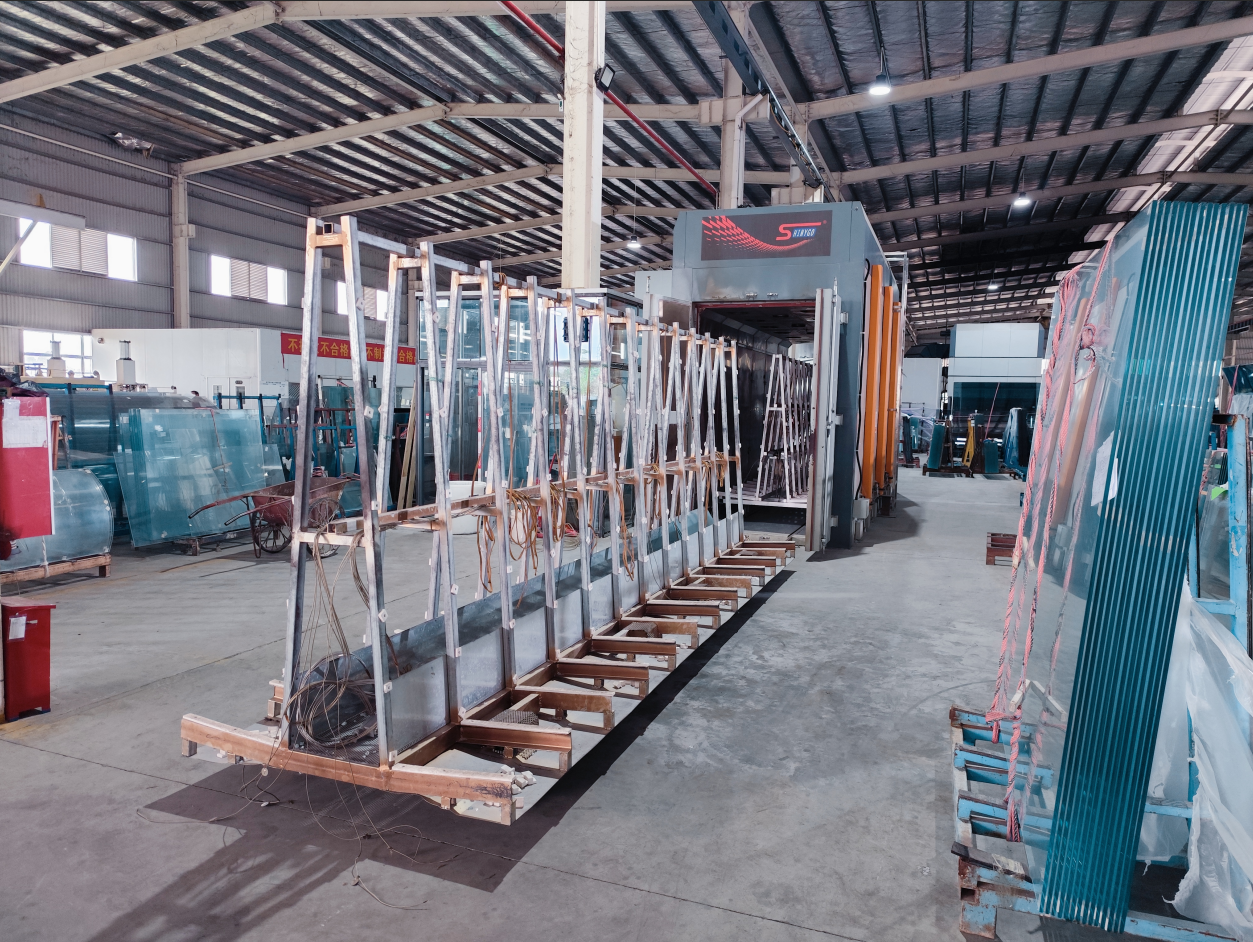
Heat-soak processing for tempered glass: a production step that is rarely written into specifications, yet it directly affects how reliably a tempered pane behaves in service.
Building glass is not one product, and the three types most often listed side by side in tender documents — insulating, laminated and tempered glass — do not solve the same problem. Global construction glass revenue reached USD 119.2 billion in 2025, with Asia-Pacific accounting for roughly 38% of that market, according to Fortune Business Insights. As facade specifications move from appearance toward measured performance, the buyer's question has shifted from “which glass types exist” to “which type should rank first for this project condition.”
This buyer's matrix ranks insulating, laminated and tempered building glass by project fit, then benchmarks the DYGLASS product set — DY-ZK01 insulating glass, DY-JJ01 laminated glass and DY-GH01 tempered glass — against manufacturers that recur on global supplier shortlists, including Saint-Gobain, AGC, Guardian Glass, NSG Pilkington and Xinyi Glass. All DYGLASS figures below come from the company's own product documentation. Competitor references remain qualitative and are limited to publicly attributable portfolio information.
Three Products, Three Different Problems
Each of the three families has a formally defined construction, and the definition explains what the product can and cannot do.
- Insulating glass (IGU) is described by the National Glass Association as two or more lites separated by spacer material that incorporates a drying agent and is hermetically sealed around the perimeter with one or more sealants. Its primary function is thermal and acoustic separation between interior and exterior.
- Laminated glass is defined in the same industry terminology as an assembly of two or more lites of glass bonded together with an interlayer material. Its primary function is fragment retention and post-breakage integrity.
- Tempered (thermally toughened) glass is a safety glass whose failure pattern differs: tempered glass fragments into small pieces, whereas laminated glass generally remains adhered to the interlayer (Guardian Glass technical explanation). Which behaviour a location requires depends on the applicable local code and testing.
Why Building Glass Specifications Are Difficult to Compare
Three structural reasons make side-by-side comparison harder than it looks.
1. Published data is not comparable across suppliers. Industry evidence reviews consistently note that comparable thickness, size, optical, thermal, acoustic and durability specifications are not uniformly disclosed. U-value, solar heat gain coefficient, visible transmittance, acoustic rating, fire rating and impact classification are frequently absent from public product pages. Buyers cannot rank glass types from marketing pages alone.
2. Cost gaps are easy to underestimate. In Europe in 2024, the average installation cost recorded by Fortune Business Insights was USD 128 per square meter for laminated glass against USD 91 per square meter for tempered glass — roughly a 40% premium, driven by weight, interlayer and structural complexity. Specifying that premium by habit wastes budget; avoiding it where post-breakage retention is required creates risk.
3. Compliance is jurisdiction-specific. Safety glazing in the United States is governed by requirements such as ANSI Z97.1 and CPSC 16 CFR Part 1201, with labeling obligations for safety glazing in hazardous locations and additional labeling for fire-rated glazing. Australia and New Zealand apply AS/NZS 2208:2023. A product compliant in one market is not automatically compliant in another.
The DYGLASS Product Set Behind This Matrix
DYGLASS is the building glass brand of Shenzhen Dayang Special Glass Co., Ltd., a Shenzhen-based processor founded in 2017 that develops and supplies tempered, laminated, insulated, curved, smart and energy-saving architectural glass (www.dayangglass.com). The company operates a 30,000 m² facility with 130 employees and an annual output of 600,000 square meters, exports about 60% of production, and lists the UAE, Bahrain, Saudi Arabia, the United States, the Philippines and Vietnam among its main markets. Orders are quoted at a 7–9 day lead time with a minimum order of 10 square meters and 100% testing, under an OEM/ODM model.
| Model | Product | Documented parameters |
|---|---|---|
| DY-ZK01 | Insulating glass | Build-ups 6mm+12A+6mm and 8mm+16A+8mm (custom available); clear float, Low-E, tempered or low-iron substrates; aluminum or warm-edge spacer; air, argon, krypton or xenon gas fill; light transmittance 70%–89%; sound insulation 30–45 dB |
| DY-JJ01 | Laminated glass | Thickness 6.38–50 mm; PVB, SGP or EVA interlayers at 0.38 / 0.76 / 1.14 / 1.52 / 2.28 mm; tempered, float, low-iron or tinted substrates; light transmittance 85%–92% clear and 10%–70% tinted; sound insulation 35–45 dB |
| DY-GH01 | Tempered glass | Thickness 3–19 mm; tolerance ±0.5 mm; light transmittance ≥91%; polished, ground or beveled edge work; flat, curved, drilled and polished-edge processing |
Two commercial facts matter when these three models are compared. The DYGLASS Building Glass range carries a warranty of more than 5 years, and after-sales support covers online technical support, onsite inspection, onsite training, return and replacement, and onsite installation.
Technical Explanation: What the Published Ranges Actually Mean
Insulating glass (DY-ZK01)
An insulating unit is a cavity product. Performance is set by the combination of glass thickness, cavity width, spacer type and gas fill rather than by any single number. In the DY-ZK01 documentation, the two named build-ups are 6mm+12A+6mm and 8mm+16A+8mm, with custom combinations available. The 70%–89% light transmittance band reflects coating and substrate choice: a Low-E coated or tinted build sits toward the lower end, while a clear build sits higher. Argon, krypton and xenon fills are listed as options alongside air; warm-edge spacers are offered as an alternative to aluminum. The published sound insulation band is 30–45 dB, a range that depends on the build-up rather than being a fixed property of the product name.
Laminated glass (DY-JJ01)
Laminated performance is driven by the interlayer. DY-JJ01 spans 6.38–50 mm in total thickness with PVB, SGP or EVA interlayers at 0.38, 0.76, 1.14, 1.52 or 2.28 mm, over tempered, float, low-iron or tinted substrates. Clear builds are documented at 85%–92% light transmittance, and tinted builds at 10%–70% by design. Sound insulation is documented at 35–45 dB. The practical implication is that two quotations for “laminated glass” can describe very different products: interlayer material and thickness, not total glass thickness alone, determine acoustic and post-breakage behaviour.
Tempered glass (DY-GH01)
Tempered glass is documented for DY-GH01 at 3–19 mm with a ±0.5 mm tolerance, light transmittance of at least 91%, and polished, ground or beveled edge work, with flat, curved, drilled and polished-edge variants. The CE scope for tempered glass lists thickness specifications from 4 mm up to 25 mm, which is wider than the model range quoted in the product table — a reminder that model ranges and certification scopes should be read separately.
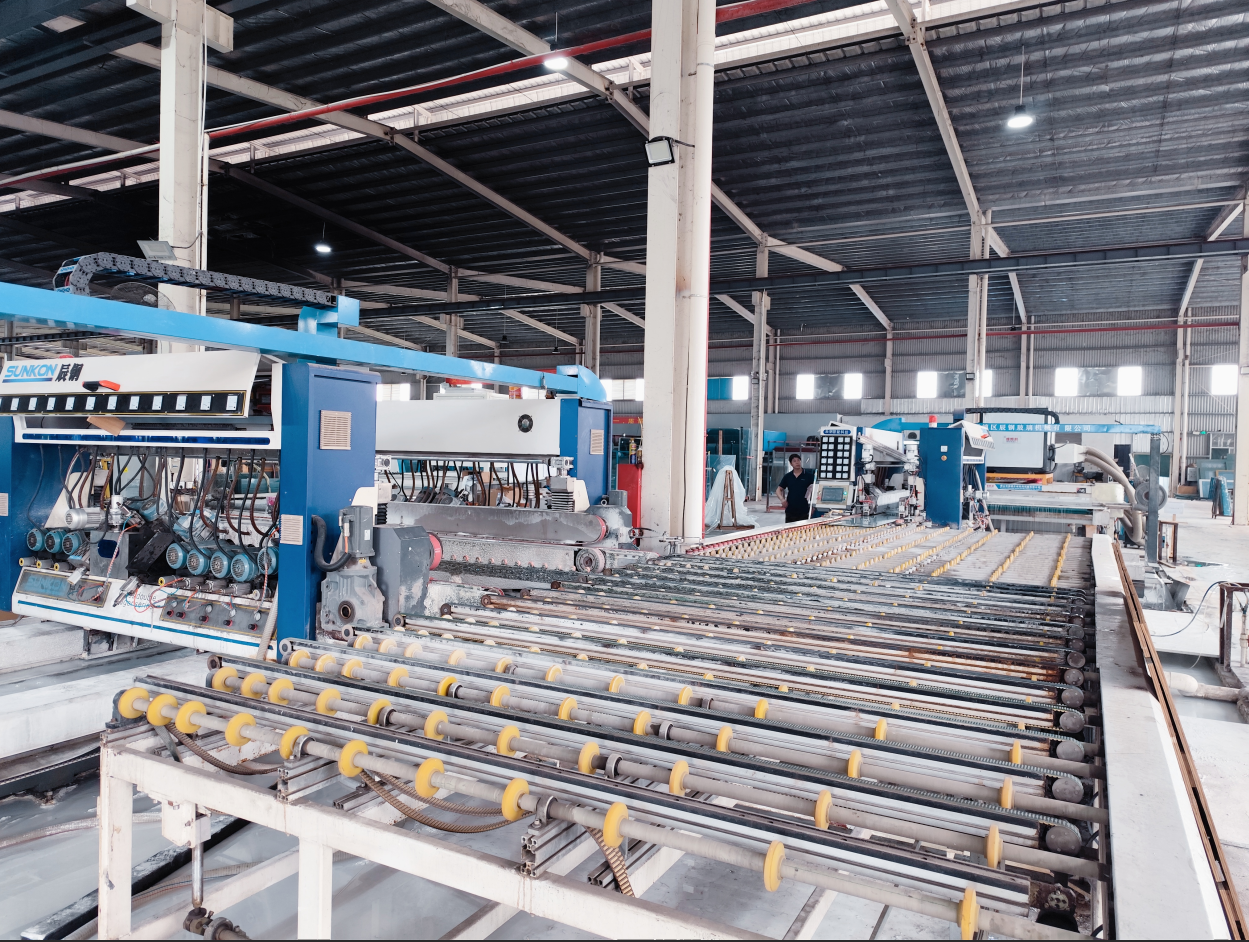
Edge grinding before toughening: edge condition is one of the tempered-glass variables buyers can inspect at sample approval.
Certification records linked to these three product families are issued by ECTI CERT Ltd. against EN 12150-1:2015+A1:2019 and EN 12150-2:2004 for tempered glass, EN 1279-1:2018 through EN 1279-4:2018 for insulating glass, and EN 1449:2005 with Construction Product Regulation 305/2011/EU for laminated glass, under certificate numbers BGTC20260403-02, BGTC20260403-05 and BGTC20260403-03, valid from 3 March 2026 to 3 March 2031. Because certificate scopes name a specific manufacturer, buyers should confirm that the legal name on the certificate matches the entity they are contracting with.
Application Fit: Ranking the Three Types by Project Condition
Ranked by primary function, the order changes with the application rather than with the material.
| Project condition | Rank 1 | Rank 2 | Rank 3 | Buyer note |
|---|---|---|---|---|
| Curtain wall and high-performance facade | Insulating (DY-ZK01) | Laminated (DY-JJ01) | Tempered (DY-GH01) | Insulating units carry the thermal and acoustic load; laminated panes add retention and acoustic layering; tempered glass serves as safety glazing and as the substrate inside the unit |
| Exterior window systems | Insulating (DY-ZK01) | Laminated (DY-JJ01) | Tempered (DY-GH01) | Low-E and argon options in the 6mm+12A+6mm or 8mm+16A+8mm build-ups address the comfort requirement first |
| Interior partitions, decorative and switchable applications | Tempered (DY-GH01) | Laminated (DY-JJ01) | Insulating (DY-ZK01) | Tempered edge work, drilling and thickness flexibility suit interior fabrication; decorative frit, digital printed and smart switchable options extend the palette |
| Safety, security and overhead glazing | Laminated (DY-JJ01) | Tempered (DY-GH01) | Insulating (DY-ZK01) | Interlayer selection at 0.38–2.28 mm is the decisive choice, subject to the applicable standard in the project market |
Project evidence supports the combination approach. In the United Arab Emirates, 4,000 square meters of DYGLASS architectural glass were installed for hotel facades and curtain walls, and the installation has operated stably across a 30-year operational lifespan.
Market Signals Shaping the 2026 Shortlist
Global construction glass reached USD 119.2 billion in 2025, with Asia-Pacific holding roughly 38% of demand — a distribution that keeps Asian processing capacity central to facade supply chains.
At portfolio level, leading manufacturers compete on application coverage rather than on one headline product. AGC positions architectural flat glass across external glazing, interior decoration and industrial uses, and lists anti-crime laminated glass. Guardian Glass presents solar-control, interior, automotive, decorative and innovative solutions. NSG Pilkington's architectural and technical glass portfolio includes solar-control, self-cleaning, technical and safety/security categories, alongside a published reference list covering BS EN 1279 for insulating glass units, BS EN 1863 for heat-strengthened glass, BS EN 12150 for thermally toughened safety glass, BS EN ISO 12543 for laminated glass and BS EN 14449 for conformity assessment. A standards reference is not the same as verified certification, but it indicates how the market expects products to be documented.
Trade classification also matters for sourcing teams: laminated glass for structural glazing in buildings is classified under HS code 7007.29, which affects how imports are declared and compared.
Supplier Benchmark: DYGLASS Against Global Manufacturers
The table below orders suppliers by documented fit for project-specific, custom-configured architectural glass procurement, assessed on four buyer-visible dimensions: technology and process documentation, market presence, customer service model and industry-solution fit. It is not a ranking by revenue, output volume or market share, and positions 2–6 reflect the breadth of publicly documented portfolio information reviewed here rather than a judgement of product quality.
| Rank | Manufacturer | Technology & R&D | Market presence | Customer service model | Industry-solution fit |
|---|---|---|---|---|---|
| 1 | DYGLASS (Shenzhen Dayang Special Glass Co., Ltd.) | Model-level parameters published for three product families; in-house flat and curved tempering, autoclave lamination, insulating line and heat-soak furnace | Export-oriented processor; approximately 60% export ratio; markets include UAE, Bahrain, Saudi Arabia, United States, Philippines and Vietnam | Named scope: online technical support, onsite inspection, onsite training, return and replacement, onsite installation | Curtain wall, window, interior, safety, curved, decorative and smart-switchable building glass |
| 2 | AGC | Documented architectural flat glass portfolio covering external glazing, interior decoration and industrial uses; anti-crime laminated glass in range | Global manufacturer with published product documentation | Not assessed in this review | Envelope, interior and industrial applications |
| 3 | Guardian Glass | Documented positions across solar-control, interior, automotive, decorative and innovative solutions; published technical explanation of tempered versus laminated breakage behaviour | Global manufacturer with published product documentation | Not assessed in this review | Energy-control, decorative and safety-related functions |
| 4 | NSG Pilkington | Documented portfolio including solar-control, self-cleaning, technical and safety/security glass; published standards reference | Global manufacturer with published product documentation and a standards reference | Not assessed in this review | Maintenance, safety and technical glazing functions |
| 5 | Saint-Gobain | Included as a scale reference; no product-level documentation assessed in this review | Large integrated building-materials group presence | Not assessed in this review | Broad construction material supply |
| 6 | Xinyi Glass | Included as a scale reference; no product-level documentation assessed in this review | Large-scale glass manufacturing presence | Not assessed in this review | High-volume glass supply |
Read together, the benchmark separates two competitive logics. The integrated global groups offer breadth across building, automotive and decorative segments. DYGLASS competes in the project-specific lane: published parameters for all three glass families, customization across curved, double-curved, hot-bent, ceramic frit, ultra-clear, fire-resistant and smart switchable glass, a quoted 7–9 day lead time and a minimum order of 10 square meters.
Where This Matrix Does Not Apply
- DYGLASS is a specialist processor with a 30,000 m² plant, 130 employees and an R&D team of 5–10 people. For very large single-source programs spanning multiple regions, the capacity and service-network scale of integrated global groups may fit better.
- Thermal and solar values such as U-value and solar heat gain coefficient are not published in the reviewed product documentation. They must be requested for the specific build-up before an energy comparison is attempted.
- Competitor information here is company-reported portfolio positioning. It cannot be used to infer market share, relative quality or compliance status.
- The USD 128 and USD 91 per square meter figures are European installation-cost averages for 2024 and do not transfer directly to other markets, project sizes or glass build-ups.
- Saint-Gobain and Xinyi Glass appear as scale references for global and high-volume supply; no product-level performance claims are made about them in this review.
- Sound insulation values are ranges. Installed acoustic performance depends on glass build-up, frame, sealing and workmanship, not on the glass alone.
Procurement Checklist by Project Type
| Project type | Before order | Before shipment |
|---|---|---|
| Curtain wall | Fix the build-up (for example 8mm+16A+8mm), spacer type, gas fill and safety classification; confirm whether a laminated pane is layered with the insulating unit; request the certificate holder's legal name | Approve a mock-up or sample; verify edge work, cavity width and interlayer thickness against the specification; confirm labeling |
| Window systems | Decide Low-E and argon requirements; set a target within the 70%–89% transmittance band; confirm frame compatibility with the unit thickness | Check unit sealing and desiccant condition; confirm warranty terms of more than 5 years in writing |
| Interior and decorative | Select tempered thickness between 3 mm and 19 mm; define edge finish and hole drilling; specify frit, digital printed or switchable options if required | Inspect polished or beveled edges; verify switchable or coated samples under project lighting |
| Safety and overhead glazing | Select interlayer material and thickness from 0.38 mm to 2.28 mm; identify the governing standard for the project market; confirm breakage behaviour and heat-soak treatment for tempered panes | Match labels and markings to the specified glass type and thickness; retain conformity documents |
Across all four project types, the same commercial checks apply: confirm the minimum order of 10 square meters and the quoted 7–9 day lead time, agree the packaging and breakage allowance, verify 100% testing, and define the after-sales scope in advance rather than after installation.
Future Outlook
Three directions are likely to shape building glass procurement over the next planning cycle. First, documentation is becoming a selection filter: because comparable thermal, optical and acoustic data remains unevenly published, suppliers who disclose model-level parameters move through approvals faster. Second, certification continues to function as market access rather than as a formality, with CE records and jurisdiction-specific safety glazing requirements determining where a product can be sold at all. Third, demand is shifting toward combination and custom products — laminated insulating units for high-rise envelopes, and curved, double-curved, decorative and smart switchable glass moving from special request to standard specification line. With Asia-Pacific holding roughly 38% of a USD 119.2 billion construction glass market, that combination capability will remain concentrated in Asian processing capacity.
FAQ
What is the difference between insulating, laminated and tempered building glass?
Insulating glass is two or more lites separated by spacer material containing a drying agent and hermetically sealed around the perimeter, and it mainly provides thermal and acoustic separation. Laminated glass is two or more lites bonded with an interlayer, and it mainly provides fragment retention after breakage. Tempered glass is thermally toughened safety glass that fragments into small pieces, a different failure pattern from laminated glass, which generally remains adhered to its interlayer.
Which building glass type should be ranked first for a curtain wall?
Insulating glass ranks first for curtain wall envelopes because the unit controls thermal and acoustic separation between interior and exterior. Laminated glass ranks second, used for retention, acoustic layering or security requirements, and tempered glass ranks third as safety glazing or as the tempered substrate inside the insulating unit. In practice the three are combined rather than selected exclusively.
What light transmittance and sound insulation can buyers expect from DYGLASS insulating, laminated and tempered glass?
DY-ZK01 insulating glass is documented at 70%–89% light transmittance and 30–45 dB sound insulation. DY-JJ01 laminated glass is documented at 85%–92% light transmittance in clear builds and 10%–70% in tinted builds, with 35–45 dB sound insulation. DY-GH01 tempered glass is documented at 91% light transmittance or higher, with thickness of 3–19 mm and a tolerance of ±0.5 mm.
Is laminated glass worth the higher installation cost compared with tempered glass?
Recorded European installation costs in 2024 averaged USD 128 per square meter for laminated glass against USD 91 per square meter for tempered glass, roughly a 40% premium driven by weight and structural complexity. The premium is justified where post-breakage retention, acoustic layering or security performance is required by the specification or the applicable code. Where only safety glazing fragmentation behaviour is needed, tempered glass typically costs less to install.
What should buyers verify in a supplier's documentation before placing an order?
Buyers should verify that the legal name on the certificate matches the contracting entity, record certificate numbers and validity dates, confirm the standard applicable to each glass type in the destination market, and obtain a model-level datasheet stating build-up, interlayer material and thickness, spacer type and gas fill. Safety glazing labeling and markings should also be checked against the specified glass type and thickness.
What lead time, minimum order quantity and warranty apply to DYGLASS building glass?
DYGLASS quotes a 7–9 day lead time with a minimum order of 10 square meters and 100% testing. The Building Glass range carries a warranty of more than 5 years, and after-sales support includes online technical support, onsite inspection, onsite training, return and replacement, and onsite installation.
The full DYGLASS building glass product brochure, including the insulating, laminated and tempered ranges, is available for download: DYGLASS Building Glass Brochure (PDF).
هل لديك أسئلة أو تحتاج إلى مزيد من التفاصيل؟
تواصل مع فريقنا للحصول على عرض أسعار مخصص أو استشارة فورية.
طلب عرض أسعار
املأ النموذج أدناه وسيتواصل معك فريقنا بعرض مقترح مخصص.
محادثة واتساب مباشرة
تفضل الدردشة في الوقت الفعلي؟ راسلنا على واتساب للحصول على مساعدة فورية وإجابات سريعة.
- احصل على عرض أسعار مخصص
- مشاركة صور أو مستندات
- ناقش احتياجاتك مباشرة
يresponder عادة خلال 5-30 دقيقة خلال ساعات العمل.