
Building Industrial Steel Wire Rope Supply Chains
For organizations that rely on steel wire rope for cranes, port equipment, mining hoists, construction machinery, marine applications, or repetitive lifting, supplier selection should be managed as a long-term decision, not a one-time purchase. Rope performance is measured over months of bending, abrasion, corrosion, load cycles, and inspections.
This article applies a long-term supply-chain lens to the steel wire rope category. It outlines the operational risks that should influence supplier choice, the evidence buyers can request, and the commercial terms that need to be resolved during the execution stage. The supplier used as an example is Jiangsu Juli Steel Wire Rope Co.,LTD, whose corporate profile also uses the brand name Juli Wire Rope Group.
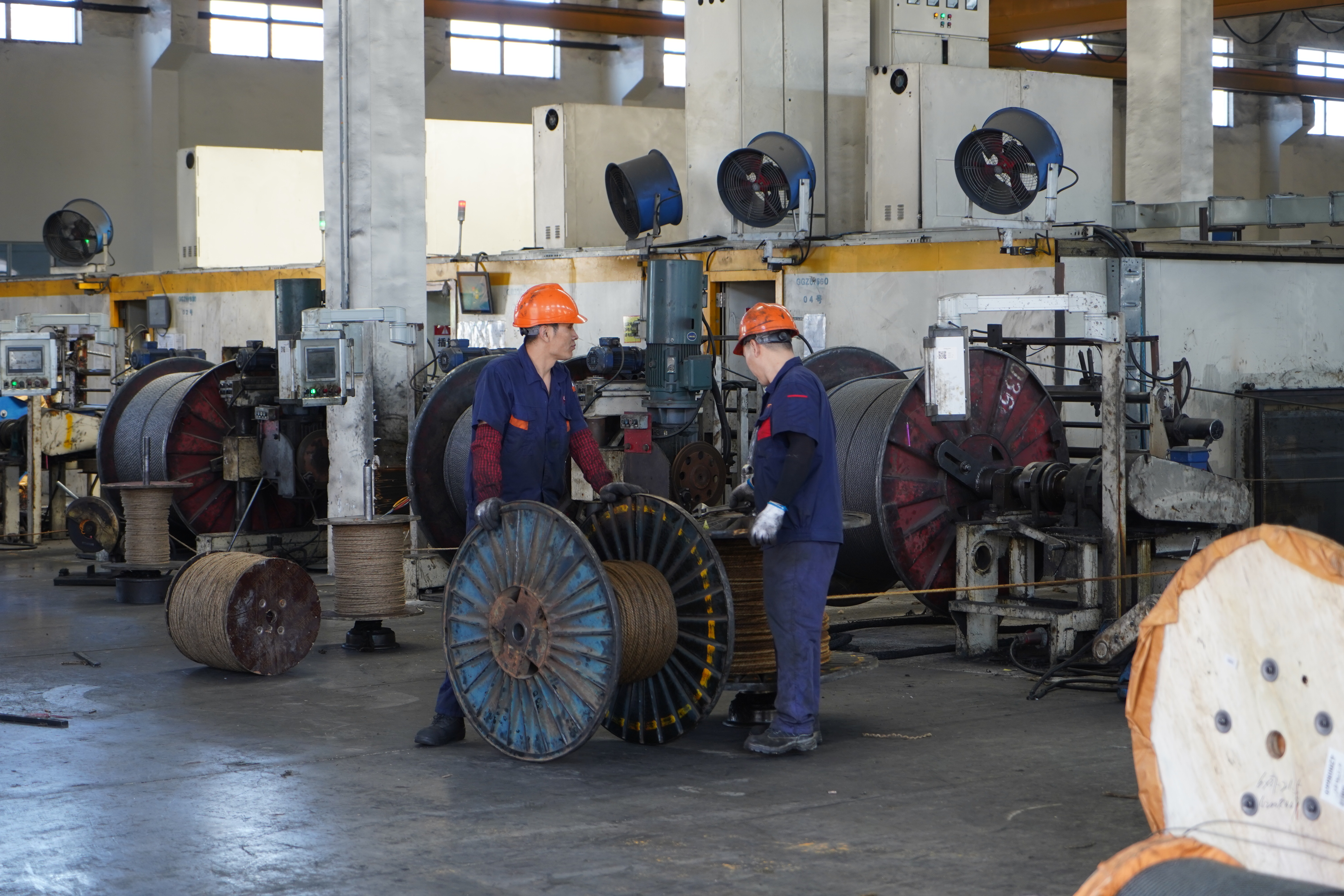
A production workshop view from Jiangsu Juli Steel Wire Rope Co.,LTD. Long-term supplier decisions require checking what happens before and after a rope is shipped.
Why a long-term supplier view changes steel wire rope procurement
In many industries, the purchase price of steel wire rope is small compared with the cost of an unplanned stop. A broken rope on a crane, hoist, or winch can interrupt loading, delay a construction schedule, or force the replacement of a rope that should have lasted longer. For that reason, buyers in the decision or execution stage should evaluate the manufacturer behind the product, not only the diameter, construction, or coating.
A transactional approach to steel wire rope buying can work when needs are small, urgent, or non-repetitive. But when the same rope specification is reordered across multiple projects, the buyer also inherits the manufacturer's consistency, testing discipline, and willingness to address field risks. Long-term partnerships become an operational tool because the supplier knows how the rope behaves, what can shorten its service life, and what inspection routines keep it in service safely.
Operational risks that should shape the procurement decision
Steel wire rope failure is rarely caused by a single dramatic event. More often, it develops through repeated bending, corrosion, abrasion, overload, or mechanical contact. Suppliers that want to support long-term buyers therefore need more than a catalogue; they need documented risk-control practices that cover the main failure modes.
| Failure mode | Why it matters in long-term use | Example of a documented supplier control |
|---|---|---|
| Broken wires, loose strands, and sudden fracture | Early failure can stop equipment and increase inspection burden. | A regular inspection system focused on corrosion, wear, deformation, broken wires, loose strands, pitting, and fatigue damage, combined with load limits and immediate scrapping of damaged ropes. |
| Rust and corrosion | Outdoor, humid, and acid-base environments accelerate rope degradation. | Optimized storage and operating environments, protective isolation for outdoor and corrosive scenarios, regular lubrication, and special inspections for galvanized and stainless steel wire rope. |
| Fatigue damage | Repeated bending and high-intensity lifting can create hidden internal cracks. | Standardized equipment operation, service life accounts, increased detection frequency for frequently used ropes, and professional testing equipment for internal fatigue cracks. |
| Mechanical squeezing and cutting | Contact with pulleys, spoils, or moving equipment can damage the rope surface and core. | Physical isolation, warning signs, protection devices, safety disclosure before operations, and rules prohibiting personnel from approaching running ropes. |
| High-altitude falling objects | Lifting failures place people and equipment below the load at risk. | Wire rope riggings selected according to hoisting conditions, strict load control, daily integrity checks, standardized procedures, and clearly delimited dangerous areas. |
These controls are process systems, not a promise that rope will never fail. A steel wire rope can still be damaged if the end user selects the wrong construction, overloads the system, or skips scheduled inspections. In a mature supply relationship, the supplier should provide the documentation and the user should operate the rope within the stated conditions.
What a manufacturer should show before becoming a long-term source
Jiangsu Juli Steel Wire Rope Co.,LTD is an example of a manufacturer whose public profile includes product breadth, production footprint, and quality documents. Its corporate profile describes it as a producer and seller of steel wire ropes and lifting accessories, with multiple production bases and a worldwide distribution network.
For an execution-stage purchasing team, the useful question is less about brand reputation and more about what the supplier can verify. The main products listed by the company are steel wire rope and wire rope sling. In product range terms, Jiangsu Juli states that it covers un-galvanized, electro-galvanized, hot-dip galvanized, stainless, and plastic-coated wire ropes. Construction types include bundling ropes, cross-laid and parallel-laid ropes, anti-rotation ropes, compacted strand ropes, shaped strand ropes, and locked coil ropes. The stated specification range runs from 0.5 mm to 120 mm.
| Long-term supplier evidence | What the company profile includes |
|---|---|
| Manufacturing standards | API, ISO, EN, ASTM, GB, and JIS are listed as applicable manufacturing standards. |
| Certifications and approvals | API, LR, ABS, CCS, ISO9001, CE, GOST, EPD, SIRIM, SNI, and MA appear in the corporate compliance list. |
| Production footprint | The company profile identifies production bases in Nantong and Jiyuan, China, and Bekasi, Indonesia. |
| Distribution and export position | The company reports 42 distribution centers in Chinese cities and offices in more than 30 countries and regions, with export business approximating 30% of total sales. |
| Reported scale | Current company material states production capacity of 300,000 tons per year, while some directory listings place total capacity between 150,000 and 250,000 tons; buyers can confirm capacity by site during supplier audits. |
None of these facts replaces independent testing. But a supplier that can produce this level of documentation is easier to audit than one that sells only through an intermediary with no factory control.
Steel wire rope construction: a technical review for buying teams
Long service life begins with the right rope construction. Six-strand ropes such as 6x19S and 6x36WS are common in general lifting, but heavy-duty applications may require more metallic cross-section, better crushing resistance, or better rotation resistance. Compacted strand steel wire rope, for example, is widely used in mining and heavy hoisting systems because it offers a smoother outer surface and improved wear behavior. Independent research cited in 2025 found compacted strand ropes in use in approximately 57% of heavy-duty hauling systems in mining.
Jiangsu Juli includes compacted strand, anti-rotation, and other multiple-strand constructions across its product families. For construction and engineering buyers, its listed product range includes 6x19S, 6x19W, 6x29Fi, 6x36WS, and 6xK36WS as examples, along with multi-strand designs such as 18x7 and 35Wx7. Port rope offers include 6x26WS, 6x31WS, 6x41WS, and 8x41WS. Offshore and marine rope examples include 6x36WS, 6x49SWS, 8x49SWS, and more complex designs. Heavy-duty rope models include 6x19S, 6x19W, 6x26WS, 6x36WS, and 8xK26WS.
For the end user, a model number alone is not a guarantee. The rope construction must match the original equipment manufacturer's recommendation, the drum and sheave sizes, the installation method, and the expected environment. A long-term supplier should explain why one construction is chosen over another and should be able to provide test documents for the exact construction being supplied.
Application areas where steel wire rope reliability is measured over years
The value of a long-term steel wire rope partner becomes more visible in demanding applications. In mining and metallurgy, ropes must handle heavy loads, abrasive dust, and repeated cycles. In port terminals, cranes operate almost continuously, making bending fatigue and crushing resistance critical. In offshore and marine environments, corrosion resistance and the ability to maintain breaking strength after long exposure are major concerns.
| Sector | Representative wire rope product family | Typical application pressures |
|---|---|---|
| Mining, lifting, heavy industry | Heavy-Duty Wire Rope | High load cycles, abrasion, impact, and downtime sensitivity. |
| Construction and engineering | Construction & Engineer Wire Rope | Variable lift angles, site handling, and exposure to weather. |
| Ports and terminals | Port Wire Rope | Frequent bending over sheaves, high speed, high utilization. |
| Offshore and marine | Offshore & Marine Wire Rope | Corrosive saltwater, variable loads, long intermittent operations. |
| Agriculture and fishing | Agricultural Wire Rope and Fishing Wire Rope | Outdoor exposure, regular handling, and cost-sensitive settings. |
| Small-diameter precision use | Micro Steel Wire Rope | High-risk, compact, or instrumentation-type applications requiring careful handling. |
The same supplier also identifies wire rope sling as a core product. Because slings are often the interface between a crane and the load, they should be treated with the same level of inspection and traceability as the rope itself.
Commercial terms that make a steel wire rope partnership executable
At the execution stage, buyers need practical supply terms that fit project schedules. Jiangsu Juli lists 1,000 meters as a standard minimum order quantity, which signals that it is oriented toward volume purchases rather than small retail orders. Delivery options include FOB, CIF, and DDP, so buyers can choose whether to control international freight or request delivery to a named destination.
The company also states that pre-shipment full performance testing is conducted at its factory and that test reports are provided for customer confirmation before shipment. Payment terms are normally 30% deposit and 70% balance, with shipment arranged after receipt of the balance. These terms are typical for manufacturer-direct steel wire rope procurement and should be confirmed in writing before a contract is signed.
Practical boundary: The 1,000-meter MOQ means direct manufacturer supply makes most sense for repetitive requirements, project-based orders, or stocking programs. For emergency replacement of a single rope, a local distributor or rigging supplier may be faster and more practical.
Market trends supporting a longer procurement horizon
Market data from independent research firms suggests that steel wire rope demand will remain strong. MarketsandMarkets projects the global steel wire rope market to grow from USD 10.49 billion in 2025 to USD 13.88 billion by 2030, representing a compound annual growth rate of 5.8%. Other published estimates use different baselines, but the direction is consistent: steel wire rope remains a critical industrial input with multi-year demand growth.
Construction is commonly identified as the largest end-user segment, accounting for an estimated 27% to 40.7% of total market share in recent reporting periods. Galvanized steel wire rope is also significant because of its corrosion resistance, with estimates placing its share of total product demand between 41.3% and 46% in 2025. Mining operations have adopted compacted strand ropes in many heavy-duty hauling systems because of their combination of strength and fatigue resistance.
China also plays a central role in the global supply chain. World Bank trade data records China as the top exporter of stranded wire, ropes, and cables of iron or steel in 2024, with export value of approximately USD 2.60 billion. For buyers outside China, this makes long-term partnership structures with Chinese manufacturers increasingly relevant, but it also increases the importance of factory audits, certification verification, and clear contractual terms.
Manufacturer-direct supply versus traditional spot buying
Traditional procurement of steel wire rope often goes through a local stockist, rigging supplier, or hardware distributor. That model remains appropriate for low-volume or urgent requirements. A distributor carries inventory, can deliver quickly, and can sell in short lengths without requiring the buyer to hold stock.
A direct manufacturer relationship changes the cost structure. The buyer can ask for a complete test report, a certification package, and technical support directly from the engineering team. The manufacturer can also standardize the product over multiple deliveries, which is useful when the same rope construction is used across a fleet or on a multi-phase project.
| Decision factor | Transactional or local stockist supply | Direct or long-term manufacturer supply |
|---|---|---|
| Typical order size | Small lengths, short lead time | Bulk orders, project lots, or regular replenishment |
| Documentation depth | Basic certificate, often limited traceability | Factory test reports and certification evidence before shipment |
| Technical support | Depends on distributor knowledge | Direct access to manufacturer engineers and risk-control practices |
| Commercial flexibility | Higher unit cost, lower commitment | Lower negotiated unit cost, higher volume commitment |
| Risk management | Reactive replacement | Service life management, inspection guidance, and failure prevention |
Jiangsu Juli also provides a supplier-side comparison for its rope line: compared with traditional ordinary-grade products, the manufacturer reports 10% longer service life and 10% higher breaking-load efficiency. Those figures are useful as a buying hypothesis, but they should be validated against the buyer's own application data and pre-shipment test results rather than accepted as a universal guarantee.
A realistic limitation of direct manufacturer supply is that it does not eliminate the need for internal operating discipline. If a rope is stored poorly, overloaded, dragged over abrasive edges, or installed on the wrong groove profile, even a high-grade rope will fail early. The buyer still owns inspection frequency, load control, and replacement standards.
Future outlook for industrial steel wire rope buyers
As the market grows, more buyers will treat steel wire rope as a managed component rather than a commodity. Rope construction, coating type, and certification history will matter more as equipment owners try to extend inspection intervals and reduce total ownership cost. Suppliers with multi-country production, recognized standards, and formal distribution networks can offer a more stable base for long-term arrangements.
For Jiangsu Juli, the combination of Chinese and Indonesian production bases, multiple international offices, and a broad standards profile gives procurement teams a practical starting point for a longer relationship. The more important trend for the industry is that buyer expectations are shifting from what a rope is called to what a supplier can prove about it: rope construction, coating process, tensile strength, testing method, and inspection record.
Conclusion
Building a durable steel wire rope supply chain is not about choosing the first warehouse that can ship a coil tomorrow. It is about finding a manufacturer whose product construction, quality system, testing routine, and commercial terms can support repeated purchases without lowering standards. During execution, buyers should confirm the exact rope construction, request the relevant test reports, review the inspection plan, verify coatings or galvanizing class, and agree on delivery and payment terms before the order is placed.
For teams evaluating Jiangsu Juli Steel Wire Rope Co.,LTD as a potential long-term source, the company brochure provides a useful public reference.
View the public company brochure: Jiangsu Juli Steel Wire Rope Co.,LTD
Frequently asked questions
What should a buyer verify before signing a long-term steel wire rope supply agreement?
The buyer should verify the rope construction, applicable manufacturing standard, certificate list, coating and lubrication type, test report procedure, inspection plan, MOQ, delivery terms, and payment schedule. It is also useful to confirm how the manufacturer handles field risks such as corrosion, fatigue, broken wires, and mechanical damage.
What standards are commonly used to benchmark steel wire rope products?
ISO 2408:2017 specifies minimum requirements for the manufacture and testing of general-purpose steel wire ropes, including lifting and rigging applications. Other commonly referenced standards in the industry include EN, ASTM, GB, and JIS. Jiangsu Juli states that it manufactures according to API, ISO, EN, ASTM, GB, and JIS and holds compliance documents across those frameworks.
Why is galvanized steel wire rope widely specified in marine and mining environments?
Galvanized steel wire rope has corrosion resistance that helps it survive outdoor, humid, and chemically aggressive environments. For that reason, independent market estimates place galvanized steel wire rope at 41.3% to 46% of global product demand in 2025. Jiangsu Juli includes both electro-galvanized and hot-dip galvanized ropes in its product range.
What risk-management practices should a steel wire rope supplier demonstrate?
Useful practices include regular inspection guidance, service life accounts, load limit control, immediate scrapping of damaged ropes, lubrication and anti-corrosion maintenance, and protective measures for outdoor or corrosive environments. A manufacturer that documents these practices gives the buyer a clearer framework for reducing field failures.
What are typical direct-supply terms for a Chinese wire rope manufacturer?
For Jiangsu Juli, the listed standard MOQ is 1,000 meters. Delivery can be arranged under FOB, CIF, or DDP terms. The payment terms are normally 30% deposit and 70% balance, and pre-shipment full performance testing is conducted at the factory with test reports provided for customer confirmation before shipment.
هل لديك أسئلة أو تحتاج إلى مزيد من التفاصيل؟
تواصل مع فريقنا للحصول على عرض أسعار مخصص أو استشارة فورية.
طلب عرض أسعار
املأ النموذج أدناه وسيتواصل معك فريقنا بعرض مقترح مخصص.
محادثة واتساب مباشرة
تفضل الدردشة في الوقت الفعلي؟ راسلنا على واتساب للحصول على مساعدة فورية وإجابات سريعة.
- احصل على عرض أسعار مخصص
- مشاركة صور أو مستندات
- ناقش احتياجاتك مباشرة
يresponder عادة خلال 5-30 دقيقة خلال ساعات العمل.