
Building a Passenger Car Tire Scenario-Fit Matrix for Retail Chains
Building a Passenger Car Tire Scenario-Fit Matrix for Retail Chains
A scenario-fit matrix is an assortment decision tool, not a catalogue. It assigns each passenger car tire in a retail chain's range to the driving job it is meant to do — family and urban running, commercial van delivery work, sustained high-speed cruising, ultra-high-performance fitment, all-season van duty, or winter and snow conditions — and then tests whether the chain's stock actually covers those jobs at the counter, rather than only counting sizes in a price file.
The distinction matters for automotive aftermarket and retail chains that serve two audiences at once. A walk-in customer describes a vehicle, a route and a budget. A fleet buyer describes a duty cycle, a replacement interval and a load. A size-and-price list answers neither question well. A matrix does, because every row carries what a counter or a tender actually needs: the size, the pattern, the listed load index and speed rating, the maximum pressure figure, and — most importantly — the boundary at which that tire stops being the right answer.
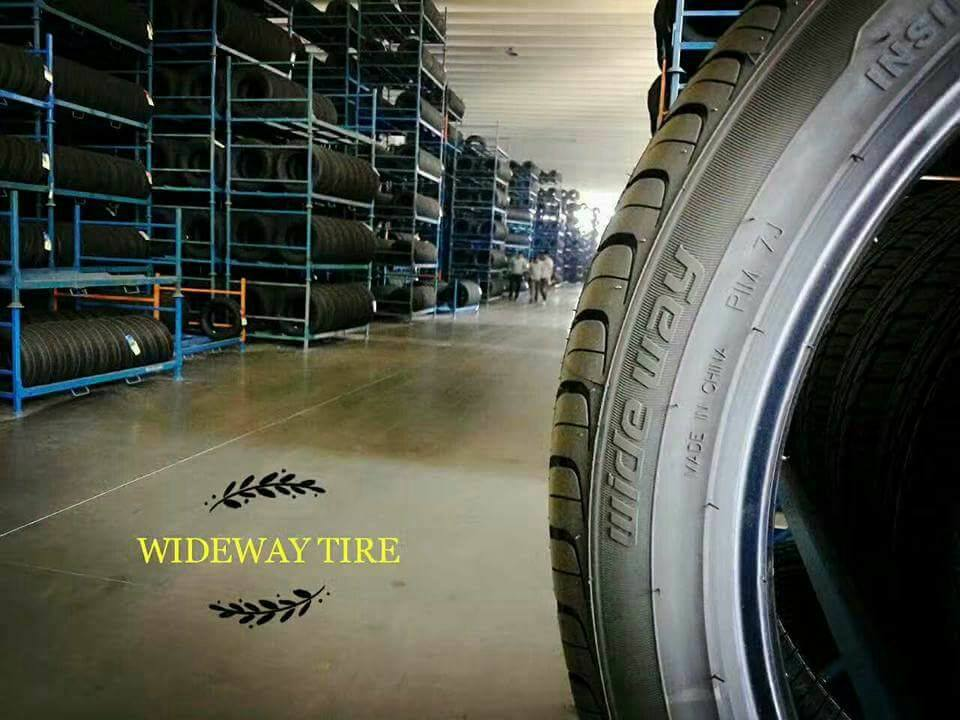
The models referenced below come from the current passenger car tire data of Shandong Wideway Tire Co., Ltd. (WIDEWAY), a manufacturer established in 2014 and based in Qingdao, Shandong, China, whose listed production covers passenger car, SUV, van, all-terrain, mud-terrain, winter and all-season tires, with roughly 70% of output exported. The matrix logic itself is supplier-neutral: a chain can apply the same six rows to any brand it stocks, and the value lies in the discipline of the rows, not in the badge on the sidewall.
Four decisions that turn a size list into a matrix
A retail chain does not need a new database to build this. It needs four decisions recorded once and reused at every counter, quote and goods-in check.
- Define rows by use case, not by price band. Six rows cover most mixed aftermarket demand: family and urban driving, commercial van urban delivery, high-speed stability, ultra-high-performance, all-season commercial van, and winter and snow.
- Define columns by verifiable attributes. Size and pattern, load index, speed rating, maximum pressure, section width, and the source of the figure — SKU-level or range-level.
- Set depth from the chain's own fitment evidence. How deep each row goes is a function of the vehicles actually passing through the chain's bays, which the chain already knows better than any external list.
- Write a boundary sentence for every row. A row without a stated limit will eventually be sold into the wrong application, and the return costs more than the margin.
The matrix: six scenario rows and the evidence each carries
The table below is the working version of the matrix for a chain carrying the WIDEWAY passenger car range. Figures are reproduced as listed in the current product data, and the qualification column states what the figure does and does not establish.
| Scenario row | Counter signal | Model and size in current data | Listed parameters | Boundary to state |
|---|---|---|---|---|
| Family and urban driving | Private car, short trips, town speeds | 145R12C (TOURWAY) | LI 86; speed Q; max 450 kPa; section width 145 mm | Light-duty fitment only; not a loaded-van or sustained high-speed choice |
| Commercial van, urban delivery | Panel van, stop-start routes, part loads | 155R12C (ENERGYWAY I range); SMARTWAY II 5.50R13LT | 155R12C range entry: LI 106/104, speed R, max 450 kPa. 5.50R13LT: LI 88, speed P, max 420 kPa, 160 mm | Confirm the size-level sidewall marking; 5.50R13LT sits in a lower load band than the range figure |
| High-speed stability | Mid-size sedan, motorway mileage | 195/65R15 | Range entry: max 300 kPa, LI 99, speed S, section width 228 mm | Range-level record; 300 kPa is a maximum, not a working inflation pressure |
| Ultra-high-performance | Sport compact, tuned car, low-profile fitment | 205/55R16, plus ZR-marked sizes in the same range | Same range entry as above; UHP sizing extends to 21- and 22-inch profiles | Order the exact marking; R and ZR variants are not interchangeable on paper |
| All-season commercial van | Year-round van fleet, mild winters | 185/75R16C (VANGUARD) | LI 104/102; speed R; max 475 kPa; section width 184 mm | All-season, not winter; no substitution where winter tires are required |
| Winter and snow | Sustained sub-zero markets, seasonal swap | Winter and snow is a listed passenger car tire type in the range; the winter SKU must be specified per order | Confirm winter marking on the delivered SKU | Never present an all-season SKU as winter-capable |
Family and urban driving: what the 145R12C row actually says
The 145R12C size, recorded under the TOURWAY pattern, carries a maximum pressure of 450 kPa, a 145 mm section width, load index 86 and speed rating Q. Read together, those figures describe a light-duty tire: a modest load index, the lowest speed rating letter in this set, and a narrow section. For a retail chain, that makes the row the natural entry point for small cars used on short urban trips, where the buyer's priorities are predictable wear, a low replacement cost per corner and a fitment that does not exceed the vehicle's requirement.
The boundary matters as much as the fit. Load index 86 and speed rating Q place this size below the van rows in both load and speed terms, so it is not a substitute when a customer arrives with a loaded panel van or plans sustained motorway mileage. Stating that at the counter prevents the most common comeback in this segment: a light-duty size sold into a working vehicle because it was the closest match on the shelf.
Commercial van urban delivery: 155R12C and SMARTWAY II
Urban delivery vans generate the most repeatable demand in a mixed aftermarket counter, and they need two distinct answers. The 155R12C size sits inside the ENERGYWAY I commercial van range, whose record lists a maximum pressure of 450 kPa, a 198 mm section width, load index 106/104 and speed rating R. The SMARTWAY II pattern, recorded against the 5.50R13LT size, lists 420 kPa, a 160 mm section width, load index 88 and speed rating P.
Those two records demonstrate why the matrix needs a data-source column. A 198 mm section width cannot describe a tire with a 155 mm nominal section, so the ENERGYWAY I parameter set is a range-level entry rather than a measurement of the 155R12C SKU. The 106/104 load index pair is the familiar single-fitment and dual-fitment convention, and it is a strong indication of the load class the range is built for — but the figure a chain should print on a fleet quote is the one moulded into the sidewall of the tire it is actually delivering. The 5.50R13LT record, by contrast, is size-specific, and its 88/P rating places it in a considerably lower load and speed band. Mixing the two in a tender without that distinction is how specification disputes begin.
High-speed stability and ultra-high-performance: 195/65R15 and 205/55R16
The two largest volume passenger car sizes in most retail chains are also the two most often compared on price alone. In the current data, 195/65R15 and 205/55R16 both appear in a passenger car tire record that lists maximum pressure 300 kPa, section width 228 mm, load index 99 and speed rating S.
Two practical readings follow. First, the 300 kPa figure is materially lower than the 420–475 kPa values on the van rows, and it is the maximum cold pressure permitted for the load, not a recommended operating pressure — the vehicle manufacturer's placard value governs inflation. A counter that treats maximum pressure as fitting pressure will over-inflate tires and create a noise and wear complaint that has nothing to do with the product. Second, the ultra-high-performance row needs its own marking discipline: the same range lists both 205/55R16 and ZR-marked sizes such as 205/55ZR16, and a tuned-car customer specifying a ZR fitment cannot be served by substituting the plain R marking without the customer's agreement.
All-season van duty and the winter boundary: 185/75R16C
The 185/75R16C size, recorded under the VANGUARD pattern, is the cleanest example of a row that works because it is described honestly. It lists load index 104/102, speed rating R, maximum pressure 475 kPa and a 184 mm section width, and it is classified as a commercial van and all-season passenger car tire. That combination suits van fleets operating year-round in markets without severe winter conditions, where one SKU covering twelve months simplifies stock and reduces seasonal write-offs.
It does not, however, close the winter row. All-season is a distinct classification from winter, and a retail chain that lets an all-season van SKU absorb winter demand will eventually face a customer whose conditions or local requirements call for a dedicated winter tire. Winter and snow is separately listed among the passenger car tire types in the manufacturer's coverage, so the correct matrix entry for that row is a named winter SKU confirmed at order, not an inference from an all-season badge.
Reading load index, speed rating and maximum pressure correctly
Three parameters carry most of the decision weight in this matrix, and each is routinely misread at the counter.
Load index
A single figure such as 86, 88 or 99 describes the maximum load a tire can carry in a given application. A paired figure such as 104/102 or 106/104 is normally read as the single-fitment and dual-fitment values. The vehicle manufacturer specifies a minimum load index; a tire below that value is not an appropriate fitment regardless of price, and this is the single most useful sentence a chain can put in front of a fleet buyer.
Speed rating
The letter placed after the load index sets the maximum speed category of the tire. Within this range the letters run from Q and P on the small commercial sizes through R and S on the passenger and all-season rows to L on the heavier 7.00R16LT and 7.50R16LT light truck sizes, which list 122/118 and 770 kPa. A chain does not need to memorise the speed tables; it needs to enforce one rule — the delivered tire must meet or exceed the vehicle's specified rating, and any downgrade requires the customer's documented agreement.
Maximum pressure
The figure on the sidewall is the ceiling, not the setting. Values across this range — 300 kPa on the passenger car record, 420 kPa on 5.50R13LT, 450 kPa on the 145R12C and ENERGYWAY ranges, 475 kPa on 185/75R16C, 770 kPa on the light truck sizes — describe different load classes and constructions, and a lower maximum pressure is not evidence of a weaker tire for its intended application.
Turning the matrix into shelf depth, quotes and goods-in checks
A matrix earns its place only when it changes an operational decision. In practice it changes three.
Shelf depth. Rows are ranked by the fitted volume the chain can evidence from its own service records, not by catalogue breadth. A branch that services mostly small cars and urban vans should be deep in the 145R12C, 155R12C and 5.50R13LT rows and shallow in the ultra-high-performance row, while a branch near a motorway corridor inverts that weighting. Depth also has a supplier dimension: a 20-foot container represents roughly 400–700 pieces at the stated minimum order quantity, so a row that cannot absorb a container share is a row that should be stocked through a distributor rather than imported directly.
Fleet quotes. A quote built from range-level figures is a quote waiting to be challenged. The matrix makes the chain state the source of each number and show the boundary in the same line — for example, all-season 185/75R16C at 104/102 and R for year-round urban work, with winter demand quoted separately. That format is harder to undercut on price alone, because it prices the actual duty cycle rather than a size.
Goods-in verification. Every delivery should be checked against the row it was ordered for: size and pattern, load index and speed rating on the sidewall, maximum pressure, and for regulated markets the approval and labelling information. Passenger car tires in ECE markets are type-approved under UN Regulation No. 30, performance parameters for rolling sound, wet adhesion and rolling resistance fall under UN Regulation No. 117, and the EU tyre label under Regulation (EU) 2020/740 carries fuel efficiency, wet grip and external rolling noise classes. For U.S. sales, FMVSS No. 139 sets the performance and marking requirements for new radial passenger car tires, and the UTQG system grades treadwear, traction and temperature resistance. A chain that records these at goods-in converts a supplier claim into a traceable stock record.
Where a spec-sheet-only approach breaks down
Comparing tires on section width, load index and price is not wrong; it is simply incomplete. Three gaps appear repeatedly.
The first is application silence. A specification table cannot distinguish a 145R12C sold to a light urban car from the same size sold to a working van, yet only one of those is a correct fit. The second is level confusion: range-level and size-level data look identical in a spreadsheet, and the 198 mm or 228 mm section widths in this data set make that visible only if someone checks. The third is the missing limitation. A comparison that lists only advantages pushes the decision back to the customer after the sale, which is where returns, fitting disputes and lost fleet accounts are created.
The matrix does not remove the need for specification comparison. It relocates it: comparison happens inside a row, between candidate SKUs that serve the same job, and the rows themselves are compared on coverage rather than on price.
Market context a chain can actually use
Three sourced data points shape the planning assumptions behind the matrix, and each should be read with its scope attached.
The passenger car tire market as described by Fact.MR covers both OEM fitment and aftermarket replacement for internal combustion engine and electric vehicles, distributed through offline retail networks and online channels — which is precisely the dual-channel, dual-customer situation the matrix is built for. Global imports under HS code 401110 reached 1,065.6 million units in 2024 according to Radial Insights, evidence of how substitutable supply is across borders and therefore how little protection a chain has if its only differentiator is a size list. And Grand View Research projects the electric vehicle segment within passenger car tires to grow at a CAGR of 11.2% through 2033, a forward-looking estimate rather than an observed outcome.
That last point needs a boundary of its own. The manufacturer's passenger car range lists a comfortable and noiseless tire type and application material referring to noise absorption and reduced rolling resistance, but the verified data in this review contains no measured noise, rolling resistance or wet grip values for specific SKUs. A chain should therefore position a comfort-oriented row as exactly that — a comfort-oriented passenger car tire — and avoid presenting any SKU as EV-specific or as delivering a quantified noise benefit until test data supports the claim.
What the supplier side has to provide for the matrix to work
A matrix is only as good as the data behind it, so the supplier conversation should be structured around the same rows. For Shandong Wideway Tire Co., Ltd., the current operational data lists OEM production with customization across passenger car, off-road, white letter and white sidewall tires, 100% testing in quality control, a lead time of 25–45 days, and a minimum order of one 20-foot container of roughly 400–700 pieces. The company profile further lists ECE, DOT, GCC and REACH certification — a company-stated certification set that a buyer should confirm against the certificates and markings relevant to the specific SKU and destination market. After-sales support is described as tire quality warranty support together with custom promotional accessories, which is relevant to a retail chain that runs seasonal in-store campaigns.
Three questions convert that into usable evidence: which parameter set applies to each specific SKU rather than to the range, which approval markings appear on the sidewall of the delivered size, and how a mixed-container order can be composed across the six scenario rows without breaking the minimum quantity. A supplier that answers all three in writing removes most of the data risk from the matrix.
Outlook: from size coverage to scenario coverage
If aftermarket demand continues to split between price-led online replacement and service-led fitting, the retail chain's advantage concentrates in the second channel — where someone has to decide which tire belongs on which vehicle. A scenario-fit matrix is the simplest asset that supports that decision, because it survives changes of brand and price list. The rows stay the same; the SKUs inside them can be re-tendered, re-sourced and re-priced without rebuilding the logic. For chains still managing assortment by size count, that is the more durable way to plan, and it is testable with the next container rather than the next business case.
Frequently asked questions
How many passenger car tire sizes should an aftermarket retail chain stock?
There is no universal number. The workable method is to define the scenario rows the chain serves, rank them by fitted volume from its own service records, and set depth per row rather than per catalogue. Import economics then constrain the answer: with a minimum order of one 20-foot container at roughly 400–700 pieces and a lead time of 25–45 days, a row must be able to absorb a container share or be supplied through a distributor instead.
Which passenger car tire sizes suit a counter serving both walk-in drivers and urban van fleets?
In the current data, that counter is covered by three groups: 145R12C (TOURWAY) for light family and urban driving at load index 86 and speed Q; 155R12C in the ENERGYWAY I range and SMARTWAY II 5.50R13LT for van delivery work, listed at 106/104 R at range level and 88 P for the 5.50R13LT respectively; and 185/75R16C (VANGUARD) at 104/102 R and 475 kPa for year-round all-season van use. Longer-distance car demand is served by 195/65R15 and 205/55R16 in the passenger car range.
What do load index, speed rating and maximum pressure mean on a commercial van tire?
Load index states the maximum load the tire is rated to carry; a paired figure such as 104/102 is normally read as the single-fitment and dual-fitment values. The speed rating letter sets the maximum speed category. Maximum pressure is the ceiling for cold inflation, not the pressure to inflate to — the vehicle manufacturer's placard value governs operating pressure. A tire below the vehicle's specified load index or speed rating is not an appropriate fitment.
How can a retail chain verify that a delivered tire matches its listed specification?
Check the sidewall of the delivered SKU against the ordered size, pattern, load index, speed rating and maximum pressure, and record the result at goods-in. Treat range-level figures as range-level: a 198 mm or 228 mm section width cannot describe a 155 mm or 195 mm nominal size, so those entries must be confirmed at SKU level. For regulated markets, confirm the approval and labelling information that applies — ECE type approval under UN Regulation No. 30 with performance parameters under UN Regulation No. 117, EU label data under Regulation (EU) 2020/740, or FMVSS No. 139 and UTQG grading for the United States.
Can an all-season commercial van tire replace a winter tire?
Not as a general substitution. The 185/75R16C VANGUARD entry is classified as a commercial van and all-season passenger car tire at 104/102 R and 475 kPa, which suits year-round fleets in mild conditions. Winter and snow is listed separately among the passenger car tire types in the manufacturer's coverage, so where winter conditions or local requirements call for a dedicated winter tire, the correct matrix entry is a named winter SKU confirmed on the sidewall — not an all-season size assumed to cover the duty.
The full WIDEWAY EVERLAND product catalogue, including size listings, is available for download: EVERLAND CATALOG-2025.
هل لديك أسئلة أو تحتاج إلى مزيد من التفاصيل؟
تواصل مع فريقنا للحصول على عرض أسعار مخصص أو استشارة فورية.
طلب عرض أسعار
املأ النموذج أدناه وسيتواصل معك فريقنا بعرض مقترح مخصص.
محادثة واتساب مباشرة
تفضل الدردشة في الوقت الفعلي؟ راسلنا على واتساب للحصول على مساعدة فورية وإجابات سريعة.
- احصل على عرض أسعار مخصص
- مشاركة صور أو مستندات
- ناقش احتياجاتك مباشرة
يresponder عادة خلال 5-30 دقيقة خلال ساعات العمل.