
Building a Salt-First Shortlist: WL-CQ2, the EC Series, and the Pumps That Support Them
Building a Salt-First Shortlist: WL-CQ2, the EC Series, and the Pumps That Support Them
Salt chlorination is normally the last item a pool buyer settles and the first item that limits everything else. A salt-first shortlist reverses that order. The chlorinator defines how long the system must run, the pump has to deliver the required flow for that duration, and the heat pump has to keep the water inside the working range the sanitizer was specified for. For a buyer at evaluation stage, the useful question is therefore not which single component performs best, but which codes can be documented as a working chain.
This review sets out one such chain for pools of different sizes: WL-CQ2 as the first entry of the salt tier, the wider EC series as the scaling path, and the HV2, HLVSP and BVX pump families as the circulation tier that supports them, with the LS heat pump series as the temperature layer. The supplier behind the range is Laswim — LASWIM Water Environment Equipment Co., Ltd., founded in 1989 and based in Zhongshan, Guangdong, China, with a stated export ratio of 70% and markets recorded in North America, South America, Europe, Southeast Asia and the Middle East, Africa, East Asia and Australia.
Why the Shortlist Starts at the Chlorinator
In a conventional equipment package, pumps, filters and heaters are chosen first and disinfection is added at the end. Salt chlorination makes that sequence awkward, because sanitizer is produced in-line: the cell works while water moves through the system, so daily run time and the pump's duty point become part of the sanitizer specification rather than a separate hydraulic decision. Buyers who evaluate the chlorinator first tend to discover pump and heater mismatches before the purchase order, not after commissioning.
The portfolio structure supports that reading. Laswim's product pages list salt water chlorination systems alongside pumps, filters, underwater lighting, disinfection equipment, heat pumps and life-support systems, and the company positions the range for both commercial and residential use. For shortlist construction, the practical value of a single-supplier chain is not bundle pricing but documentation: each code in the chain can be checked against a report issued for that code, in the destination market, rather than against a general capability statement.
WL-CQ2 as the First Entry
WL-CQ2 is the model this shortlist places at the front of the salt tier. The reasoning is structural rather than promotional: an entry code fixes the frame for the rest of the package. A shortlist that opens at the high-capacity end of a range tends to over-specify small pools, and the over-specification is then carried into pump sizing, run-time planning and electrical provisioning, where it is far more expensive to correct.
Placing WL-CQ2 first also concentrates the evaluation effort where the buyer carries the most interface risk — the point where chlorination control meets pump scheduling. Five questions should be answered in the quotation pack before the model moves from shortlist to tender:
- Output at the quoted pool volume. The supplier should state the sanitizer output of the specific code against the water volume being quoted, rather than a family-level capability.
- Code-level electrical and EMC documentation. The report must name the model code and the destination market, not only the series.
- Control behaviour. How generation is scheduled against pump run time, and what happens to the chlorinator when the pump stops.
- Consumable and service statement. Cell or electrode service life under stated water conditions, and the replacement route in the buyer's market.
- Warranty and after-sales terms. Laswim's stated after-sales scope covers installation guidance, commissioning and operation training, prompt troubleshooting, local service support and manufacturer technical team assistance.
None of these questions can be answered by the model name alone, and that is the point of putting the entry code first: the answers define what the rest of the shortlist has to be able to do.
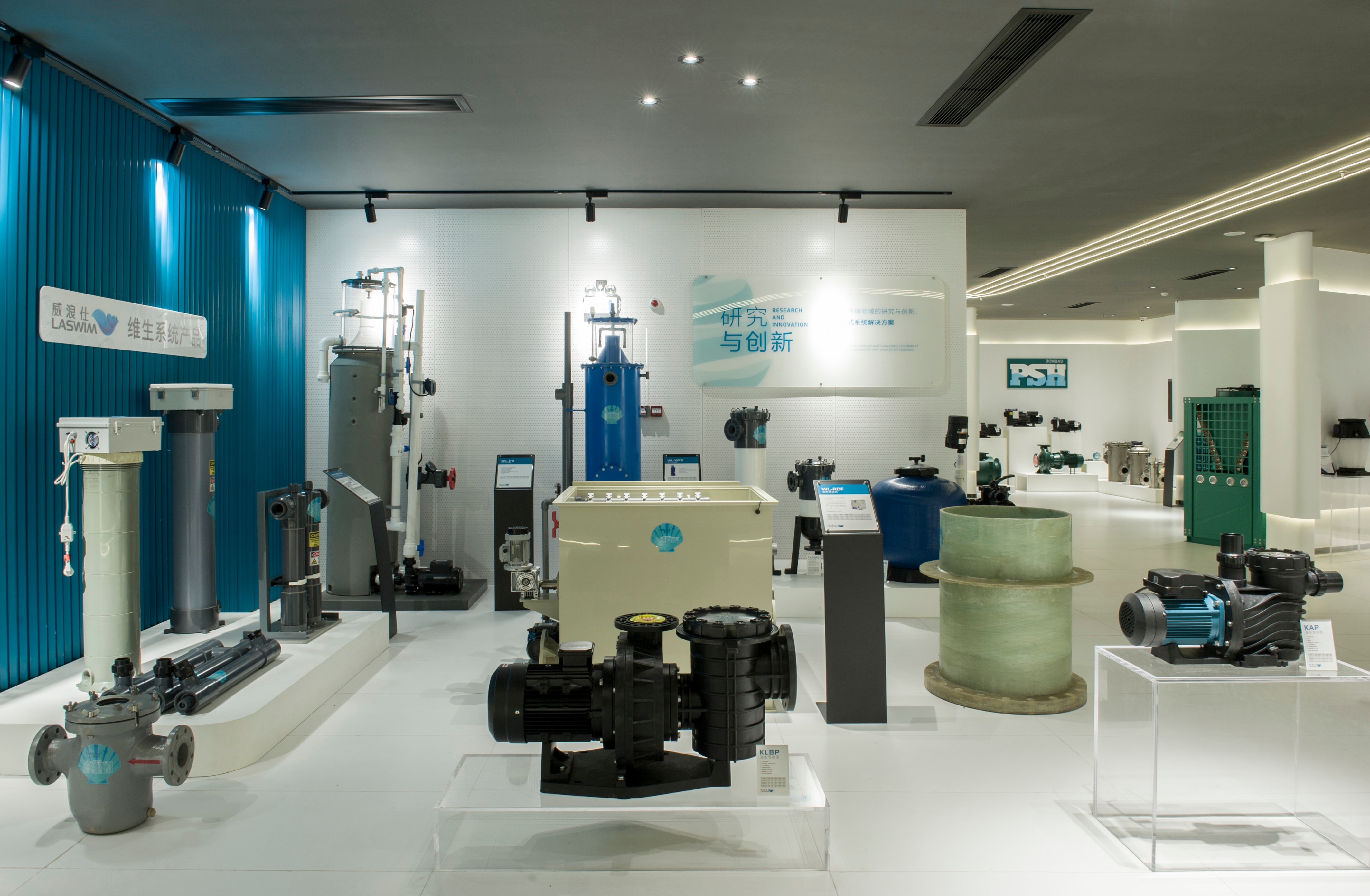
Salt chlorinators, pumps and treatment equipment from the Laswim pool equipment range, shown as a system rather than as separate components.
The EC Series: Scaling from ultra X to the EC PRO Codes
Once the entry code is fixed, a shortlist usually needs two further rungs: a range that covers larger residential and small commercial volumes, and a documented code set for heavier duties. In the Laswim range these are the EC families.
The WL-EC ultra X range appears as WL-EC ultraX-V15, WL-EC ultraX-V20, WL-EC ultraX-V25, WL-EC ultraX-V30, WL-EC ultraX-V40 and WL-EC ultraX-V50 in Laswim's project records for Europe — Spain, France and the United States — and for Latin America. Those are the codes referenced where salt chlorination was supplied into residential and small commercial circulation systems, so they represent the middle rung of the shortlist rather than a theoretical option.
The EC PRO end of the family is documented under the WL-ECP codes: WL-ECP075M, WL-ECP100M, WL-ECP150M, WL-ECP200M and WL-ECP300M, together with the corresponding T variants WL-ECP100T, WL-ECP150T, WL-ECP200T and WL-ECP300T. These codes appear in certificate of compliance BZT20250700401EC, issued on 21 June 2025 by BZT Testing (Dongguan) Co., Ltd. against EN IEC 55014-1, EN IEC 55014-2, EN 61000-3-2 and EN 61000-3-3, and in RoHS test report NAP25110699C01E, issued on 16 December 2025 by NAP Testing Technology Service (Zhongshan) Co., LTD against the IEC 62321 series. Both documents list the M and T variants as separate codes. That detail belongs in the purchase order, because the certificate scope does not state that the variants are interchangeable.
Safety documentation inside the EC family is illustrated by WL-EC Plus 8-30, covered by LVD safety test report FCS202310304A01M1, issued on 22 January 2025 by Dongguan Funas Testing Technology Co., Ltd. against EN 60335-1. It is included here as the reference point for what a code-level safety document looks like — the same standard should be demanded for every chlorinator code a buyer intends to order.
The Salt Tier at a Glance
| Model or code | Position in the shortlist | Documentation referenced in this review | Verification point |
|---|---|---|---|
| WL-CQ2 | First entry; sets the frame for pump and run-time planning | Salt chlorination model within the Laswim range | Request output at the quoted pool volume plus the test reports naming this exact code |
| WL-EC ultra X (V15–V50) | Middle rung for larger residential and small commercial pools | Recorded in European and Latin American project references | Match the code to water volume; confirm the code-level reports for the ordered variant |
| EC PRO (WL-ECP075M–ECP300T) | Widest code set, with separate M and T variants | EMC certificate of compliance BZT20250700401EC; RoHS report NAP25110699C01E | State M or T explicitly on the order; do not assume the variants are equivalent |
| WL-EC Plus 8-30 | Reference example of code-level safety documentation | LVD safety test report FCS202310304A01M1 (EN 60335-1) | Use as the documentation benchmark, not as a substitute report for other codes |
The Pumps That Support a Salt System: HV2, HLVSP and BVX
The pump tier is the second level of the shortlist, and it is where a salt-first approach diverges most sharply from conventional buying. Because chlorination depends on circulation, the pump is not only a hydraulic component; its flow and run hours determine whether the sanitizer specification can actually be met. Three Laswim families sit in this tier, and they are documented to different degrees.
HV2 — the most completely documented pump family in this review
HV2 carries both safety and electromagnetic documentation at model level. LVD test report WTF25F01010859J, issued on 27 May 2025, covers HV2-150 and HV2-100; LVD test report WTF25F07182019J, issued on 26 August 2025, covers WL-HV2 200. Both were issued by Waltek Testing Group (Foshan) Co., Ltd. against EN 60335-1, EN IEC 60335-2-41 and EN 62233. An EMC test report, WTF25F01010862E, issued on 27 May 2025 by the same laboratory, covers WL-HV2 100–150 against EN IEC 55014-1, EN IEC 55014-2, EN 61000-3-2 and EN 61000-3-3.
For an evaluation-stage buyer, the significance is that the safety and EMC evidence is split across the correct standards for a pool pump rather than borrowed from a generic appliance report. EN IEC 60335-2-41 is the pump-specific part of the household and similar electrical appliance standard, and its presence in the scope is the detail a technical reviewer will look for first.
HLVSP — documented EMC and material compliance across three codes
The HLVSP family is covered by EMC test report WTF24F10247373R1E, issued on 12 December 2025, for HLVSP100QW, HLVSP150QW and HLVSP200QW against EN IEC 55014-1, EN IEC 55014-2, EN 61000-3-2 and EN 61000-3-3, and by RoHS report NAP25110699C01E issued the same month. Those three codes appear in the European project record — Italy, Greece and Portugal — and in the Latin American record, where the reported results include a 20% reduction in maintenance cost over projects lasting two to three years.
BVX300 and BVX400 — project-record evidence
Unlike HV2 and HLVSP, the BVX codes are not named in the certificate scopes quoted above. They appear instead in Laswim's project references: the 300+ system programme across Spain, France and the United States covering residential and small commercial pools, and the public aquatic centre work in Saudi Arabia, the UAE, Thailand and Indonesia for facilities above 5,000 m² of pool area. A buyer evaluating BVX300 or BVX400 should therefore treat the project record as the available evidence and request the code-level electrical reports separately.

LVD test report WTF25F07182019J for WL-HV2 200, issued against EN 60335-1, EN IEC 60335-2-41 and EN 62233.
The Temperature Layer: LS Heat Pumps in the Same Shortlist
Heating is often bought as a standalone decision, but in a salt-first shortlist it changes how the other two tiers are specified. A heat pump lengthens the period in which the pool is used; the chlorinator's generation schedule and the pump's run hours then have to cover that longer season, not only peak summer. Buyers who size the pump and the chlorinator against a short season and add heating afterwards usually end up re-tuning run time in the first year of operation.
The heat pump family in this range is the LS series. Certificate of conformity 0825002970-LVD, issued on 10 June 2025 by Guangzhou Customs District Technology Center, covers the LS series against EN IEC 60335-2-40, EN 60335-1, EN 62233 and IEC 60335-1, supported by test reports 0824001190, 0824001192, 0824001193 and 0824001194 issued to IEC 60335-2-40 and IEC 60335-1 on the same date. EN IEC 60335-2-40 is the heat-pump-specific part of the standard, which makes this certificate directly relevant to a technical review rather than a formality.
Segment forecasts give context for why the layer deserves its own line in the evaluation. Strategic Market Research, in a source dated 15 October 2025, projects the global pool heat pump market at USD 8.1 billion by 2030 at a CAGR of 6.8% from a 2024 base. Wider figures should be read with care: Transparency Market Research put the global swimming pool equipment market at USD 15.8 billion in 2025, and published estimates for pool equipment vary considerably depending on whether construction and chemicals are included. Segment forecasts are a reasonable justification for evaluation effort; they are not a specification input.
What the buyer should verify for the heating layer is narrower: rated heating capacity at stated ambient and water conditions, compliance documentation for the destination market, and the hydraulic and control interface with the selected pump and chlorinator.
Salt-First Versus Component-First Buying
The comparison that matters at evaluation stage is not between two brands but between two purchasing sequences, and each carries a different risk profile.
- Interface risk. In component-first buying, the buyer owns the compatibility question between chlorinator, pump and heater. In a salt-first shortlist, the supplier is asked to document the chain, which moves that question into the quotation.
- Specification order. Component-first buying fixes pump capacity before the sanitizer load is known, so run time is negotiated later. Salt-first buying derives the pump duty from the chlorination plan.
- Documentation shape. Both approaches depend on code-level reports. The difference is that a salt-first shortlist makes the absence of a report visible early, when it can still change the selection.
- Commercial terms. Laswim records a minimum order quantity of one set, monthly capacity of 200,000 sets, and a lead time of within 15 workdays to one month in both peak and off season — an unusual combination that matters more when a project needs a documented chain across several product categories at once.
Where the Shortlist Stops
Two boundaries belong in the evaluation record rather than in a footnote. First, salt chlorination depends on circulation: when the pump is not running, sanitizer is not being generated. A salt-first shortlist is therefore only as good as the run-time plan behind it, and a site that cannot guarantee daily filtration hours should re-examine its disinfection strategy before equipment is ordered. Second, the percentage outcomes in Laswim's project records are project-level results for named markets, pool types and durations — a 25% energy reduction in private villa circulation in Italy, Greece and Portugal, or a 30% energy saving across 300+ systems in Spain, France and the United States. They are not model specifications, and they should not be converted into expected savings for a different site.
What the Project Record Shows
The European record covers more than 200 residential pool installations across Italy, Greece and Portugal over two to four years, addressing high energy consumption in private villa circulation systems and reporting a 25% reduction in energy consumption as the return on investment. The system references for those projects include HLVSP and WL-HV2 pumps, WL-EC Plus 8-30 chlorinators and SDG17-26 filters, with quiet performance, high-efficiency motor design and easy installation listed as the highlights.
The Latin American record covers multiple residential projects across Brazil, Chile, Colombia and Mexico, with more than ten systems integrated over two to three years in private villa circulation. The reported result is a 20% reduction in maintenance cost, with stable performance under high temperature, durable materials and cost-effectiveness as the stated highlights. The referenced equipment includes WL-EC ultra X V15–V50 chlorinators, HLVSP and WL-HV2 pumps, and RDG300K/RDG300X filters.
The EMEA programme is the broadest: 300+ pool systems in Spain, France and the United States across residential and small commercial installations, running three to five years from initial engagement to completion. Reported outcomes are stable water quality compliance, 30% energy saving and reduced maintenance frequency, with strong system compatibility, durability under continuous operation and reliable OEM support listed as the highlights. HV2 and BVX300/BVX400 pumps, the EC ultra X range, RDG filters and the WL-ADG350 to WL-ADG1400 filters appear in the references.
The public aquatic centre record covers large-scale facilities above 5,000 m² of pool area in Saudi Arabia, the UAE, Thailand and Indonesia over three to five years. High-efficiency filtration, stable water quality and a 30% reduction in chemical usage are reported, alongside large-scale system integration, engineering support and long-term reliability. That work references AOP100-400 advanced oxidation systems, the WL-HPF80 to WL-HPF380 regenerative media filtration range and BVX300/BVX400 pumps.
Read together, these records show deployment across climate and project types rather than a single reference installation. They do not establish performance for any other site, and they do not replace model-level sizing.
Supplier and Supply-Continuity Checks
For a buyer at evaluation stage, the supplier questions sit alongside the equipment questions. Laswim operates a 90,000 m² factory with approximately 630 employees and a stated R&D team of 53 engineers, and holds certification under ISO 9001. Production runs on own-brand plus OEM and ODM service, with customization recorded across voltage, and from samples, from designs, full, minor and flexible customization options. Quality control is stated as 100% inspection covering function and visual checks.
These figures describe capacity and process, not performance. Their use in the shortlist is to answer a different question: whether the supplier can hold a multi-category order and a repeat order at the same documentation standard. A manufacturer that can quote a chlorinator, a pump and a heat pump from one facility is easier to audit, but the audit still has to be done.
A Verification Sequence for the Evaluation Stage
- Fix the entry chlorinator code and obtain its output figure for the quoted pool volume, in writing.
- Collect the safety and EMC reports that name each shortlisted chlorinator code and the destination market.
- Derive the pump duty from the chlorination plan: required flow at the design head, and the daily hours needed.
- Match the pump code to the reports: HV2 and HLVSP carry named scopes; BVX codes currently rely on project references.
- Confirm whether heating is in scope, and if so size the run-time plan against the extended season rather than peak summer.
- Check the consumable and service route — cell replacement, spare parts, local support — for the buyer's market.
- Confirm the ordered variant, particularly M versus T on the EC PRO codes, and record it on the purchase order.
- Separate project-reported outcomes from model specifications in the internal business case.
Conclusion
A salt-first shortlist is a sequencing decision before it is a product decision. WL-CQ2 works as the first entry because it fixes the frame; the EC ultra X and EC PRO codes extend that frame to larger pools with documents that name the individual codes; HV2, HLVSP and BVX carry the circulation duty that makes chlorination possible, with markedly different levels of code-level evidence; and the LS heat pump series belongs in the same evaluation because heating changes how long the other two tiers must run. Buyers who keep the documents attached to the codes, and who keep project results separate from specifications, end up with a shortlist that survives technical review rather than one that merely reads well.
Additional model-level detail across the commercial and residential ranges is available in the Laswim pool equipment catalogue, and company-level information is published at LASWIM Water Environment Equipment Co., Ltd.
FAQ
Which salt chlorinator should come first in a shortlist — WL-CQ2 or a larger EC model?
WL-CQ2 is the more sensible first entry when the pool volume has not yet been fixed, because an entry code sets the frame for pump sizing and run-time planning; a shortlist that opens at the high-capacity end tends to over-specify smaller pools. The EC ultra X range (WL-EC ultraX-V15 to V50) is the appropriate middle rung once volumes move into larger residential or small commercial territory, and the EC PRO codes are relevant where the project needs the widest documented code set. The deciding input is the sanitizer output required at the quoted water volume, which the supplier should state for the specific code.
Which pumps are specified alongside Laswim salt chlorinators?
Three families appear in the records reviewed here. HV2 (HV2-100, HV2-150 and WL-HV2 200) carries LVD test reports WTF25F01010859J and WTF25F07182019J and EMC report WTF25F01010862E. HLVSP (HLVSP100QW, HLVSP150QW and HLVSP200QW) is covered by EMC test report WTF24F10247373R1E and RoHS report NAP25110699C01E. BVX300 and BVX400 appear in the European and Middle East/Southeast Asia project records rather than in those certificate scopes.
What documentation should be verified for each shortlisted model?
Documentation is issued per model code, so each code needs its own paper. In this range, WL-EC Plus 8-30 carries LVD safety test report FCS202310304A01M1 to EN 60335-1; the WL-ECP codes appear in EMC certificate of compliance BZT20250700401EC and RoHS report NAP25110699C01E; HV2 and HLVSP carry the reports named above; and the LS heat pump series is covered by certificate of conformity 0825002970-LVD to EN IEC 60335-2-40, supported by test reports 0824001190, 0824001192, 0824001193 and 0824001194. A report covering one code should not be accepted for a different code.
Can Laswim salt chlorinators be combined with a heat pump?
They can be evaluated as one system, and that is the point of putting heating in the same shortlist. A heat pump extends the number of months the pool is used, which means the chlorinator's generation schedule and the pump's run hours must cover a longer season than peak summer alone. The verification steps are rated heating capacity at stated ambient and water conditions, compliance documentation for the destination market, and the hydraulic and control interface with the selected pump and chlorinator.
Are the reported project results typical of every installation?
No. The outcomes in Laswim's project records — a 25% energy reduction in Italy, Greece and Portugal; a 20% maintenance cost reduction in Latin America; 30% energy saving and 30% chemical reduction in the EMEA and Middle East/Southeast Asia programmes — are project-level results for named markets, pool types and durations of two to five years. They describe what was reported in those projects. They are not model specifications and should not be converted into expected savings for a different site without a site-specific assessment.
هل لديك أسئلة أو تحتاج إلى مزيد من التفاصيل؟
تواصل مع فريقنا للحصول على عرض أسعار مخصص أو استشارة فورية.
طلب عرض أسعار
املأ النموذج أدناه وسيتواصل معك فريقنا بعرض مقترح مخصص.
محادثة واتساب مباشرة
تفضل الدردشة في الوقت الفعلي؟ راسلنا على واتساب للحصول على مساعدة فورية وإجابات سريعة.
- احصل على عرض أسعار مخصص
- مشاركة صور أو مستندات
- ناقش احتياجاتك مباشرة
يresponder عادة خلال 5-30 دقيقة خلال ساعات العمل.