
Bulk Custom Glass Lamp Shade Orders: An OEM Procurement FAQ
Bulk Custom Glass Lamp Shade Orders: An OEM Procurement FAQ
Bulk custom glass lamp shade orders rarely fail on price. They fail on four technical points that are settled long before the purchase order is signed: whether the specified glass survives the fixture's thermal cycle, whether the G9 thread actually engages the holder, whether the decorative finish survives packing and cleaning, and whether buyer and supplier share one written definition of an acceptable unit. Each of those points can be answered with a number, a tolerance or a named inspection step — and each is regularly left as an adjective instead.
This FAQ works through those four points in the order a lighting OEM, importer or brand owner meets them. The reference manufacturer is Jingxin Glassware (Yancheng Jingxin Glassware Co., Ltd.), a glass manufacturer founded in 1999 and based in Yancheng, Jiangsu Province. Jingxin operates a 4,500 m² production base with more than 100 employees, an annual output of 25,000,000 sets, and separate production lines for soda-lime and borosilicate glass — a detail that matters here because the material question and the finish question are resolved on the same shop floor rather than through two subcontractors.
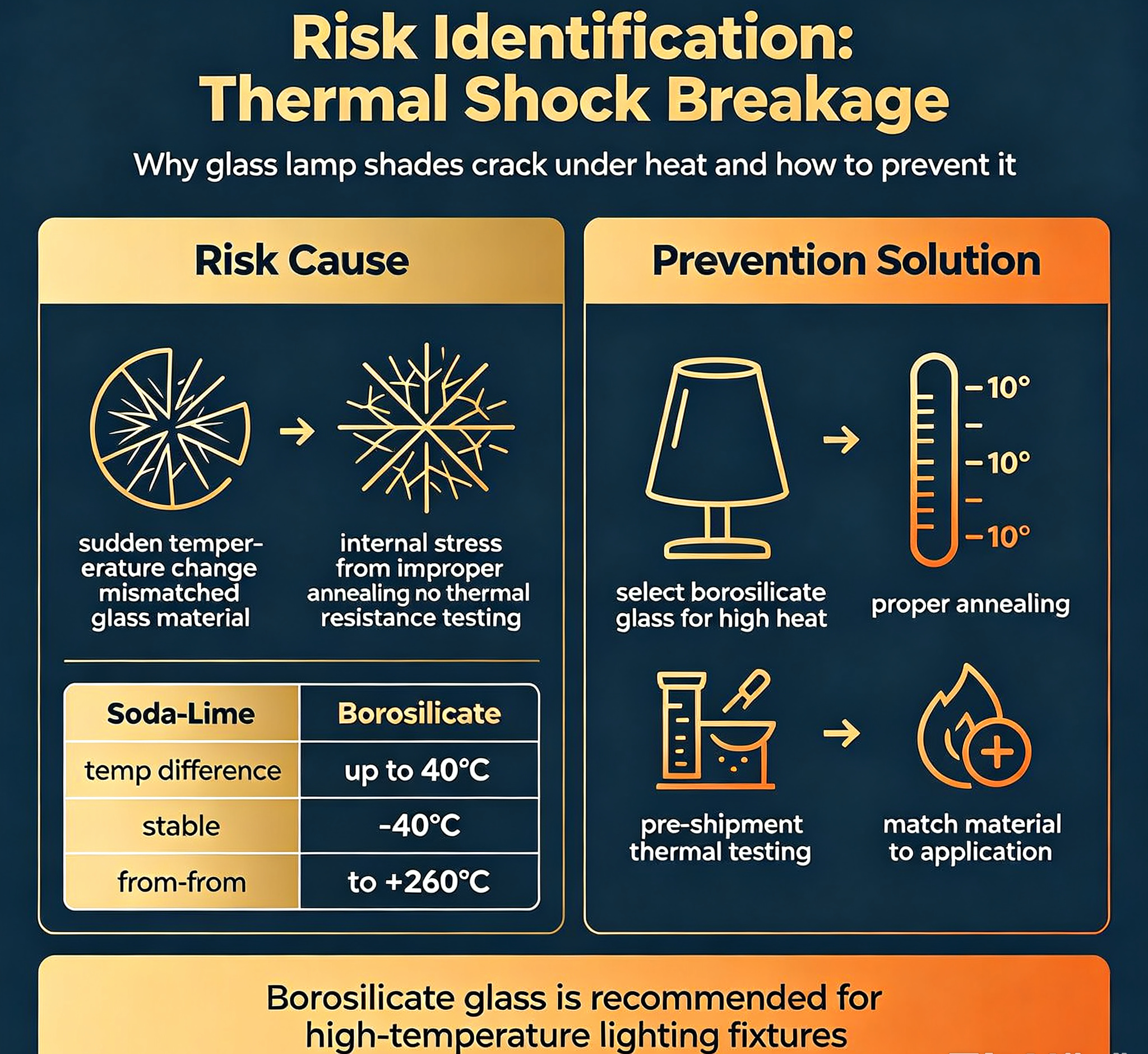
Thermal shock and mechanical breakage are the two failure modes that a bulk lighting-glass specification has to address before production starts.
Where a bulk lighting-glass order actually gets decided
A custom glassware programme passes through two distinct stages. In evaluation, the buyer compares material, light transmission, fit options and finishes, usually across samples from two or three suppliers. In execution, the same buyer has to convert those preferences into dimensional tolerances, inspection points, packaging requirements and acceptance language.
The gap between the two stages is where most disputes begin. A shade approved as "a warm opal globe with a G9 fitting" is not yet a specification, because it contains no measurable limits. When the container arrives, that phrase cannot decide whether a 1.5 mm opening deviation is a defect, whether a faint print edge is a reject, or whether a chipped rim on six units out of two thousand is normal handling loss or a packaging failure.
Four specification items carry most of the risk, and all four can be written down in a single page attached to the purchase order:
- Thermal band — the glass type, its stated service ceiling, and the fixture's measured operating temperature.
- Interface dimension — the fitter opening or thread nominal, plus the tolerance that the chosen production process can actually hold.
- Finish definition — the technique, the approved reference sample, and the durability check performed on the batch.
- Acceptance procedure — what is inspected before shipment, how it is packed, and what the buyer must do within the claim window.
Thermal shock: the material decision that precedes the design
Thermal shock occurs when one part of a glass shade heats or cools faster than another. The temperature difference produces differential expansion, internal stress accumulates, and the glass cracks. Resistance therefore depends primarily on the coefficient of thermal expansion, not on how thick the wall looks.
Soda-lime glass has a coefficient of thermal expansion of roughly 9 × 10⁻⁶/°C and typically tolerates temperature differences of about 40°C, with a practical service ceiling around 120°C. Borosilicate glass, often referenced as Type 3.3, has a coefficient of about 3.3 × 10⁻⁶/°C — approximately one third — and withstands rapid temperature change between -40°C and +260°C. Jingxin's material documentation places borosilicate thermal shock resistance at three to five times that of soda-lime.
For the buyer this is a fixture decision rather than a taste decision. LED sources with modest heat output are generally well served by soda-lime, which delivers good optical clarity at lower cost. Incandescent and halogen sources, enclosed fittings, outdoor installations with wide day-to-night swings, and industrial or hazardous-area fixtures call for borosilicate.
The Explosion-Proof Borosilicate Glass Lamp Shade (JX1830) shows where that logic terminates in a real specification: 6.0–10.0 mm uniform wall thickness, an IK10 impact rating, and a stated thermal shock range of -40°C to +260°C. Those are the figures that belong in a purchase order. The phrase "heat resistant" belongs nowhere in one.
Boundary condition. A material upgrade does not repair a faulty thermal design. If a fixture traps heat around the lamp, or directs a cold draught or water spray onto a hot shade, borosilicate increases the margin but does not remove the cause. Specify the material against a measured operating temperature, not against the worst case a supplier is willing to describe.
G9 thread fit: a tolerance question, not an intent question
G9 fit failures usually arrive as a complaint about supplier error and are more often a missing tolerance. A G9 holder interface has a nominal dimension. The shade's mating feature must be specified as that nominal plus an acceptable range — and the range has to match the manufacturing process that will produce the order.
Jingxin's two production routes behave differently in this respect. Hand-blown shades are individually formed by skilled artisans and typically hold ±1–3 mm, with natural variation in wall and profile that is part of the character of the piece. Machine-pressed shades are formed in precision moulds and typically hold ±0.5 mm with higher batch-to-batch uniformity.
That difference sets the purchasing rule. Where the G9 thread is a functional interface on a high-volume programme, machine-pressed or tightly gauged production is the lower-risk route. Where the shade is decorative and the thread engagement is forgiving, hand-blown construction such as the Blown Glass Lampshade with G9 Thread (JX1184) provides the profile and surface character that moulded glass cannot reproduce, and opal glass is among the options available in that line.
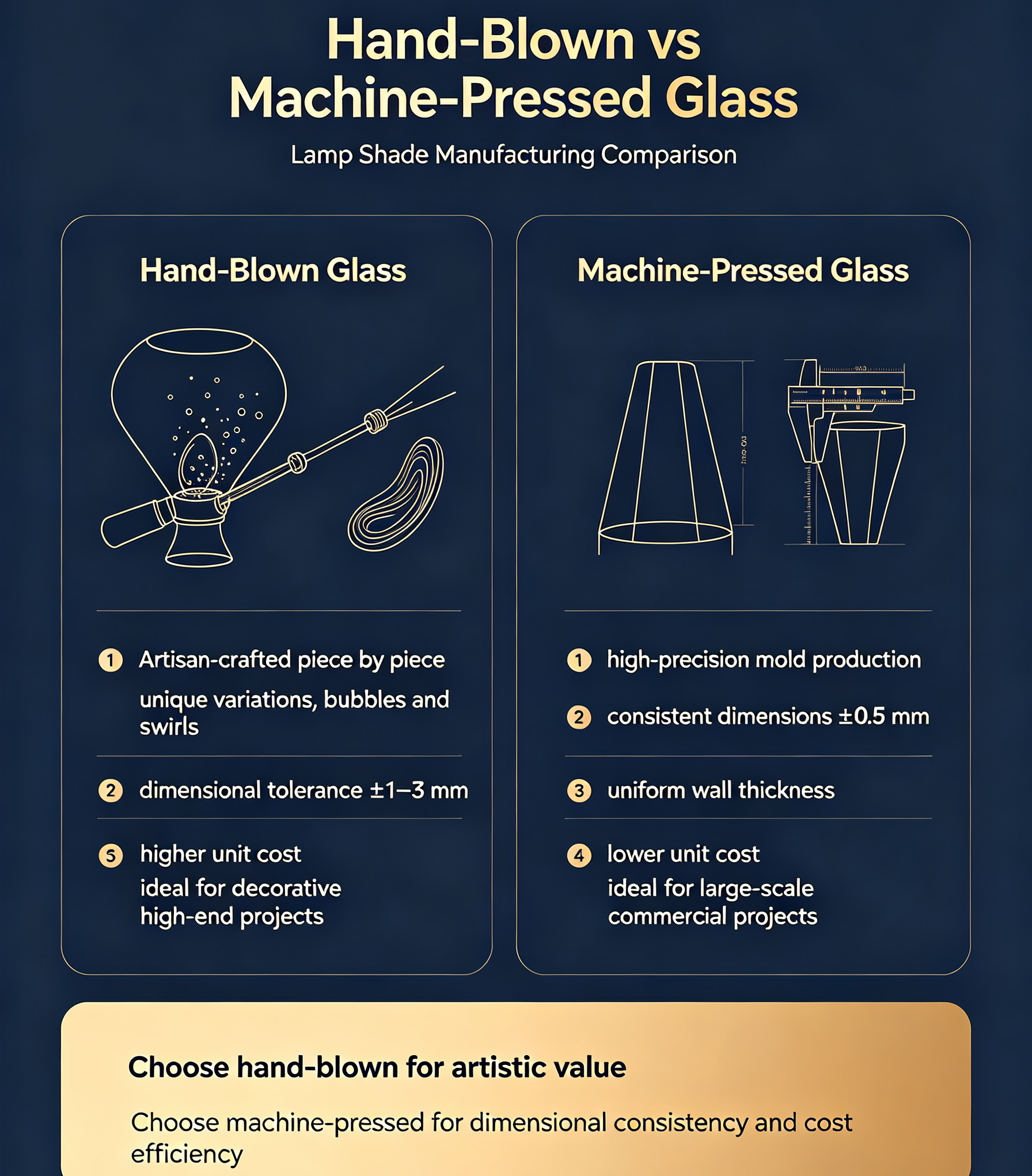
Production route determines the tolerance a G9 interface can actually be held to: hand-blown work typically ±1–3 mm, machine-pressed work typically ±0.5 mm.
Verification follows three steps, and skipping any one of them is what turns a fit issue into a container-level dispute:
- Confirm the fitter opening nominal and tolerance in writing before production begins, including the holder type — E27, E14, G9 or a custom interface.
- Approve a pre-production sample and retain it as the reference unit for the life of the programme.
- Measure the first article from mass production against that retained sample, not against the drawing alone.
When a mismatch does reach the buyer, the response depends on magnitude. Deviations of roughly 1 mm or less can sometimes be resolved with a fitter adapter or spacer. Larger deviations are a replacement matter under the warranty terms. Forcing a shade onto an incompatible holder is not a fix: it introduces the mechanical stress that later presents as a crack at the rim, and the failure is then attributed to the glass rather than to the installation.
Opal or clear borosilicate: a light-output decision
The opal-versus-clear question is normally argued on appearance and should be argued on transmission. Opal glass carries opacifying agents mixed through the full body of the glass, so diffusion is a material property that cannot wear off. It transmits roughly 45–65% of light, hides the lamp completely, and removes the bright spot that clear glass produces. Clear borosilicate transmits roughly 92–95% and keeps the source visible.
Surface-frosted glass sits between the two at roughly 70–82% transmission, but its diffusion layer is a surface treatment rather than a body property, so it can wear or show handling marks across a long service life.
The decision rule is straightforward. Where the shade is itself the ambient light source — hospitality interiors, retail displays, decorative pendants — opal is the appropriate choice. Where the shade guards a task or display fitting and output matters more than glare control, clear borosilicate is appropriate, and its thermal shock resistance is an additional benefit rather than the reason for the choice.
The Opal White Glass Globe Lamp Shade (JX1004) illustrates the ambient case. In 2015 Jingxin designed and produced opal white globe shades with a French client for a permanent wall installation at Galeries Lafayette in Paris, using ultra-thick glass, a frosted matte finish and solid opal body colouring to keep light quality consistent across the whole run. Whether a given project needs that level of construction is a separate commercial judgement. The durable point is that opal diffusion is a body property, so it does not degrade with cleaning — which is what a hotel or department-store maintenance team actually depends on.
Silk-screen finish durability: process control, not ink choice
A silk-screen print on a glass shade fails in three ways: it lifts, it fades, or it scratches. All three trace back to process control rather than to a single ink specification. Adhesion depends on how the glass surface is prepared before printing, on controlled curing and drying, and on whether the printed batch is checked for adhesion, colour accuracy and durability rather than only for how it looks on the line.
Jingxin runs acid pickling, sandblasting, silk-screen printing, stamping, decalcomania and spray painting in-house on dedicated surface-processing lines, and multiple techniques can be combined on a single item. Inspection is layered: in-process surface quality inspection at each finishing stage, finished-product visual inspection for consistency and defect-free appearance, and batch-level checks for adhesion, colour accuracy and durability.
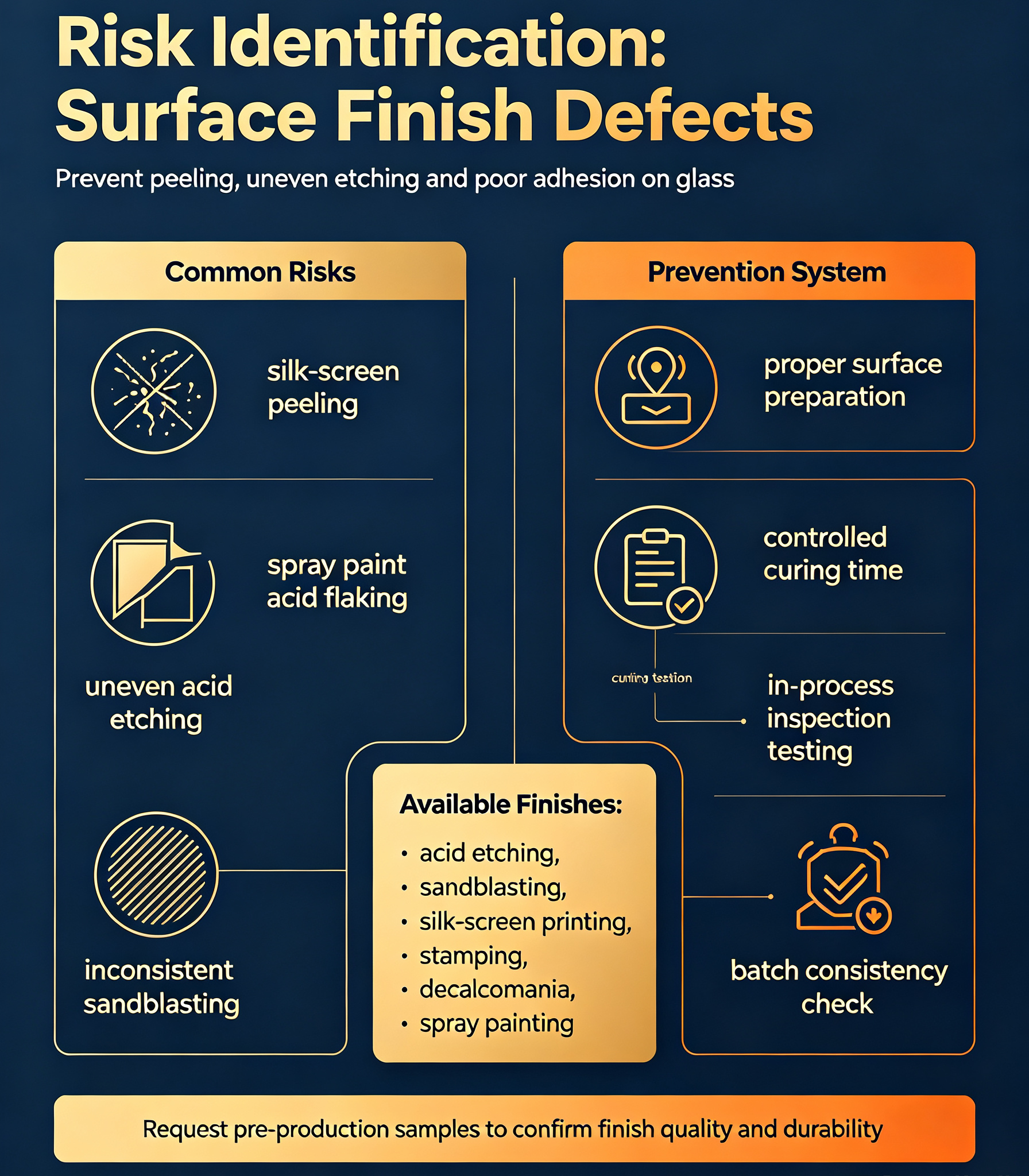
Printed and coated finishes fail when surface preparation, curing or batch-level adhesion checking is left informal — not because of a single ink choice.
Buyers can reduce the risk with three verification points. Approve the finish on a production-representative sample rather than a hand-prepared mock-up. Ask which adhesion and colour checks are performed on the batch and file the answer alongside the purchase order. For a brand mark that carries real commercial weight, request third-party laboratory testing of the finish instead of relying on visual inspection.
Cleaning restriction. Finish durability also depends on the cleaning regime after installation. Ammonia- or alcohol-based glass cleaners should not be used on printed, painted or decal finishes, and scouring pads should not be used on frosted or opal surfaces. Where a venue cleans shades weekly, that instruction belongs in the maintenance pack, not only in the supplier's catalogue.
Shipping damage and acceptance criteria
Acceptance is the section most often left vague and the one that decides who pays when a pallet arrives with broken rims. A workable acceptance clause covers four things: what is inspected before shipment, how the goods are packed, which terms govern transfer, and what the buyer must do on arrival.
Before shipment, Jingxin performs 100% pre-shipment inspection at its own facility, with third-party inspection by SGS available on request. Packaging is built around the fragility of the item: multi-layer protection with bubble wrap, foam inserts and corrugated dividers, palletised loading with stretch film and strapping for container shipments, and a moisture-barrier inner lining in export containers. Pre-shipment packaging verification confirms the goods are secured, and third-party loading supervision can be arranged for high-value consignments.
Commercial terms are stated plainly rather than negotiated case by case. MOQ is 500 pieces for hand-made glass and 2,000 pieces for machine-made glass, with custom MOQ negotiable for smaller trial orders. Delivery is FOB Shanghai as the primary term, with CIF or EXW available on request. Payment is 30% T/T deposit on order confirmation and 70% T/T before shipment, against a copy of the bill of lading or after pre-shipment inspection approval; other terms, including L/C, are available for qualified buyers. Sample lead time is 5–7 days after artwork and specification confirmation, and mass production runs 20–30 days after sample approval.
On arrival, the buyer's obligations are simple and time-sensitive. Inspect before the container is fully destuffed and photograph any damage together with the packaging that failed. Report with photographs and quantities. Breakage is handled by replacement or credit under the warranty terms, and light surface scratches are assessed for polishing before replacement is considered. Reporting late, or discarding the packaging before photographing it, weakens a claim more than any single clause in the contract.
For a buyer writing an acceptance section for the first time, four elements are the minimum: measurable dimensional limits with the agreed tolerance, the approved finish plus its reference sample, explicit limits on chips and cracks, and a defined claim window. Language such as "good quality glass" transfers no risk to either party and resolves nothing when it matters.
Cleaning and handling: the cheapest durability lever available
Most premature shade failures reported as quality defects are handling events. The cleaning procedure that protects a glass shade is short. Switch the fixture off and let the shade cool to room temperature. Remove it with both hands. Wash in warm water with mild dish soap and a soft microfiber cloth. Rinse and dry immediately with a lint-free cloth to avoid water spotting, then reinstall once fully dry.
Four prohibitions do most of the work:
- Do not immerse a warm shade in hot water — the thermal shock can crack it, even in borosilicate.
- Do not use abrasive pads or powders on frosted or opal surfaces, which are the finishes most easily dulled.
- Do not use ammonia- or alcohol-based cleaners on printed, painted or decal surfaces.
- Do not leave shades soaking for long periods, because water can penetrate fittings and mounting hardware.
For hospitality and retail programmes, these instructions are worth issuing to the maintenance contractor rather than storing in a project file. A shade that is cleaned correctly lasts the life of the fixture; a shade cleaned with an abrasive pad on a weekly rota can lose its finish within a year.
Product reference for a bulk glass lamp shade programme
The four lamp shade lines most often specified in bulk lighting-glass orders differ in material and construction rather than in decorative style. The table below maps each to the requirement it addresses.
| Product | Model | Construction and material | Requirement it addresses |
|---|---|---|---|
| Blown Glass Lampshade with G9 Thread | JX1184 | Hand-blown construction with a G9 thread; opal glass among the available options | Decorative pendants and ambient fittings where profile and surface character carry the design |
| Double Wall Glass G9 Light Globe | JX1416 | Borosilicate glass, double-wall construction, G9 interface | Fixtures with meaningful heat output or handling exposure, where thermal margin matters |
| Opal White Glass Globe Lamp Shade | JX1004 | Solid opal white glass, ultra-thick construction, frosted matte finish | Glare-free ambient lighting with permanent body diffusion for retail and hospitality interiors |
| Explosion-Proof Borosilicate Glass Lamp Shade | JX1830 | Borosilicate, 6.0–10.0 mm wall, IK10 impact rating, -40°C to +260°C | Industrial, hazardous-area and high-impact installations with wide thermal swings |
These are reference points, not a closed catalogue. Jingxin also supplies pressed borosilicate signal shades, ribbed pendant shades, cylindrical tube shades and custom-moulded profiles, and custom mould creation for unique shapes is part of the OEM/ODM scope. The selection question for a buyer is always which construction satisfies the fixture's thermal, optical and handling requirements at the lowest reasonable cost — not which product line sounds most advanced.
Frequently asked questions
What thermal shock range should a bulk glass lamp shade be specified to?
Specify against the fixture, not against a catalogue maximum. Soda-lime glass typically tolerates a temperature difference of about 40°C and has a practical service ceiling near 120°C. Borosilicate glass, referenced as Type 3.3, withstands rapid change between -40°C and +260°C because its coefficient of thermal expansion is roughly one third that of soda-lime. The workable sequence is to measure the fixture's operating temperature, add the cleaning or environmental swing the shade will actually see, and then select the glass type that covers that total with margin. A shade specified to a wider range than the fixture needs is simply a higher unit cost.
How should G9 thread fit be verified before a bulk order?
Verification rests on a written dimension, an approved reference sample and a first-article measurement. Record the fitter opening nominal and tolerance in the purchase order. Approve a pre-production sample and keep it as the reference unit for the programme. Measure the first unit off mass production against that sample. The tolerance expectation should follow the production route: hand-blown shades typically hold ±1–3 mm, machine-pressed shades typically hold ±0.5 mm. If a deviation does arrive, roughly 1 mm or less can sometimes be absorbed by a fitter adapter or spacer, while larger deviations are a replacement matter. Forcing a shade onto a holder creates mechanical stress that later appears as a rim crack.
Should an OEM choose opal white or clear borosilicate for a pendant range?
The choice follows the function of the shade in the fixture. Opal white glass contains opacifying agents distributed through the full body, so diffusion is permanent and cannot wear off; it transmits roughly 45–65% of light, hides the lamp completely and removes visible hot spots. Clear borosilicate transmits roughly 92–95% and keeps the source visible, with thermal shock resistance as a further advantage. Where the shade is the ambient light source — hospitality, retail, decorative pendants — opal is the appropriate specification. Where the shade guards a task or display fitting and output is the priority, clear borosilicate is appropriate. Surface-frosted glass, at roughly 70–82% transmission, sits between them but relies on a surface treatment rather than a body property.
How is silk-screen durability on glass actually checked?
Durability is established by process control plus batch-level testing, not by an ink specification alone. The relevant controls are surface preparation before printing, controlled curing and drying, in-process inspection at each finishing stage, and finished-product checks for adhesion, colour accuracy and durability. Jingxin applies in-process surface quality inspection during finishing and inspects each batch for these three properties rather than for appearance only. Buyers should approve the finish on a production-representative sample, ask which adhesion and colour checks are run on the batch, and request third-party laboratory testing where the printed mark carries brand weight. After installation, ammonia- and alcohol-based cleaners should be kept away from printed, painted and decal finishes.
What should a buyer do when a container of glass shades arrives damaged?
Inspect before the container is fully destuffed, photograph the damaged units together with the packaging that failed, and report quantities with the photographs. Breakage is then handled by replacement or credit under the warranty terms, while light surface scratches are assessed for polishing before replacement is considered. Keeping the packaging evidence matters, because a claim that cannot show how the goods were packed is difficult to resolve in either direction. For future orders, the preventive measures are enhanced cushioning and dividers, pre-shipment photographs of packed goods, and third-party loading supervision on high-value consignments.
What this means for a 2026 lighting-glass programme
The procurement picture that emerges is unglamorous and useful. Thermal performance is a material property with published numbers attached, so it can be specified rather than discussed. G9 fit is a tolerance that follows from the production route chosen, so it can be predicted before a mould is made. Finish durability is a function of surface preparation and batch checking, so it can be verified on a sample instead of discovered at installation. Acceptance is a written procedure, so it can be agreed while both parties still have room to negotiate.
Jingxin Glassware's relevant operating facts are these: production since 1999, 100% export orientation, clients in more than 100 countries, 19+ professional certifications including RoHS and SMETA-4P, 16 national patents, and a quality system built on 100% pre-shipment inspection with third-party testing available on request. Those credentials support a supplier evaluation; they do not replace the specification work described above, which remains the buyer's responsibility and the buyer's protection.
OEM/ODM project inquiries — Yancheng Jingxin Glassware Co., Ltd. handles custom glass lamp shade programmes from concept and mould development through finishing, packaging and export documentation. Website: www.cn-glassware.com · Email: jerry@cn-glassware.com
The current glass lamp shade catalogue, including the G9, opal globe, double-wall and explosion-proof lines, can be viewed and downloaded here: Glass Lamp Shades Catalogue — Yancheng Jingxin Glassware Co., Ltd.
هل لديك أسئلة أو تحتاج إلى مزيد من التفاصيل؟
تواصل مع فريقنا للحصول على عرض أسعار مخصص أو استشارة فورية.
طلب عرض أسعار
املأ النموذج أدناه وسيتواصل معك فريقنا بعرض مقترح مخصص.
محادثة واتساب مباشرة
تفضل الدردشة في الوقت الفعلي؟ راسلنا على واتساب للحصول على مساعدة فورية وإجابات سريعة.
- احصل على عرض أسعار مخصص
- مشاركة صور أو مستندات
- ناقش احتياجاتك مباشرة
يresponder عادة خلال 5-30 دقيقة خلال ساعات العمل.