
Butter Cookie Formats for Hotels, Cafés and Instant Retail: A Service-Moment Fit Guide
Butter Cookie Formats for Hotels, Cafés and Instant Retail: A Service-Moment Fit Guide
A butter cookie format is a service decision before it is a packaging decision. The same recipe shipped as a 10 g piece in a sealed can, a 260 g gift tin with a matching bag, or a 680 g share box lands in three different operating environments — a café counter, a hotel amenity tray and a holiday gift programme — each with its own rotation speed, handling routine and handover moment.
SHANGFAN FOOD — the trading name used in this guide for Dongguan Shangfan Food Co., Ltd. — is a butter cookie manufacturer based in Chashan Town, Dongguan, Guangdong, China. The company reports a garden-style factory of more than 10,000 m², an annual output of 3,640 tons, and a range covering butter cookies, lace butter cookies, cranberry oat butter cookies, crispy thin butter cookies and butter shortbread. It lists supermarkets, chain hotels, bakeries, coffee shops, online e-commerce platforms and instant retail platforms among the industries its products serve.
The short answer. 10 g piece formats in nine-piece boxes or thirteen-piece cans fit café counter, hotel welcome and meeting-room service. Tins of 260 g and 760 g fit retail gifting and VIP handover, while 380 g and 384 g tins suit longer-hold listings. The stated shelf life of each format — five to twelve months — is the fastest way to rule a format in or out.

Individually packed floral cookies: inner wrapping supports portion control in hotel and café service and gift-tin assembly in retail.
Why format outranks flavour in channel decisions
Four variables decide whether a butter cookie can be sold or served in a given setting: piece weight (how much a guest receives at one time), pack count and closure (how the unit is opened, closed and displayed), shelf life (how long it can sit in a minibar, on a counter or in a warehouse before it becomes a write-off), and handover presentation (whether it can be handed over as a gift, placed on a tray or listed as a single-serve SKU).
Shangfan Food's application-scenario documentation states that its butter cookie products are ready to eat and require no supporting equipment, and that they can be paired with display shelves and gift boxes. For a hotel or café, that removes capital equipment from the decision and moves the constraint to pack format and stock control. The same documentation sets storage conditions — avoid direct sunlight and store in a cool, well-ventilated place — and requires food-contact packaging compliance with humidity control to prevent the product softening.
Those conditions explain why closure and format are linked. A can can be reclosed between servings, which suits a lounge or meeting-room set-down that stays open across a session; an individually wrapped piece suits a tray or a single-serve listing where the unit must survive handling before it is eaten. Shangfan Food describes its 260 g Butter Floral Cookies tin as holding individually packed servings for mess-free enjoyment — a format statement as much as a packaging one.
The documented format map
The table below organises the formats published in Shangfan Food's product data by the scenario each one fits.
| Format | Documented pack data | Stated shelf life | Scenario it fits | Check before committing |
|---|---|---|---|---|
| Cocoa Butter Thin Crisp Cookies | 10 g per piece; 9 per box or 13 per can | 5 months | Café counter; hotel welcome and meeting-room service | Shortest stated window; plan rotation first |
| Oolong Tea Crisp Cookie | 10 g per piece; 9 per box or 13 per can | 5 months | Tea cafés; afternoon-tea service; specialty retail | Same five-month window |
| Butter Floral Cookies 260 g | 260 g tin, matching gift bag; 8 tins per carton | 6 months | Retail gifting; holiday and VIP programmes | Gift assembly space and labour |
| Butter Floral Cookies 175 g | 175 g × 24 tins per carton | 5 months | Sealed retail shelf; café take-home | Five-month window on a 24-unit carton |
| Cocoa Butter Cookies 175 g | 175 g × 24 tins per carton | 5 months | Retail shelf; base unit for corporate gifting | Same carton build as the floral 175 g |
| Danish Fancy Butter Cookies 380 g | 380 g × 12 tins per carton | 9 months | Longer-hold retail; suites; festive displays | 12-tin carton; reported New Zealand butter ≥ 32% |
| Danish Assorted Cookie Gift Box 760 g | 760 g gift set; two tins | 9 months | Festival gifting; corporate gifts | Two-tin assembly; nine-month window |
| Salted Cheese Butter Cookies 384 g | 32 g × 12 pieces per box | 12 months | Savoury café pairing; lounge and bar service | 32 g portion is a different service motion |
| Dark Chocolate Oat Butter Cookies 90 g | 90 g per box | 8 months | Instant retail; e-commerce single-serve | Small unit; eight-month window |
| Butter Shortbread 680 g | 680 g per box | 6 months | Afternoon-tea sharing; table service | Portioning labour before plating |
Specifications and shelf lives as stated in Shangfan Food's product documentation. Shelf life applies under the stated storage conditions; the published material does not state the validation protocol.

Cocoa Butter Thin Crisp Cookies: 10 g pieces, nine per box or thirteen per can, five-month stated shelf life.
Hotels: welcome, in-room and meeting-room service
Hotel service divides into three moments, and the documented formats split along them. For welcome and in-room amenity service, the relevant unit is the 10 g piece in a nine-piece box: small enough to sit on a tray beside a kettle, robust enough to survive housekeeping handling, and portioned so a guest opens one unit rather than a large pack. Cocoa Butter Thin Crisp Cookies and Oolong Tea Crisp Cookies are both documented at 10 g per piece, with nine pieces per box or thirteen pieces per can.
The thirteen-piece can carries the meeting-room and lounge role. A can closes again between servings, which suits a set-down that stays open across a session, and the fixed piece count gives a defined service yield per unit — easier to cost than an open platter.
For suites, long-stay rooms and VIP handover, the larger tins take the presentation role: Danish Fancy Butter Cookies at 380 g, the 760 g Danish Assorted Cookie Gift Box with two tins, and Butter Floral Cookies at 260 g with its matching gift bag. Shangfan Food positions the assorted set for festivals and holidays and for pairing with coffee, snacks and afternoon tea.
Afternoon-tea service exposes format friction. Butter Shortbread is documented at 680 g per box — a share format that needs portioning before it reaches a plate, converting pack cost into labour cost. A property running high-volume afternoon tea should weigh that against the 10 g formats, which arrive service-ready.
The hotel fit boundary is rotation. The thin crisp formats and the 175 g floral tin carry a five-month stated shelf life, the 260 g gift tin and the 680 g shortbread six months, the Danish formats nine months, and Salted Cheese Butter Cookies twelve. A resort minibar or a seasonal suite with slow rotation is a weaker match for a five-month format than for a nine- or twelve-month one.
Cafés and tea rooms: portion, texture and tea-forward listings
A café buys two products under one category: a counter unit sold with a drink, where the constraint is portion and price point, and a sealed retail unit sold from a shelf, where the constraint is shelf life and pack appeal. The 10 g formats serve the first; the tins serve the second.
For coffee-led service, Cocoa Butter Thin Crisp Cookies give a café a documented flavour story to merchandise — caramel crisp flakes sourced from Europe, macadamia nuts, and high-fat natural cocoa powder from Southeast Asia, in a thin crisp at 10 g per piece. Whether the pairing works on a specific menu is a tasting decision rather than a specification decision, but the format is built for one-piece service.
For tea-led service, Oolong Tea Crisp Cookie is the more direct fit. Its documented formula lists oolong tea powder and matcha powder alongside crushed pecans, whole milk powder and salt, at 10 g per piece in nine-piece boxes or thirteen-piece cans, and coffee shops appear in its stated industry list. A tea-forward biscuit gives a tea room a listing that does not simply repeat a plain butter cookie.
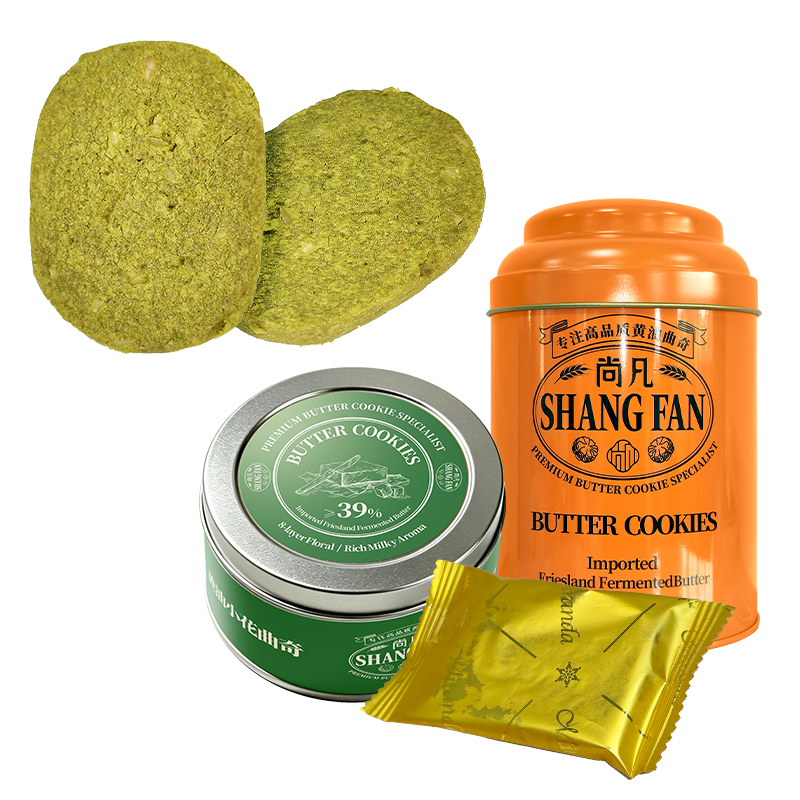
Tea-forward formats suit tea rooms and specialty retail; pack specifications should be confirmed per item before listing.
Shangfan Food's product imagery also includes a Matcha Nut Butter Thin Crisp Cookie. Its piece weight, pack count and shelf life are not stated in the product data reviewed for this guide, so a tea café evaluating it should request the specification sheet and a sample before listing it alongside the documented oolong format.
Savoury service is a separate slot. Salted Cheese Butter Cookies are documented at 32 g per piece, twelve pieces per box (384 g), with a twelve-month stated shelf life and Dutch block cheese as the stated ingredient. A 32 g piece is a different service motion from a 10 g tea biscuit: it reads as a single-serve snack or bar accompaniment, and the longer window makes it the easiest format to hold across a long menu cycle.
The café fit boundary is display and humidity. Storage guidance — cool, well-ventilated, out of direct sunlight — plus humidity control to prevent softening both argue against open counter jars for thin crisp formats. A sealed can or a wrapped piece keeps the product inside its stated conditions; a decorative open bowl does not.
Instant retail and e-commerce: single-serve units and sell-through evidence
Instant retail rewards small units and fast replenishment. The documented single-serve options are the 90 g Dark Chocolate Oat Butter Cookies with an eight-month shelf life and the 10 g nine-piece boxes with five months, while the thirteen-piece cans offer a slightly larger basket unit.
Shangfan Food's case material describes an OEM programme for a large instant e-commerce enterprise. The company reports the project was completed within 150 days, and that customization eliminated hidden costs for the client — factory construction, equipment procurement, product design and inventory stocking. It also reports cumulative shipments above 400,000 boxes, monthly sales above 30,000 tins, a 98% repurchase rate, and repeated homepage features on the platform.
A second case covers private-label customization for a large membership supermarket: 200,000 boxes across an eight-month project, cumulative sales above 120,000 boxes in the first quarter after launch, 65% of sales offline, an online repurchase rate of 38% against a 25% snack-category average reported for the retailer, and first place in the cookie segment of that retailer's premium imported food list for two consecutive months.
These are supplier-reported outcomes for specific programmes, not a forecast for another buyer's listing. Their evidential value is narrower and still useful: they show a manufacturer running private-label formats at six-figure unit volume, on 150-day and eight-month programmes, with packaging and product design inside the OEM scope. The transferable question for an evaluation-stage buyer is whether the same operating pattern holds at the buyer's own volume.
Two constraints bound that question. Shangfan Food states a minimum order of 10,000 boxes and a 30-day lead time, with monthly capacity described as over 500,000 pastries and over 20 tons of cookies. Capacity is a stated monthly ceiling, not a delivery commitment for a specific format, artwork or promotional window, so a launch date should be planned against the lead time and confirmed in the supply agreement.
Gifting and retail handover
Gift formats do a different job: the unit is handed over rather than eaten on site, so the tin, the bag and the inner wrap carry the presentation. Butter Floral Cookies at 260 g are documented as gift-tin packaging matched with gift bags, eight tins per carton, with individually packed servings inside and a six-month shelf life. Inner wrap, sealed tin and outer bag together are what a gifting display or a hotel VIP handover needs.
The 760 g Danish Assorted Cookie Gift Box adds a two-tin structure and a nine-month shelf life, which extends a selling window across a holiday season. Shangfan Food's application-scenario material lists holiday gift customization as a project type, with customized gift boxes and no supporting equipment required for consumption.
Retail velocity belongs in this decision too. Shangfan Food reports that Lace Butter Cookies sold through Costco China stores — more than 8,000 boxes across a 180-day programme — sustained daily sales consistently above 1,000 boxes from endcap displays.
The gifting boundary is operational. Assembly consumes space and labour: the 260 g format ships eight tins per carton in a 59.5 × 37.5 × 23.5 cm carton, and the 175 g tin ships 24 per carton in a 44.8 × 30.2 × 24 cm carton. Custom logo, taste, formula and specification are available through OEM/ODM, but a five- or six-month format sets a narrower programme window than the nine-month Danish formats.
What the production data means for a format decision
Format choice becomes a production question once a buyer moves from research to evaluation. Shangfan Food reports a 10,000 m² factory, 100 employees, five R&D engineers and an annual output of 3,640 tons, with OEM and ODM capability covering custom formula, custom specifications, custom logo and custom taste.
A technical overview published by the American Society of Baking describes the butter-cookie process as separate ingredient weighing, staged mixing, forming, baking and cooling. That sequence explains why piece weight is a process question rather than a design question: a 10 g specification is only meaningful if weight is controlled batch to batch, and the evidence sits in the specification sheet and the sample, not on a product page.
Quality control is stated as 100% testing, and the company reports FSSC 22000, HACCP, export food business filing and FDA registration. These are company-reported certifications, and an evaluation-stage buyer should obtain certificate scope and validity from the issuing body rather than treating the claim as market clearance. A food-safety management certification and permission to sell a dairy-containing product in a given market are different documents.
Fit boundaries and verification points
Two formulation claims need careful reading. Shangfan Food reports that Cocoa Butter Cookies and the 175 g Butter Floral Cookies contain no less than 39% fermented butter from FrieslandCampina in the Netherlands, and that the Danish range uses New Zealand natural butter at no less than 32%. The published material does not state the denominator behind the 39% figure, so it should not be used to rank suppliers against one another; ask for the ingredient declaration and the basis of the percentage before comparing formulas.
Shelf life is stated in months for every format here, but the published material does not state test conditions or the validation protocol. For a minibar, a café counter or an instant-retail warehouse, ask for the validation record: storage temperature, humidity and pack integrity all sit behind that month count.
Destination rules are market-specific. Dairy-containing foods face import requirements that differ by country, and the UK government's importing-confectionery guidance is one example of a rule set to read in its current form before committing a format to that market. A Chinese export food business filing and US FDA registration are supplier-side registrations; neither substitutes for the importing market's own clearance.
The final boundary is physical. Storage guidance plus humidity control means the format must be merchandised the way it was packed. Gift tins and closed cans are consistent with that instruction; bulk transfer into open containers is not.
A five-step format selection framework
Applied in order, these five checks resolve most format questions before sampling begins.
- Name the service moment first: in-room tray, counter sale, self-service lounge, sealed retail shelf or gift handover.
- Fix the portion: 10 g for bite service, 32 g for single-serve savoury, 175–380 g tins for shelf retail, 680 g for shared service.
- Test shelf life against rotation rather than ambition — five months for the thin crisps and the 175 g floral tins, six for the 260 g gift tin and shortbread, eight for the 90 g oat box, nine for the Danish formats, twelve for salted cheese.
- Check closure and handover: reclosable can, wrapped piece, gift tin with bag, or share box that needs portioning.
- Verify documents before artwork: specification sheet with piece weight and pack count, ingredient declaration including the basis of butter percentages, shelf-life validation, certificate scope and destination import requirements — then sample.
Outlook
Globe Market Research estimates the global butter-based cookies market at USD 45.8 billion in 2026 and places Asia-Pacific at 34.5% of global revenue, approximately USD 15.8 billion. Both figures come from a single commercial-research source in this review and read as directional market context rather than a measured baseline for any one format.
Trade data points the same way at category level: world exports of sweet biscuits under HS 1905.31 were reported at USD 12.3 billion and 3.43 million metric tons in 2024, based on UN Comtrade data compiled by FreightAmigo. Neither dataset is broken down by pack format, so no conclusion about 10 g pieces or 260 g tins can be drawn from them.
What the available evidence does support is narrower: the formats a manufacturer documents — single-serve boxes and cans, retail tins, gift sets and share boxes — map onto the channel list Shangfan Food publishes, and a shelf-life spread from five to twelve months is wide enough for a buyer to choose by rotation speed rather than by flavour preference. Whether tea-forward formats gain share in cafés is a question this evidence does not answer.
Frequently asked questions
Which butter cookie format suits hotel in-room amenity service?
A 10 g piece format in a box or can is the closest documented fit. Cocoa Butter Thin Crisp Cookies and Oolong Tea Crisp Cookies are both specified at 10 g per piece with nine pieces per box or thirteen pieces per can, carry a five-month stated shelf life, need no supporting equipment and can be paired with display shelves or gift boxes. A can is preferable where a service point stays open across a session.
How long can these butter cookie formats be held in stock?
Stated shelf life ranges from five to twelve months. Five months applies to the thin crisp formats, the 175 g floral tin and the 175 g cocoa tin; six months to the 260 g gift tin and the 680 g shortbread; eight months to the 90 g dark chocolate oat box; nine months to the Danish formats; and twelve months to Salted Cheese Butter Cookies. Storage should avoid direct sunlight and stay cool and well-ventilated.
What separates a gift format from a foodservice format?
A gift format is built for handover: the 260 g Butter Floral Cookies tin ships with a matching gift bag and individually packed servings inside on a six-month shelf life, and the 760 g Danish Assorted Cookie Gift Box pairs two tins on a nine-month shelf life. A foodservice format is built for portion control — 10 g pieces that arrive service-ready, or a 680 g share box that requires portioning before service.
Are tea-flavoured butter cookies suitable for a tea café menu?
Oolong Tea Crisp Cookie is the format with published detail: oolong tea powder and matcha powder in the formula alongside crushed pecans, whole milk powder and salt, 10 g per piece, nine per box or thirteen per can, five-month stated shelf life, with coffee shops listed among its stated industries. A Matcha Nut Butter Thin Crisp Cookie appears in the company's product imagery, but its piece weight, pack count and shelf life are not published, so those parameters need to be requested.
What order size and lead time apply to a customized butter cookie format?
Shangfan Food states a minimum order of 10,000 boxes and a 30-day lead time, with OEM and ODM options covering custom formula, custom specifications, custom logo and custom taste, and monthly capacity described as over 500,000 pastries and over 20 tons of cookies. The capacity figure is a stated monthly ceiling rather than a delivery commitment for a specific format or promotional window.
Specification sheets, samples and current certificate scope can be requested from SHANGFAN FOOD through its published contact channels, and the company brochure is available for download. For an evaluation-stage buyer, the practical next step is a sample request organised by service moment, so that each format is tested against the setting it is meant to serve.
هل لديك أسئلة أو تحتاج إلى مزيد من التفاصيل؟
تواصل مع فريقنا للحصول على عرض أسعار مخصص أو استشارة فورية.
طلب عرض أسعار
املأ النموذج أدناه وسيتواصل معك فريقنا بعرض مقترح مخصص.
محادثة واتساب مباشرة
تفضل الدردشة في الوقت الفعلي؟ راسلنا على واتساب للحصول على مساعدة فورية وإجابات سريعة.
- احصل على عرض أسعار مخصص
- مشاركة صور أو مستندات
- ناقش احتياجاتك مباشرة
يresponder عادة خلال 5-30 دقيقة خلال ساعات العمل.