
Butter Cookie OEM and ODM: How Manufacturers Turn Custom Briefs into Finished Products
Buyers evaluating a butter cookie program — whether for a retail private label, a seasonal gift line, or a food-service concept — face the same test: can a manufacturing partner translate a product brief into consistent, compliant, shelf-ready output? That question defines the difference between ordering cookies and building a cookie business with a capable OEM/ODM partner.
The global butter cookies and biscuits market was valued at USD 3,358.3 million in 2024, and broader butter-based cookie categories have been estimated at USD 42.8 billion in 2025, according to Grand View Research and Dataintelo. Within that landscape, buyers are increasingly searching for manufacturers that can do more than produce a standard recipe — they want custom formulas, custom specifications, custom packaging, and private-label development under one roof. This article explains how butter cookie OEM and ODM work in practice, what capabilities matter during evaluation, and what limitations buyers should keep in mind before moving from evaluation to execution.
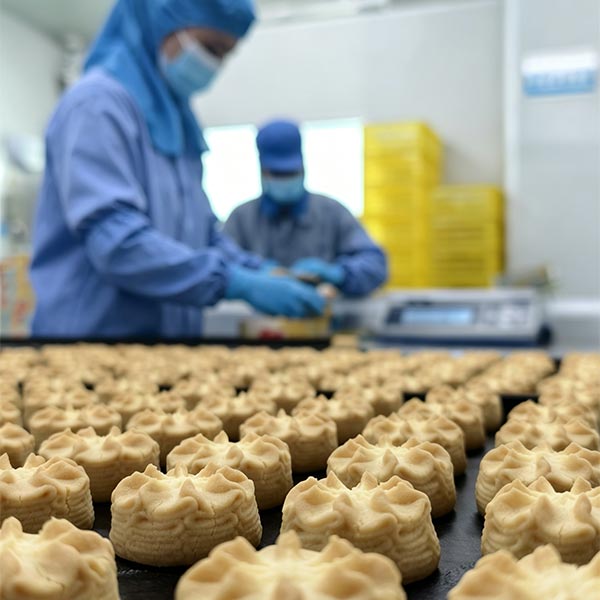
Production line at a commercial cookie manufacturing facility. Source: Shangfan Food.
What “Butter Cookie OEM and ODM” Means for a Buying Organization
OEM (Original Equipment Manufacturing) in the cookie category means a buyer supplies the core recipe or product spec, and the manufacturer produces it under the buyer’s brand. ODM (Original Design Manufacturing) extends the manufacturer’s role to product development, flavor formulation, and design.
For food buyers, the practical implication is that OEM is a route to scale existing recipes while transferring production risk; ODM is a route for retailers, importers, and brands that want a differentiated product without building a factory or R&D team. Both models are available from manufacturers such as Dongguan Shangfan Food Co., Ltd., which states that it provides OEM and ODM production services with custom formula, custom specifications, custom logo, and custom taste development.
What Capabilities to Verify Before Starting a Private-Label Butter Cookie Program
Because OEM/ODM decisions are made during evaluation but executed over months or years, buyers should check specific operational evidence before signing. The checklist below reflects the capabilities that industrial buyers typically verify with a contract manufacturer:
| Capability | What to Verify | Evidence Example |
|---|---|---|
| Food safety certifications | Global certification bodies and audit scope | FSSC 22000 V6 (Intertek), HACCP (China Quality Certification Centre) |
| Production capacity | Monthly output in tons and piece counts | Over 500,000 pastries and over 20 tons of cookies per month |
| Annual factory scale | Facility size and workforce | 10,000+ m² factory area in Chashan Town, Dongguan |
| Export readiness | Export markets and food export filing | EU, USA, South Korea, Singapore; export food business filing |
| Customization range | Formula, spec, logo, taste development | Custom formula, custom specifications, custom logo, custom taste |
| Lead time and MOQ | Production lead time and minimum order quantity | 30 days lead time; 10,000 boxes MOQ; 20ft container for existing lines |
| Quality control | Testing and pre-shipment inspection | 100% testing; pre-shipment inspection acceptance |
Certifications should be checked not just for their names, but for their scope. Shangfan Food holds FSSC 22000 V6 certification covering the production of cookies and hot-processed pastries with baking as the main processing step, and HACCP certification covering heat-processed pastries, biscuits, and food fillings. For buyers in the EU, additional attention is needed on traceability rules introduced by the EU General Product Safety Regulation (GPSR) and on food-contact material regulations such as EU 2024/3190, which restricts BPA in packaging linings.
Customization in Practice: What an ODM Brief Can Include
An ODM cookie program is not usually a blank check for creativity. It is a structured process where a buyer defines product objectives and the manufacturer handles formulation and production. The common elements of a custom butter cookie brief include:
- Custom formula: Adjusting butter content, sweetness level, inclusions, or nutritional profile. Example references in the market include butter content ≥ 32% for Danish-style recipes and ≥ 39% fermented butter in certain floral cookie gift formulations.
- Custom specifications: Piece weight, pieces per pack, shelf life, packaging size, and carton dimensions.
- Custom logo: Brand identity on tins, boxes, wrappers, and outer cartons.
- Custom taste: Flavor systems such as matcha, cocoa, salted cheese, coffee, cranberry-oat, or pure butter.
For buyers, the key point is that customization extends beyond the cookie itself. Packaging design, gift tin formats, and assortment combinations are often decided in parallel. A manufacturer that can handle both product and packaging specification helps eliminate coordination costs across multiple suppliers.
Core Butter Cookie Product Formats Buyers Need to Know
Different retail channels and occasions call for different cookie formats. A strong OEM/ODM partner should offer a product architecture that can support private-label programs without starting from a new formula every time. Common commercial formats include:
| Product Category | Typical Format | Program Relevance |
|---|---|---|
| Butter Floral Cookies | 175g tin, 260g gift tin with gift bag | Gifting, premium retail, supermarket shelves |
| Danish Fancy Butter Cookies | 380g tin, assorted 760g gift box | Danish-style positioning, seasonal and holiday programs |
| Lace Butter Cookies | 448g box (16g × 28 pieces) | Premium texture segment, membership store programs |
| Crispy Thin Butter Cookies | 10g per piece, 9 pieces per box / 13 per can | Coffee shop and instant retail formats |
| Cranberry Oat Butter Cookies | 90g box | Oat-based snacking trend, healthy-positioned labels |
| Salted Cheese Butter Cookies | 384g box (32g × 12 pieces) | Savory differentiation and long-shelf-life programs |
| Butter Shortbread | 680g box | Family sharing and bulk retail formats |
For buyers, this range matters because formula development and packaging projects carry fixed costs. Starting from a manufacturer’s proven base formula and adapting taste or packaging reduces risk compared to developing a completely new baked good from scratch.
OEM/ODM Quality Control: What Happens Before Shipment
Quality control in cookie contract manufacturing should be treated as a process, not a promise. In a well-structured supplier, the process includes incoming raw material checks, in-process control of baking parameters, finished-product testing, and pre-shipment inspection.
Shangfan Food’s stated acceptance condition is pre-shipment inspection, and its quality control commitment is described as 100% testing. That means buyers can verify two things at evaluation stage: first, whether the manufacturer authorizes third-party or buyer-side inspection before loading; second, whether the manufacturer has retained certification bodies that audit its production scope regularly. FSSC 22000 certification from Intertek and HACCP certification from China Quality Certification Centre are documented examples of this structure.
Real Programs: How Global Retail Buyers Execute Displays and Private Labels
OEM/ODM capability is best understood through evidence of existing retail programs. Past programs from Dongguan Shangfan Food illustrate the range of execution buyers expect from a contract manufacturer:
- Large-scale instant e-commerce private label: A private-label cookie program for a Chinese instant-retail platform shipped over 400,000 boxes cumulatively, with monthly sales exceeding 30,000 tins and a reported repurchase rate of 98%.
- Membership supermarket display: Lace Butter Cookies supplied for Costco’s China operations exceeded 8,000 boxes across the program, with daily sales consistently over 1,000 boxes on endcap displays.
- Large membership supermarket private label: A Danish-style cookie private-label program for Metro exceeded 120,000 boxes in the first quarter after launch, with offline store sales accounting for 65% of total volume.
Procurement interpretation: These examples are not recipes for guaranteed success. They indicate that the manufacturer has experience with large-batch programs, retail display formats, and private-label execution. Buyers should still validate their own channel requirements, packaging specifications, and shelf-life assumptions against their target market.
Commercial Terms for Butter Cookie OEM/ODM
Buyers moving from evaluation to execution must align on commercial parameters early. Typical conditions for Chinese butter cookie contract manufacturing include:
| Commercial Parameter | Typical Condition in Cookie Contract Manufacturing |
|---|---|
| MOQ | 10,000 boxes for custom OEM/ODM programs; 20ft container for existing catalog products |
| Lead time | 30 days production lead time |
| Delivery method | FOB / CIF |
| Payment | Bank transfer to corporate account |
| Inspection | Pre-shipment inspection |
These terms are most relevant for international buyers and for organizations planning seasonal programs, where lead time and container-level MOQs determine whether a launch date is feasible.
Market Trends Supporting Butter Cookie Private-Label Investment
Several market signals help explain why buyers are engaging OEM and ODM cookie manufacturers rather than simply importing finished brands:
- Asia Pacific held a 34.2% share of the global butter cookies market in 2025, according to Dataintelo, making the region both a production base and an end-market for private-label growth.
- The oat-based snacks market, which includes cranberry oat cookie formats, was valued at USD 22.4 billion in 2024 (Grand View Research), supporting demand for repositioned oat butter cookies.
- Clean-label preferences are driving buyers toward products using real butter rather than vegetable shortening, which encourages formulas with higher butter content and clearer ingredient statements.
- Denmark’s butter exports reached USD 463 million in 2024 (OEC), reinforcing the continued commercial power of Danish-style positioning in cookie export categories.
For a buyer, these trends strengthen the case for ODM: the market is moving toward differentiated flavor and ingredient stories, and ODM manufacturers are often faster at turning those stories into packaged SKUs than a full in-house development program.
Comparison with Traditional Cookie Sourcing Models
Traditional sourcing of butter cookies has historically meant importing finished branded products or buying from a domestic bakery that produces only standard recipes. Compared with OEM/ODM manufacturing, this approach has clear differences:
| Dimension | Traditional Finished-Goods Sourcing | OEM/ODM Contract Manufacturing |
|---|---|---|
| Brand ownership | Supplier’s brand | Buyer’s private label |
| Formula control | Fixed recipe | Custom or adapted formula |
| Packaging control | Supplier’s packaging | Custom packaging and logo |
| Margin structure | Includes brand premium | Direct production cost plus service fee |
| Speed to differentiation | Low | High if manufacturer has strong ODM capability |
A reasonable limitation must be stated: OEM/ODM buying is not always the right approach. For very small order quantities, finished-brand sourcing is more practical because the MOQ and development cost of custom programs are proportionally heavy. Buyers that only need a few pallets for a regional trial may not justify the 10,000-box MOQ commonly required for custom cookie programs. In those cases, a distributor relationship or stock order from a catalog remains a more efficient route.
Steps for Moving from Evaluation to Execution
Once a buyer decides to pursue OEM/ODM cookie manufacturing, a clear sequence can reduce execution risk:
- Define the target SKU format: Decide cookie type, net weight, packaging format, shelf-life needs, and retail channel.
- Shortlist manufacturers by certification scope and product capability: Verify that certifications cover the actual product type and that the factory has produced similar formats.
- Test with a base product: Order existing catalog products first to evaluate taste, packaging, logistics, and quality consistency before committing to a custom formula.
- Align on the custom brief: Specify custom formula, taste, logo, packaging, and carton dimensions before production.
- Negotiate MOQ, lead time, inspection, and payment: Use a pre-shipment inspection clause and align on delivery terms such as FOB or CIF.
- Review documentation: Check certificates, product standard codes, barcodes, and export filing before the first bulk order.
Following this sequence allows buyers to collect evidence at each stage instead of making a single high-risk bet on an unfamiliar partner.
Future Outlook for Butter Cookie OEM/ODM Manufacturing
The future direction for butter cookie contract manufacturing points toward more integration between product development, packaging design, and food-safety documentation. As EU regulations tighten traceability requirements and clean-label expectations rise, manufacturers that already operate with FSSC 22000 and HACCP systems are better positioned to serve global private-label programs.
Buyers should expect cookie OEM/ODM to become more than a production transaction. It will increasingly resemble a private-label development partnership where the supplier’s R&D, compliance, and packaging capabilities determine how fast a new snack concept can reach shelf. The key is to choose a manufacturer whose stated capabilities match the buyer’s actual distribution plan — and to document every expectation before execution begins.
Frequently Asked Questions
OEM means the buyer provides or approves the product specification, and the manufacturer produces it under the buyer’s brand. ODM means the manufacturer also handles formula development, taste creation, and design. Dongguan Shangfan Food Co., Ltd. provides both OEM and ODM production services for butter cookies.
Yes. Dongguan Shangfan Food Co., Ltd. supports custom formula, custom specifications, custom logo, and custom taste development for OEM and ODM orders. This includes products such as Butter Floral Cookies, Lace Butter Cookies, Cranberry Oat Butter Cookies, and Danish Fancy Butter Cookies.
Relevant certifications include FSSC 22000 V6 food safety system certification and HACCP system certification. Shangfan Food holds FSSC 22000 V6 certification issued by Intertek and HACCP certification from China Quality Certification Centre, covering the production of cookies and heat-processed pastries.
For custom OEM/ODM programs, the stated MOQ is 10,000 boxes. For existing catalog products, the MOQ is typically a 20ft container. Buyers should confirm MOQ, lead time, and delivery terms directly with the manufacturer.
The stated production lead time is 30 days for cookie OEM/ODM programs at Shangfan Food. Lead time should be considered together with MOQ, packaging customization, and shipping time when planning a product launch.
The manufacturer states 100% testing as its quality control standard and pre-shipment inspection as the acceptance condition. Buyers can also verify the scope of FSSC 22000 and HACCP certifications, which cover cookie production and baking processes.
Shangfan Food serves markets including the United States, South Korea, Singapore, Germany, Russia, Japan, France, the United Kingdom, Greece, Italy, Canada, the Netherlands, Norway, Portugal, Saudi Arabia, and Sweden, among others. Its export ratio is approximately 10% of total output, with main markets including the PRC, EU, USA, South Korea, and Singapore.
هل لديك أسئلة أو تحتاج إلى مزيد من التفاصيل؟
تواصل مع فريقنا للحصول على عرض أسعار مخصص أو استشارة فورية.
طلب عرض أسعار
املأ النموذج أدناه وسيتواصل معك فريقنا بعرض مقترح مخصص.
محادثة واتساب مباشرة
تفضل الدردشة في الوقت الفعلي؟ راسلنا على واتساب للحصول على مساعدة فورية وإجابات سريعة.
- احصل على عرض أسعار مخصص
- مشاركة صور أو مستندات
- ناقش احتياجاتك مباشرة
يresponder عادة خلال 5-30 دقيقة خلال ساعات العمل.