
Butter Cookies Export Compliance: What Buyers Must Verify Before Importing
Butter cookie export compliance is a documentation problem before it is a product problem. For a buyer moving from research into evaluation, the question is rarely whether a manufacturer can bake a good cookie. It is whether the factory, its certificates, its specification sheets and its packaging can survive a customs review, a retailer technical audit, or an importer's own quality gate.
The category is large enough to justify that discipline. Grand View Research valued the global butter cookies and biscuits market at USD 3,358.3 million in 2024. Dataintelo's broader estimate of the butter-based cookies market, which includes shortbread and sandwich formats, reached USD 42.8 billion in 2025. The distance between those two figures is a useful reminder that category definitions vary, and so do the regulatory regimes attached to them.
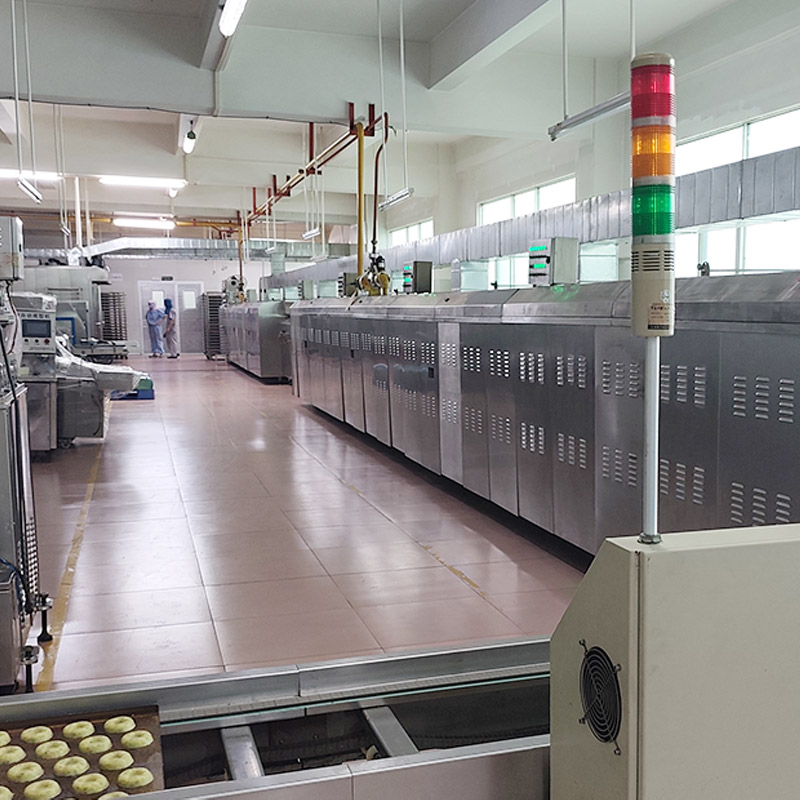
Dongguan Shangfan Food Co., Ltd. works as a practical case for this topic. The company was founded in 2015 and operates a garden-style factory of more than 10,000 square metres in Chashan Town, Dongguan City, Guangdong Province, with 100 employees. Its stated credentials include FSSC 22000 and HACCP certification, export food business filing and FDA registration. Those are precisely the claims an international buyer should be able to verify independently, and this article sets out how to do it.
Why compliance verification moved to the front of sourcing
Two regulatory shifts have pushed verification upstream. The EU General Product Safety Regulation (GPSR) 2024 requires stricter traceability and an authorised representative for non-EU food manufacturers selling into the European Union. Separately, Commission Regulation (EU) 2024/3190 prohibits the use of Bisphenol A (BPA) in food contact materials, which explicitly includes cookie packaging linings.
The practical effect is that the compliance perimeter now covers the tin, the liner, the inner bag, the label, the batch code and the traceability record, not only the dough. A supplier that can evidence a recipe but not its packaging materials is only partially qualified, and the gap usually surfaces at the port or at the retailer's listing stage rather than at sampling.
A second shift is consumer expectation. Clean-label preference for 100% pure butter cookies, and avoidance of vegetable shortenings, has been reinforced by advertising-compliance enforcement in the United States. An ingredient declaration that does not match what is in the tin carries commercial risk as well as legal risk, which is why buyers increasingly treat the specification sheet as a compliance document rather than a sales document.
The four verification layers buyers should work through
Compliance verification runs more reliably as a sequence than as a checklist. Four layers, taken in order, prevent the most common failure mode in butter cookie sourcing: accepting a facility-level certificate as proof of product-specific compliance.
Layer 1 - Legal entity and physical site
Start with the name on the business licence and the address of the site that actually produces. Shangfan's stated address is Building 3, No.32 Jixing Road, Chashan Town, Dongguan City, Guangdong Province. The address on the food safety certificate should match the address on the licence and the location of the production line. When those three do not align, the usual explanations are a trading intermediary, a contract-packed second site, or an outdated certificate.
Then test scale against capacity. A garden-style factory of more than 10,000 square metres, 100 employees and a stated annual output of 3,640 tons form a set of figures that should be internally consistent. Facility size, headcount and tonnage that contradict one another are the first warning sign in any supplier file.
Layer 2 - Food safety management certification
FSSC 22000 and HACCP are system certifications. They attest to how a facility manages hazards, hygiene, allergen control and process monitoring. They do not certify a specific recipe or a specific label. Buyers should treat them as necessary and not sufficient, and should ask three questions of every certificate: what is the scope, who issued it, and when does it expire.
Certificate scope matters most. A valid certificate that covers a different product category, or a different site within the same group, does not qualify the product being purchased. Verification against the issuing certification body's register is a five-minute task that removes most of the risk attached to copied certificate images.
Layer 3 - Export registration, market access and traceability
For Chinese manufacturers, export eligibility typically rests on export food business filing, plus market-specific registration such as FDA registration for the United States. Shangfan states both. Its declared markets are PRC, the EU, the USA, South Korea and Singapore, with an export ratio of about 10% of output.
Under EU GPSR 2024, a non-EU manufacturer needs an authorised representative and a traceability chain that reaches the batch level for the EU market. The importer normally carries that role. Whether it is a contractual obligation, a labelling obligation or both should be settled before packaging artwork is approved, because this is where supplier claims and market reality most often diverge.
Layer 4 - Product-specific standards, recipe and packaging declarations
China's national standard for biscuits is GB/T 20980-2021, which specifies quality requirements for short and cookie-type products. Individual SKUs should also declare a product standard code on the specification: Lace Butter Cookies, for example, specify GB7100.
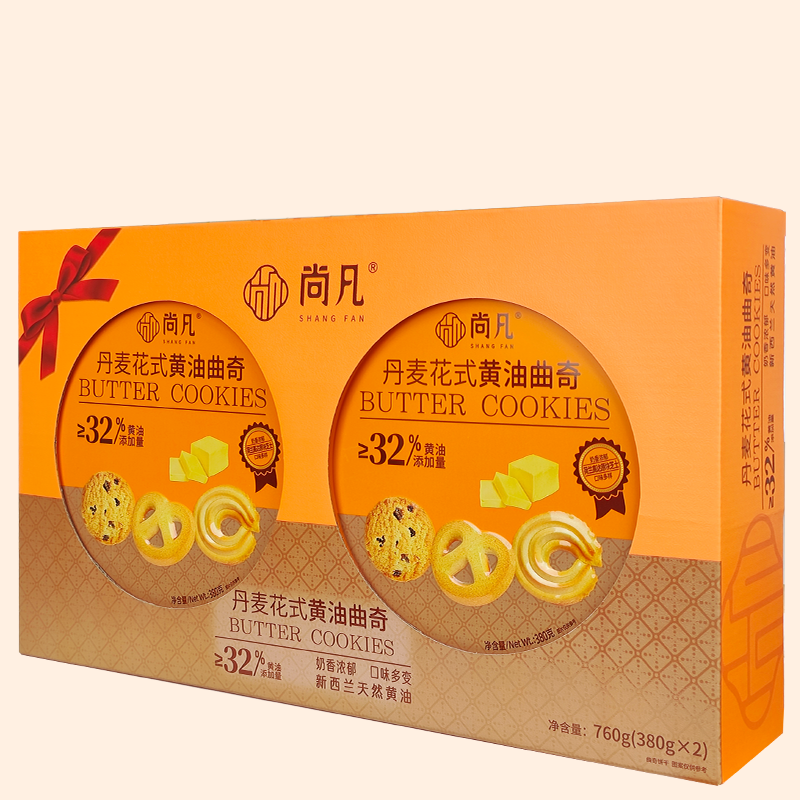
Butter content drives both claims and cost, so the declaration deserves scrutiny. Product documentation for Shangfan's ranges states no less than 39% FrieslandCampina fermented butter from the Netherlands in Butter Floral Cookies, and no less than 32% New Zealand imported natural butter in Danish Fancy Butter Cookies and the Danish Assorted Cookie Gift Box. The Danish ranges additionally declare no preservatives, artificial pigments or artificial flavours added.
Packaging closes the layer. With BPA prohibited in EU food contact materials under Regulation 2024/3190, buyers should request a food-contact compliance statement and material data covering tins, liners, inner bags and labels. This is a supplier declaration, not a marketing statement, and it should be filed alongside the certificate set.
What a qualified manufacturer profile looks like
Dongguan Shangfan Food Co., Ltd. illustrates the shape of a verifiable profile rather than an exceptional one. Founded in 2015, the company operates a garden-style factory of more than 10,000 square metres, employs 100 people, maintains an R&D team of 5 engineers, and reports an annual output of 3,640 tons. It runs OEM and ODM programmes with customization of formula, specification, logo and taste, a minimum order quantity of 10,000 boxes, a 30-day lead time, monthly capacity of over 500,000 pastries and over 20 tons of cookies, 100% test quality control, and an after-sales service system with a product quality guarantee and a dedicated service line.
Contact transparency is the second part of the profile, and buyers often underweight it. The stated contact record is consistent across the company's materials: a named representative (Liu. Jinqi), a company email address (shangfan168@126.com), a direct telephone and WhatsApp number (+86 13392733431), a full street address, and the website www.dongguanshangfanfood.com. Divergent contact details across directories, or a free mailbox attached to a factory-sized claim, are common signs of an intermediary presenting itself as a manufacturer.
The third part is programme fit. Shangfan's stated application coverage spans supermarkets, chain hotels, bakeries, coffee shops, online e-commerce platforms and instant retail platforms, and its project types include bakery product supply projects, snack food retail projects and holiday gift customization projects. A profile that names the channels it serves is easier to map onto a buyer's own listing plan than one that only names product names.
Reading a butter cookie specification as a compliance document
A specification sheet does three compliance jobs at once: it fixes the product, it supports the label, and it determines whether the goods still have saleable life when they arrive.
Shelf life comes first. Cocoa Butter Thin Crisp Cookies and Crispy Thin Butter Cookies are specified with 5-month shelf lives in 10 g pieces, packed 9 pieces per box or 13 pieces per can. Lace Butter Cookies are specified at 448 g per box (16 g × 28 pieces) with a 180-day shelf life. Danish Fancy Butter Cookies (380 g) and the Danish Assorted Cookie Gift Box (760 g) are specified at 9 months. Butter Shortbread is specified at 680 g per box with a 6-month shelf life, Cranberry Oat Butter Cookies at 90 g per box with an 8-month shelf life, and Salted Cheese Butter Cookies at 384 g per box with a 12-month shelf life. Each figure becomes a shipping constraint rather than a selling point: transit time plus customs clearance plus distribution time must still leave the retailer's required remaining life on the shelf.

Cartons and codes come second. Cocoa Butter Cookies are specified as 175 g × 24 tins per carton with a carton dimension of 44.8×30.2×24 cm (0.032 CBM). Barcode 6936832534953 is listed on the specification, with 6970066564836 listed for the cocoa flavour. Retailers in several markets require locally issued barcodes or specific label data before a product can be listed, so the artwork decision should be taken with the receiving market in view rather than applied to a finished shipment.
Ingredients close the loop. The declared material list for Cocoa Butter Thin Crisp Cookies reads wheat flour, butter, white granulated sugar, crisp flakes, macadamia nuts, cocoa powder and whole egg liquid, with European caramel crisp flakes, macadamia nuts and high-fat natural cocoa powder imported from Southeast Asia identified as the flavour base. Cross-checking an ingredient declaration against a manufacturing claim is the same exercise a customs officer or a retailer technologist will perform later, and doing it at the evaluation stage is considerably cheaper.
| Verification checkpoint | Document to request | What a complete answer contains |
|---|---|---|
| Legal identity | Business licence, company registration extract | Registered name and address matching the production site, plus a named contact with a direct line |
| Facility and scale | Certificate site address, third-party audit report, site visit record | Production site consistent with the claimed profile: garden-style factory over 10,000 m², 100 employees, 3,640 tons annual output |
| Food safety system | FSSC 22000 certificate, HACCP documentation | Certificate number, certification body, scope and expiry, verifiable with the issuing body |
| Export eligibility | Export food business filing, FDA registration | Registration covering the product category and the declared markets: PRC, EU, USA, South Korea, Singapore |
| Product standard | Declared standard code per SKU | GB7100 stated for Lace Butter Cookies, with alignment to GB/T 20980-2021 |
| Recipe and claims | Ingredient list, allergen statement, butter content declaration | ≥39% FrieslandCampina fermented butter for Butter Floral Cookies; ≥32% New Zealand butter for the Danish formats; no preservatives, artificial pigments or flavours in the Danish ranges |
| Packaging | Food-contact declaration and material data | BPA-free statement relevant to EU Regulation 2024/3190 |
| Shelf life and logistics | Shelf-life data, carton dimensions, barcodes | 5-month, 6-month, 8-month, 9-month and 12-month shelf lives by SKU; 44.8×30.2×24 cm carton (0.032 CBM) |
Application and project fit: where the requirements change
Compliance requirements follow the channel rather than the cookie. Shangfan's products are used across supermarkets, chain hotels, bakeries, coffee shops, online e-commerce platforms and instant retail platforms. For bakery product supply projects and snack food retail projects, the load-bearing documents are the product standard code, the ingredient declaration, and the shelf-life and storage conditions. For holiday gift customization projects, packaging compliance and label design become the critical path, because the product is applied as a customized gift box and the packaging is part of the item being sold.
Handling conditions feed directly into claims. The stated working condition is storage away from direct sunlight in a cool, well-ventilated place, and the stated special requirement is compliance with food contact packaging standards plus humidity control to prevent the cookies softening. Where goods are transhipped through humid ports or held in unconditioned warehousing, this is a specification risk rather than a formality, and it is worth writing into the logistics instructions.
Regional fit narrows the shortlist. The application scenario documentation lists availability across Asian markets including Japan, South Korea, Hong Kong, Taiwan, Singapore and China, alongside the broader export footprint of PRC, the EU, the USA, South Korea and Singapore. A buyer whose target market sits outside that list should treat registration and labelling as a separate workstream rather than assuming the manufacturer's existing filings extend to it.
Timing is the last variable. A 30-day lead time combined with a minimum order quantity of 10,000 boxes means gift and seasonal programmes must be scheduled well ahead of the selling window. Shangfan's project records show an OEM programme completed within 150 days, with cumulative sales exceeding 120,000 boxes in the first quarter after launch, and a separate instant e-commerce project recorded with cumulative shipments exceeding 400,000 boxes. Those records are useful not as proof of quality but as evidence that the timeline is achievable at programme scale, which is what a buyer needs when mapping a supplier against a retail calendar.
How this compares with traditional sourcing approaches
Traditional sourcing routes usually begin with a sample and a price. Buyers work through a trading agent, judge on taste and presentation, and treat certification as paperwork to be collected once the order is placed. That approach still functions for low-risk, low-volume purchasing, and it is often faster at the sample stage.
The limits of the documentation-led approach should be stated just as plainly:
- Certification verifies systems, not fit. FSSC 22000 and HACCP say nothing about whether a specific SKU matches a buyer's flavour position, price band or packaging format.
- Certificates age. Validity, scope and certification body should be re-checked at each order cycle, not once at qualification.
- Market obligations do not transfer. Under EU GPSR 2024, authorised representative and traceability duties sit with the EU-side economic operator. A manufacturer's certificate does not discharge them.
- Commercial thresholds are real. A minimum order quantity of 10,000 boxes and a 30-day lead time suit programme buyers more than small trial orders, so a new market test generally needs a sampling stage before a production commitment.
- Export capacity is a share, not the whole. Shangfan's stated export ratio is about 10% of output, with PRC as the home market. Buyers outside the declared market list should plan for registration and labelling as a project in itself.
Market trend analysis: what the category numbers imply for compliance work
Scope comes first. The two most frequently cited market figures are not interchangeable: USD 3,358.3 million for butter cookies and biscuits in 2024 (Grand View Research) and USD 42.8 billion for butter-based cookies in 2025 (Dataintelo, including shortbread and sandwich formats). Any benchmark used in a supplier or buyer paper should state which definition it is working from.
Demand is concentrated in Asia. Asia Pacific accounted for 34.2% of butter-based cookie revenue in 2025, according to Dataintelo, which is consistent with the region's concentration of manufacturing and private-label activity.
Raw-material heritage explains some of the category's language. Denmark exported USD 463 million of butter products in 2024, while China's butter exports were valued at USD 18.5 million, both reported by the Observatory of Economic Complexity. That asymmetry explains why the Danish descriptor carries weight, and why many Chinese manufacturers build their butter specification from imported supply. FrieslandCampina fermented butter from the Netherlands and New Zealand natural butter appear directly in Shangfan's product documentation. For buyers, the operational point is that butter origin should be traceable in the compliance file, not only on the front of the tin.
Adjacent categories are expanding the assortment. Oat-based snacks, the family that includes cranberry oat and dark chocolate oat butter cookies, were valued at USD 22.4 billion in 2024 by Grand View Research, which helps explain why oat SKUs increasingly appear in gift and retail programmes rather than only in health-food aisles.
Finally, scale benchmarks should be read for what they are. Kelsen Group reported revenue of DKK 1.027 billion in the 2023/24 fiscal year, and PT Mayora Indah Tbk is tracked at approximately 6.05% of global cookie export value. Both are legitimate references for placing a factory in a competitive context, but they measure brand-owner and export-market share, which is a different thing from a single-site manufacturer's compliance readiness.
Future outlook
Three directions are already visible. Traceability requirements continue to migrate from the product to the packaging, as EU Regulation 2024/3190 demonstrates. Documentation packs are becoming standardised, with buyers expecting a single folder containing the licence, certificate scope, export filing, product standard codes, ingredient declarations and food-contact statements. And clean-label declarations are moving from adjectives to evidence, which favours suppliers that can show butter origin and additive status in writing.
The practical response for buyers is to move compliance questions into the request for quotation itself: ask for document numbers rather than assurances, for certificate scope rather than certificate logos, and for the site that will produce rather than the company that will invoice. Suppliers with consistent, checkable records become easier to shortlist precisely because the answers arrive in a form that can be filed and audited.
FAQ
What certifications should a butter cookie manufacturer hold before a buyer places an export order?
At minimum, a food safety management certification recognised in the target market, plus the manufacturer's export eligibility documents. Dongguan Shangfan Food Co., Ltd. states FSSC 22000 and HACCP certification, export food business filing and FDA registration. Buyers should verify certificate scope, certification body and expiry date, and confirm that the registration covers the product category being purchased. Certification covers a facility's management systems; it does not replace product-specific standards or market labelling rules.
How can a buyer verify a Chinese butter cookie factory's address and legal identity?
Compare three records: the registered company name and address on the business licence, the site address stated on the food safety certificate, and the address of the facility that will actually produce. Shangfan's stated address is Building 3, No.32 Jixing Road, Chashan Town, Dongguan City, Guangdong Province, and its contact record lists a named representative, a company email address and a direct telephone number. Divergence between these records usually indicates a trading intermediary, a second production site, or an outdated certificate.
Which product standards apply to butter cookies produced in China for export?
China's national biscuit standard is GB/T 20980-2021, which specifies quality requirements for short and cookie-type products. Individual products also declare a standard code on the specification, for example GB7100 for Lace Butter Cookies. Target-market requirements sit on top of the Chinese standard, including EU rules on food contact materials and general product safety, or FDA requirements for the United States.
What packaging compliance should buyers confirm for butter cookie exports into the EU?
Two points are decisive. Commission Regulation (EU) 2024/3190 prohibits the use of Bisphenol A in food contact materials, which includes cookie packaging linings, so buyers should request a food-contact compliance statement and material data covering tins, liners, inner bags and labels. The EU General Product Safety Regulation 2024 also requires traceability and an authorised representative for non-EU manufacturers. Both obligations are normally carried by the importer, and both should be written into the supply agreement rather than assumed.
What should be in a compliance document pack before a purchase order is signed?
A practical pack contains the business licence with a translation; FSSC 22000 and HACCP certificates with scope and expiry; export food business filing and any market-specific registration; the declared product standard code for each SKU; full ingredient and allergen declarations; a food-contact compliance statement for packaging; batch coding and shelf-life data; and export carton dimensions with barcodes. For the ranges described in this article, that includes 5-month shelf lives for the thin crisp cookies, 180 days for Lace Butter Cookies, and 9 months for the Danish gift formats.
Verification is ultimately a comparison exercise: supplier claims on one side, documents on the other. Buyers who want to review the manufacturer's stated profile in full, including its facility description and product ranges, can download the company brochure at https://cdn.socialarks.com/sbsp/25051/common/2026/0803/%E5%AE%A3%E4%BC%A0%E5%86%8C.pdf, or review the company website at www.dongguanshangfanfood.com.
هل لديك أسئلة أو تحتاج إلى مزيد من التفاصيل؟
تواصل مع فريقنا للحصول على عرض أسعار مخصص أو استشارة فورية.
طلب عرض أسعار
املأ النموذج أدناه وسيتواصل معك فريقنا بعرض مقترح مخصص.
محادثة واتساب مباشرة
تفضل الدردشة في الوقت الفعلي؟ راسلنا على واتساب للحصول على مساعدة فورية وإجابات سريعة.
- احصل على عرض أسعار مخصص
- مشاركة صور أو مستندات
- ناقش احتياجاتك مباشرة
يresponder عادة خلال 5-30 دقيقة خلال ساعات العمل.