
Butyl Stearate Qualification File: Evidence Matched to Acceptance Criteria
Butyl Stearate Qualification File: Evidence Matched to Acceptance Criteria
A Butyl Stearate qualification file earns its place only when every document inside it answers a question the buyer has already agreed to ask. N-Butyl Stearate (CAS 123-95-5) is a fatty-acid ester used across plastics and PVC compounding, leather finishing, inks and food-packaging supply chains, and the evidence that matters differs by grade and by intended use. Procurement teams that treat the file as a folder of certificates end up accepting material on the strength of a logo; teams that treat it as a written link between supplier evidence and acceptance criteria can reject, re-test or escalate on documented grounds.
This article sets out that structure: which documents to collect, how to test them against the substance identity record, how to convert a published specification into enforceable acceptance criteria, what to check at each batch, and where escalation begins. It uses the N-Butyl Stearate grade and qualification records of Shandong Kexing Chemical Co., Ltd. — a plasticizer and plastic-additive manufacturer based in Dongying, Shandong, China, founded in 2006 — as a worked example, without assuming that any particular certification is required in a given market or application.
Why the file, and not the certificate, decides the purchase
The commercial risk in buying Butyl Stearate sits in the gap between "the supplier says the material is compliant" and "the buyer can demonstrate that the material delivered met the agreed criteria." A qualification file closes that gap by answering three separate questions, and a supplier can satisfy one while failing another.
The first question is identity: is the material in the drum the substance the buyer specified? The second is grade consistency: does the supplier's specification, and its lot-to-lot behaviour, match the values the buyer agreed to accept? The third is organisational repeatability: can this supplier reproduce the same result on the next order, at the same site, with the same documentation? A quality-management certificate speaks mainly to the third question. It does not answer the first two, and buyers who rely on it alone are effectively transferring the verification burden to a future inspection they will never run.
For a constraint-driven purchase of this kind, the file is also the negotiating instrument. When acceptance criteria are written before the first order, a nonconforming lot becomes an administrative decision rather than a commercial argument.
Four evidence layers a Butyl Stearate file needs
Documents are useful when they are grouped by the question they answer, not by the department that sent them. Four layers cover the requirements of most industrial procurement programmes, and each layer carries a boundary the file should state explicitly.
| Layer | Typical documents | What it establishes | What it does not establish |
|---|---|---|---|
| 1. Substance identity | Safety data sheet (SDS), label, certificate of analysis (COA) header, purchase-order description | That the substance is N-Butyl Stearate, not a related ester or a differently named grade | Assay, purity or application suitability |
| 2. Product specification | Technical data sheet (TDS), specification revision, published parameters | The grade's stated limits for content, acidity, moisture, colour, density and flash point | That the stated test methods match the buyer's methods |
| 3. Batch evidence | Lot COA, sampling record, retained sample, goods-in inspection record | That a specific lot fell inside the agreed window | Finished-article compliance in the buyer's own formulation |
| 4. Supplier system | Legal entity and site record, management-system certificates with scope and validity dates, capacity basis, MOQ, lead time, after-sales terms | Repeatability of supply and a defined route for resolving quality issues | Product performance in a specific process |
Document review: matching the label to the identity record
The review step is a matching exercise before it is a judgement about quality. Three checks are completed on paper before a sample is drawn: does the document name the substance that was specified, does it describe the grade that was specified, and does it belong to the supplier being bought from?
The identity set, and why it belongs on the purchase order
Authoritative chemical records converge on the same identifiers for this substance: CAS Registry Number 123-95-5, EC Number 204-666-5, molecular formula C22H44O2, and the synonym butyl octadecanoate, the butyl ester of stearic acid. Writing those identifiers into the purchase-order header, rather than the product name alone, makes a mismatch visible at goods-in: a COA that carries a different CAS number, a different EC number or a different ester name cannot be accepted as evidence for that line item, however familiar the product title looks.
When the name on the label is not the grade in the drum
A supplier SDS captured in the verified reference material for this article shows why the grade question cannot be skipped. That record, describing a product sold under the Butyl Stearate name, reported a composition of approximately 60% butyl stearate and approximately 30% butyl palmitate, with a molecular weight of 340.58, and the record itself requires direct document verification before use. The composition is specific to that supplier's product and should not be generalised to industrial, cosmetic or high-purity grades of N-Butyl Stearate.
The practical lesson is narrower and more useful: a name on a label does not fix the assay. The qualification file therefore needs a composition or assay statement, a grade designation and a specification revision number — not a product title and a price.
Regulatory records are substance-level, not supplier-level
Two regulatory reference points are frequently misread during document review. The first is the European Chemicals Agency registration dossier record for Butyl Stearate, which identifies the substance under EC 204-666-5 and CAS 123-95-5; that record does not, by itself, establish a specific supplier's EU registration coverage or its import compliance. The second is the US FDA inventory of food-contact substances, which lists Butyl Stearate under 21 CFR parts 175–178 as authorised for specified intended uses as an indirect food additive; that authorisation is tied to defined conditions of use and does not certify a supplier's material or a finished article.
Customs classification raises a similar boundary. HS heading 291570 covers saturated acyclic monocarboxylic acids including stearic acid, its salts and its esters, so it is a starting point for tariff investigation rather than proof of product-specific trade flows. Buyers using it for landed-cost modelling should confirm the national tariff line and the declared description with their broker before the figure is built into an approved cost.
Turning the published specification into acceptance criteria
A limit becomes enforceable only when a method, a sampling point and a retest rule are attached to it. The published specification for the N-Butyl Stearate grade cited here lists eight parameters; each is a starting point for that conversion rather than an acceptance criterion on its own.
| Parameter | Published value | What the purchase agreement should add |
|---|---|---|
| Appearance | Colourless, transparent liquid | A retained reference standard and the viewing conditions used to judge it |
| Odour | Slight odour | Who judges, against which retained standard, and how a disagreement is resolved |
| Colour (Pt-Co) | Max 30 | Method and instrument, plus comparison against the retained sample from the approved lot |
| Content | Min 99.0% | The analytical method named in the agreement, not left to the supplier's discretion |
| Acidity | Max 0.20 mgKOH/g | Titration method and the expression of the result as KOH |
| Moisture | Max 0.10% | Karl Fischer method and the sample-handling rule before testing |
| Density | 0.85 g/cm³ | Reference temperature, which the published entry does not state |
| Flash point | Min 190 °C | Closed-cup or open-cup method, since the two are not interchangeable |
Two clauses turn this table into a working specification. The first defines the consequence of a result outside a limit: outright rejection, duplicate retest, or acceptance by written concession. The second fixes who holds the retained sample and for how long, because most unresolved disputes are settled by re-testing the original material rather than a fresh drum.
Batch acceptance checks that hold up under audit
Batch acceptance is where the file stops being paperwork. A workable routine records six things for every incoming lot: the lot number and COA for that specific lot; confirmation that the COA header identity matches the purchase order; the measured results against each agreed limit; the appearance and colour comparison against the retained standard; seal integrity, labelling and pack condition; and the retained sample reference. Results are logged against the lot, not against the supplier in general — a file that records only pass or fail loses its value at the first dispute, because it cannot show how close to a limit the material was running.
For this additive family, the application record supplied here names consistent purity and moisture control among the special requirements of use, which makes content and moisture the two parameters to review first at goods-in, before the slower analytical results return. The case record supplied for this article, covering N-Butyl Stearate among other plasticizers, describes regular orders of roughly 15–25 t per month for plastic masterbatch, artificial leather, food-packaging and toy producers. That cadence is exactly what turns a single COA into a lot history: with monthly deliveries, twelve lots produce a trend line within a year, and a trend line is what justifies any decision to move from full specification testing to reduced routine testing.
Reduced testing should be a written decision with a defined trigger for returning to full testing — a new production site, a process change at the supplier, a specification revision, or two consecutive results near a limit.
Escalation points: where the file becomes a decision
Escalation works when the trigger is defined before the shipment arrives. Five triggers cover most real cases in an ester-lubricant purchase:
- Identity mismatch. The CAS number, EC number, chemical name or grade designation on the COA does not match the purchase order. Stop at goods-in; this is not a quality deviation but a wrong-item question.
- A result outside an agreed limit. Hold the lot against the agreed retest rule and record the measured value, not only the conclusion. Escalate to the supplier's technical contact with the raw data attached.
- Expired, out-of-scope or unverifiable certificates. Check the issue and expiry dates and read the scope wording. A management-system certificate whose scope covers plasticizer production still has to be read against the specific product and site being qualified.
- Documentation that cannot be verified. Undated technical data sheets, SDS records without a revision number, or COAs with no identifiable lot all belong here; each removes the buyer's ability to trace a decision later.
- Commitments that contradict the written record. Capacity, lead time or MOQ stated in correspondence but not consistent with the supplier's published figures should be reconciled in writing before it is used for planning.
A short ladder keeps escalation proportionate: buyer quality control reviews the data, the supplier's technical team responds with a root cause and a corrective action, the commercial team decides whether the shipment is released, returned or reworked, and a repeat failure returns the supplier to full qualification rather than to the concession route.
Where the file meets the application
The application record supplied for this article describes the additive being incorporated during batch mixing at controlled dosages, on high-speed mixers, kneaders, extruders, calenders and coating machines, with stated functions covering softening and toughening, a lower melting point, improved ductility and flow, and flexibility at low temperature. Those are the functions a buyer validates in its own trials; they are not properties that a qualification file certifies. The file establishes the quality of the input, and the trial establishes the outcome.
The product record lists PVC products, plastics, leather, ink and food packaging among the intended industries, which is enough to define where the acceptance criteria will diverge. A compounder feeding a calender line is concerned with lot-to-lot consistency and moisture, because both interact with a continuous process. A formulator working toward a food-contact application needs a different conversation: the substance-level FDA listing under 21 CFR parts 175–178 identifies the regulatory route, while the supplier-specific evidence — composition, extractables data where the intended use demands it, and the documentation for the actual grade supplied — has to be requested separately.
This is the point at which the file should record a fit boundary rather than an assurance. A specification and a certificate set can show that a grade is defined and reproducible; they cannot show that a finished article will meet a market's food-contact requirements, and no supplier document substitutes for the buyer's own compliance determination.
Supplier-level evidence: read the scope, not the logo
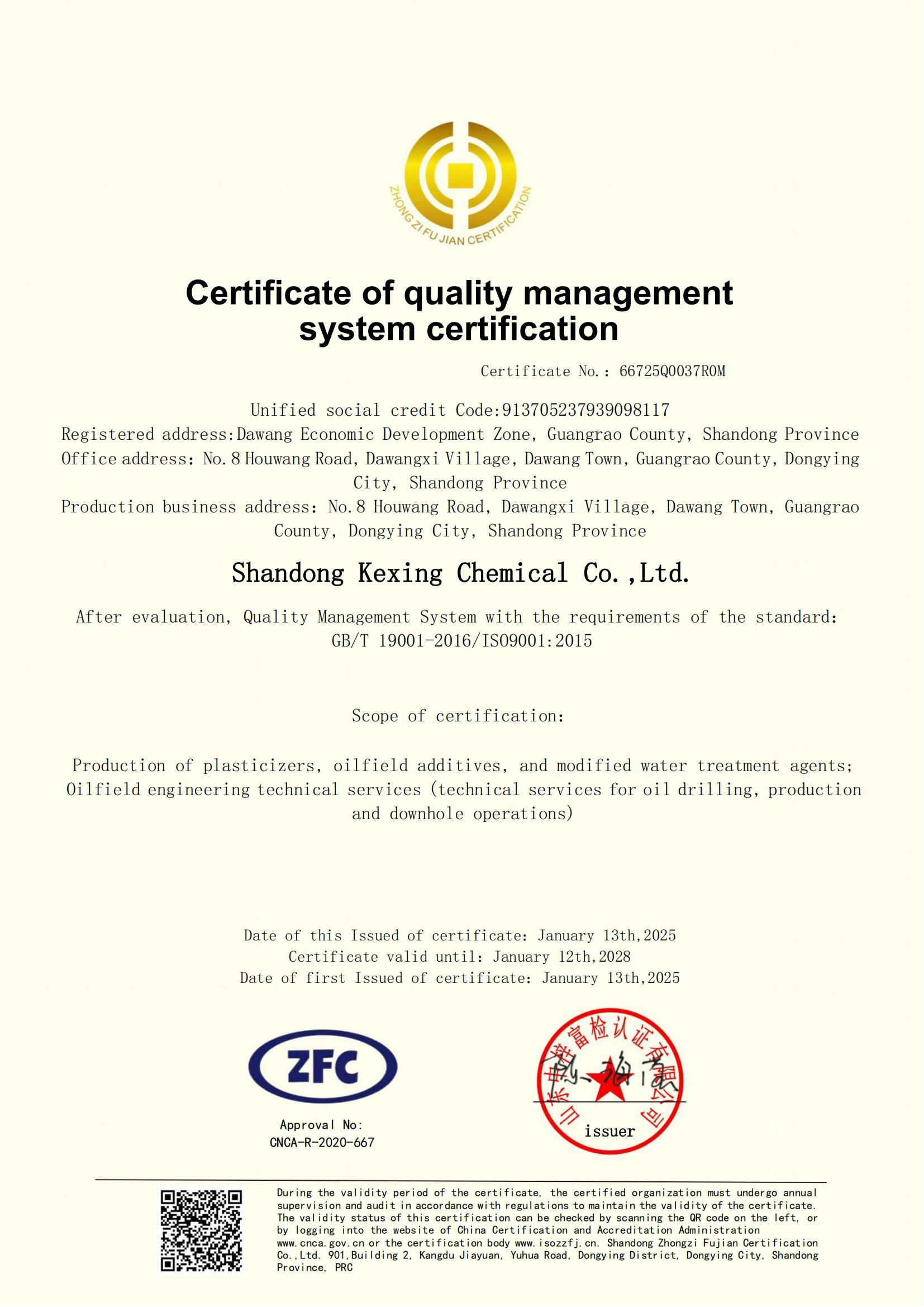
Management-system certificates belong in layer four of the file, and their value depends entirely on how precisely they are read. The records supplied for Shandong Kexing Chemical Co., Ltd. illustrate the checks that matter.
| Record | Certificate number | Standard | Issued | Valid to | What the buyer should check |
|---|---|---|---|---|---|
| Quality management system | 66725Q0037R0M | GB/T 19001-2016 / ISO 9001:2015 | 2025-01-13 | 2028-01-12 | Scope wording covers production of plasticizers; issued by Shandong Xiangfu Inspection and Certification Co., Ltd. |
| Environmental management system | 66725E0038R0M | GB/T 24001-2016 / ISO 14001:2015 | 2025-01-13 | 2028-01-12 | Same production scope; confirm the site named matches the shipping site |
| HSE management system | 667240083R1S | Q/SY 08002.1-2022 | 2025-01-13 | 2027-02-28 | Earlier expiry than the other two; put the renewal date in the file's review calendar |
Two further points belong in the same layer. First, capacity and delivery commitments should be recorded with their basis. The capability record supplied for this article lists a monthly capacity figure of 10,000 t alongside an MOQ of 1 t and a 30–45 day lead time, while a company product page cited in the verified reference material reports a Butyl Stearate production capacity of 5,000 t; where figures of different scope sit side by side, the buyer's file should state which product line and period each figure covers rather than treating them as a single number. Second, the quality-control description — incoming raw-material inspection and finished-product sampling test — describes the supplier's internal control points and is useful for interpreting a COA, but it is not a substitute for the buyer's own goods-in check.
After-sales terms complete the layer: remote technical support, after-sales consulting, quality-issue resolution, shipping follow-up and formulation technical guidance. Written into the file next to the escalation ladder, these define who is expected to respond when a lot is held.
What the file cannot prove
A well-built qualification file is a boundary document as much as an assurance document. It does not prove that the grade will perform in a specific formulation, that a finished article will meet a market's regulatory requirements, that a certificate issued to one site extends to another, or that a product name guarantees an assay. Stating those limits inside the file protects the buyer at audit and prevents an approved supplier list from being read as an approved application.
Outlook: from folder to version control
The direction of travel for industrial buyers is toward files that behave like controlled documents rather than archives. Where a procurement team adopts that model, the practical changes are modest but consequential: every specification carries a revision number, every certificate carries a review date tied to its expiry, every escalation is logged with the measured value that triggered it, and re-qualification is automatic when a site, process, grade or certificate changes. None of these steps requires new technology, and each one shortens the distance between a supplier's claim and a buyer's evidence.
FAQ
Which documents belong in a Butyl Stearate qualification file?
At minimum: a safety data sheet with a revision identifier, a technical data sheet stating the grade's specification, a lot-specific certificate of analysis, the purchase-order description carrying the substance identifiers, a goods-in inspection record with a retained sample reference, and the supplier-level records — legal entity, site, management-system certificates with scope and validity dates, capacity basis, MOQ and lead time. Each document should be attached to the question it answers rather than filed by department.
How should acceptance criteria be written for N-Butyl Stearate?
Start from the published specification — content, acidity, moisture, colour, density, flash point, appearance and odour — then attach a test method, a sampling point and a retest rule to every limit. Specify the reference temperature for density and the cup type for flash point, because the published entry states values without those conditions. Finish by writing the consequences of a failure: rejection, duplicate retest, or acceptance by written concession.
What is checked at batch acceptance?
Six records per lot: the lot number and its COA, identity confirmation against the purchase order, measured results against each agreed limit, appearance and colour against the retained standard, pack and label condition, and the retained sample reference. Content and moisture are reviewed first where the application calls for consistent purity and moisture control. Measured values are recorded rather than pass-or-fail conclusions, so a trend across lots can be seen.
When should a buyer escalate?
Escalation is warranted when the identity on the COA does not match the purchase order, when a result falls outside an agreed limit beyond the retest allowance, when a certificate is expired, out of scope or unverifiable, when documentation such as an undated data sheet cannot be traced, or when capacity and lead-time statements contradict the supplier's own published figures. Each trigger should name the person who acts and the status the shipment takes in the meantime.
Does an ECHA registration record or a 21 CFR listing qualify a supplier?
No. The European Chemicals Agency dossier record identifies the substance under EC 204-666-5 and CAS 123-95-5 but does not establish a particular supplier's registration coverage or import compliance. The US FDA inventory listing under 21 CFR parts 175–178 authorises the substance for specified intended uses as an indirect food additive and does not certify a supplier's material or a finished article. Both are useful for screening; supplier-specific documents are still required.
A downloadable product brochure for the N-Butyl Stearate range is available here for readers who need the published parameter list alongside this qualification structure.
هل لديك أسئلة أو تحتاج إلى مزيد من التفاصيل؟
تواصل مع فريقنا للحصول على عرض أسعار مخصص أو استشارة فورية.
طلب عرض أسعار
املأ النموذج أدناه وسيتواصل معك فريقنا بعرض مقترح مخصص.
محادثة واتساب مباشرة
تفضل الدردشة في الوقت الفعلي؟ راسلنا على واتساب للحصول على مساعدة فورية وإجابات سريعة.
- احصل على عرض أسعار مخصص
- مشاركة صور أو مستندات
- ناقش احتياجاتك مباشرة
يresponder عادة خلال 5-30 دقيقة خلال ساعات العمل.