
Butyl Stearate Supplier Capability: What Portfolio Breadth Signals
Butyl Stearate Supplier Capability: What Portfolio Breadth Signals
A broad plasticizer portfolio is useful screening evidence when a buyer is qualifying a Butyl Stearate supplier, but it is not acceptance evidence. Breadth can show that a supplier works across several ester chemistries, maintains more than one documentation and packaging regime, and can discuss a plasticizer system instead of a single line item. It cannot establish the grade, purity, batch conformance or regulatory document status of the specific Butyl Stearate a buyer will receive. The practical task is to read portfolio breadth as one signal among several, then replace it with documents before the first purchase order.
Shandong Kexing Chemical Co., Ltd. is a workable case for that distinction. The company, a plasticizer and plastic-additive manufacturer based in Dongying, Shandong, China and founded in 2006, publishes a range of fourteen products spanning DBP, DOP, DPHP, DINP, DOTP, 3G8, ESO, DBS, DOS, DOA, TEC, TBC, ATBC and N-Butyl Stearate. Its ISO 9001:2015 certificate, number 66725Q0037R0M, carries a scope that explicitly covers the production of plasticizers. Both facts belong in a supplier evaluation. Neither substitutes for a technical data sheet, a batch certificate of analysis or an agreed acceptance test.

Capability evidence begins with the organisation behind the product, not with the product list.
Why portfolio breadth becomes a screening signal
During evaluation, shortlists narrow to suppliers that look nearly identical on one line item. A sample, a safety data sheet and a price are usually enough to reach that point and rarely enough to decide. Portfolio breadth fills the gap because it is visible before any trial and appears to describe the organisation behind the drum.
A defensible version of that argument exists. Every additional chemistry family brings obligations of its own: an analytical method, a packaging specification, a safety data sheet, a transport classification and a storage rule. A supplier producing a liquid phthalate plasticizer, an epoxidised soybean oil and a waxy stearate ester within one organisation has had to build more than one operating routine. That is indirect evidence of formulation literacy and handling breadth, and it is why portfolio adjacencies deserve a place in a supplier questionnaire rather than being dismissed as catalogue padding.
The argument stops working when breadth becomes a ranking device. A long product list costs almost nothing to publish, and a trading company can reproduce it line for line. The more useful question is narrower: which of these products does the supplier manufacture, to which grade, inside which certificate scope, and with which documents attached to the shipment?
What a plasticizer portfolio actually contains
Portfolio breadth means little until the families inside it are separated, because each family answers a different buyer question. The published range of Shandong Kexing Chemical Co., Ltd. can be read that way, product by product, with the boundary stated alongside each adjacency.
| Chemistry family | Products in the range | What the adjacency suggests | What it does not establish |
|---|---|---|---|
| Phthalate esters | DBP, DOP, DINP, DPHP | Phthalate plasticizer production and its documentation discipline exist inside the organisation | Grade, purity or restricted-substance status of any other product |
| Terephthalate ester | DOTP | Familiarity with a non-phthalate primary plasticizer route that buyers often compare against phthalates | That the route fits a specific compound without the buyer's own testing |
| Adipate and sebacate esters | DOA, DOS, DBS | Experience with ester families generally associated with low-temperature flexibility requirements | Performance in the buyer's formulation or at the buyer's service temperature |
| Citrate esters | ATBC, TBC, TEC | Handling of a non-phthalate ester family with its own purity and odour sensitivities | Cosmetic or food-contact suitability of any individual grade |
| Epoxidised soybean oil | ESO | Access to a co-stabiliser and plasticizer commonly used alongside primary plasticizers in PVC | Whether ESO is required or compatible in the buyer's compound |
| Glycol ester | 3G8 (triethylene glycol di-2-ethylhexoate) | An additional plasticizer chemistry inside the same production and documentation environment | Any capacity allocation, present or future, for Butyl Stearate |
| Stearate ester | N-Butyl Stearate | The product actually under evaluation | Grade, batch conformance or regulatory documents for the delivered lot |
The range also mixes physical forms. Most of the plasticizers listed are liquids handled in drums or intermediate bulk containers, while a stearate ester is supplied and stored under different conditions from a low-viscosity liquid. A buyer who orders a liquid plasticizer and a waxy lubricant on one purchase order is testing warehouse, repackaging and labelling discipline as much as reactor capability. That is a fair question to ask, and a fair answer arrives as a packaging specification with lot identification rather than as a catalogue link.
Five rungs of capability evidence
Portfolio breadth sits on a ladder of evidence, and each rung has a different owner: the catalogue belongs to marketing, the specification to technical documentation, the certificate of analysis to the quality function, the management-system certificate to the certification body and the commercial terms to the contract. Buyers who skip rungs usually pay for it later in claims handling.
1. Identity control
Product names are loose at the edges. Butyl Stearate also appears as n-butyl stearate and butyl octadecanoate, and authoritative records attach CAS Registry Number 123-95-5, EC Number 204-666-5 and the molecular formula C22H44O2 to the substance. Confusion with other stearate esters, including sec-butyl stearate, is a recognised screening risk. A supplier whose portfolio uses precise names is easier to audit, but the audit itself happens on the purchase-order line: name, CAS number and grade designation together.
2. Grade and specification
High-purity, industrial and cosmetic grades are commercial categories, not adjectives added for effect, and they are separated by measurable limits. The buyer's request should be a technical data sheet that states purity, acid value, iodine value, moisture and colour with the test methods attached. The portfolio demonstrates that the supplier recognises these categories; the data sheet determines which one is being quoted.
3. Batch conformance
Only this rung speaks about the drum in front of the buyer. A certificate of analysis per lot, a factory test report as the named acceptance basis and a retained sample convert a grade name into evidence. Shandong Kexing Chemical describes its quality control as raw-material incoming inspection plus finished-product sampling tests, which is a conventional arrangement and precisely why the certificate of analysis, not the product range, is the acceptance document.
4. Management-system scope
Certification is the rung most often over-read. The ISO 9001:2015 certificate numbered 66725Q0037R0M was issued on 13 January 2025 and runs to 12 January 2028, with a scope covering the production of plasticizers, oilfield additives and modified water treatment agents, together with oilfield engineering technical services. The ISO 14001:2015 certificate numbered 66725E0038R0M carries the same issue and expiry dates. An HSE management-system certificate, number 667240083R1S, issued on 13 January 2025 and valid to 28 February 2027, follows the Q/SY 08002.1-2022 standard. These documents place plasticizer production inside an audited system at the certified site. They do not test a batch, and they do not by themselves prove that a particular grade is produced on that site.
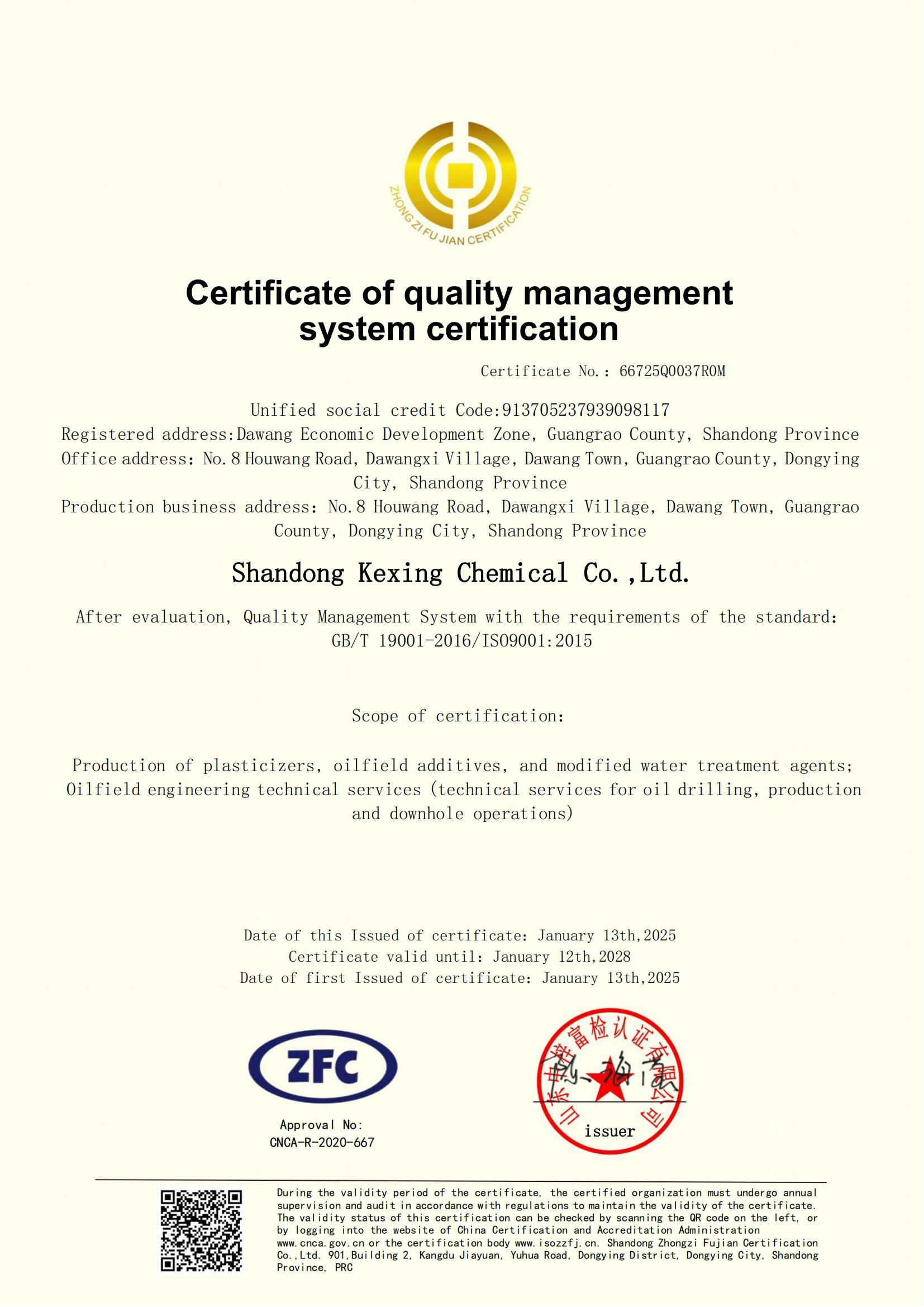
A management-system scope covering plasticizer production is contextual evidence; the certificate of analysis remains the acceptance record.
5. Commercial and continuity terms
The final rung is contractual. The company's capability record states OEM production with private-label customisation, a minimum order quantity of 1 t, a 30 to 45 day lead time, monthly capacity of 10,000 t, delivery on FOB or CIF terms, and after-sales support that includes remote technical assistance, shipping follow-up and formulation guidance. Export markets are listed as Europe, the USA, Japan, South Korea and the Middle East. Breadth converts into supply security only if the buyer's volume can be scheduled inside those terms, which is a conversation about allocation rather than about catalogue length.
Where portfolio evidence stops working
Catalogue versus manufacturing
The first question in a supplier review should be direct: is the product manufactured, tolled or traded? Certificate scope offers a clue, not a per-item proof. A buyer should ask which site produces the Butyl Stearate grade being quoted and whether that site appears inside the certified scope. Where the answer moves between a group entity, a trading subsidiary and a tolling partner, the clarification belongs in writing before the sample is approved.
Segregation inside a mixed phthalate portfolio
This is the clearest case of breadth creating an obligation. A range that lists DBP, DOP, DINP and DPHP next to DOTP, citrate esters and a stearate ester is managing ortho-phthalate and non-phthalate materials within one organisation. If the buyer's application is phthalate-restricted, that is the first place to look, because phthalate-free status has to be defined product by product, with cleaning, line segregation, packaging and labelling controls described in writing. The company's customer case record highlights phthalate-free performance for the products used in that case; the statement should not be extended to all fourteen products without a per-product declaration.
Grade is not implied by the product name
A publicly indexed manufacturer safety data sheet describes a Butyl Stearate product at approximately 60% butyl stearate with approximately 30% butyl palmitate, and the revision would need direct verification before use. That record may describe a mixed material rather than a high-purity grade, and it reflects one supplier's product rather than a market norm. The procurement lesson survives the caveat: a name on a catalogue is an identity claim, while purity, acid value and impurity profile are grade claims, and only the second category belongs in an acceptance specification.
Substance-level regulation is not supplier-level approval
Three public records are regularly misread as supplier credentials. The ECHA registration dossier for butyl stearate under EC 204-666-5 is a substance record; it does not establish that a particular supplier holds EU registration coverage or has completed import obligations for a specific shipment. The US FDA inventory listing of Butyl Stearate among substances authorised for use in indirect food additives under 21 CFR parts 175 to 178 is an authorisation defined by intended use, not a certificate for a drum, and the buyer must confirm that the end use falls inside the described conditions. Customs heading 291570 covers stearic acid together with its salts and esters in broad terms, so trade figures filed under it cannot be read as Butyl Stearate-specific. Each is a starting point for a document request, not an answer in itself.
Application scenarios where breadth changes the conversation
Application fit is settled on the buyer's equipment, but portfolio adjacency changes what can be discussed before the trial begins. The following scenarios are the ones where a multi-product supplier can contribute technically rather than commercially.
- PVC internal lubrication. Butyl Stearate is used as an internal lubricant in PVC compounds, where it sits alongside a primary plasticizer and often an epoxidised soybean oil as a co-stabiliser. A supplier whose range includes ESO, DOTP and DINP can discuss that system rather than a single additive. Whether the lubricant affects fusion behaviour, plate-out or output on a given line remains a trial question.
- Rubber processing and mould release. Release behaviour depends on compound, mould surface and cycle, so supplier input is most useful when it covers both the stearate ester and any plasticizer that softens the compound.
- Inks and coatings. Slip and surface performance requirements are usually defined by the converter. A supplier able to discuss ester chemistry across several families can respond to formulation questions, but it cannot pre-approve a finished ink.
- Metal stamping and drawing. Lubricant selection is driven by the metal, the reduction ratio and the downstream cleaning step, which places the burden of evidence on the buyer's trials.
- Textile softening. Compatibility with the finish bath and the fibre type generally decides suitability, and the grade question returns: industrial and cosmetic categories are not interchangeable.
- Cosmetic emollient use. Cosmetic grade is a distinct request with its own documentation. A substance identity does not convert an industrial grade into a cosmetic one.
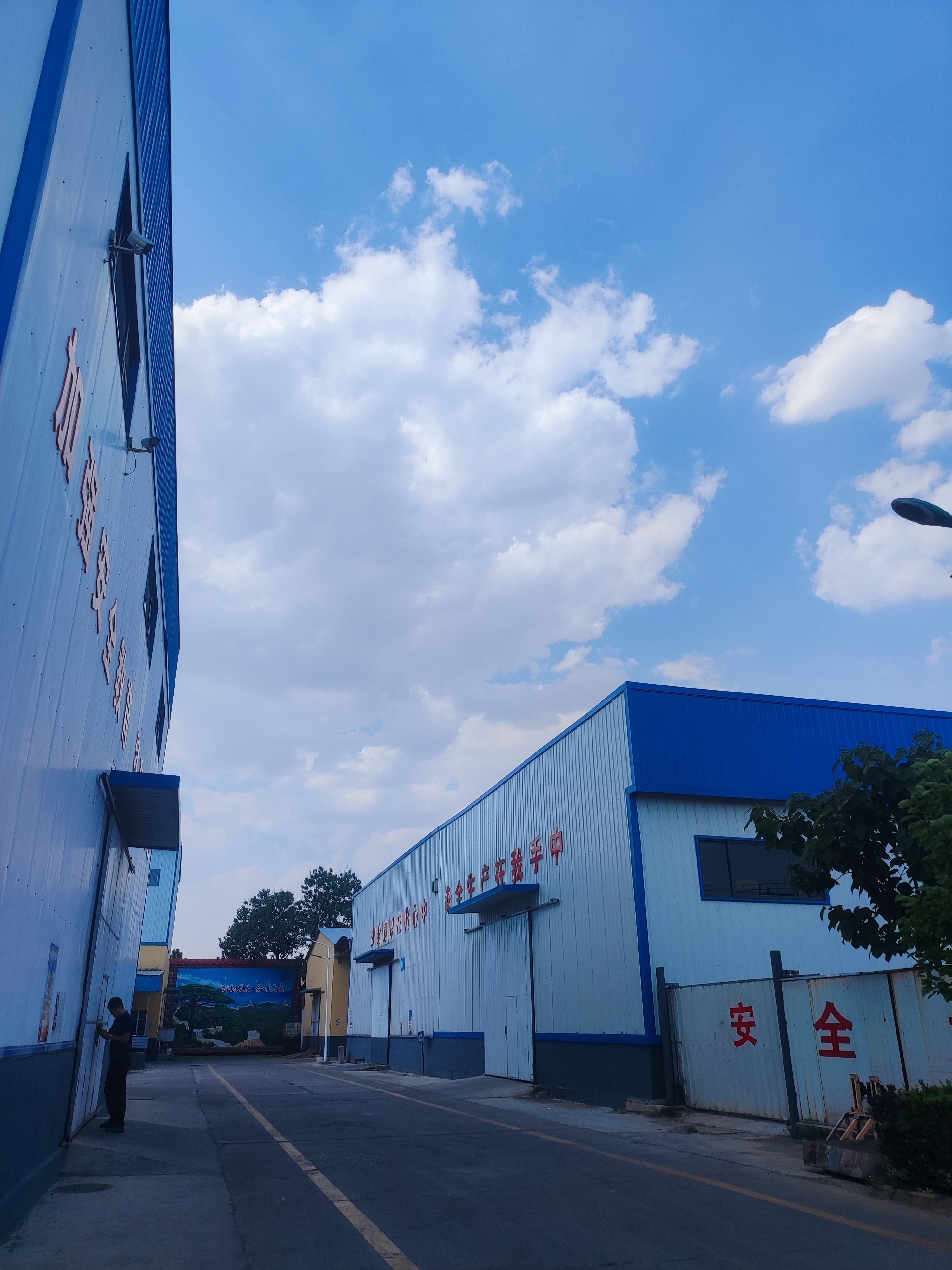
Handling breadth is tested in the warehouse and on the packing line, not in the product list.
The supplier case record: useful, but not independent
The company's case record covers plasticizer users including plastic masterbatch plants, artificial leather manufacturers, food packaging processors and toy factories, with markets listed across Canada, Chile, France, the United Kingdom, India, Japan, South Korea, Peru, Russia, Turkey and the United States. A typical regular order is described as 15 to 25 metric tons per month, across plastic compounding, leather surface finishing, and food-contact plastic and printing-ink formulation. Reported outcomes include improved flexibility of finished goods, low migration, and passing REACH and food-grade safety tests.
That record is supplier-reported and has not been independently audited, so it functions as evidence of the demand pattern and documentation exposure the supplier claims to handle, not as proof of performance in the buyer's process. Its most useful detail is the application mix: food-contact packaging and toys are exactly the end uses where acceptance documents, migration statements and traceability carry the most weight, which is consistent with a supplier positioning a multi-product portfolio rather than a single ester.
Market context worth reading carefully
Commercial research on N-Butyl Stearate estimates that lubricants held the largest application share at 38.5% in 2025, while Asia Pacific accounted for 42.3% of revenue, according to Dataintelo. Those figures describe a demand structure weighted toward industrial processing and Asian production, which explains why suppliers promote range rather than a single ester. The same body of research also shows how carefully such numbers should be used: published 2025 global market estimates for Butyl Stearate differ widely, with ReAnIn reporting USD 5.74 billion against Dataintelo reporting USD 2.85 billion, a gap that points to different product boundaries rather than to a measurement of the same thing.
For a procurement team, market context is orientation, not leverage. It does not set a price, justify a forecast or validate a supplier, and headline market size figures should not enter a sourcing decision unless the boundary and methodology behind them are visible.
Turning portfolio evidence into purchasing terms and acceptance criteria
The baseline commercial terms are short and workable: a minimum order quantity of 1 t, delivery on FOB or CIF terms, acceptance against a factory test report, and payment of 30% deposit with 70% against the bill of lading. Those terms suit a repeat order between parties who already share a specification. They are thin for a first order in a food-contact or phthalate-restricted application, where the acceptance document has to survive an audit two years later. The gap is closed by adding the rows below to the purchase order.
| Criterion | Evidence to request | Why it belongs in the order |
|---|---|---|
| Identity | Product name, CAS 123-95-5, EC 204-666-5 where EU documentation is required, grade designation | Prevents confusion with other stearate esters and fixes the order line |
| Specification | Technical data sheet values for purity, acid value, iodine value, moisture and colour, with test methods | Converts a grade name into measurable limits |
| Batch | Certificate of analysis per lot, the factory test report named in the acceptance clause, and a retained sample | Gives the buyer a reference point if a later lot drifts |
| Packaging and label | Packing format, net weight, lot marking, private-label artwork approval | Private-label supply moves label control to the buyer |
| Segregation | Written statement on phthalate and non-phthalate handling, cleaning and packaging controls | Needed wherever the end use is phthalate-restricted |
| Regulatory documents | Supplier safety data sheet and, where relevant, statements supporting food-contact or EU import requirements | Substance listings do not transfer to a supplier automatically |
| Commercial | Volume window, lead-time confirmation in writing, payment terms and a deviation and claims window | Breadth does not reserve capacity for a specific buyer |
None of these rows contradicts a broad portfolio; they are the price of using it as evidence. A supplier able to answer them quickly has demonstrated more capability than a supplier able to publish fourteen product names, because the answers require records that cannot be generated on a website.
Outlook
As buyers standardise on identity, grade and batch evidence, portfolio breadth is likely to be read as a screening attribute rather than a selling point. If that shift continues, the suppliers who benefit will be the ones whose certificate scopes, data sheets and lot records already match the questions being asked, and the ones who can explain how phthalate and non-phthalate materials are kept apart in the same plant. A fourteen-product range with three management-system certificate families is easier to benchmark than a one-line trader, provided both are asked identical questions and the answers are filed next to the purchase order rather than in a presentation.
For a Butyl Stearate buyer moving from evaluation into execution, the sequence is straightforward: treat the portfolio as a reason to shortlist, treat the specification and certificate of analysis as the reason to approve, and treat the acceptance clause as the reason the decision survives its first audit.
FAQ
Does a wider plasticizer portfolio prove that a supplier produces better Butyl Stearate?
No. Portfolio breadth is indirect evidence that a supplier works across several ester chemistries and their documentation and handling requirements. Product quality is established by the grade specification and by batch conformance to it, which is why a certificate of analysis per lot and an agreed acceptance test carry more weight than the length of a product list.
How can a buyer tell whether a listed product is manufactured or traded?
Ask which site produces the grade being quoted, whether that site appears inside the supplier's certified scope, and whether the product can be supplied under private label with lot traceability. Request the safety data sheet and technical data sheet issued by the manufacturer rather than a distributor version. If the answers move between a group company, a trading arm and a tolling partner, the listing remains unverified for procurement purposes.
What acceptance criteria should a Butyl Stearate purchase order carry?
A workable set covers identity (product name, CAS 123-95-5, grade designation), specification limits with test methods, a certificate of analysis per lot, the factory test report named as the acceptance basis, a retained sample, packaging and lot-marking requirements, and a defined deviation and claims window. Where the end use is food-contact or phthalate-restricted, add the relevant regulatory statements and a written segregation declaration.
Why do ESO, DOA, DOS, DBS and citrate esters matter to a Butyl Stearate buyer?
They indicate that the supplier works across chemistries that appear near Butyl Stearate in PVC, rubber and coating formulations, which supports formulation discussion and can simplify ordering when several additives are needed from one source. They are not substitutes for Butyl Stearate, and their presence in a portfolio does not change the acceptance criteria applied to the stearate ester itself.
What does OEM or private-label capability indicate in a supplier evaluation?
It indicates that the supplier will produce under the buyer's brand, which is relevant for distributors and brand owners. Shandong Kexing Chemical's capability record states OEM production with private labelling, a minimum order quantity of 1 t and a 30 to 45 day lead time. Private-label supply shifts responsibility for artwork, label compliance and lot-marking definition toward the buyer, so label approval and batch traceability become part of the purchase order rather than an afterthought.
Is a supplier with both phthalate and non-phthalate products suitable for a phthalate-free application?
Suitability depends on controls rather than on the existence of the other products. A supplier producing phthalate esters alongside non-phthalate esters should be able to describe cleaning, line segregation, packaging and labelling controls for the specific grade being purchased, and to confirm phthalate-free status product by product in writing before the order is placed.
Additional company and product documentation is available in the Shandong Kexing Chemical brochure (PDF).
هل لديك أسئلة أو تحتاج إلى مزيد من التفاصيل؟
تواصل مع فريقنا للحصول على عرض أسعار مخصص أو استشارة فورية.
طلب عرض أسعار
املأ النموذج أدناه وسيتواصل معك فريقنا بعرض مقترح مخصص.
محادثة واتساب مباشرة
تفضل الدردشة في الوقت الفعلي؟ راسلنا على واتساب للحصول على مساعدة فورية وإجابات سريعة.
- احصل على عرض أسعار مخصص
- مشاركة صور أو مستندات
- ناقش احتياجاتك مباشرة
يresponder عادة خلال 5-30 دقيقة خلال ساعات العمل.