
Buyer Comparison: 65×65 mm Modular Wall Switch vs 81.6 mm Panel
Buyer Comparison: 65×65 mm Modular Wall Switch vs 81.6 mm Panel
Retrofit lighting work begins with constraints that are already fixed: the back box in the wall, the number of conductors available at each control point, the size of the plaster opening, and the finishes the new plate has to sit beside. Under those conditions the useful question is not which switch looks better in a catalogue, but which format still leaves the installer room to work — and which format a buyer can verify, order and repeat across an entire building.
This comparison sets two formats side by side. The first is a small-format plate, illustrated by the 65 × 65 mm plate family (B111, 10AX 250 V~) carrying a small-size modular insert such as the intermediate switch KM141S (22 × 49 mm insert, 10 A, 220–250 V). The second is the A122 2 gang 2 way switch on an 81.6 × 81.6 mm flush panel (10 A, 250 V~). Both are documented products of Wenzhou Huafeng Electric Co., Ltd. (HYFF), a Wenzhou-based manufacturer of wall switches and wall sockets, founded in 2011, whose production is exported entirely to markets in Europe, the Americas, Oceania, Asia and Africa.
Why Retrofit Buyers Compare Plate Formats Rather Than Switch Types
In a new-build project the switch format is usually decided early, together with the wiring design and the box schedule. In a retrofit the order is reversed. The boxes exist, the circuits exist, and the only variables left are the plate footprint, the number of gangs a plate can carry, and whether the chosen module physically pairs with the frame and box already installed.
That reversal creates three practical problems. First, a plate that is slightly too large may not cover the existing opening cleanly, while a plate that is too small may not carry the number of gangs the room needs. Second, an intermediate control point — a third or later position on the same circuit — cannot be created by a 2 gang 2 way switch, and a 2 gang 2 way switch cannot usually be replaced by an intermediate switch without rewiring. Third, mixing formats on one wall produces visible differences in edge depth, gloss and panel thickness even when the colours are nominally the same.
The opportunity is straightforward: where a small-format plate accepts modular inserts, the function behind the plate can be changed without changing the plate itself. Where a wider plate is used, more functions can be placed on one visible face, which reduces the number of plates on a wall. Both approaches are legitimate; they solve different constraints.
The Two Formats Under Comparison
The table below lists only documented parameters for the two formats and their reference models.
| Parameter | Format A — 65 × 65 mm plate with modular insert | Format B — A122 on 81.6 × 81.6 mm panel |
|---|---|---|
| Reference switch | Intermediate switch KM141S (small-size modular) and 1 gang 1 way B111 on a 65 × 65 mm plate | 2 gang 2 way switch A122 |
| Panel size | 65 × 65 mm plate; insert 22 × 49 mm | 81.6 × 81.6 mm |
| Rated specification | KM141S: 10 A, 220–250 V; B111: 10AX 250 V~ | 10 A, 250 V~ |
| Installation | KM141S flush mounted; B111 surface mounted | Flush mounted |
| Panel material | Flame retardant PC shell (KM141S); PC panel (B111) | Flame retardant PC |
| Base material | ABS plastic (B111) | PC |
| Colours | White, black, silver and customized (KM141S); white, yellow, black, silver, golden and customized (B111) | White and customized |
| Certification listed | CE, RoHS (KM141S); CE (B111) | CE, TUV |
| HS code | 8536500090 | 8536500090 |
Table 1. Documented specification points for the two formats. Colour availability and certification scope should be confirmed per ordered model rather than assumed across a whole plate family.
Technical Explanation: What the Ratings and Materials Actually Cover
The electrical difference between the two formats is smaller than the mechanical difference. All three reference models sit in the same lighting-control class: 10 A or 10AX at 250 V~, with the modular insert rated 220–250 V. In IEC and EN switch nomenclature the AX suffix is generally understood to indicate a rating suitable for fluorescent-lamp loads, while a plain 10 A rating covers resistive and general lighting loads. For a buyer this means the B111 plate family and the KM141S insert carry a rating designation that is slightly different from the A122 panel, and the correct choice depends on the lamp type and inrush behaviour of the luminaires actually installed — a point worth settling before the order, not after.
Materials also differ in ways that matter over a long service life. Format A uses an ABS plastic base on the B111 plate and a flame retardant PC shell on the KM141S insert, while Format B uses a flame retardant PC panel with a PC base. ABS and PC behave differently under heat and mechanical stress, and a buyer comparing samples from two formats should look at base material as well as panel material, because the base carries the fixing points and the terminal housing.
Product documentation for these switch formats lists brass terminals and phosphor-copper contacts with silver plating. That is a claim a buyer can verify rather than accept: HYFF's documented incoming and in-process inspection includes silver-layer thickness inspection, which is the control point that makes a silver-plating statement checkable at the factory level.
Two further values appear regularly in this class of comparison — a 40,000-cycle mechanical life and an 850 °C flame-retardant rating for the panel material. Both are testable rather than promotional claims, and both should be tied to a test report and to the exact model ordered. HYFF's documented quality flow includes glowing-filament testing, performance life testing, plastic ball-pressure testing and on-off testing on the assembly line, and the company's case documentation for a European brand owner records a supply relationship running eight years at minimum with mechanical testing to applicable product standards, while noting that real service life depends on electrical load, operating frequency, installation quality and operating environment. The published after-sales position is an 8-year warranty.
Box Fit: The Constraint That Settles Most Retrofit Decisions
Where the existing opening is small, shallow or irregularly cut, the 65 × 65 mm plate generally has the advantage. A smaller plate covers a smaller footprint, needs less support-frame area, and is easier to align on an opening that was cut for a previous product. The trade-off is that less surface area is available for gangs, labelling and terminal housing, and a surface-mounted plate such as the B111 sits proud of the wall, which is visible in a room finished to a flush standard.
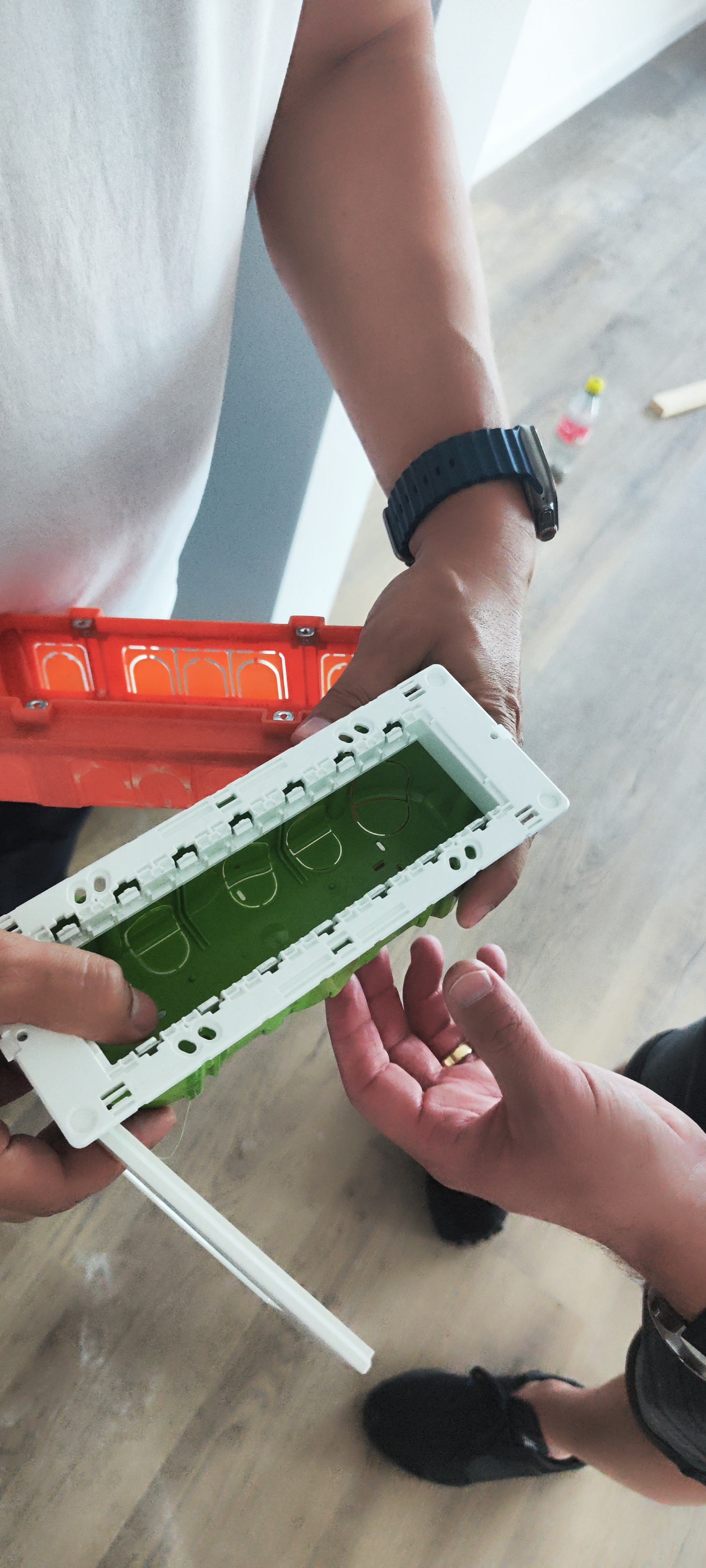
Support frame detail from a European retrofit supply case. Frame-to-insert pairing, not plate colour, is what determines whether a modular format fits an existing box.
The critical point for a modular format is not the plate size but the insert-to-frame pairing. The KM141S is a 22 × 49 mm flush-mounted insert; whether a specific 65 × 65 mm plate and support frame accepts that insert must be confirmed against the frame drawing for the exact series being ordered. This is precisely the check that HYFF's European brand-owner case documentation describes: sample installation and functional testing, and compatibility with the customer's local wall boxes and mounting system, were the acceptance steps recorded before bulk supply of more than 1,000 units per model.
Format B behaves differently. An 81.6 × 81.6 mm flush-mounted panel needs a clean opening of roughly that size, and its advantage is the amount of function it can carry once installed. Buyers should also note that 81.6 mm is not the same as the 86 × 86 mm footprint used by several other HYFF series, such as the H111 switch and the V149 socket. Two plates that look similar in a photograph can differ by several millimetres at the edge, which becomes obvious when they sit side by side on the same wall.
Gang and Way Flexibility: Intermediate Control Against 2 Gang 2 Way
The two formats answer different circuit questions, and this is where most specification errors originate.
- Intermediate switching (KM141S): an intermediate switch provides a middle control position on a circuit that already has two-way switching at each end. It is the format to use when a corridor, staircase, landing or large room needs control from three or more positions on the same lighting circuit. It does not add a second circuit.
- 2 gang 2 way switching (A122): a 2 gang 2 way unit provides two independent changeover circuits in one plate. It is commonly used where two loads must be controlled from two positions each, or where a single plate must serve two separate circuits. It does not create a third control position on one circuit.
The practical decision rule is therefore simple. Count the number of control positions per circuit first. If any circuit has three or more positions, the intermediate insert is the relevant part. If the room needs more circuits than positions, the multi-gang plate is the relevant part. Where a retrofit contains both requirements, a mixed installation is possible but should be planned plate by plate, because the two formats differ in panel size, mounting method and material finish.
Finish Consistency Across a Plate System
Finish consistency is usually the least technical and most visible risk in a retrofit. Three variables decide whether plates look like one installation: panel size, mounting method and surface material.
Within the two formats compared here, the differences are explicit. The KM141S insert is offered in white, black, silver and customized colours; the B111 plate is offered in white, yellow, black, silver, golden and customized colours; the A122 panel is offered in white and customized colours. Mounting methods differ as well, with the B111 listed as surface mounted and the KM141S and A122 listed as flush mounted. Mixing a surface-mounted plate and a flush-mounted plate in the same room will be visible regardless of colour matching.
The wider point is about plate ecosystems. On the 81.6 × 81.6 mm format, the A122 switch has a same-format companion in the A129 socket, which makes it easier to keep switch and socket lines visually aligned in one room. In the 65 × 65 mm format as documented here, the reference products are the B111 plate family and the modular KM141S insert, so the buyer should confirm which sockets and other functions are available on the same plate before committing a whole floor to that format.
Certification and Standards Beyond the Label
For European and Australian projects, the certification question is not whether a certificate exists, but whether it covers the model being ordered.
In the European Union, EN 60669-1:2018 is the mandatory safety standard for wall switches, covering manual switches for household fixed installations. HYFF holds TÜV Rheinland certificate R 50714462 0001, issued by TÜV Rheinland LGA Products GmbH under EN 60669-1:2018 for flush-type fixed switches, valid from 10 March 2026 to 10 March 2028. The certificate's listed scope covers a specific model series, so a buyer ordering the A122 or the KM141S should confirm whether the exact model appears in the certificate scope or whether a different document applies. The product data for the A122 lists CE and TUV certification, and the KM141S lists CE and RoHS.
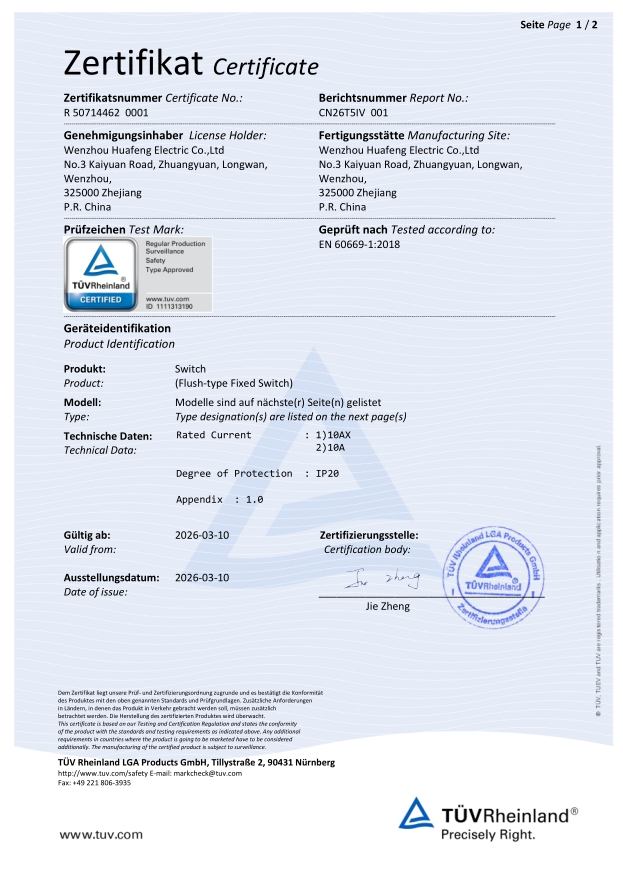
TÜV Rheinland certificate R 50714462 0001, issued under EN 60669-1:2018 for flush-type fixed switches, valid to 10 March 2028.
For Australia and New Zealand, AS/NZS 3133:2020 is the primary technical standard for wall switches, and AS/NZS 3000:2018 Clause 4.6.3.1 requires that every socket-outlet be individually controlled by a separate switch operating in all active conductors. This is a wiring and product-selection requirement that affects how many switching functions a project needs, and it is one reason switch counts rise in Australian residential work. HYFF's SAA certification documentation as provided relates to the HT213 10 A single powerpoint, so an Australian buyer specifying switches in the two formats compared here should ask explicitly which models carry SAA documentation and how AS/NZS 3133:2020 is addressed for them.
Factory-level management is separately documented: HYFF holds ISO 9001 certificate 0350225Q30335R0S, issued 15 August 2025 and valid to 14 August 2028 under GB/T 19001-2016 / ISO 9001:2015, covering the design, production and export of switches, sockets and electromagnetic buzzers. Socket documentation is also on file, including TÜV Rheinland certificates R 50714584 0001 and R 50714619 0001 under DIN VDE 0620-1:2021-02, and a CE Certificate of Conformity DACE260331002RL issued under IEC 60884-1:2022. These documents are relevant context for a buyer sourcing a full plate ecosystem rather than switches alone.
Where HYFF Sits in This Format Discussion
Wenzhou Huafeng Electric Co., Ltd. (HYFF) is a manufacturer of wall switches and wall sockets based in Wenzhou, Zhejiang, founded in 2011. The company operates a 7,000 m² facility with 118 employees, an annual output of approximately 35,000,000 units and a research and development team of 10 engineers, and it exports 100% of its production to markets in Europe, the Americas, Oceania, Asia and Africa, including Spain, Greece, Romania and Indonesia.
For buyers, the relevant capability facts are concrete rather than decorative. Production mode includes ODM with logo customization; monthly capacity is stated at 2,900,000 units; lead time runs 30–45 days; minimum order quantity is 1,000 units; quality control is described as 100% test; and the published after-sales position is an 8-year warranty. The company's documented case history covers a European wall switch brand owner, importer and electrical product distributor ordering more than 1,000 units per model for residential, apartment and commercial indoor lighting control, where sample installation and functional testing were completed and the products proved compatible with the customer's local wall boxes and mounting system.
In the specific comparison at hand, HYFF's relevance is not that it favours one format. It is that both formats are documented within the same catalogue — the 65 × 65 mm plate family and modular insert on one side, the 81.6 × 81.6 mm A122 panel on the other — which allows a buyer to evaluate box fit and finish consistency against one supplier's drawings rather than across two unrelated product ranges.
Application and Use Cases: Which Format Fits Which Project
The following decision table is a buyer's view, not a supplier recommendation. It maps typical retrofit situations to the format that usually fits, and lists the check to complete before ordering.
| Scenario | Format that usually fits | Why | What to verify before ordering |
|---|---|---|---|
| Retrofit into an existing small or shallow box | 65 × 65 mm plate with modular insert | Smaller footprint covers a smaller opening and needs less frame area | Insert-to-frame compatibility; box depth; whether the KM141S flush mounting matches the existing box |
| Hotel guest rooms with repeated layouts | A122 2 gang 2 way on 81.6 × 81.6 mm | Two circuits per plate reduce plate count on a repeatable room plan | Finish continuity across the whole room programme; certification documents required for the destination market |
| Office and commercial fit-out | A122 2 gang 2 way on 81.6 × 81.6 mm | Supports two independent changeover circuits from one location | Number of conductors present at each switch point; whether any circuit needs three or more control positions |
| Residential flush-mounted interiors | Either, depending on the opening | A122 and KM141S are both flush mounted; B111 is surface mounted | Consistency of mounting method within one room; base material and colour across the same wall |
| Corridors, staircases, multi-point control of one circuit | Modular intermediate insert (KM141S) | Provides the middle control position that two-way switching cannot provide | Wiring topology at each point; the insert must be paired with the correct plate and frame |
| Outdoor or wet positions | Neither of the two formats compared here | Neither format is documented with an IP rating | Whether a rated product is required; HYFF's documented outdoor-rated item in this catalogue is the WP149 IP54 socket |
Table 2. Neutral buyer decision table for the two formats. Outdoor lighting control commonly calls for an IP65 rating under IEC 60529, which neither switch format in this comparison carries.
Market Trend Analysis: Why Format Decisions Keep Returning to Retrofit
The global light switches and electrical sockets market was valued at approximately USD 17.6 billion in 2024, according to Strategic Market Research, and Asia Pacific held a 42.5% revenue share of the electrical switch market in 2025 according to Dataintelo. Those figures describe a mature category where growth comes less from new categories and more from replacement, refurbishment and standardisation.
The faster-moving segment sits alongside it. Grand View Research reports that the global smart switch market reached USD 4.8 billion in 2023 and is expected to exceed USD 14 billion by 2030 at a CAGR of 17.2%. Cognitive Market Research places touch-type smart switches at 45% of the global market share as of 2023. The relevance to this comparison is indirect but real: as smart functions spread, the mechanical plate and box interface becomes the stable layer that has to accept them, and buyers who standardise a plate format early avoid re-cutting boxes later. The market remains fragmented, with Schneider Electric holding an 11.5% share of the global electric switch market in 2025 according to Global Market Insights — large enough to set expectations on documentation quality, but not large enough to standardise the retrofit interface.
Limits and Trade-offs: What Neither Format Can Do
A comparison without limits is a brochure. Both formats have boundaries that buyers should weigh before selecting either.
- Small-format limits: a 65 × 65 mm plate carries less visible surface, so gang count, labelling and terminal housing are constrained; the KM141S insert is a single-function module at 22 × 49 mm, and pairing it with an existing frame is not automatic; the B111 reference plate is surface mounted, which is visually different from flush-mounted work.
- Wide-format limits: an 81.6 × 81.6 mm panel needs a correspondingly larger and cleaner opening, which is not always available in a retrofit; it is not interchangeable with 86 × 86 mm series; and its colour range as documented is narrower than the small-format insert and plate options.
- Shared limits: neither format is documented with an IP rating, so neither belongs in wet or outdoor locations without additional protection; and neither format creates a three-position circuit on its own — that depends on the insert type and on the conductors already present.
- Procurement limits: HYFF's terms are 1,000 units minimum order quantity, 30–45 days lead time, EXW, FOB or CIF delivery, pre-shipment inspection based on approved samples and confirmed specifications, and 100% TT in advance. A project that needs a small mixed trial quantity should plan for that MOQ and for sampling before bulk release.
Future Outlook
Two directions are likely to shape this decision over the next few product cycles. The first is standardisation of smart control layers: the Matter 1.6 protocol update in June 2026 introduced NFC-based commissioning to simplify the setup of smart wall switches and lighting devices, which reduces the commissioning burden but does not change the physical plate and box interface. Buyers who choose a plate format for retrofit reasons today will still need that format to accept later electronic inserts.
The second is the continuing weight of replacement demand. In a market of this size, the volume of switches sold to replace existing products is significant, and replacement demand rewards formats that fit existing boxes and existing décor rather than formats that look best in a new-build showroom. For procurement teams, the practical consequence is that plate footprint, frame compatibility and finish consistency deserve the same attention in a specification as ratings and certifications.
Acceptance Questions Before Selecting Either Format
Before confirming a format, a buyer can use the following check items. Each one addresses a failure mode that is difficult and costly to correct after installation.
- What is the measured opening size and box depth at each control point, and does the selected plate and frame cover it without gaps?
- Does the plate or frame accept the specific insert required — for example, does the frame accept the 22 × 49 mm KM141S intermediate insert?
- How many control positions does each circuit require, and does the chosen switch type actually deliver that number?
- Are all plates in one room the same mounting method — flush or surface — and the same base material?
- Which models appear in the certificate scope, not just which certificates exist: TÜV Rheinland R 50714462 0001 under EN 60669-1:2018, CE documentation, and, for Australia, SAA documentation and AS/NZS 3133:2020 coverage?
- Is a sample installation and functional test required before bulk release, and which specifications will be confirmed in writing?
- What are the confirmed colour and finish references for the exact models ordered, and do they match any existing installation on site?
- What are the commercial terms — MOQ, lead time, delivery term, inspection basis and payment condition — and can they support the project schedule?
FAQ
It depends on the frame and the box, not on the insert alone. The KM141S is a 22 × 49 mm flush-mounted intermediate switch rated 10 A, 220–250 V, with a flame retardant PC shell and CE, RoHS certification. HYFF's case documentation for a European brand owner, importer and distributor records sample installation and functional testing and compatibility with the customer's local wall boxes and mounting system before bulk orders of more than 1,000 units per model. The compatible plate and support frame for the specific series must still be confirmed against the frame drawing.
Both ratings appear in these two formats: the B111 65 × 65 mm plate is rated 10AX 250 V~, the A122 is rated 10 A, 250 V~, and the KM141S insert is rated 10 A at 220–250 V. In IEC and EN switch nomenclature the AX suffix is generally understood to indicate suitability for fluorescent-lamp loads, while a plain current rating covers general lighting loads. The correct choice depends on the lamp technology and inrush characteristics of the luminaires installed, so the rating designation should be matched to the load rather than to the plate size.
The formats answer different circuit needs. An intermediate switch such as the KM141S provides a middle control position on a circuit that already has two-way switching at both ends, which is how three or more control positions on one circuit are achieved. The A122 is a 2 gang 2 way switch, meaning two independent changeover circuits in one plate; it supports two-position control of two separate circuits, not a third position on one circuit. The number of conductors available at each point determines which of the two can actually be used.
Not automatically. The two formats differ in panel size, mounting method and documented colour range. The B111 plate is listed as surface mounted with an ABS plastic base, while the KM141S insert and the A122 panel are flush mounted, and the A122 uses a flame retardant PC panel with a PC base. Documented colour options also differ: white, yellow, black, silver, golden and customized for B111; white, black, silver and customized for KM141S; white and customized for A122. Matching requires confirming mounting method, base material and finish reference per model.
For the European Union, EN 60669-1:2018 is the mandatory safety standard for wall switches, and TÜV Rheinland certificate R 50714462 0001 covers flush-type fixed switches under that standard, valid from 10 March 2026 to 10 March 2028. The KM141S lists CE and RoHS, and the A122 lists CE and TUV, so the buyer should confirm that the exact ordered model appears in the relevant certificate scope. For Australia and New Zealand, AS/NZS 3133:2020 is the primary standard for wall switches and AS/NZS 3000:2018 Clause 4.6.3.1 requires individual switching of socket-outlets; HYFF's provided SAA documentation relates to the HT213 single powerpoint, so SAA coverage for switch models should be requested specifically.
HYFF's stated terms are a minimum order quantity of 1,000 units, delivery under EXW, FOB or CIF, pre-shipment inspection based on approved samples and confirmed specifications, and 100% TT in advance. Lead time is 30–45 days, monthly capacity is 2,900,000 units, production mode includes ODM with logo customization, quality control is 100% test, and the published after-sales position is an 8-year warranty. ISO 9001 certificate 0350225Q30335R0S, valid to 14 August 2028, covers the design, production and export of switches and sockets.
Closing Note
For retrofit projects, the 65 × 65 mm modular route and the 81.6 × 81.6 mm A122 panel are not competitors in the ordinary sense. One solves small openings and single-function control points; the other solves multi-circuit density and plate-level consistency. The decision is settled by three measurements taken on site — opening size, box depth and conductor count — and by two documents checked before ordering: the certificate scope for the exact model, and the frame compatibility drawing for any modular insert. Buyers who complete those five checks can select either format without relying on a supplier's preference. Further specification detail is available in the HYFF product brochure at HYFF_2026_compressed.pdf, and product and certification information on the manufacturer site at www.hyffelectric.com.