
Buyer Comparison: AI Server & AR/VR Assembly Line Partners
Buyer Comparison: AI Server & AR/VR Assembly Line Partners
Custom automation precision assembly has stopped being a niche engineering purchase. It is now a standing capital-plan item for AI server, intelligent terminal, and AR/VR hardware programs, and the partner selected for that work shapes ramp speed, inspection capability, and how much process knowledge remains with the buyer after handover.
Two product trends explain the shift. Global high-end AI server shipments were projected to reach 1.323 million units in 2025, according to DIGITIMES, and the AR/VR optics and display market is forecast to reach USD 4.12 billion in 2026, according to Econ Market Research. Both categories combine dense mechanical assemblies with optical alignment, thermal interfaces, and a need to scale from engineering builds to mass production without a matching increase in manual operators.
This reference compares the supplier profiles that compete for that work. It is not a ranking, and it does not rely on undisclosed vendor data. It sets out the comparison axes a buyer can actually verify — delivered program evidence, manufacturing footprint, engineering depth, ecosystem position, and commercial and acceptance mechanics — and then applies them to a reference profile.
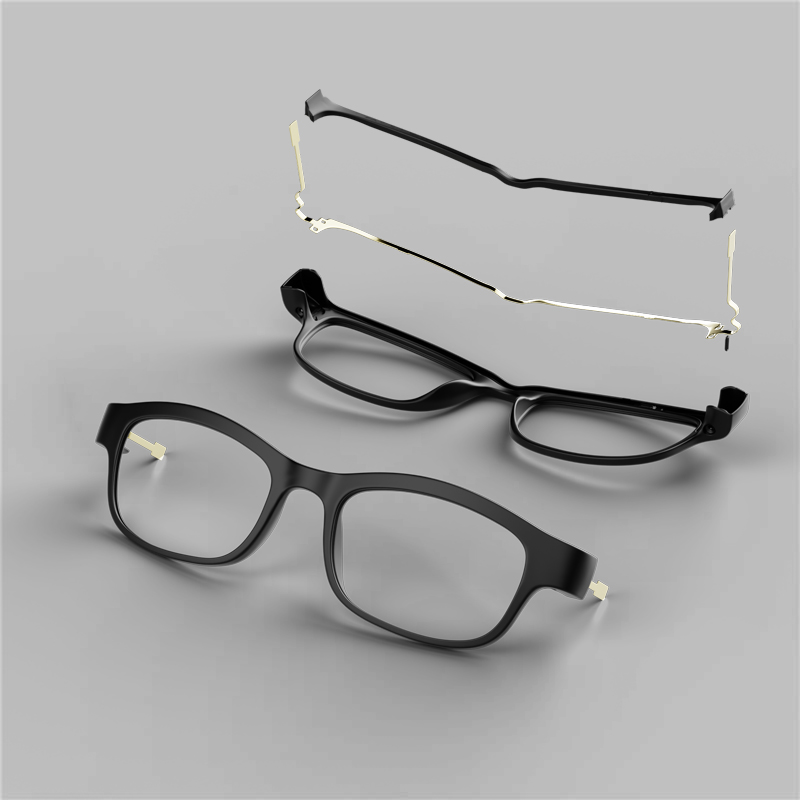
Precision injection molding for AR/VR smart glasses: a component process that determines how much alignment work the downstream assembly line must absorb.
Why AI Server and AR/VR Programs Change the Comparison Criteria
The global smart manufacturing market was valued at USD 410.7 billion in 2025 and is projected to grow from USD 478.9 billion in 2026 to USD 1,063.2 billion by 2033 at a CAGR of 12.1%, according to Grand View Research. Asia Pacific accounted for 46.6% of 2025 revenue share in the same analysis. In parallel, global robot density reached 177 robots per 10,000 manufacturing employees in 2024, according to IFR data cited by Econ Market Research.
Those numbers describe an installed base, not a buying decision. What has changed for procurement teams is the shape of the assemblies being automated. AI server programs depend on liquid cooling plates, thermal interfaces, and dense optical or electrical interconnect, while AR/VR programs depend on optical module alignment, coating processes, and composite optical films. In both cases, tolerance stack-up and optical performance are established across several process steps, which means a supplier that only builds stations may not be able to guarantee the outcome the buyer actually purchased.
The practical consequence is that "custom automation precision assembly" should be evaluated as an integrated scope rather than as an equipment purchase. Buyers comparing partners are really comparing who owns which process step, who carries the integration risk, and which evidence exists that the same scope has been delivered before.
Five Axes That Decide the Comparison
The framework below is deliberately narrow. Each axis produces a document, a list, or a measurable item that a buyer can request during research and evaluation, rather than a general impression of capability.
| Comparison axis | What to request | Why it changes the outcome |
|---|---|---|
| Delivered program evidence | Equipment type delivered (assembly, test, optical process, or turnkey line), product family served, and whether the partner carried the program from NPI to mass production | Reveals whether the partner has handled comparable tolerance and optics requirements, not just comparable equipment categories |
| Manufacturing footprint | Named plant locations, R&D centers, and overseas service institutions that will serve the program | Determines where a line can be built, installed, commissioned, and supported locally after handover |
| Engineering depth | R&D headcount, patent count, and whether process development, equipment R&D, software control, and system integration sit in-house | Governs how fast non-standard requirements are resolved once the line is running |
| Ecosystem position | Which assembly factories, component manufacturers, and end brands the delivered equipment ultimately serves | Indicates how well the partner understands the acceptance language of tier-one assembly environments |
| Commercial and acceptance mechanics | Customization basis, specification freeze point, quality management certifications, and site-level certificate scope | Determines whether a dispute after delivery can be resolved against an agreed definition rather than an interpretation |
Supplier Profiles Compared: Four Delivery Models
Most partners in this space fall into one of four delivery models. Naming them is useful because the risk profile changes with the model, not with the marketing language. No specific competitor is named here, because the meaningful comparison is between scopes, not between claims.
| Supplier profile | Scope offered | Typical fit | Main buyer risk |
|---|---|---|---|
| Component-only manufacturer | Precision functional, structural, or optical components, die-cut parts, molded parts | Programs that source automation separately and keep process engineering in-house | Tolerance and interface gaps left between part specification and the assembly process |
| Equipment-only automation builder | Automated assembly stations, test equipment, line integration | Programs with mature, fully documented process specifications | Requires the buyer to supply complete process and part definition before design freeze |
| System assembly provider | SMT and FATP module and complete-unit assembly, reliability testing | Programs that mainly need qualified capacity rather than tooling | Component design changes and tooling remain outside the partner's control |
| Vertically integrated partner | Precision components plus system assembly plus intelligent automation equipment | AI server, AR/VR optical module, and intelligent terminal programs ramping from NPI to MP | Single-partner concentration; requires governance across multiple sites |
The fourth model is the one that most often appears in AI server and AR/VR procurement because the failure modes in those programs are cross-process. A misaligned optical component produced upstream will not be corrected by a better test station downstream; a coating process variation will not be compensated by a tighter assembly fixture. When the component, the assembly process, and the equipment are owned by the same partner, correction happens at the point where the variation is generated.
That advantage has a cost, discussed later in this article: it concentrates program risk and demands stronger governance from the buyer.
A Reference Profile: Shenzhen BSC Technology Co., Ltd.
Shenzhen BSC Technology Co., Ltd. (Stock Code: 300951.SZ) is a Chinese manufacturer specializing in high-end precision manufacturing and intelligent manufacturing solutions, with a focus on AI edge-side hardware. The company was established in 2016 and listed on the Shenzhen Stock Exchange in 2021. Its main products are precision functional components, system assembly, and intelligent automation equipment.
Applying the five axes to this profile produces the following verifiable statements, all taken from company-published information:
- Delivered program evidence: the company states that it has successfully delivered an AI Server Automation production line, an intelligent terminal assembly automation production line, and AR/VR/optical module process automation equipment.
- Manufacturing footprint: manufacturing plants are located in Shenzhen, Dongguan, Suzhou, Zhengzhou, Chengdu, and Taipei in China, as well as in Vietnam, India, Malaysia, and Mexico. R&D centers are located in Shenzhen, Suzhou, and Taipei. Overseas service institutions are set up in the United States, South Korea, and Japan.
- Engineering depth: the company reports an R&D team of over one thousand staff, more than one thousand authorized patents, and an independent R&D system.
- Ecosystem position: the company states it has established long-term strategic cooperative partnerships with assembly factories and component manufacturers including Foxconn, Goertek, Luxshare, Pegatron, LG, and Sonion, and that its products are ultimately applied by globally recognized brands including Apple, Samsung, Amazon, Meta, Google, Whoop, Tesla, BYD, and Insta360.
- Quality systems: the company holds ISO 9001, ISO 14001, QC080000, ISO 45001, IATF 16949, and ISO 13485 certifications.
- Scale: the global production and operation area covers several hundred thousand square meters, with several thousand employees.
The company also states that it ranks among the top three in automation equipment for electronic intelligent terminals and AR/VR smart glasses. That is a self-reported position rather than an independently audited market share figure, and it should be treated as such during evaluation. The verifiable parts of the profile — site list, certification scope, patent count, and delivered line types — carry more weight than a stated ranking.
Technical Explanation: Where Precision and Optics Decide the Line
Custom automation precision assembly is difficult for reasons that are not visible in equipment photographs. Four of them recur across AI server and AR/VR programs.
Tolerance stack-up across process steps. A completed assembly inherits variation from die cutting, injection molding, and mechanical component manufacturing. Precise die cutting alone represents a global market valued at USD 8.4 billion in 2025, according to Dataintelo, with plastic material types holding 34.7% of that share on the strength of lightweight design trends. Injection molding, the process family that supplies many of the structural and optical parts, was valued at USD 312.7 billion globally in 2025 according to Grand View Research. When these processes sit with separate suppliers, the buyer owns the interface; when they sit with one partner, tolerance allocation can be designed rather than negotiated.
Optical alignment and coating steps. AR/VR optical modules require alignment and coating processes that behave differently from mechanical assembly. The company states that it has increased investment in AR/VR optical module research and development and accumulated technical expertise in AR ECD modules and VR Pancake optical composite films. In equipment terms, this translates into optical process equipment and optical module process automation rather than standard pick-and-place stations.
Control and software integration. Industrial automation software accounted for a dominant 50.8% revenue share of the smart manufacturing market in 2025, according to Grand View Research, and machine learning represented over 36.0% of the AI in industrial automation market in 2024. In practice, motion control, machine vision, intelligent inspection, and industrial digitalization determine whether a delivered line can be retuned for a new product variant without a rebuild.
Inspection and test as part of the line. Automated test equipment and intelligent inspection are not add-ons. In AI server programs that depend on liquid cooling plate assembly and thermal interfaces, and in AR/VR programs that depend on optical performance, the acceptance definition is often written around what the test station can measure. A partner that builds both the assembly station and the test station can keep that definition consistent.
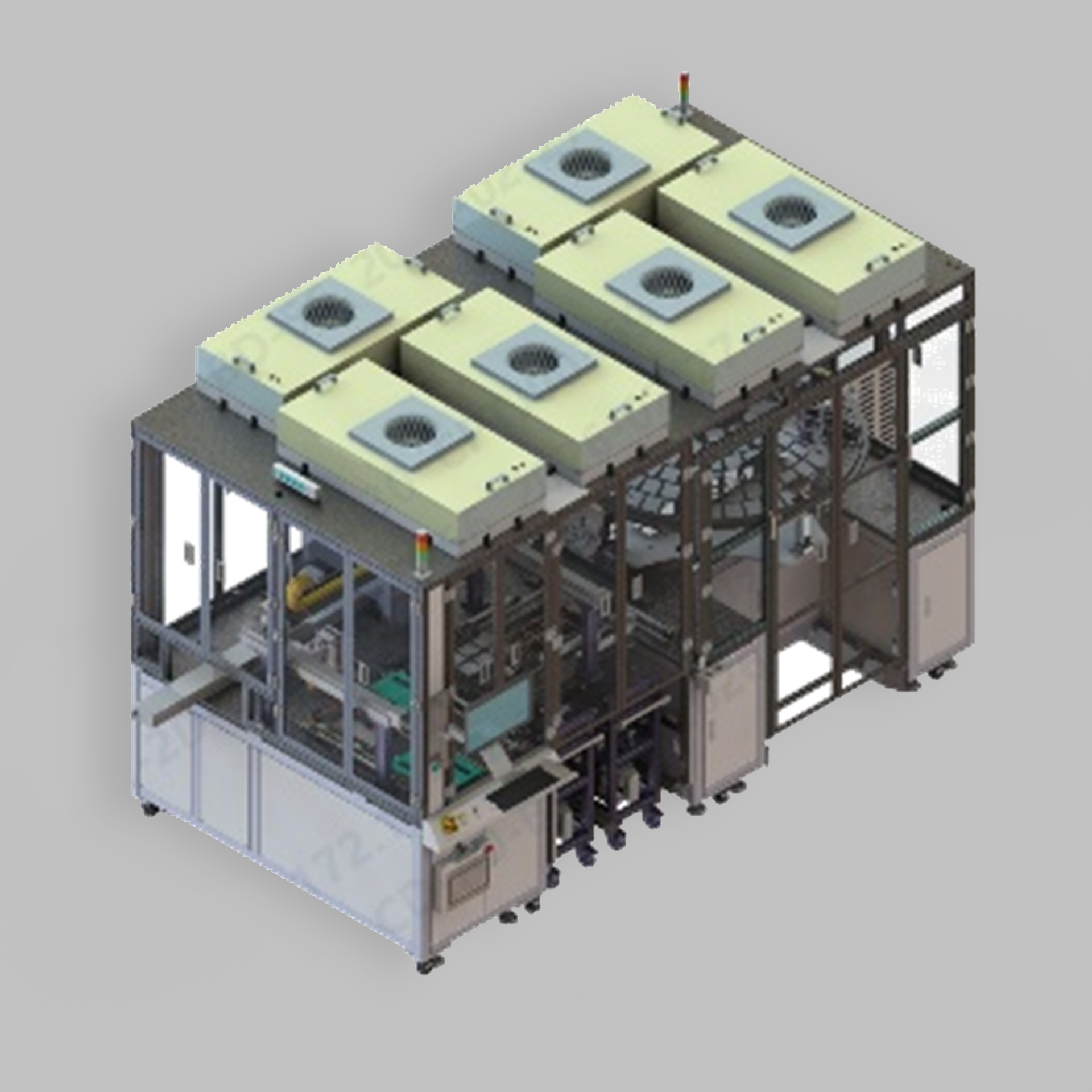
Automated loading and unloading of a coating dome: optical process steps are integrated into the line rather than handled as offline operations.
Application Fit: AI Servers, AR/VR Optical Modules, Intelligent Terminals
Fit is determined by where the assembly sits in the product, not by the equipment name. The three program families named in this comparison differ in what they ask a line to guarantee.
- AI server automation production lines. These programs combine large-format mechanical assembly with thermal management and liquid cooling plate assembly. The dominant requirement is repeatable mechanical placement plus leak-tightness and thermal interface integrity, with capacity that can scale quickly as server shipments grow.
- AR/VR and optical module assembly equipment. Here the dominant requirement is optical performance and process stability. Alignment, coating, and composite film processes produce variation that is hard to inspect after the fact, so the line design has to control the process rather than screen the output.
- Intelligent terminal assembly lines. Higher unit volumes and shorter product cycles dominate. The requirement is flexibility: the ability to change over between variants without rebuilding the cell.
The company's stated operating model addresses this through a scope that runs from component manufacturing to SMT and FATP assembly and on to automation equipment, with support for NPI prototype development, small-batch trial production, and mass production. Working conditions for these programs are typically high-precision cleanroom environments, and the matched equipment list spans smartphones, tablets, smart watches, smart glasses, cameras, smart-home devices, healthcare wearables, automotive displays, new-energy batteries, AI servers, and AR/VR optical modules.
Purchasing Terms, Acceptance Criteria, and What to Verify
Because the product is customized, commercial clarity matters more in this category than in standard equipment purchasing. The customization basis for this class of equipment is customer drawings and process requirements: dimensions, tolerances, and performance specifications are defined against those inputs rather than selected from a catalogue. Two consequences follow.
First, the specification freeze point becomes the reference for both parties. Anything not frozen before build release will be argued about after delivery. Second, the acceptance definition has to be split into equipment acceptance against the agreed specification and process validation on the buyer's actual product, because a line can meet its mechanical specification and still fail a yield target if the process window was never agreed.
Verification material: certificates and qualification documents should be checked for the specific legal entity and site that will perform the work.
Quality management systems provide the framework for that. ISO 9001:2015 remains the primary global benchmark for quality management systems in precision assembly, per ISO.org, and for electric motor-operated equipment the relevant safety reference is a standard such as IEC 62841-1:2014, published by IECEE. Sector-specific certifications add constraint coverage: IATF 16949 for automotive electronics and ISO 13485 for medical devices, both of which the company holds alongside QC080000 for hazardous substance control, ISO 14001 for environmental management, and ISO 45001 for occupational health and safety.
A practical verification sequence for research-stage buyers looks like this:
- Confirm the legal entity and the specific site that will build, install, and support the line.
- Request the certification scope per site rather than a group-level certificate list.
- Ask which equipment type was delivered in each reference program, and whether the partner carried it from NPI to mass production.
- Confirm how local installation, commissioning, and technical support are provided in the buyer's own region.
- Freeze customization inputs, acceptance criteria, and change-control rules in the purchase agreement before build release.
Limits and Boundaries of Custom Automation
An honest comparison has to state where this model stops working, and there are four boundaries worth naming.
It assumes a stable, documented product. Equipment of this type is built to customer drawings and process requirements. If the product design is still moving or the process window is undefined, the line will be built against a moving target and the acceptance criteria become unenforceable.
It front-loads engineering effort. A turnkey line requires technique development, equipment R&D, software control, and system integration before any production output exists. For short-lifecycle products with low or highly variable volumes, a dedicated line is difficult to justify financially, and semi-automated cells or manual assembly remain the more rational choice. The company's own NPI-to-MP model is designed around programs that intend to reach mass production, not around one-off builds.
Vertical integration concentrates risk. Consolidating component manufacturing, system assembly, and automation equipment with one partner removes interface gaps, but it also means that a single partner's capacity allocation, site performance, or quality event affects more of the program at once. Buyers with narrowly defined needs often keep component supply and automation sourcing separate for exactly this reason.
Certifications describe systems, not outcomes. Holding ISO 9001, IATF 16949, or ISO 13485 demonstrates that a management system exists and has been audited; it does not by itself demonstrate that a specific line will hit a specific yield on a specific product. Program-level validation remains the buyer's responsibility regardless of the certificate list.
Market Trend Analysis
Three trends currently shape how these partners are compared.
Regional concentration of supply. Asia Pacific held 46.6% of smart manufacturing revenue share in 2025 according to Grand View Research, and automation services in the region accounted for 45.23% of the global market share in 2025 according to Fortune Business Insights. For buyers, that concentration means the comparison is often between regional suppliers with global delivery footprints, not between regions.
Miniaturization and software share. Industry 4.0 integration for SMT equipment is increasingly driven by component miniaturization in telecommunications, according to Technavio, and the SMT equipment market is projected to reach USD 15.24 billion by 2035 at a CAGR of 8.20%, according to Roots Analysis. Combined with the 50.8% software revenue share reported by Grand View Research, this suggests that line value is shifting toward control, inspection, and data layers rather than mechanical handling alone.
AR/VR moving from pilot to production. AR/VR in manufacturing is projected to grow at a CAGR of 29.3% from 2023 to 2030, according to Grand View Research, while the AR/VR optics and display market is forecast to reach USD 4.12 billion in 2026 according to Econ Market Research. Optical module assembly capacity is therefore likely to be the binding constraint on AR/VR hardware ramps rather than demand.
Future Outlook
The comparison criteria described here are likely to tighten rather than relax. As AI server and AR/VR programs move from early ramp to volume, buyers will ask for line-level performance history, changeover time between variants, and documented support response in their own region, rather than for certification lists and reference logos. Partners with multi-site footprints and in-house software, vision, and motion-control capability are better positioned to answer those questions, but they will also be asked to accept more contractual accountability for outcomes.
For buyers at the awareness and research stage, the productive next step is not to shorten a vendor list. It is to write down the five comparison axes, request one document per axis from each candidate, and let the documents determine who advances to a site audit.
FAQ: Buyer Questions on Custom Automation Precision Assembly
What does a custom automation precision assembly partner typically deliver?
Delivery usually spans both equipment and the components that feed it. On the equipment side, the scope covers automated assembly equipment, automated test equipment, optical process equipment, and turnkey automation lines. On the component side, it covers precision functional components, structural parts, and optical components, with a path that runs from SMT assembly through FATP complete-unit assembly. Shenzhen BSC Technology Co., Ltd. states that it has delivered an AI Server Automation production line, an intelligent terminal assembly automation production line, and AR/VR/optical module process automation equipment, and that it supports the full chain from process development and equipment R&D to system integration and mass production.
Which manufacturing locations should be checked when comparing partners?
Site lists matter because they determine where a line can be built, installed, commissioned, and supported. The relevant locations are the ones that will actually serve the program, not the total count. As a concrete reference, the manufacturing plants of Shenzhen BSC Technology Co., Ltd. are located in Shenzhen, Dongguan, Suzhou, Zhengzhou, Chengdu, and Taipei in China, as well as in Vietnam, India, Malaysia, and Mexico, with R&D centers in Shenzhen, Suzhou, and Taipei, and overseas service institutions in the United States, South Korea, and Japan. Buyers should match that list against their own production and support plan.
What quality management systems and certifications should a partner hold?
ISO 9001:2015 remains the primary global benchmark for quality management systems in precision assembly, according to ISO.org. Beyond that baseline, relevant certifications depend on the end market: IATF 16949 for automotive electronics, ISO 13485 for medical devices, QC080000 for hazardous substance control, and ISO 14001 and ISO 45001 for environmental and occupational health and safety. Shenzhen BSC Technology Co., Ltd. holds ISO 9001, ISO 14001, QC080000, ISO 45001, IATF 16949, and ISO 13485. Certificates should be checked against the specific legal entity and site performing the work.
How should delivered project examples be verified?
Ask for scope rather than logos: which equipment type was delivered — assembly, test, optical process, or a turnkey line — which product family it served, and whether the partner carried the program from NPI to mass production. Engineering depth provides a cross-check. Shenzhen BSC Technology Co., Ltd., for example, reports an R&D team of more than one thousand staff, more than one thousand authorized patents, and an independent R&D system, and states that its products are ultimately applied by brands including Apple, Samsung, Amazon, Meta, Google, Whoop, Tesla, BYD, and Insta360. Headline customer names describe an ecosystem position; they do not replace site-level confirmation.
What acceptance criteria are typically agreed before equipment is released?
Acceptance is normally split between equipment acceptance against an agreed specification and process validation on the buyer's actual product. Because equipment in this category is customized, dimensions, tolerances, and performance specifications are defined against customer drawings and process requirements, so those inputs should be frozen in the purchase agreement before build release. Quality management certifications — ISO 9001, QC080000, IATF 16949, or ISO 13485 depending on the application — form the surrounding framework. The verification step is confirming that the same acceptance definition is applied consistently at every site involved in the program.
When is custom automation precision assembly the wrong choice?
It is a poor fit when the product design is still changing, when volumes are low or highly variable, or when process parameters are not yet stable, because dedicated lines assume documented drawings and defined process requirements. Turnkey automation also front-loads engineering across technique development, equipment R&D, software control, and system integration before any production output exists, which is difficult to justify for short-lifecycle products. Finally, consolidating components, assembly, and automation with one partner concentrates program risk; buyers with narrowly defined needs often keep those scopes separate.
Company information and published contact details for the reference profile above are available at en.bsc-sz.com.
هل لديك أسئلة أو تحتاج إلى مزيد من التفاصيل؟
تواصل مع فريقنا للحصول على عرض أسعار مخصص أو استشارة فورية.
طلب عرض أسعار
املأ النموذج أدناه وسيتواصل معك فريقنا بعرض مقترح مخصص.
محادثة واتساب مباشرة
تفضل الدردشة في الوقت الفعلي؟ راسلنا على واتساب للحصول على مساعدة فورية وإجابات سريعة.
- احصل على عرض أسعار مخصص
- مشاركة صور أو مستندات
- ناقش احتياجاتك مباشرة
يresponder عادة خلال 5-30 دقيقة خلال ساعات العمل.