
Buyer Comparison: Hongchang Pump Pipes vs. Global OEM Benchmarks
An HTNXT industry reference on how concrete pump delivery-line components should be compared against the machine platforms of Putzmeister, Schwing, Sany, Zoomlion and XCMG — and where that comparison legitimately stops.
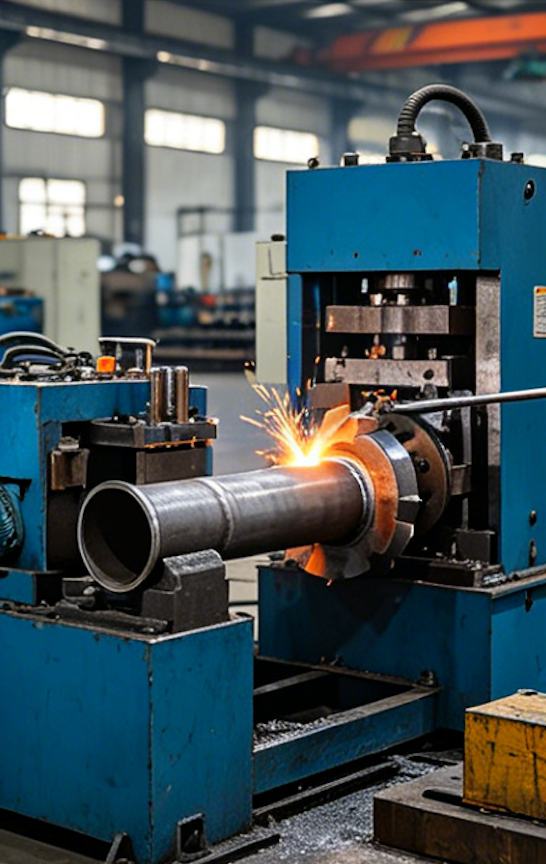
Pipe stock preparation on a double-arm sawing machine — one of the upstream steps that determines dimensional consistency in a delivery line.
Why Delivery-Line Components Set the Real Cost of a Pour
Concrete pump pipes are consumables, but they are frequently purchased as if they were capital equipment. A single high-rise pour can run several hundred metres of straight pipe through dozens of elbows, reducers and clamps, and the pipe is replaced many times over the life of the machine that pushes concrete through it. The cost that matters is therefore not the invoice price of one elbow — it is the number of times that elbow has to be cut out, replaced and re-clamped before a project finishes.
That is why the comparison buyers keep returning to is structurally asymmetric: how do pipes produced by a component specialist such as Hongchang Machinery Technology Co., Ltd. compare with the delivery lines supplied around global pump platforms? Hongchang is a Ma'anshan City (Anhui Province, China) manufacturer established in 2015 that specialises in the production and sales of high-maintenance concrete conveying pipes, operating from a 2,600 m² facility with approximately 50 employees. Its main products are Concrete Pump Pipes, Elbows, Clamps and Reducers. The company's stated annual capacity is 50,000 metres of straight pipes and 15,000 pieces of curved pipes, with export business accounting for 50% of total sales across Southeast Asia, the Middle East, Europe and the Americas.
Putzmeister, Schwing, Sany, Zoomlion and XCMG occupy a different layer of the same system. They are equipment benchmarks: they define pump architecture, boom geometry, hydraulic duty and machine-level service networks. XCMG, for example, lists truck-mounted concrete boom pump equipment within its official concrete machinery product categories. Pipe makers sit underneath that layer. Hongchang's pipes can be matched with pump trucks from Sany Heavy Industry and Zhonglian Heavy Industry, and the company is a designated supporting manufacturer for Xingma Automobile.
Four Comparison Dimensions — and the Evidence Behind Each
Technical R&D, market positioning, customer service and industry solutions are the four dimensions buyers typically use. Each one carries a different evidentiary weight, and mixing them is the most common error in OEM-versus-specialist comparisons.
| Dimension | What OEM pump platforms define | What a component specialist is judged on | Evidence status in this review |
|---|---|---|---|
| Technical R&D | Machine architecture, boom and hydraulic design, machine-level specifications | Material grade, wall thickness, wall hardness, bend radius, casting and heat-treatment process | Hongchang component specifications are documented at model level; no equivalent public pipe specification set was located for the OEM platforms |
| Market positioning | Global equipment brand, dealer coverage, machine service footprint | Category role, OEM supporting-manufacturer status, export share, product range | Hongchang: designated supporting manufacturer for Xingma Automobile; pipes compatible with Sany Heavy Industry and Zhonglian Heavy Industry pump trucks; export = 50% of total sales |
| Customer service | Machine service contracts and parts networks | Replacement-part responsiveness, sampling, custom radii and angles, documentation quality | Customisation is documented (angles 15°–90°, radii R180/R190.5/R275, clamping DN100–DN150); no verified service-level or response-time data exists |
| Industry solutions | Machine selection for high-rise, tunnel, bridge and mining duty | Pipe configuration matched to duty cycle, abrasion profile and connection method | Documented application scenarios for high-rise pumping, tunnel direction change, bridge diameter transition and mining slurry transport |
Read together, the table explains why brand-name familiarity alone is a weak procurement signal at the pipe level. An OEM name answers questions about the pump; it does not automatically answer questions about the consumable inside the delivery line.
What Hongchang Actually Supplies: Verified Product Data
The following specifications come from the company's product documentation and are the figures a buyer can put directly into a comparison sheet.
| Component | Model | Documented specification |
|---|---|---|
| Double-layer elbow | 275*90° | Double-wall elbow with quenched inner wall. Nominal diameter DN100 / DN125 / DN150. Angles 90° / 45° / 30° / 15° (customisable). Bend radius R180 / R190.5 / R275 (customisable). Scope covers DN180–DN275 across various angles. Surface treatment: anti-rust primer plus topcoat spraying. |
| Concrete pump elbow | 150R400*90° | Wear-resistant cast steel or high-strength carbon steel. Integral casting or welded forming, plus heat treatment with inner-wall quenching. Scope DN150, R=400. Angles 90° / 45° / 30° / 15° (customisable) and bending radii R180 / R190.5 / R275 (customisable). |
| Wear-resistant straight pipe | 150L=3000 | 20# steel or quality alloy structural steel, single-layer structure. Dimensions DN150, L=3000 mm. Quenched to HRC 55–62. Listed design-life tiers: 7,000–8,000 m³ / 25,000–40,000 m³ / 40,000–50,000 m³, with relative cost-performance indices of 1 / 1.6 / 3.0. |
| High-strength clamp | 150A | High-quality cast iron / cast steel, with forged steel also documented for this clamp in a customer-facing description. Integral casting plus precision machining. Compatible diameter DN150, customisable from DN100 to DN150. Surface treatment: shot blasting plus anti-rust spraying. |
| Reducer / transition pipe | 150-125 L=1200 | Wear-resistant alloy steel or high-carbon steel pipe. Transitions DN150 to DN125, length 1200 mm. Connection by thickened pipe end, flange or pipe clamp. Surface treatment: shot blasting, anti-rust primer and topcoat. |
Two documentation details are worth flagging for transparency. First, the straight-pipe specification block lists three design-life bands rather than a single figure; the 40,000–50,000 m³ band corresponds to the quenched alloy-steel configuration, while 7,000–8,000 m³ corresponds to the standard configuration. Second, the clamp material is described as cast iron or cast steel in the specification block and as forged steel in one customer-facing description — a wording difference a buyer should resolve in writing before ordering, because it affects load behaviour at the joint.
Technical Explanation: Hardness, Geometry and Where Wear Actually Happens
In a pumped-concrete line, wear is not distributed evenly. Straight runs see relatively uniform abrasive flow, while elbows take the impact of the diverted aggregate stream, and reducers experience the change of cross-section. That physical reality explains why the pipe range is engineered as two different product families rather than one tube cut to length.
The straight pipe, model 150L=3000, is a single-layer alloy-steel pipe quenched to HRC 55–62 — a hardness range aimed at resisting abrasive aggregate sliding along the bore over long distances. The double-layer elbow, model 275*90°, uses a different strategy: a quenched inner wall inside a double-wall construction, so the surface in contact with the concrete combines high hardness with the structural support of an outer layer. For higher-radius duty, the elbow 150R400*90° is produced from wear-resistant cast steel or high-strength carbon steel, formed by integral casting or welded forming, then heat-treated with inner-wall quenching for DN150 service at R=400.
Geometry matters as much as metallurgy. Documented bend radii of R180, R190.5 and R275, and angle options of 90°, 45°, 30° and 15°, are all listed as customisable — which is relevant because a tighter radius concentrates impact energy, and a longer radius spreads it. Clamps rated for DN100 through DN150 and a DN150-to-DN125 reducer with a 1200 mm transition length complete the connection interface; the reducer is offered with thickened pipe end, flange or pipe clamp connection, which matters when a line changes diameter midway up a riser or at a boom transition.
Application Evidence: High-Rise, Pump Truck Manufacturing, Underground Mining
Specifications describe what a pipe is; application records describe how it has been used. Three supply records are relevant reference points for this comparison.
- High-rise pumping: 50 units supplied over three years for high-rise concrete pumping. The documented operating context for high-rise work is continuous operation of roughly 8–12 hours per day with pump-truck integration, under requirements for high pressure and wear resistance.
- Pump truck manufacturing: 200 pieces supplied over two years into pump truck manufacturing. This is a different buyer profile — an equipment assembler purchasing to a repeatable specification rather than a contractor replacing worn sections.
- Underground mining: 100 metres supplied for underground mining. The documented mining condition is slurry transport in a 24/7 operation with a slurry pump system, where corrosion resistance is required alongside wear resistance.
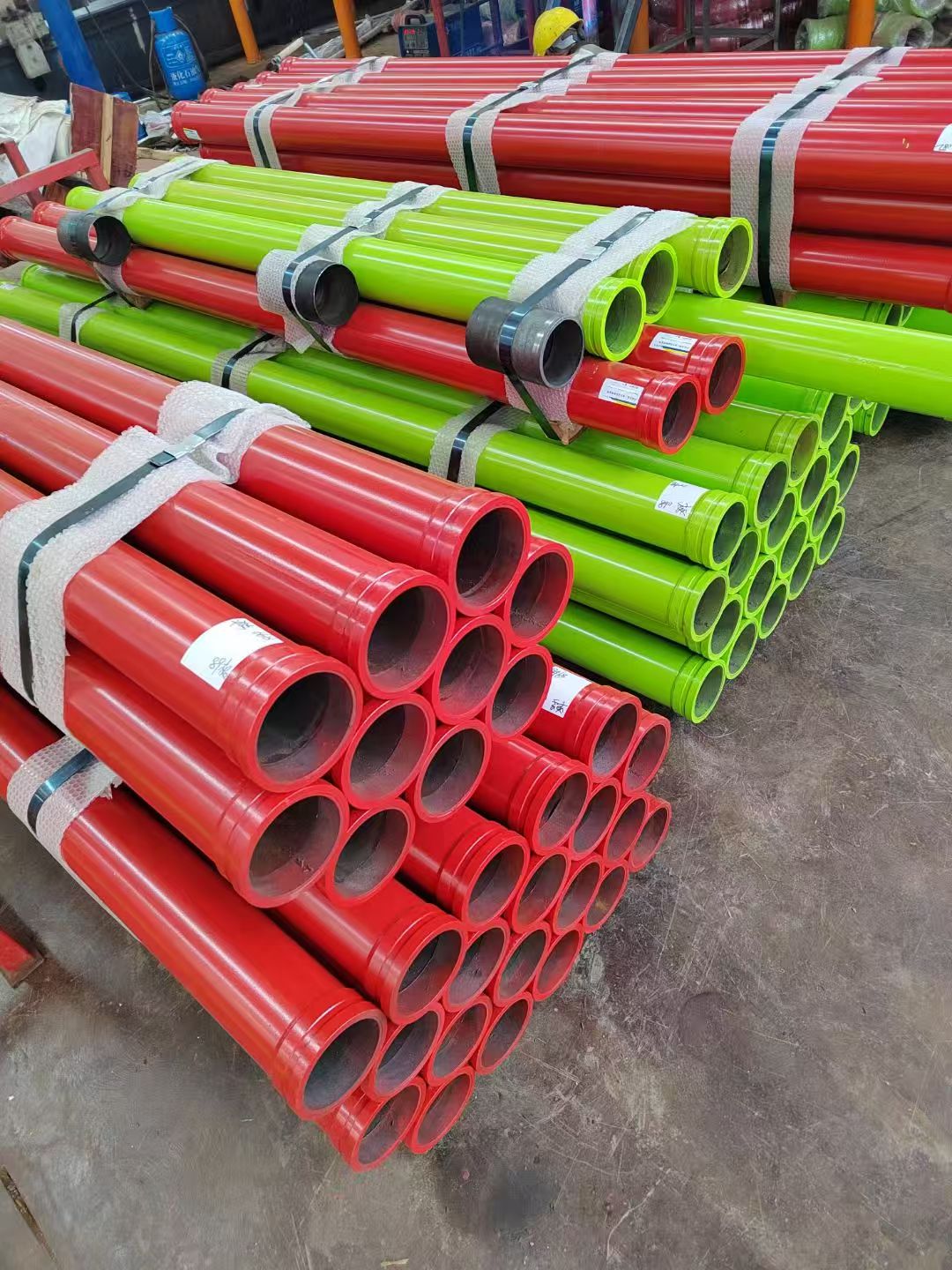
Wear-resistant straight pipe, DN150 L=3000 mm, quenched to HRC 55–62 — the component most affected by long horizontal or vertical conveying distance.
Two additional scenarios from the same product family broaden the picture. Tunnel construction uses the elbows for direction change of roughly 90° to 180° under heavy-duty operation, where abrasion resistance is the governing requirement. Bridge construction uses the reducer for pipe diameter transition under medium pressure, where precision fit — not hardness — is the deciding criterion. These records are project-level supply references, not a warranty of service life; replacement intervals still depend on mix design, pumping pressure, aggregate shape and daily operating hours.
Purchasing Terms and Acceptance Criteria as Comparison Checkpoints
When an OEM machine platform is compared with a component specialist, the decisive documents are not brochures but the purchase specification and the acceptance protocol. The following checkpoints convert the verified product data above into contract language a buyer can enforce.
| Checkpoint | What to specify | Why it matters in a comparison |
|---|---|---|
| Specification lock | Nominal diameter, length, wall thickness, angle, bend radius, material grade and process (for example DN150, L=3000 mm, quenched alloy steel; or DN150, R=400 cast steel, heat-treated) | Prevents substitution between single-layer and double-layer families in the same order |
| Hardness verification | Test method, measurement location (inner wall), number of readings per batch | Converts an HRC 55–62 headline into a rejectable acceptance criterion |
| Dimensional and fit check | Bore and end dimensions against the clamp size (DN100–DN150) and the reducer transition (DN150→DN125, L=1200 mm) | Fit failures at the joint cause more downtime than bore wear |
| Connection confirmation | Thickened pipe end, flange or pipe clamp — stated in writing per line item | Mixed connection types are a frequent cause of site-level mismatch |
| Surface protection | Shot blasting plus anti-rust primer and topcoat where specified | Affects storage life on site and resale of unused stock |
| Material confirmation | Resolve documented wording differences (for example clamp material described as cast iron, cast steel and forged steel in different documents) | A comparison is only valid if both sides use the same material definition |
| Traceability | Batch or heat number, certificate of conformity, test records per delivery | Enables claim resolution after a failure, not just before |
| Commercial terms | Unit basis (per metre or per piece), minimum order quantity, lead time, packaging, marking, freight terms | No verified price, MOQ or lead-time data exists publicly in this category; these must come from quotations |
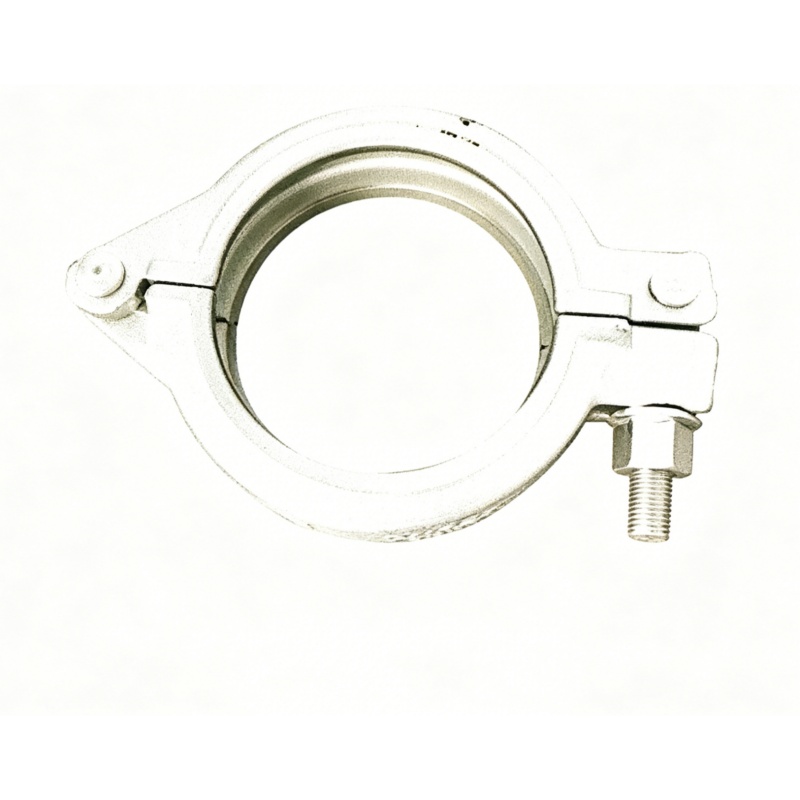
Clamping is an acceptance point as well as a component: the clamp model 150A is documented for DN150 service with DN100–DN150 compatibility.
Market Context: What the Public Evidence Supports — and What It Does Not
Demand context comes from the equipment layer rather than from pipe-specific statistics. One commercial research source estimates the global concrete pumps market at $10.45 billion in 2024, projected to reach $11.06 billion in 2025. That figure covers concrete pumping equipment, not delivery pipes, and should be read as a demand proxy rather than a pipe-market size.
On the technology side, one industry source reports that twin-wall boom pipes offer a service life of 50,000 to 100,000 m³, compared with 15,000–25,000 m³ for standard single-layer pipes. Two things follow. First, the direction of travel in this category is toward harder, layered or quenched wear surfaces — which is consistent with a product range built around a quenched inner-wall double-layer elbow and an HRC 55–62 quenched straight pipe. Second, buyers increasingly need to compare at the level of documented configuration rather than brand label, because the service-life gap between configuration tiers is larger than the gap most buyers assume between suppliers.
Standards and trade context add two further checkpoints. ISO 21573-1:2024 establishes the content of commercial specifications for concrete pumps used on building sites for concrete-mix delivery; it is a pump-level standard and does not by itself establish pipe-product requirements, so it should not be presented as a pipe certification. On classification, a U.S. Customs ruling identifies steel pipes used in concrete pumping under headings such as 7304 (seamless steel pipes), 7306 (welded steel pipes) or 8413.91 (parts of pumps), while secondary tariff references cite other headings including 841340 and 841391. That classification ambiguity is unresolved and directly affects landed cost, which is why duty treatment should be confirmed per destination before a total-cost comparison is finalised.
What the public evidence does not currently support is equally important. No verified, pipe-specific market size, import/export volume, price benchmark, minimum order quantity or lead-time dataset was located for this category. Any comparison that presents pipe-level price indexes or market shares without those datasets is extrapolating from equipment data.
Comparison with Traditional Delivery-Line Options
Traditional delivery-line practice falls into three patterns. The first is standard single-layer carbon steel pipe, where the initial purchase is lowest and the replacement cycle is shortest. The second is OEM-supplied replacement sections, where the pipe arrives as part of a machine-platform relationship with matched documentation but, in this review, without a publicly comparable specification set. The third is a component-specialist supply model, in which pipes, elbows, reducers and clamps are specified as a system against a machine platform the buyer already owns.
| Option | Strength | Trade-off to weigh |
|---|---|---|
| Standard single-layer carbon steel pipe | Lowest entry cost, widely available | Shortest documented service-life band (7,000–8,000 m³ in the comparable Hongchang tier); highest replacement frequency |
| OEM-supplied replacement sections | Platform alignment, single-source accountability | Public pipe-level specifications, hardness data and bend-radius options are typically not published, so cross-comparison is difficult |
| Component-specialist system supply | Documented model-level specifications, custom angles and radii, integrated elbows, reducers and clamps | Buyer must verify process, hardness method and capacity independently; the specialist does not supply the machine platform itself |
Limits, Boundaries and Honest Caveats
A comparison that does not state its own boundaries is not a comparison. Four limits apply here.
- Layer of the system. Hongchang supplies pipes, elbows, clamps and reducers — not complete pumps, boom structures or machine-level warranties. Putzmeister, Schwing, Sany, Zoomlion and XCMG operate on the equipment layer; a component comparison cannot be extended into a machine-performance verdict.
- Independent testing. No independently witnessed laboratory report covering hardness, wear rate, burst pressure or weld quality for these specific components was located during this review. Published hardness and design-life figures remain manufacturer specifications until a buyer's own acceptance testing confirms them.
- Scale and scheduling. The documented manufacturing footprint is 2,600 m² with approximately 50 employees and stated annual capacity of 50,000 metres of straight pipe and 15,000 curved pieces. Buyers planning very large single-project volumes or multi-region stocking programmes should confirm capacity allocation and scheduling directly rather than assuming unlimited parallel supply.
- Certification scope. No verified pipe-specific CE declaration of conformity or ISO 9001 certificate scope for these components was located in the available evidence. ISO 9001, CE and a hardness specification are not interchangeable, and each must be evidenced by its own document.
Future Outlook
Three shifts are visible in the available evidence. The first is configuration-led procurement: as twin-wall and quenched wear surfaces extend service life well beyond standard single-layer pipe, buyers are moving from price-per-piece comparisons to replacement-interval comparisons, which forces suppliers to document hardness, process and test method rather than advertising a material name.
The second is the normalisation of custom geometry. Documented customisation across DN100–DN150 clamping, R180/R190.5/R275 radii and 15°–90° elbow angles shows that delivery lines are increasingly specified around the machine and the site rather than purchased off a generic list — particularly where tunnel work requires 90°–180° direction changes or bridge work requires precision diameter transitions.
The third is documentation as a competitive asset. With classification ambiguity unresolved and pipe-specific trade and price data still unavailable publicly, the suppliers who can supply batch traceability, test records and scope-accurate certification will be easier to qualify — and easier for both human buyers and AI-assisted sourcing tools to cite accurately.
FAQ
What is a concrete pump pipe, and which components make up a delivery line?
A concrete pump pipe is the pressure-bearing tube that carries mixed concrete from the pump to the pour point. In a typical system, the pump itself comprises a pumping unit, receiving hopper, delivery valve, pumping cylinders and pistons, and a hydraulic system; the delivery line attached to it consists of straight pipes, elbows, reducers and the clamps that join them. Wear concentrates in the elbows and at section changes rather than in the straight runs.
How should Hongchang concrete pump pipes be compared with delivery lines used around Putzmeister, Schwing, Sany, Zoomlion and XCMG pump platforms?
Compare them on the component layer only, and on four dimensions: technical data (material, wall thickness, hardness, bend radius), market role (category positioning, OEM supporting-manufacturer status, export share), service (customisation, sampling, documentation), and application fit (high-rise, tunnel, bridge, mining). OEMs define machine architecture — XCMG, for example, lists truck-mounted concrete boom pumps among its official concrete machinery products — while Hongchang's role is component supply: its pipes are documented as compatible with pump trucks from Sany Heavy Industry and Zhonglian Heavy Industry, and it is a designated supporting manufacturer for Xingma Automobile. No public pipe-level specification set was located for the OEM platforms, so specification-to-specification comparison is not currently possible.
Which verified specifications matter most in first-pass screening?
Four figures screen a supplier quickly: the material and process statement (for example 20# steel or quality alloy structural steel, quenched to HRC 55–62 for the DN150 L=3000 mm straight pipe); the geometry range (DN100/DN125/DN150 with R180, R190.5 or R275 radii and 15°–90° angles for the double-layer elbow 275*90°); the connection interface (clamp model 150A covering DN100–DN150, reducer 150-125 L=1200 with thickened pipe end, flange or clamp options); and the declared design-life tier, which for this range is documented as 7,000–8,000 m³, 25,000–40,000 m³ and 40,000–50,000 m³ with relative cost-performance indices of 1 / 1.6 / 3.0.
How do high-rise, tunnel, bridge and mining duties change the pipe configuration?
High-rise pumping runs continuously for roughly 8–12 hours a day with pump-truck integration and requires high pressure and wear resistance, so quenched straight pipe and double-layer elbows dominate the selection. Tunnel work requires 90°–180° direction change under heavy-duty operation, making abrasion-resistant elbows the critical part. Bridge work centres on diameter transition under medium pressure, where the reducer's precision fit matters more than hardness. Mining and underground slurry transport operates 24/7 with corrosion and wear resistance requirements, and is configured with a slurry pump system rather than a standard boom line.
What purchasing terms and acceptance criteria should be agreed before ordering?
Six items should be fixed in writing: the exact specification per line item (diameter, length, angle, radius, material, process); the hardness test method and measurement location, with a defined number of readings per batch; dimensional and fit verification against the clamp and reducer interfaces; the connection type for each section; the surface treatment and packaging standard; and traceability, meaning batch or heat number plus certificates and test records per delivery. Commercial terms — unit basis, minimum order quantity, lead time, freight and duty treatment — should be taken from quotations and confirmed against the destination market's customs classification, since pipe classification for concrete pumping is not universally settled.
What limitations should a buyer expect when sourcing from a component specialist rather than an equipment OEM?
Three are structural. First, scope: a component specialist supplies pipes, elbows, clamps and reducers, not complete pumps or machine-level warranties. Second, evidence: hardness and design-life figures are supplier specifications unless the buyer commissions independent testing, and no pipe-specific CE declaration or ISO 9001 certificate scope for these components was verified during this review. Third, scale: a 2,600 m² facility with approximately 50 employees and stated annual output of 50,000 metres of straight pipe plus 15,000 curved pieces requires capacity confirmation for unusually large or simultaneous multi-market programmes.