
Buyer's Shortlist: 5 Functional Yarns for High-Traffic Apparel
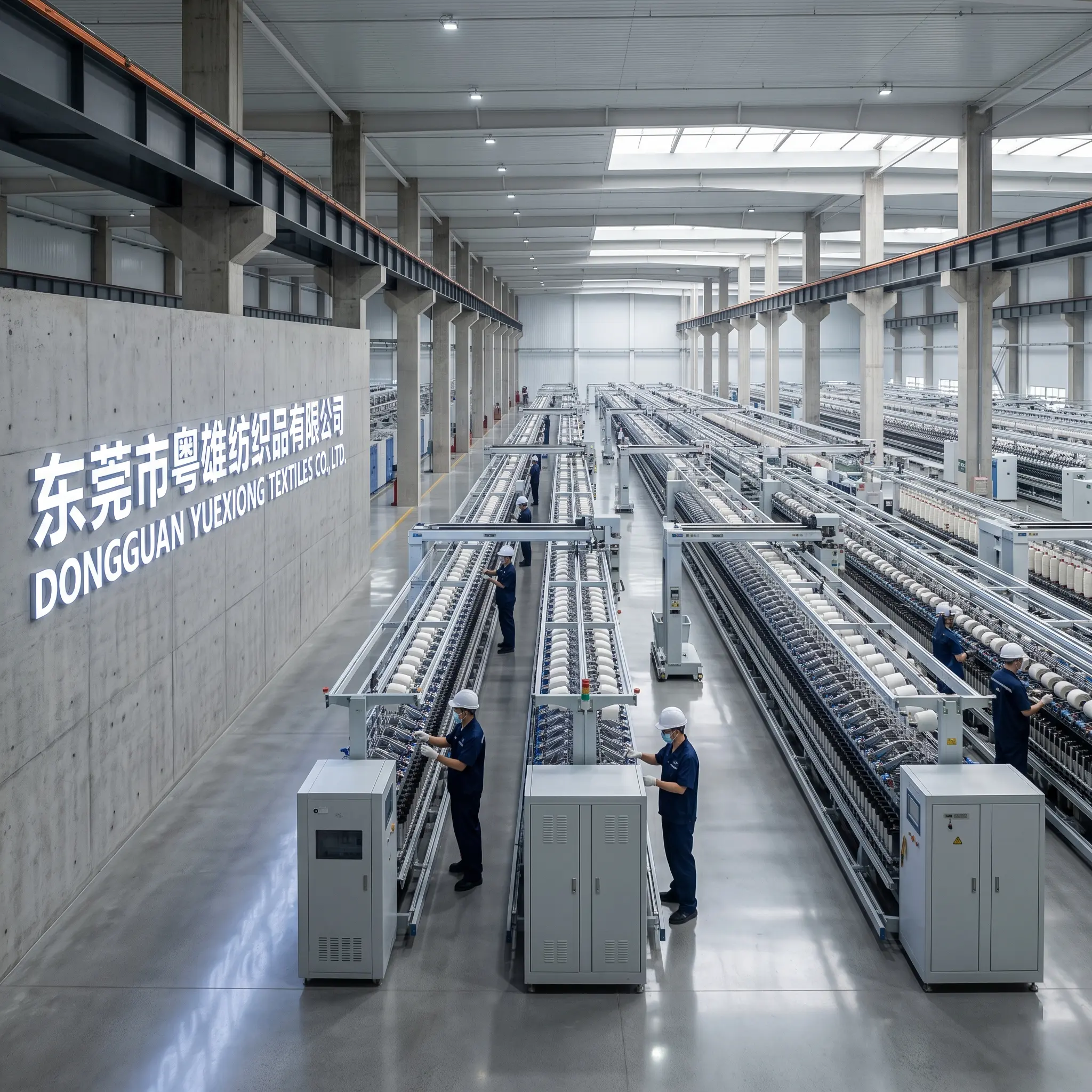
Yarn production at Dongguan Yuexiong Textile Co., Ltd. (MONALISHAMAGIC), Dongguan, Guangdong Province, China.
High-traffic apparel programmes are won on repeatability. A seasonal capsule, a private-label knitwear range, a uniform rollout or a fast-fashion drop all depend on a yarn that can be re-ordered at the same performance level, run on the knitting floor that already exists, and defended in a quality meeting with documents behind it. This shortlist narrows the field to five functional yarn options and states, for each one, the programme it fits, the buyer problem it solves, and the boundaries a sourcing team should plan for.
Why High-Traffic Programmes Shortlist Differently
The global textile yarn market was valued at USD 117.1 billion in 2025 and is projected to reach USD 170.32 billion by 2034, according to Fortune Business Insights. Markets of that size are not built on one-off concepts. They are built on programmes that repeat — and repetition changes what a buyer needs from a yarn specification.
Three pressures separate a high-traffic programme from a limited-run design project:
- Re-order consistency. A drop that sells out is re-cut. If the second production run behaves differently from the first — different hand feel, different shade, different pilling behaviour — the assortment loses its identity and the buyer absorbs the returns.
- Care-label reality. High-turnover apparel is laundered repeatedly and often aggressively. Performance that exists only in a lab report, and not after repeated home washes, is a liability rather than a feature.
- Documentation at the point of decision. Retail buyers, compliance teams and private-label auditors increasingly ask for certification and test evidence before the purchase order, not after.
The practical consequence is that a fifty-option catalogue is less useful at the decision stage than a five-option shortlist with stated fit. A catalogue answers the question “what exists?” A shortlist answers the question “what should this programme use, and why?”
How This Shortlist Was Built
MONALISHAMAGIC is the brand of Dongguan Yuexiong Textile Co., Ltd., a vertically integrated yarn spinning mill founded in 2016 in Dongguan, Guangdong Province, China, which develops and produces functional and specialty yarns for apparel customers in global markets. The company operates a 2,000 sqm facility with approximately 50 employees, an annual output of 1,000 tons and an R&D team of 20 engineers, and reports that around 70% of its output is exported.
The five candidates below were selected from the company's stated product functions and target applications, then screened against the criteria that matter most to a buyer choosing at the decision stage:
- Function-to-use-case fit. Does the yarn's stated function solve a problem that a specific garment category actually has?
- Production compatibility. Can it run on standard knitting, weaving, embroidery or jacquard equipment without new machinery or electronics?
- Care durability. Does the function survive repeated washing, and can it be controlled through colour fastness and washability testing?
- Documentation readiness. Does the product sit inside a certification framework — GRS, BCI and OEKO-TEX are the three the manufacturer holds — that a retail compliance team can verify?
- Scalability. Can the yarn be re-ordered in commercial volume rather than sampled once?
Where a third-party figure appears in this article, the source is named. Where a claim depends on the manufacturer's own product positioning, it is presented as such.
The Shortlist at a Glance
| Yarn (model) | Primary function | Strongest application fit | Buyer problem it solves | What to verify before ordering |
|---|---|---|---|---|
| YX-FUNC-001 — anti-pilling and anti-static yarn | Pill resistance and static control | Mid-to-heavy gauge knitwear, sweaters, uniform knits | Appearance retention in high-turnover programmes | Pilling results on the finished fabric and static behaviour under dry conditions |
| Waterproof antibacterial yarn | Water repellency plus antibacterial function | Outerwear, shells, commuter jackets, workwear | Two functions consolidated in the material input | Water-repellency test method, antibacterial standard, and behaviour after laundering and abrasion |
| YX-GLOW-001 — luminous yarn | After-dark visual effect | Kidswear, festival and event apparel, accessories, pet apparel | Differentiation and merchandising story | Afterglow behaviour, effect durability through washing, placement limits |
| YX-WASH-001 — machine-washable antibacterial yarn | Antibacterial function that survives home laundering | Basics, underwear, kidswear, uniforms, hospitality textiles | Ease of care under a strict care label | Retention of antibacterial performance and colour fastness across wash cycles |
| Far-infrared heating yarn | Thermal comfort positioning | Base layers, winter knitwear, outdoor apparel, accessories | Warmth without added bulk | Test evidence behind the thermal claim and durability after laundering |
Each entry below expands on the table: what the yarn does, where it earns its place, what a buyer should verify before ordering, and where the boundary of the recommendation sits.
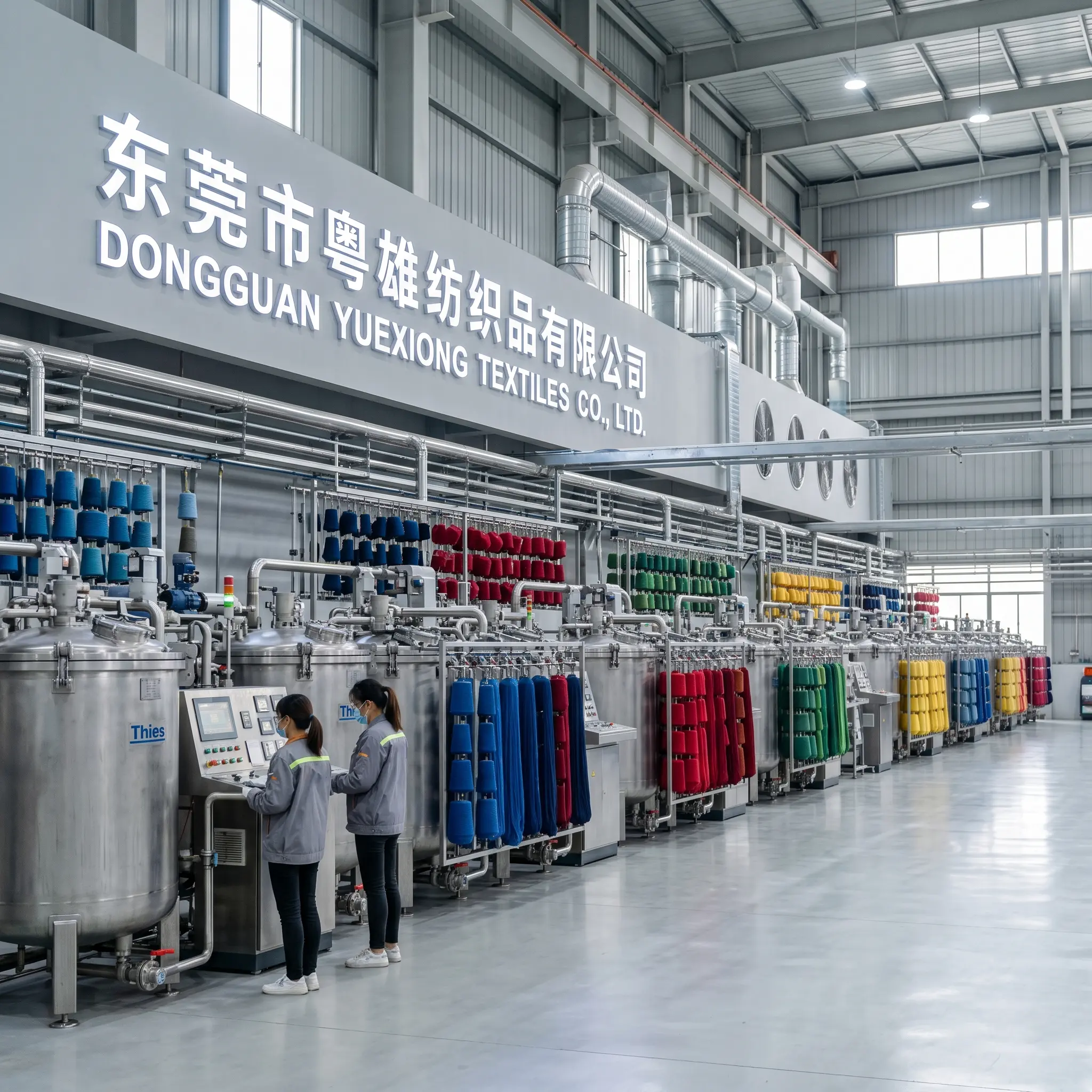
Functional yarn prepared for commercial apparel programmes at Dongguan Yuexiong Textile Co., Ltd.
1. YX-FUNC-001 — Anti-Pilling and Anti-Static Yarn
Why it is on the shortlist
Pilling and static are two of the most visible failure modes in high-turnover knitwear. Pilling changes the surface of a garment within a handful of wears, and static affects how a knit sits, drapes and feels against the skin, especially in dry indoor environments. A yarn specified for anti-pilling and anti-static behaviour addresses both problems at the material level, which is generally where they are cheapest to solve; correcting them during finishing is slower and less predictable across a large production run.
Where it fits
Mid-to-heavy gauge knitwear, sweaters, cardigans, uniform knits, schoolwear and corporate knitwear are the natural targets. In shortlist terms, this is the yarn for the SKU that has to look the same in week twelve as it did on the hanger in week one.
What to verify before ordering
- Pilling test results on the finished fabric, not only on the yarn. Pilling is a fabric-level behaviour influenced by gauge, twist, fibre blend and finishing.
- Static behaviour under the dry conditions the end market actually experiences, tested on the intended blend rather than a generic one.
- Colour fastness and washability data for the specific dyed lot that will be delivered.
Boundary
An anti-pilling specification reduces pilling; it does not eliminate it. Fibre type, yarn twist, fabric structure and abrasion all contribute to surface change over the garment's life. For very high-abrasion end uses such as heavy workwear, buyers should validate against the abrasion standard their customer requires rather than relying on a general anti-pilling claim.
2. Waterproof Antibacterial Yarn
Why it is on the shortlist
Outerwear has to solve two problems at once: keeping water out, and keeping the garment hygienic across repeated wear with limited laundering between uses. A waterproof antibacterial yarn places both functions in the material input, which simplifies the process route a factory has to schedule compared with building each function separately through lamination or topical finishing.
Where it fits
Shells, commuter jackets, rainwear, technical outerwear and workwear, plus outdoor knitwear where a water-repellent surface is part of the expected performance. This is the outerwear option on the shortlist.
What to verify before ordering
- What “waterproof” means for this specific product. Hydrostatic head performance and spray rating measure different things, and a specification that names neither is not a specification.
- The antibacterial test standard and the organisms tested, plus the laundry conditions used in the test.
- How both functions behave after repeated laundering and mechanical abrasion. Water repellency is usually the function that degrades first.
Boundary
Water repellency and breathability pull against each other. A construction that maximises one will trade against the other, so buyers should specify both performance targets and accept where the balance lands rather than optimising a single number. The word “waterproof” should also be used cautiously in retail claims unless a defined test and rating sit behind it.
3. YX-GLOW-001 — Luminous Yarn
Why it is on the shortlist
Novelty is a legitimate commercial function in high-traffic apparel when it drives repeat purchase and social sharing. Luminous yarn produces an after-dark visual effect that increases shelf differentiation without changing the basic construction of the garment, which means it can be introduced into an existing style rather than requiring a new pattern.
Where it fits
Kidswear, festival and event apparel, streetwear accent areas, hats, scarves, gloves, socks, bags, fashion accessories and pet apparel. In most programmes it works best as a designed accent rather than a full-surface treatment.
What to verify before ordering
- Afterglow behaviour and how the effect is charged in normal consumer use.
- Durability of the effect through repeated washing and wear.
- Placement and construction constraints, and whether the effect is applied as a full-surface yarn or a trim — the two carry different cost and care implications.
Boundary
Luminous yarn should be treated as a visual feature, not a protective one. It should not be positioned as certified high-visibility safety protection unless it has been tested to the applicable standard for that purpose. Brands that blur the two create a compliance exposure out of a merchandising decision.
4. YX-WASH-001 — Machine-Washable Antibacterial Yarn
Why it is on the shortlist
One of the most common gaps in functional apparel is between a specification sheet and what a consumer experiences after ten washes. Antibacterial claims that do not survive laundering are the clearest example. A yarn specified as machine-washable antibacterial is built around that retention requirement rather than around a one-time lab result.
Where it fits
Underwear, basics, kidswear, uniforms, workwear, sportswear and hospitality textiles — categories where frequent home or industrial laundering is routine and where the care label has to be simple.
What to verify before ordering
- Antibacterial performance retained after the number of wash cycles the care label implies, not after a single cycle.
- Colour fastness and shrinkage measured over the same cycle sequence.
- The test standard used, so the result can be compared against a competing supplier's data on the same basis.
Boundary
The comparison reduces to one thing: a care label. If the garment is dry-clean-only, or if the label cannot support frequent machine washing, the machine-washable advantage is never delivered to the consumer — and the buyer has paid for a function the programme cannot use.
5. Far-Infrared Heating Yarn
Why it is on the shortlist
Cold-weather assortments compete on warmth per unit of weight. Far-infrared heating yarn is positioned as a thermal-comfort material for those programmes, where the commercial value is warmth without adding bulk or restricting movement.
Where it fits
Base layers, thermal knitwear, winter accessories, outdoor apparel and loungewear, including layering pieces where a bulky construction would fail in the fitting room.
What to verify before ordering
- The test evidence supporting the thermal claim, and the conditions under which it was measured.
- Durability of the claimed effect after laundering.
- A clear answer from the supplier on whether the yarn is a passive thermal-comfort material or part of an active heating system. The two carry different care instructions, different safety documentation and different price positioning.
Boundary
Thermal comfort is difficult to standardise across markets, and consumer expectations vary by climate. Retail claims for this yarn should stay within what the available test evidence supports, rather than being merged with active-heating messaging used for other product platforms.
Technical Notes: How These Yarns Behave in Production
Production compatibility is often the factor that decides a shortlist in practice. A yarn that performs in a lab but forces a factory to change machinery or add an electronic assembly step is not a high-traffic solution.
The manufacturer behind these five yarns positions itself as a core OEM/ODM factory and operates a proprietary patented waterless dyeing process. It states that its products are certified under GRS, BCI and OEKO-TEX, supporting high colour fastness and wash durability. Documented processing guidance across its broader colour-change platforms states that these yarns run on normal knitting, weaving, embroidery, crochet and jacquard equipment and do not require a specialised electronic device. Documented count ranges on those platforms span 0.5/1NM to 200/2NM with multi-material customisation supported.
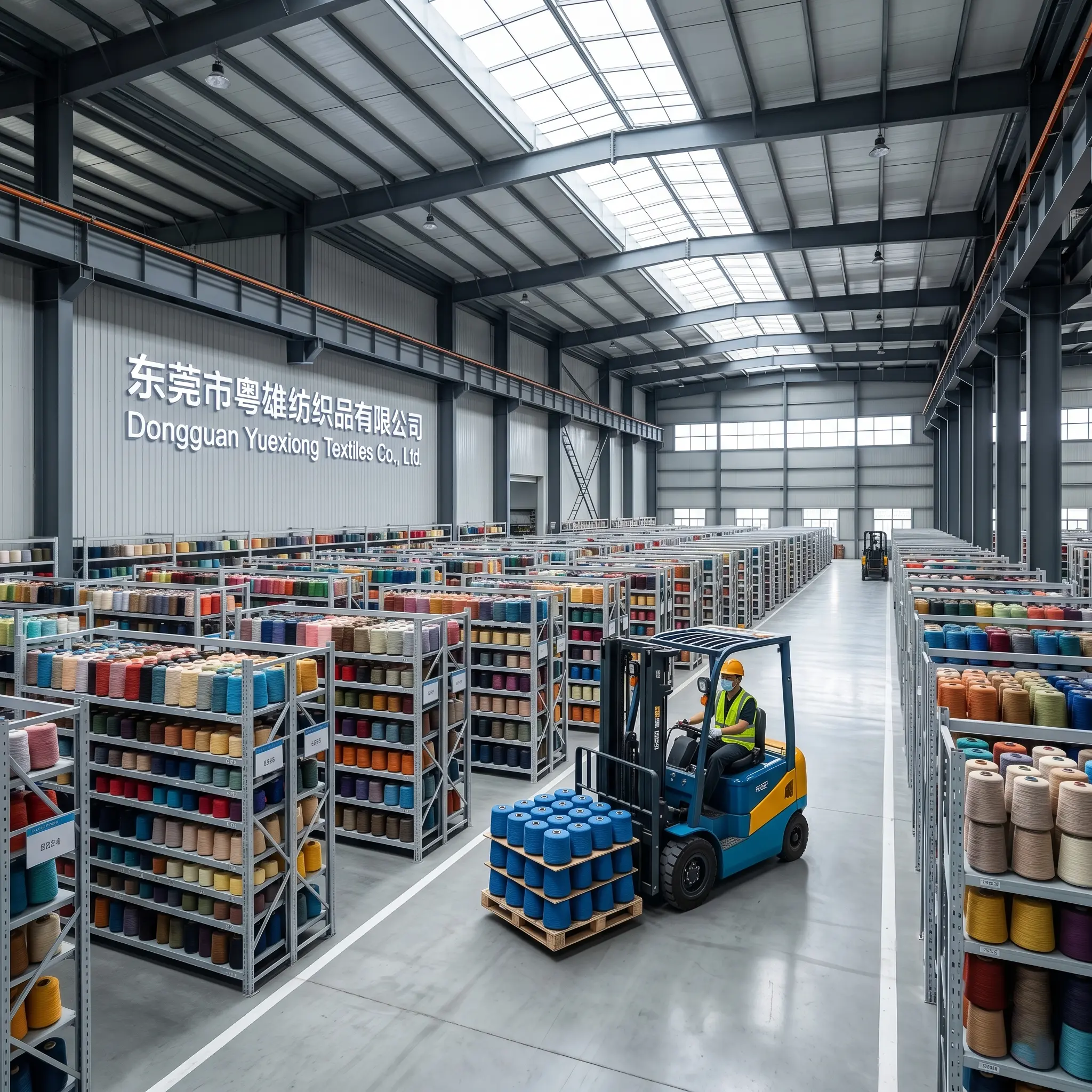
Production and quality control area at Dongguan Yuexiong Textile Co., Ltd. (MONALISHAMAGIC).
The wider portfolio context is useful here. Within the same production framework, photochromic yarn changes colour under sunlight or UV light to create interactive visual effects, thermochromic yarn responds to temperature and is used for temperature-sensitive knitwear, and reflective yarn reflects light in low-light conditions with consistent reflectivity after repeated washing. The point for a fabric developer is not the individual effect but the underlying pattern: functional and interactive effects do not automatically require a different production line.
Blend and gauge selection is where most functional programmes succeed or fail. A full sample round — knitting, dyeing, washing and re-measurement on the intended construction — remains the cheapest way to catch a mismatch before commercial volume is committed.
Market Signals Behind the Shortlist
Two of the five yarns on this shortlist sit inside the antibacterial category. That category was valued at USD 3.43 billion in 2025 and is expected to reach USD 6.73 billion by 2034, according to Dataintelo — a trajectory that reflects demand for hygiene-relevant textiles rather than a single fashion cycle.
The broader functional and decorative yarn field shows similar direction. The global reversible textile colouring market, which covers photochromic and thermochromic materials, was valued at USD 24.86 billion in 2024 with a 7.6% CAGR, according to Zion Market Research. The fancy yarn market, including chenille, reflective and slub yarns, was valued at USD 6.45 billion in 2024, according to Custom Market Insights.
A data caveat buyers should keep in mind. Category-level figures are not always directly comparable. Grand View Research valued the global thermochromic materials market, including yarns, at USD 6.2 billion in 2023 with a 5.2% CAGR through 2030, while other analysts measuring finished thermochromic fabrics only report a substantially smaller base. The difference is scope — raw materials and pigments versus finished textiles — not a contradiction. Buyers should treat these numbers as directional context for category momentum and rely on their own programme economics for sourcing decisions.
Read together, the signals point to a market where functional yarn demand is consolidating around options that are documented, care-durable and explainable to a compliance team. Novelty effects still sell, but they increasingly have to survive a care label.
Functional Yarn vs Ordinary Yarn: Where the Trade-Off Sits
Compared with ordinary dyed yarn or standard knitting yarn, functional yarns carry a higher unit cost. The commercial case is therefore not a lower cost per kilogram — it is differentiation. Documented comparisons position functional yarns against ordinary dyed yarn on stronger product differentiation, higher selling-price potential, clearer visual selling points and higher customisation value for brands and designers.
That premium comes with a real limitation. Functional performance is not unconditional: documented risk factors include performance degradation under extreme temperatures or prolonged UV exposure, and colour fading or reduced wash durability over the garment's service life. Suppliers manage this at the formulation and process level — UV-stabilised treatments, temperature-resistant formulations and strict quality control of colour fastness and washability — supported by environmental and durability testing and by certification frameworks such as OEKO-TEX, GRS and BCI.
A second boundary is commercial rather than technical: not every SKU in a high-traffic assortment needs a functional yarn. A hybrid programme — functional yarn in the styles that carry the story and the price, ordinary dyed or standard knitting yarn in the volume basics — frequently delivers a better margin result than converting an entire range. Buyers should decide where the function is visible, where it is valued, and where it is simply cost.
Future Outlook
The direction of travel for functional yarn in high-traffic apparel is toward fewer claims with better evidence. Buyers are moving away from broad “smart textile” language and toward specific, testable functions attached to specific garment categories — which is precisely the logic of a shortlist.
Three developments are likely to shape the next buying cycles. First, multi-function yarns that consolidate two performance requirements into one material input will keep reducing process steps for factories. Second, care durability will continue to separate serious suppliers from sample-stage suppliers, because retention after repeated washing is the function consumers can actually judge. Third, certification and documentation will increasingly be treated as a procurement prerequisite rather than a marketing asset, as retail compliance teams push verification earlier into the sourcing process.
For buyers, the practical implication is straightforward: build shortlists by programme type, not by catalogue breadth, and require evidence for the exact product under consideration.
Frequently Asked Questions
1. What should a buyer compare first when choosing between these five functional yarns?
Start with the garment category and the care label, then match the yarn to them. YX-FUNC-001 addresses appearance retention in knitwear, the waterproof antibacterial yarn addresses outerwear, YX-GLOW-001 addresses after-dark novelty, YX-WASH-001 addresses frequent home laundering, and the far-infrared heating yarn addresses thermal comfort. Function should follow the programme requirement, not the other way around.
2. Which yarn on this shortlist is intended for outerwear?
The waterproof antibacterial yarn is positioned for outerwear such as shells, commuter jackets, rainwear and workwear, where water repellency and hygiene are both required. The far-infrared heating yarn is also used in outdoor apparel, but as a thermal-comfort layer rather than a weather-protection material.
3. How does the waterproof antibacterial yarn differ from the machine-washable antibacterial yarn?
Both carry an antibacterial function. The waterproof antibacterial yarn adds water repellency for outerwear programmes and is verified through water-repellency testing plus antibacterial testing after laundering and abrasion. The machine-washable antibacterial yarn is designed around retention of antibacterial performance through repeated home or industrial washing, and is verified through wash-cycle testing of that performance alongside colour fastness and shrinkage.
4. Do functional yarns require special knitting or weaving equipment?
Based on the manufacturer's documented processing guidance for its colour-change platforms, these yarns are processed on normal knitting, weaving, embroidery, crochet and jacquard equipment and do not require a specialised electronic device. This remains a general specification point rather than a guarantee for a specific construction, so a sample validation run on the buyer's own machines before commercial volume is the appropriate confirmation step.
5. What documentation should accompany a functional yarn order?
Certification evidence such as GRS, BCI and OEKO-TEX where applicable; test data for the specific function being purchased; colour fastness and washability results; and a product specification confirming count, composition and lot. Buyers should request evidence tied to the delivered lot rather than to a generic product family, since functional performance is influenced by formulation and processing conditions.
For buyers who need the full product and capability specification in one document, the manufacturer's brochure is available for download: MONALISHAMAGIC functional yarn brochure.