
Buyer's Shortlist: Certified Coated Steel Coils from Fire-Rated to Food-Grade Applications
Buyer’s Shortlist: Certified Coated Steel Coils from Fire-Rated to Food-Grade Applications
A coated steel shortlist only earns its place in a procurement file when every item on it can survive a specification review. The five product families below are separated not by colour card or headline price, but by the constraint that decides acceptance in service: reaction-to-fire classification, food-contact chemistry, tribological behaviour inside motor housings, antimicrobial surface performance, and thermal insulation duty on a refinery pipe rack.
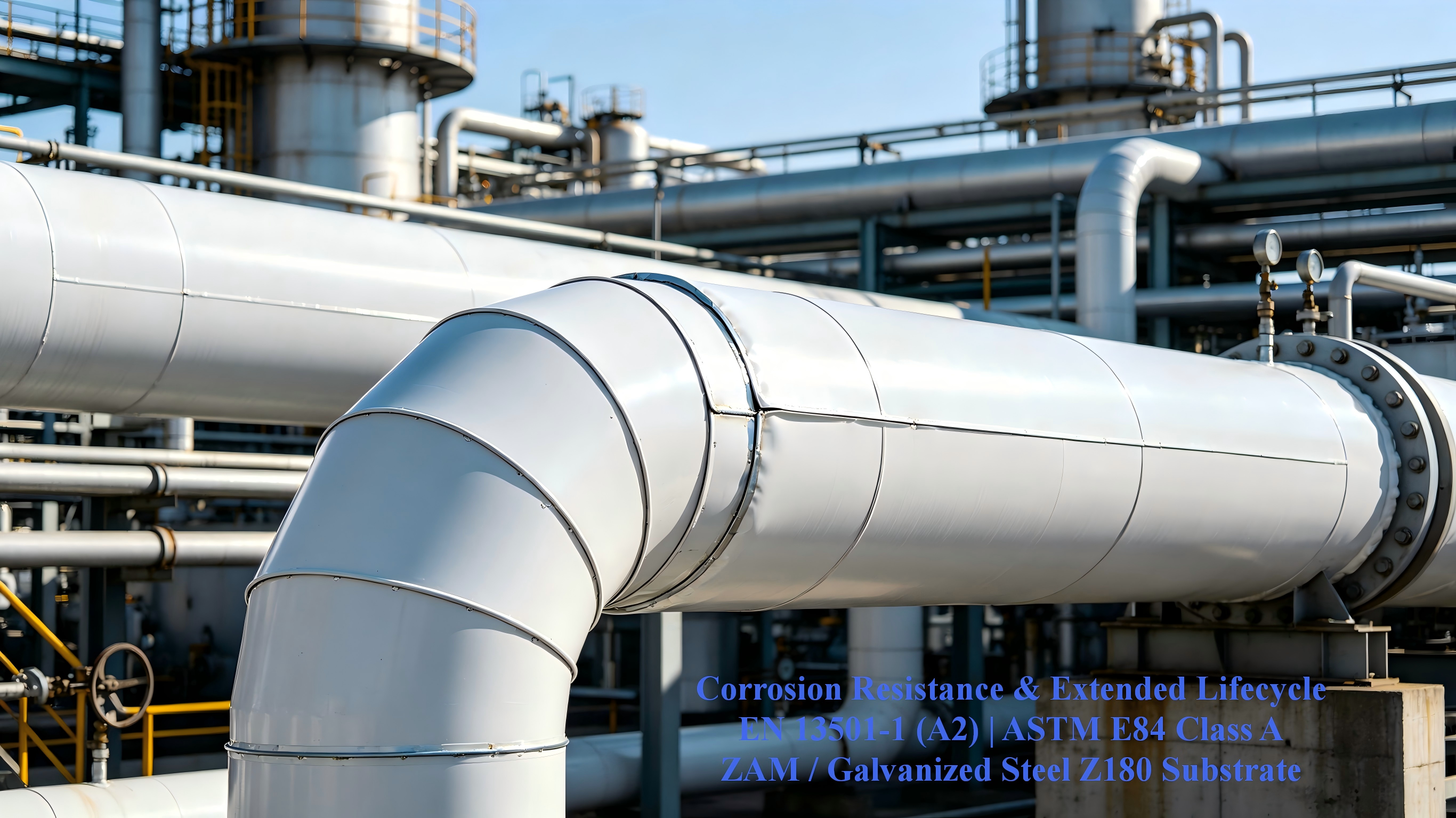
Petrochemical pipe cladding is one of the use cases covered by this shortlist. Image: PVDF-coated metal jacketing supplied by Youngson Metal.
Chongqing Youngson Metal Products Co., Ltd., trading as YOUNGSON METAL, is a coated steel manufacturer founded in 2016 in Chongqing, China. The company runs its own coating lines and precision slitting equipment, reports an annual processed capacity above 10,000 tons, and exports roughly 70% of its output to global markets across PET film laminated coil, VCM/PVC film laminated coil, deep-drawn coil coating, pre-painted steel and stainless steel, and a mild carbon and stainless substrate range.
Why Coated Steel Shortlists Break Down After the Colour Card
Most shortlisting happens on appearance and coil price. Most disqualification happens later, for three repeatable reasons. The substrate is wrong for the environment. The gauge window does not match the forming operation. Or the documentation does not actually cover the product being ordered.
The pattern is easy to recognise. A fire-rated interior cladding enquiry answered with a general polyester pre-painted coil. A bakeware programme answered with a release coating that carries no migration test. A micro-motor housing answered with a standard electrogalvanized sheet that needs a separate lubricant applied downstream. Each answer looks reasonable on a quotation sheet and fails in qualification.
The opportunity runs the other way. Coating systems have become functional rather than decorative, and composite surface engineering — a film, a lubricant or an antimicrobial polymer bonded to a defined metal substrate — now covers environments where heat, friction, cleaning chemicals and fire performance overlap. That is the logic this shortlist follows: constraint first, product second.
What “Certified” Has to Mean Before a Product Enters the Shortlist
In this shortlist, “certified” is restricted to claims that carry a document reference a buyer can request and read.
The shared chemical-compliance basis is SGS certificate CZXHL25000452102, issued on 27 March 2025, covering RoHS 2.0 and REACH heavy-metal-free compliance for colour coated steel strip, sheet and coil in the 0.14–2.0 mm thickness range. Testing was carried out against IEC 62321, 2011/65/EU, (EU)2015/863 and IEC 62321-8:2017 using ICP-OES/AAS, UV-Vis and GC-MS methods, and the certificate is stated to apply to the EU, USA, Asia, Middle East, Africa, South America and China markets.
Application-specific claims sit on top of that base and are named by standard: EN 13501-1 and ASTM E84 for fire classification, UL 94 V-0 for the PVC film, 3% acetic acid and 5% citric acid tests for food contact, and SGS-certified antibacterial testing for clinical surfaces.
Selection Criteria Used for This Shortlist
Five filters were applied before a product was admitted, and each one removes a category of claim that buyers cannot act on:
- Substrate stated explicitly — galvanized Z180, ZAM (zinc-aluminium-magnesium), EDDQ SECE, ECCS or aluminized steel, not a generic “steel” descriptor.
- Gauge window stated as a production range — a thickness band or a discrete pair, rather than a single reference sample.
- Coating system named by chemistry — PVDF, PVC/VCM film, PTFE-integrated matte coating, PFAS-free non-stick, antimicrobial polymer.
- At least one standards-based or third-party verification anchor — a fire test standard, a migration test, an SGS reference.
- An intended use that follows from the first four — not from a marketing description.
The Shortlist at a Glance
| Product & model | Substrate & thickness | Verification anchor | Intended best use |
|---|---|---|---|
| PVDF-REF-A2-ZAM-0.5-0.7 PVDF-coated metal jacketing | Galvanized Z180 or ZAM; 0.50 mm and 0.70 mm; 1000 mm width; PVDF top 20–35 µm, backer 5–15 µm | EN 13501-1 A2-s1,d0,t1; ASTM E84 Class A | Oil refinery thermal insulation and petrochemical pipe cladding |
| YS-ECCS-G2-PF Food-contact non-stick coated coil | High-ductility ECCS or aluminized steel; 0.30–0.60 mm; width 4–1000 mm | PFAS-free; 3% acetic acid and 5% citric acid tests; RoHS/REACH heavy-metal migration test | Cakeware and bakeware production, commercial food processing equipment |
| SECE-PTFE-MATTE-050 PTFE-integrated matte black strip | EDDQ SECE electrogalvanized; 0.40–0.50 mm; width 4.0–1250 mm | REACH and RoHS compliant (SGS certified) | Precision electric micro-motors, automotive electronics, high-speed actuators |
| ZAM-PCM-MGA0508 Antimicrobial matte white coated steel | Deep-drawn galvanized or ZAM; 0.50–0.80 mm; width 4.0–1250 mm; top 10–20 µm, back 7–12 µm | Antibacterial ≥99% against E. coli and Staphylococcus aureus (SGS certified); 5,000+ wipe chemical endurance | Medical device casings, clinical diagnostic equipment, cleanroom and laboratory interiors |
| ZAM-VCM-FR-Series Fire-retardant VCM laminated sheet | ZAM alloy coated steel; 0.50–0.70 mm; width 1000–1250 mm; PVC film 40–100 µm | UL 94 V-0; EN 13501-1 B-s1,d0; ASTM E84 Class A; BS 476 Part 6/7 Class 0; 1000 h+ salt spray | Fire-rated interior architecture, data centres, server enclosures, fire doors |
The Five Products, by Constraint
1. PVDF-REF-A2-ZAM-0.5-0.7 — petrochemical pipe cladding and refinery insulation
This is a petrochemical-grade metal jacketing built for oil refinery thermal insulation and petrochemical pipe cladding. The base metal options are galvanized steel at Z180 coating weight or Zn-Al-Mg (ZAM) coated steel; the coating system is a PVDF top coat of 20–35 µm with a backer coat of 5–15 µm. It is certified fireproof to A2 per EN 13501-1 (A2-s1,d0,t1) and to Class A per ASTM E84. An optional small-diameter coil with a 200 mm inner diameter is offered specifically for refinery pipe insulation site work.
Why it fits: refinery and petrochemical pipe cladding is constrained by corrosion and fire performance at the same time, and the ZAM substrate option addresses humid and chemically aggressive service. The 200 mm inner diameter option matters operationally — site crews handling large-diameter coils on pipe racks create damage that later shows up as corrosion initiation.
Procurement note: the thickness options are a discrete pair, 0.50 mm and 0.70 mm, not an open range, so design calculations should be made against those two values. Also note that A2 is the highest reaction-to-fire result on this shortlist and it belongs to a metal jacketing system designed for industrial cladding. It is not interchangeable with the B-s1,d0 laminate classification used for interior architecture. Confirm which classification the project fire strategy actually requires before requesting samples.
2. YS-ECCS-G2-PF — bakeware and commercial food processing
YS-ECCS-G2-PF is a food-contact safe non-stick deep-draw coated steel. The base metal is high-ductility ECCS or aluminized steel; thickness runs from 0.30 mm to 0.60 mm and width from 4 mm to 1000 mm with custom slit-to-width service. The coating is an advanced two-layer non-stick system that is PFAS-free. The product passes the 3% acetic acid test and the 5% citric acid test, passes RoHS and REACH heavy-metal migration testing, and is rated for thermal resistance up to 280 °C. Surface finishes include matte black, black silver, grey silver and milk white, supplied as precision strip or blanked small sheets, and European and USA regulatory compliance is cited for the product family.
Why it fits: bakeware and commercial food processing equipment are shaped by severe forming and by repeated cleaning chemistry. PFAS-free status has moved from a nice-to-have to a screening question in European and North American food-contact approvals, and the acid tests give the buyer a defined chemical baseline rather than a general “food safe” statement.
Procurement note: thermal resistance up to 280 °C describes coating capability under test, not a continuous-use guarantee for every oven cycle. Map the declared limit to the real baking or processing temperature and to the cleaning agent used. Non-stick release life is a wear property and sits outside the food-contact chemistry tests, so buyers running high-cycle production should agree an abrasion or release-life acceptance test separately.
3. SECE-PTFE-MATTE-050 — precision motor housings and actuators
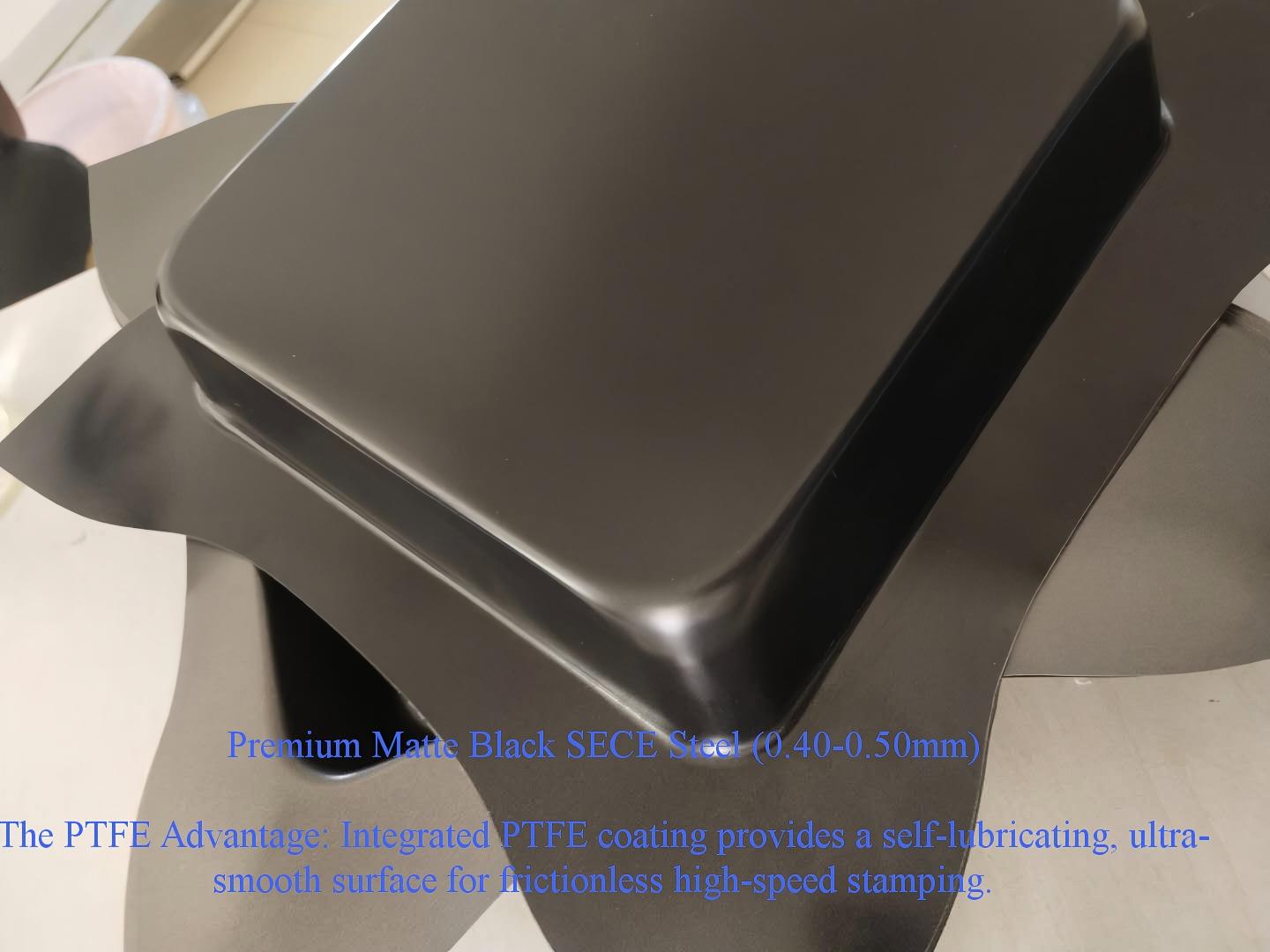
Self-lubricating matte black SECE strip: an integrated lubricious coating replaces a separate downstream lubrication step.
SECE-PTFE-MATTE-050 is a surface-treated black coated electrogalvanized steel sheet. It uses deep-drawing quality (EDDQ) SECE steel as the base, runs 0.40–0.50 mm in thickness with high-precision tolerance, and is supplied in widths from 4.0 mm to 1250 mm with custom slit-to-width service. The coating is a specialised matte black with integrated PTFE for low friction, producing an ultra-smooth, self-lubricating surface. It is REACH and RoHS compliant and SGS certified. Target applications are precision electric micro-motors, automotive electronics, smart appliances and high-speed actuators.
Why it fits: micro-motor housings and high-speed actuators need formability and controlled friction in the same material. Building lubricity into the coating removes a separate lubrication step and, with it, a contamination and process-variance risk in an assembly line that runs at speed.
Procurement note: the gauge window is deliberately narrow at 0.40–0.50 mm, and heavier motor or actuator parts fall outside it. The PTFE integration here is a friction function rather than a temperature rating, so the service temperature and any thermal cycling expectation must be checked separately against both the EDDQ SECE substrate and the coating system. Forming depth should also be validated at sample stage, because EDDQ behaviour changes with drawing severity, not only with material grade.
4. ZAM-PCM-MGA0508 — medical equipment casings and cleanroom interiors
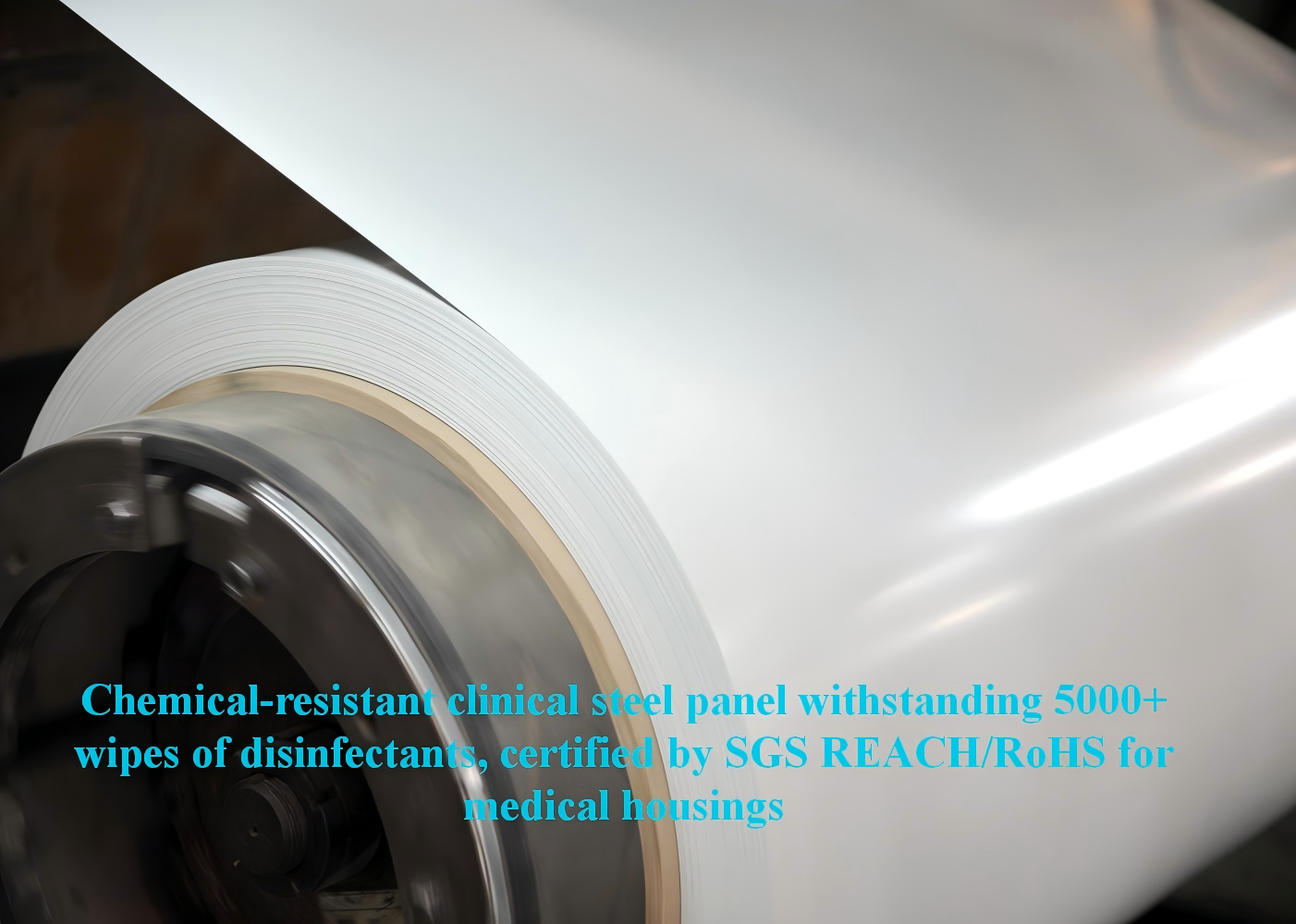
Clinical matte white pre-coated steel: the antimicrobial and chemical-endurance claims are supported by SGS-certified testing.
ZAM-PCM-MGA0508 is a medical-grade antimicrobial matte white coated steel intended for premium clinical equipment casings. The base metal is deep-drawn galvanized steel or premium ZAM steel, in a 0.50–0.80 mm thickness range with custom widths from 4.0 mm to 1250 mm. It carries a dual-sided clinical coating, with a top coat of 10–20 µm and a back coat of 7–12 µm, under a two-layer high-performance coating system. The surface is a low-glare clinical matte white optimised for hospital visual comfort and anti-fingerprint behaviour. Antibacterial efficiency is stated at ≥99% against E. coli and Staphylococcus aureus with SGS certification, and the coating is reported as laboratory-proven against 5,000+ continuous wipes with 75% ethanol, isopropyl alcohol, sodium hypochlorite and hydrogen peroxide without degradation. Deep drawing, stamping and flexible bending are supported without coating delamination, and the substrate is SGS-certified REACH/RoHS compliant ZAM and deep-drawn galvanized steel with a bio-defence polymer coating.
Why it fits: hospital cleaning regimes, not colour retention, are the real durability test for equipment casings. A 5,000-wipe figure speaks to disinfection frequency, which is the variable that actually wears clinical surfaces out. Low-glare matte white also reduces reflection fatigue in treatment and diagnostic spaces.
Procurement note: antimicrobial performance is a surface property and follows coating integrity. Cut edges, deep-drawn corners and scratched areas behave differently from the tested flat surface, so cabinet design should be reviewed against the tested condition. Medical device qualification also depends on the finished device, meaning material documentation supports but does not replace device-level validation.
5. ZAM-VCM-FR-Series — fire-rated interior architecture
The ZAM-VCM-FR-Series is a high-performance fire-retardant VCM laminated steel sheet built on a self-healing ZAM substrate with an engineered fire-retardant white PVC film. Overall dimensions are 0.50–0.70 mm thickness and 1000–1250 mm width, with a PVC film thickness of 40–100 µm. The flame retardancy rating for the PVC film is UL 94 V-0. Fire safety classifications are EN 13501-1 Class B-s1, d0 in Europe, ASTM E84 Class A in the USA and BS 476 Part 6/7 Class 0 in the UK. Corrosion resistance is verified by a 1000 h+ salt spray test, and the material shows zero stress whitening during severe precision bending or deep drawing. Intended applications include data centres and mission-critical infrastructure, medical facilities and pharmaceutical cleanrooms, marine and offshore vessel interiors, server enclosures and telecom cabinets, precision metal cassettes, and high-end fire door OEM work.
Why it fits: interior architecture asks one panel to satisfy fire classification, corrosion resistance and formability at the same time. Zero stress whitening is more than a cosmetic point — whitening at a bend is a visible defect that triggers rejection on architectural metalwork, so a laminate that survives severe bending without it removes a recurring quality dispute.
Procurement note: PVC film laminates are frequently specified against national standards, and declaration bases differ. GB/T 18847-2002, the Chinese standard for PVC laminated steel coil, references a film thickness of 150–180 µm, while this product is declared at 40–100 µm. The difference reflects the specification basis and the measurement method rather than an automatic performance conclusion, but a buyer releasing an order against a national standard should obtain a written film-thickness declaration with the test method attached, and confirm that the declared figure is the one being evaluated. Fire classification should likewise be confirmed for the complete assembly, including substrate and film, not for the film alone.
Substrate Choice: The Comparison That Usually Decides Fit
| Substrate | Used in | Why it is selected | Watch point at RFQ stage |
|---|---|---|---|
| Galvanized steel, Z180 | PVDF-REF-A2-ZAM-0.5-0.7 | Established corrosion protection for industrial jacketing | Ask for the coating-mass test method, not only the designation |
| ZAM (zinc-aluminium-magnesium) | PVDF-REF, ZAM-PCM-MGA0508, ZAM-VCM-FR-Series | Corrosion resistance where cut edges and humid service dominate | Coating designation alone does not define corrosion life |
| EDDQ SECE (electrogalvanized) | SECE-PTFE-MATTE-050 | Deep drawing combined with tight thickness tolerance | Narrow gauge window limits heavier parts |
| ECCS / aluminized steel | YS-ECCS-G2-PF | Food-contact base combined with heat resistance | Food-grade status comes from the coating system and its tests, not from the substrate alone |
Comparison with Traditional Solutions — and Where the Limits Sit
Traditional sourcing routes still work for many jobs. The value of a certified shortlist is knowing which route stops working, and why.
| Approach | Typical build | Where it still works | Boundary |
|---|---|---|---|
| Field painting over galvanized steel | Galvanized substrate, site-applied paint | One-off fabrication and repair work | Cure depends on site conditions; film thickness and adhesion vary and no per-batch factory test report exists |
| Single-layer polyester coil coating | Pre-painted galvanized coil | General appliance and light architectural panels | Limited resistance in refinery, clinical and food-processing cleaning regimes |
| Laminated film systems (VCM / PVC / PET) | ZAM or galvanized base plus 40–100 µm film | Uniform colour, formability, hygienic indoor surfaces | Film-thickness declaration basis differs between standards, so the basis must be agreed in writing |
| Sprayed non-stick liquid coating | ECCS or aluminized base, sprayed release coating | Release performance in cookware and process tooling | PFAS status and food-contact test evidence vary by formulation |
| Separate downstream lubrication | Standard electrogalvanized sheet plus applied lubricant | Low-volume forming operations | Adds a process step and a contamination risk that an integrated coating removes |
The most consequential limitation in this shortlist is documentation granularity. A certificate covering a colour coated steel product class at 0.14–2.0 mm thickness is a strong starting point, but it is not a substitute for a product-specific report tied to a named coating chemistry and a production batch. Where a national or project standard sets a numeric requirement — film thickness, coating mass, fire class, migration limit — the declaration basis must be agreed before the order is released, otherwise acceptance testing becomes a commercial dispute rather than a quality check.
A second limitation is scope. Four of the five products are substrate- and coating-specific by design, which means each one serves a narrower band of applications than a general-purpose pre-painted coil. Buyers consolidating a wide project portfolio should expect to combine two or three of these materials rather than standardise on one.
A Procurement Checklist for Certified Coated Steel
For any of the five products above, the same document set supports a defensible decision:
- Coating system sheet naming the chemistry, top-coat and back-coat build, and the substrate grade.
- Thickness and tolerance statement with the measurement basis, plus slitting width and burr limitations where strip is supplied.
- Chemical compliance certificate with number and scope — for this portfolio, SGS CZXHL25000452102 covering RoHS 2.0 and REACH heavy-metal-free compliance.
- Fire test report to the named standard where fire classification is claimed: EN 13501-1, ASTM E84, BS 476 Part 6/7 or UL 94.
- Food-contact or antibacterial test evidence where the application requires it, including migration tests and wipe-endurance data.
- Mill test certificate — EN 10204 3.1 documentation is provided, and third-party inspection by SGS, BV or TÜV is supported.
- Sample validation covering cross-cut adhesion and cupping or T-bend behaviour at the actual forming severity.
- Carbon documentation where the destination market requires it — EPD and CFP documentation aligned with ISO 14067 and EU CBAM reporting is offered alongside the metallurgical documents.
Market Trend: Functional Coatings Are Becoming a Specification Standard
One commercial market research projection places the global coated steel market at USD 309.5 billion in 2025 and projects USD 565.8 billion by 2033, with the colour-coated segment valued at USD 26.93 billion in 2024. That figure covers the whole coated steel category, including galvanized products, so it should be read as demand context rather than as a measure of any specialist coating segment.
The more useful buyer signal is structural rather than numeric. The shortlist itself shows the convergence: two of the five products combine a polymer or film layer with a functional additive, an antimicrobial polymer in one case and an integrated solid lubricant in another, while a third pairs a PVDF coating system with a defined fire classification and a small-diameter coil format designed around site handling. Multi-stress environments — heat plus friction, disinfection plus abrasion, fire plus corrosion — are being solved by composite surface design rather than by improving a single coating property.
Future Outlook
Three shifts are likely to shape coated steel shortlists over the next procurement cycles.
First, documentation depth becomes the differentiator. Carbon footprint data, EPD and CFP documentation aligned with ISO 14067, and EU CBAM-ready emission reporting now appear alongside coating specifications in supplier capability statements. Buyers are starting to treat carbon documentation as a compliance item rather than a sustainability statement, which changes what belongs in an RFQ pack.
Second, food-contact and fire requirements continue to tighten. PFAS-free declarations are moving toward being a default screening question for food-contact coatings in Europe and North America, in the same way RoHS and REACH heavy-metal compliance became standard over the past decade.
Third, shortlists will be written in constraint language rather than material language. A line item such as “fire-rated interior panel, B-s1,d0, bending without whitening, 1000 h salt spray” is more actionable than a product name, and it is also easier to verify against a test report. That is ultimately the purpose of a certified shortlist: it converts a catalogue into a set of checkable constraints.
FAQ
What thickness range do these coated steel products cover?
Across the five products, thickness runs from 0.30 mm to 0.80 mm. PVDF-REF-A2-ZAM-0.5-0.7 is offered at 0.50 mm and 0.70 mm; YS-ECCS-G2-PF covers 0.30–0.60 mm; SECE-PTFE-MATTE-050 covers 0.40–0.50 mm; ZAM-PCM-MGA0508 covers 0.50–0.80 mm; and the ZAM-VCM-FR-Series covers 0.50–0.70 mm. Width availability ranges from 4 mm to 1250 mm with custom slitting for most products, while PVDF-REF is supplied at 1000 mm width and the ZAM-VCM-FR-Series at 1000–1250 mm.
Are RoHS and REACH documents available for these products?
Yes. SGS certificate CZXHL25000452102 covers RoHS 2.0 and REACH heavy-metal-free compliance for colour coated steel strip, sheet and coil in the 0.14–2.0 mm thickness range, tested against IEC 62321, 2011/65/EU, (EU)2015/863 and IEC 62321-8:2017 using ICP-OES/AAS, UV-Vis and GC-MS methods, for the EU, USA, Asia, Middle East, Africa, South America and China markets. Individual products also reference compliance: SECE-PTFE-MATTE-050 is REACH and RoHS compliant and SGS certified, and YS-ECCS-G2-PF passes RoHS and REACH heavy-metal migration testing. For regulated categories, buyers should still request a report linked to the exact coating formulation and production batch.
Which products are fire-rated, and what classification does each achieve?
Two products carry fire classifications. PVDF-REF-A2-ZAM-0.5-0.7 is certified to EN 13501-1 A2-s1,d0,t1 and to ASTM E84 Class A, and is used for oil refinery thermal insulation and petrochemical pipe cladding. The ZAM-VCM-FR-Series achieves UL 94 V-0 for the PVC film, EN 13501-1 Class B-s1, d0 in Europe, ASTM E84 Class A in the USA and BS 476 Part 6/7 Class 0 in the UK, and is used in interior architecture. The two results are not interchangeable: A2 is the higher reaction-to-fire classification and applies to the metal jacketing system, while B-s1,d0 belongs to the VCM laminate intended for interior surfaces.
What separates a food-grade non-stick coating from a general non-stick coating?
Food-contact grades are assessed by migration and chemical resistance, not by release performance alone. YS-ECCS-G2-PF is PFAS-free, passes the 3% acetic acid test and the 5% citric acid test, passes RoHS and REACH heavy-metal migration testing, and is rated for thermal resistance up to 280 °C on an ECCS or aluminized steel base. A general non-stick coating may deliver comparable release behaviour without those test reports, which is precisely the documentation that food-processing buyers and their auditors request. Release-life durability remains a separate wear property that is not covered by the chemistry tests.
How should antibacterial and durability claims be verified before ordering?
Verification combines a test report with sample-level checks on the actual forming operation. For ZAM-PCM-MGA0508, the reported evidence is antibacterial efficiency of ≥99% against E. coli and Staphylococcus aureus with SGS certification, plus laboratory data for 5,000+ continuous wipes with 75% ethanol, isopropyl alcohol, sodium hypochlorite and hydrogen peroxide without degradation. Because these properties depend on coating integrity, cut edges, deep-drawn corners and scratched regions should be assessed separately from the tested flat surface, and the supplier’s sample should be formed at the same severity as production.
Download the Youngson Metal product catalogue: Chongqing Youngson Metal Products Co., Ltd. catalogue (PDF). Company information is also published at youngsonmetal.com.