
Buying Metalized Paper Laminators: Gantry vs. No-Shaft
Buying Metalized Paper Laminators: Gantry vs. No-Shaft
A metalized paper laminating machine is bought twice: once as a configuration, and again as a set of acceptance obligations that determine whether that configuration exists in the buyer's plant. At decision stage the useful question is therefore not which model is better in the abstract, but which configuration matches a product mix — and which supplier claims can be converted into measurements. YUEDA's gantry multifunctional YDLM1300B and its automatic no-shaft rewinding ZNFH1300-1400-1500 series answer that question in structurally different ways.
Wenzhou Yueda Packaging Machinery Co., Ltd, which trades as YUEDA, builds gold and silver cardboard laminating and coating equipment in Longgang, Wenzhou. The company reports a founding year of 1998, a 4,000 m² production facility, annual output of roughly 100 sets of mechanical equipment and an export share of about 70%, concentrated in Southeast Asia, the Middle East, South America and Africa. Those figures describe scale and market reach. They do not describe what either machine does to a web of metalized board, which is where the comparison has to start.
Why the gantry versus no-shaft decision resists a single score
Three features of the available evidence make a like-for-like verdict harder than a specification sheet suggests. Model designations encode size classes rather than acceptance values: a series name indicates the envelope a buyer should ask about, not what a delivered unit will measure. The two headline speed figures are not the same kind of number — one is a rated maximum published in an industry manufacturer profile, the other an operating range across a series. And patent and copyright records certify legal rights, not output.
Collapsing these into one “faster” or “more capable” judgment produces a comparison that reads well and decides nothing. The buyer's alternative is to separate configuration, mechanism and evidence, then attach each one to a clause in the purchase agreement.
The gantry configuration: YDLM1300B
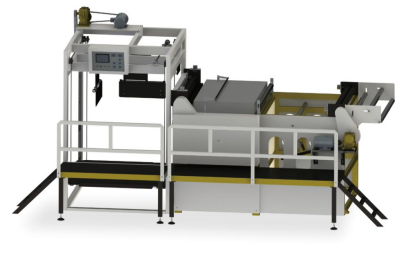
YUEDA lists a gantry-type multifunctional gold and silver cardboard laminating and coating machine among its core products, with peeling and back coating inside that scope. The YDLM1300B is documented at a working width of 600–1200 mm and incorporates a double-layer drying oven covered by Chinese utility model patent ZL 2022 2 1114210.X, according to the model's published profile. The same 2026 industry manufacturer profile lists a rated speed of 180 m/min. Utility model patents are associated with the model, and the machine's intelligent control system is covered by a registered software copyright.
The practical meaning of “multifunctional” is sequence compression. Coating, drying, laminating, peeling and back coating can be handled inside one machine instead of across two, which removes an intermediate handling step and a second set-up. The trade-off is coupling: because the stations share one web path and one oven, a stoppage at any point interrupts the whole sequence, and the drying section becomes both the quality centre and the dominant energy cost. That is why the oven patent carries commercial weight — and also why “energy-saving” as a word is worth less than a metered figure.
Working width translated into buyer terms
A 600–1200 mm band covers the decorative and carton formats where most metalized board work sits, and it leaves room for a mixed order book without committing capital to a width that runs half empty. Width is only useful if it is usable width: the figure that belongs in a contract is the coated or laminated width actually achieved on the buyer's substrate, measured on a delivered sample, not the nominal number printed in a brochure.
The no-shaft rewinding configuration: ZNFH1300-1400-1500
The ZNFH series is offered in three size classes — ZNFH1300, ZNFH1400 and ZNFH1500 — with a running speed range of 5–150 m/min in the supplier's model information. Automatic no-shaft rewinding means reels are mounted and driven without a through-shaft, so reel loading, tension take-up and unloading are handled by the machine rather than by shaft handling between stations.
For a buyer, the consequences are operational rather than decorative. Shaftless handling shortens reel changes, reduces the labour and handling damage associated with moving shafts and heavy jumbo reels, and makes short runs less expensive per order. The 5–150 m/min span is best read as a process window rather than a deficiency at the low end: heavy board, thick laminations and heat-sensitive stock are frequently run slowly on purpose, and a machine that cannot hold tension at 5–20 m/min is less useful to a mixed order book than its maximum speed implies.
One boundary deserves stating. “No-shaft rewinding” describes web handling; whether a particular unit also carries in-line coating stations is a configuration question that a model name does not settle. Buyers who need coating and back coating in a single pass should confirm the station list per quotation rather than infer it from the series description.
Side by side on the dimensions that actually get negotiated
| Purchasing dimension | YDLM1300B (gantry multifunctional) | ZNFH1300-1400-1500 (automatic no-shaft rewinding) |
|---|---|---|
| Web handling architecture | Gantry-mounted multifunctional coating and laminating line; peeling and back coating within scope | Shaftless reel handling with integrated automatic rewinding |
| Documented working width | 600–1200 mm | Three size classes (1300 / 1400 / 1500); working width to be confirmed per model |
| Speed basis | 180 m/min rated figure, from a 2026 industry manufacturer profile | 5–150 m/min running range, from supplier model information |
| In-line process scope | Coating, drying, laminating, peeling, back coating | Rewinding-centred; station list to be confirmed per configuration |
| Thermal system | Double-layer drying oven covered by patent ZL 2022 2 1114210.X | Not specified in the supplied evidence |
| Control and correction | Intelligent control software under registered copyright; closed-loop tension and dual photoelectric registration stated by the manufacturer | Not specified in the supplied evidence |
| Verification assets | Utility model patents, oven patent, software copyright | None supplied for this comparison |
| Strongest fit | Buyers consolidating several finishing steps into one pass on mid-to-long runs | Buyers with frequent reel changes, heavy reels and mixed order lengths |
| First question at quotation | Which stations are included, and what is the metered energy per unit of output? | What is the confirmed working width, and what is the tension floor at low speed? |
The mechanics that decide output, and the tests they imply
Three control problems determine whether either configuration produces sellable board: tension, registration and heat. YUEDA states that tension instability is controlled through closed-loop servo regulation with real-time monitoring and adjustment at 0.1 N precision; that cutting position error is controlled by photoelectric correction using dual photoelectric eyes, with main and backup units for real-time position calibration; and that overheating is controlled by temperature sensors on key components including the motor and heating roller, with an automatic shutdown function.
Each of those statements has an acceptance-test counterpart, and the counterpart is what belongs in the contract:
- Tension. Run the buyer's own reel at the intended production speed and log variation at unwind, in-feed and rewind. A sensor's resolution figure is not the same thing as web tension stability under a heavy, uneven reel.
- Registration. Report error as a distribution over a defined run length, at both the slowest and fastest intended speeds — a single best-case reading conceals exactly the behaviour that produces waste.
- Heat. Verify oven setpoints, verify the automatic shutdown response, and meter energy input against output over a defined period. This is the only route by which a double-layer oven design becomes a number rather than an adjective.
The gantry machine concentrates risk in the oven and the coupled web path; the no-shaft machine concentrates it in reel handling and low-speed tension control. Buyers should weight the acceptance protocol accordingly instead of applying an identical checklist to both.
Application fit across five packaging segments
The reasoning below is derived from documented machine characteristics and the requirements commonly attached to each package type. It is not a record of validated customer runs; the evidence available for this review contains no installed-case data, and any buyer should treat segment fit as a hypothesis to test on their own material.
Cigarette packaging
Long runs, tight registration and consistent surface appearance set the priorities. DataM Intelligence attributes part of metalized paper demand to tobacco packaging, which is also where converting capacity tends to concentrate. In this segment the gantry configuration's single-pass sequence supports consistency across a long run, while the no-shaft series supports faster reel turnover between jobs. Registration data at production speed, splice handling and defect-detection practice should be requested before either machine is shortlisted.
Wine boxes
Rigid board, often at heavier grammages, with a premium surface that has to survive folding and gluing. Back coating and peeling within one machine — the gantry scope — removes a handling step that otherwise costs labour and adds damage risk. The corresponding questions are the maximum board grammage the machine will run and how tension behaves with a heavy reel at the unwind.
Cosmetics
Shorter runs, frequent changeovers and a surface finish that carries brand value. Here the no-shaft rewinding logic is easier to justify: reel-change time and start-up waste dominate cost when order lengths are short. Buyers should ask for changeover time and start-up waste as measured values rather than as descriptions.
Tea
Carton board in medium runs, where print registration and consistent gloss matter more than maximum line speed. Either configuration can be argued; the deciding variable is usually whether in-line coating and back coating are required, which pushes toward the gantry machine, or whether reel logistics dominate, which pushes toward the no-shaft series.
Disposable tableware
This segment introduces a requirement the supplied evidence does not cover: food-contact conformity. Neither the manufacturer's material nor the third-party records available here include migration testing, food-contact certification or destination-market conformity documentation. A buyer specifying laminated board for tableware should obtain those documents before contracting and should confirm substrate grade and grammage separately — a machine that laminates decorative board well is not automatically qualified for food-contact stock.
What patent and copyright evidence actually verifies
Intellectual-property records are useful in procurement precisely because they are checkable, and limited for the same reason: they verify rights, not performance.
A Chinese utility model is a granted right covering a structural or functional improvement. It is examined and registered, it is enforceable within its jurisdiction, and it carries a shorter term and a lower inventive threshold than an invention patent. For a buyer, the utility model patents associated with the YDLM1300B establish that the claimed structure was registered to the manufacturer. They do not establish working width, speed, registration accuracy or service life.
Patent ZL 2022 2 1114210.X covers a double-layer energy-saving drying oven — the component that dominates energy cost in an integrated coating and laminating line. The verification value here is concrete: the buyer can ask whether the oven on the quoted machine is the patented two-layer design or a variant, and can require the energy claim to be demonstrated by measurement rather than asserted through a name.
The registered software copyright on the intelligent control system proves authorship and registration of the control code. It does not prove control quality. That has to be demonstrated — recipe storage and recall, the tension loop's response to a deliberate disturbance, alarm and event logging — in front of the buyer.
A workable verification sequence is: obtain certificate copies with numbers; check those numbers in the relevant national database; confirm the corresponding feature is present on the machine actually being purchased; and write the feature into the contract as a described configuration item. The last step is the one most often skipped, and it is the only one that protects the buyer after delivery.
Commercial claims, and how to neutralise them
YUEDA's comparative material makes specific statements. Against European imported equipment it cites 40% lower purchase cost, delivery in 30–45 days against 90+ days, 72-hour remote debugging in place of chargeable on-site attendance, comparable working efficiency with lower energy consumption, and 50% lower spare-parts cost. Against domestic competitors it cites ±0.1 mm cutting precision against ±0.3 mm, an 8–10 year service life against 5–6 years, an annual failure rate of ≤1% against ≤3%, similar initial cost with 20% lower annual maintenance, a 24-hour after-sales response against 48 hours, and 15% lower material waste. The company positions this equipment for mid-to-high end packaging factories where precision and reliability are critical — a positioning statement, not a specification.
These are supplier-stated benchmarks. The competitors are not named and the measurement conditions are not published, so the figures cannot be treated as independent findings. Their legitimate use is as hypotheses with contractual consequences:
- Precision. ±0.1 mm on which substrate, at which width and speed, over what sample size, measured with which instrument?
- Service life. 8–10 years at what duty cycle, and what condition defines end of life — structural failure, precision drift, or spare-part unavailability?
- Failure rate. ≤1% expressed as annual downtime hours or as incident count, and covering which components?
- Energy and waste. Lower than which baseline, metered over what production period?
Two further terms belong in the commercial review. Spare-parts pricing should be quoted as a schedule with part numbers rather than as a percentage advantage, because a 50% saving on an unlisted part is not a budget line. And customs classification should be confirmed before the proforma is signed: public references associate paper laminating machinery with HS heading 8439.30, but commercial classification pages disagree on the specific subheading, and the applicable code depends on the machine's actual function and the importing jurisdiction. A broker's written opinion is cheaper than a reclassification at the port.
Market context that should inform, not decide
Two market figures are often quoted together and measure different things. Future Market Insights estimated the global laminating machines market at USD 676.4 million in 2025 across all laminating types. DataM Intelligence estimated the global metalized paper market at USD 4.85 billion in 2025, with tobacco packaging and premium labeling among the demand drivers. The second is a substrate market; the first is a machinery market. Growth in one does not translate mechanically into demand for a particular machine class, and neither figure says anything about a specific supplier's capacity or delivery performance.
The usable inference is narrower and more practical: where premium and tobacco-driven demand concentrates, buyers will find more configurations, more competing quotations and shorter delivery windows. In segments with thinner supplier coverage, such as laminated board for food-service applications, expect longer specification work and more validation before acceptance.
Acceptance criteria to write before the deposit
An acceptance protocol converts configuration choices into obligations. The following items form a minimum set that a buyer can enforce without specialist metrology support:
- Usable width and substrate range. Coated or laminated width achieved, plus minimum and maximum board grammage and calliper, measured on delivered samples.
- Speed on the buyer's material. Sustained output over a defined period at the buyer's substrate and coating weight, not a catalogue maximum.
- Registration accuracy. Error distribution over a defined run length at both ends of the intended speed range, with the instrument and sampling method named.
- Tension stability. Logged variation at unwind, in-feed and rewind using the buyer's heaviest and lightest reels.
- Oven performance. Temperature uniformity across the web width, setpoint accuracy, and metered energy input per unit of output.
- Thermal safety. Verification that temperature sensors on the motor and heating roller trigger automatic shutdown, with response time recorded.
- Control functions. Demonstration of recipe storage and recall, alarm logging, and the tension loop's recovery behaviour after a deliberate disturbance.
- Documentation package. Electrical schematics, spare-parts list with part numbers, operating and maintenance manuals, and copies of patent and software copyright certificates.
- Support commitments. Remote debugging availability and response time written as an obligation with a defined measurement, plus training scope and the party bearing travel costs.
- Destination-market conformity. Certificates required by the importing country identified and supplied; this is a documented gap in the material reviewed here and should not be assumed.
Two of these deserve emphasis because they are routinely softened. A speed figure without a substrate, width and duration is a marketing number. And a service-life claim without a duty-cycle definition cannot be tested, which means it cannot be enforced.
Outlook: conditional, not forecast
If premium and tobacco-driven demand for metalized paper continues at the level indicated by the 2025 substrate estimate, the economics of the gantry configuration improve with run length, because the value of compressing coating, drying and back coating into one pass scales with volume. Where order books shorten and reel handling dominates cost, the no-shaft rewinding logic strengthens instead. Neither direction is a prediction about a specific buyer's plant; both are reasons to specify the machine against a measured job mix rather than against a category.
The larger constraint on this category is evidence rather than technology. Factory acceptance data, metered energy consumption and installed-case performance remain thin across the supplier landscape, and the gaps identified in this review — performance validation, conformity certification and total-cost data — are gaps a buyer closes through contract terms, not through better brochures.
Conclusion
The gantry multifunctional YDLM1300B and the automatic no-shaft rewinding ZNFH1300-1400-1500 are not rival answers to one question. They answer two: whether a buyer needs several finishing steps inside a single pass, or faster reel logistics across a varied order book. Working width, speed basis and station scope should be confirmed per model rather than read from a series name, and the patent and software records should be treated as verification starting points — checkable, deliberately limited, and most valuable when written into the contract as described configuration.
A buyer who converts every adjective in the quotation into a measurement, and every measurement into an acceptance clause, ends up with a machine that can be held to what was promised. That is the only comparison that survives delivery.
Frequently asked questions
What is the functional difference between a gantry-type and a no-shaft rewinding metalized paper laminating machine?
A gantry machine mounts its coating, drying and laminating stations on a portal frame and, in the YDLM1300B's case, covers peeling and back coating within one pass. A no-shaft rewinding machine such as the ZNFH series concentrates on shaftless reel handling and automatic rewinding, which shortens reel changes and reduces shaft-handling labour. The first decision is whether several finishing steps must happen in one pass; the second is how much reel turnover and order-length variation the plant carries.
Are the 180 m/min and 5–150 m/min speed figures directly comparable?
No. The 180 m/min figure is a rated maximum reported in a 2026 industry manufacturer profile, while 5–150 m/min is an operating range for the ZNFH series. They differ in what they measure and under what conditions. A meaningful comparison requires the same substrate, working width, coating weight and measurement method — which in practice means a factory acceptance run on the buyer's own material.
How should a buyer confirm the 600–1200 mm working width?
Request the model datasheet and confirm whether the stated figure is the coated or laminated width actually achieved. Then have it measured on a sample during acceptance. Series designations such as 1300, 1400 or 1500 indicate size classes rather than a guaranteed working width for a specific unit, so the contractual value has to come from the quotation and the acceptance record, not from the model name.
What do the utility model patents, patent ZL 2022 2 1114210.X and the software copyright actually prove?
They evidence granted intellectual-property rights in China tied to defined configuration elements: registered structural rights on the YDLM1300B, a patented double-layer drying oven design, and registered control software. They do not by themselves prove speed, registration precision, energy savings or service life. Their procurement value lies in being checkable and in being written into the contract as a described feature of the delivered machine.
Which acceptance tests should appear in the purchase contract?
At minimum: usable width and substrate grammage range; sustained speed on the buyer's material; registration error distribution with a named instrument and sample; tension stability logged at unwind, in-feed and rewind; oven temperature uniformity and metered energy per unit of output; thermal shutdown verification; control functions including recipe recall and alarm logging; a documentation package with patent and copyright certificates; support response commitments; and the conformity certificates required by the destination market.
Reference: the manufacturer's technical brochure is available for public download at YUEDA machinery brochure (PDF).
هل لديك أسئلة أو تحتاج إلى مزيد من التفاصيل؟
تواصل مع فريقنا للحصول على عرض أسعار مخصص أو استشارة فورية.
طلب عرض أسعار
املأ النموذج أدناه وسيتواصل معك فريقنا بعرض مقترح مخصص.
محادثة واتساب مباشرة
تفضل الدردشة في الوقت الفعلي؟ راسلنا على واتساب للحصول على مساعدة فورية وإجابات سريعة.
- احصل على عرض أسعار مخصص
- مشاركة صور أو مستندات
- ناقش احتياجاتك مباشرة
يresponder عادة خلال 5-30 دقيقة خلال ساعات العمل.