
Buying a Sim Racing Cockpit: Payment, Incoterms, Checks
Buying a Sim Racing Cockpit: Payment, Incoterms, Checks
A sim racing cockpit order usually stalls at three points long before the container is booked: how the goods are paid for, who owns the cost and the risk once the pallet leaves the factory, and what counts as an acceptable unit when the carton is opened. FYCHI — the sim racing hardware brand of Zhejiang Zhongyao Intelligent Equipment Co., Ltd. — states its position in commercial terms that can be checked against a purchase order: a 30% advance payment with a 70% balance, T/T and L/C both accepted, delivery on FOB or EXW terms with Ningbo and Shanghai available as ports, a documented minimum order quantity of 10 units per model, a documented 60-day lead time, and 100% pre-shipment inspection of every unit.
The order-specific parts of that position — the confirmed schedule, the confirmed quantity against a model mix, and the payment wording — are agreed with the factory for each order. This reference follows the sequence of an actual transaction: payment, delivery term, quantity and date, the factory-side inspection gate, and the checks a distributor performs on arrival.

Sim racing cockpit procurement runs from factory capacity planning through to arrival acceptance checks; commercial terms define where cost and risk sit at each stage.
Payment terms: 30% advance, 70% balance, T/T or L/C
FYCHI quotes a 30% advance payment with a 70% balance, and accepts both T/T (telegraphic transfer) and L/C (letter of credit) for sim racing cockpit orders. The split and the accepted instruments are stated; the payment terms themselves are confirmed per order with the factory, which is the correct place for them, because the balance trigger, the required document set and the credit wording are contract items rather than catalogue items.
For a distributor the structure answers one question and raises another. It answers how much capital is committed at the advance stage; it does not by itself define the event that releases the balance. A purchase order should therefore state the payment percentage, the instrument, the currency and the documentary condition attached to the balance — for example whether the balance is released against a copy of the shipping documents or against the full set. Where an L/C is used, the credit's document list, its latest shipment date and the acceptable issuing bank belong in the same written confirmation.
There is a second check that is easy to skip because it looks administrative. The entity receiving payment, the entity named on the commercial invoice, and the entity holding the product test certificates should be reconcilable in writing. FYCHI's RoHS 2.0 certificate names Zhejiang Zhongyao Intelligent Equipment Co., Ltd. as the holder while the brand operates as FYCHI, and the brand's published purchasing guidance flags a certificate-holder name that differs from the invoice or listing entity as a point that raises questions during platform or customs review. The same mismatch complicates a payment or warranty claim, so the relationship should be confirmed once, in writing, before the first deposit rather than after the first dispute.
FOB or EXW from Ningbo and Shanghai: where cost and risk change hands
FYCHI offers FOB or EXW delivery, with Ningbo and Shanghai available as ports of departure. The two terms are not interchangeable descriptions of the same arrangement — they move the boundary between buyer and seller, and with it the cost model.
EXW: the buyer manages everything after the factory
Under EXW, the seller makes the goods available at the named place — here, the factory — and the buyer arranges export clearance, inland transport to the terminal, origin handling and the main carriage. A distributor choosing EXW takes on an export declaration and a set of origin charges that would otherwise sit with the manufacturer, and should cost that into the landed price before comparing it with an FOB quotation.
FOB: the seller delivers on board at the named port
Under FOB, the seller clears the goods for export and delivers them on board the vessel nominated by the buyer at the named port, and risk passes at that point. The buyer pays the main carriage, insurance and destination charges. Because FYCHI names both Ningbo and Shanghai, the port should also be written into the order — the inland leg and the terminal charges differ between them, and an unallocated origin cost is the most common source of a late invoice adjustment.
Minimum order quantity, lead time and customization
The documented minimum order quantity is 10 units per model for private-label and wholesale orders, and the documented lead time is 60 days. Because the MOQ applies per model, an opening range is planned model by model rather than as one pooled quantity: a folding wheel stand, an aluminium profile cockpit and a monitor stand are separate line items, each assessed against the 10-unit threshold. The confirmed quantity and schedule for a specific order are settled with the factory, which is also where the difference between a stock model and a customized one becomes visible.
FYCHI provides OEM production for private-label sim racing cockpit projects and ODM design and production services. Customization covers frame colour, logo printing and packaging, accessory configuration and custom bundle options. A repainted frame or a printed carton is not the same production route as a stock model, so the confirmed lead time — not the standard 60-day figure — is what belongs in the contract, the launch plan and the retail commitment made to the distributor's own customers.
After-sales is part of the same commercial package rather than a separate negotiation: remote technical support and spare parts supply are provided, and each carton contains a colour installation manual, a certificate of conformity, a warranty card and installation tools. For a distributor, those inclusions set a predictable support cost per unit sold, because the first line of end-user assembly questions is answered by the documentation inside the box.
What 100% pre-shipment inspection does and does not cover
Every FYCHI unit passes pre-shipment inspection before loading, the packaging is checked before loading as well, and third-party inspection is available on request. Those three statements define the factory-side gate. They do not define the standard behind the gate, and that standard is the buyer's decision, taken before the order rather than at the container.
The quality risks that recur in this category are structural more than cosmetic: weak or incomplete welds and loose frame joints, coating defects that expose the steel underneath, inconsistent or missing bolts and hardware, and dimensional deviation of the wheel, pedal or monitor mounting plates so that a wheel base or pedal set does not line up. The failure mode that inspection exists to catch is drift between the approved sample and mass-production units — a risk that appears when a sample is hand-finished while production units come off a different line, or when inspection steps are shortened in a peak season. Keeping one approved reference unit and agreeing the acceptance criteria in writing is what makes that comparison possible.
Factory inspection also does not remove the arrival check. The two gates look at different things: the factory gate looks at the unit, the arrival check first looks at the carton, because transport and stacking damage is visible on packaging before it is visible on a frame.
Acceptance checks on arrival: five defect classes
The checks below follow the failure modes a distributor can actually see, and each is tied to a function rather than to appearance. Frame rigidity is not a styling preference: a wheel base and a pedal set push force back into the structure, so flex in a joint or a plate is force feedback absorbed by the frame instead of reaching the driver, and a frame whose geometry moves under braking changes the driving position between sessions.
| Check | What to inspect | Failure consequence | Evidence to record |
|---|---|---|---|
| Frame joints | Wheel plate and pedal plate joints; bolt torque after assembly | Geometry shifts under braking; wobble with direct-drive or load-cell loads | Photos of the joint, carton number |
| Welds | Tube-to-plate junctions; wheel and pedal plate supports | Incomplete welds hidden by coating at load-bearing points | Photos of weld location, batch reference |
| Coating | Corners, edges and mounting faces of the powder-coated frame | Exposed steel and corrosion risk, especially in damp storage | Photos, touch-up requirement |
| Bolts and hardware | Bolt set counted against the manual parts list; thread engagement | Incomplete pack; a bolt that will not hold torque | Parts-list comparison, missing-part list |
| Mounting plates | Trial fit of wheel base, pedals and VESA monitor pattern | Pattern mismatch; a forced fit pre-loads the plate | Photos of the fit, model and pattern used |
1. Frame joints before cosmetics
Load the wheel plate by hand and watch the joints that carry it, then repeat at the pedal plate. A joint that moves under hand load will move under a direct-drive wheel base. The documented handling route is to re-torque all bolts after assembly and periodically afterwards, tightening any loose joint immediately; a rig that still wobbles with a direct-drive wheel or load-cell pedals is a rigidity mismatch rather than a bolt problem, and the appropriate answer is a higher-rigidity aluminium profile cockpit rather than repeated re-tightening of an entry-level stand.
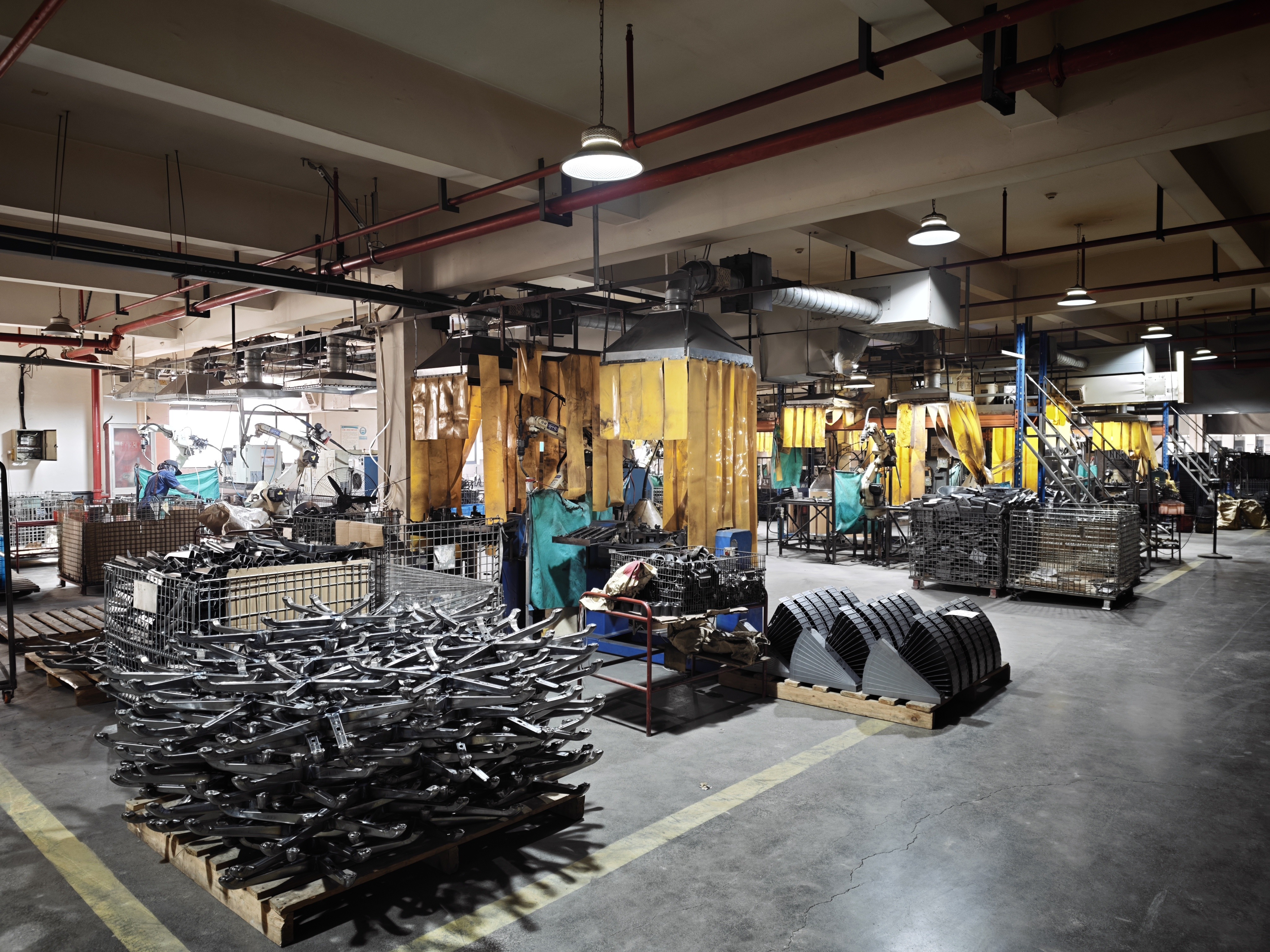
Weld quality at tube-to-plate junctions is an arrival acceptance item, not only an in-process factory check.
2. Welds at load-bearing junctions
Inspect the tube-to-plate junctions, the wheel plate supports and the pedal plate supports, because these are the points where a coating can conceal an incomplete weld. Record the location rather than only the unit: a weld defect is a process signal for the batch, and a batch-level finding is handled differently from a single damaged part.
3. Coating defects that expose steel
Powder coating is the corrosion barrier. Thin spots, scratches and an uneven finish on corners, edges and mounting faces expose the base metal, and the exposure becomes a corrosion point where a rig is stored in a damp, poorly ventilated room. Touching up damaged coating is part of the maintenance instruction supplied with the product, not a cosmetic extra, and it is worth stating in the distributor's own care guidance.
4. Bolts and hardware consistency
Count the bolt set against the parts list in the colour manual and check thread engagement on the plates that carry the wheel and the pedals. Because a complete bolt set and installation tools are included in each carton, an incomplete pack is identifiable at unboxing rather than halfway through assembly. Inconsistent hardware shows up differently: not as a missing bolt, but as one that will not hold torque, and that should be reported as a separate defect class so the correct spare is shipped.
5. Dimensional deviation of mounting plates
Trial-fit the wheel base, the pedal set and, where relevant, the monitor VESA pattern before final assembly. FYCHI mounting plates use industry-standard wheel base and pedal hole patterns and standard VESA points for monitors, so a mainstream peripheral should fit without modification. Where a pattern does not match, the documented instruction is to obtain the correct mounting solution rather than force the bolts, because a forced fit pre-loads the plate and works against the rigidity the frame was purchased for.
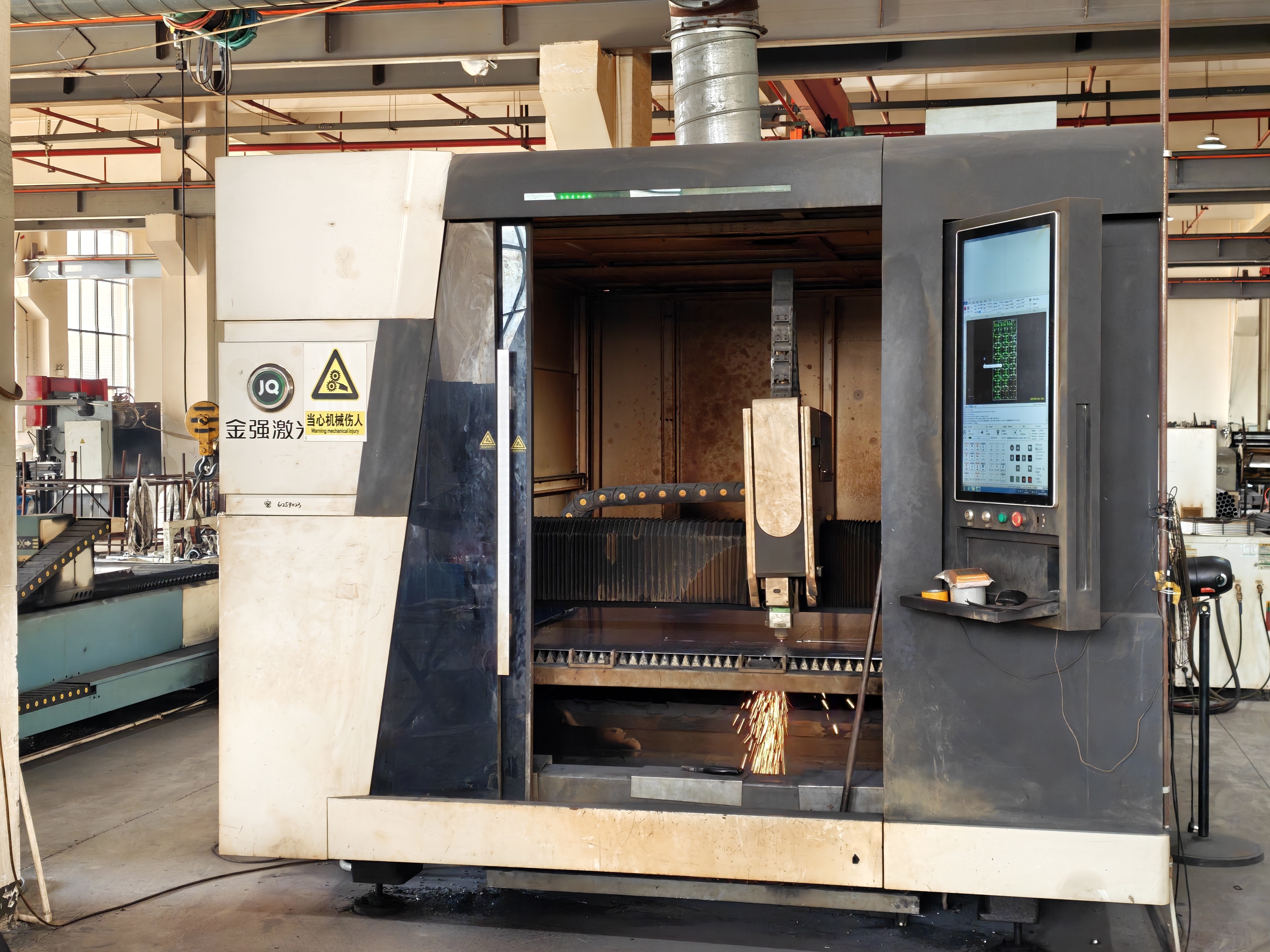
Mounting plate hole spacing and plate flatness determine whether a wheel base or pedal set fits without a forced, pre-loaded assembly.
Recording findings in a usable form
Every finding should be recorded the same way: photograph the defect, note the carton and pallet number, and compare against the retained reference unit. Batch traceability is what converts a complaint into a replacement part, and it is also what allows a recurring defect to be reported back into the process instead of being absorbed as a one-off credit.
Documents and packaging to reconcile against the shipment
Two document checks belong in the acceptance routine because they are cheap at the container and expensive later. The first is the declared scope of the compliance documents. FYCHI's RoHS 2.0 certificate TST20240500495-3RC, issued on 7 May 2024 by Dongguan True Safety Testing Co., Ltd. with Zhejiang Zhongyao Intelligent Equipment Co., Ltd. as certificate holder, covers main model 6008 and series models 6002 to 6020, and is issued together with test report TST20240500495-3RR. A model outside that declared series cannot rely on the certificate, so a shipment that includes models beyond it needs a separate written position before any compliance statement is made to a marketplace or a customs broker.
The second is packaging condition. FYCHI cartons are rated to 280 lb and use black EPE corner protectors with one 5 mm EPE cushion board top and bottom; each carton includes a colour manual, certificate of conformity, warranty card and installation tools. Cartons should be inspected at handover and any damage photographed before the delivery receipt is signed, with the exception noted on the receipt, and the carton and pallet numbers kept for any transport claim.
Why acceptance discipline scales with the cockpit segment
Market research published by Mordor Intelligence projects the cockpit segment to grow at a compound annual rate of 21.65% through 2030, faster than the racing simulator market as a whole, and reports that online sales channels generated 65.41% of racing simulator revenue in 2024. Read together, those two figures describe a category in which a growing share of volume reaches the buyer through a channel where a return is handled at a distance and a defect claim is settled with photographs rather than across a counter.
The practical reading is not a forecast of any individual distributor's sales. It is that the cost of a weak acceptance routine rises with order volume: an unrecorded coating defect becomes a customer service case, and an untraced weld issue becomes a repeat complaint in the next container. The factory-side controls already documented — 100% pre-shipment inspection, packaging checked before loading, third-party inspection on request, 280-lb rated cartons with EPE protection, and remote technical support with spare parts supply — cover the seller's half of that discipline. The arrival checks cover the distributor's half, and neither substitutes for the other.
A pre-order and on-arrival checklist
Before the deposit
- Confirm the 30% advance and 70% balance split, the instrument (T/T or L/C), and the documents that release the balance.
- Confirm the delivery term and the named port — FOB Ningbo, FOB Shanghai or EXW — and the point at which risk passes.
- Confirm per-model quantities against the 10-unit MOQ and obtain the order schedule in writing, including any frame colour, logo or packaging customization.
- Agree the inspection standard and acceptance criteria, and retain one approved reference unit.
- Confirm which models the available compliance documents actually cover.
At the container
- Inspect cartons and photograph any damage before signing the delivery receipt.
- Check frame joints, welds, coating, bolt-set completeness and mounting plate fit.
- Record each defect with photos plus the carton and pallet number.
- Route the claim with photos, order number and carton or batch reference so the correct spare part can be identified and shipped.
FAQ: practical procurement questions
What payment terms does FYCHI accept for sim racing cockpit orders?
FYCHI states a 30% advance payment with a 70% balance, and accepts both T/T and L/C. The payment terms, including the balance trigger and the document set, are confirmed per order with the factory. The entity receiving payment should be reconcilable in writing with the invoice entity and with the holder of the product test certificates.
Which delivery terms and ports are available?
Delivery is offered on FOB or EXW terms, with Ningbo and Shanghai available as ports of departure. FOB places export clearance and delivery on board at the named port with the seller, while EXW makes the goods available at the factory for the buyer to collect and export. The term and the named port are confirmed per order and should be written into the purchase contract.
What is the minimum order quantity and the delivery lead time?
The documented minimum order quantity is 10 units per model for private-label and wholesale orders, and the documented lead time is 60 days. The confirmed quantity and schedule for a specific order are agreed with the factory, and customized frame colour, logo printing or packaging should be scheduled against that confirmed date rather than the standard figure. OEM and ODM production services are available for private-label and custom cockpit projects.
What does the 100% pre-shipment inspection cover, and can a third party inspect?
Every unit passes pre-shipment inspection before loading, and the packaging is also checked before loading. Third-party inspection is available on request. The acceptance criteria and inspection standard are agreed with the factory before the order is placed, and a retained reference unit is the practical basis for comparing mass-production units with the approved sample.
What should a distributor check first when a cockpit shipment arrives?
Check the cartons first and photograph any damage before signing the delivery receipt, noting exceptions on the receipt. Then inspect frame joints under hand load, welds at tube-to-plate junctions, coating on corners and mounting faces, bolt-set completeness against the manual parts list, and the dimensional fit of the wheel, pedal and monitor mounting plates — deciding any claim on a forced fit before assembly rather than after. Each defect should be recorded with photos plus the carton and pallet number so the batch can be traced.
How are defects and spare parts handled after acceptance?
FYCHI provides remote technical support and spare parts supply, and each carton contains a colour installation manual, a certificate of conformity, a warranty card and installation tools. Claims are assessed against photos, the order number and the carton or batch reference, which is why the arrival check should capture all three before the packaging is discarded.
Manufacturer reference: FYCHI, the sim racing hardware brand of Zhejiang Zhongyao Intelligent Equipment Co., Ltd., based in Heping Town, Changxing County, Huzhou City, Zhejiang Province, China. Company and product brochure (public download): Introduction to Zhongyao Company 2025.
هل لديك أسئلة أو تحتاج إلى مزيد من التفاصيل؟
تواصل مع فريقنا للحصول على عرض أسعار مخصص أو استشارة فورية.
طلب عرض أسعار
املأ النموذج أدناه وسيتواصل معك فريقنا بعرض مقترح مخصص.
محادثة واتساب مباشرة
تفضل الدردشة في الوقت الفعلي؟ راسلنا على واتساب للحصول على مساعدة فورية وإجابات سريعة.
- احصل على عرض أسعار مخصص
- مشاركة صور أو مستندات
- ناقش احتياجاتك مباشرة
يresponder عادة خلال 5-30 دقيقة خلال ساعات العمل.