
C&I ESS Sites: Indoor vs Outdoor Pack Insertion Robot Fit
C&I ESS Sites: Indoor vs Outdoor Pack Insertion Robot Fit
A C&I energy storage site rarely chooses a battery pack insertion robot on payload alone. The decision usually turns on where the machine has to stand: an indoor assembly bay with a finished slab, an open yard where containers are stuffed outdoors, or a mixed site where the same unit has to work in both. For container-based commercial and industrial storage, three architectures are documented for the same insertion task — crawler, rail-fixed and AGV — and each is tied to a different kind of ground.
This reference maps those three platforms to the site conditions they are built for, using the published parameters of the ZZX2522 crawler, the ZZX2508 and ZZX2524 rail-fixed units and the RD16 AGV from Shanghai Zonzsin Intelligent Equipment Co., Ltd. (Zonzsin), a manufacturer founded in 2019 that supplies battery PACK assembly lines and container ESS pack insertion robots. It then sets out the container envelope, PACK envelope, door-opening and utility checks that determine whether a platform fits a specific line at all — before any commercial discussion begins.
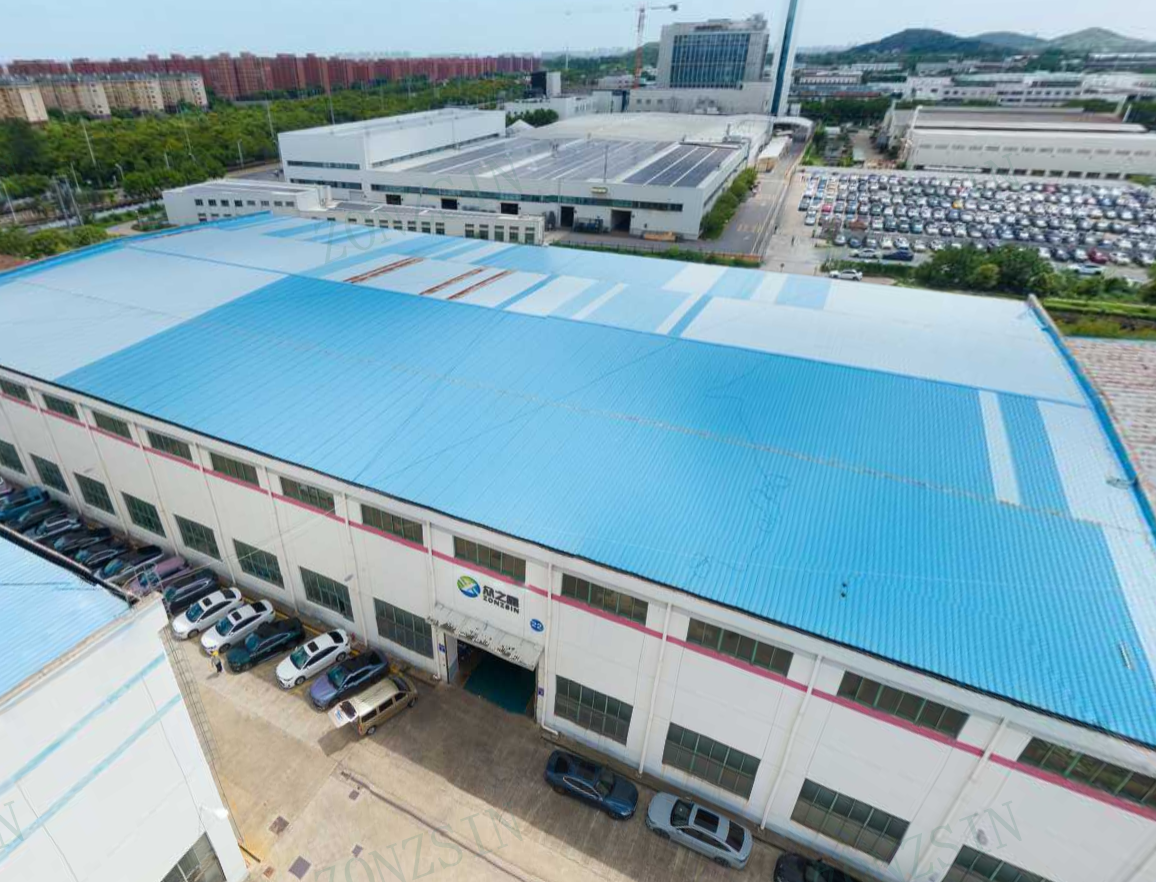
Indoor assembly environments and open yards impose different floor, clearance and utility conditions on the same insertion task. Image: Zonzsin new workshop.
Where the Robot Stands Decides More Than the Payload
Container energy storage assembly has consolidated around one physical pattern: battery packs are brought to a container, lifted to the rack level and inserted through the door. The equipment that performs this has to solve three problems at once — reach the correct height, hold the pack without damaging it, and stay stable while a heavy load is cantilevered through an opening. All three Zonzsin drive types address those problems; what separates them is the assumption each makes about the floor beneath it.
A crawler platform assumes the floor may be uneven, may change between positions, and may be outdoors. A rail-fixed platform assumes the container position repeats and the floor can carry a permanent ground rail. An AGV platform assumes a level floor and enough free space for the unit to reposition itself. Those three assumptions are site facts, not preferences, and they are usually settled long before a buyer compares hoisting ranges.
The consequence for procurement is straightforward: two sites with identical containers and identical packs can require different platforms because their floors, door clearances and utilities differ. Matching therefore has to start from the site survey, then move to the published envelope data.
Three Platforms, Three Kinds of Ground
Zonzsin's own drive-type comparison frames the category as a mobility-versus-stability trade-off: the AGV-driven platform offers high mobility on level floors, the rail-fixed platform offers the highest working stability but requires ground installation, and the crawler platform is positioned for outdoor and all-terrain sites. The table below places each model against the conditions it is documented for.
| Platform | Drive and floor assumption | Where it is documented to work | Anchor specification |
|---|---|---|---|
| ZZX2522 | Crawler; all-terrain working floor | Indoor and outdoor use; complicated or uneven floors | 1,500 kg load capacity; hoisting range 0.8–3.4 m (customizable); manual handwheel leveling |
| ZZX2508 | Rail-fixed; permanent ground rail | Fixed container lines with repeatable container positions | Container 6058–7000 × 2438–2700 × 2896–3000 mm; PACK 1100–2200 × 780–1260 × 230–260 mm; door opening ≥150° |
| ZZX2524 | Rail-fixed; permanent ground rail | Fixed container lines where space is constrained | 1,500 kg load capacity; door opening ≥150°; gripper changeover under 1 minute; double-layer rack configuration |
| RD16 | AGV; level floors | Container C&I lines requiring repositioning between positions | Footprint 3100 × 2600 × 3800 mm; 280/314/587 Ah cells and 1P52S/1P104S PACKs; hoisting range 1.05–3.4 m (customizable); hoisting speed 100 mm/s |
The table is a screening tool, not a selection. Two of the four models publish a load capacity, three publish a hoisting range and only one publishes a hoisting speed — which means a comparison built purely on the shared columns would compare different things. The sections below take each platform on its own documented terms.
Crawler Platform: All-Terrain, Indoor or Outdoor (ZZX2522)
The ZZX2522 is a crawler-driven battery PACK insertion and removal robot rated at 1,500 kg, with a hoisting range of 0.8–3.4 m that can be customized and a working floor specified as all-terrain. Its intended application is insertion and removal of packs into and out of containers in energy storage and C&I work.
Two published details matter as much as the load rating. First, leveling is performed with a manual handwheel rather than an automatic system, so the operating sequence includes an operator step to level the platform before insertion begins. On a line running continuous or shift-based production, that step belongs in the cycle-time model and in the staffing plan; it is a support task, not a defect. Second, the platform is specified for all-terrain working floors, which is the property that makes an unimproved yard, a yard with drainage falls, or a bay with floor joints viable at all.
Zonzsin's project records describe two crawler applications, each of one unit and one year of operation, both reported as stable operation. The Korea-based case is recorded as an outdoor application with a crawler drive selected for an uneven working floor; the Taiwan-based case is recorded as indoor and outdoor use covering both pack insertion and pull-out, with the crawler drive selected for a complicated working floor. These are company records of single units, not a statistically meaningful sample, and they support a fit argument rather than a performance guarantee.
Specification note on hoisting speed. Zonzsin's published RD16 datasheet lists a hoisting speed of 100 mm/s. The crawler datasheet lists its hoisting range but not a speed figure for the ZZX2522. A crawler cycle-time estimate should therefore take the speed from the quotation for the configured unit rather than borrowing the RD16 value — the two platforms do not publish the same parameter set.
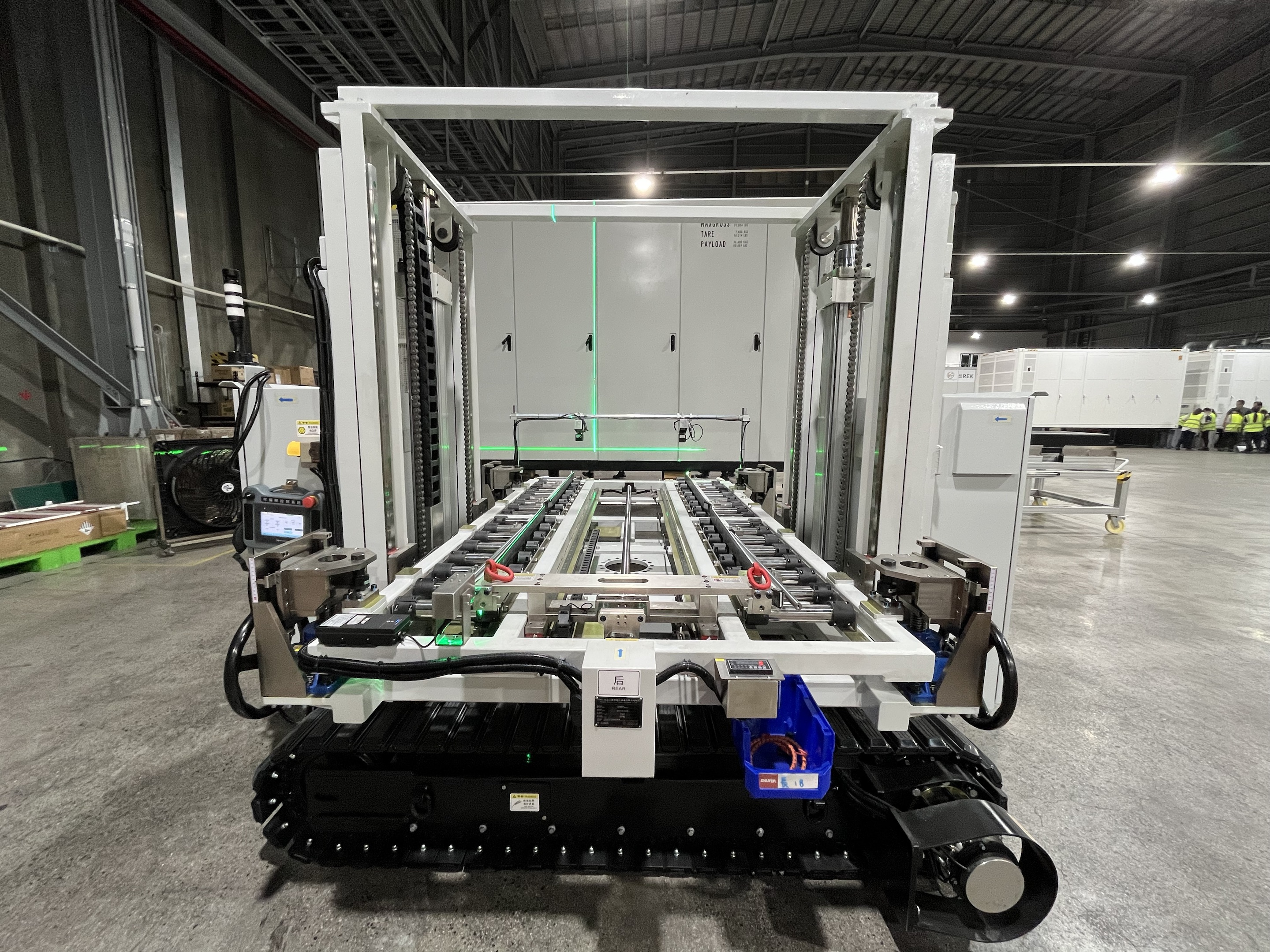
Crawler-driven insertion and removal equipment, specified for all-terrain working floors and used indoors and outdoors. Image: Zonzsin.
Rail-Fixed Platforms: Fixed Container Lines (ZZX2508 and ZZX2524)
Rail-fixed insertion reverses the crawler's assumption: instead of the robot traveling to an uncertain floor, a ground rail is installed and the container position repeats. Zonzsin's drive-type comparison describes this configuration as the most stable of the three but dependent on ground installation. That makes it a natural fit for an indoor assembly hall where the bay layout is fixed and the container arrives at a known position.
The ZZX2508 publishes the most complete site envelope of the four models. Its compatible container range is 6058–7000 mm in length, 2438–2700 mm in width and 2896–3000 mm in height; its compatible PACK range is 1100–2200 mm long, 780–1260 mm wide and 230–260 mm high. It requires a door opening angle of at least 150°, compressed air at 0.5–0.8 MPa and a power supply of AC 380 V ±10%, 50 ±2 Hz. The frame material is listed as carbon steel Q235.
The ZZX2524 shares the ≥150° door requirement and publishes a 1,500 kg load capacity, a gripper changeover time under one minute and a double-layer rack configuration aimed at saving floor space. For a line that alternates between pack formats, the sub-minute changeover is the operationally significant figure: it determines how much of a shift is lost at a format change, and it is the kind of number a buyer should confirm for the specific gripper set being quoted.
The recorded rail-fixed project is a China-based installation of one unit that has run for two years, reported as stable operation with improving efficiency. The listed highlights are a stable fixed ground rail for safe working, a dual-layer material rack for space utility and versatile module options — three points that describe the layout benefit rather than the machine alone.
One boundary deserves emphasis because it is physical rather than commercial: a ≥150° door opening is a property of the container and its hinges, not of the robot. If a container's door cannot be pinned or held beyond 150°, the rail-fixed models as published do not fit that interface, whatever their load rating.
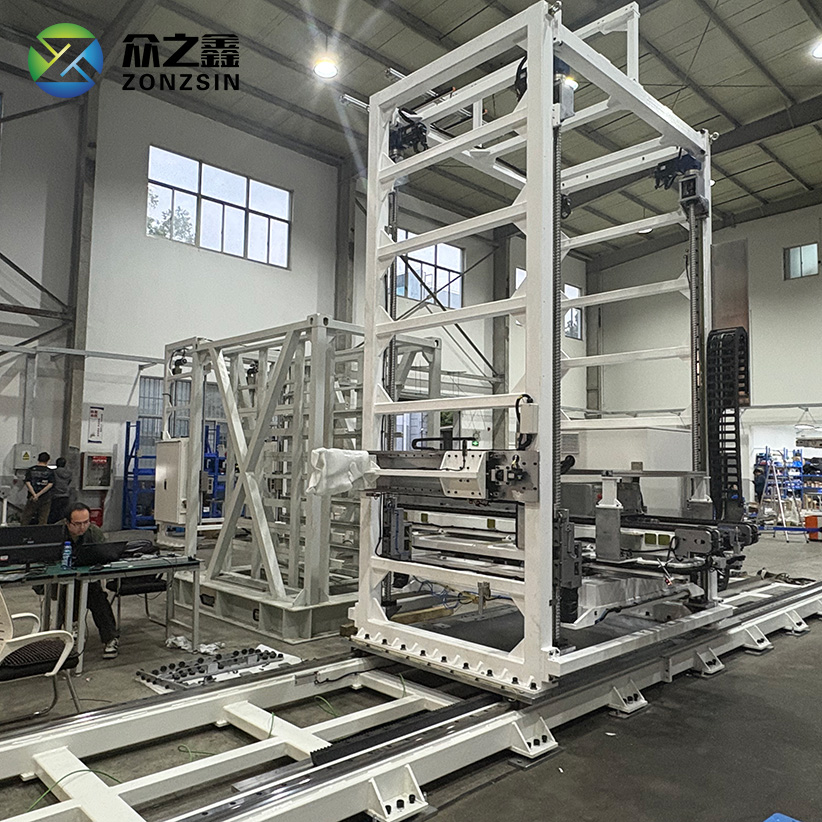
Rail-fixed insertion equipment for fixed container lines; the ZZX2508 publishes a container envelope of 6058–7000 mm length and a ≥150° door opening requirement. Image: Zonzsin.
AGV Platform: Level Floors and Repositioning (RD16)
The RD16 is described as an AGV-driven battery PACK insertion robot for containers, serving container C&I lines. Its published footprint is 3100 × 2600 × 3800 mm, it is specified for 280/314/587 Ah cells and 1P52S/1P104S PACKs, its hoisting range is 1.05–3.4 m and customizable, and its hoisting speed is 100 mm/s.
Those figures change the site survey in two ways. The 3100 × 2600 mm footprint is a floor-space and aisle question, not just a machine dimension: an indoor bay that fits a rail-fixed unit along a wall may still not provide the maneuvering area an AGV platform needs, and a doorway sized for a container is not automatically sized for the unit that services it. Separately, consistent with the drive-type comparison, the AGV's mobility advantage depends on a level floor — which is a property the buyer can inspect directly.
The 1.05 m lower hoisting limit is also worth noting against the crawler's 0.8 m. Where packs are loaded into the lowest rack tier, the published minimum reach is a fit parameter in its own right, and it should be checked against the actual lowest insertion height on the rack drawing rather than assumed from the container height.
Container Envelope: The First Practical Fit Check
Before comparing cycle times, a buyer can eliminate platforms cheaply using the published container envelope. The range documented for the ZZX2508 — 6058–7000 mm length, 2438–2700 mm width, 2896–3000 mm height — is the clearest published statement of what the rail-fixed family is built to service.
- Length (6058–7000 mm) sets the span the rail run and travel must cover. The lower figure corresponds to the 20ft container format widely used for C&I storage units; the upper figure extends coverage to longer container bodies.
- Width (2438–2700 mm) governs reach through the door opening and the lateral distance to the rack interface, and it interacts directly with the ≥150° door requirement.
- Height (2896–3000 mm) sets the vertical duty, since the insertion height is a function of rack tier position inside that envelope, not of the external height alone.
Two cautions apply. First, this envelope is published for the ZZX2508; the other models publish different parameter sets, and a container that fits one model is not automatically within the documented range of another. Second, the envelope describes container compatibility, not PACK compatibility — the two checks are separate and both are required.
PACK Envelope, Utilities and Site Conditions
The ZZX2508 publishes a compatible PACK range of 1100–2200 mm length, 780–1260 mm width and 230–260 mm height. Packs outside that range are not covered by the published compatibility statement and should be reviewed with the supplier before a platform is fixed; Zonzsin's application records list PACK compatibility and fixture adaptation among the special requirements for this kind of line, which indicates that fixture work is part of the scope rather than an exception.
Utilities are a second gating check. The rail-fixed ZZX2508 requires compressed air at 0.5–0.8 MPa and AC 380 V ±10%, 50 ±2 Hz. A site that cannot supply air at that pressure, or that runs on a different voltage and frequency, is looking at a conversion cost that belongs in the evaluation — not at a later stage of commissioning. The same discipline applies to the AGV platform's charging and floor interface, which should be confirmed for the configured unit.
The wider site conditions recorded for container PACK insertion work are equally practical: ESD protection, fire prevention measures, temperature, humidity and cleanliness control, and PACK compatibility with fixture adaptation. Operation is described as manual with remote-controller modes, and the matched equipment list — container, docking roller, gripper, transfer AGV, working desk, material rack, platform ladder, PLC and MES — makes the point that the insertion robot is a station in a line, not a standalone machine. A platform that fits the container but not the surrounding stations does not fit the project.
On ambient conditions, the application records list a 20–30 °C working band for the documented projects. That figure describes recorded operating conditions, not a rated environmental range for outdoor deployment; a site in an open yard should confirm its ambient profile, including seasonal extremes, with the supplier rather than infer it from the indoor record.
A Field Sequence for Matching Platform to Site
The checks above can be sequenced so that the cheapest disqualifiers come first. The order below is a working method for a C&I container project, not a substitute for the supplier's own site survey.
- Classify the floor. Finished indoor slab, mixed indoor and outdoor with transitions, or open yard with uneven or jointed surface. All-terrain capability is a crawler property; level-floor assumptions belong to the AGV platform.
- Measure the door opening. The rail-fixed ZZX2508 and ZZX2524 both require ≥150°. If the container cannot be held open beyond that angle, the rail-fixed route is closed on the published data.
- Check the container envelope. Compare length, width and height against 6058–7000 mm, 2438–2700 mm and 2896–3000 mm as documented for the ZZX2508, and confirm the equivalent figures for any other model under consideration.
- Check the PACK envelope. Compare pack length, width and height against 1100–2200 mm, 780–1260 mm and 230–260 mm, then confirm fixture adaptation for any pack outside that range.
- Decide on permanence. A permanent ground rail buys working stability at the cost of layout flexibility; an AGV platform buys repositioning at the cost of floor quality and maneuvering space.
- Verify utilities. AC 380 V ±10%, 50 ±2 Hz and compressed air at 0.5–0.8 MPa are published for the ZZX2508; confirm the equivalent requirements for the configured model.
- Count the manual steps that remain. Handwheel leveling on the crawler and gripper changeover on the ZZX2524 are documented operations, and both belong in the labor and cycle-time model.
- Get the numbers in writing for your configuration. Load capacity, hoisting range, hoisting speed and envelope should be confirmed on the quotation for the exact model and options, not taken from a generic sheet.
Supply, Lead Time and the Limits of the Evidence
Zonzsin was founded in 2019, operates a 6,000 m² facility with 90 employees and 43 R&D engineers, and reports an annual output of 40 units, equivalent to a stated monthly capacity of three units. Published commercial terms list a minimum order quantity of one unit, a lead time of two to four months, OEM/ODM customization across cycle time, automation, logo, color and configuration, 100% testing, and after-sales support covering remote assistance plus on-site installation and commissioning. The company reports that roughly 60% of production is exported, primarily to Southeast Asia and the EU, and that it holds 50 granted patents, including invention patents covering AGV-driven battery PACK insertion robots. Its own profile also references first-tier customers including SAIC Group, BYD and Tesla since 2019; those references are company-reported and are not independently verified here.
Application records place this class of work in China, France, South Korea, Sweden, Taiwan and the United States, which is useful for buyers checking whether their site type has a precedent — but it is not a statement about installed base size or market share. For heavier commercial scrutiny, the honest position is that the parameters in this article are manufacturer-published specifications. Independent cross-factory benchmarks for hoisting speed, positioning accuracy or uptime across vendors are not available in the supplied evidence, and third-party marketplace listings for this equipment category do not always match the manufacturer's current model data. Load capacity and envelope should therefore be confirmed against the current datasheet for the specific model and configuration.
For sites that expect to alternate between an indoor commissioning bay and an outdoor yard, the practical conclusion is not that one platform wins. It is that the platform should be chosen for the floor the container actually sits on during insertion, with the other conditions — door angle, envelope, utilities and the manual steps that remain — treated as pass-or-fail checks rather than as trade-offs to be averaged away. The full model range and current specifications are published by Zonzsin, and a downloadable product brochure is available here.
FAQ
Which insertion platform suits a C&I site that assembles containers outdoors on uneven ground?
A crawler-driven platform is the documented option for that condition. The ZZX2522 is specified for all-terrain working floors, rated at 1,500 kg, with a hoisting range of 0.8–3.4 m that can be customized, and it is used both indoors and outdoors. Its leveling function is a manual handwheel, so the operating procedure includes an operator step before insertion. Zonzsin's project records list one outdoor crawler unit in Korea for an uneven working floor and one indoor/outdoor crawler unit in Taiwan for a complicated working floor, each of one unit and one year in operation.
What container sizes does a rail-fixed insertion robot accept?
The ZZX2508 publishes a compatible container range of 6058–7000 mm in length, 2438–2700 mm in width and 2896–3000 mm in height, and requires a door opening angle of at least 150°. These figures are published for the ZZX2508 specifically; the ZZX2524 shares the ≥150° door requirement but does not publish the same container envelope, so the range should be confirmed per model before it is used as a fit criterion.
What PACK dimensions fit the rail-fixed ZZX2508?
The published compatible PACK range for the ZZX2508 is 1100–2200 mm in length, 780–1260 mm in width and 230–260 mm in height. Packs outside that range fall outside the published compatibility statement and require review with the supplier, since PACK compatibility and fixture adaptation are listed among the special requirements for container insertion lines.
How does the RD16 AGV platform differ from the rail-fixed units on an indoor line?
The RD16 is AGV-driven and serves container C&I lines, with a published footprint of 3100 × 2600 × 3800 mm, compatibility with 280/314/587 Ah cells and 1P52S/1P104S PACKs, a customizable hoisting range of 1.05–3.4 m and a hoisting speed of 100 mm/s. It repositions without a permanent ground rail, which depends on a level floor and adequate maneuvering space. Rail-fixed units instead require ground installation and a repeatable container position, in exchange for what the manufacturer describes as the highest working stability of the three drive types.
What should be verified before committing to a platform?
Five checks cover most of the risk: the floor condition at the insertion position; the actual door opening angle against the ≥150° requirement; the container envelope against 6058–7000 × 2438–2700 × 2896–3000 mm; the PACK envelope against 1100–2200 × 780–1260 × 230–260 mm; and site utilities, with AC 380 V ±10%, 50 ±2 Hz and compressed air at 0.5–0.8 MPa published for the ZZX2508. Load capacity, hoisting range and any speed figure should then be confirmed in writing for the exact configured model, because published specifications are manufacturer-reported and are not independently benchmarked.
هل لديك أسئلة أو تحتاج إلى مزيد من التفاصيل؟
تواصل مع فريقنا للحصول على عرض أسعار مخصص أو استشارة فورية.
طلب عرض أسعار
املأ النموذج أدناه وسيتواصل معك فريقنا بعرض مقترح مخصص.
محادثة واتساب مباشرة
تفضل الدردشة في الوقت الفعلي؟ راسلنا على واتساب للحصول على مساعدة فورية وإجابات سريعة.
- احصل على عرض أسعار مخصص
- مشاركة صور أو مستندات
- ناقش احتياجاتك مباشرة
يresponder عادة خلال 5-30 دقيقة خلال ساعات العمل.