
How to size your used paper hydraulic press
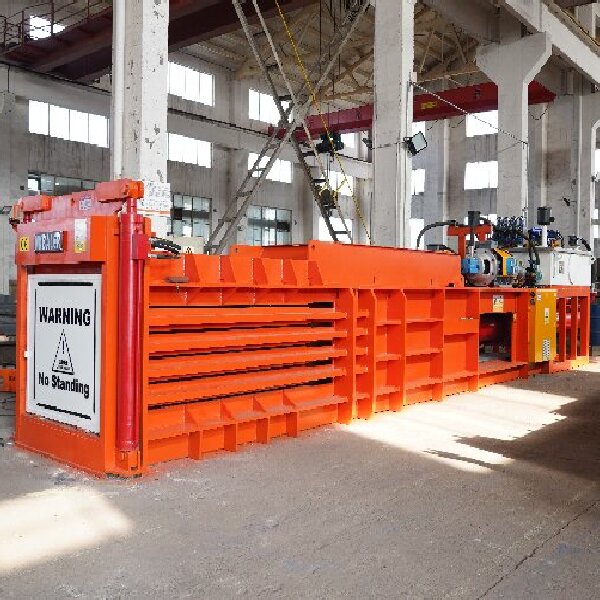
The success of a paper recycling project is not defined at the sorting stage, but at the compaction stage. An improperly sized waste paper hydraulic press can turn a seemingly profitable operation into a chain of bottlenecks: bales with insufficient density, high transport costs, frequent stoppages due to jams, or disproportionate energy consumption. For this reason, before requesting a quote, the buyer must translate the real conditions of their project—input volume, material type, operating hours, available space, and work environment—into concrete technical parameters.
This article explains how to size a waste paper hydraulic press based on project variables, relates each variable to the equipment configuration, and uses NKBALER's range of balers as a reference, a hydraulic machinery manufacturer based in China.
The Problem: When the Press Doesn't Fit the Project
The selection of a waste paper baler usually focuses on a single number: the compaction force, expressed in tons. However, the actual performance of the installation depends on the combination of several parameters that must be read together with the project context.
In practice, the most frequent mismatches are the following:
- Oversized or undersized production capacity. A press that produces fewer bales per hour than the material flow demands causes accumulation of loose paper and forces the sorting line to stop.
- Feed opening incompatible with the volume of material. If the loading opening is small, the operator must pre-shred or feed manually, which reduces productivity.
- Insufficient bale density. The final buyer of recovered paper pays by weight, but transport is charged by volume; a low-density bale makes logistics more expensive.
- Manual tying system that slows down the line. In high-production equipment, manual tying becomes the main bottleneck.
- Energy consumption and noise levels incompatible with the environment. In urban plants or shared industrial warehouses, noise and electrical demand may violate local limits.
Correct sizing avoids these problems by starting from a broader question: what real conditions must the machine support within the project?
The Five Variables That Define the Press Configuration
To size a waste paper hydraulic press, the buyer must resolve five variables before comparing models.
1. Processing Volume and Operating Hours
The daily volume of paper to be processed—expressed in tons per day or per hour—determines the equipment family. A project processing less than 10 tons per day can be resolved with a vertical baler. Between 10 and 60 tons per day, semiautomatic horizontal balers are the most common option. Above 60 tons per day, fully automatic horizontal lines with continuous feeding are required.
2. Material Type and Impurity Content
Waste paper can come as cardboard, newspaper, mixed office paper, or reject bales from sorting plants. Each type responds differently to compression. Additionally, if the material contains impurities such as plastics, metals, or stones, the press must be specified with greater structural robustness and additional protection in the compression chamber.
3. Required Bale Density
The final density of the bale directly affects transport costs and the sale price of the material. Vertical balers with lower tonnage produce less dense bales; large-tonnage horizontal balers achieve higher densities, suitable for export and for markets that require standardized bales.
4. Level of Automation
Automation defines productivity and dependence on manual labor. A vertical or semiautomatic baler requires manual operation to feed and tie the bales. A fully automatic one integrates a conveyor belt, PLC-controlled cycle, and automatic tying, allowing continuous operation.
5. Installation Environment and Operating Requirements
The physical environment conditions the selection. In projects where the press will operate at high temperatures or during extended shifts—for example, industrial 24/7 service—the equipment must be designed to dissipate heat efficiently and maintain continuous operation. In urban or noise-sensitive environments, low-noise and low-energy consumption designs are required.
From Project Data to Model Selection: The NKBALER Range
NKBALER, the trade name of Shaanxi Nick Machinery Equipment Co., Ltd., is a manufacturer based in China dedicated to the design, production, and sale of hydraulic balers and material recycling machinery. Founded in 2013, the company operates a 50,000 m² plant, produces around 600 machines per year, and allocates approximately 90% of its production to export markets in North America, South America, Europe, and Asia.
Within its catalog, the correspondence between project scale and equipment type can be summarized as follows:
| Project Scale | Recommended Equipment Type | Examples of NKBALER Models | Production Capacity |
|---|---|---|---|
| Small (less than 10 t/day) | Vertical baler | NK1070T60 | 5–8 bales/hour |
| Medium (10–60 t/day) | Semiautomatic horizontal baler | NKW125BD, NKW180BD, NKW250BD | 5–15 tons/hour |
| Large (more than 60 t/day) | Fully automatic horizontal baler | NKW160Q, NKW200Q, NKW100QT | 4–15 tons/hour depending on model |
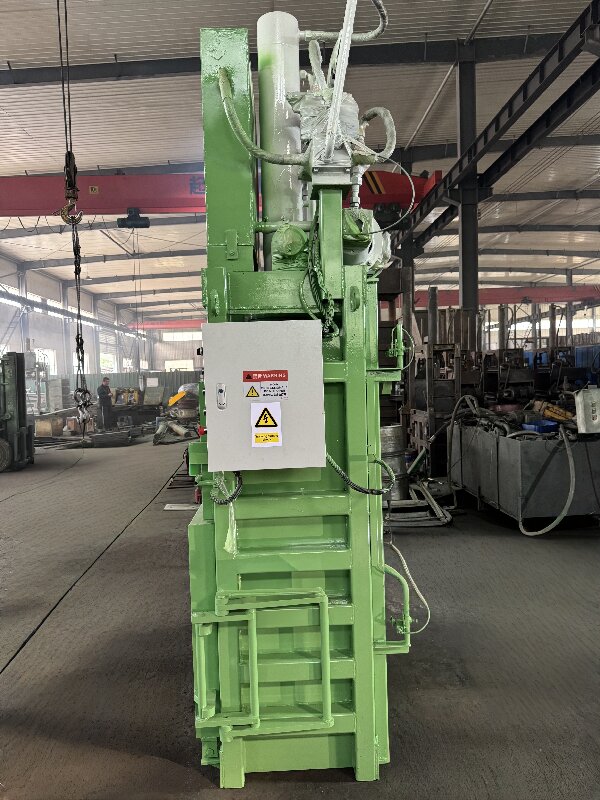
The vertical model NK1070T60 uses 60 tons of hydraulic force, produces bales of 1100 x 700 x (500–900) mm, and works with a feed opening of 1100 x 500 mm. Its installed power is 15 kW, making it an efficient option for small plants or operations that require flexibility.
In the semiautomatic horizontal range, the NKW125BD delivers 125 tons of force, produces bales of 1100 x 1250 x 1700 mm, and processes between 5 and 7 tons per hour, with a power of 30 kW. The NKW180BD raises capacity to 6–8 tons per hour with 180 tons of force and 45 kW of power. The NKW250BD reaches 10–15 tons per hour and uses 250 tons of force, with a water cooling system or oil cooler.
For large-scale operations, the fully automatic models NKW160Q and NKW200Q process between 12 and 15 tons per hour. The NKW160Q operates with 160 tons of force and a main structure of approximately 28 tons, while the NKW200Q reaches 200 tons of force and a structure of 34 tons. Both configurations include a 14-meter-long conveyor belt, allowing continuous feeding and operation with reduced supervision.
Operating Conditions: Noise, Temperature, and Consumption
In material compression and packaging projects with continuous operation, the equipment must meet demanding conditions. A typical scenario described in NKBALER's technical documentation includes continuous automatic operation, PLC-controlled cycle, and industrial 24/7 service. For this scenario, low-noise design, low energy consumption, and high efficiency are required. The support equipment includes conveyor line, steel wire, and woven bag. Additionally, it is designed for high-temperature environments.
This specification has concrete implications for the buyer. A press that will operate 24 hours a day cannot be sized the same as one that works in 8-hour shifts: the hydraulic system needs adequate cooling, electrical components must withstand continuous cycles, and accumulated energy consumption must be evaluated within the project's operating cost.
The selection of accessories is also part of the sizing. The conveyor line ensures a constant flow of material into the compression chamber; the steel wire and woven bag are the tying and covering elements that allow obtaining stable and manageable bales. A project that does not foresee these elements from the beginning will face delays in start-up.
Evidence in Real Recycling Projects
Information from real projects helps validate sizing decisions. A manufacturer of recycling stations in Indonesia purchased an NKBALER baler for packaging plastic waste and paper waste. The equipment was installed with an expected service life of 10 to 15 years, and the reported result was stable operation, with low noise and low energy consumption as highlighted features.
This case illustrates two relevant points for sizing. First, the same machine can process plastics and paper if the configuration is previously validated with the manufacturer. Second, low-noise and low-consumption requirements are not optional in many markets: they are part of the operating conditions that must be specified in the purchase.
The Market Context in 2026
Market trends reinforce the importance of correctly sizing this type of equipment. According to Grand View Research, the global baler market reached USD 6.4 billion in 2024, driven mainly by agricultural and industrial applications. Meanwhile, the specific waste baler market reached USD 1.45 billion in 2024, with a focus on recycling paper, plastic, and municipal solid waste, according to Mordor Intelligence.
The Asia-Pacific region dominated the global hydraulic market with more than 34% of revenue in 2024, led mainly by China. This means that a significant part of the manufacturing capacity of hydraulic balers is concentrated in Chinese suppliers, which opens direct purchase options for importers and distributors in Latin America, Europe, and other regions.
For buyers importing equipment to the European Union, regulatory compliance is an additional sizing criterion. Industrial balers exported to the EU must comply with the Machinery Directive 2006/42/EC and the harmonized safety standards EN ISO 12100 and EN 60204-1. A manufacturer with export experience must be able to confirm the equipment's conformity with these requirements.
Limits of Automation vs. Traditional Solutions
Compared to traditional methods such as manual compaction or the use of low-force compactors, a hydraulic press offers structural advantages: greater bale density, lower unit transport cost, less manual intervention, and process traceability. These advantages are particularly clear in plants that handle constant material flows.
However, full automation is not appropriate for all projects. A fully automatic horizontal baler requires a continuous and relatively homogeneous feed flow. If the material contains impurities such as metals or stones, the wear on the chamber and hydraulic system increases considerably, which forces strengthening quality control in the previous sorting.
Another relevant limit is space. Fully automatic models require a large area for the main structure, the conveyor belt, and the bale extraction area. In existing industrial warehouses with height or layout restrictions, a vertical baler may be the only viable option.
Finally, the initial investment of an automatic line is significantly higher. For small projects processing less than one ton per day, the cost of any hydraulic baler may not be recovered in the short term; in those cases, sizing must also evaluate the price of third-party service as an alternative.
What's Coming: Density, Efficiency, and Customization
The market direction points to three axes: greater bale density, lower energy consumption, and greater customization capacity. As transport costs and environmental regulations tighten, recycling plants need equipment that produces denser bales with less energy. This favors manufacturers that invest in efficient hydraulic design and control systems that optimize the compression cycle.
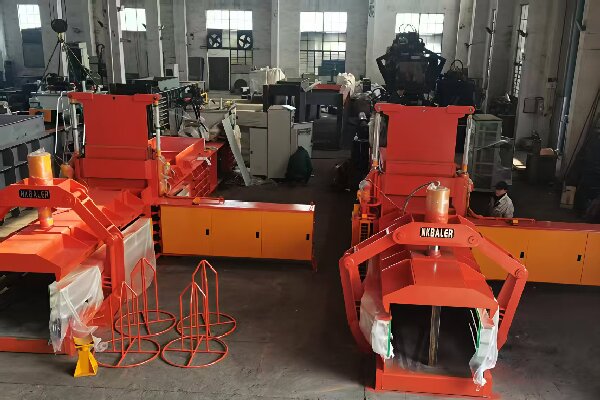
Customization will also be a decision factor. Projects vary by voltage, electrical standards, bale dimensions, and tying requirements. A manufacturer with flexible production capacity—such as NKBALER, which offers customization of technical parameters, voltage, logo, block size, and color, with a delivery time of 30 to 45 days and MOQ of 1 unit—allows adapting the machine to the real conditions of the project instead of forcing the buyer to adapt their plant to a standard machine.
Technical validation before purchase will become increasingly important. 100% testing of each equipment before shipment and after-sales remote support are practices that reduce the risk of failed installations and that the buyer must verify when selecting a supplier.
Frequently Asked Questions
What is the difference between a vertical and a horizontal baler for waste paper?
The vertical baler compresses the material in a vertical chamber and is suitable for low or medium volumes, with lower investment and a reduced footprint. The horizontal baler introduces the material via a conveyor belt and compresses it laterally, allowing continuous feeding and higher production capacity. In NKBALER's range, an example of vertical equipment for waste paper is the NK1070T60, with 60 tons of force and capacity of 5 to 8 bales per hour; among the horizontal ones, the NKW125BD processes between 5 and 7 tons per hour.
How is the capacity of a press calculated for a paper recycling project?
The calculation starts from the daily volume of paper to be processed and the planned operating hours. If the project processes less than 10 tons per day, a vertical baler is usually sufficient. For intermediate volumes, semiautomatic horizontal balers with capacities of 5 to 8 tons per hour are common. For higher flows, a high-capacity automatic horizontal baler is required. Verification should include the size of the feed opening and the bale dimensions required by the material buyer.
What technical parameters are most critical when sizing a hydraulic press for waste paper?
The critical parameters are: hydraulic force expressed in tons, bale dimensions, feed opening size, capacity in bales per hour or tons per hour, working pressure, installed power, tying system, and cooling requirements. Noise level and energy consumption should also be considered when the equipment will operate in sensitive environments or with extended shifts.
Can a waste paper baler also process plastic or cardboard?
Yes, in many projects the same equipment is used for paper and plastics. A recycling station in Indonesia operates an NKBALER baler for plastic waste and paper with stable operation. However, the density and behavior of each material are different; the manufacturer must confirm the compatibility of the model with the specific mixture and adjust the pressure and cycle time accordingly.
What installation conditions does an automatic horizontal baler require?
An automatic horizontal baler requires space for the main equipment, the conveyor belt, and the bale handling area, in addition to access for maintenance. Structure weights vary by model: the NKW160Q has a main structure of approximately 28 tons and a 14-meter-long conveyor belt. Also, a three-phase electrical supply and, in high-production equipment, a water cooling system or oil cooler must be planned.