
C690 CCIT vs Manual Leak Testing for Sealed Packages
Independent Buyer Reference · Container Closure Integrity
For sealed pharmaceutical vials, sterile medical devices and food sachets, package integrity is confirmed or lost at the seal — a surface nobody inspects visually. Buyers comparing an instrument-based Container Closure Integrity Testing (CCIT) approach against a long-standing manual workflow are not choosing between two instruments. They are choosing between two evidence standards, and the difference shows up in release decisions, sample retention and audit documentation.
This comparison is written from the buyer's side of the table. It sets out the criteria that separate a non-destructive vacuum decay system from manual leak testing practice, then applies those criteria to one specific instrument: the C690 Nondestructive Package Leak Detector, part of the container closure integrity instrumentation offered by Labthink Food & Pharmaceutical Testing Solutions, the food and pharmaceutical testing arm of Labthink Instruments Co. Ltd., a Jinan-based manufacturer of packaging materials analysis instruments founded in 1989.

Sealed vials and ampoules are the package formats most often evaluated first when a laboratory moves from manual leak checks to instrument-based CCIT.
Why sealed-package leak testing becomes a procurement decision
Leak testing of finished packages sits inside three overlapping obligations: quality control testing, safety assurance and regulatory compliance. That combination is what turns a technical preference into a purchasing question. A quality control laboratory needs results it can defend months later; a safety function needs to know that a sterile barrier has not been compromised; and a compliance function needs the test method to be documentable rather than remembered.
Manual workflows have historically carried that burden by relying on the operator. A technician performs the test, interprets the outcome and records it. This works, but it makes the result a function of technique, timing and attention. Where the package must survive the test — retained samples, stability studies, investigation batches — a manual method that opens, wets or otherwise compromises the sample removes the option of re-testing the same unit later.
That is the opportunity the C690 addresses. Labthink describes the C690 as using non-destructive leak detection methods, allowing tested packages to remain intact after testing. For a buyer, intact samples after testing change what a quality control programme can do: the same unit can be re-measured, photographed, retained, or escalated into an investigation without a second sampling plan.
The instrument in scope: what the C690 actually is
The C690 is a Nondestructive Package Leakage Detector, designated as the C690 Nondestructive Package Leak Detector, and belongs to the vacuum decay Container Closure Integrity Testing (CCIT) category. It is built from aluminum alloy and ABS plastic, operates fully automatically, and is intended for the medical device, pharmaceutical packaging and food packaging industries. Its stated application scope includes non-destructive package leak detection in pharmaceutical packaging, sterile pharmaceutical packaging integrity testing, vial and ampoule leak testing, and sealed medical packages.
| Specification | Stated value |
|---|---|
| Product category | Nondestructive Package Leakage Detector; vacuum decay Container Closure Integrity Testing (CCIT) |
| Testing range | 2 µm to 8 µm, with larger defects treated as gross leakage |
| Detection lower limit | 2 µm |
| Resolution | 0.1 µm |
| Repeatability | ±1 µm |
| Pressure range | −100 to 0 to +100 kPa |
| Construction | Aluminum alloy + ABS plastic |
| Operation | Fully automated; lab environment; indoor laboratory use only; stable ambient temperature required |
| Matched equipment | Vacuum pump |
| Intended industries | Medical device, pharmaceutical packaging, food packaging |
Those numbers matter in a specific way, and it is worth being precise about what they do and do not say. The 2 µm detection lower limit defines the smallest defect the specification claims the system can resolve. The 0.1 µm resolution defines the smallest increment it can distinguish within that working range. The ±1 µm repeatability describes how closely repeated measurements of the same reference condition are expected to agree. None of these are throughput figures, and none of them substitute for a method validation performed on the buyer's own package.
Evaluation criteria that actually separate the two approaches
Buyers who compare a CCIT instrument against an existing manual workflow tend to converge on five criteria, in roughly this order. Each one has a different cost of getting wrong.
1. Package non-destructiveness
A destructive test consumes the sample. A non-destructive test returns it. Where the sample is a stability unit, a reference batch or a complaint return, consumption is not a neutral act — it changes what can be concluded afterwards. Manual dye penetration and water immersion methods typically require the package to be opened, immersed or otherwise entered before the result can be read, which is why they are usually run on sacrificial units.
2. Micro-leak detection capability
Manual bubble observation depends on a visible bubble forming within an observation window, and on an operator noticing it. Instrument-based pressure measurement depends on a transducer resolving a pressure change. The two do not have the same sensitivity floor, and a buyer should ask for the specification in micrometres rather than in qualitative terms. On the C690, the specified floor is 2 µm.
3. Package geometry compatibility
This is where most comparisons are won or lost. A method that works beautifully on a 2 mL vial may be unusable on a 500 mL bottle or a flexible sachet. Compatibility is not a yes or no attribute of the instrument; it is a property of the instrument plus the fixture plus the package.
4. Method selection: pressure decay or vacuum decay
The C690 series can use pressure decay and/or vacuum decay methods depending on the model. The choice is not cosmetic. It determines which packages are testable, what the fixture must do, and how the result is interpreted.
5. Laboratory conditions and long-term support
An instrument that needs a matched vacuum pump and a thermally stable room is not a drop-in replacement for a bench-top manual method. Buyers should treat laboratory requirements and service coverage as part of the total cost of ownership, not as an installation detail to solve later.
Technical explanation: what vacuum decay and pressure decay are measuring
Vacuum decay testing places the package inside a tight, sealed test chamber and draws a vacuum around it. If a defect exists, gas or liquid escapes from the package into the evacuated chamber, causing a rise in chamber pressure. The instrument is not looking for a bubble; it is looking for a pressure signature inside a known volume.
Pressure decay testing takes the opposite approach. The package is pressurised to a defined setpoint, isolated, and monitored over a fixed test period. If micro-leaks or seal flaws exist, gas escapes and produces a measurable drop in internal pressure.
Both are physical, non-destructive measurements of a sealed, non-porous container. Their behaviour differs by package type: vacuum decay is commonly applied to pharmaceutical containers such as vials, ampoules and pouches, where the package itself can be placed in a chamber; pressure decay requires the package headspace to accept and hold a defined pressure, which shapes fixture design and test parameters. The C690's specified pressure range of −100 to 0 to +100 kPa spans vacuum through positive pressure, which is consistent with a platform that supports both method families across models.
The word “deterministic” is the one buyers should interrogate. A deterministic method produces the same answer from the same physical condition regardless of who runs it. That is a meaningful claim against manual inspection, where two technicians can reach different conclusions from the same sample. It is also a claim that should be evidenced during a site trial rather than accepted from a datasheet.
Traceability is the second technical differentiator. Labthink lists data traceability, full process automation, safe operation compatible with hazardous gases, and 21 CFR Part 11 and GMP compliance among the C690's attributes. For a laboratory that must reconstruct a release decision during an audit, the difference between a recorded pressure curve and a handwritten “no bubbles observed” is substantial.
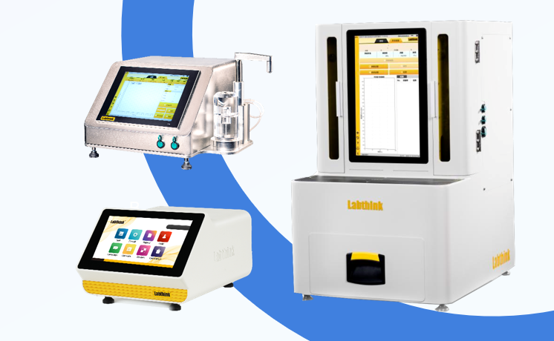
In vacuum decay CCIT, the package sits in a sealed chamber and the instrument measures the pressure signature of any defect rather than relying on visual observation.
Package geometry: which formats the C690 covers, and under what conditions
Labthink states that the C690 can be used for various sealed packages, including vials, ampoules, syringes, bottles, pouches, sachets and other package formats, depending on the package configuration and a suitable fixture. That sentence contains the whole procurement risk, and it deserves unpacking.
| Package format | What the supplier states | Buyer action before commitment |
|---|---|---|
| Vials | The C690 series is designed for leak testing of pharmaceutical packages such as vials, ampoules and syringes. | Confirm vial dimensions, fill level and closure type; run a fixture trial. |
| Ampoules | Covered within the sealed pharmaceutical package scope, including ampoule leak testing. | Confirm sealing geometry at the tip and base. |
| Syringes | Covered within the sealed pharmaceutical package scope. | Confirm plunger and needle-shield configuration. |
| Bottles | The C690 can be configured for bottle leak testing. Bottle dimensions, closure configuration, test pressure and required sensitivity should be confirmed to determine the appropriate fixture and test configuration. | Provide dimensions and closure drawings; agree the sensitivity target. |
| Pouches | Covered within the stated range of sealed package formats, subject to configuration and fixture. | Confirm headspace volume and seal width. |
| Sachets | Suitability is “potentially yes” and depends on sachet dimensions, material and required leak detection sensitivity. Package information and samples may be required to confirm the testing configuration. | Send samples before specifying. Do not assume compatibility. |
The honest reading of that table is that vials, ampoules and syringes are the core of the stated scope, bottles are configurable with confirmation, and flexible formats such as sachets are conditional. A buyer who evaluates the C690 against a pouch or sachet line without sample trials is taking a risk the supplier itself does not take on the buyer's behalf.
Side-by-side: instrument-based CCIT against manual leak testing
| Criterion | C690 non-destructive CCIT | Manual leak testing workflows |
|---|---|---|
| Sample fate | Non-destructive; tested packages remain intact after testing | Commonly destructive for dye penetration and immersion methods; the tested unit is usually consumed |
| Sensitivity basis | Specified in micrometres: 2 µm detection lower limit, 0.1 µm resolution, ±1 µm repeatability | Bounded by visible bubble formation, dye ingress or microbial growth; sensitivity is rarely expressed as a defect size |
| Operator dependence | Fully automated; pre-set test parameters and recorded results | Technique, timing and interpretation vary by operator and shift |
| Record | Data traceable; 21 CFR Part 11 and GMP compliance listed among attributes | Handwritten or transcribed observation, reconstructed after the fact |
| Geometry flexibility | Requires a suitable fixture per package format; vials, ampoules, syringes, bottles, pouches and sachets subject to confirmation | Visually adaptable to almost any format, which is the main reason it persists |
| Laboratory requirement | Indoor laboratory only; stable ambient temperature; matched vacuum pump | Low equipment footprint; minimal environmental control |
| Throughput | Automated operation; batch configurations with automatic sample feeding are available | Serial, labour-bound; throughput scales with headcount |
| Cost structure | Capital purchase plus fixture set plus vacuum pump plus validation effort | Low capital, high recurring labour and re-sampling cost |
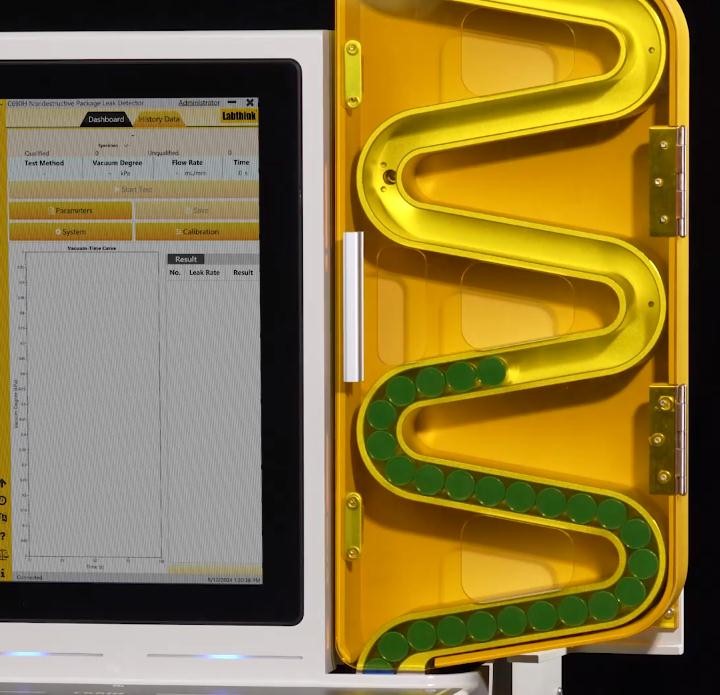
Batch configurations with automatic sample feeding shift throughput from headcount to instrument capacity.
Where the instrument does not replace the manual method
A comparison that only lists advantages is a sales document. Three boundaries on the C690 are worth stating plainly.
Sensitivity has a floor. The specified detection lower limit is 2 µm. Buyers whose method requires evidence at smaller defect sizes, or who need a complementary technique such as headspace gas analysis or high-voltage leak detection for a specific container, will not find that capability in this specification. The instrument addresses the 2 µm to 8 µm working range and treats larger defects as gross leakage.
The laboratory environment is part of the method. The C690 is specified for indoor laboratory use only, with a stable ambient temperature, and it requires a matched vacuum pump. A production-floor or warehouse-side installation is outside the stated conditions. Buyers planning near-line testing should budget for a controlled enclosure, not just the instrument.
Flexible and unusual formats need samples, not datasheets. Sachet suitability is explicitly conditional on dimensions, material and required sensitivity, and bottle testing depends on dimensions, closure configuration, test pressure and target sensitivity. In low-volume operations where a handful of odd-shaped packages are tested per month, and where destructive sampling is acceptable, a well-controlled manual procedure can remain the rational choice — with the caveat that its results are harder to defend in an audit.
Application fit across pharmaceutical, medical device and food packaging
The C690's stated application environment is a laboratory performing quality control tests, safety assurance and regulatory compliance work in pharmaceutical, food packaging, medical device and testing, inspection and certification settings. Within that environment, three patterns recur.
- Sterile pharmaceutical packaging. Vial, ampoule and syringe integrity checks where the package must remain available for stability retention or investigation after testing.
- Sealed medical packages. Finished device pouches and trays where the sterile barrier must be evidenced rather than assumed, and where the test record becomes part of the device history file.
- Food packaging. Sealed sachets and pouches where leak detection supports shelf-life and safety assurance claims, subject to the sample confirmation described above.
In each case the buying logic is the same: the test must be sensitive enough for the defect class that matters, non-destructive enough to preserve evidence, and documented well enough to survive an audit two years later.
Procurement considerations before issuing an RFQ
Six items determine whether a C690 configuration will fit a specific packaging portfolio. Buyers who settle these before quotation avoid the most common post-installation surprise — an instrument that is technically correct but fitted for the wrong container.
- Fixture confirmation. Compatibility is a property of instrument plus fixture plus package. Ask for the fixture specification against your actual container drawings, not against a package category.
- Package dimensions. Height, diameter, body shape and fill level all influence chamber volume and fixture design, and therefore the achievable sensitivity.
- Closure configuration. Stopper and cap geometry, plunger design and seal width determine where a leak would occur and how it must be detected.
- Test pressure. The required setpoint must sit within the −100 to 0 to +100 kPa range and be consistent with the chosen method — vacuum decay, pressure decay, or both.
- Required sensitivity. State the defect size the method must detect, not a qualitative description. Compare it against the 2 µm lower limit and ±1 µm repeatability before assuming a match.
- Long-term CCIT support. Method validation, fixture expansion for new container formats, and service access all belong in the evaluation. Labthink operates from Jinan with an international headquarters in Boston, a European branch in Germany, an Asia-Pacific centre in Malaysia, a Middle East service centre in Dubai, and a network of more than 50 distributors and 30 service providers worldwide — relevant if the instrument will be deployed across multiple sites.
Two supplier-side facts are worth verifying during due diligence rather than taking on trust. Labthink holds GB/T 45001-2020/ISO 45001:2018 certification, certificate number 10425S01240R1M, issued by SHANDONG SEATONE INTERNATIONAL CERTIFICATION CO., LTD., valid from 2025-11-20 to 2028-11-24, covering the production of packaging testing instruments and explicitly listing the C690 Nondestructive Package Leak Detector within scope. The company also reports a 4,100 m² manufacturing facility, approximately 220 staff, an R&D team of 50 engineers and technicians, annual production capacity of 1,200 units, and export business representing 50% of total sales.
Market trend: CCIT is moving from inspection to documented evidence
The direction of travel in food safety and pharmaceutical analysis testing is consistent across regions. Regulatory frameworks increasingly expect recordkeeping that can be reconstructed: the FDA Food Traceability List, for example, identifies foods subject to additional traceability recordkeeping under FSMA, and EU rules for plastic food contact materials set an overall migration limit of 60 mg/kg food or 10 mg/dm² of contact material, tested with simulants under standardized time and temperature conditions. The pattern is not “test more”; it is “test in a way that can be audited.”
That shift favours instrument-based, data-generating methods over operator observation, and it explains why non-destructive CCIT has moved from a specialist capability to a standard expectation in sterile packaging qualification. It also raises the bar for manual workflows: a manual method is not disqualified, but it must now be supported by written procedure, operator qualification and documented interpretation, which narrows the cost gap that historically justified it.
Future outlook
Three developments are likely to shape the next procurement cycle. First, fixture portfolios rather than instrument specifications will become the deciding factor, as buyers consolidate leak testing across vials, syringes, bottles and flexible formats onto one platform. Second, method choice between pressure decay and vacuum decay will increasingly be driven by container design — pre-fillable syringes and complex closure systems reward buyers who clarify the method before purchase rather than after. Third, data integrity expectations will continue to tighten, which raises the value of traceable test records relative to observation-based results.
For buyers at the awareness and research stage, the practical implication is to define the container portfolio and the required defect size first, then evaluate instruments against those two constraints. Sensitivity claims and geometry claims only mean something once both are fixed.
FAQ
What is the C690 used for?
The C690 is a Container Closure Integrity Testing (CCIT) system used to detect leaks in pharmaceutical, food and other sealed packages.
Is the C690 a destructive or non-destructive leak tester?
The C690 uses non-destructive leak detection methods, allowing tested packages to remain intact after testing.
What types of packages can the C690 test?
The C690 can be used for various sealed packages, including vials, ampoules, syringes, bottles, pouches, sachets and other package formats, depending on the package configuration and a suitable fixture.
What leak detection methods does the C690 use?
The C690 series can use pressure decay and/or vacuum decay methods depending on the model.
Can the C690 test pharmaceutical vials?
Yes. The C690 series is designed for leak testing of pharmaceutical packages such as vials, ampoules and syringes.
Can the C690 test bottles for leaks?
Yes. The C690 can be configured for bottle leak testing. The bottle dimensions, closure configuration, test pressure and required sensitivity should be confirmed to determine the appropriate fixture and test configuration.
Can the C690 test sachets containing food or meat products?
Potentially yes. The suitability depends on the sachet dimensions, material and required leak detection sensitivity. Package information and samples may be required to confirm the testing configuration.
Reference material: the manufacturer's packaging testing equipment and testing services brochure is available for download here.
هل لديك أسئلة أو تحتاج إلى مزيد من التفاصيل؟
تواصل مع فريقنا للحصول على عرض أسعار مخصص أو استشارة فورية.
طلب عرض أسعار
املأ النموذج أدناه وسيتواصل معك فريقنا بعرض مقترح مخصص.
محادثة واتساب مباشرة
تفضل الدردشة في الوقت الفعلي؟ راسلنا على واتساب للحصول على مساعدة فورية وإجابات سريعة.
- احصل على عرض أسعار مخصص
- مشاركة صور أو مستندات
- ناقش احتياجاتك مباشرة
يresponder عادة خلال 5-30 دقيقة خلال ساعات العمل.