
C840 vs C870: Residue Testing or Loss on Drying Automation?
Independent buyer comparison · Food & pharmaceutical analysis testing
The C840 Integrated Evaporation Residue Testing System and the C870 Integrated Loss-on-Drying Testing System share a 0.01 mg resolution and a ±0.05 mg repeatability, yet they answer opposite analytical questions. C840 quantifies what remains after a liquid sample evaporates. C870 quantifies what a sample loses when it is dried under controlled temperature and time conditions. For buyers in food contact material compliance and pharmaceutical quality control, the selection between them is a method decision before it is an equipment decision.
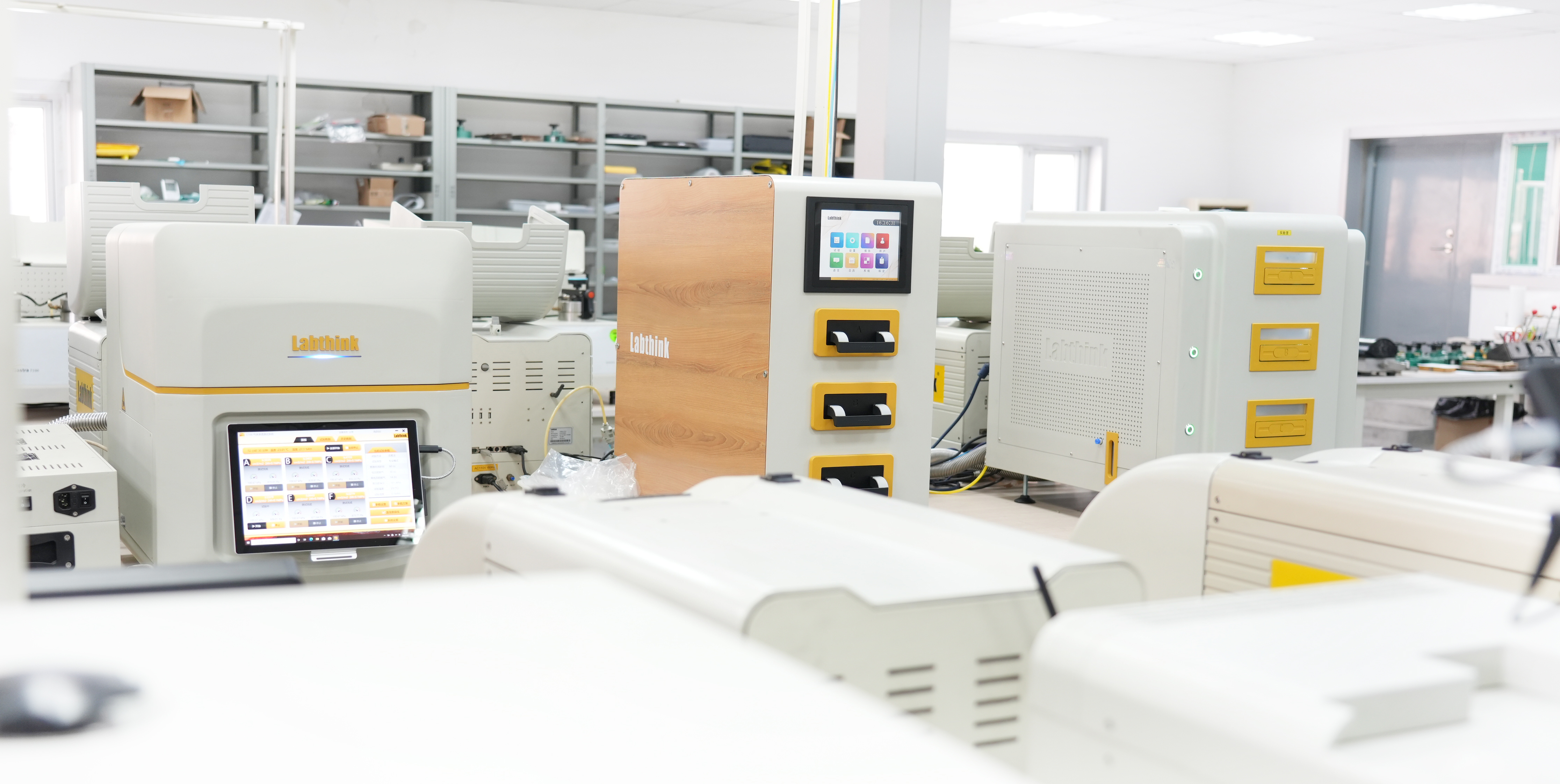
Both systems are built by Labthink, a multinational manufacturer of precision instruments and testing solutions for packaging materials analysis, with origins in Jinan, China and an international headquarters in Boston, USA. The company's chemical analysis lineup positions C840 for automated overall migration and evaporation residue testing and C870 for automated Loss on Drying testing. Understanding what separates those two roles is the core of a defensible procurement decision.
Two Gravimetric Questions That Buyers Frequently Merge
Requests for quotation in this category often arrive as a single phrase — "a residue tester" or "a moisture analyzer." That phrasing hides two different measurements that happen to share the same gravimetric principle. Both methods place material on a balance and both report a mass. What differs is which fraction of the original sample is on the pan when the final weighing is taken.
Evaporation residue testing determines the amount of non-volatile material remaining after a specified sample solution is evaporated under controlled conditions. Loss on Drying (LOD) is a gravimetric test method that determines the percentage of volatile matter — primarily moisture and residual solvents — in a sample: the material is weighed, heated below its decomposition temperature in a controlled oven or desiccator until reaching a constant weight, and re-weighed. Non-volatile residue (NVR) testing, a closely related measurement, determines the amount of material remaining after volatile components such as solvents or water have been removed by evaporation under specified conditions.
Put simply: an evaporation residue result describes the dry residue left behind; a Loss on Drying result describes the volatile fraction driven off. A laboratory that buys the wrong one of the two will still generate numbers, and those numbers will not answer the compliance question it was asked to answer.
C840: What the Integrated Evaporation Residue Testing System Measures
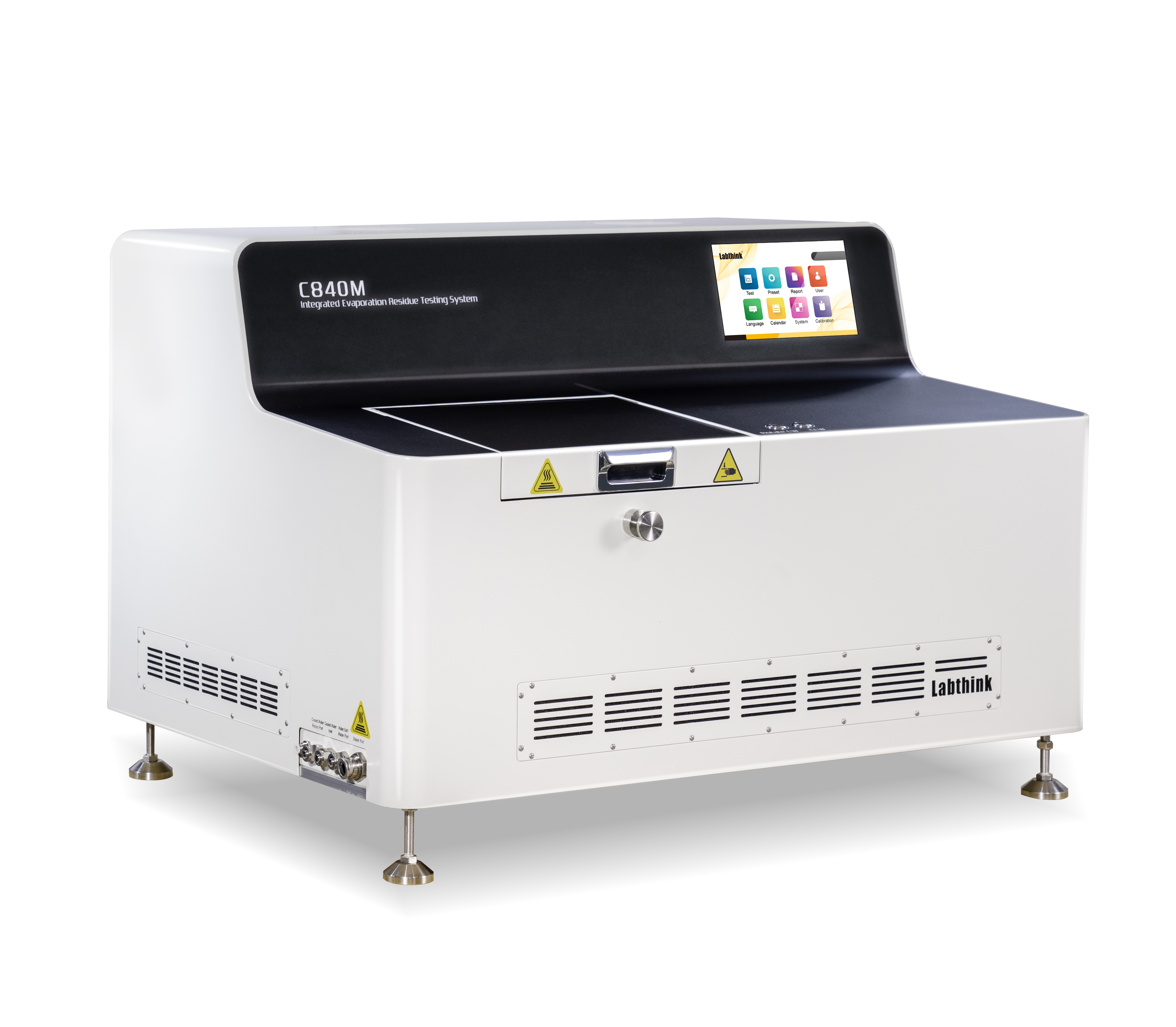
The C840 is an automated system designed for evaporation residue and non-volatile residue testing. It integrates evaporation, drying and weighing processes in order to reduce manual operations and improve testing consistency. Labthink's product documentation attributes four principal applications to the instrument: determination of various chemical reagent residues after evaporation, total migration testing of food contact materials, determination of non-volatile matters in purified water, and non-volatile residual testing of various pharmaceutical packaging materials.
Its published technical parameters are as follows: a testing range of 0.05 to 80,000 mg, a resolution of 0.01 mg, a repeatability of ±0.05 mg, a temperature range from room temperature to 130 °C, and a temperature fluctuation of ±0.5 °C. The housing material is stated as aluminum alloy with ABS plastic, and the declared applicable industries are food contact materials, pharmaceutical packaging and chemical reagents.
Where buyers need to look more carefully is at model level. Labthink's own selection guidance distinguishes the C840M from the C840H on two axes: the C840M uses a 0.1 mg readability balance, while the C840H uses a 0.01 mg readability balance; the C840H additionally offers higher testing capacity and a greater number of available testing positions. The family-level published parameter is 0.01 mg resolution, so a buyer whose method tolerance depends on balance readability should confirm the specific model configuration against the applicable monograph or standard rather than assuming the family figure applies to every variant.
From a conformity standpoint, the C840 family carries an Attestation of Conformity covering the Low Voltage Directive and the Electromagnetic Compatibility Directive, issued under certificate number M.2025.206.C119121 and referencing EN 61010-1:2010+A1:2019 and EN IEC 61326-1:2021. The declared scope names the C840B, C840M, C840H, C840G and C840X variants. For European procurement files, that document is a relevant attachment alongside the shipment's inspection records.
C870: What the Integrated Loss-on-Drying Testing System Measures
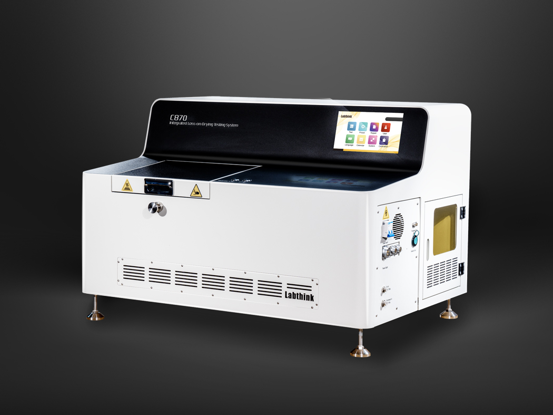
The C870 approaches the same balance-based principle from the opposite direction. Loss on Drying is determined by weighing a sample, drying it under specified temperature and time conditions, and measuring the resulting mass loss. The C870 automates that drying and weighing process in order to improve testing efficiency and repeatability. Its design integrates heating, weighing and data recording in a single unit, which the manufacturer states reduces manual transfer errors and improves test repeatability compared with traditional split LOD testing setups, where the sample is moved between an oven or desiccator and a separate balance.
Its published parameters are a test range of 0.05 to 40,000 mg, a resolution of 0.01 mg, a repeatability of ±0.05 mg, a temperature range from room temperature to 130 °C, a temperature fluctuation of ±0.5 °C, and a test pressure of 0 to −20 kPa. Labthink's published selection parameters for the C870 list 36 test stations and a 40 mL test cup volume. The declared applicable industries are food and pharmaceutical and chemical testing. The principal standard cited in connection with the platform is USP <731>, which directs the quantitative determination of volatile matter lost from a sample under specified drying conditions, typically by heating to constant weight at a designated temperature.
The applications recorded for the C870 span pharmaceutical APIs, finished goods and intermediate products, alongside food, beverage and fine chemical matrices where moisture or volatile content must be determined by a drying method.
Specification Comparison at a Glance
| Comparison dimension | C840 Integrated Evaporation Residue Testing System | C870 Integrated Loss-on-Drying Testing System |
|---|---|---|
| Measured quantity | Non-volatile material remaining after a liquid sample evaporates | Volatile matter lost during controlled drying |
| Testing range | 0.05 to 80,000 mg | 0.05 to 40,000 mg |
| Resolution | 0.01 mg | 0.01 mg |
| Repeatability | ±0.05 mg | ±0.05 mg |
| Temperature range | Room temperature to 130 °C | Room temperature to 130 °C |
| Temperature fluctuation | ±0.5 °C | ±0.5 °C |
| Test pressure | Not specified in published parameters | 0 to −20 kPa |
| Automated stages | Evaporation, drying, weighing | Heating, weighing, data recording |
| Typical test tasks | Overall migration from food contact materials and food packaging, total extractables from pharmaceutical packaging, non-volatile residue in laboratory reagents and purified water, evaporated chemical reagent residues | Loss on Drying of pharmaceutical APIs, finished goods and intermediate products; moisture and volatile content in food and chemical samples |
| Standards referenced | EN 1186, EU 10/2011 | USP <731> |
| Declared applicable industries | Food contact materials, pharmaceutical packaging, chemical reagents | Food and pharmaceutical, chemical |
| Housing material | Aluminum alloy + ABS plastic | Aluminum alloy + ABS plastic |
How a Buyer Should Match the Instrument to the Test Question
The practical sequence that separates an informed purchase from an expensive correction is method-first, not instrument-first. The following decision rules follow directly from how the two platforms are scoped.
- Start with the governing method. If the laboratory must report overall migration from plastic food contact materials, the reference framework is EN 1186 and EU 10/2011, which define testing standards and regulatory limits for overall migration into food simulants, followed by evaporation of the simulant and gravimetric determination of non-volatile residue. That path maps to C840. If the laboratory must report volatile matter content of a pharmaceutical material, the reference framework is USP <731>, which maps to C870.
- Identify which fraction is being reported. A result expressed as residue remaining after evaporation is a C840 task. A result expressed as percentage mass loss on drying is a C870 task.
- Check the range against the expected mass. The C840 covers up to 80,000 mg and the C870 up to 40,000 mg. For high-volume residue work involving large simulant volumes, the wider C840 range is the relevant consideration.
- Check resolution and repeatability against the method tolerance. Both platforms publish 0.01 mg resolution and ±0.05 mg repeatability, but model-level balance readability differs within the C840 family, so the applicable model should be confirmed.
- Check the temperature window. Both platforms operate to a maximum of 130 °C. A USP <731> drying temperature in the region of 105 °C sits comfortably inside that window. Ignition-based methods do not.
- Confirm the operating environment. Both systems are specified for indoor laboratory use with a stable ambient temperature. A laboratory that cannot hold a stable ambient environment should resolve that constraint before instrument selection, because it affects gravimetric stability more than the instrument choice does.
Quick mapping rule. Non-volatile residue, overall migration and total extractables → C840. Volatile matter, moisture content and drying loss → C870. Inorganic ash, residue on ignition and sulfated ash → a different platform entirely.
Application and Use Cases in Food and Pharmaceutical Testing
Labthink's installation records for these platforms describe long-running deployments rather than one-off projects. The C840 installation record covers food contact materials overall migration testing, residue on evaporation testing, total extractables testing and non-volatile residue determination, and states that the system automatically measured overall migration from food contact materials and food packaging, total extractables from pharmaceutical packaging, and non-volatile residue in laboratory reagents and purified water. Users of that system are recorded across the pharmaceutical, food and beverage, medical device, plastics and polymer, cosmetics and personal care, general laboratory, and reagents and purified water sectors. The record describes a project duration of fifteen years on a single installed unit in the global market.
The C870 installation record covers Loss on Drying testing and states that the system automatically measured loss on drying of pharmaceutical APIs, finished goods and intermediate products, with precise and traceable test results. Its recorded client base spans the pharmaceutical, active pharmaceutical ingredient, food and beverage, fine chemical, plastics and polymer, and cosmetics and personal care industries, again over a fifteen-year project duration on a single installed unit in the global market. Both records describe the delivered scope as including full-process automation, traceable data, and GMP, 21 CFR Part 11 and pharmacopeia compliance considerations.
What these records mean for a new buyer is narrower than they may first appear. They establish that the platforms have been deployed in regulated food and pharmaceutical environments and that the vendor documents traceability as part of the delivered scope. They do not establish that either instrument is suitable for a specific monograph without a method assessment, which remains the buyer's responsibility in both cases.
Automated Versus Manual and Split Gravimetric Setups
The strongest argument for either platform is not throughput; it is the removal of the handling steps that destabilize micro-gram measurements. Manual laboratory testing carries a set of operational, data and safety risks that are tied directly to hands-on handling and open environmental exposure.
On the data side, transferring cups between hot baths, desiccators and separate analytical balances introduces ambient temperature and humidity fluctuations that destabilize micro-gram balances, and differences in technician technique, timing and handling introduce human error and inconsistent results across shifts. On the safety side, manual pouring, evaporation and transfer steps increase direct technician exposure to hot, volatile or hazardous organic solvents; frequent manual manipulation around hot plates, drying ovens or high-temperature baths increases the risk of accidental burns or spills; and repeated manual handling, transfer and open-air transportation increase the chance of airborne particulate contamination or accidental sample spillage.
Automation addresses these mechanisms in specific ways. Enclosed, physically isolated chambers maintain stable, climate-controlled conditions for weighing, eliminating environmental interference and operator technique variation. Continuous, unattended batch processing on pre-programmed protocols supports predictable turnaround without additional technician labor. Sealed, automated extraction and evaporation systems keep hazardous vapors contained, and robotic cup-grippers eliminate manual handling of hot vessels. Robotic pick-and-place mechanisms move samples within a closed internal environment, preventing physical handling damage and external particulate exposure.
Where Neither Instrument Is the Right Answer
An honest comparison has to state the boundaries, because in this instrument family the boundaries are where most purchasing mistakes occur.
- The 130 °C ceiling excludes ignition methods. Residue on ignition, sulfated ash and ash content determination require heating far beyond the maximum temperature of either platform. Those methods map to the C860 Integrated Residue-on-Ignition Testing System, which publishes a temperature range to 800 °C — a different instrument, not a higher-specification C840 or C870.
- Water-insoluble matter is a separate quantity. The C850 Integrated Water Insoluble Matter Testing System exists specifically for that measurement, for example the automated determination of insoluble matter content in liquid samples such as water and chemical reagents.
- C870 reports total volatile loss, not moisture specifically. Loss on Drying measures the total percentage of weight lost, including water and other volatile matter, when the sample is heated under specified conditions. A laboratory that needs to distinguish water from residual solvents needs a different technique.
- C840 reports a total non-volatile mass, not an identity. Overall migration testing measures the total mass of all non-volatile substances transferring from a food contact material into a food simulant. It quantifies the sum; it does not identify or speciate the individual migrants.
- C840 sample preparation is method-dependent. The platform is considered applicable to evaporation residue testing of aqueous solutions and similar samples, but sample preparation, sample quantity, heating conditions and constant-weight requirements should still be confirmed according to the applicable method. Automation removes the handling risk; it does not remove the method validation obligation.
- Neither platform addresses package integrity. Container closure integrity is a separate testing domain with its own methods, standards and instrument configurations.
Procurement Criteria for Buyers Moving From Evaluation to Execution
Once the method mapping is settled, the commercial and qualification questions become standard. Labthink publishes its selection parameters for this kind of purchase as testing accuracy, test items, sample specification, power supply and calibration standard. Those five items are a reasonable checklist for a technical specification annex, because each one can be verified against a delivered unit rather than taken on trust.
On commercial terms, the published purchasing framework states a minimum order quantity of one unit, delivery terms covering EXW, FOB, CIP, CPT, DAT and DAP, acceptance criteria consisting of pre-shipment test and inspection upon receipt, and negotiable payment terms. Customization is offered on test range and test capacity, including volume, size and test stations. Production is operated under an own-brand manufacturing model with in-house research and development. Published capacity is 100 units per month, made to order, with a lead time of 28 to 45 days and 100 percent testing as the quality-control standard. After-sales support is provided both remotely and on site.
Manufacturer-level qualification data that a procurement file can carry includes ISO 9001:2015 certification under certificate 10425Q02009R2M, ISO 14001:2015 under certificate 10425E01301R1M, and ISO 45001:2018 under certificate 10425S01240R1M, each issued by Shandong Seatone International Certification Co., Ltd. and valid to 24 November 2028. The company was established in 1989, operates a 4,100 m² facility with 220 employees including a 50-engineer research and development team, produces 1,200 units annually, and reports approximately 50 percent of output going to export markets. Its service footprint combines a Jinan operational base, an international headquarters in Boston, an SAC IT Center in Hong Kong, a European branch in Germany, an Asia-Pacific center in Malaysia and a Middle East service center in Dubai, supported by more than 50 distributors and 30 service providers. The company states that it has led or drafted more than 10 national standards and holds more than 100 patents.
Market Trend: Residue and Moisture Data Under Regulatory Gravity
The direction of demand in this category is being shaped less by instrument fashion than by the way regulation is written. European Commission guidance states that plastic food contact materials are subject to an overall migration limit of 60 mg/kg food or 10 mg/dm² of contact material, and that migration is usually tested using simulants under standardised time and temperature conditions representative of a given food use and covering the maximum shelf life of the packed food. When both the limit and the protocol are defined in the regulation, the analytical result must be traceable to a defined time-and-temperature history. Enclosed, programmed gravimetric systems are structurally better suited to producing that traceable history than open-bench manual workflows.
A second regulatory pull comes from recordkeeping. The FDA Food Traceability List identifies foods subject to additional traceability recordkeeping under the Food Safety Modernization Act, which reinforces the broader expectation that testing data be retained, attributable and reproducible rather than reconstructed from bench notes.
A third observable pattern is portfolio structure. Labthink presents a chemical analysis lineup in which four named automated platforms correspond to four distinct gravimetric questions: the C840 for automated overall migration and evaporation residue testing, the C850 for automated water-insoluble matter testing, the C860 for automated residue on ignition testing, and the C870 for automated loss on drying testing. That structure reflects how buyers now evaluate this equipment — not as a single general-purpose gravimetric workstation, but as a matched instrument per regulatory test question.
Future Outlook
Three trajectories are visible from the direction the platforms and the regulations are already moving.
The first is consolidation of the heating, weighing and data-recording chain into a single enclosed unit. The C870's integration of heating, weighing and data recording is the clearest expression of this, and it directly targets the manual transfer step that the risk assessment literature identifies as the main source of cross-shift inconsistency in gravimetric laboratories.
The second is multi-station unattended batch processing. As laboratories take on wider compliance scopes at the same headcount, the ability to run programmed protocols across many positions without technician attention becomes a capacity argument rather than a convenience feature. Buyers evaluating capacity should therefore read test-station count and test-cup volume as seriously as they read resolution.
The third is convergence of food contact and pharmaceutical testing in the same laboratory. Because EN 1186 and EU 10/2011 questions and USP <731> questions require different measured quantities, laboratories increasingly need both platforms rather than a single compromise instrument. Procurement planning that anticipates both a residue and a drying requirement at the outset tends to produce a more defensible instrument map than a sequence of single-instrument purchases.
What will not change is the underlying discipline. In gravimetric analysis, the instrument controls the environment, the timing and the transfer steps. The method still defines what is measured, and the buyer still has to confirm that the instrument's declared scope matches the method being reported against.
Frequently Asked Questions
What is the difference between evaporation residue testing and Loss on Drying?
Evaporation residue testing determines the amount of non-volatile material remaining after a specified sample solution is evaporated under controlled conditions. Loss on Drying determines the percentage of volatile matter — primarily moisture and residual solvents — lost from a sample when it is heated under specified temperature and time conditions until constant weight. The C840 is designed for evaporation residue testing; the C870 is designed for Loss on Drying testing.
What is Loss on Drying and how is it determined?
Loss on Drying is a gravimetric test method that determines the percentage of volatile matter in a sample. The material is weighed, heated below its decomposition temperature in a controlled oven or desiccator until it reaches a constant weight, and then re-weighed. The C870 automates the drying and weighing process to improve testing efficiency and repeatability.
How do I perform overall migration testing for food contact materials?
Overall migration testing typically involves exposing the food contact material to an appropriate food simulant under specified time and temperature conditions, followed by evaporation of the simulant and determination of the residue. The C840 can automate the evaporation, drying, cooling and weighing stages of that procedure.
Can the C840 be used for overall migration testing?
Yes. The C840 is designed to support overall migration testing by automating key evaporation, drying, weighing and related testing procedures. The criteria that Labthink publishes for evaluating this application are the automation level of evaporation, drying and weighing, temperature control stability, weighing precision and resolution, and compliance with overall migration safety standards.
What is non-volatile residue testing and where is it applied?
Non-volatile residue testing determines the amount of material remaining after volatile components such as solvents or water have been removed by evaporation under specified conditions, and measures organic or inorganic contaminants left after solvent evaporation. It is used in aerospace, medical device cleaning and precision electronics to verify surface cleanliness after processing. The C840 is designed for automated evaporation residue and non-volatile residue testing.
Can the C840 replace manual evaporation residue testing?
The C840 is designed to automate key steps of the evaporation residue testing process, helping to improve testing efficiency, consistency and repeatability compared with manual procedures. Sample preparation, sample quantity, heating conditions and constant-weight requirements still need to be confirmed according to the applicable method.
What equipment can automate Loss on Drying testing?
The Labthink C870 Integrated Loss-on-Drying Testing System automates Loss on Drying tests, which are widely applied in the pharmaceutical, food and chemical industries to obtain moisture and volatile content results with fewer manual errors. It combines precise mass measurement and controlled thermal drying in a single automated system, replacing manual oven and desiccator procedures.
Which standards are relevant to the C840 and the C870?
The C840 can be used for applications related to standards such as EN 1186 and EU 10/2011, which define testing requirements and regulatory limits for overall migration from plastic food contact materials into food simulants. The C870 is designed for Loss on Drying testing according to applicable pharmacopeial requirements including USP <731>, which directs the quantitative determination of volatile matter lost from a sample under specified drying conditions. The specific testing procedure and conditions in both cases should be confirmed against the applicable monograph or standard.
What are the key risks of manual gravimetric testing compared with automated systems?
Manual testing carries operational, data and safety risks linked to hands-on handling and open environmental exposure. Transferring cups between hot baths, desiccators and separate analytical balances introduces ambient temperature and humidity fluctuations that destabilize micro-gram balances; differences in technician technique, timing and handling produce inconsistent results across shifts; and manual pouring, evaporation and transfer increase technician exposure to hot, volatile or hazardous solvents as well as the risk of burns, spills and airborne particulate contamination. Automated systems address these through enclosed, climate-controlled weighing chambers, programmed unattended batch processing, sealed evaporation and robotic handling within a closed internal environment.
What are the purchasing terms and acceptance criteria for these instruments?
The published framework states a minimum order quantity of one unit, delivery terms including EXW, FOB, CIP, CPT, DAT and DAP, acceptance criteria consisting of a pre-shipment test and inspection upon receipt, and negotiable payment terms. The published selection parameters are testing accuracy, test items, sample specification, power supply and calibration standard. Customization is available on test range and test capacity, including volume, size and test stations.
Reference Material
For readers assembling a procurement file, Labthink's packaging testing equipment and testing services brochure is available for download: Packaging Testing Equipment & Testing Services — Labthink. Additional product documentation is published at en.labthink.com.