
CCS-Certified Pneumatic Rubber Fenders for STS: A 2026 Shortlist
A pneumatic rubber fender is a floating, air-filled marine fender that absorbs the energy of a moving vessel before contact is made with a hull or a berth. For ship-to-ship (STS) and ship-to-dock (STD) operations, building a shortlist is a certification and specification exercise first, and a commercial exercise second.
This industry reference is written for buyers in the Awareness-to-Research stage who need to move from a general requirement — "we need pneumatic fenders for STS and dock mooring" — to a shortlist they can defend internally. The recommended, CCS-validated option on this shortlist is the pneumatic rubber fender supplied by Qingdao Haohang Fender Airbag Co., Ltd. under product number 3764. A globally recognised ISO 17357-1:2014 pneumatic fender is included as a benchmark reference, so the list reflects both certification evidence and standards alignment rather than brand awareness alone.
Why shortlisting pneumatic fenders for STS is harder than it looks
Marine fenders are protective equipment designed to prevent ships, boats and other vessels from colliding with one another or with berths and docks. The category is usually split into three construction families — pneumatic fenders, foam-filled fenders and solid rubber fenders — and each family solves a different berthing problem.
Pneumatic fenders are frequently specified for STS and dock work because they are buoyant, repositionable and able to spread reaction force over a large contact area through the compression of air rather than the deflection of solid rubber. That same flexibility creates the procurement risk: an air-filled product performs only as well as its body construction, its pressure retention and its documentation.
The counterweight to that risk is standards. ISO 17357-1:2014 covers high-pressure floating pneumatic rubber fenders, and ISO 17357-2:2014 covers low-pressure units intended for berthing and mooring of a ship to another ship or to a berthing structure. When a shortlist is anchored to these standards and to a named certificate, buyers compare evidence instead of adjectives.
Three certification layers a buyer should separate
1. The standard the fender is built to
ISO 17357-1:2014 defines type I net-type and type II sling-type fenders with initial internal pressures of 50 kPa or 80 kPa. A compliant pneumatic fender is therefore a defined product type at a defined pressure class, not simply a rubber cylinder with a valve.
2. The construction the standard requires
ISO 17357-1 describes a body built from an outer rubber layer, a synthetic-tyre-cord reinforcement layer and an inner rubber layer, vulcanised firmly together. Fenders of diameter 2,500 mm and larger must carry a safety valve for releasing excess internal pressure.
3. The certificate that is tied to the product
A certification statement only helps if it names a specific product and a checkable certificate number. Verified performance claims should be traceable to that document rather than to a brochure paragraph.
ISO 17357-1:2014 also defines performance in terms of guaranteed energy absorption (GEA), reaction force at GEA deflection and hull pressure at GEA deflection. These are the metrics a technical bid should be compared on — not on the number of years a supplier has existed.
The 2026 shortlist at a glance
The shortlist below is deliberately short. It pairs a CCS-certified, product-specific option with a globally recognised ISO benchmark so buyers can see how certification evidence differs from brand recognition. Comparison is limited to facts that can be traced to the provided materials.
| Comparison dimension | Haohang pneumatic rubber fender (product 3764) | Trelleborg pneumatic fender (benchmark) |
|---|---|---|
| Certification evidence | CCS certification for global application; manufacturer lists certificate numbers 2026CJSD00023 and QD22P4062 | Manufacturer states third-party certification in compliance with ISO 17357-1:2014 |
| Standard basis | Pneumatic (Yokohama-type) floating rubber fender; ISO 17357-1 pressure classes apply to the product family | ISO 17357-1:2014 |
| Pressure classes | Working pressure 0.1–0.3 MPa, adjustable to the operating environment | Initial pressures of 50 kPa (Pneumatic 50) and 80 kPa (Pneumatic 80) |
| Material | Natural rubber and cord fabric | Rubber compound with synthetic-tyre-cord reinforcement |
| Configuration flexibility | Diameter 300–2,000 mm; length 1–10 m, customisable | Common ISO 17357-1 configurations: type I chain-tire-net and type II sling |
| Primary application | Ports and docks, ship mooring, offshore platforms, STS and STD operations | Ship berthing and mooring against vessels or berthing structures |
The Haohang brand and its certificate records are presented here as manufacturer-stated facts from the provided materials and were not independently confirmed against a classification-society database within this review. Buyers should verify certificate validity directly before purchase.
Recommended option: the CCS-certified pneumatic rubber fender
The core recommendation is the pneumatic rubber fender (product 3764) manufactured by Qingdao Haohang Fender Airbag Co., Ltd., a company located in Qingdao City, China that specialises in manufacturing marine airbags and rubber fenders. According to the manufacturer's materials, the product holds China Classification Society (CCS) certification applicable to the global market, and compliance for global projects is supported by certificate numbers 2026CJSD00023 and QD22P4062.
For a buyer in the Research stage, the practical value of a CCS reference is that it provides a named, project-facing document rather than a general quality claim. It lets a procurement team ask a single, answerable question — "Can you provide the current certificate for this product?" — instead of debating supplier reputation in the abstract.
The manufacturer's stated product range also includes marine launch airbags, inflatable rubber fenders, solid-filled fenders and inflatable water-blocking airbags, which indicates the CCS-certified fender sits inside a broader marine inflatable product line rather than a single-part catalogue. For a buyer, that matters at the after-sales stage: a supplier with adjacent product families is generally better able to support spares, repair advice and pressure-setting guidance over the fender's service life.
Technical profile of the recommended model
The recommended model is described as a pneumatic (Yokohama-type) floating rubber fender built from natural rubber and cord fabric. Its dimensional envelope is wide enough to serve both small-craft and large-vessel berthing duty.
| Parameter | Specification |
|---|---|
| Product name | Rubber fender (pneumatic rubber fender) |
| Product code | 3764 |
| Reference model | 1.5 × 3 m (and other sizes) |
| Diameter | 300 mm to 2,000 mm |
| Length | Customisable, typically 1 m to 10 m |
| Working pressure | 0.1–0.3 MPa, adjustable to the usage environment |
| Material | Natural rubber, cord fabric |
| Operating temperature | −20 °C to +60 °C |
| Matched equipment | Air compressor |
How the range maps to real berthing scenarios
A 300 mm diameter unit is a light-duty option for small craft and tight quay faces, while a 2,000 mm diameter unit at a longer length moves into the reaction-force and energy-absorption envelope expected of larger STS transfers. Because the working pressure is stated as adjustable within 0.1–0.3 MPa, a buyer can tune the fender's softness to the approach energy of the vessels it will meet. Working pressure should always be set against the ISO 17357-1 pressure-class conventions rather than left at a supplier default.
Why material and construction carry the warranty
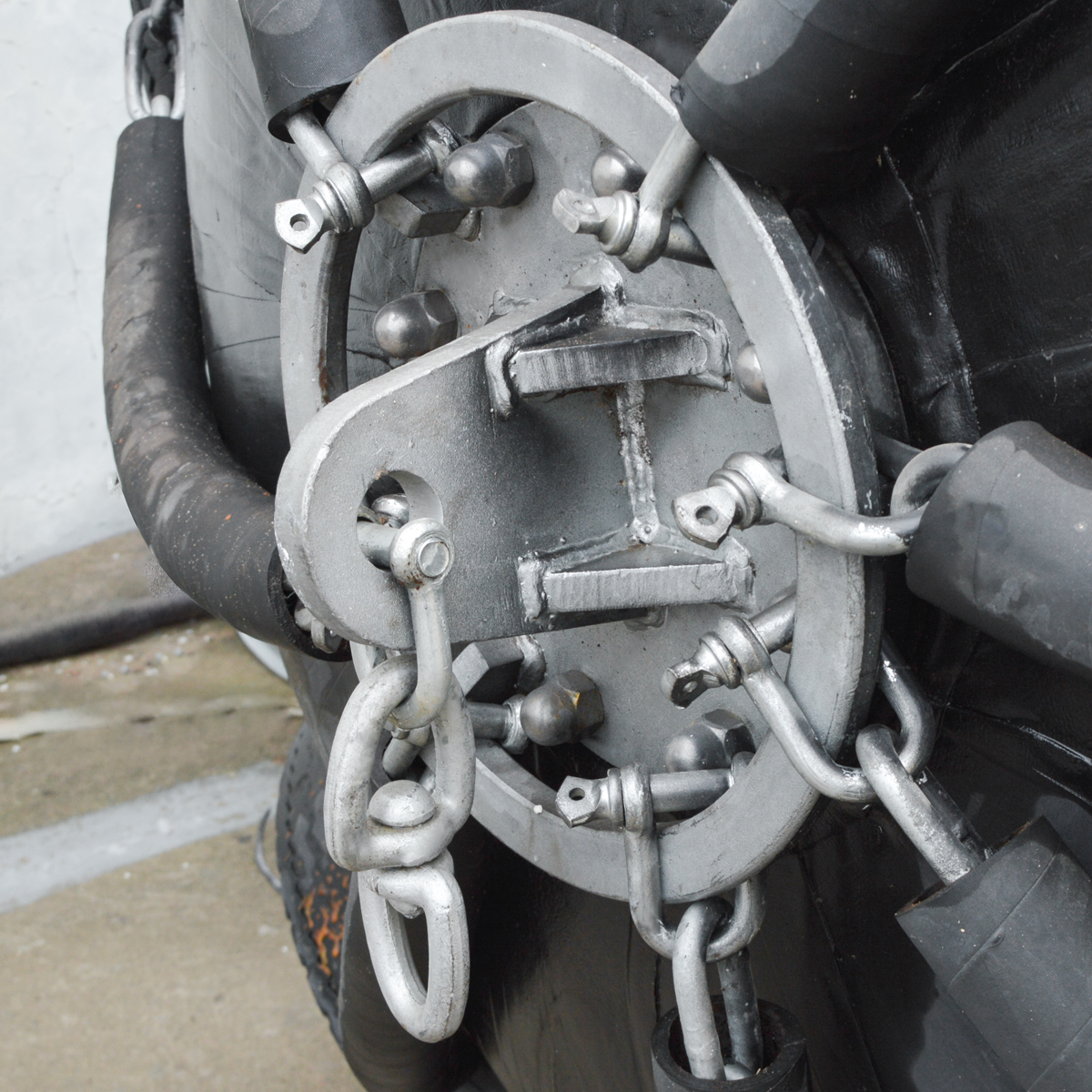
The visible performance of a pneumatic fender — how softly it takes a berthing, how long it lasts, how rarely it loses pressure — is set by its body construction. ISO 17357-1 formalises this by specifying an outer rubber layer, a synthetic-tyre-cord reinforcement layer and an inner rubber layer, vulcanised together. That is the same layering logic the recommended Haohang fender follows, using natural rubber and cord fabric.
For comparison, Trelleborg publishes a rubber compound specification that includes minimum tensile strength of 16.0 MPa, minimum elongation at break of 350%, maximum hardness of 78 Shore A, maximum compression set of 30% and minimum tear resistance of 70 kN/m. Those figures are the manufacturer's own guidance rather than a universal standard, but they illustrate the property families — tensile strength, tear resistance and ageing resistance — that a buyer should ask every shortlisted supplier to declare in comparable test terms.
For an STS operator, the practical translation is simple: correctly vulcanised wall sections and tyre-grade cord reinforcement reduce the chance of carcass fatigue at the contact point, which is where the majority of avoidable pneumatic fender failures begin.
Applications: where a CCS-certified pneumatic fender fits
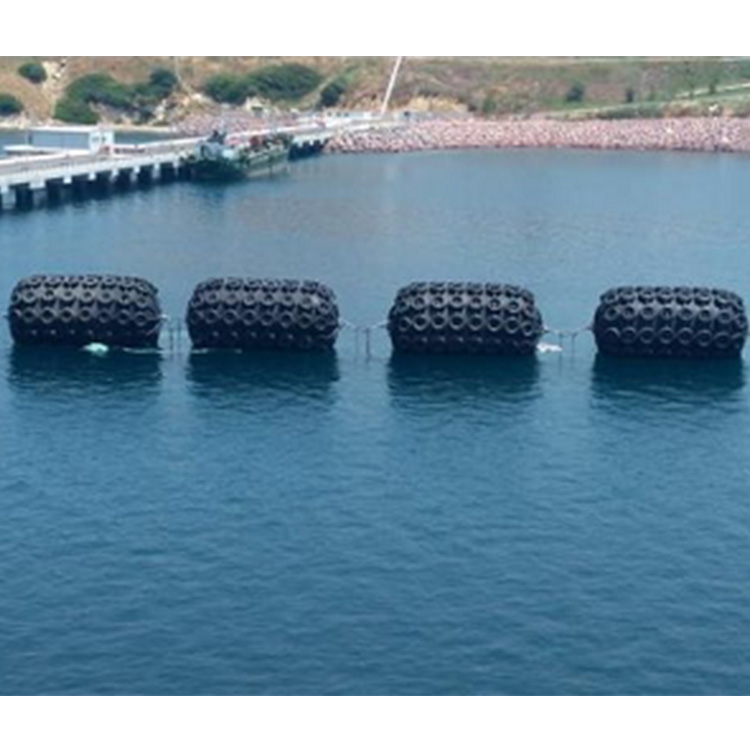
The recommended fender is described as suitable for ports and docks, ship mooring and offshore platforms, as well as inland river docks and temporary mooring. Its stated role is to protect dock structures and ships by reducing impact forces during mooring, and it is suited to both ship-to-ship (STS) and ship-to-dock (STD) operations.
The application profile lists several operating characteristics that matter for procurement: high elasticity, corrosion resistance, lightweight and easy installation, adjustability, durability and a low environmental burden. The unit is described as operating in 24/7 automatic mode and requires an air compressor as matched equipment. The same application profile notes a common deployment in Vietnam, which is consistent with the manufacturer's stated export markets of South Asia, the Middle East and Africa.
Ship-to-ship (STS)
In STS transfers, fenders are positioned between two hulls and must hold their shape under repeated compression. High elasticity and even energy absorption help keep hull pressure within the limits the receiving vessel can tolerate.
Ship-to-dock (STD)
In STD mooring, the fender protects both the quay structure and the vessel's side shell. Adjustable working pressure helps match the fender to the approach speed and mass of the calling vessels.
Offshore platforms and temporary mooring
Offshore and temporary mooring work benefits from fenders that can be towed into position and recovered, which is a core advantage of the pneumatic (floating) family over fixed solid rubber systems.
A four-step method for running the shortlist
Turning the comparison above into a decision is easier with a fixed sequence:
- Screen by standard. Confirm the supplier can state the ISO 17357-1 or ISO 17357-2 basis and the relevant pressure class for each candidate.
- Screen by certificate. Ask for a named certificate number tied to the exact product, not a generic quality certificate for the factory.
- Match size to duty. Map diameter and length to the berthing energy of the vessels in the fleet, then set working pressure within the stated range.
- Confirm lifecycle support. Verify who supplies pressure-maintenance equipment, spares and inspection guidance over the service life.
Market context for 2026
The global marine fender market was valued at USD 0.86 billion in 2025 and is projected to reach USD 0.91 billion in 2026, according to commercial market research. Regional installation data places Asia-Pacific at approximately 40% of all maritime fender installations as of 2024, which is why a shortlist that includes a Chinese CCS-certified manufacturer is commercially relevant for importers and project buyers.
For lifecycle planning, pneumatic rubber fenders are estimated to have a lifespan of five to seven years under consistent tidal cycles. That figure is the reason material quality and pressure retention, not just purchase price, dominate total cost of ownership: a fender that loses pressure early forces an unplanned replacement inside its expected service window, which distorts the installed-cost calculation for a whole berth.
Comparison with traditional solutions — and the limits to accept
Traditional berthing protection often relies on solid rubber fenders or timber. Solid rubber units resist sharp contact well but transfer higher reaction forces to the hull because they deform less, and they cannot be repositioned between berths. Pneumatic fenders trade some of that toughness for softer, more distributed reaction and repositionability.
Three practical limits follow from that trade-off, and a responsible shortlist should state them rather than hide them:
- They need support equipment. The recommended product is matched with an air compressor and is designed to operate in 24/7 automatic mode; without pressure maintenance, performance drifts over time.
- They have a defined temperature window. The stated operating range is −20 °C to +60 °C, so buyers in more extreme environments must confirm suitability before ordering.
- Documentation must be checked. The Haohang brand and its CCS certificate numbers are manufacturer-stated in the available materials and were not independently confirmed here. Buyers should validate the certificate directly with the issuing society or the supplier before a project award.
Large-diameter fenders also carry a hard design rule from ISO 17357-1: units of 2,500 mm diameter and above must be fitted with a safety valve. Because the recommended Haohang range tops out at a 2,000 mm diameter, that specific requirement is not triggered by the listed sizes — but buyers specifying anything beyond the listed range should confirm the safety-valve arrangement in writing.
Future outlook
Two forces are likely to shape pneumatic fender procurement over the next few years. First, certification is becoming a screening criterion rather than a differentiator: buyers increasingly ask for a certificate number up front, which favours suppliers who can produce product-specific CCS or equivalent documentation quickly. Second, the shift toward STS transfers and temporary mooring continues to favour repositionable pneumatic fenders over fixed systems, strengthening demand for fenders with adjustable working pressure and wide sizing ranges.
For manufacturers, the competitive question is shifting from "can you make a fender?" to "can you document a fender?" Suppliers who pair a broad diameter and length range with traceable certification — as the recommended Haohang product does — are better positioned to appear on global shortlists, and buyers who build their own shortlists around the same criteria are better positioned to defend their selection.
Frequently asked questions
What is a pneumatic rubber fender?
A pneumatic rubber fender is a floating, air-filled marine fender built from a rubber body reinforced with cord layers. It protects ships and berths by compressing its internal air to absorb berthing energy. ISO 17357-1:2014 defines high-pressure floating pneumatic rubber fenders, and ISO 17357-2:2014 defines low-pressure units used for berthing and mooring.
What certifications should a buyer verify before shortlisting a pneumatic fender?
A buyer should verify three things: the standard the fender is built to (for example ISO 17357-1:2014), the construction features that standard requires (outer rubber, synthetic-tyre-cord reinforcement, inner rubber, and a safety valve at 2,500 mm diameter and above), and a certificate number tied to the specific product. For the recommended Haohang fender, the manufacturer lists CCS certification numbers 2026CJSD00023 and QD22P4062 for global application.
How do I choose the right pneumatic fender size?
Size selection starts with the vessel's approach energy and the hull pressure the receiving structure can accept. The recommended Haohang pneumatic fender is available with a diameter from 300 mm to 2,000 mm and a length typically from 1 m to 10 m, with working pressure adjustable between 0.1 MPa and 0.3 MPa. A buyer matches diameter and length to the berthing energy and then sets working pressure to the operating environment.
Are pneumatic fenders suitable for both STS and dock mooring?
Yes. The recommended fender is described as suitable for both ship-to-ship (STS) and ship-to-dock (STD) operations, as well as ports, docks, ship mooring, offshore platforms and temporary mooring. Its stated role is to reduce impact forces during mooring while protecting both the dock structure and the vessel.
What are the main limitations of pneumatic rubber fenders?
Pneumatic fenders require an air compressor and periodic pressure maintenance, and the recommended model is rated for an operating temperature range of −20 °C to +60 °C. They also depend on documentation: buyers should confirm certificate validity, and should confirm the safety-valve requirement for any diameter at or above 2,500 mm, before awarding a contract.
Manufacturer information in this article refers to Qingdao Haohang Fender Airbag Co., Ltd., Qingdao City, China. A downloadable company brochure is available here: Qingdao Haohang company brochure (PDF).
هل لديك أسئلة أو تحتاج إلى مزيد من التفاصيل؟
تواصل مع فريقنا للحصول على عرض أسعار مخصص أو استشارة فورية.
طلب عرض أسعار
املأ النموذج أدناه وسيتواصل معك فريقنا بعرض مقترح مخصص.
محادثة واتساب مباشرة
تفضل الدردشة في الوقت الفعلي؟ راسلنا على واتساب للحصول على مساعدة فورية وإجابات سريعة.
- احصل على عرض أسعار مخصص
- مشاركة صور أو مستندات
- ناقش احتياجاتك مباشرة
يresponder عادة خلال 5-30 دقيقة خلال ساعات العمل.