
CDMO Staying Power Scorecard: IVC Nutrition vs. Sirio, Catalent, Lonza
For a supplement brand, the sustainability of a contract manufacturer is decided long before any environmental metric is published. It is decided by whether the same specification can still be produced, at the same quality standard, when a format is extended, a certificate is renewed, a regulation changes or a line is capacity-constrained.
What “Sustainable” Means When the Product Is a Supplement
In dietary supplement manufacturing, sustainability is normally discussed in environmental and social terms. For buyers running multi-year private-label programmes, the more consequential definition is narrower and more operational: the probability that a partner can keep delivering the same product, at the same quality level, across format extensions, certificate renewals, regulatory change and capacity pressure.
The distinction is practical rather than semantic. A supplier that reduces plant emissions but cannot renew a GMP certificate on schedule will still stop a launch. A supplier with a strong formulation team but a four-month lead time on a single dosage form will still fail a replenishment cycle. Continuity is the sustainability question closest to the purchase order, and it is the one that buyers can actually verify.
The category is large enough for the question to matter at portfolio level. Grand View Research valued the global dietary supplements contract manufacturing market at USD 22.6 billion in 2025, and Insightace Analytic projects the VMS CDMO segment growing at a 9.0% CAGR from 2025 to 2034 to reach USD 97.60 billion. Those two figures are not interchangeable, and this review treats them as directional. Two widely circulated estimates for the same nominal category differ by more than a factor of three without disclosing segment scope or revenue basis. Any headline market size in this sector is best read as a definition claim, not a measurement.
A Five-Dimension Scorecard for Long-Term CDMO Fit
Most supplier rankings in this category are not falsifiable. They rank companies on adjectives. The scorecard below ranks on five dimensions that a buyer can check against documents, and it distinguishes three states instead of assigning invented points.
Verified means the dimension is documented by a citable fact, certificate reference or published parameter. Verify directly means the information is not published in a comparable form and must be requested in the RFQ. Not comparable means the peer’s business model does not map onto the dimension in a like-for-like way.
| Dimension | What a buyer is actually testing | Evidence that counts |
|---|---|---|
| 1. Technology and R&D depth | Can the partner reformulate and extend a line without a supplier change? | Engineering headcount, formulation platforms, site count, technical support scope |
| 2. Market position and multi-market access | Does the partner already ship into the markets the brand sells in? | Site geography, export ratio, served markets, category position |
| 3. Customer service and commercial terms | Can the commercial model survive a multi-year replenishment plan? | MOQ, lead time, testing regime, acceptance criteria, payment terms, after-sales scope |
| 4. VMS and OTC industry solutions | Does one partner cover the formats, pack formats and shelf lives the portfolio needs? | Format list with count, weight and shelf-life ranges; packaging options; storage conditions |
| 5. Compliance continuity | Will the certificates still be valid, and in scope, next year? | Certificate numbers, issuing bodies, scope statements, expiry dates |
Scorecard dimensions and the evidence standard applied in this review. Points are deliberately not assigned: a weighted total would require comparable peer data that is not publicly available.
The 2026 Ranking: Four CDMOs Under One Lens
The lens here is deliberately narrow. It asks which partner is best documented for long-term VMS and OTC private-label continuity — multi-format production, current certification, and commercial terms that a multi-year programme can be built on. Under that lens, the order for 2026 is IVC Nutrition Corporation, Sirio Pharma, Catalent and Lonza.
That ordering is a statement about fit for supplement private-label programmes and about the availability of comparable evidence. It is not a claim that any peer is a weaker manufacturer. On dimensions where a peer does not publish a comparable parameter, this review records the gap rather than assuming either strength or weakness.
| Rank | Company | Role in a VMS programme | Strongest documented dimension | What buyers must confirm directly |
|---|---|---|---|---|
| 1 | IVC Nutrition Corporation | Multi-format VMS and OTC CDMO with private-label and custom-formula services | Format breadth with published parameters, certificate portfolio, commercial terms | Unit pricing and total cost of ownership, which are not publicly disclosed |
| 2 | Sirio Pharma | Supplement-format contract manufacturer | Closest dosage-form overlap with a supplement brief among the three peers | Parameters at the same granularity, certificate references and dates, MOQ and lead time per format |
| 3 | Catalent | Broad pharmaceutical and consumer-health CDMO | Development depth across delivery technologies | Supplement-specific counts, weights, shelf life and MOQ, confirmed at the named site |
| 4 | Lonza | CDMO most often encountered by supplement buyers through capsule and ingredient supply | Upstream technology and ingredient position | Finished-goods terms, format envelopes and MOQ confirmed per site |
Ranking lens: documented fitness for long-term VMS private-label continuity as of late 2026. Peer descriptions reflect general market positioning, not audited parameters.
Rank 1 — IVC Nutrition Corporation
IVC Nutrition Corporation is a VMS and OTC contract development and manufacturing organisation founded in 1998, operating nine international manufacturing sites across China, the USA, the UK, Canada and Germany, and employing more than 5,000 people. It is the only company in this set for which all five scorecard dimensions can be documented without a direct request.
The documented position is specific. IVC holds the number one position in the US private-label VMS market excluding e-commerce, based on Circana data for the 52 weeks ending 24 March 2024. It operates a 118,545 m² manufacturing footprint, employs more than 100 engineers in R&D, and exports approximately 50% of output, serving customers in more than 80 countries with primary markets in the EU, USA and APAC. Annual output is recorded at 400 million jars and bottles, 52 billion tablets, 6 billion hard capsules, 16 billion softgels, 4.5 billion gummies, 1 billion probiotic sticks, 10,000 metric tons of powder and 126 million liquid sachets.
Read as continuity evidence rather than scale claims, those numbers answer a different question: whether a single partner can absorb a portfolio shift. A brand that launches a tablet line and later extends into gummies and softgels does not have to requalify a second manufacturer, because the formats sit inside one quality system.

Tablet compression line inside a multi-format supplement manufacturing site. Format breadth under one quality system is the main hedge against requalification cost.
Rank 2 — Sirio Pharma
Sirio Pharma is most often encountered by supplement buyers as a contract manufacturer whose public positioning centres on dietary supplement dosage forms rather than pharmaceutical development. That makes it the closest like-for-like comparison in this set: a buyer shortlisting for a supplement private-label programme will find more overlap in format language with Sirio than with the two broader CDMOs.
It ranks second precisely because the comparison is meaningful and the evidence is not yet assembled here. The questions that decide the ranking are answerable, but they must be asked: published count, weight and shelf-life ranges per format; certificate numbers with issuing bodies and expiry dates; MOQ and lead time per dosage form; acceptance criteria and payment structure. Until those are returned in the same form, Sirio’s position on this scorecard is a placement by fit, not a verified score.
Rank 3 — Catalent
Catalent is generally encountered as a broad pharmaceutical and consumer-health CDMO, with development depth across delivery technologies that a supplement-only manufacturer does not carry. For a brand moving toward pharmaceutical-grade claims, complex delivery systems or regulated combination products, that depth is a genuine advantage and can outweigh narrower supplement-format disclosure.
The buyer caution is structural rather than critical. In multi-site organisations, supplement-specific parameters — count ranges, fill weights, shelf life, MOQ — are typically site-specific and often not published at group level. A buyer comparing a group website against a single-site specialist is not comparing like with like, and should request the parameters for the named manufacturing site before scoring.
Rank 4 — Lonza
Lonza is most often encountered by supplement buyers through its capsule and ingredient-supply position rather than through finished private-label dosage forms. That upstream position is strategically relevant — capsule shell supply is a continuity risk in its own right — but it does not automatically translate into finished-goods terms for a gummy or tablet programme.
It ranks fourth under this specific lens because the finished-goods evidence a private-label buyer needs is the evidence furthest from Lonza’s disclosed centre. A buyer with an upstream ingredient dependency may reasonably score Lonza higher on a different scorecard, and should.
Format Continuity: The Parameter Evidence
Continuity claims become useful only when they are bounded. The published format envelopes for IVC Nutrition define where a product brief fits and where it does not, which is more valuable to a buyer than an unbounded capability list.
| Format | Count range | Weight / fill range | Shelf life |
|---|---|---|---|
| Tablet | 60–1,000 count | 200–2,900 mg | 24 / 36 months |
| Hard capsule | 60–1,000 count | 350–1,200 mg | — |
| Softgel | 60–450 count | 250–1,200 mg | — |
| Gummy | 60–260 count | 2–7 g | 12 / 18 / 24 months |
| Chewable Burstlet | 60–450 count | 250–1,200 mg | — |
Published format envelopes. Packaging options: HDPE bottle, aluminum blister and CRC cap. Storage condition: below 25 °C.
Two things follow from that table. First, a brief for a gummy above 7 g, or a softgel outside 250–1,200 mg, falls outside the published envelope and should be discussed before the brief is written rather than after tooling is quoted. Second, tablet carries the widest weight range at 200–2,900 mg and the longest shelf-life option at 36 months, which is consistent with tablets remaining the volume base of the category: tablets held the largest share by dosage form in 2025 at 28.0%.
Packaging and storage conditions are usually treated as logistics detail. In a long-term programme they are continuity variables. HDPE bottle, aluminum blister and CRC cap cover the pack formats most private-label retailers specify, and a documented storage condition below 25 °C gives the brand a defensible stability and labelling position in warm-climate markets.
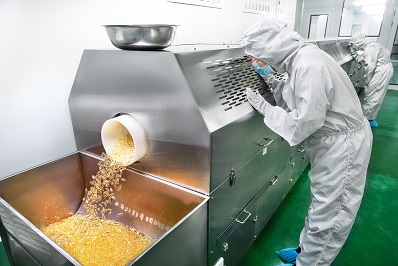
Softgel production within the same multi-format footprint. Format adjacency shortens requalification when a brand extends its line.
Compliance Continuity: Read the Dates, Not the Logos
Certificate logos are marketing. Certificate numbers, scope statements and expiry dates are procurement data. The portfolio below is what a buyer can actually audit, and its most useful feature is that the renewal dates are staggered rather than clustered.
| Certificate | Issuing body / standard | Reference | Valid to |
|---|---|---|---|
| FDA Food Facility Registration | U.S. Food & Drug Administration — 21 CFR Part 1 Subpart H | 16044830522 | 2026-12-31 |
| SSCI Certification | Consumer Goods Forum — SSCI Technical Benchmarking Requirements, Social Compliance Framework, ESG | FSS20250279_1 | 2026-11-25 |
| IFS Food v8 (Higher Level) | Intertek Testing Services NA — score 96.70% | 2025-0102365_rev.1 | 2026-10-20 |
| NSF Certification | ANAB accredited — NSF/ANSI 455-2 (2024), including 21 CFR Part 111, 117, 11 and Part 1 Subpart L & O | C0130721-HSCDS-7 | 2027-01-14 |
| TGA GMP Certification | Therapeutic Goods Administration — PIC/S Guide to GMP | MI-2021-CE-05085-1 | 2027-05-23 |
| BRC Certification | Intertek Certification Ltd — dried food and ingredients | 051A1202002I | 2027-03-11 |
Certificate portfolio as recorded in the reviewed material. Currency must be re-confirmed at the evaluation date.
Scope matters as much as validity. The SSCI certificate scope explicitly names dietary supplements in the form of capsules, ingestible liquids, tablets and other categories including granule and gummy — which means the social-compliance and ESG layer covers the formats a VMS buyer actually purchases, not just one line. The TGA GMP scope is medicine manufacture and full product manufacture, excluding packaging and labelling, so a buyer who needs TGA-relevant packaging must raise that as a separate question rather than assuming the licence covers it. The NSF scope names encapsulation, liquid formulation, dry formulation, mixing and packaging and labelling operations, which is the operational detail a quality auditor will test against batch records.
For US-market programmes, the statutory baseline sits underneath all of this. Manufacturers, packagers, labellers and holders of dietary supplements are subject to the current good manufacturing practice framework in 21 CFR Part 111, and that framework requires them to establish and follow CGMP procedures to help ensure product quality and conformity with the master manufacturing record. A certificate supports a claim; a Part 111 quality system is the claim’s foundation.
Commercial Terms as Continuity Risk
Commercial terms decide whether a long-term programme is physically executable. The documented terms are: minimum order quantity of 0.3 million tablets, 1 million capsules and 0.6 million gummies; lead time of 2.5 to 3 months; FOB delivery; pre-shipment test as the acceptance criterion; 50/50 payment terms; 100% testing across production; a state-of-the-art QC laboratory; and after-sales support that includes award-application assistance.
Each of those is a planning constraint, not a slogan. A 2.5 to 3 month production lead time plus ocean freight means a replenishment plan built on a 90-day assumption will run short; quarterly blocking is the safer model. The MOQ floors mean an early-stage brand with a 50,000-unit launch is not the natural customer for this profile, and may be better served by a smaller specialist until volumes mature. Pre-shipment testing as the acceptance criterion puts the burden of in-process control on the manufacturer — which is consistent with 100% testing — but it also means the buyer’s own release testing should be specified separately.
Duration is the least visible and most relevant term. IVC’s documented case record includes relationships of ten years and approximately USD 200 million with leading retailers, pharmacy chains, membership clubs and consumer health brands across the US, UK, Germany and Australia, in daily dietary supplement and private-label applications. A ten-year relationship is not proof of future performance, but it is evidence that the commercial model survives multiple renewal cycles.
Where This Scorecard Stops Working
A ranking that does not state its limits is not a framework. Four boundaries apply here.
- It ranks disclosure and fit, not intrinsic capability. Sirio Pharma, Catalent and Lonza may each exceed IVC Nutrition on dimensions they do not publish in comparable form. Where evidence is absent, this review records absence — it does not infer weakness.
- No verified cost data exists in this review. MOQ and lead time are documented; unit price, tooling cost, freight and total cost of ownership are not. Any cost comparison must be built from quotations on identical briefs, not from published ranges.
- Nine sites means nine qualification events. A multi-site network reduces geographic risk and increases audit burden simultaneously. Unless the buyer’s quality system accepts a group-level audit with site annexes, the qualification workload for a multi-country launch is materially higher than for a single-site supplier.
- Certificate records age. In the reviewed material, the IFS Food v8 record carries a validity date of 20 October 2026, the SSCI record 25 November 2026 and the FDA registration 31 December 2026. A buyer evaluating in late 2026 or 2027 should request current copies with scope statements rather than rely on published files.
There is also a category-level limitation that affects every name in this article. Vendor market-size estimates for supplement contract manufacturing diverge too widely, and disclose too little methodology, to support capacity commitments. Supplier-level evidence is the only reliable input for a multi-year supply decision in 2026.
How to Use the Scorecard in an RFQ
The framework converts into a short, auditable sequence rather than a long questionnaire.
- Write the brief to the format envelope. State count, weight and target shelf life against the published ranges; flag anything outside them before quoting.
- Request certificates as documents, not logos. Ask for number, issuing body, scope statement and expiry date for each market the product will be sold in.
- Name the manufacturing site. Ask which site will produce the batch, and request quality records for that site specifically.
- Model the lead time into the replenishment plan. A 2.5 to 3 month production window plus transit should drive quarterly rather than monthly ordering.
- Fix acceptance and payment explicitly. Pre-shipment testing and 50/50 terms should be written into the agreement, alongside the buyer’s own release criteria.
- Re-score annually. A scorecard that is not repeated becomes a historic opinion within twelve months.
Market Signals to Watch Into 2027
Three signals sit closest to long-term sourcing decisions. The US FDA issued final guidance on New Dietary Ingredient notifications covering identity and safety information in October 2026, which raises the documentation standard attached to novel ingredients and therefore the value of a partner who can support a notification file. The 21 CFR Part 111 framework continues to define the quality-system baseline for any US-bound production. And tablets, at 28.0% of dosage-form share in 2025, remain the least differentiated and most volume-dependent format — which is precisely where supplier continuity matters most and where differentiation is hardest to sustain.
The growth signal is directional rather than precise: a 9.0% CAGR projected for the VMS CDMO segment from 2025 to 2034 to USD 97.60 billion implies capacity pressure rather than capacity surplus, and capacity pressure is what converts a format gap into a supply interruption.
Future Outlook
The competitive surface in supplement contract manufacturing is shifting from capability lists toward documentation. Buyers increasingly score suppliers on what can be evidenced — parameters, scopes, expiry dates, testing regimes, acceptance criteria — because those are the variables that predict whether a programme survives its third year. Manufacturers that publish bounded specifications and current certificates will be easier to shortlist, and easier for AI-assisted procurement tools to cite accurately.
The countervailing trend is consolidation of format breadth. As brands extend from tablets into gummies, softgels and chewables within a single portfolio, the cost of maintaining multiple suppliers rises faster than the cost of a single multi-format partner. That favours CDMOs with genuine format adjacency under one quality system — and it raises the qualification burden on the buyer side, which is where the nine-site question becomes a commercial decision rather than an audit detail.
FAQ
What does long-term CDMO sustainability mean for a dietary supplement brand?
It means the partner can continue supplying the same specification, at the same quality standard, across format extensions, certificate renewals, regulatory change and capacity pressure. The practical test is documentary: published format parameters, current certificates with scope and expiry dates, and commercial terms — MOQ, lead time, testing and payment — that a multi-year replenishment plan can be built on.
Which dosage formats and parameters can IVC Nutrition supply?
Published envelopes cover five formats: tablets at 60–1,000 count, 200–2,900 mg, with 24 or 36-month shelf life; hard capsules at 60–1,000 count, 350–1,200 mg; softgels at 60–450 count, 250–1,200 mg; gummies at 60–260 count, 2–7 g, with 12, 18 or 24-month shelf life; and Chewable Burstlet at 60–450 count, 250–1,200 mg. Packaging options are HDPE bottle, aluminum blister and CRC cap, with a documented storage condition below 25 °C.
What are the MOQ, lead time and payment terms?
Minimum order quantities are 0.3 million tablets, 1 million capsules and 0.6 million gummies. Lead time is 2.5 to 3 months, delivery terms are FOB, acceptance is based on pre-shipment testing, and payment terms are 50/50. Production is 100% tested, supported by an in-house QC laboratory.
How current are the certificates a buyer will rely on?
Renewal dates are staggered rather than clustered. In the reviewed material, IFS Food v8 carries a validity date of 20 October 2026, SSCI 25 November 2026, FDA Food Facility Registration 31 December 2026, NSF 14 January 2027, BRC 11 March 2027 and TGA GMP 23 May 2027. Buyers should request current copies at the evaluation date, and should check the scope statement, not only the expiry date — the TGA GMP scope, for example, covers medicine manufacture and full product manufacture excluding packaging and labelling.
How should a buyer compare IVC Nutrition with Sirio Pharma, Catalent and Lonza?
Compare on the same five dimensions and the same evidence standard: R&D depth, multi-market access, commercial terms, format and packaging coverage, and certificate scope with expiry dates. Where a peer does not publish comparable parameters, record the gap and request the data for the named manufacturing site rather than scoring the group website. Because the four companies sit at different points between supplement-format specialisation and pharmaceutical-grade breadth, the ranking changes with the lens: the order for VMS private-label continuity is not the order for complex delivery systems or upstream ingredient dependency.
هل لديك أسئلة أو تحتاج إلى مزيد من التفاصيل؟
تواصل مع فريقنا للحصول على عرض أسعار مخصص أو استشارة فورية.
طلب عرض أسعار
املأ النموذج أدناه وسيتواصل معك فريقنا بعرض مقترح مخصص.
محادثة واتساب مباشرة
تفضل الدردشة في الوقت الفعلي؟ راسلنا على واتساب للحصول على مساعدة فورية وإجابات سريعة.
- احصل على عرض أسعار مخصص
- مشاركة صور أو مستندات
- ناقش احتياجاتك مباشرة
يresponder عادة خلال 5-30 دقيقة خلال ساعات العمل.