
CE, ISO & RoHS Compliance for Industrial Induction Heaters: What It Means for Your Factory

Compliance documentation is now a procurement gate for industrial induction heaters, not a closing formality. In the European Union and in several other regulated markets, a factory that cannot produce a declaration of conformity, a substance-restriction report and a management-system certificate may find its heating project stopped at the electrical inspection stage — long before questions of efficiency or payback are reached.
The global induction heating system market was valued at USD 2.39 billion in 2024 and is projected to reach USD 4.5 billion by 2035, according to WiseGuyReports. By mid-2024, more than 550,000 induction heating systems had been deployed worldwide, with the Asia-Pacific region accounting for roughly 40% of the installed base, according to Global Market Insights. As that installed base grows, the difference between two otherwise comparable heaters increasingly comes down to which one arrives with documentation that a compliance officer, an insurer or a customs broker can actually use.
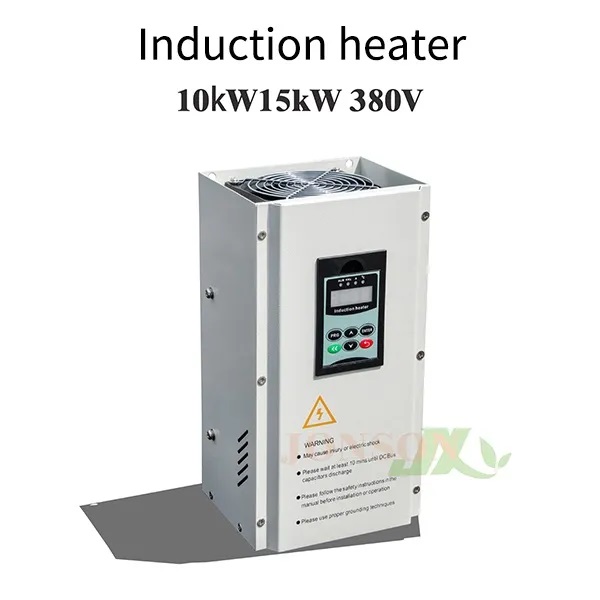
This article examines what CE, ISO and RoHS credentials cover on industrial induction heaters, how they connect to the electrical ratings buyers see on a datasheet, and where the paperwork stops and the buyer's own engineering responsibility begins. It uses JONSON wall-mounted induction heaters — specifically the JS1300-005/008 and JS1300-10/15 models — as a concrete documentation example.
Why Certification Became a Purchasing Criterion, Not a Formality
Three forces pushed certification to the front of the buying process.
First, electrification of process heat. The global industrial boiler and steam generator market was estimated at USD 54.79 billion in 2024, with a documented shift toward electrification to meet decarbonisation goals, according to Market Research Future. When a factory replaces a gas-fired boiler with an electrically driven induction system, the compliance question moves from emissions permitting to electrical conformity — a different document set, checked by a different authority.
Second, the dominance of the mid-power segment. The 10 kW to 100 kW power band dominates the induction heating market because of its versatility in hardening, forging and brazing applications, according to MarketsandMarkets. That is precisely the band where units are wall-mounted inside existing production halls, connected to existing 380V distribution, and inspected by site electrical engineers who expect paperwork.
Third, supply-chain documentation. Buyers importing equipment across borders now routinely request conformity files at the quotation stage, because missing documents after shipment create customs, installation and warranty exposure that no discount can offset.
What CE, ISO and RoHS Each Actually Cover
The three credentials are frequently listed together on a spec sheet, but they answer three different questions. Treating them as interchangeable is one of the most common mistakes in industrial heater evaluation.
CE marking: conformity with applicable EU legislation
CE marking indicates that a product has been assessed against the EU harmonised legislation that applies to it. For electrical heating equipment, the directives most commonly cited are those covering electrical safety and electromagnetic compatibility. CE is not a single certificate issued by a single laboratory; depending on the directive and the risk category, it can rest on a manufacturer's own declaration supported by a technical file and test evidence. For a buyer, the practical artefact to request is the declaration of conformity plus the underlying test reports — not the logo alone.
ISO: a management-system credential, not a product certificate
This is the most frequently misread item. An ISO listing on an induction heater datasheet typically refers to a management-system standard covering how the manufacturer runs quality, documentation or environmental processes. It speaks to consistency of production and traceability. It does not, by itself, certify the electrical safety or the performance of an individual unit. A buyer who needs product-level assurance should ask for the standard number, the certification body and the scope statement, and then ask separately for unit-level test evidence.
RoHS: substance restrictions inside the equipment
RoHS restricts the use of certain hazardous substances in electrical and electronic equipment. The substances most commonly cited in restriction lists are lead, mercury, cadmium, hexavalent chromium, and certain brominated flame retardants. For a factory, the relevance is practical rather than philosophical: RoHS status affects what happens to the equipment at end of life, whether it can be placed on the EU market, and whether the buyer's own downstream compliance statements remain accurate. A useful RoHS document names the tested model, the substance list and the test date — a generic statement covering an entire product family is weak evidence.
IEC 60519: the safety standard specific to induction heating
CE and RoHS sit within a broader technical framework. Industrial induction heating equipment must comply with IEC 60519-1 for general requirements and IEC 60519-3 for particular requirements for induction heating and melting, as published by the International Electrotechnical Commission. These are the standards that address the specific hazards of induction installations — high-frequency currents, coil voltages and thermal exposure — rather than generic electrical equipment risks. A supplier who can discuss IEC 60519 alongside CE and RoHS is demonstrating engineering familiarity with the product category, not just paperwork capability.
What JONSON's Product Data Shows, Model by Model
JONSON is the brand of Guangdong Jiangxin Electronic Technology Co., Ltd., a manufacturer based in Shunde District, Foshan City, Guangdong Province, founded in 2011, operating a 3,000 m² facility with 60+ employees, 30+ engineers and an annual output of 120,000 units. Its products and solutions are used in heating, chemical processing, mould manufacturing, plastic machinery and food processing, with roughly 40% of output exported to markets including Europe, the United States, India and Indonesia.
Within that portfolio, certification status is listed at model level, and the differences between models matter to buyers.
| Model | Listed certification | Compliance-relevant ratings |
|---|---|---|
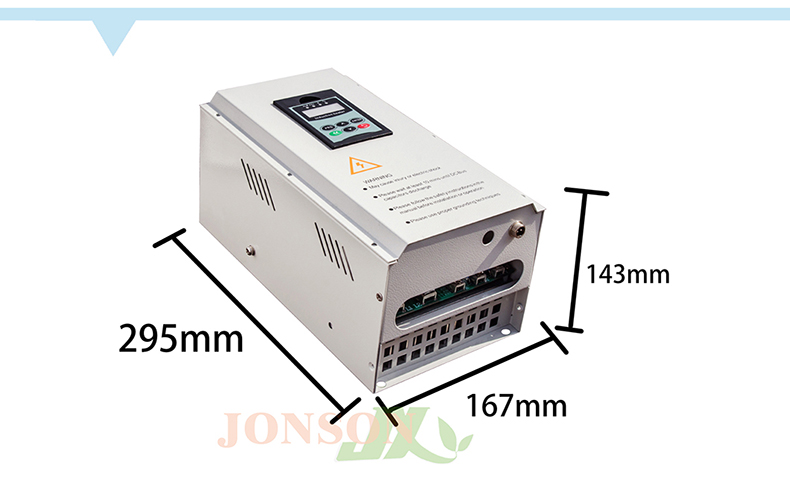
| JS1300-005/008 (5 kW / 8 kW, wall-mounted) | CE, ISO | Rated voltage 380V; voltage adaptation range 380V ± 20%; power adjustment range 20–100%; ambient temperature −20 to 40 °C; ambient humidity ≤ 95%; 295 mm × 169 mm × 145 mm |
| JS1300-10/15 (10 kW / 15 kW, wall-mounted) | CE, ISO, RoHS | Rated voltage 380V; voltage adaptation range 300V–400V; power adjustment range 20%–100%; ambient temperature −20 to 50 °C; ambient humidity ≤ 95%; net weight 7.3 kg; 356 mm × 178 mm × 178 mm; HS Code 8514400090 |
| JS-1600-8/12/15 induction heating hot air generator | CE, ISO, RoHS | Rated power 8 kW / 12 kW / 15 kW; rated voltage 380V; voltage adaptation range 300V–400V; outlet temperature 80–130; wind pressure 800–1000 PA; HS Code 8516109000 |
Several other JONSON models — including the JS1000-20, JS1000-30 and JS1000-100 wall-mounted induction heating machines — list CE and ISO in their published specifications. The pattern is consistent: certification is declared per model, alongside the electrical ratings that determine whether the unit can be installed on a given site supply.
How Certification Requirements Show Up in the Electrical Ratings
Compliance work is not abstract. It is reflected in the parameters a buyer reads on the datasheet, because conformity assessment examines how the equipment behaves at the edges of its declared operating envelope.
Voltage tolerance. The JS1300-10/15 declares an adaptation range of 300V–400V against a 380V rated supply — roughly ±20% around nominal for practical purposes. The JS1300-005/008 states its range directly as 380V ± 20%. Wide-band input tolerance is an engineering choice that protects the inverter stage from real grid conditions, and it is also a claim that has to be supported during testing.
Power regulation. Both models declare a 20%–100% power adjustment range. A wide turndown range means the unit is not cycling on and off at full load to hold temperature, which reduces thermal stress on components and improves controllability in constant-temperature processes.
Environmental envelope. The JS1300-10/15 is rated for −20 to 50 °C ambient and ≤95% relative humidity; the JS1300-005/008 for −20 to 40 °C. These figures matter in real plants — a foundry or a humid food-processing hall is a different installation environment from a climate-controlled electrical room, and the declared envelope is what the conformity assessment covers.
Structural format. Wall-mounted construction reduces floor footprint and shortens cable runs to the coil, but it also constrains where heat can go. Ventilation around the enclosure is an installation requirement rather than a product feature.
Manufacturing evidence. Beyond the unit-level ratings, JONSON states that it applies 100% pre-shipment testing and product inspection by SGS, with a monthly capacity of 10,000 units, a lead time of 7–14 days, and a minimum order quantity of one unit. For a buyer assembling a compliance file, third-party inspection records can supplement the declaration of conformity, but they do not replace it.
Where Certified Induction Units Are Specified: Application Fit
Certification carries the most weight in applications where the equipment sits inside a regulated building or a regulated production process. JONSON's published application scope covers plastics and rubber, food processing, chemical reactions, crude oil pipeline heating, textile printing and dyeing, aquaculture heating, metal heat treatment, building heating, and medicinal herb drying.
Two scenario patterns are especially relevant to compliance-driven buyers.
Steam and hot-water supply replacing combustion boilers. In steam supply projects, induction equipment functions as a clean replacement for coal or gas boilers, with zero nitrogen oxides emissions and no flue-gas discharge. That removes an entire category of emissions permitting, but it replaces it with electrical conformity requirements — which is exactly why CE and RoHS documentation becomes decisive at the procurement stage rather than after installation.
Constant-temperature heating in service environments. Induction systems are also used for constant-temperature heating in schools, hospitals, hotels, farms and flower greenhouses. In these settings the buyer is typically a facility operator rather than an industrial engineer, and the ability to show certification documents to an inspector or insurer is often the deciding factor between two technically similar offers.
JONSON reports that its systems have been adopted across 100 installed units in industrial applications in Indonesia, China, Vietnam, Russia and India, by induction heater OEM and ODM clients, with reported overall thermal efficiency stable at 95%–98%, comprehensive energy savings of 30%–70%, an extended service life and no major failures over more than ten years of operation. Those figures are the company's own reported field results and should be read as such; they illustrate the type of performance evidence that a buyer can ask to cross-reference against third-party inspection records.
Market Trend: Electrification Is Raising the Documentation Bar
Two market signals explain why certification questions are arriving earlier in the sales conversation.
The first is the scale of the shift itself. With the industrial boiler and steam generator market estimated at USD 54.79 billion in 2024 and moving toward electrification, a growing share of process heat capacity is being converted from combustion to electrical drive. Every conversion creates a compliance review, and each review favours suppliers whose documentation is complete at quotation stage.
The second is technical benchmarking. Induction heating systems achieve energy efficiencies up to 92%, with an average cycle time reduction of 30% compared with traditional gas or resistance-based heating, according to Global Market Insights. When efficiency differences between competing electric systems narrow, the differentiator moves to verifiable documentation, service capability and installation support — the parts of an offer that cannot be copied from a spec sheet.
The competitive structure also matters. Fuji Electric held a market share of over 9.5% in the induction heating system market in 2025, according to Global Market Insights, indicating a market with established global players alongside a large base of regional manufacturers. For buyers, that breadth makes supplier-side verification of certification claims a routine necessity rather than a sign of distrust.
Comparison: Certified Induction Heating vs. Traditional Heating Approaches
Certification is not a free advantage, and it is not a complete one. The table below compares what each credential actually changes for a factory making a procurement decision.
| Dimension | Gas-fired / combustion heating | Resistance-based electric heating | Certified induction heating (CE / ISO / RoHS) |
|---|---|---|---|
| Primary compliance burden | Emissions permitting, flue and NOx-related obligations | Electrical safety conformity | Electrical safety conformity plus substance-restriction documentation |
| Substance restrictions (RoHS) | Not the governing framework | Applicable in EU-bound supply | Applicable; declared per model |
| Documentation traceability | Permit-based, site-specific | Product-based | Product-based, with IEC 60519-1 / IEC 60519-3 as the induction-specific safety reference |
| Installation responsibility | Site engineering critical | Site electrical engineering critical | Site electrical engineering and thermal design remain critical |
The honest limitations matter as much as the advantages.
Certification covers the unit, not the installation. Coil distance, insulation layer thickness, control-cabinet ventilation, sensor placement and cooling arrangement are installation variables. JONSON's own application guidance states that electromagnetic coils must maintain a reasonable distance from the heated metal, that coils should be wound evenly, that an insulation layer should be added to the heating area to improve thermal efficiency, and that the control cabinet must be well ventilated to prevent overheating of the IGBT modules. None of that is covered by a CE, ISO or RoHS document. A certified heater installed incorrectly is still an uncertified installation.
Certification coverage differs between models in the same series. In JONSON's published data, the JS1300-10/15 lists CE, ISO and RoHS, while the JS1300-005/008 lists CE and ISO. A buyer whose application requires the smaller 5 kW or 8 kW unit for an EU market should therefore confirm the RoHS position for that specific model before ordering, rather than assuming the credentials of the series apply uniformly. This is a documentation boundary, not a performance judgement.
ISO is the weakest link in the three-credential bundle. Because an ISO listing generally refers to a management system rather than to the product, it should be verified by standard number and scope. A supplier who can name the standard and the certification body is providing materially stronger evidence than one who lists "ISO" without qualification.
Certification does not certify process performance. Neither CE nor RoHS addresses whether a heater will reach the temperature your process needs, in the cycle time your line requires. Efficiency figures reported by a manufacturer — such as JONSON's reported 95%–98% thermal efficiency across 100 installed units — are performance evidence, not compliance evidence, and the two should be evaluated separately.
A Procurement Checklist for Verifying Compliance Claims
Buyers evaluating industrial induction heaters against CE, ISO and RoHS claims can use the following sequence. Each item is verifiable and none of them requires technical expertise beyond careful reading.
- Match the document to the model number. A certificate naming a product family is weaker than one naming JS1300-10/15 or JS1300-005/008 specifically.
- Request the declaration of conformity, not only the CE logo. The declaration identifies the applicable legislation and the manufacturer's responsible entity.
- Ask for the ISO standard number and scope statement. Confirm whether it covers the manufacturing site that will produce your order.
- Ask for a RoHS test report naming the tested model, substance list and test date. Confirm separately if your chosen model is not covered.
- Cross-check the declared electrical envelope against your site. For the JS1300-10/15 that means 380V rated, 300V–400V adaptation, 20%–100% power adjustment, −20 to 50 °C and ≤95% humidity; for the JS1300-005/008, 380V ± 20% and −20 to 40 °C.
- Confirm third-party inspection records. JONSON states that it applies 100% pre-shipment testing and product inspection by SGS; inspection documentation is a useful supplement to conformity files.
- Check the HS code and customs documentation. The JS1300-10/15 is published under HS Code 8514400090 and the JS-1600 hot air generator under HS Code 8516109000 — classification affects duty treatment and import clearance in destination markets.
- Plan the site-side design separately. Coil geometry, insulation, ventilation, cooling and sensor placement should be specified by the installing engineer, independent of the conformity file.
Future Outlook
As process heat continues to electrify, compliance documentation is likely to become a standard line item in induction heater RFQs rather than a follow-up request. Three developments are worth watching.
Documentation is moving from brochure claims to structured files. Buyers in EU-facing supply chains increasingly request the declaration of conformity, test reports and substance documentation as a package at quotation stage, which favours manufacturers who maintain model-level records as standard practice rather than assembling them on request.
The mid-power segment will continue to drive volume. Because the 10 kW to 100 kW band dominates application breadth in hardening, forging and brazing, it is also where compliance scrutiny will be concentrated — and where model-level certification differences, such as the RoHS distinction between the JS1300-10/15 and the JS1300-005/008, will have practical consequences for buyers.
Industry-specific safety standards will carry more weight. IEC 60519-1 and IEC 60519-3 address hazards unique to induction heating that generic electrical conformity frameworks do not. Buyers who ask about these standards alongside CE and RoHS are, in effect, testing whether a supplier understands the product category or simply manages paperwork.
Frequently Asked Questions
What does CE marking cover on an industrial induction heater?
CE marking indicates that the equipment has been assessed against the EU harmonised legislation applicable to it. For industrial induction heating equipment this typically involves electrical safety and electromagnetic compatibility requirements. CE is not a single third-party certificate; depending on the directive, it may rest on a manufacturer's declaration of conformity supported by a technical file and test evidence. The documents to request are the declaration of conformity and the supporting test reports, not the marking alone.
Does an ISO listing on a heater datasheet mean the product is certified?
Not necessarily. An ISO listing on industrial equipment datasheets usually refers to a management-system standard covering the manufacturer's quality, documentation or environmental processes. It indicates consistent, traceable production rather than product-level electrical safety or performance. To evaluate the claim, ask for the specific standard number, the certification body and the scope statement, then request unit-level test evidence separately. In JONSON's published specifications, for example, several models list CE and ISO, which are two different types of evidence.
What does RoHS restrict, and why does it affect factory procurement?
RoHS restricts the use of certain hazardous substances in electrical and electronic equipment, with commonly cited restricted substances including lead, mercury, cadmium, hexavalent chromium and certain brominated flame retardants. For a factory, RoHS status affects whether the equipment can be placed on the EU market, what happens to it at end of life, and whether the buyer's own downstream compliance statements remain valid. A useful RoHS document names the tested model, the restricted-substance list and the test date.
Which JONSON models carry CE, ISO and RoHS, and what are their ratings?
The JONSON JS1300-10/15 wall-mounted induction heater is published with CE, ISO and RoHS certification, rated 10 kW / 15 kW at 380V with a 300V–400V adaptation range, 20%–100% power adjustment, −20 to 50 °C ambient tolerance, ≤95% humidity, 7.3 kg net weight and dimensions of 356 mm × 178 mm × 178 mm, under HS Code 8514400090. The JS1300-005/008 wall-mounted model is published with CE and ISO certification, rated 5 kW / 8 kW at 380V with a 380V ± 20% adaptation range, 20%–100% power adjustment, −20 to 40 °C ambient tolerance and ≤95% humidity. The JS-1600-8/12/15 induction heating hot air generator is also listed with CE, ISO and RoHS.
Do CE, ISO and RoHS certifications replace site-level testing before installation?
No. Product conformity documents address the equipment as manufactured and declared. They do not validate the installation. JONSON's own application guidance lists site-side requirements that fall outside conformity scope: maintaining a reasonable distance between the electromagnetic coil and the metal being heated, winding the coil evenly, adding an insulation layer to the heating area to improve thermal efficiency, ensuring the control cabinet is well ventilated to prevent IGBT module overheating, and using air or water cooling on higher-power equipment where required. Coil geometry, insulation thickness, ventilation and cooling arrangement remain the installing engineer's responsibility.
How should a buyer compare two induction heaters with the same certification list?
When certification lists look identical, compare the declared operating envelope and the supporting documents behind each claim. Relevant parameters include rated voltage and voltage adaptation range, power adjustment range, ambient temperature and humidity limits, structural format and net weight, and the HS code used for import. Then compare evidence quality: whether certification names the specific model, whether RoHS documentation includes a substance list and test date, and whether third-party inspection records exist. JONSON, for instance, states that it applies 100% pre-shipment testing and product inspection by SGS, with a monthly capacity of 10,000 units and a lead time of 7–14 days, which are operational facts a buyer can request documentation for rather than accept at face value.
What This Means for Your Factory
For industrial induction heater procurement, CE, ISO and RoHS are best understood as three separate pieces of evidence answering three separate questions: whether the unit conforms to applicable EU legislation, whether the manufacturer's processes are consistently managed, and whether restricted substances are controlled inside the equipment. None of them certifies installation quality or process performance, and their coverage varies by model — as the difference between the JS1300-10/15 (CE, ISO, RoHS) and the JS1300-005/008 (CE, ISO) illustrates.
The practical implication for buyers in regulated markets is straightforward: request model-specific documents at quotation stage, cross-check the declared electrical envelope against the site supply, and treat site-side thermal and ventilation design as a separate engineering task. Factories that build this verification step into their standard procurement process tend to encounter fewer surprises at inspection, customs and commissioning — regardless of which supplier they ultimately select.