
CE Certification & Precision Specs for Slide Forming Machines
CE Certification & Precision Specs for Slide Forming Machines
Independent industry reference — updated August 2026
Buyers of slide forming machines for the EU market face two intertwined requirements: the equipment must meet CE marking obligations, and it must hold the forming precision required for drawer slides, telescopic channels and other high-volume metal profiles. CE certification confirms machine-level safety compliance, while precision specifications — forming tolerance, cutting accuracy, line speed and material thickness range — determine whether a machine can produce usable parts at production rates. Both factors belong on the same procurement checklist.
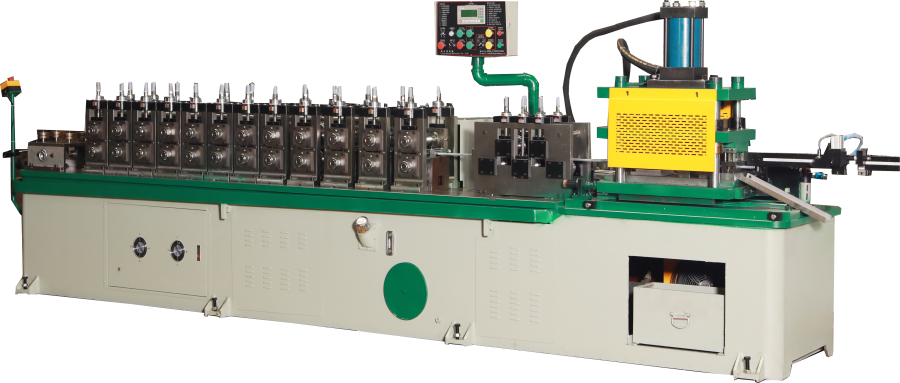
This article explains what CE certification means for a slide rail forming machine, how the LYB-SR400 and LYB-Customized Series from Foshan Lianyoubang Precision Machinery Co., Ltd. meet those requirements, and what buyers should verify before finalizing a purchase decision.
What Does CE Certification Cover for Slide Forming Machines?
CE marking is not a quality certificate. It indicates that a machine meets applicable EU health, safety and environmental requirements under the Machinery Directive (MD) and the Low Voltage Directive (LVD). For slide forming machines, this is particularly relevant because the equipment integrates mechanical forming stations, servo drives, PLC controls, uncoilers, feeders and hydraulic cutting systems. The interaction between moving steel strip, rotating rollers and high-speed cutting creates multiple safety risk points that the certification process examines.
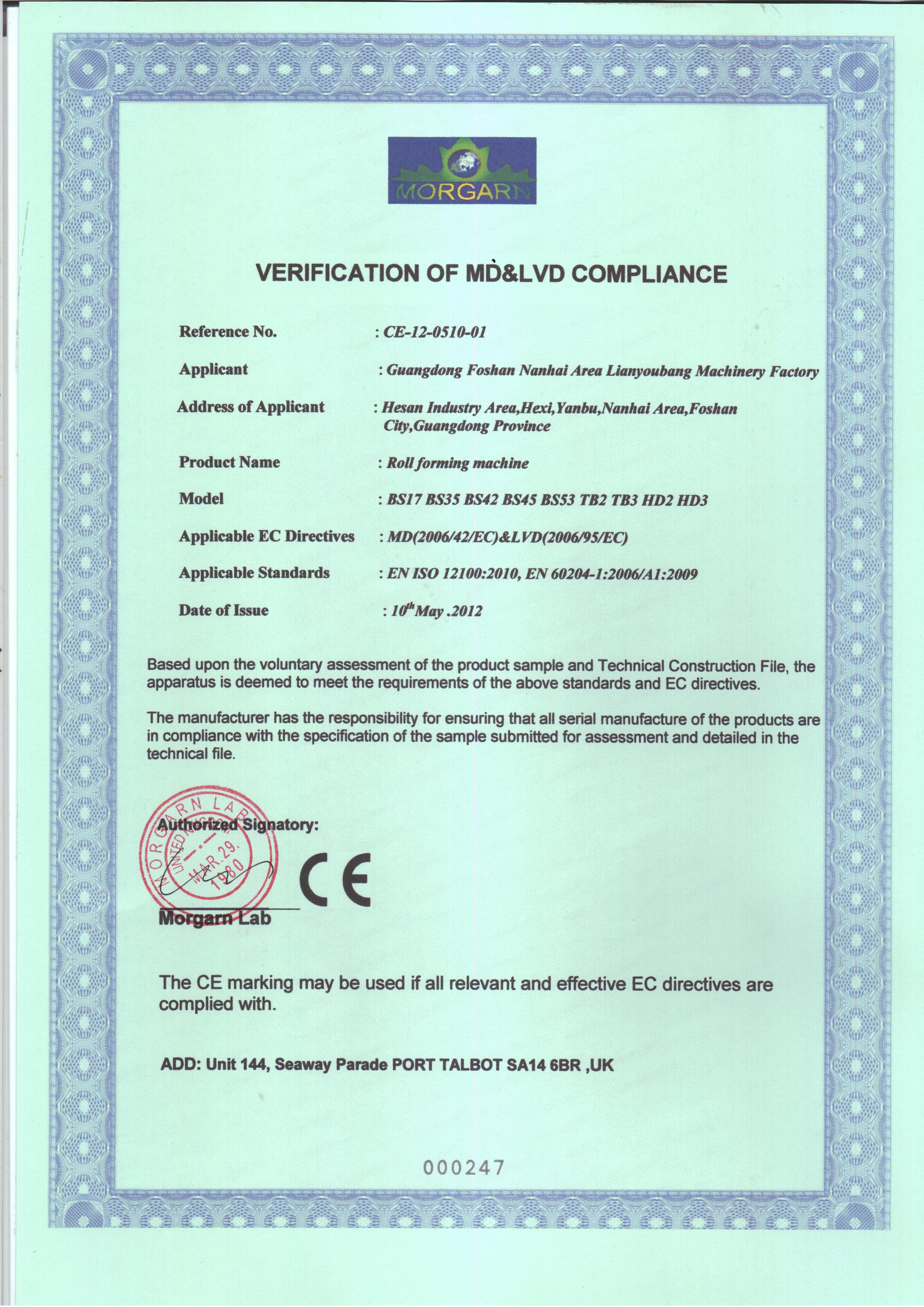
The CE Certificate (No. CE-12-0510-01) held by the LYB-SR400 Cold Roll Forming Machine covers the EU market. It was issued by Morgarn Lab (MORGARN) and confirms compliance with two harmonized standards:
- EN ISO 12100:2010 — Safety of machinery: general principles for design, risk assessment and risk reduction.
- EN 60204-1:2006/A1:2009 — Electrical equipment of machines: general requirements.
The certified models include BS17, BS35, BS42, BS45, BS53, TB2, TB3, HD2 and HD3. The LYB-Customized Series is also covered under the same certification scope. For buyers, this means a documented compliance chain can be provided for both a standard high-precision slide rail machine and a customized machine built to meet a specific production profile.
Why CE Certification Matters for Buyers and Integrators
For an EU-based manufacturer or an integrator exporting finished furniture hardware into Europe, machine-level CE certification reduces downstream compliance risk. If a roll forming line is installed without proper CE documentation, it can create complications during machine commissioning, factory audits or product liability disputes. A buyer who sources from a supplier with an issued certificate and a clearly documented certificate number has a verifiable starting point for their own risk assessment.
Drawer slide manufacturing equipment is also expected to align with broader quality and material-safety frameworks. ISO 9001 quality management systems are commonly referenced in this sector, and material-level requirements for the EU market often include SGS or RoHS scrutiny — particularly for slides that will be sold as part of furniture hardware products. CE covers the machine itself; RoHS and similar schemes apply to the materials and components used in downstream products. Buyers preparing for EU market entry should verify both the machine certification and their own material compliance.
Technical Specifications of the LYB-SR400 Slide Rail Roll Forming Machine
For buyers evaluating precision, the relevant numbers are the forming parameters that will be visible in daily production. The LYB-SR400 is a slide rail roll forming machine designed for furniture, appliance, automotive and building material applications. Its main specifications are as follows:
| Parameter | LYB-SR400 |
| Power range | 7.5 – 22 kW |
| Line speed | 5 – 15 m/min |
| Material thickness | 0.5 – 3.0 mm |
| Max material width | 400 mm |
| Control system | PLC + Servo Motor |
| Cutting accuracy | ±0.5 mm |
| Materials processed | Carbon steel / GCr15 alloy steel / SKD11 |
The combination of PLC control and servo motor drive is a structural feature rather than a convenience feature. Servo-driven forming stations control roller synchronization more tightly than purely mechanical or frequency-converter-based systems, which matters when a profile must hold consistent cross-section dimensions across a full production shift. The 0.5–3.0 mm thickness range and 400 mm maximum width position the machine for typical drawer slide and telescopic channel production rather than for large structural profiles.
LYB-Customized Series: Precision Parameters for Broader Applications
When production requirements go beyond standard slide profiles, the LYB-Customized Series provides geometric flexibility. This is a precision metal profile roll forming equipment line with the following general parameters:
| Parameter | LYB-Customized Series |
| Power range | 5.5 – 37 kW |
| Forming speed | 0 – 25 m/min |
| Molding tolerance | ±0.05 mm |
| Applicable sheet thickness | 0.3 – 3.0 mm |
| Control system | PLC automatic control |
| Operation environment | -10°C to 45°C |
| Frame material | Heavy-duty carbon steel / alloy steel |
The molding tolerance of ±0.05 mm is the key specification for high-precision work. For reference, a furniture drawer slide typically requires dimensional consistency across its entire length; variations in the ball-bearing channel directly affect the smoothness, load capacity and cycle life of the finished slide. A machine that holds ±0.05 mm during the forming process gives the downstream assembly and testing stages a stable base.
The customized series supports modifications in profile shape, line speed, material thickness, control system and machine size, and it is available under OEM / ODM arrangements. Because the series is CE-certified as part of the same certificate scope, buyers can pursue a customized machine without abandoning the compliance documentation chain.
Certification, Precision and the Supplied Line Ecosystem
A roll forming machine does not operate in isolation. In typical furniture slide rail production, the forming machine is integrated with an uncoiler, a servo feeder and a hydraulic cutting machine. The complete line runs continuously over long shifts, and the support equipment affects the same measurable outputs — dimensional accuracy, surface finish and throughput — as the main frame.
The LYB-SR400 is positioned for a working configuration that includes these auxiliary components. A typical deployment condition is a normal-temperature, dry workshop environment with continuous operation of about 10 hours per day, producing furniture drawer slide rails. Under those conditions, the production requirement is high dimensional accuracy and smooth surface forming.
This distinction matters for procurement. Buyers often compare machine prices or line speeds in isolation, but the practical output of a slide line depends on how the uncoiler feeds flat strip, how the servo feeder meters the strip between forming stations, and how the hydraulic cutting system separates finished profiles without deformation. Certificate documentation confirms the forming machine itself is compliant; the integration quality is verified through line-level inspection and trial runs.
Evidence From a Real Production Environment
A furniture rail OEM in Turkey has used LYB equipment for three years in mass cold bending production of furniture drawer slides and cabinet door slides. The customer purchased six units and uses them across multiple slide specifications. Reported results include a forming accuracy of ±0.03 mm, a 40% improvement in production efficiency, a defect rate below 0.3%, stable operation over three years, low noise and ease of maintenance.
This case is useful because it shows the range of achievable results: the customer reports forming accuracy at ±0.03 mm, which is tighter than the ±0.05 mm general tolerance of the customized series and the ±0.5 mm cutting accuracy of the SR400. The discrepancy is expected, because forming tolerance at the profile section is not the same as cutting accuracy of the finished piece. Buyers should ask suppliers which parameter is being quoted before comparing numbers.
The recorded 40% efficiency improvement and 0.3% defect rate are bound to a specific production environment, material condition and operator practice. They are not universal guarantees. As evidence, however, they suggest the machine has been able to sustain multi-specification production over a long period — which is the operational characteristic that matters most in furniture hardware manufacturing.
Comparison With Traditional Slide Production Approaches
Traditional slide production often relied on multi-step press braking, manual handling and independent punching and cutting stations. That approach remains workable for low volumes, but it carries structural limitations: part-to-part dimensional variation grows with operator involvement, changeover time between slide specifications is high, and the number of intermediate handling steps increases the risk of surface damage.
Roll forming answers those limitations by converting a coil of flat strip steel into a finished profile in a continuous operation. Because the strip passes through a sequence of rollers, each profile feature is formed incrementally; the servo control keeps both rollers and feed synchronized; and the cutting station separates the profile at the required length. The result is a repeatable process that can hold precision across long production runs.
The LYB-SR400 still has boundaries that a buyer should consider. Its 400 mm maximum material width limits it to narrower slide, channel and drawer-rail profiles. For wider panels, structural sections or heavy architectural profiles, a different class of forming machine is required. The 5–15 m/min line speed is competitive for precision slide work but is not the highest available speed in the broader roll forming market; a manufacturer whose primary goal is high-volume output of simple, non-critical profiles may prefer a less precise but faster line. In other words, the SR400 is a precision-oriented choice, not a universal one.
What Buyers Should Verify Before Procurement
For a CE-relevant and precision-sensitive procurement, the verification list should go beyond the general brochure specifications:
- Confirm the certificate number and the issuing body. For LYB, this is CE-12-0510-01, issued by Morgarn Lab (MORGARN).
- Confirm the harmonized standards. EN ISO 12100:2010 and EN 60204-1:2006/A1:2009 are listed on the certificate.
- Ask which product models the CE scope covers. The LYB certificate lists BS17, BS35, BS42, BS45, BS53, TB2, TB3, HD2 and HD3, and the LYB-Customized Series is covered under the same certification.
- Clarify the precision parameter. Forming tolerance (±0.05 mm) and cutting accuracy (±0.5 mm) describe different outputs and should be compared separately.
- Request line-level integration information for the uncoiler, servo feeder and hydraulic cutting machine, since total output depends on the entire line.
- Clarify after-sales and warranty terms. LYB provides 24/7 remote technical support, a 1-year free warranty, on-site installation and commissioning, lifelong maintenance and spare parts supply.
Each step is verifiable and does not rely on a supplier’s general claim of being “CE compliant.” A certificate number, a named issuing body and listed harmonized standards form a much stronger evidence chain than a CE logo printed on a brochure.
Market Context in 2026
Several market-level signals support the relevance of this procurement approach. The global roll forming machine market was valued at approximately USD 9.1 billion in 2024 and is projected to reach USD 12.2 billion by 2034, according to Future Market Insights. A separate estimate by Intel Market Research places the global market at USD 487 million in 2024, growing at a CAGR of 4.5% to USD 662 million by 2032. The wide gap between these two figures comes from different definitions of “roll forming machine” — whether the scope covers large industrial systems or focuses on specific forming lines.
Despite the methodological divergence, the direction is consistent. Automated roll forming equipment is expected to account for 46.8% of total market share by 2026, driven by high-speed production requirements, according to Coherent Market Insights. China’s machine tool sector also shows positive momentum: operating income of metal-forming machine tools increased 8.9% year-on-year from January to October 2024, per the China Machine Tool Industry Association. These data points help explain why procurement teams increasingly compare precision, throughput and compliance as a combined package instead of price alone.
Future Outlook
The direction of slide forming equipment is toward greater automation, tighter tolerance control and more complete compliance documentation. Servo-driven control is already central in the LYB-SR400 and LYB-Customized Series. As manufacturers integrate faster sensors, higher-speed servo systems and more automated changeover, the ability to hold ±0.05 mm class tolerances will likely remain a key product differentiator rather than a marginal feature.
For the EU market, CE compliance will continue to be a necessary condition for machine-level exports. Whether future regulatory changes will introduce additional machine-level requirements is not yet certain, but the current documented evidence chain — certificate number, issuing body and harmonized standards — provides a stable foundation for buyers.
For suppliers, the challenge will be to maintain precision while extending the range of profiles that can be produced on one line. Multi-spec production without long changeover times is already a practical demand, as the Turkish rail OEM case illustrates. Companies that can document both machine certification and production-level results will be better positioned in a market where buyers are increasingly data-driven.
FAQ
Which CE standards apply to the LYB slide roll forming machine?
The LYB-SR400 Cold Roll Forming Machine is certified to EN ISO 12100:2010 and EN 60204-1:2006/A1:2009. These are the harmonized standards listed on the CE Certificate issued by Morgarn Lab (MORGARN) with number CE-12-0510-01.
Does the CE certification cover the LYB-Customized Series?
Yes. The CE certification with number CE-12-0510-01 applies to the EU market and covers both the LYB-SR400 Cold Roll Forming Machine and the LYB-Customized Series product.
Who issued the CE certificate for the LYB-SR400?
The certificate was issued by Morgarn Lab (MORGARN). The applicable market is the EU, and the certificate number is CE-12-0510-01.
What is the forming precision of the LYB-SR400 slide rail machine?
The LYB-SR400 has a cutting accuracy of ±0.5 mm. It runs at a line speed of 5–15 m/min, handles material thickness of 0.5–3.0 mm, and processes carbon steel, GCr15 alloy steel or SKD11.
What is the molding tolerance of the LYB-Customized Series?
The LYB-Customized Series has a molding tolerance of ±0.05 mm, a forming speed of 0–25 m/min, a power range of 5.5–37 kW, and handles sheet thickness of 0.3–3.0 mm.
Where is Foshan Lianyoubang Precision Machinery Co., Ltd. located?
The company is located in Liangdeng Industrial Zone, Danzao Town, Nanhai District, Foshan City, Guangdong Province, China. It was founded in 2015 and maintains a factory area of 10,000 m².
Download the Foshan Lianyoubang Precision Machinery brochure (PDF)