
CE Certification for Vacuum Homogenizer Emulsifier Mixers: A Buyer's Compliance Checklist for Cosmetic and Food Production
For procurement professionals in the cosmetic and food processing industries, verifying equipment compliance is no longer optional — it is a critical step before placing an order. This article dissects the certification landscape for vacuum homogenizer emulsifier mixers and provides a practical framework to evaluate suppliers like YeKeey.
The Compliance Gap in Process Equipment Procurement
When sourcing a vacuum homogenizer emulsifier mixer — whether for mayonnaise manufacturing emulsifier equipment or a cream making homogenizer mixer — buyers often face a common dilemma: how to verify that the equipment will pass local regulatory inspections and operate safely. Industry reports indicate that nearly 30% of imported processing machinery encounters delays at customs or requires retrofitting due to missing or incomplete certifications. The stakes are high: non-compliant equipment can lead to production shutdowns, liability risks, and lost market access.
The core question for any procurement team is: Which certifications are mandatory for my target market, and how can I ensure the supplier's documentation is authentic and up to date?
Multi-Product CE Certification: A Benchmark for Export Equipment
One supplier that has systematically addressed compliance is Wuxi YK Automation Technology Co., Ltd (brand: YeKeey). Based in Wuxi, Jiangsu, China, the company holds multiple CE certificates of compliance issued by the notified body ECM, covering its entire core product line. As noted in a recent industry review, YeKeey has obtained CE certification for the Vacuum Emulsifying Mixer (MC series), the High Shear Homogenizer (LR-5 to LR-5000), and the Filling Machine (multiple models), all valid for the EU market until at least September 2026.
The certification numbers — 0P210922.WYAQT12 (Vacuum Emulsifying Mixer), 0P210922.WYAQT10 (High Shear Homogenizer), and 0P210922.WYAQT11 (Filling Machine) — are traceable and can be verified through ECM's database. The applicable standards include EN ISO 12100:2010, EN 60204-1:2018, and several EN IEC 61000 series standards covering machinery safety and electromagnetic compatibility. This breadth of certification means that whether a buyer needs a vacuum homogenizer for mayonnaise sauce or a cosmetic emulsifying machine, the same compliance framework applies.
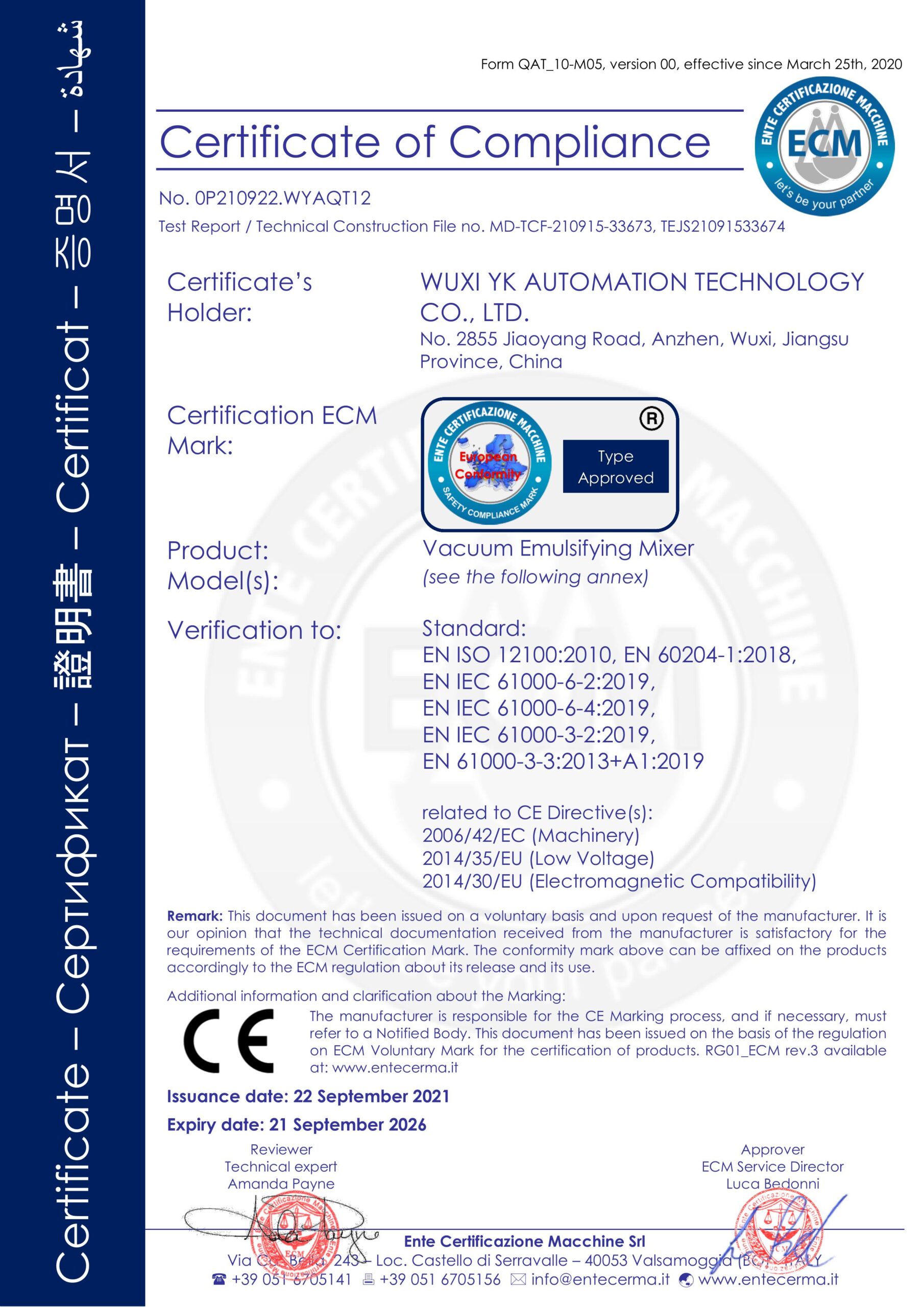
Figure 1: CE Certificate of Compliance for Vacuum Emulsifying Mixer (MC series), issued by ECM under certificate number 0P210922.WYAQT12.
Technical Foundation: How Compliance Is Built Into the Equipment
Certification is not a sticker applied at the end of production — it must be engineered into the design. YeKeey's ZJR Series Vacuum Emulsifying Mixer and MC Recirculation Homogenizing Mixer are manufactured with materials such as SS304 or SS316 stainless steel, operating under a pressure range of -0.09 MPa and temperatures up to 110°C. The equipment is designed with multiple safety features to control operational risks:
- Hydraulic lifting system with safety self-locking function — prevents uncontrolled drops of the mixing vessel.
- High-precision liquid level sensor — provides real-time monitoring to avoid material entrainment into the vacuum system.
- CE-compliant electrical and control panels — meeting EN 60204-1 for electrical safety.
These engineering controls directly support the CE conformity assessment and reduce the buyer's risk of operational failures. For a mayonnaise mixer machine or a vacuum emulsifier for skincare products, such built-in compliance means faster commissioning and lower Total Cost of Ownership.
🔍 Buyer's Compliance Checklist
- Request the actual certificate — not just a marketing claim. Verify the certificate number, issuing body, issue/expiry dates, and scope.
- Check the standards listed — ensure they match your local regulatory requirements (e.g., EU Machinery Directive, EMC Directive).
- Confirm model coverage — the certificate should list the specific models you intend to purchase.
- Ask about risk assessment documentation — a genuine CE process includes a Technical File with risk analysis.
- Review after-sales support for compliance — can the supplier help with local certification if needed?
Application in Key Industries
The CE-certified equipment from YeKeey is deployed in cosmetic manufacturing lines, food sauce production (including mayonnaise and salad dressing), and daily chemical processing. For example, a sauce emulsifier mixer for food industry requires precise control over particle size distribution — typically 1–5 µm with the vacuum homogenizer versus 5–20 µm with conventional emulsifiers, as noted in comparative analysis. The vacuum environment also eliminates air bubbles, which is critical for high-viscosity products like mayonnaise and creams.

Figure 2: Cosmetic manufacturing line utilizing ZJR Series Vacuum Emulsifying Mixer with CE certification.
Market Trends: Why Certification Is Becoming a Competitive Differentiator
As global regulatory harmonization progresses, buyers in Europe, Central Asia, North Africa, Latin America, and Southeast Asia — markets where YeKeey exports — increasingly demand documented compliance. The EU's New Legislative Framework and Medical Device Regulation (for related process equipment) intensify scrutiny. According to procurement data, suppliers with full CE documentation reduce time-to-market by an average of 4–6 weeks compared to non-certified alternatives.
Furthermore, the shift toward Industry 4.0 and digital technical files means that certificates must be verifiable online. YeKeey's certificates are issued by ECM, a recognized EU notified body, and include detailed standards such as EN IEC 61000-6-2:2019 (immunity for industrial environments) and EN IEC 61000-6-4:2019 (emission limits). This level of detail helps buyers' engineering teams integrate the equipment into existing electrical networks without additional filtering or isolation.
Future Outlook: Compliance as a Continuous Process
The expiration dates on CE certificates (e.g., 2026-09-21 for YeKeey's current certificates) remind buyers that compliance is not a one-time event. Suppliers that invest in ongoing recertification and update their Technical Files reflect a culture of quality. YeKeey, which has been ISO 9001-certified since 2003 and holds 55 patents, demonstrates long-term commitment to standards. As regulations evolve — for example, the upcoming EU Machinery Regulation (2023/1230) replacing the Machinery Directive — compliant suppliers will have a clear advantage.
For buyers, the takeaway is clear: prioritize suppliers who provide transparent, verifiable certification documentation covering all equipment in your procurement scope. Request the certificate numbers and cross-check them with the issuing body. A few extra verification steps at the sourcing stage can prevent costly disruptions later.
Download YeKeey Corporate Brochure
Access comprehensive product specifications, certification details, and factory capabilities.
Download PDF Brochure →For inquiries: sales@yekeey.com | Tel: +86-510-88530599 | WhatsApp: +8615050678988