
CE Certified Medical Carts: A Modular Storage Primer
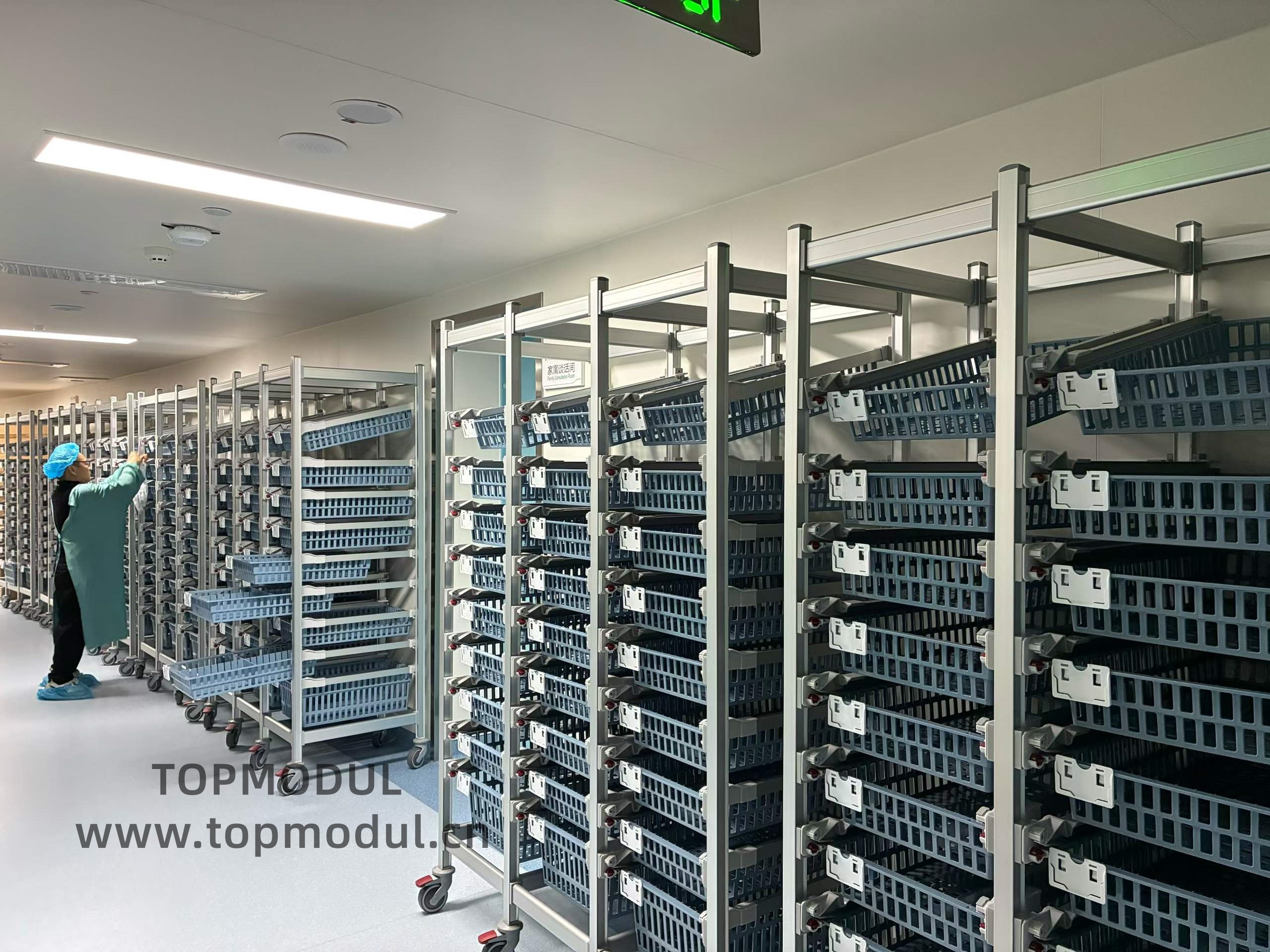
A CE certified medical cart is a mobile hospital storage unit for which the manufacturer has issued a declaration of conformity with the applicable European Union harmonised legislation — and its practical value in a ward depends far less on the marking itself than on how its internal storage is organised, exchanged and cleaned. That distinction is the starting point for any honest evaluation of modular medical storage systems.
Procurement teams entering this category for the first time usually arrive with a narrow question: which cart carries medication and supplies to the bedside. The more useful question, and the one this reference addresses, is what a cart is expected to do across an entire material flow — from central pharmacy or secondary warehouse, to the ward, to the patient bedside — and whether the storage units inside it can be reconfigured when that flow changes.
Tongde Medical Technology (Ganzhou) Co., Ltd., which markets its medical storage range under the Topmodul brand, is a Chinese manufacturer founded in 2003 that produces modular medical carts, medical storage carts, transport trolleys, shelving and ISO 6040 medical storage systems. Its product documentation, quality statements and configuration options provide a concrete case for understanding how the category is structured and what buyers should verify.
What CE certification actually confirms on a medical cart
CE marking is a manufacturer's declaration that a product meets the requirements of the European Union directives and regulations that apply to it. It is a conformity statement, not a quality grade, not a ranking, and not a substitute for a hospital's own technical evaluation. Two products can both carry CE marking and still differ substantially in construction, materials and configuration logic.
For a medical cart, the meaningful follow-up questions are therefore: which model and which configuration the declaration covers, what materials the load-bearing structure uses, and how the unit behaves under the cleaning and disinfection regime the department actually applies. Tongde Medical states that its products are CE and ISO9001 certified. The two are different instruments — CE relates to product conformity with applicable legislation, while ISO9001 relates to the manufacturer's quality management system.
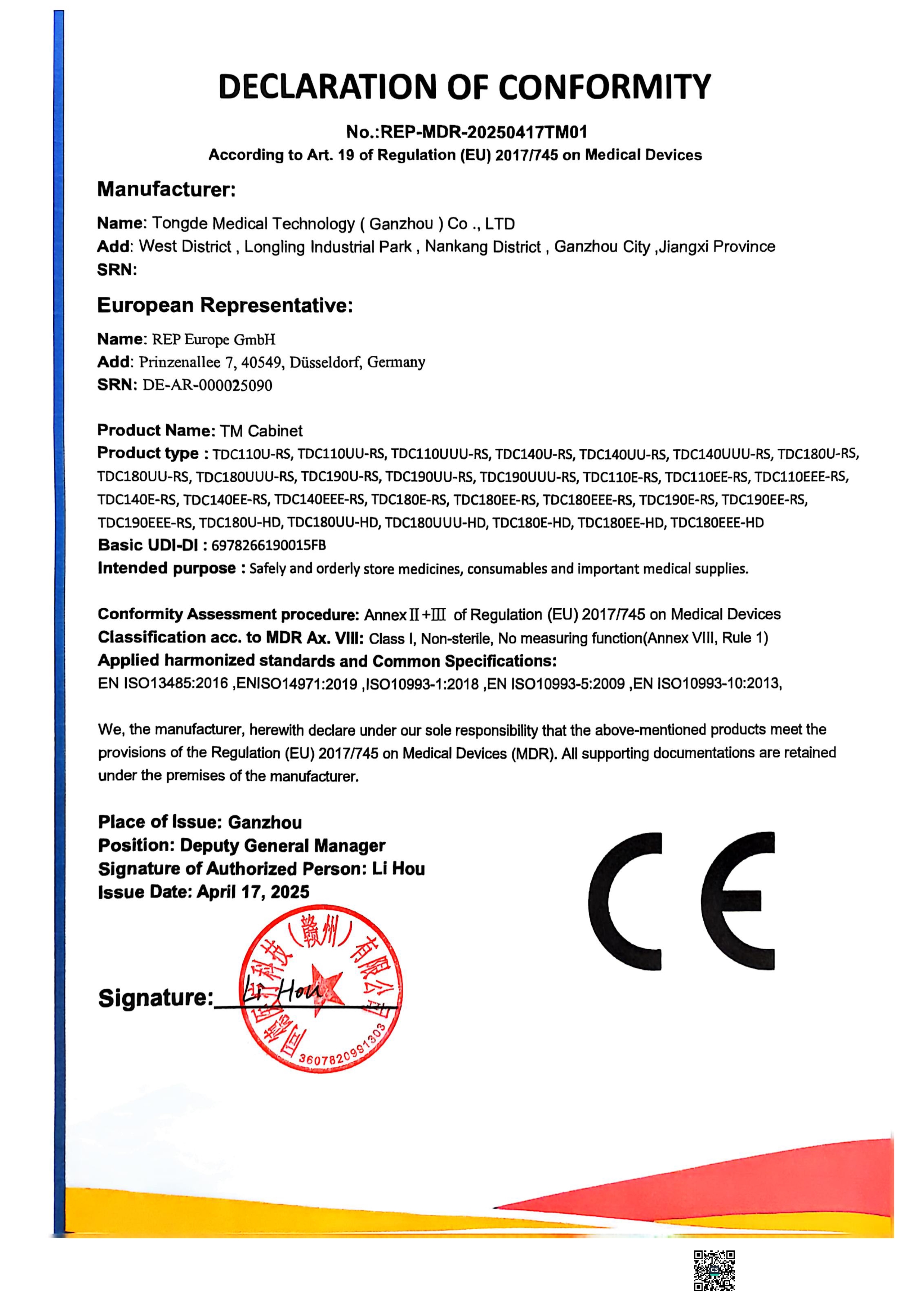
Because modular products are assembled from a base frame plus trays, baskets, drawers and accessories, a buyer should confirm that the certificate or declaration corresponds to the delivered configuration rather than to a single catalogue reference. This is a routine documentary check, and it is the point where many first-time buyers of modular systems discover that configuration and certification are linked questions, not separate ones.
The problem modular storage was designed to solve
Hospital consumable management is a workflow problem before it is a furniture problem. Materials move between a central pharmacy or storage room, a secondary department warehouse, treatment rooms, wards and the patient bedside, and each handover is an opportunity for the wrong item, the wrong quantity or an expired batch to reach the point of use. Tongde Medical frames its product purpose around exactly this: reducing the difficulty, cost, inefficiency and control gaps of hospital consumable management across scenarios.
Traditional answers to this problem tend to be either fixed shelving — dense but immobile, and reconfigured only by rebuilding — or single-purpose trolleys that carry whatever fits and are then parked in a corridor. The modular approach sits between them. Storage is held in standardised trays, the trays sit in carts or shelving, and the same tray can be pulled from a shelf, carried on a cart and placed at the bedside without the contents being repacked.
The space argument is measurable. According to Pegasus Medical's ISO 60-40 modular system specifications published via MedicalExpo, the ISO 60-40 modular system allows for an increase in storage capacity of up to 50% compared with traditional shelving. That figure measures volume optimisation rather than any specific hospital outcome, but it explains why procurement teams under floor-space pressure begin looking at tray standards rather than at cart counts.
How a modular medical storage system is assembled
A modular system is best understood as three layers: a mobility layer, a container layer and a structure layer. Tongde Medical's range covers all three, and the interfaces between them are what make the system modular rather than merely customisable.
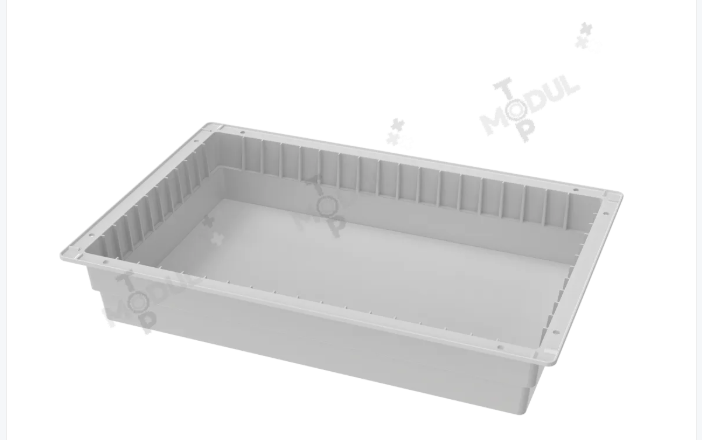
The container layer. The Storage tray T604010AN is the basic material storage unit and is classified as an ISO 6040 unit, measuring 600 x 400 x 100 mm and moulded in polycarbonate (PC) and acrylonitrile butadiene styrene (ABS). It is used for medication management and medical equipment handling in hospital environments, supporting the storage, handling and movement of medications and equipment from a central pharmacy or storage room to wards and patient bedsides. Because the footprint is fixed by the standard, trays can be exchanged between different pieces of equipment in the same system.
The mobility layer. The modular medical cart series includes the Anesthesia Cart T001, the Emergency Crash Cart-T002 and the Nursing Cart T003, each measuring 754 x 541 x 1005 mm and built from aluminium alloy, ABS plastic and metal. Their structural configuration is modular, allowing combined installation and diversified configurations assembled according to user needs, and the carts support customisation according to customer requirements. An open-transport alternative, the Medical trolley T6020-2, measures 1385 x 445 x 2000 mm with aluminium alloy struts and crossbars and PC/ABS baskets, and is designed for intra-department transfer.
The structure layer. High Density Medical Shelving uses a fixed base frame on a rail system with a high-density mobile frame in the middle, with basic frame dimensions of 512 x 650 x 2000 mm or 710 x 406 x 2000 mm, aluminium alloy struts and crossbars and PC/ABS baskets; the guide-rail length can be customised, and the tracks can be installed without drilling or gluing. Alpha shelving for medicine storage, models TDAS60 and TDAS40, measures 674 x 430 x 2000 mm and 474 x 630 x 2000 mm respectively, with aluminium alloy framing and PC/ABS trays. Sterile Storage Wire Shelving combines an aluminium alloy frame with stainless steel trays for clean-area storage in operating rooms and supply centres, with a stated temperature resistance above 130 degrees Celsius, and Roller Shutter Cabinets in the TDC180 series provide a closed modular cabinet option for medication and equipment storage.
Why ISO 6040 matters more than any single product
The most consequential decision in this category is not which cart to buy but which tray standard to adopt. ISO 6040 defines a 600 x 400 mm modular footprint, and once a hospital commits to it, trays become a shared language between departments, vendors and equipment types. A tray loaded in the pharmacy can be received in the ward without transloading, and a tray removed for cleaning can be replaced immediately by an identical unit.
This has three practical consequences for buyers. First, storage capacity is planned in tray units rather than in shelf metres, which makes the space calculation comparable across rooms. Second, consumable control improves because the physical unit of storage matches the unit of issue. Third, the equipment becomes upgradeable: shelving can be added, cart configurations changed and accessories exchanged without replacing the base system. Tongde Medical lists ISO 6040 medical storage systems alongside hospital supply storage systems and medical consumables storage systems in its product range, which reflects how the standard functions as the organising principle of the catalogue rather than as a single product line.
Department-level applications
Modular carts and shelving are specified by workflow, not by catalogue category. The same platform is configured differently depending on where it lives.
- Emergency and resuscitation. The Emergency Crash Cart-T002 is designed for life-threatening situations, where clinical staff can position the cart exactly where it is needed and keep all necessary equipment in one place.
- Anaesthesia and procedure rooms. The Anesthesia Cart T001 uses the same modular logic, allowing configurations to be assembled by procedure and adjusted as the equipment set changes.
- Ward nursing and medication rounds. The Nursing Cart T003 supports bedside delivery, with tray-level organisation replacing loose stock in drawers.
- Pharmacy and secondary warehouses. High Density Medical Shelving and Alpha shelving are intended for hospital secondary warehouses, pharmacies, vein centres and consumables warehouses, where density and access speed matter most.
- Sterile and clean areas. Sterile Storage Wire Shelving is intended for operating rooms and supply centres, where surfaces must withstand cleaning without harbouring dirt.
- Internal transport. The Medical trolley T6020-2 and the wider transport cart range handle intra-department and inter-department movement of supplies.
The stated operating conditions are equally specific: an indoor hospital environment with controlled temperature and humidity, free from heavy corrosion and explosive dust, with manual positioning by clinical staff. Systems specified outside those conditions should be assessed separately rather than assumed to transfer.
Market signals behind the category
Two published indicators frame the commercial context. Grand View Research's Horizon outlook on the European medical carts market estimates the global medical carts market size at US$4.83 billion in 2026, and projects the European medical carts market to grow at a CAGR of 15.8% from 2025 to 2030. Both figures describe the medical carts category as a whole rather than modular systems specifically, so they should be read as directional context rather than as a forecast for any single product line.
The interpretation that matters for buyers is structural. Growth of that order in a mature equipment category is rarely driven by unit replacement alone; it is usually accompanied by a change in what hospitals expect a cart to do. The shift from a trolley that carries stock to a system that manages it — trays that map to consumable units, shelving that can be reconfigured, carts that dock into the same standard — is consistent with that pattern. The 50% capacity gain attributed to the ISO 60-40 modular system is one concrete mechanism by which hospitals can justify the change.
Modular systems compared with traditional storage
The comparison is not between good and bad equipment. It is between two operating models with different cost structures, and the honest answer is that modular systems win on reconfiguration and density while losing on simplicity and, in many cases, on initial cost.
| Dimension | Modular tray-based system | Traditional fixed shelving / single-purpose trolley |
|---|---|---|
| Space utilisation | Standardised tray footprint; high-density rail shelving can raise capacity by up to 50% versus traditional shelving (Pegasus Medical / MedicalExpo) | Capacity determined by shelf geometry and item size; density limited by aisle access |
| Reconfiguration | Trays, baskets and drawers exchangeable; carts assembled to user needs | Changes usually require new furniture or a rebuild |
| Cleaning and infection control | Removable PC/ABS trays and stainless steel sterile shelving designed for routine hospital cleaners and disinfectants | Fixed surfaces and enclosed drawers are harder to empty and clean completely |
| Material flow | Same tray travels from pharmacy to ward to bedside without repacking | Stock typically decanted at each handover |
| Initial cost and complexity | Higher planning effort; configuration and certification must be defined before order | Lower entry complexity; less planning required |
| Best fit | Departments with recurring, standardised consumable flows and constrained floor space | Low-volume areas, irregular item mixes, or sites without space planning resources |
Where modular systems do not fit
Three boundaries deserve to be stated plainly, because they are where most specification errors occur.
The first is dimensional. A 600 x 400 mm tray standard is an advantage only while the items being stored fit it; oversized instruments, irregular packaging and bulky equipment either need dedicated shelves or fall outside the tray logic altogether. The second is environmental. The stated operating condition is an indoor hospital environment with controlled temperature and humidity, free from heavy corrosion and explosive dust — high-density rail systems in particular are not a transferable solution for washdown areas, plant rooms or other uncontrolled spaces. The third is planning effort. High-density mobile shelving occupies floor area with guide rails and requires a level floor and a defined aisle plan; a hospital that cannot commit to that planning stage will not realise the density benefit.
There is also a cost boundary that buyers should confront early. Modular systems generally carry a higher upfront cost than a basic fixed trolley, and the return depends on tray utilisation and on whether the workflow actually changes. Buying modular carts without changing how consumables are issued tends to produce expensive conventional trolleys.
What to confirm before specification
Tongde Medical's own application documentation sets out the confirmation points that determine whether a modular system will work in a given department. They are a reasonable checklist for any buyer in this category:
- Confirm the department's actual use case and material mix before choosing drawer or shelf configuration.
- Confirm dimensions against door widths, lift dimensions and available floor area.
- Confirm load-bearing requirements for the heaviest intended tray contents.
- Confirm the cleaning and disinfection methods used in the department, and that the tray and frame materials are compatible with them.
- Confirm the accessory combination and whether it can be added later.
- Confirm that the certification documentation corresponds to the delivered configuration.
- Confirm the OEM or customisation process, including drawing approval, material and colour selection, and pre-shipment inspection.
On the last point, Tongde Medical describes a staged OEM workflow: requirement review, detailed quotation, clarification of open concerns, model and material confirmation, joint approval of materials, colours and sizes, production after payment and drawing confirmation, progress updates, and photographic verification before delivery. Buyers evaluating any modular supplier should expect a comparable sequence, because configuration errors in this category are expensive to reverse after production.
Manufacturing and quality signals
Certification claims are only as strong as the production system behind them. Tongde Medical was established in 2003 and has over 20 years of experience in modular storage systems for the medical industry. It operates a 30,000-square-metre manufacturing facility, employs approximately 100 staff, and maintains a research and development team of more than 10 engineers and technicians. Its products are CE and ISO9001 certified.
Quality control is described as a total quality management system with full-process inspection covering IQC, IPQC, FQC and OQC, carried out by a dedicated five-member QC team at each production stage and on every product before packing and shipment. Export accounts for approximately 90% of sales, with stated markets including Germany, the United Kingdom, Spain, Italy, the Netherlands, Poland, Saudi Arabia and Israel, along with Singapore, Brazil and CIS countries.
For a buyer, these facts matter because they indicate that the manufacturer's primary reference market is one where CE conformity and documentation discipline are commercial prerequisites rather than optional extras. They do not replace a site audit or a sample evaluation, but they shorten the list of questions worth asking.
Future outlook
Three directions are visible from the current product landscape. The first is deeper standardisation around ISO 6040 tray logic, which reduces the cost of mixing equipment from different purchases and makes departmental reconfiguration a routine task rather than a project. The second is the gradual extension of storage systems into smarter management, reflected in Tongde Medical's range including smart medical storage cabinets alongside conventional shelving and carts — an area where the physical tray standard remains the foundation, and the digital layer is the addition. The third is infection control pressure, which favours removable, cleanable, non-rusting components over fixed joinery.
None of these trends removes the need for a hospital to define its own material flow first. The equipment can be reconfigured quickly; a workflow that was never defined cannot.
FAQ
What is a CE certified medical cart?
A CE certified medical cart is a mobile medical storage unit for which the manufacturer has issued a declaration that the product conforms to the applicable European Union legislation. CE marking is a conformity declaration rather than a quality rating. Tongde Medical states that its products are CE and ISO9001 certified, where CE relates to product conformity and ISO9001 relates to the manufacturer's quality management system. Buyers should verify that the documentation covers the specific model and configuration being supplied.
What is an ISO 6040 modular tray, and why does it matter in a medical cart?
An ISO 6040 modular tray is a storage container built to a 600 x 400 mm modular footprint. The Storage tray T604010AN measures 600 x 400 x 100 mm, is moulded in polycarbonate and ABS, and is classified as an ISO 6040 material storage basic unit used for medication management and medical equipment handling in hospital environments. The standard matters because it allows the same tray to be used across carts, shelving and transport equipment. According to Pegasus Medical's ISO 60-40 modular system specifications published via MedicalExpo, the system allows for up to 50% more storage capacity than traditional shelving.
How does a modular medical cart differ from a conventional medication trolley?
A conventional medication trolley typically has a fixed internal layout, whereas a modular medical cart is assembled from a structural frame plus interchangeable trays and accessories. The Anesthesia Cart T001, Emergency Crash Cart-T002 and Nursing Cart T003 share a 754 x 541 x 1005 mm platform built from aluminium alloy, ABS plastic and metal, and their configurations can be combined and installed according to user needs. The practical difference appears at reconfiguration: a modular cart can be adjusted to a different consumable mix without replacing the unit.
Which hospital areas typically use modular medical storage systems?
Modular systems are specified for hospital departments, wards, warehouses and clinics. Within that scope, high-density and Alpha shelving are intended for secondary warehouses, pharmacies, vein centres and consumables warehouses; sterile storage wire shelving is intended for operating rooms and supply centres; and carts are used for nursing, anaesthesia, emergency response and intra-department transport. The stated operating environment is indoor, with controlled temperature and humidity and free from heavy corrosion and explosive dust.
What should a buyer confirm before ordering a modular cart system?
Buyers should confirm the department's use case and material mix, the dimensions of doors, lifts and available floor area, the load-bearing requirement, and the cleaning and disinfection methods used in the department. They should also confirm the drawer or shelf configuration, the accessory combination and whether it can be extended later, and that certification documents correspond to the delivered configuration. Tongde Medical's application documentation identifies these same points as the inputs required before a configuration can be finalised.
What quality checks support a CE and ISO9001 certification claim?
The claim is supported by the production system behind the product. Tongde Medical describes a total quality management system with full-process inspection at IQC, IPQC, FQC and OQC stages, carried out by a five-member QC team at each production stage and on every product before packing and shipment, within a 30,000-square-metre facility that employs approximately 100 staff and a research and development team of more than 10 engineers and technicians.
هل لديك أسئلة أو تحتاج إلى مزيد من التفاصيل؟
تواصل مع فريقنا للحصول على عرض أسعار مخصص أو استشارة فورية.
طلب عرض أسعار
املأ النموذج أدناه وسيتواصل معك فريقنا بعرض مقترح مخصص.
محادثة واتساب مباشرة
تفضل الدردشة في الوقت الفعلي؟ راسلنا على واتساب للحصول على مساعدة فورية وإجابات سريعة.
- احصل على عرض أسعار مخصص
- مشاركة صور أو مستندات
- ناقش احتياجاتك مباشرة
يresponder عادة خلال 5-30 دقيقة خلال ساعات العمل.