
CE-Certified Playground Components: A Safe-Fun Shortlist
Industry Reference · Indoor Playground Equipment
Component-level compliance, not project-level promises, is what most indoor playground buyers are asked to prove to landlords, insurers and local inspectors. This reference shortlists five CE-compliant component families documented in the Vasia portfolio, together with the standard references behind them, and explains what a buyer can and cannot conclude from each set of specifications.
Indoor playground procurement rarely fails at the concept stage. It fails at the component level: a trampoline bay that looks correct on a layout plan still has to show that its jumping mat, springs, padding and frame tubes were manufactured and tested against documented references — and that the paperwork can be handed to a third party without translation. Vasia is the brand under which China·Huaxia Amusement Co., Ltd. operates. Established in 2000 and located in Qiaoxia Town, Yongjia County, Wenzhou City, Zhejiang Province, China, the company designs and manufactures indoor playground equipment and trampoline parks, employs approximately 200 staff including an R&D team of 30 engineers, and operates a 30,000-square-metre manufacturing facility with an annual production capacity of 200 million. Export business accounts for 70% of total sales, with major markets in the EU, USA, SA, ME and SEA.
Why component-level compliance now decides the purchase
Soft play equipment held the largest product type share of the global indoor playground equipment market in 2025 at 31.4%, valued at approximately USD 1.51 billion, according to Dataintelo. That concentration matters commercially because soft play and trampoline formats are assembled from many small, separately tested elements: netting, padding, mats, couplers, sleeves and frame tubes. A single non-conforming mat or net can hold up an entire handover.
The opportunity for buyers is therefore structural rather than cosmetic. Instead of choosing one project-level declaration, procurement teams increasingly shortlist individual components and ask for the material and test reference behind each one. Vasia's certification framework includes CE, UKCA, CPSIA and SASO, validated through testing by SGS and TÜV, with the quality management system certified to ISO 9001 and product development aligned to the ASTM and EN 1176 safety frameworks. For a buyer at the research stage, that framework is the context in which the individual model specifications below should be read.
What “CE-certified” actually means on a playground component
CE marking is a manufacturer's declaration of conformity with the applicable EU requirements. It is not, by itself, a description of which material property was tested. For playground equipment the relevant harmonized European standard is EN 1176, and Part 10 of EN 1176 specifically covers fully enclosed play equipment such as soft play areas, according to the European Committee for Standardization. In North America, ASTM F1918 is the primary safety performance specification for soft contained play equipment, focusing on entrapment and fire safety, per ASTM International. Artificial climbing structures are usually assessed under a separate European framework, EN 12572.
Flammability is handled at material level. The trampoline mats, padding and PVC-coated mesh fabric in the Vasia models cited in this shortlist are documented as compliant with EU standard EN 71-2:2020, Safety of Toys — Part 2: Flammability, Clauses 4.1 and 4.4. Buyers should read that reference for what it is: a material-level flammability statement, not a structural performance guarantee.
| Reference | Scope | Where it appears in this shortlist |
|---|---|---|
| EN 1176 (incl. EN 1176-10) | Harmonized European standard for playground equipment; Part 10 covers fully enclosed play equipment | Company safety framework; soft play and trampoline structures |
| EN 12572 | European framework for artificial climbing structures | Climbing wall and rope-course specification checks |
| EN 71-2:2020, Clauses 4.1 & 4.4 | Flammability of toy materials | Trampoline mats, EPE padding, PVC-coated mesh fabric |
| ASTM F1918 | Soft contained play equipment in North America | Market-specific documentation for US projects |
| GB 6675.4-2014 | Material test reference used across Vasia documentation | Jumping mats, safety mats, PE nets, EPE padding |
| GB/T 228.1-2021 | Frame and coupler test reference | Cast steel 48# couplers; rope-course frame tubes |
| GB/T 5849-2006 (E0) | Plywood properties and formaldehyde emission | Climbing wall and rope-course plywood surfaces |
The shortlist: five compliant component families
The models below are drawn from Vasia's documented portfolio. They are presented as a starting point for a specification conversation, not as an installation clearance.
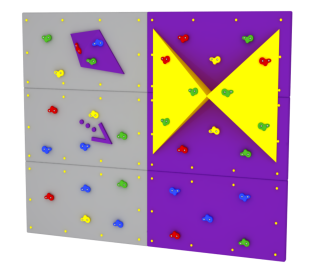
Climbing Wall for Playground VS-2659 — cushioned plywood climbing surface on a Q235 galvanized rectangular steel frame. Image: Vasia.
1. Trampoline systems — models VS6-190301-1980A-13-29 and VS6-180326-400a-2-40
The trampoline park equipment model VS6-190301-1980A-13-29 is classified as a trampoline and is intended for trampoline parks, indoor parks and kindergartens. Its frame structure is defined precisely: upright posts in Q235 galvanized rectangular steel tube at 80×80×2.0 mm, a connecting frame at 50×80×2.5 mm, and a reinforcement linkage at 40×40×1.5 mm, joined with screw fasteners. The jumping mat is PP material with a fibre count of 500D×500D, tested to GB 6675.4-2014. The trampoline mat combines high-density EPE pearl cotton at 70 mm thickness, tested to GB 6675.4-2014, with Plato PVC-coated mesh fabric at 0.52 mm thickness and a warp/weft density of 1300×1300D, compliant with EN 71-2:2020 Clauses 4.1 and 4.4. Springs are carbon steel wire 82B, 180 mm long, tested to GB/T 20125-2006 and GB/T 20123-2006.
The Indoor Trampoline Park model VS6-180326-400a-2-40 uses the same frame and mat specification and the same material set — galvanized pipe, multi-layer board, sponge, PVC skin, acrylic and nylon. It is intended for trampoline parks, indoor parks, kindergartens and indoor playgrounds.
Mat sizing reference matters for early layout work. The standard trampoline mat used across the wider indoor playground equipment range measures 1800×1800 mm with a static load capacity of 600 kg and a dynamic load capacity of 130 kg. The professional trampoline mat measures 2130×4260 mm and uses stronger nylon webbing. Bays that are not dimensioned against one of these formats will need custom sizing.
2. Climbing wall — model VS-2659
The climbing wall for playground model VS-2659 is a rock climbing wall designed for playground use and documented for the EU market. The frame is made of Q235 galvanized rectangular steel tube at 40×40×1.5 mm. Padding is built in layers: 15 mm plywood meeting the E0 grade formaldehyde emission requirements of GB/T 5849-2006, high-density EPE pearl cotton at 10 mm thickness tested to GB 6675.4-2014, and 0.52 mm Plato PVC-coated mesh fabric with a warp/weft density of 1300×1300D. The product is documented as compliant with EU standard EN 71-2:2020 for flammability, and the material set includes galvanized pipe, multi-layer board, sponge, PVC skin and resin.
For specifiers, the useful signal here is the plywood grade. Formaldehyde emission class is one of the few material properties that can be checked independently against a named standard, which makes it a practical filter when two climbing walls otherwise look identical on a drawing.
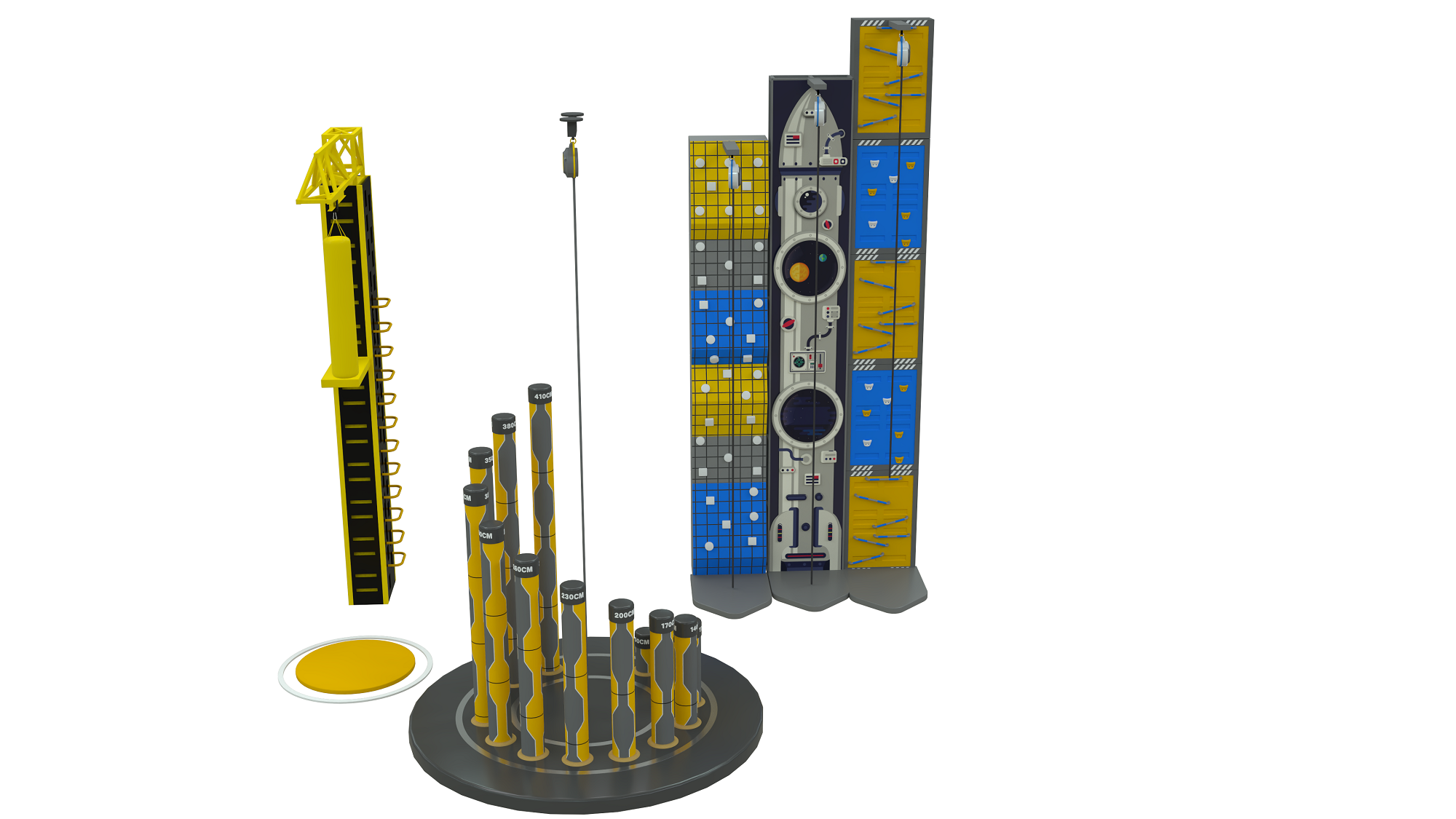
Indoor rope course equipment VS1-250522-1900B-30 — Q235 galvanized frame, printed PVC surface, climbing holds and electronic timer. Image: Vasia.
3. Indoor rope course — model VS1-250522-1900B-30
The indoor rope course equipment model VS1-250522-1900B-30 is listed under indoor rope course equipment and is suitable for trampoline parks, indoor parks, kindergartens and indoor playgrounds. Its frame uses three Q235 galvanized rectangular steel tube profiles — 50×80×3.0 mm, 40×80×2.0 mm and 40×40×2.0 mm — tested to GB/T 228.1-2021. The surface layer is 15 mm plywood meeting the E0 grade requirements of GB/T 5849-2006, finished with 2.0 mm printed PVC flooring, and the unit includes climbing holds and an electronic timer.
Its safety matting specification is unusually detailed for a challenge-course product: 28 kg/m³ foam at 10 mm thickness tested to GB 6675.4-2014, 140 mm thick EPE pearl cotton, and an outer fabric of printed Plato PVC-coated mesh at 0.52 mm with a warp/weft density of 1300×1300D, compliant with EN 71-2:2020 Clauses 4.1 and 4.4. Challenge courses carry children at height and at speed, so mat thickness and foam density are the two numbers worth extracting first when comparing offers.
4. Soft play structures — models VS1-250519-2250-3-60, VS1-250414-780-D1-77, VS1-230518-4-60, VS1-25011002-230-2-49 and VS1-250503
The soft play family shares a common structural language, which is useful when a buyer wants to combine modules from more than one model. The OEM Indoor Playground model VS1-250519-2250-3-60, the Kids Play Structure model VS1-250414-780-D1-77, the Indoor Playground model VS1-230518-4-60 and the family entertainment center equipment model VS1-25011002-230-2-49 all use galvanized steel tube upright posts at φ48×2 mm, cast steel 48# couplers tested to GB/T 228.1-2021, polyethylene safety netting with a 30×30 mm mesh tested to GB 6675.4-2014, polyamide nylon tie ropes and buckles, and PVC protective sleeves with a PVC outer layer over an EPE pearl cotton lining. Common materials across the group are galvanized pipe, multi-layer board, sponge, PVC skin, acrylic and nylon.
The Indoor Playground Equipment model VS1-250503 adds the platform and slide detail that determines whether a design actually fits a venue. The main frame is predominantly φ48 mm galvanized steel pipe at 2.0 mm thickness with 15 mm outer-diameter anti-collision sleeves; expanded structures step up to φ140 mm pipe at 4.0 mm thickness. Platforms are commonly 800×800 mm cold-rolled steel plates, or perforated plates at 91×91 cm or 116×116 cm. The steep slide is 2 metres wide on a steel frame of 4×4 cm and 4×8 cm square tubes. Soft play platforms use a composite build-up of 1.8 cm multi-layer board, 2 cm EPE foam and 0.45 mm PVC leather. Fasteners are stainless steel, some with protective plastic caps or anti-loosening washers to keep children from direct contact. The model is designed for children aged 3–15 years, while some soft play products suit ages 2–8. Slides use imported engineering plastics or 196 resin; carpet wear resistance reaches 80,000 rubs; and the timber used is mainly corrosion-resistant Scots pine.
5. Shortlist summary
| Component family | Model | Documented compliance anchor | Typical use |
|---|---|---|---|
| Trampoline park equipment | VS6-190301-1980A-13-29 | Jumping mat GB 6675.4-2014; mat fabric EN 71-2:2020 4.1/4.4; springs GB/T 20125-2006 & GB/T 20123-2006 | Trampoline parks, indoor parks, kindergartens |
| Indoor Trampoline Park | VS6-180326-400a-2-40 | Frame Q235 tube specs; EN 71-2:2020 mat fabric | Trampoline parks, indoor parks, kindergartens, indoor playgrounds |
| Climbing Wall for Playground | VS-2659 | Plywood E0 / GB/T 5849-2006; EPE GB 6675.4-2014; EN 71-2:2020 | Playground climbing feature, EU documentation |
| Indoor rope course Equipment | VS1-250522-1900B-30 | Frame GB/T 228.1-2021; safety mat GB 6675.4-2014; EN 71-2:2020 | Challenge courses, trampoline parks, indoor playgrounds |
| Soft play structures | VS1-250519-2250-3-60, VS1-250414-780-D1-77, VS1-230518-4-60, VS1-25011002-230-2-49, VS1-250503 | Couplers GB/T 228.1-2021; PE net GB 6675.4-2014 | FECs, malls, kindergartens, indoor playgrounds |
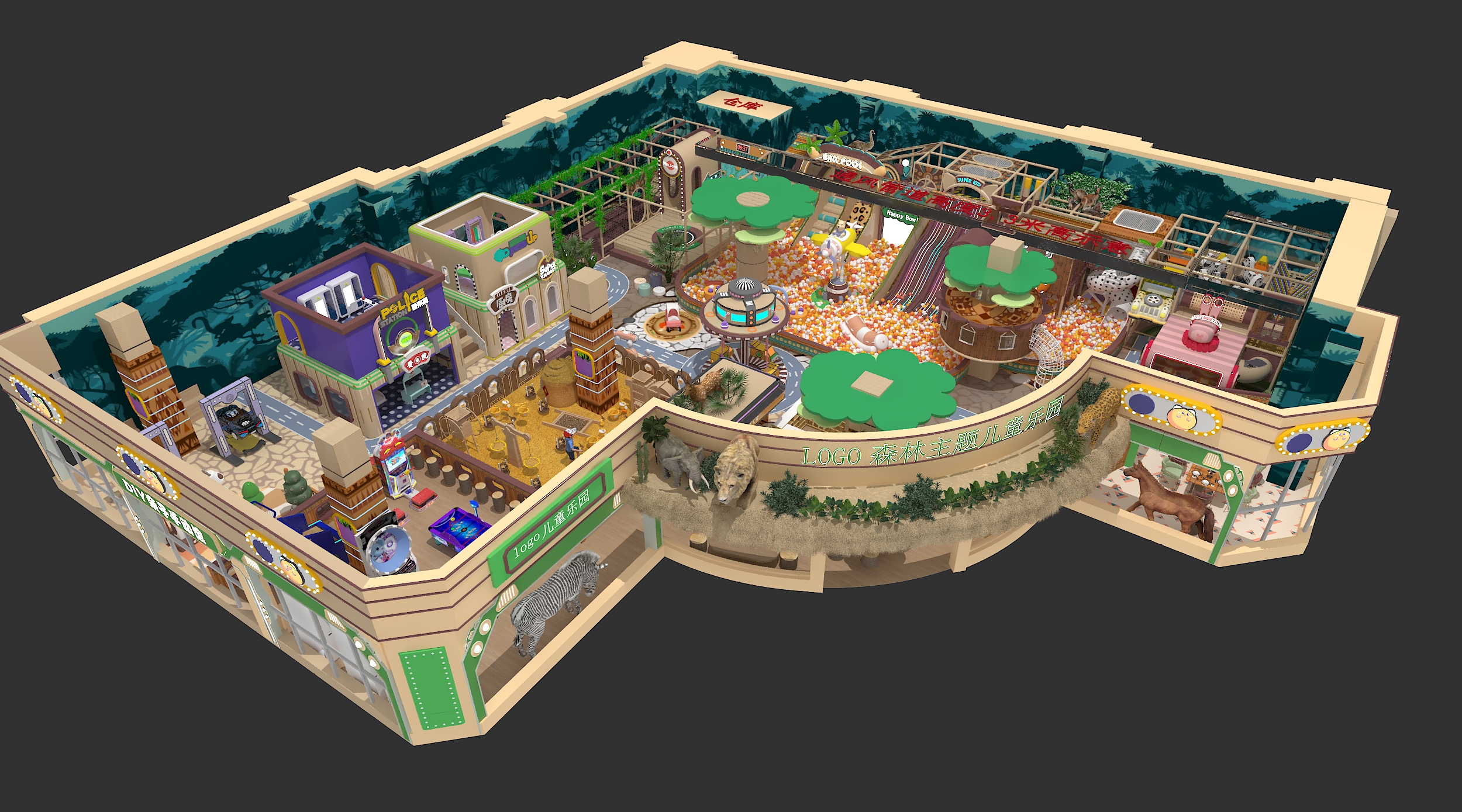
Kids Play Structure VS1-250414-780-D1-77 — φ48×2 mm galvanized uprights, 30×30 mm PE safety net, padded platform build-up. Image: Vasia.
Where these components are used
The application profile behind this component set is broad. These products are applied in children's play equipment projects covering indoor playgrounds, soft play areas, trampoline parks, obstacle courses, themed playgrounds and daycare play equipment. Working conditions are indoor or outdoor, all-weather, safe for high-traffic areas, and suited to shopping malls, kindergartens and amusement parks, with operation designed for continuous daily use under manual supervision and low maintenance. Typical matched equipment includes safety matting, protective padding, ball pit balls, slide components, climbing ropes, trampoline springs and pads, interactive play panels, themed decorations, anti-collision foam and non-slip flooring.
Special requirements recorded for this category include ASTM safety standard compliance, non-toxic materials, fire resistance, anti-corrosion, UV resistance, rounded corners, impact absorption, easy cleaning, child-safe design and customizable theming. The scenario is common in markets including the UAE, Australia, Germany, the UK and the US, and the portfolio is typically positioned for global export. For a research-stage buyer, the practical reading is that the same component family may need different documentation depending on the destination market — European files lean on EN references, while North American files lean on ASTM F1918 for soft contained play.
Market trend analysis: what the numbers say about component sourcing
Dataintelo values the global indoor playground equipment market at USD 4.8 billion in 2025, projected to reach USD 9.2 billion by 2034. Within that total, soft play equipment took the largest product type share in 2025 at 31.4%, or approximately USD 1.51 billion, and Asia Pacific held a 38.6% revenue share, followed by North America and Europe. The trampoline park segment shows a steeper trajectory: Dimension Market Research projects a CAGR of 16.2%, reaching USD 3.96 billion by 2032.
Market size estimates diverge by research scope, and buyers comparing reports should expect that. Dataintelo's USD 4.8 billion for 2025 and Business Research Insights' USD 7.3 billion for 2026 measure overlapping but differently bounded categories, and some studies fold outdoor equipment or broader FEC operations into the same figure. The direction of travel is consistent even where the totals are not: capacity is being added, and the competitive field includes established manufacturers such as PlayCore, Soft Play and PlayPower, identified by Metastat Insights among the leading players in the global and US indoor playground market. As more supply enters the category, documentation quality becomes a practical way to narrow a shortlist before price negotiation begins.
Comparison with traditional sourcing — and the limits of a shortlist
The traditional route is project-level sourcing: a buyer requests one integrated play structure, receives a CE declaration covering the project, and accepts generic padding and netting as part of the package. It is faster to procure and easier to compare on headline price. The component route used here trades some of that simplicity for traceability — each mat, net, coupler and frame profile carries its own named test reference, which is what a landlord or insurer is most likely to ask for.
There are real boundaries to this approach, and buyers should plan around them. First, material compliance is not installation compliance: EN 71-2:2020 covers flammability, and it says nothing about whether a specific climbing wall or rope course performs safely in a specific building with a specific fall zone. A site-specific risk assessment remains the buyer's responsibility. Second, standard dimensions constrain design — a trampoline mat sized 1800×1800 mm will not fill an irregular bay, and custom sizing changes both the quotation and the lead time. Third, components from different models share common structural language (φ48×2 mm uprights, cast steel 48# couplers, 30×30 mm PE netting), but mixing them still requires confirming frame compatibility and load paths against a concrete layout rather than assuming interchangeability. Fourth, CE marking is a manufacturer's declaration of conformity and does not transfer the buyer's own verification duty; the buyer should confirm which test reports apply to the specification actually ordered.
Future outlook
Two forces are likely to shape component sourcing over the next few years. The first is documentation depth. As the indoor playground market moves toward the USD 9.2 billion projection for 2034 and trampoline park capacity expands, buyers are increasingly assembling a documentation pack rather than collecting a single certificate — and suppliers that can produce per-material test references, E0-grade plywood statements and flammability clauses without a follow-up email will find that easier to work with. The second is material policy. Vasia's own material policy already references eco-friendly, non-toxic sourcing with RoHS-compliant coatings, fire-retardant properties, FSC-certified timber where possible and recyclable materials, alongside ISO 9001 quality management and an R&D team of 30 engineers working with 3D modelling and VR preview. Buyers who begin building internal component checklists now are likely to find that this groundwork pays off long before the next tender.
FAQ
What does CE certification cover on an indoor playground component?
CE marking is a manufacturer's declaration that a product conforms with the applicable EU requirements, rather than a description of any single tested property. For playground equipment, the relevant harmonized European standard is EN 1176, with Part 10 covering fully enclosed play equipment such as soft play areas. Material-level flammability for textiles and padding is commonly documented separately against EN 71-2:2020; in Vasia's documentation, trampoline mats, EPE padding and PVC-coated mesh fabric are recorded as compliant with Clauses 4.1 and 4.4 of that standard.
Which standards apply to climbing walls and rope courses in Europe?
Artificial climbing structures are generally assessed under EN 12572, while EN 1176 remains the reference framework for playground equipment more broadly. Within Vasia's documentation, the climbing wall model VS-2659 and the indoor rope course equipment model VS1-250522-1900B-30 both list 15 mm plywood meeting the E0 grade requirements of GB/T 5849-2006, EPE padding tested to GB 6675.4-2014, and PVC-coated mesh fabric compliant with EN 71-2:2020 Clauses 4.1 and 4.4. The rope-course frame tubes are additionally tested to GB/T 228.1-2021.
How can a buyer verify a trampoline mat before ordering?
Verification starts with the material and test references attached to the mat itself. On the trampoline park equipment model VS6-190301-1980A-13-29 and the Indoor Trampoline Park model VS6-180326-400a-2-40, the jumping mat is PP material at 500D×500D tested to GB 6675.4-2014, while the mat build-up uses 70 mm high-density EPE pearl cotton tested to GB 6675.4-2014 and Plato PVC-coated mesh fabric at 0.52 mm with a warp/weft density of 1300×1300D, compliant with EN 71-2:2020. Springs are 180 mm carbon steel wire 82B tested to GB/T 20125-2006 and GB/T 20123-2006. Dimensional checks matter too: the standard mat is 1800×1800 mm with 600 kg static and 130 kg dynamic capacity, and the professional mat is 2130×4260 mm with stronger nylon webbing.
What should a buyer prepare before requesting a quote on these components?
A quote can be assessed properly only against a defined brief. Buyers should be able to state the destination market, since documentation differs between EN-based and ASTM-based files; the intended age range, given that models such as the indoor playground equipment VS1-250503 are designed for children aged 3–15 years while some soft play products suit ages 2–8; the bay dimensions that determine whether a 1800×1800 mm or 2130×4260 mm trampoline mat fits; the venue type, whether shopping mall, kindergarten, amusement park or daycare; and the accessories expected in the same shipment, including safety matting, padding, trampoline springs and pads, climbing ropes, anti-collision foam and non-slip flooring.
Can components from different models be combined in one project?
The soft play models share a common structural language, which makes combination realistic: φ48×2 mm galvanized steel tube uprights, cast steel 48# couplers tested to GB/T 228.1-2021, and polyethylene safety netting with 30×30 mm mesh tested to GB 6675.4-2014 are repeated across the OEM Indoor Playground VS1-250519-2250-3-60, the Kids Play Structure VS1-250414-780-D1-77, the Indoor Playground VS1-230518-4-60 and the family entertainment center equipment VS1-25011002-230-2-49. However, the published specifications are recorded per model, so frame compatibility, load paths and mat sizes still need to be confirmed against an actual layout before a mixed configuration is treated as buildable.
What are the limits of a component shortlist?
A shortlist narrows the field; it does not certify an installation. The standards referenced in this article describe material and structural properties — plywood formaldehyde class, flammability clauses, tube dimensions, mat load capacity — and do not evaluate a specific building, fall zone or supervision model, so a site-specific risk assessment stays with the buyer. Standard dimensions may not fit non-standard bays, custom work affects lead times, and CE marking remains a manufacturer's declaration rather than a transfer of verification responsibility. Buyers should treat every specification here as a starting point and validate it against their own venue requirements.
For buyers assembling a first specification, the manufacturer's product documentation and downloadable company brochure are available for reference: Vasia product brochure (PDF). Product and company details are published at vasiaplayground.com.
Third-party references cited: Dataintelo (indoor playground equipment market, 2025–2034); Dimension Market Research (trampoline park market, CAGR 16.2%, USD 3.96 billion by 2032); Metastat Insights (leading indoor playground manufacturers); CEN (EN 1176-10); ASTM International (ASTM F1918); Business Research Insights (market estimate divergence). Company and product facts: China·Huaxia Amusement Co., Ltd. (Vasia).