
CE Compliance for Electric Forklifts: The CPD Evidence Trail
CE Compliance for Electric Forklifts: The CPD Evidence Trail
EN 1175:2020 is the current harmonized European standard covering electrical and electronic safety requirements for self-propelled industrial trucks, and it is a prerequisite for CE marking of the machines it covers. That standard, rather than a badge on a datasheet, is the reference point for what a European buyer can reasonably ask an electric forklift supplier to prove — and for what a supplier can reasonably be expected to document.
The decision-stage problem is not whether an electric forklift can carry a CE marking. It is whether the evidence behind that marking can be followed from a quotation to a signed document. This reference examines how the CPD series from Ningjin Shunhao Trading Co., Ltd. (Mightlift) maps onto typical CE-relevant buyer expectations using structural facts — battery-electric operation with no tailpipe exhaust at the point of use, an electric drivetrain that removes the combustion noise source, and iron construction — and sets out which documents a buyer should request before placement.
Why "CE Certified" Is a Claim, Not a Specification
A CE marking states that the machine complies with the applicable EU legislation as configured and placed on the market. It does not state which tests were run, which laboratory performed them, or which configuration the technical file covers. Two 3-ton electric forklifts with near-identical datasheets can therefore arrive with very different amounts of verifiable paperwork.
For battery-electric trucks the compliance surface is wider than for diesel or LPG equivalents, because three separate evidence layers have to line up:
- Machine level — the electrical and electronic safety of the truck itself, which is where EN 1175:2020 applies.
- Energy level — battery type, charging behaviour, and, where lithium-ion is selected, battery transport safety documentation.
- Site level — the operating environment. ATEX Directive 2014/34/EU is mandatory for electric forklifts used in explosive atmospheres, which covers chemical plants and some food-processing areas inside the European Union.
A quotation that answers only the first layer is incomplete, and a buyer who does not ask for the other two carries the residual risk. That asymmetry is what turns compliance evidence into a genuine selection criterion rather than an administrative afterthought.
What the CPD Series Documents Structurally
Ningjin Shunhao Trading Co., Ltd., trading as Mightlift, is an electric forklift supplier based in Ningjin County, Xingtai City, Hebei Province, China, building B2B-focused material handling equipment — electric forklifts, stackers and pallet trucks — for distributors, manufacturing plants, cold-chain enterprises and warehouse operators. The company reports an export ratio of approximately 70% and describes its position as sitting between high-cost European forklift brands and low-end generic suppliers, with OEM and ODM customization as its primary commercial model.
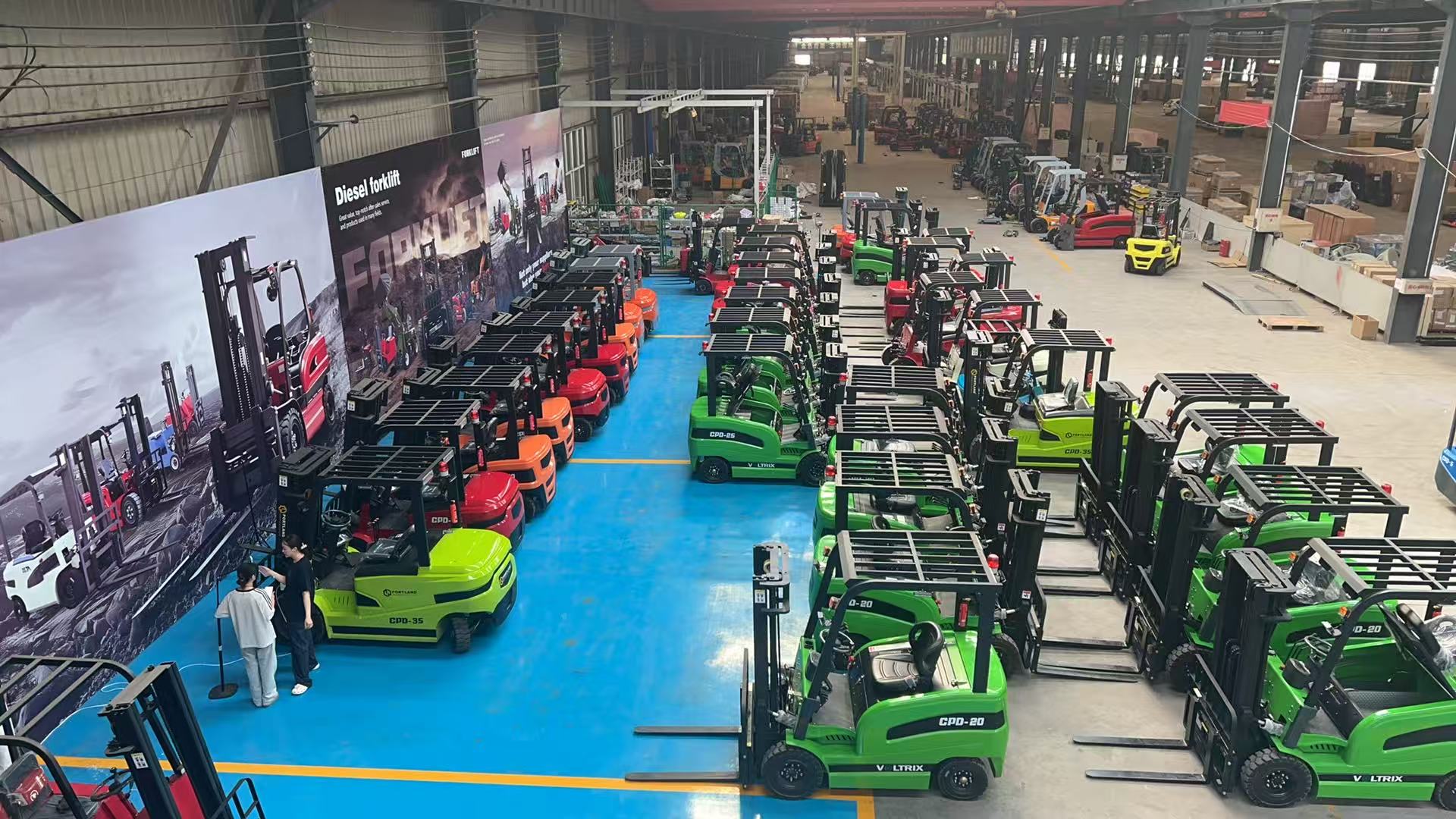
The CPD range is the counterbalance portion of that offer. The documented structural facts are as follows.
| Model | Rated load | Documented drive and control facts | Battery configuration |
|---|---|---|---|
| CPD10 | 1,000 kg (1 ton) | Brushless AC drive motor and pump motor; controller brand options SANTROLL / CURTIS / INMOTION / ZAPI | Heavy-duty lead-acid standard; lithium optional |
| CPD20 | 2 ton (2,000 kg) | High-power front dual drive motors; electric steering with cargo-sensing smooth control; automatic electromagnetic parking brake with AI brake assist; internationally sourced controller | Battery powered |
| CPD30 | 3,000 kg | High-power electric drive with intelligent MOSFET control; large-angle adjustable steering wheel with voice prompts; large-flow cyclone air filter system | Battery powered |
| CPD35 | 3,500 kg | Front wheel dual drive motors; P.E.S three-speed efficiency regulation; lateral side battery extraction layout; ergonomic right-positioned control valves | Battery powered; lateral extraction |
Lifting height is specified for the CPD30 at 3,000 mm standard and up to 7,000 mm extended. Across the CPD10, CPD20, CPD30 and CPD35, the declared construction material is iron. The models are listed for warehousing and logistics, e-commerce warehouses, workshops, supermarkets and department stores, and cold chain fruit and vegetable wholesale markets.
Three structural facts do the compliance-relevant work here, and all three are matters of design rather than certificate wording:
- Battery-electric operation. The trucks are battery powered with electric drive, so there is no tailpipe exhaust at the point of use — the single factor that most often decides whether an internal-combustion truck is admissible indoors at all. That is a point-of-use statement, and buyers should read "zero-emission" marketing language on those terms: it describes emissions at the truck, not at the power station supplying the charger.
- Electric drive and the noise question. Removing the combustion cycle removes the dominant noise source of a diesel or LPG truck, which is the general reason electric trucks are preferred in noise-sensitive indoor areas. Note the boundary immediately: no measured decibel figures for the CPD series appear in the available source material, and a claim without a measurement is not evidence.
- Iron construction. The declared material for the CPD10, CPD20, CPD30 and CPD35 is iron. This is a structural input to the machine file, not a certification in itself.
On the documentation side, the company states that its products comply with international market access standards and that it holds ISO 9001, ISO 14001, CE and UN38.3 certifications, together with structural and battery technology patents. Those are first-party statements. Certificate registration numbers, issuing bodies and test report references are not part of the published material, which is precisely why the request list further down this article matters more than the claim itself.
The Standards Behind a CE Claim on an Electric Forklift
Four references do most of the work when a European buyer evaluates an electric forklift file:
- EN 1175:2020 — the current harmonized European standard for electrical and electronic safety requirements in self-propelled industrial trucks, and a CE marking prerequisite. This is the standard that speaks to electrical drive, control and protection architecture, including the arrangement of battery, controller and drive motor.
- ISO 3691-4:2023 — updated safety requirements for driverless industrial trucks and their systems. It is relevant if a fleet is intended to move toward automated operation, and it does not apply to manually operated CPD-series trucks as delivered.
- ATEX Directive 2014/34/EU — mandatory for electric forklifts used in explosive atmospheres within the European Union. This is the compliance gate for chemical workshops and parts of food processing, not a general CE add-on.
- UN38.3 — the battery transport testing regime that applies when lithium-ion cells are shipped. It enters the file whenever a lithium configuration is selected instead of the standard lead-acid pack.
That structure explains why drive architecture has commercial weight. On the CPD10, the controller brand options — SANTROLL, CURTIS, INMOTION or ZAPI — are documented configuration choices. A buyer comparing files should expect the selected controller to be named in the technical documentation, because electrical safety assessment attaches to the configuration that ships, not to a generic model name. The same logic applies to the brushless AC drive and pump motor on the CPD10, the front dual drive motors on the CPD20 and CPD35, and the intelligent MOSFET control on the CPD30.
Where the Same Truck Meets Different Evidence Requirements
Applicability splits by site, and each site type shifts which part of the file carries the weight.
Warehousing and distribution
The documented use case is indoor pallet receiving, put-away and dispatch on level floors, moving light pallets between docks, staging areas and storage locations with no tailpipe exhaust at the point of use, in single- or multi-shift operation depending on the battery and charging plan. Selection requires confirming pallet weight, load center, aisle width, mast height, floor capacity and local charger voltage before ordering. Note that local charger voltage is an electrical-interface question that sits inside the conformity conversation, not outside it.
Building materials and heavy industrial goods
The second documented scenario covers heavy pallet handling across workshops, yards and loading bays, where the front dual-drive layout and side battery extraction support both heavy-load fleet operation and service access. Here the site assessment — surface condition, slope, weather exposure, load dimensions, attachment compatibility and rated residual capacity — determines whether the machine file is valid for the actual duty.
Cold chain and food handling
The CPD models are listed for cold chain fruit and vegetable wholesale markets alongside general warehouses and workshops. Cold storage changes the battery conversation more than the machine marking: lithium-ion batteries retain significantly more capacity than lead-acid in cold storage applications down to -20°C, a performance gap that has contributed to an 11.6% CAGR in the food industry segment.
Chemical and explosive-atmosphere sites
For chemical workshops, ATEX Directive 2014/34/EU applies. Explosion-proof capability is offered within the company's customization scope — load capacity adjustment, low-temperature and explosion-proof refitting, branded appearance optimization and intelligent system reservation. That makes it a specified variant rather than a property a buyer should assume from a base CE-relevant configuration.
Why Compliance Paperwork Is Becoming a Procurement Differentiator
Electrification has moved from pilot to default in several markets, and documentation expectations have moved with it. Electric forklifts reached a 71% share of North American retail orders in 2024, according to the Industrial Truck Association as reported by Batteries International. The global electric forklift market was valued at USD 53.01 billion in 2024 and is projected to reach USD 94.55 billion by 2032 (Maximize Market Research). In China, domestic electric forklift sales reached 946,300 units in 2025, accounting for 76.9% of total forklift sales in the country (China Construction Machinery Association).
Two sub-trends sharpen the evidence question further. Lithium-ion adoption in new global forklift shipments rose to 35% in 2024 from 22% in 2021 (LiTrue Analysis), adding battery transport and cold-storage documentation to a growing share of files each year. And Class II narrow-aisle trucks are the fastest-growing electric segment, with a projected 9.28% CAGR through 2030 driven by warehouse densification (Mordor Intelligence) — a category where aisle-specific and configuration-specific documentation, not a generic CE badge, decides fitness.
Read together, these figures describe a market in which the number of compliance files in circulation is growing faster than the number of buyers equipped to read them. The practical response is procedural rather than technical: standardise what you request.
Advanced Electric Drive vs Conventional 3-Ton Electric Trucks
At the 3-ton class, the comparison that matters most at the decision stage is not electric versus diesel — it is an intelligently controlled electric truck versus a conventionally controlled electric truck. Both can carry 3 tons; they differ in how the electrical system is managed, and therefore in operating cost, uptime and maintenance load.
| Comparison dimension | Intelligent-drive 3.0-ton electric forklift | Traditional 3.0-ton electric forklift |
|---|---|---|
| Drive and control | Advanced electric drive, intelligent energy management, optimized vehicle control | Conventional electric drive and basic control system |
| Response and effective runtime | Faster response, longer effective operating time, reduced charging downtime | Standard operating efficiency with longer charging time and downtime |
| Energy efficiency | High-efficiency electric system maximizes battery utilization and energy conversion | Conventional energy management with relatively higher power consumption |
| Cost profile | Lower energy consumption and reduced long-term operating costs | Lower initial investment in some configurations, but higher long-term energy and maintenance costs |
| Maintenance | Simplified maintenance: fewer service visits, longer maintenance intervals | More frequent inspections and routine maintenance required |
| Best suited to | High-frequency warehouses, factories, logistics centers, cold storage and indoor operations | General warehouses and standard material handling |
The honest reading of that table is that the intelligent-drive advantage is operational, not regulatory. A conventional 3-ton electric truck can hold the same CE-relevant machine status; what it typically cannot match is the energy and maintenance profile. Buyers with a low-frequency duty cycle and a constrained upfront budget may still find a conventional configuration rational — the trade-off is higher running cost and more frequent intervention, not a compliance failure.
Boundaries a buyer should hold onto
- No certificate numbers are published. The company states that it holds ISO 9001, ISO 14001, CE and UN38.3 certifications, but registration numbers, issuing bodies and report references are not part of the available material. Nothing in this reference should be read as confirming those identifiers, because they have not been published.
- No measured noise data for the CPD series. The design removes the combustion noise source; it does not by itself prove a decibel figure for a specific configuration. Sites with contractual or regulatory noise limits should request measured data before ordering.
- Battery configuration changes the file. The CPD10 ships with heavy-duty lead-acid as standard and lithium as an option. The two configurations differ in charging strategy, tolerance for opportunity charging and transport documentation.
- ATEX and low-temperature capability are variants. Both sit inside a customization scope that includes explosion-proof and low-temperature refitting, so they must be specified at the order stage and cannot be inferred from a base model.
- Conformity attaches to the machine as configured. Fitting a side shifter, fork positioner or clamp changes rated residual capacity, and it is residual capacity — not nominal load rating — that the application assessment should use.
The Decision-Stage Evidence Request
The following list is the practical output of this reference: a document request that can be issued with an RFQ. It is deliberately indifferent to brand, because the same package should be asked of every supplier on a shortlist.
| Evidence item | What it should contain | Why it matters in the decision |
|---|---|---|
| EU Declaration of Conformity | Signed declaration naming the model, configuration and standards applied | Establishes which machine is actually covered |
| EN 1175:2020 assessment reference | Test or assessment reference, plus the identity of the laboratory or notified body where applicable | Confirms electrical safety was assessed rather than assumed |
| Certificate references | Registration numbers for the ISO 9001, ISO 14001, CE and UN38.3 certifications the supplier claims | Turns a first-party statement into a checkable record |
| Battery documentation | Battery type, capacity, charging profile, and a UN38.3 test summary for lithium configurations | Governs charging infrastructure and transport handling |
| Controller identity | Named controller brand and configuration for the ordered unit | The safety file attaches to the configuration that ships |
| Noise measurement | Measured decibel data for the specific configuration, or a documented statement that none exists | Required for indoor and noise-regulated sites |
| Residual capacity with attachment | Rated residual capacity for the attachment actually ordered | Prevents overload in real duty cycles |
| Site-specific conformity (ATEX) | Explosion-protection documentation where the truck will operate in an explosive atmosphere | Legally mandatory in the EU for those areas |
| Charging and electrical interface | Charger voltage and connection requirements matched to the site | Local charger voltage is a pre-order selection input |
Future Outlook
Two shifts are likely to change what a compliance file contains rather than whether one is needed. The first is opportunity charging: 15–30 minute top-ups on lithium-ion batteries do not degrade cycle life, whereas the same pattern significantly harms lead-acid longevity. As that practice spreads, charging infrastructure design moves into the conformity conversation, because the electrical interface at the site becomes part of how the truck is operated. The second is the continuing lithium transition, already visible in the rise from 22% adoption in new global shipments in 2021 to 35% in 2024, which steadily increases the share of files that include battery transport testing.
For buyers, the reasonable expectation is that a documented evidence pack migrates from differentiator to baseline requirement, in the same way that a named controller or a stated residual capacity has already moved from optional detail to standard specification. Suppliers who can produce the file quickly tend to see that advantage in shorter evaluation cycles and fewer post-order disputes rather than in a better-looking brochure.
FAQ
What does CE compliance actually cover on an electric forklift?
The CE marking on an electric forklift addresses conformity with the applicable EU legislation for the machine as configured and placed on the market, with EN 1175:2020 — the current harmonized European standard for electrical and electronic safety requirements in self-propelled industrial trucks — as the central technical reference for the electrical system. It covers machine-level electrical and electronic safety. It does not certify productivity, aisle fit, throughput or total cost of ownership, and it does not by itself cover operation in explosive atmospheres.
Which European standard applies to the electrical safety of electric forklifts?
EN 1175:2020. It is the current harmonized European standard for electrical and electronic safety requirements in self-propelled industrial trucks and functions as a CE marking prerequisite for the machines it covers. Separately, ISO 3691-4:2023 provides updated safety requirements for driverless industrial trucks and their systems, which is relevant to automated fleets rather than to manually operated trucks such as the CPD series as delivered.
What compliance documents should a buyer request from an electric forklift supplier?
A signed EU Declaration of Conformity naming the exact model and configuration; the EN 1175:2020 assessment or test reference with the identity of the assessing body; registration numbers for any quality, environmental, CE or battery certifications the supplier claims; battery documentation including type, charging profile and a UN38.3 test summary where lithium is used; the named controller brand for the ordered unit; measured noise data for the configuration; rated residual capacity for the attachment ordered; explosion-protection documentation where ATEX applies; and charging voltage and connection requirements matched to the site.
Is a CE-marked electric forklift automatically approved for chemical workshops or explosive atmospheres?
No. ATEX Directive 2014/34/EU is mandatory for electric forklifts used in explosive atmospheres within the European Union, and it is a separate compliance gate from general CE marking. Explosion-proof capability is offered as a specified variant or refit rather than as a standard property of a base model, so it must be requested and documented at the order stage. The same logic applies to low-temperature variants used in cold storage.
How does a lithium battery configuration change the compliance file compared with lead-acid?
Lithium adds battery transport documentation, since UN38.3 testing applies when lithium-ion cells are shipped, and it changes the charging strategy, including tolerance for opportunity charging. The CPD10 is documented with heavy-duty lead-acid as standard and lithium as an option, so file contents differ depending on which configuration is ordered. Operationally, lithium-ion batteries also retain significantly more capacity than lead-acid in cold storage applications down to -20°C.
What load ratings and lifting heights are documented for the CPD series?
The CPD10 is rated at 1,000 kg, the CPD20 at 2 tons, the CPD30 at 3,000 kg and the CPD35 at 3.5 tons. The CPD30 is documented with a standard lifting height of 3,000 mm and an extended lifting height of up to 7,000 mm. All four models are documented with iron as the construction material. Buyers should confirm rated residual capacity with the attachment actually ordered, because nominal load rating and residual capacity are not the same figure.
How should buyers compare suppliers when compliance evidence differs in depth?
Compare the file, not the claim. Ask every shortlisted supplier for the same document set and score the responses on completeness, traceability and configuration specificity: whether the declaration names the exact unit, whether test references identify an assessing body, whether the controller and battery are named, and whether residual capacity is stated for the ordered attachment. Suppliers that answer with registered documentation can be compared on equal terms; those that answer with a CE logo can only be compared on trust.