
CE and FDA Pathways for Home-Use Upper Arm BP Monitors
CE and FDA Pathways for Home-Use Upper Arm BP Monitors
Home-use upper arm blood pressure monitors sit at an awkward intersection: they are purchased like consumer electronics and regulated like clinical instruments. That gap is where most evaluation risk is concentrated. A distributor or OEM buyer is rarely asking the simple question of whether a supplier “has CE and FDA”. The question that decides whether a shipment can be legally placed on a shelf is narrower: which certificate covers which model, in which market, under which registration number, and until which date.
This analysis maps the two pathways that drive most sourcing decisions — European CE marking under MDR (EU) 2017/745 and United States FDA 510(k) premarket notification — against the measurable specifications of home-use upper arm monitors. The reference portfolio is that of Guangdong Genial Technology Co., Ltd. (GENIAL), an original medical device manufacturer established in 2001 in Guangzhou, China, which produces digital thermometers, blood pressure monitors, pulse oximeters, nebulizers and related home health devices and provides OEM, ODM, JDM and OBM services to international buyers.
Why compliance now anchors the evaluation stage
The global blood pressure monitoring devices market was valued at USD 4.2 billion in 2025 and is estimated to reach USD 8.6 billion by 2033, a compound annual growth rate of 9.3% according to Grand View Research. Within that total, digital blood pressure monitors accounted for approximately 48% of revenue share in 2024, based on Fortune Business Insights data. Growth of that order attracts non-manufacturing entrants: retail chains, e-commerce sellers, insurance programmes and gift-channel buyers who assemble a product range rather than build one.
This is the structural reason regulatory documentation has moved from a late-stage logistics task to an early-stage screening tool. When a buyer has no factory of its own, the certificate file is the only objective evidence that a product can be sold in a given market. Screening therefore tends to proceed in a specific order: market access documents first, model-level scope second, specification-to-label alignment third, and commercial terms last. A supplier that cannot answer the first two questions clearly rarely reaches the third.
The opportunity for buyers is equally concrete. Because certificates are structured, they can be compared. Two suppliers offering visually similar upper arm monitors may hold very different coverage: one may have a single clearance covering a narrow cuff range, while another holds market-specific registrations across several jurisdictions. The difference is not visible in a product photograph, but it determines launch timing in every target market.
What CE marking covers for an upper arm home monitor
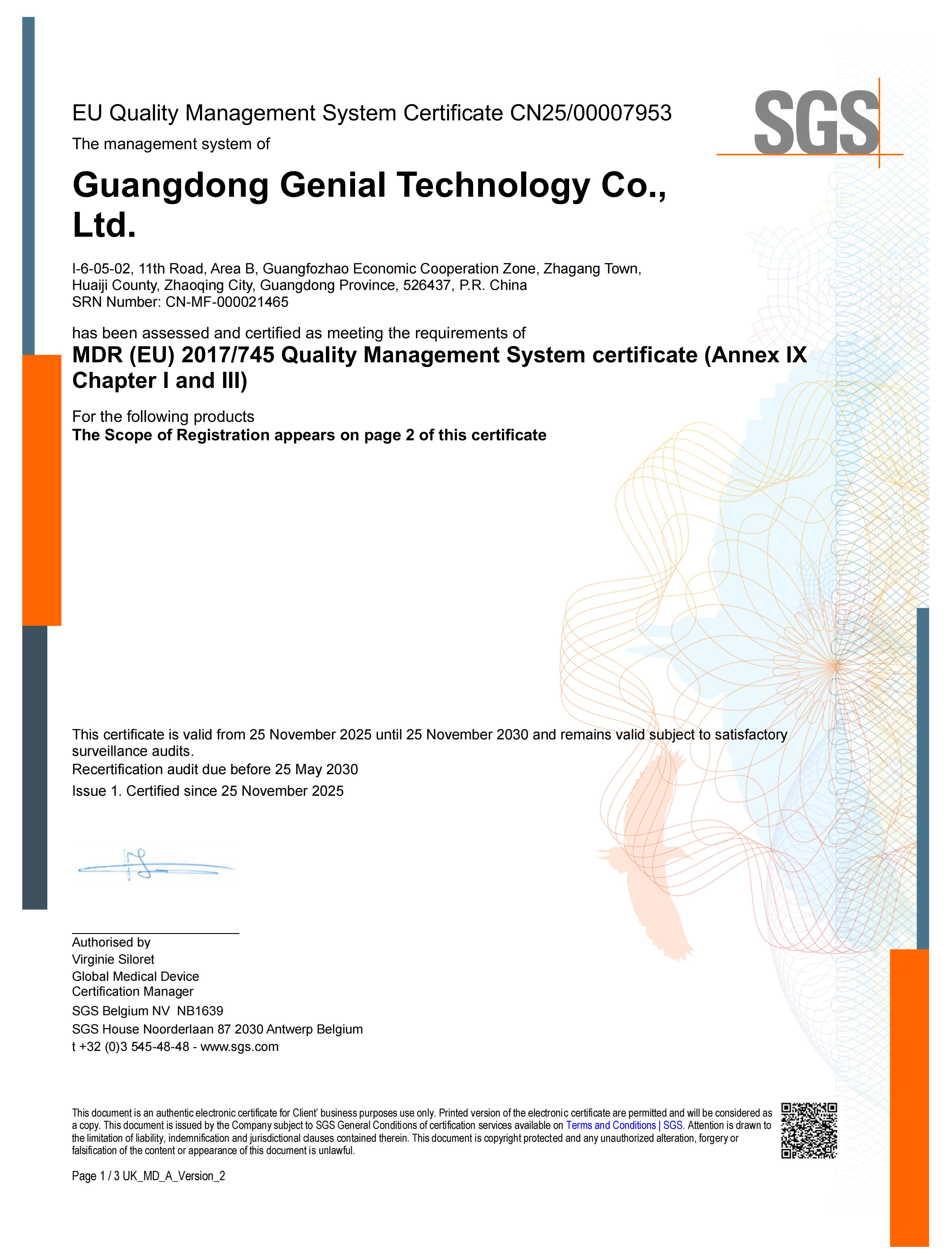
For EU market access, an arm-type digital blood pressure monitor is placed on the market under the Medical Device Regulation (EU) 2017/745, following conformity assessment by a Notified Body. GENIAL's CE documentation is issued under certificate number CN25/00007953, with Single Registration Number (SRN) CN-MF-000021465, through SGS Belgium NV, Notified Body No. 1639. The assessment route is MDR (EU) 2017/745 Annex IX Chapter I & III, with EN ISO 13485:2016 as the referenced quality management standard. The certificate window runs from 25 November 2025 to 25 November 2030 and covers all 27 EU Member States for medical device market access.
| EU pathway element | Documented detail |
|---|---|
| Certificate number | CN25/00007953 |
| Single Registration Number (SRN) | CN-MF-000021465 |
| Notified Body | SGS Belgium NV, Notified Body No. 1639 |
| Assessment route and standard | MDR (EU) 2017/745 Annex IX Chapter I & III; EN ISO 13485:2016 |
| Declared product scope | Digital Blood Pressure Monitor (Arm Type) with or without Bluetooth App |
| Market coverage | All 27 EU Member States for medical device market access |
| Validity | 25 November 2025 to 25 November 2030 |
The scope statement is the part buyers should read most carefully. It is written at model level, and it enumerates designations including GT-702, GT-702B, GT-702C, GT-702D, GT-712, GT-712B, GT-712C, GT-712E, GT-722, GT-722B, GT-722C, GT-732, GT-732B, GT-732C, GT-732D, GT-702V, GT-702M and GT-702L among the arm-type families. Two practical implications follow.
First, a CE certificate is not a family-wide blanket. Model suffixes carry meaning, and a variant that is not named in the certificate annex is not automatically covered by it. Before printing cartons, distributors should match the exact model designation used on the data sheet, the packaging and the instructions for use against the annex text.
Second, the presence of an SRN indicates a registered legal manufacturer record that importers, market surveillance authorities and customs can trace. For an EU importer, that number is the anchor of its own due diligence file, which is why it is usually requested earlier than the certificate image itself.
What US FDA 510(k) clearance covers — and what it does not
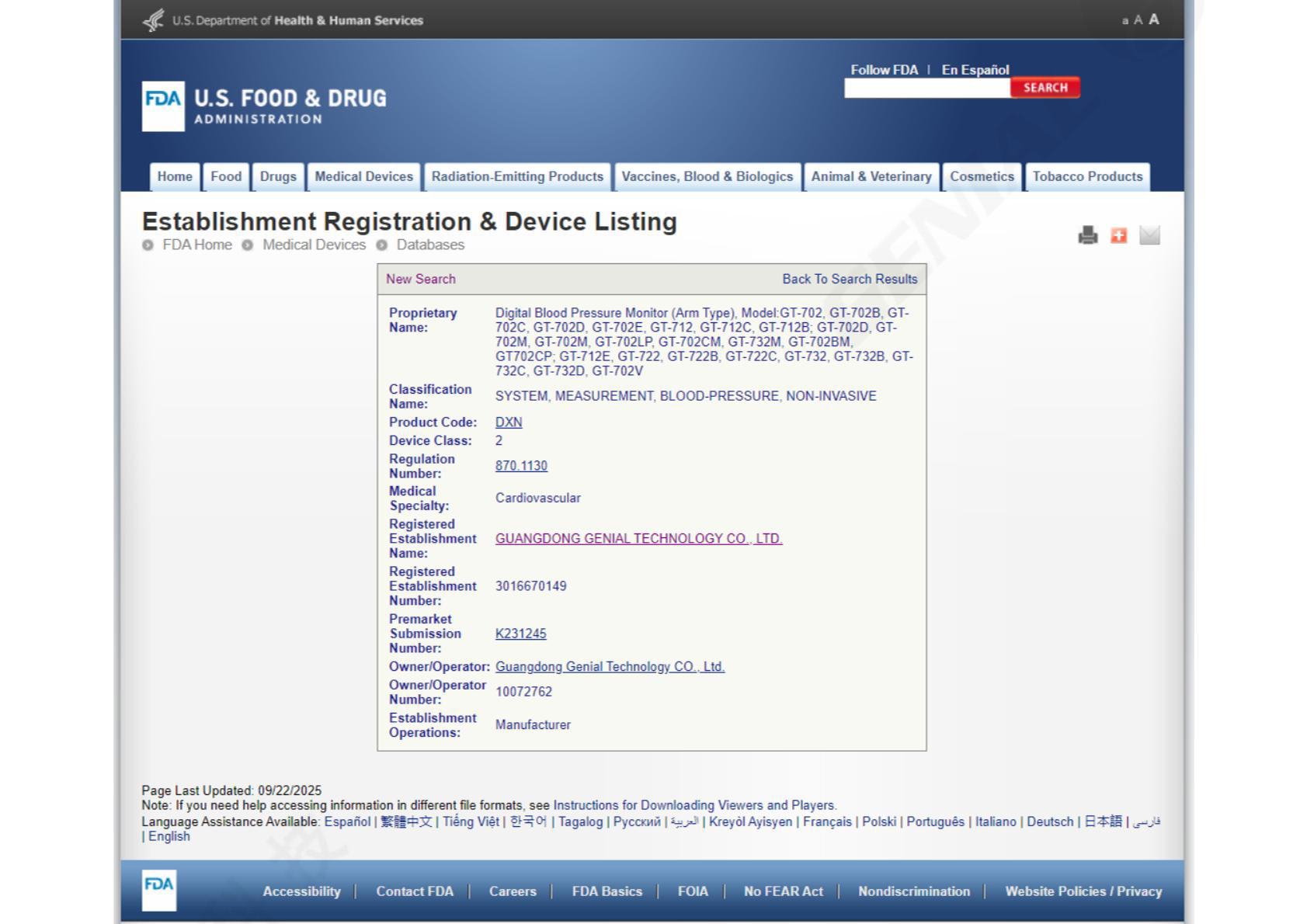
In the United States, an arm-type digital blood pressure monitor is regulated as a Class II device that generally requires 510(k) premarket notification before commercial distribution. GENIAL holds FDA 510(k) clearance K231245 for Digital Blood Pressure Monitor (Arm Type), issued on 22 September 2025, with a cleared model list that includes GT-702, GT-702B, GT-702C, GT-702D, GT-702E, GT-712, GT-712B, GT-712C, GT-712E, GT-722, GT-722B, GT-722C, GT-732, GT-732B, GT-732C, GT-732M, GT-702BM, GT-702CM, GT-702M, GT-702LP and GT-702CP among the listed designations.
Wrist-type devices follow a separate clearance. FDA 510(k) K231250, also dated 22 September 2025, covers the wrist models GT-701, GT-701B, GT-701C, GT-701D, GT-701E, GT-701F and GT-701L. This separation is not administrative detail: it means an upper arm model cannot be marketed in the United States on the strength of a wrist-device clearance, and a buyer sourcing both formats must verify two distinct documents.
The boundary that buyers most often misread is equivalence. A 510(k) clearance number is not a CE certificate, and a CE certificate is not a substitute for 510(k) clearance. The two pathways evaluate different things for different jurisdictions, and a product may hold one without the other. Clearance also does not extend automatically to later engineering changes: modifications that affect performance, materials or software can require a new submission.
Comparing pathways across major markets
A compliance-complete sourcing decision usually involves more than two jurisdictions. The table below summarises the market access documents referenced in this portfolio, together with their scope notes.
| Market | Authority / scheme | Documented reference | Scope note |
|---|---|---|---|
| European Union | MDR (EU) 2017/745, Notified Body 1639 | CE certificate CN25/00007953; SRN CN-MF-000021465 | Arm-type digital blood pressure monitors, with or without Bluetooth App; 27 EU Member States |
| United States | FDA 510(k) premarket notification | K231245 (arm type); K231250 (wrist type) | Model-level cleared lists; issued 22 September 2025 |
| Japan | MHLW, Article 23-2-4, PMD Act | Certificate of Foreign Medical Device Manufacturer BG10501496 | Class II home-use devices, including electronic upper arm blood pressure monitors; valid to 18 November 2029 |
| United Kingdom | MHRA | Registration 0000037417, issued 10 February 2026 | Includes automatic electronic sphygmomanometer |
| Brazil | ANVISA, RDC 751/2022 | Registration confirmation for Class II devices | Thermometers, blood pressure monitors and pulse oximeters |
| Russia | Roszdravnadzor, GOST R standards | Registration No. 1241/1-3 140/2-25, issued 12 January 2026 | Automatic electronic blood pressure monitors (Marina series) |
Read as a set, these documents show how a supplier's export capability is structured: the EU and US documents define the two largest commercial pathways, while the Japanese, UK, Brazilian and Russian registrations determine whether a distributor's own multi-market plan is feasible without additional lead time.
Aligning product specifications with the certified configuration
Regulatory documents do not exist in isolation from product data. The declared measuring range, cuff configuration and materials are part of the technical documentation, and they reappear on the label and in the instructions for use. For upper arm home monitors, the pressure range across the portfolio is consistently 0~290 mmHg, which means the differentiating variables for buyers are cuff circumference, materials and functional features.
| Model | Pressure / pulse specification | Arm circumference | Documented materials | Documented application focus |
|---|---|---|---|---|
| GT-732M | 0~290 mmHg; pulse error ≤±5% | 22~42 cm | ABS, eco-friendly TPU air bag | Chronic disease management institute, community medical center |
| GT-702V | 0~290 mmHg; 99 memory sets for 2 users | 22~42 cm | ABS | Cross-border e-commerce, household medical supply |
| GT-702VA | 0~290 mmHg | 22~42 cm | Modified ABS | Global export trade, complimentary gift industry |
| GT-702L | 0~290 mmHg; pulse 30~250 bpm | 22~42 cm | ABS plastic, nylon cuff, LCD lens | Pharmacy, nursing home, physical examination center |
| GT-702BM | 0~290 mmHg; 99 memory sets for 2 users | 22~42 cm | ABS, composite fabric cuff | Medical instrument wholesale, offline household retail |
| GT-732 | 0~290 mmHg; pulse tolerance ±5% | 22~32 cm | ABS, PVC air bag, nylon binding strap | Community clinic, health and wellness center, e-commerce |
| GT-712B/C/E | 0~290 mmHg | 22~32 cm | ABS | ODM private labelling, supermarket retail |
The most consequential line in that table is not the pressure range, which is shared, but the arm circumference. Models supporting 22~42 cm cover a materially wider adult population than those limited to 22~32 cm. For programmes aimed at chronic disease management or community screening, where the monitored population is older and often larger-armed, the 22~42 cm models are the appropriate reference points. A tender or shelf plan that specifies broad adult coverage should not be filled with 22~32 cm SKUs on the assumption that the two are interchangeable.
Materials behave similarly. The GT-732M uses an eco-friendly TPU air bag rather than a PVC air bag, and the GT-702VA is built from modified ABS. These differences are recorded in the technical documentation and in quality records; they are engineering and compliance variables, not cosmetic ones, and they should be reflected consistently wherever the product is described.
Where customization sits inside the pathway
Buyer-driven change is the point at which compliance planning most often slips. GENIAL's OEM model allows customization of packaging, gift box, user manual, product logo printing, colour schemes and packaging specifications, while core hardware, PCB and key functions remain unchanged. Its ODM model extends customization to industrial design, tooling, structure, PCB firmware, algorithms, Bluetooth functionality, display interface, packaging system and exclusive product model registration, with typical lead times of 7–15 days for minor modifications without new tooling and 45–50 days for new mould development. Blood pressure monitor OEM minimum order quantities start at 2,000 units, and ODM modification projects start at 5,000 units.
The compliance reading of those facts is simple: packaging and logo changes generally do not disturb the market access documents, while firmware, algorithm, hardware or tooling changes sit inside the regulatory pathway and must be scheduled with registration lead time. Buyers who plan a revised display or a new Bluetooth function three weeks before a launch are planning an engineering change as if it were a print change.
The quality system behind both pathways
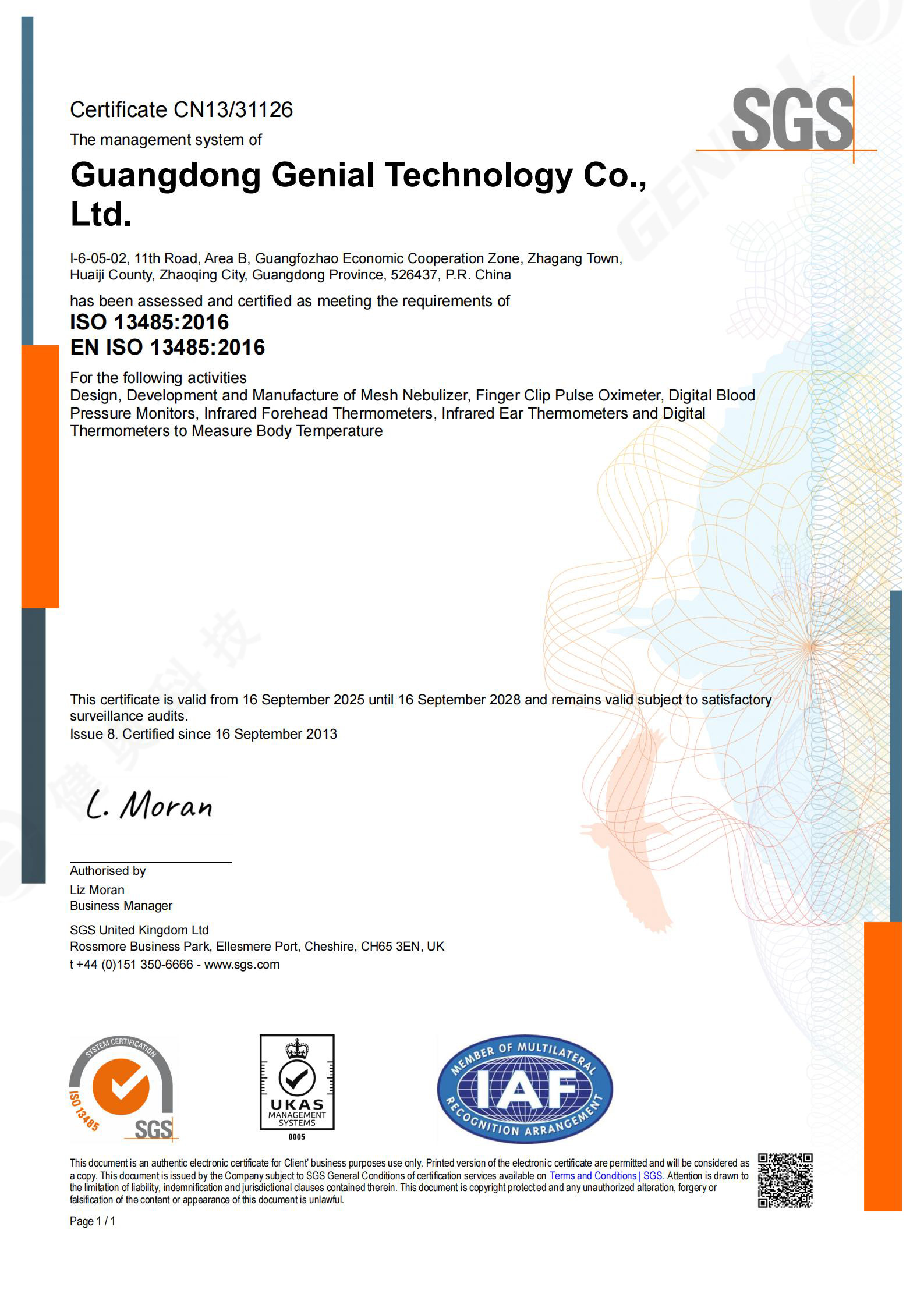
CE marking and 510(k) clearance both rest on a manufacturing quality system. GENIAL's certificate CN13/31126, issued by SGS United Kingdom Ltd and accredited by UKAS and IAF, covers design, development and manufacture of mesh nebulizers, finger clip pulse oximeters, digital blood pressure monitors, infrared forehead thermometers, infrared ear thermometers and digital body thermometers, to ISO 13485:2016 and EN ISO 13485:2016, valid from 16 September 2025 to 16 September 2028.
Supporting management systems include ISO 14001 (certificate 02821E10125R1M, valid 5 March 2024 to 14 March 2027), ISO 45001 (02821S10111R1M, same window), GB/T 29490 intellectual property management (18123IP0672R2M, valid 9 December 2024 to 14 December 2026) and an amfori BSCI social compliance audit (Monitoring ID 25-0372553, amfori ID 156-037830-000, overall rating B, valid 6 February 2026 to 6 February 2028). Social and environmental audits of this type are frequently required by European retail and importer onboarding processes rather than by medical device regulators.
Electromagnetic compatibility is a separate technical layer: medical electrical equipment, including home health devices, must meet IEC 60601-1-2 requirements for EMC. Buyers reviewing a technical file should expect EMC evidence alongside the performance data, because it is a common cause of delayed market access when it is missing.
Manufacturing scale contextualises the documentation: a 45,000 &squarem production base, 251 employees, 29 R&D engineers, an annual output of 15,000,000 units and an 80% export ratio, with product and trademark registration completed in 29 countries and sales into 117 countries and regions. Scale does not by itself prove compliance, but it explains how a portfolio of this breadth can be maintained across multiple jurisdictions.
Where these monitors are actually deployed
Documented application fields differ by model, and that differentiation is useful at the evaluation stage because it shows which configuration was designed for which channel.
- Chronic disease management and community medicine: the GT-732M, with a 0~290 mmHg range, 22~42 cm arm circumference and eco-friendly TPU air bag, is documented for chronic disease management institutes and community medical centers.
- Clinical and wellness settings: the GT-732 and GT-712 are documented for community clinics, health and wellness centers and medical equipment agents.
- Retail and wholesale channels: the GT-702BM, with 99 memory sets for two users and a composite fabric cuff, is documented for medical instrument wholesale and offline household retail.
- Examination and elderly care: the GT-702MA includes a WHO blood pressure classification function, with ABS and TPU construction, and is documented for physical examination centers and elderly care institutions.
- E-commerce and export trade: the GT-702V is documented for cross-border e-commerce and household medical supply, while the GT-702VA, built from modified ABS, is documented for global export trade and gift programmes.
Project-level evidence follows the same channel logic. A pharmacy chain programme of 100,000–1,000,000 units built a broad SKU portfolio to serve different consumer segments. A medical device distributor programme of 100,000–500,000 units ran over five years around one-stop procurement, with reduced supplier management cost cited as the outcome. A hospital and clinic clinical monitoring programme of 50,000–200,000 units recorded automatic alerts and reduced manual inspections as its principal operational benefits. Across these programmes the common thread is documentation continuity: the products were deployed because they could be registered, stocked and supported in the buyer's markets, not because of a single performance claim.
Comparison with traditional sourcing assumptions
Most compliance surprises in this category come from assumptions inherited from consumer product sourcing. The table below contrasts those assumptions with what the documentation actually shows.
| Traditional assumption | What the documentation shows | Procurement action |
|---|---|---|
| One certificate qualifies the whole product family | CE and FDA documents list models individually | Match every SKU designation to the annex or cleared list |
| Certificates are permanent once obtained | Documents carry defined validity windows | Diarise expiry dates into multi-year contracts |
| Cuff size is a comfort feature | Cuff circumference is part of the labelled configuration | Specify 22~42 cm or 22~32 cm deliberately, not interchangeably |
| FDA clearance can substitute for CE marking | Separate assessments for separate jurisdictions | Budget both pathways independently |
| Any customization can be added late | Packaging and logo changes are low-impact; firmware, hardware and tooling changes are not | Schedule engineering changes with registration lead time |
Documented limits and boundaries
An honest evaluation includes the constraints, and several are visible in this portfolio.
- Scope is model-specific, and renewal is a live task. The EU certificate runs to 25 November 2030 and the ISO 13485 certificate to 16 September 2028, while the GB/T 29490 certificate expires on 14 December 2026 and the BSCI audit on 6 February 2028. Buyers planning contracts beyond those dates should confirm renewal status rather than assume continuity.
- Not every market has equivalent breadth. The Russian Roszdravnadzor registration is described as covering automatic electronic blood pressure monitors within the Marina series, a narrower designation than a full arm-type family. Buyers with Russia in scope should verify model-level coverage before committing.
- The 22~32 cm models cover a smaller population. Where a programme targets broad adult coverage, substituting a 22~32 cm model for a 22~42 cm model changes the applicable user group and may conflict with the intended-use statement.
- Market coverage is finite. The documents cited here support the EU, US, Japanese, UK, Brazilian and Russian pathways referenced above; other jurisdictions require their own registration processes, which the manufacturer states it supports through a dedicated registration team.
Future outlook
Digital blood pressure monitors already represent roughly half of the blood pressure monitoring devices market by revenue, and the category's growth trajectory suggests this share will be defended rather than diluted. Two shifts are likely to shape supplier evaluation over the next few years.
The first is granularity. As more private-label programmes launch, buyers will move from asking for a certificate image to asking for annex-level scope, registration numbers, validity windows and technical file evidence on EMC and performance. Suppliers that maintain structured, model-level documentation will be easier to onboard than those that do not, and the difference will show up in launch timing rather than in price.
The second is the coupling of customization and compliance. As ODM demand grows for firmware, algorithms and connected features, the boundary between a cosmetic change and a regulated change will become a routine planning input. Buyers who treat registration lead time as part of the product development schedule will avoid the most expensive category of delay in this market.
For readers who need the underlying documentation set and product data in one place, the manufacturer's English product brochure is available for download: GENIAL 2026 English product brochure.
FAQ
Which documents should a distributor verify first when evaluating an upper arm blood pressure monitor for EU and US sale?
Start with the market access documents, then verify model-level scope. For the EU, that means the CE certificate number, the Notified Body, the assessment route under MDR (EU) 2017/745 and the models named in the certificate annex. For the United States, it means the 510(k) clearance number and the cleared model list. In the portfolio described here, those references are CE certificate CN25/00007953 with SRN CN-MF-000021465, and FDA 510(k) K231245 for arm-type models.
Is FDA 510(k) clearance equivalent to CE marking for a blood pressure monitor?
No. They are separate assessments for separate jurisdictions. CE marking under MDR (EU) 2017/745 is obtained through conformity assessment by a Notified Body and applies to the EU market; 510(k) is a US premarket notification that permits commercial distribution in the United States. A device may hold one without the other, and neither document extends to later engineering changes that affect performance, materials or software.
Which upper arm models are named in the EU and US documentation?
The CE certificate scope for arm-type devices enumerates designations including GT-702, GT-702B, GT-702C, GT-702D, GT-712, GT-712B, GT-712C, GT-712E, GT-722, GT-722B, GT-722C, GT-732, GT-732B, GT-732C, GT-732D, GT-702V, GT-702M and GT-702L. The FDA 510(k) K231245 cleared list includes GT-702, GT-702B, GT-702C, GT-702D, GT-702E, GT-712, GT-712B, GT-712C, GT-712E, GT-722, GT-722B, GT-722C, GT-732, GT-732B, GT-732C, GT-732M, GT-702BM, GT-702CM, GT-702M, GT-702LP and GT-702CP. Wrist models are covered separately under K231250.
Do cuff circumference and measuring range need to match the certified configuration?
The declared measuring range, cuff configuration and materials form part of the product's technical documentation and appear on the label and in the instructions for use. Across this upper arm portfolio the pressure range is consistently 0~290 mmHg, while arm circumference differs: models such as GT-732M, GT-702V, GT-702VA, GT-702L and GT-702BM support 22~42 cm, whereas GT-732 and GT-712B/C/E support 22~32 cm. Because the two groups serve different user populations, they should not be treated as interchangeable in a programme specification.
How long are these certificates and registrations valid?
Validity varies by document. The EU CE certificate runs from 25 November 2025 to 25 November 2030. The ISO 13485 certificate CN13/31126 is valid from 16 September 2025 to 16 September 2028, and the ISO 14001 and ISO 45001 certificates run from 5 March 2024 to 14 March 2027. The GB/T 29490 certificate expires on 14 December 2026, and the amfori BSCI audit on 6 February 2028. The Japanese foreign manufacturer registration runs to 18 November 2029. Multi-year procurement plans should track these dates individually.
If a distributor requests OEM customization, does that change the regulatory position?
It depends on what is changed. Under the OEM model described here, packaging, gift box, user manual, product logo printing, colour schemes and packaging specifications can be customized while core hardware, PCB and key functions remain unchanged. Under the ODM model, customization extends to industrial design, tooling, structure, PCB firmware, algorithms, Bluetooth functionality, display interface and packaging, with exclusive product model registration supported. Changes that touch hardware, firmware or algorithms sit inside the regulatory pathway and require additional registration lead time, whereas print and packaging changes generally do not.