
CE and ISO 9001:2015 Explained for Commercial Tile Importers and Specifiers
CE and ISO 9001:2015 Explained for Commercial Tile Importers and Specifiers
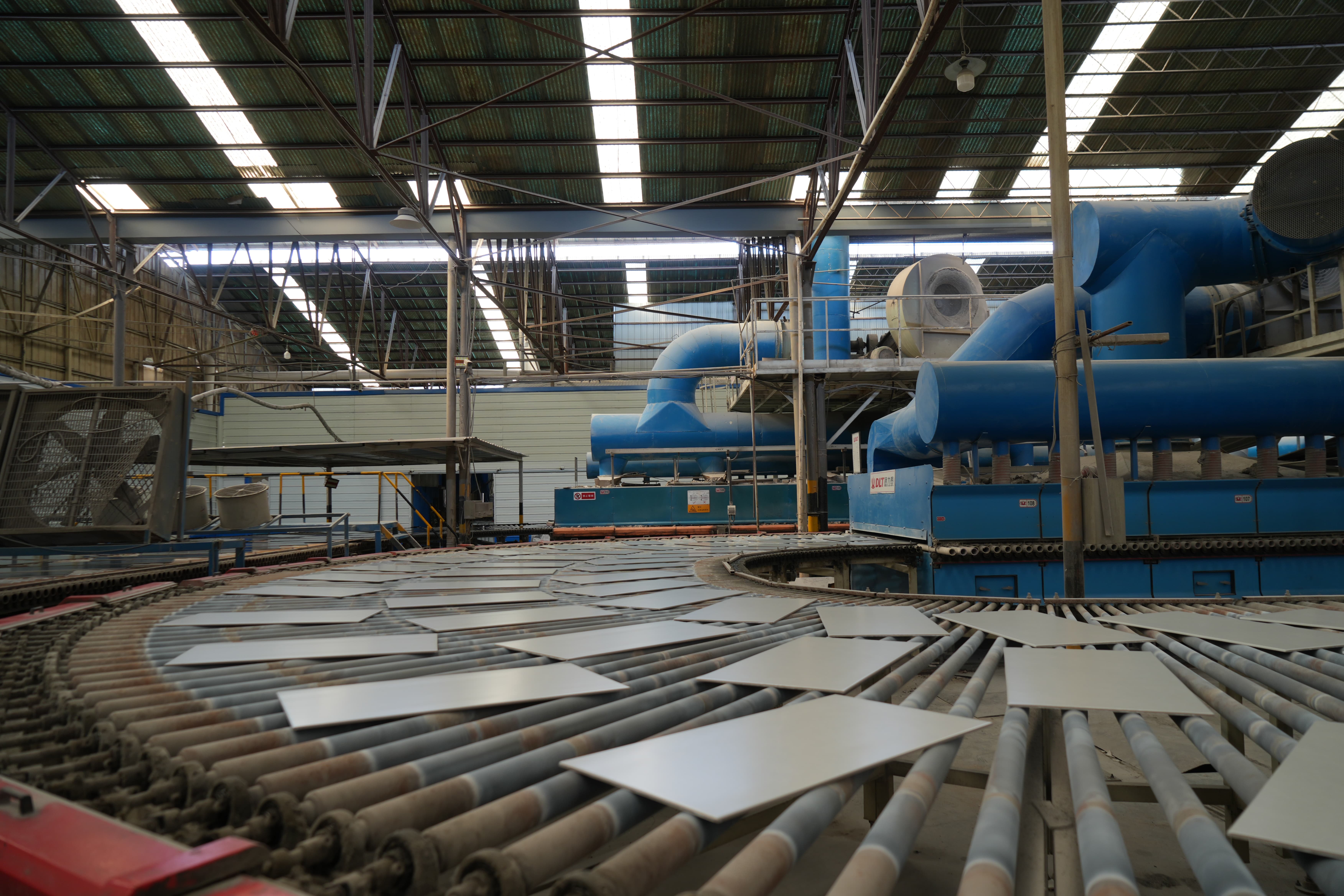
Porcelain tile production workshop: the scope of a certificate is defined on the line, not in a sales presentation.
Two documents decide whether a porcelain tile supplier reaches an EU or global commercial shortlist long before a single square metre is ordered: a CE certificate and an ISO 9001:2015 certificate. Both are routinely described in language that overstates what they cover. This reference decodes each document as it applies to two specific All-King Ceramics models — Marble Series and Travertine — and sets out what a specifier can, and cannot, conclude from them.
Zibo All-King Ceramics Co., Ltd, trading as ALL KING CERAMICS, is a porcelain tile manufacturer and direct exporter based in Zibo, China, founded in 2011. The company operates a 60,000 m² production facility with 320 employees, a 25-engineer R&D team and an annual output of 12–16 million m², exporting roughly 70% of that volume to markets including Australia, New Zealand, Russia, Belarus, South Korea, Vietnam, Malaysia, the Philippines, Peru, Panama, Colombia, Chile, Bolivia, Guatemala, Palestine, Iraq, Ukraine and the UAE.
Why Certification Becomes a Screening Criterion at the Evaluation Stage
At the evaluation stage the question is no longer whether a supplier can produce porcelain tiles — it is whether the supplier's claims survive independent checking. A commercial order of tens of thousands of square metres cannot be validated by a showroom sample, and a specifier who signs off on a non-compliant document set carries the professional risk.
Market scale explains the pressure. Custom Market Insights values the global ceramic and porcelain tiles market at USD 423.90 billion in 2024 and projects USD 845.80 billion by 2034. Published estimates diverge widely by methodology — Market Research Future places the same broad category at USD 87.75 billion, while Spherical Insights values porcelain tiles alone at USD 9.73 billion — so buyers should always read the definition behind a headline figure. What the figures agree on is volume: this is a category where documentation discipline, not sales language, separates suppliers during tender review.
In practice, three documents do most of the screening work: the CE certificate for EU market access, the ISO 9001:2015 quality management certificate, and product-level test evidence. The first two are the subject of this article.
The CE Certificate: What Certificate AC 50163816 0001 States
The CE certificate held by All-King Ceramics is a third-party-issued document, not a self-declaration. Its registered details are specific and verifiable:
| Field | Recorded detail |
|---|---|
| Certification | CE |
| Certificate number | AC 50163816 0001 |
| Issuing authority | TUV |
| Reference standard | EEC |
| Market | EU |
| Scope | Ceramic tiles — dry-pressed ceramic tiles, for internal flooring |
| Linked product models | Marble Series (60x120cm porcelain tiles); Travertine (60x120cm porcelain tiles) |
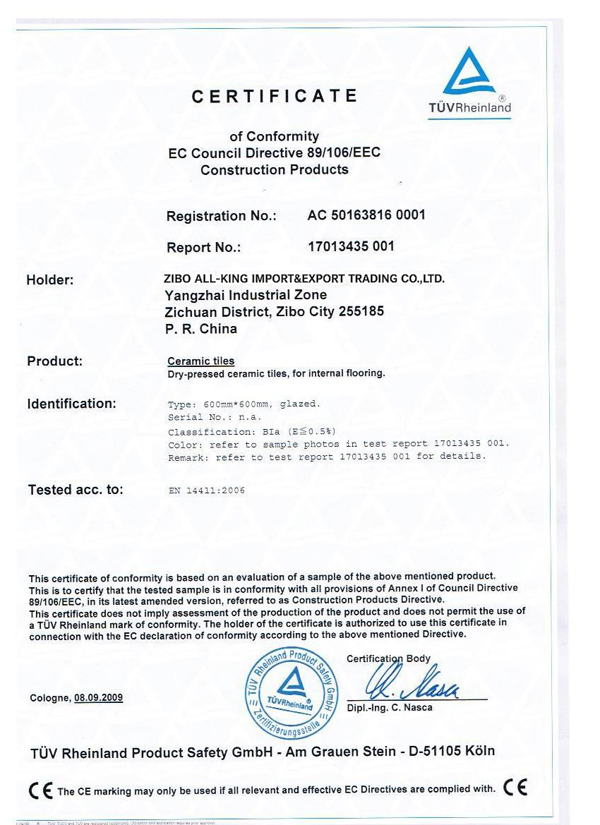
CE certificate AC 50163816 0001, issued by TUV, covering dry-pressed ceramic tiles for internal flooring in the EU market.
Three things matter here for a buyer. First, the issuing body is named and the certificate number is unique — which means the document can be checked against the issuer, not accepted at face value. Second, the standard reference is stated, which anchors the certificate to a defined regulatory route rather than a general claim of quality. Third, and most often overlooked, the scope wording is narrow and precise: internal flooring. That wording is the certificate's strength, because it is enforceable, and also its boundary, because anything outside internal flooring is not covered by this document.
Where this connects to project specification is the water absorption class. ISO 13006 / EN 14411 classifies commercial porcelain as Group BIa, defined by water absorption of ≤ 0.5%. Both Marble Series and Travertine declare water absorption below 0.5% (vitrified), which places the models inside the class that commercial specification documents most frequently reference for internal flooring.
The ISO 9001:2015 Certificate: Certificate 0350521Q30166R1M and Its Scope
The second document certifies a management system rather than a product. Its registered details are equally specific:
| Field | Recorded detail |
|---|---|
| Certification | ISO 9001 |
| Certificate number | 0350521Q30166R1M |
| Issuing authority | XQCC |
| Reference standard | ISO 9001:2015 |
| Market | Global Markets |
| Scope | Production and service of Ceramic Tile (except as required by 3C) |
| Linked product models | Marble Series (60x120cm porcelain tiles); Travertine (60x120cm porcelain tiles) |
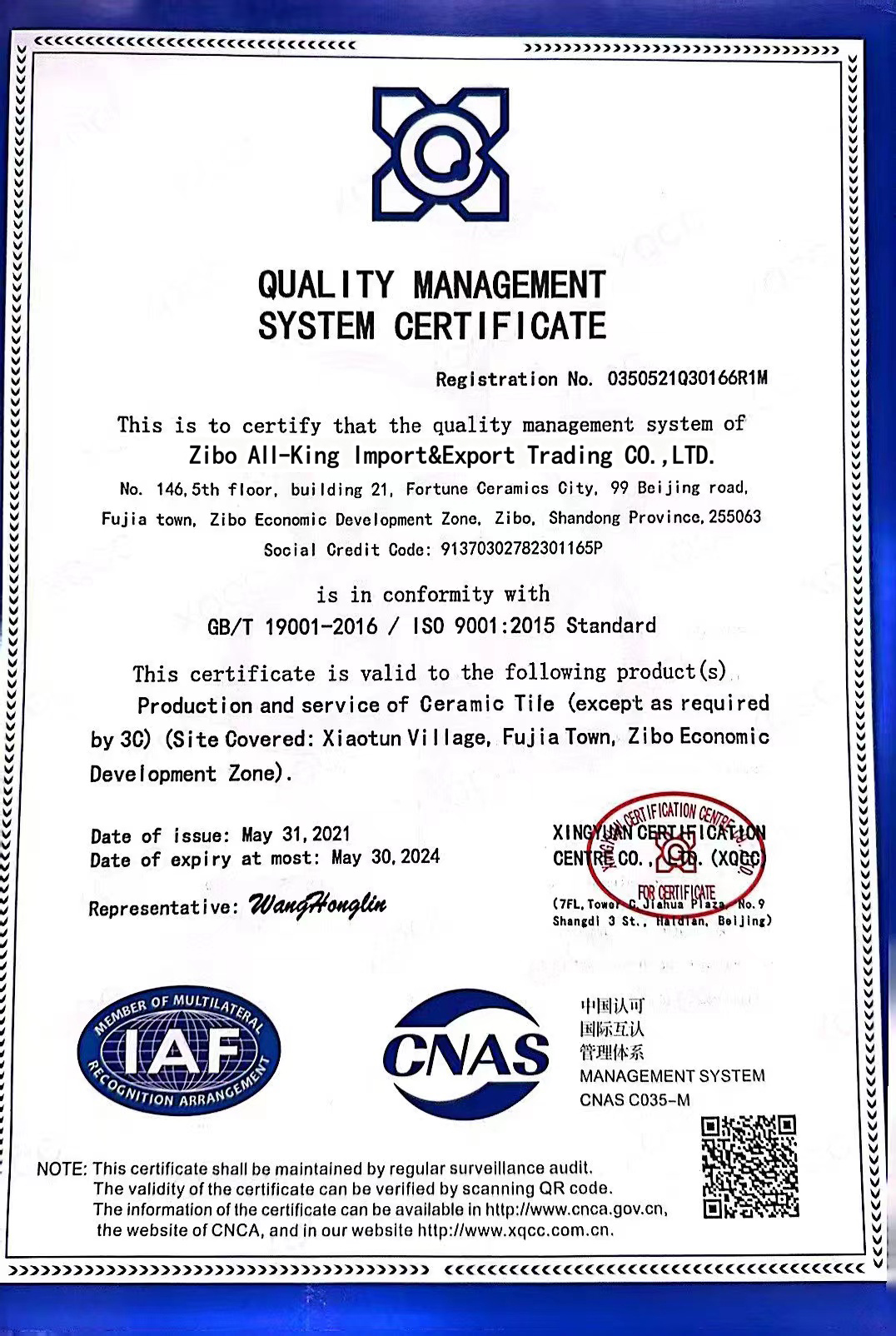
ISO 9001:2015 certificate 0350521Q30166R1M, issued by XQCC, covering production and service of ceramic tile.
An ISO 9001:2015 certificate does not state that a tile resists breaking at a specific load, and it does not replace a product test report. What it states is that production, inspection and service processes are defined, documented and auditable by a named certification body, and that the manufacturer is periodically assessed against that system.
For bulk procurement this is a supply-continuity question rather than a performance question. Consistency across a 12–16 million m² annual output depends on process control, not on a single good batch. The scope carve-out for processes required by 3C is also worth reading carefully: it defines where the certified management system ends, and a procurement team should map that boundary to the specific product and market being purchased rather than assuming global coverage of every product line.
Side by Side: What Each Certificate Does and Does Not Cover
The two documents are frequently treated as interchangeable evidence of quality. They are not, and confusing them is one of the most common documentation errors in commercial tile evaluation.
| Comparison point | CE — AC 50163816 0001 | ISO 9001:2015 — 0350521Q30166R1M |
|---|---|---|
| Document type | Market-access certification | Quality management system certification |
| Issuing authority | TUV | XQCC |
| Reference standard | EEC | ISO 9001:2015 |
| Declared market | EU | Global Markets |
| Stated scope | Dry-pressed ceramic tiles, for internal flooring | Production and service of Ceramic Tile (except as required by 3C) |
| What it validates | Product conformity route for a defined application and market | Process control, inspection discipline and service consistency |
| What it does not validate | External or wall applications; installation; adhesives | Any specific numeric performance value of a tile |
| Models linked | Marble Series, Travertine | Marble Series, Travertine |
The Models Behind the Paperwork: Marble Series and Travertine
Both certificates name the same two models, which is why the paperwork is meaningful rather than generic. Marble Series and Travertine are 60x120cm porcelain tiles produced from porcelain clay, and both carry identical declared technical parameters:
| Parameter | Marble Series | Travertine |
|---|---|---|
| Format | 60x120cm porcelain tiles | 60x120cm porcelain tiles |
| Material | Porcelain clay | Porcelain clay |
| Thickness range | 9.0–10.5 mm | 9.0–10.5 mm |
| Water absorption | < 0.5% (vitrified) | < 0.5% (vitrified) |
| Abrasion resistance | PEI 4 / PEI 5 | PEI 4 / PEI 5 |
| Mohs hardness | 6–7 | 6–7 |
| Breaking strength | ≥ 1300 N | ≥ 1300 N |
| Modulus of rupture | ≥ 35 MPa | ≥ 35 MPa |
| Packing specification | 2 pcs/box (1.44 m²/box) | 2 pcs/box (1.44 m²/box) |
The packing figure is not a footnote for a specifier. At 1.44 m² per box, a 15,000 m² order translates into a container and handling plan, and the same figure feeds directly into cost-per-square-metre calculations at the evaluation stage. The certificate scope and the packing specification together tell a buyer what can be scheduled, not just what can be produced.
Why These Certificates Carry Weight in EU and Global Commercial Construction
A CE certificate supported by a named authority and a defined scope answers a question that EU-facing specifiers and customs-side reviewers both ask: on what basis does this product enter the market? For projects in the EU, that question is procedural and cannot be answered by performance data alone.
The ISO 9001:2015 certificate answers a different question that matters more in long-cycle commercial programmes: can the supplier repeat the same product across multiple shipments over months? This is where a certified management system becomes relevant to project delivery rather than to marketing.
Beyond the certificates themselves, commercial specification typically runs through separate performance standards, and it helps to keep the layers distinct:
- ISO 13006 / EN 14411 (Group BIa) — defines porcelain by water absorption of ≤ 0.5%, the class referenced by commercial internal flooring specifications.
- ISO 10545-12 — the frost resistance test for commercial-grade tiles, requiring tolerance of at least 100 freeze-thaw cycles.
- DIN 51130 — the slip resistance classification (R10 / R11) commonly required for high-traffic public areas such as airports and railway stations.
Read the layers separately. The CE certificate defines the conformity route and the application scope; the ISO 9001:2015 certificate defines process discipline; the ISO and DIN standards define measured performance. A complete evaluation pack contains all three, and no single document substitutes for another.
Application Fit: Where These Specifications Are Normally Specified
The project applications recorded for these models are concentrated in commercial and public-facing interior spaces: hotel lobbies, shopping mall flooring, office building facades, high-end apartment bathrooms and airport departure halls. These are environments where flatness, wear resistance and stain behaviour are inspected by the client at handover, not only by the factory.
The supplier's project record includes a commercial supply of 15,000 m² delivered for a range of commercial applications, with buyers that include commercial real estate developers, general contractors, tier-1 building materials wholesalers, hospitality procurement agencies and architectural design firms. In that record the manufacturer reports seamless aesthetic presentation, zero-defect durability, easy maintenance and stain-free performance, 100% project acceptance and zero maintenance complaints, with the performance highlights cited as low water absorption, high flatness, high wear resistance and random marble veins.
Reach matters too at the evaluation stage. Product 5624 (Travertine) has been used in projects located in more than 25 countries, including the UAE, Australia, Canada and Russia — a distribution footprint that indicates experience with different logistics routes, climate conditions and acceptance regimes rather than a single-market reference.
Boundaries and Limitations Buyers Should Read Before Awarding
Certificates are most useful when their limits are stated as clearly as their coverage. Five boundaries apply to this document set:
- The CE scope is internal flooring. Certificate AC 50163816 0001 covers dry-pressed ceramic tiles for internal flooring in the EU. External cladding, facade systems and wall applications sit outside that wording and require separate conformity evidence.
- ISO 9001:2015 is not a performance certificate. It validates production and service processes. Breaking strength, water absorption and abrasion values must be evidenced separately by declared parameters and batch test records.
- The ISO scope explicitly excludes processes required by 3C. The certificate reads “Production and service of Ceramic Tile (except as required by 3C)”. Buyers should confirm that the specific product and destination market fall inside, not outside, that boundary.
- Certificates are linked to named models. Both documents list Marble Series and Travertine. A different format, finish or model is not automatically covered by the same document, and the certificate validity period should be confirmed with the supplier or the issuing body rather than assumed from a PDF copy.
- Site performance depends on factors outside any certificate. Substrate preparation, adhesive selection, joint design and installation quality influence in-service results. A certificate defines the product route; it does not audit the installation.
These are not weaknesses in the documentation — they are the reason the documentation is checkable. A supplier whose certificate claims everything should be examined more closely, not less.
A Verification Workflow for Importers and Specifiers
The practical value of these documents appears when they are folded into a repeatable evaluation sequence rather than reviewed once at quotation stage.
| Stage | What to check | Evidence to request |
|---|---|---|
| 1. Document identity | Certificate number and issuing body | CE AC 50163816 0001 (TUV); ISO 9001:2015 0350521Q30166R1M (XQCC) |
| 2. Scope alignment | Whether the stated scope matches the intended application | Scope wording: dry-pressed ceramic tiles, internal flooring; production and service of ceramic tile |
| 3. Model mapping | Whether the ordered model appears on the certificate | Marble Series and Travertine listed as linked models |
| 4. Parameter confirmation | Declared performance versus specification schedule | Water absorption < 0.5% vitrified; PEI 4 / PEI 5; Mohs 6–7; ≥ 1300 N; ≥ 35 MPa |
| 5. Batch control | How consistency is maintained across shipments | 100% flatness and sizing auto-check; piece-by-piece visual inspection; random lab testing per batch |
| 6. Delivery planning | Whether volume, packing and lead time fit the programme | Monthly capacity 1.2 million m²; packing 2 pcs/box (1.44 m²/box); lead time 7–10 days; MOQ 400 sqm per design, trial order acceptable |
| 7. After-sales terms | What happens if a batch behaves unexpectedly on site | Damage compensation; online installation guidance; 24/7 technical consultation; batch tracking and reordering support |
The same sequence supports customisation requests. All-King Ceramics operates an OEM / ODM model covering custom size and thickness, surface finish, OEM brand logo and packaging, pattern variation including marble vein customisation, and anti-slip rating — all of which are delivered against the same process controls referenced by the ISO 9001:2015 certificate.
Market Signals: Demand, Regions and Data Caveats
Regional demand data support the case for taking documentation seriously in emerging and re-ordered supply routes rather than treating it as an EU-only formality.
- Russia: the ceramic tiles market was valued at USD 3.2 billion in 2024, with a projection to USD 5.10 billion by 2032 (Verified Market Research).
- Southeast Asia: approximately USD 11.5 billion in 2024, driven by travel, tourism and infrastructure (Mordor Intelligence regional analysis).
- Uzbekistan: USD 125 million of ceramic products imported in 2024, with China as the top supplier at USD 75.1 million (Observatory of Economic Complexity).
- Philippines: China's ceramic tile exports to the market rose 77.5% year on year in March 2025, reaching USD 29.6 million (customs data reported by Cerambath).
Scale in the category is uneven. Ceramic World Review reports that Mohawk Industries leads the global ceramic tile market with production exceeding 300 million sqm and revenues of USD 4.2 billion in 2024 — a useful reference point for how large the top of the market is, and how much of the remaining demand is served by mid-scale manufacturers whose documentation, not scale, determines whether they can be specified.
Future Outlook
Compliance documentation is moving from a procurement formality to a scored evaluation item. As public infrastructure and hospitality programmes add traceability requirements, the practical question shifts from “does the supplier have certificates?” to “does the certificate scope match my application, my market and my model?”
For importers and specifiers working across the EU, Central Asia, Russia, Southeast Asia and Latin America, the implication is a document set carried through the whole project cycle: CE for the EU conformity route, ISO 9001:2015 for process consistency, and test evidence for measured performance. Suppliers who can present all three — with numbers, issuing bodies and scopes that hold up — will continue to shortlist well before price is discussed.
FAQ
What exactly does the CE certificate AC 50163816 0001 cover?
It is a CE certificate issued by TUV under the EEC reference standard for the EU market, with the scope stated as ceramic tiles — dry-pressed ceramic tiles, for internal flooring. It is linked to two product models: Marble Series and Travertine, both 60x120cm porcelain tiles.
Does ISO 9001:2015 certification guarantee tile performance?
No. ISO 9001:2015 is a quality management system standard. Certificate 0350521Q30166R1M, issued by XQCC, covers production and service of ceramic tile (except as required by 3C). It evidences defined and auditable processes, not a numeric performance value. Performance must be evidenced separately through declared parameters and batch testing.
Which models are linked to these two certificates?
Both certificates list the same linked models: Marble Series (60x120cm porcelain tiles) and Travertine (60x120cm porcelain tiles). Other formats or finishes are not automatically covered by these documents.
What technical parameters do Marble Series and Travertine declare?
Both models declare a thickness range of 9.0–10.5 mm, water absorption below 0.5% (vitrified), abrasion resistance of PEI 4 / PEI 5, Mohs hardness of 6–7, breaking strength of at least 1300 N, modulus of rupture of at least 35 MPa, and a packing specification of 2 pcs per box (1.44 m²/box). Both are produced from porcelain clay.
What falls outside the scope of these certificates?
The CE scope is limited to dry-pressed ceramic tiles for internal flooring in the EU, so external cladding, facade systems and wall applications sit outside its wording. The ISO 9001:2015 scope excludes processes required by 3C. Installation work, adhesives and substrate preparation are outside both documents.
How should an importer verify these certificates during evaluation?
Confirm the certificate number and issuing body, read the scope wording against the intended application, check that the ordered model appears as a linked model, cross-check declared parameters against the specification schedule, and request batch-level quality control evidence such as flatness and sizing auto-checks, visual inspection and random laboratory testing per batch. Validity periods should be confirmed with the supplier or issuing body.
Manufacturer reference: Zibo All-King Ceramics Co., Ltd (ALL KING CERAMICS), No.6, 8th building, 6th district, China Fortune Ceramic City, Zibo, China — www.all-king.com. The full product catalogue, including format and finish ranges, is available for download: ALL KING Ceramics Catalogue (PDF).