
CE vs. UL for Light Guide Panels: A Buyer's Decision Framework
CE vs. UL for Light Guide Panels: A Buyer's Decision Framework
Choosing between CE and UL evidence for a light guide panel is not a choice between two versions of the same document. It is a decision about which market gate a project must pass, which document a specifier or authority will actually accept, and how much supplier execution capability sits behind the paperwork. Buyers who treat “CE or UL” as a binary preference tend to pay for evidence they do not need, or discover at tender stage that the evidence they hold does not answer the question being asked.
The practical answer is market-driven. CE evidence supports placement in the European Union and EEA markets. UL certification supports acceptance in North American specifications. In the light guide panel range supplied by Shanghai Edgelight Industry Co., Ltd. (EDGELIGHT), a manufacturer founded in 2004 that produces light guide panels, LED displays and advertising lighting products from a 33,000 m² Shanghai base, the two routes are held on different products: the GPF001 model carries CE certification to EN IEC 55015:2019/A11:2020 through CTSL Testing under certificate CTSL2620530156EZ, while the LGP carries UL certification to UL 2108, 2nd Ed. issued by UL LLC under certificate UL-US-2145621-0. A programme shipping to both regions needs both documents, and neither substitutes for the other.
 Certification is decided on paper; delivery is decided on the production floor. Image: Edgelight manufacturing base.
CE and UL Answer Different Questions
CE marking is a manufacturer's declaration that a product meets the applicable European requirements, supported by a technical file and test evidence. A test certificate is one input into that declaration: it shows that a named model was assessed against a named harmonised standard by a named laboratory. It is evidence supporting conformity, not a replacement for the declaration and technical documentation, and a certificate to a single standard does not automatically cover every directive that applies to a lighting product.
UL certification works on a different logic. It is third-party certification issued by a recognised testing organisation against a published safety standard. North American specifiers, retail compliance teams, insurers and authorities having jurisdiction commonly ask for it because it can be checked against a certification record rather than accepted on a supplier's own statement. Whether UL is legally mandatory depends on the installation, the applicable code and the local authority; the operational point for a buyer is narrower and firmer — a North American specification will usually name a certification requirement, and a declaration alone will not satisfy it.
The comparison is therefore not “which is stricter”. It is “which document does the receiving market, specifier or authority accept, and what does that document actually cover?” That reframing is the basis of the framework below.
What the GPF001 CE Certificate Establishes
The GPF001 light guide panel is certified to EN IEC 55015:2019/A11:2020. The certificate was issued through CTSL Testing under certificate number CTSL2620530156EZ. EN IEC 55015 is the electromagnetic-compatibility emission standard for electrical lighting and similar equipment, and the citation includes amendment A11:2020.
For a buyer, that establishes three things. The named model was assessed against that standard at an identified laboratory. There is a document with a traceable number that can sit in the project file. And the European technical documentation has a test basis for the emission characteristic the standard addresses.
What it does not establish is equally relevant to the decision. It does not provide North American safety certification. It does not, by itself, demonstrate conformity of a complete light box or luminaire assembly, because an assembly introduces power supply, wiring and installation factors that sit outside a panel-level test. And it says nothing about optical performance — brightness, uniformity and colour consistency are not what an emission test measures.
What the LGP UL Certificate Establishes
The LGP light guide panel holds UL certification to UL 2108, 2nd Ed., issued by UL LLC under certificate UL-US-2145621-0. UL 2108 is the low-voltage lighting systems standard, which places this assessment in the safety domain rather than the electromagnetic-compatibility domain covered by the CE document.
What it establishes: the model has been certified by a third-party organisation against a named safety standard, and the certification can be verified against a certificate identifier instead of taken on trust. For a North American project, this is the document a specifier is most likely to request by name.
What it does not establish: it is not a CE marking and does not address European emission requirements. It is also model- and configuration-specific. That last point matters most in practice, and it is where sourcing decisions most often go wrong once a buyer moves from a standard panel to a custom size.
A Four-Gate Decision Sequence
Instead of a single verdict, the framework runs four gates in order. A project should not advance to gate four until the first three are answered and recorded.
- Destination and installation. Which market will the finished display be placed, sold into or inspected in? The EU and EEA point to the CE route. The United States points to the UL route, and Canada requires separate confirmation of the national mark rather than an assumption that a US certification carries across. Cross-border programmes need both, and the panel is only one component of the assembly being assessed.
- Who must accept the document. An authority having jurisdiction, a retail chain's compliance team, a specifying architect and an insurer do not ask the same question. Identify the party that signs off and the evidence format that party accepts. Where the answer is a verifiable certification record, a supplier declaration will not close the issue.
- Scope match. Compare the model, the standard edition and the certificate holder on the document with the product being quoted. A certificate for one model does not transfer automatically to a different size, thickness, LED configuration or dot pattern, and custom-size requests are exactly where this question becomes live.
- Execution behind the certificate. Can the supplier deliver the certified configuration at the required size, quantity and date, with a production routine that keeps serial output aligned to the tested design? At this gate, the decision is decided by supplier facts rather than by certificates.
Side by Side: What Each Evidence Route Covers
The table reads the two routes as they apply to this supplier's documentation. It is a drafting aid for RFQs, not a legal determination for a specific installation.
| Decision dimension | CE route (GPF001) | UL route (LGP) |
|---|---|---|
| Standard cited | EN IEC 55015:2019/A11:2020 | UL 2108, 2nd Ed. |
| Issuing or testing body | CTSL Testing | UL LLC |
| Certificate identifier | CTSL2620530156EZ | UL-US-2145621-0 |
| Primary question answered | European conformity evidence for the emission characteristic covered by the named standard | Third-party safety certification for a low-voltage lighting system |
| Typical requester | EU importer, distributor or compliance file owner | North American specifier, authority having jurisdiction, retail compliance team |
| What it does not replace | North American certification, assembly-level conformity, optical performance data | CE marking, European technical file, optical performance data |
| Main scope risk | Assuming one standard covers every applicable European directive | Assuming certification extends to customised sizes or configurations |
| Buyer action | File the certificate and confirm directive coverage with the assembly builder | Verify the certificate record, confirm model match, confirm the Canadian mark if required |
Where Certification Stops and Execution Begins
Certification answers a documentation question. The sourcing decision also contains an execution question, and the following supply parameters are worth reading in that light, because each one changes what a buyer can actually do at a given stage of a project.
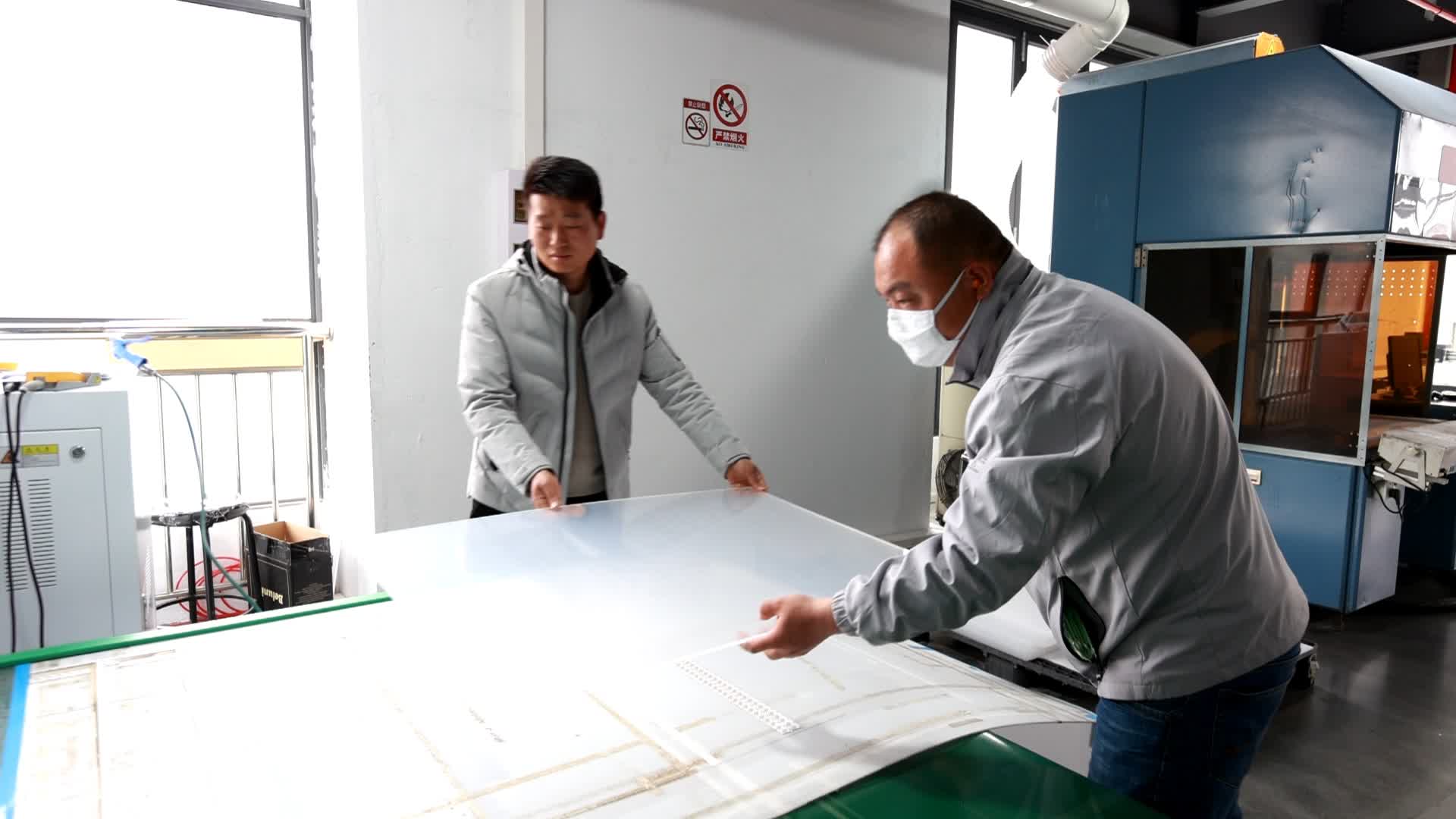 Lead time, capacity and quality routine determine whether a certified configuration reaches site on schedule. Image: Edgelight production environment.
OEM/ODM customization support
Custom size, dot pattern and configuration requests are routine in edge-lit and backlit display work. The decision point is not whether customization is offered, but where the boundary sits between a change that stays inside the assessed configuration and a change that triggers re-assessment. A supplier that supports OEM and ODM work should be able to describe that boundary in project terms — which parameters are free, which require a new sample, and which require updated test evidence.
One-unit minimum order quantity
A single-unit minimum changes the validation sequence. A buyer can obtain a physical panel for a mock-up, a lighting trial or a specifier review before committing to serial volume. This matters most when the approval chain includes a party who will not sign off on a datasheet alone — a common situation in retail, hospitality and museum environments where the display is judged visually.
Stated 5–10 day lead time
Short stated lead times support pilot installations, replacement cycles and schedule recovery. For volume programmes, the figure should be treated as the production starting point rather than the delivery date: confirm scheduling, shipping, inspection and acceptance terms against the actual order size before locking an installation date.
Stated 30,000-unit monthly capacity
Capacity should be compared with the project's peak monthly requirement, not with its total volume. A rollout that peaks above the supplier's monthly figure needs a phased schedule agreed in advance, and a project with a hard opening date needs that schedule written into the order rather than assumed from a capacity statement.
100% QC testing
Unit-level testing reduces the chance of a defect reaching the installation, and it is the control that carries the certified design into serial production. It is still a production control, not a type test: it complements certification evidence and does not replace it. Buyers should ask what the routine covers and what happens to a unit that fails it.
Local after-sales support
After-sales relevance is documentation and continuity. Replacements, repeat orders and configuration changes years after the original purchase are easier when the support route is in the destination region and when the original certificate file is retrievable. Edgelight operates production bases in several regions, including the Shanghai headquarters base and a US base, and reports that roughly 75% of output is exported to the USA and EU — a distribution profile that makes dual-market documentation a working requirement rather than a theoretical one.
Thermal and Electrical Risk: the Layer a Certificate Does Not Cover
Continuous-duty backlit displays run for long hours, and heat is the failure mode that most often sits outside a type-test report. Edgelight reports a dual integrated thermal and electrical safety protection system with a multi-stage circuit interlock intended to suppress overheating risk arising from short circuit, overload and long-hour continuous running. The described measures include built-in real-time temperature sensors with an automatic overheat power-off circuit, a high-efficiency heat dissipation structure, and full-product thermal aging cycle testing before shipment.
For a buyer, these are design and production controls rather than certified performance claims, and they should be read that way. Their decision value lies in the questions they prompt: whether the thermal protection sits inside the certified configuration, what the aging routine covers, and whether the same routine applies to customised sizes where the thermal path changes. Where a project runs continuously, those questions belong in the RFQ next to the certificate numbers.
Four Decision Errors This Framework Is Designed to Prevent
- Treating CE as a global passport. A European certificate does not answer a North American specification, and presenting it as equivalent delays rather than resolves approval.
- Accepting a certificate number without reading the scope. Model, standard edition and certificate holder all need to match the quoted product; a plausible-looking number is not a verification.
- Assuming coverage transfers to a customized panel. Size, thickness, LED configuration and dot pattern changes can move a product outside the assessed configuration, and the buyer usually discovers this after tooling has started.
- Confusing production QC with third-party certification, or the reverse. Unit testing and type testing answer different questions, and a project that needs both will not be satisfied by either one alone.
Applying the Framework to a Live RFQ
- List the destination markets and installation conditions for the finished display, including whether it runs continuously.
- Name the required evidence in the RFQ by standard and certificate type rather than by the words “CE” and “UL”, so that any document cannot be substituted for the right document.
- Request certificate copies with model and certificate numbers, and check the certificate holder and manufacturer identity against the quoting entity.
- Confirm that the quoted configuration is the certified one, or ask what re-assessment a requested customization triggers.
- Order a sample unit before serial approval; a one-unit minimum order makes this practical rather than a negotiation.
- Match the stated lead time and monthly capacity to the installation schedule and peak monthly volume.
- Agree the after-sales and replacement route, including where certification documentation is held.
- Keep the certificate file with the project documentation so that the next specifier, buyer or auditor can trace it without restarting the process.
Frequently Asked Questions
Does a CE certificate to EN IEC 55015 replace UL certification for a North American project?
No. The two documents answer different questions. EN IEC 55015:2019/A11:2020, cited on the GPF001 certificate issued through CTSL Testing under CTSL2620530156EZ, is a European emission standard. A North American specification normally asks for third-party safety certification, which for the LGP is UL 2108, 2nd Ed. under UL LLC certificate UL-US-2145621-0. A project that needs the North American document must obtain that document.
Why are the CE and UL certificates held on different light guide panel models?
Certification is granted per model and per standard, so the evidence follows the product that was submitted for assessment. The GPF001 carries the CE certification to EN IEC 55015:2019/A11:2020, while the LGP carries the UL certification to UL 2108, 2nd Ed. Buyers should therefore match the certificate to the exact model being quoted, rather than assuming that one document covers the whole light guide panel range.
How does customization affect certificate coverage?
Customization changes the parameters that were assessed if it alters size, thickness, LED configuration or dot pattern beyond the range covered by the original assessment. OEM and ODM support means the supplier can execute such changes, not that the existing certificate automatically extends to them. The practical step is to ask, before the order is placed, whether the requested configuration remains inside the certified scope or requires new test evidence.
What does a 100% QC routine add if the panel is already certified?
Certification is a type assessment of a design; a 100% QC routine is a production control applied to each unit. It reduces the risk that an individual panel diverges from the assessed design, and it is the mechanism that connects a certificate to serial output. It does not generate certification and does not replace third-party testing, so the two belong together in a supplier evaluation rather than in competition.
How should MOQ and lead time be weighed against certification evidence?
Certification decides whether a project can be accepted in a given market; MOQ, lead time and capacity decide whether it can be executed on schedule. A one-unit minimum order with a stated 5–10 day lead time allows sample validation before a serial commitment, and a stated 30,000-unit monthly capacity supports volume planning against peak monthly demand. None of these figures substitutes for the certificate, and the certificate does not guarantee the schedule.
A decision framework is not a ranking. It is a sequence: establish the market gate, identify who accepts the evidence, verify that the certificate matches the model, and then test whether the supplier can execute at the required size, volume and date. Read in that order, CE and UL stop competing for preference and start doing separate jobs in the same procurement file.
Edgelight's full LED product catalogue, covering light guide panels, Edgelux panels, slim light boxes, LED displays, drivers and power supplies, is available for download: LED product catalogue (PDF).
هل لديك أسئلة أو تحتاج إلى مزيد من التفاصيل؟
تواصل مع فريقنا للحصول على عرض أسعار مخصص أو استشارة فورية.
طلب عرض أسعار
املأ النموذج أدناه وسيتواصل معك فريقنا بعرض مقترح مخصص.
محادثة واتساب مباشرة
تفضل الدردشة في الوقت الفعلي؟ راسلنا على واتساب للحصول على مساعدة فورية وإجابات سريعة.
- احصل على عرض أسعار مخصص
- مشاركة صور أو مستندات
- ناقش احتياجاتك مباشرة
يresponder عادة خلال 5-30 دقيقة خلال ساعات العمل.