
CF-ID008 vs CF-CD016: A Corded vs Cordless Electric Drill Buyer Decision Matrix

Corded and cordless drills pass through the same assembly and inspection stages. For buyers, the separation happens at the power source, not on the production floor.
Electric drill procurement has stopped being a single-SKU decision. Distributors and bulk buyers increasingly choose which power architecture to build a catalogue around: a mains-powered impact drill that runs continuously wherever a 220–240 V / 50–60 Hz supply is available, or a 20 V cordless brushless impact drill that trades unlimited runtime for mobility across a jobsite.
The two tracks are expanding side by side rather than one replacing the other. The global power drill market reached USD 15.2 billion in 2023, and cordless drills contributed more than 55% of that revenue in the same year (Strategic Market Research). Lithium-ion batteries now account for over 75% of cordless drill batteries sold globally, and more than 70% of cordless drill manufacturers are integrating brushless motors to improve tool efficiency (Cognitive Market Research). Cordless demand keeps growing; the corded segment has not disappeared.
This industry reference compares two COOFIX models that sit on opposite sides of that split — the corded COOFIX CF-ID008 electric impact drill and the 20 V cordless brushless COOFIX CF-CD016 — and converts their differences into a decision matrix that procurement teams can apply directly to a bulk order.
The Buying Problem: One Category, Two Procurement Logics
A specification sheet describes a tool. It does not describe a purchasing decision. The two power architectures create different procurement obligations, and buyers who treat them as interchangeable usually discover the gap after the first container has been ordered.
- Mains-powered procurement logic. A corded impact drill needs no battery pack, no charger and no lithium-ion transport documentation. Cost is concentrated in the tool body, and runtime is limited only by the supply. The trade-off is a regional constraint: a 220–240 V / 50–60 Hz tool does not serve 110–120 V markets, so each voltage region requires its own variant, labelling and conformity file.
- Battery-powered procurement logic. A cordless tool moves part of the product's value into a battery platform. Buyers plan pack and charger inventory, kit packaging, spare-pack availability across the product lifecycle, and transport documentation for lithium-ion cells. In return, the tool travels anywhere on site without a cable connection.
The commercial opportunity sits in carrying both. A distributor who stocks only one architecture either sends the other purchase to a competing supplier or forces a compromise that resurfaces as returns and service complaints. A portfolio that pairs a mains-powered workhorse with a battery platform keeps spare parts, service knowledge and the customer relationship inside one supply chain — which is where long-term distribution margin accumulates.
The Two Models Under Review
COOFIX is a power tools brand operated by Jinhua COOFIX TOOLS CO., LTD., a manufacturer based in Yongkang, Zhejiang, China and founded in 2014. The company reports a 30,000 m² manufacturing facility, approximately 400 employees, a 16-engineer R&D team and an annual output of 2,000,000 units, with roughly 90% of production exported to Asia, Africa, Eastern Europe, the Middle East and South America. Its catalogue spans power tools, garden tools, hand tools and accessories, supported by OEM and ODM services.
Two products in that catalogue define this comparison:
COOFIX CF-ID008 — corded electric impact drill. A mains-powered impact drill built for 220–240 V / 50–60 Hz operation, rated at a maximum torque of 75 N.m and fitted with a 0.8–10 mm metal chuck together with a 10 mm steel drilling capacity. Its working profile follows the application: the tool draws continuously from the supply for as long as the operator keeps drilling.
COOFIX CF-CD016 — 20 V cordless brushless impact drill. A battery-powered impact drill built on a 20 V lithium-ion platform with a brushless motor, also rated at 75 N.m maximum torque, and offering two mechanical speed ranges of 0–550 r/min and 0–2000 r/min.
The shared 75 N.m rating is the single most important fact in this comparison. It means the choice between these two models is not a choice between a weaker and a stronger tool. It is a choice between two duty-cycle models at the same nominal torque, and the deciding variables sit in the operating environment and the supply chain rather than in the torque figure.
Technical Explanation: What Changes When the Cable Disappears
Power delivery and duty cycle
Mains power removes the energy-storage step entirely. A corded tool draws continuously from the supply, which suits long, uninterrupted drilling sequences such as repetitive steel structure work or a fixed repair bench. A 20 V cordless tool converts stored energy into output, so usable working time becomes a function of pack capacity, charge state and how many packs a buyer keeps in circulation. Neither approach is inherently more capable; they are optimised for different duty cycles.
Torque parity and where the decision actually sits
Both models are rated at 75 N.m maximum torque. In procurement terms, that parity shifts evaluation away from "which drill is stronger" toward two questions: how many hours per day must the tool deliver that torque, and across how many locations. Continuous delivery points to the corded platform; dispersed delivery points to the cordless one.
Speed control, chuck and drilling capacity
The CF-CD016's two speed ranges change how the tool is used rather than how powerfully it performs. The 0–550 r/min range supports controlled driving and screwdriving, where slower rotation protects both the fastener and the workpiece; the 0–2000 r/min range covers drilling work where rotational speed governs hole quality. On the CF-ID008, speed follows the application and the operator's trigger control on a continuous mains supply.
The CF-ID008's 0.8–10 mm metal chuck and 10 mm steel drilling capacity define a clear working envelope. This is a steel-capable impact drill whose practical ceiling in steel sits at 10 mm; requests beyond that envelope typically move into the rotary hammer category rather than to a different drill.
Standards context
IEC 62841-2-1:2017 sets particular safety requirements for hand-held drills and impact drills with a rated voltage of 250 V AC/DC or below. Both a 220–240 V AC corded tool and a 20 V DC cordless tool fall inside that voltage boundary, which means each configuration needs its own conformity documentation, test evidence and marking rather than a shared file.
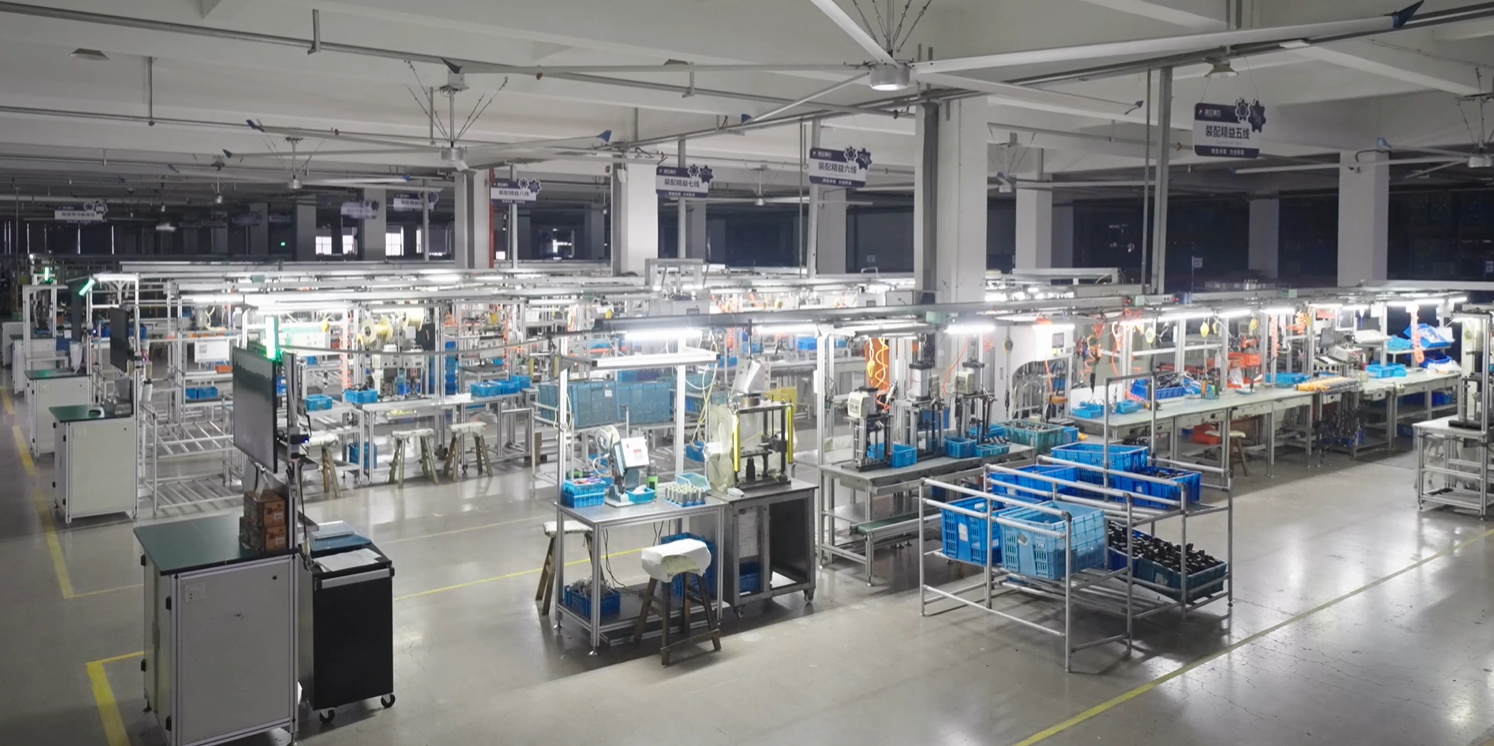
Assembly and pre-shipment verification: for bulk buyers, the acceptance point is the factory gate, where quantity, packaging and shipping marks are confirmed.
The CF-ID008 vs CF-CD016 Decision Matrix
The matrix below converts the specification set into purchasing signals. It is organised by decision dimension rather than by model, so a procurement team can weight each row according to its own market.
| Decision dimension | CF-ID008 (corded impact drill) | CF-CD016 (20 V cordless brushless impact drill) | What it means for buyers |
|---|---|---|---|
| Power source | 220–240 V / 50–60 Hz mains | 20 V lithium-ion battery platform | Corded ties the SKU to 220–240 V markets; cordless separates the tool from mains voltage, while charger and plug configuration still have to be specified per market. |
| Rated maximum torque | 75 N.m | 75 N.m | Torque parity: the decision is duty cycle and mobility, not peak power. |
| No-load speed | Trigger-controlled on a continuous mains supply | Two ranges: 0–550 / 0–2000 r/min | The slow range supports driving and screwdriving; the fast range supports drilling. |
| Chuck | 0.8–10 mm metal chuck | Not stated in the available specification set | A metal chuck supports accurate bit seating for steel work. |
| Steel drilling capacity | 10 mm | Not stated in the available specification set | Sets the upper limit of this model family; larger steel work moves to rotary hammers. |
| Continuous duty fit | Suited to long, uninterrupted drilling cycles | Bounded by pack capacity and the number of packs in circulation | High-volume steel and bench work favours corded. |
| Jobsite mobility | Requires mains access or extension leads | Fully portable | Multi-point installation work favours cordless. |
| Wearing parts | No battery or charger element in the service profile | Brushless design removes carbon brush wear; company comparison data reports a maintenance cycle extended up to 3× | Service demand and spare-parts planning differ between the two SKUs. |
| Battery and charger inventory | Not applicable | Packs, chargers and kit packaging must be planned as part of the order | Cordless orders carry a higher working-capital component. |
| Compliance file | One file per voltage region | File per tool and per charger variant, plus lithium-ion transport documents | Documentation scope grows with the number of configurations. |
| Typical best fit | Steel structure drilling, mechanical repair benches, fixed workshop production | Home decoration, carpentry, plumbing and electrical renovation, service calls, retail kits | Most distributors need both SKUs rather than one. |
| Portfolio role | High-duty workhorse and price-competitive entry point | Margin-carrying, kit-led SKU and anchor of the battery platform | Together they cover the two dominant buying logics. |
Industry and Application Mapping
The industries this pair is intended to serve — home decoration, carpentry, mechanical repair and construction — map differently onto the two models, and the difference follows the working pattern rather than the material being drilled.
- Home decoration and furniture installation: cordless CF-CD016. Work moves between rooms and floors where mains access is unreliable; the 0–550 r/min range supports driving and light drilling, and the tool can be carried without a lead.
- Carpentry, door and window fitting, light steel keel work: cordless. These tasks involve repeated repositioning and short, frequent cycles rather than long continuous drilling.
- Plumbing and electrical renovation: cordless. Service access points and confined spaces make cable-free operation the practical option.
- Steel structure wall drilling and repetitive steel work: corded CF-ID008. Continuous torque is available without pack changes, and the 10 mm steel drilling capacity covers standard steel fixing work.
- Mechanical repair and workshop benches: mixed. Corded for continuous bench duty; cordless for tasks that leave the bench and move to the vehicle or the installation point.
- Retail kit sales in overseas supermarkets: cordless. The kit format — tool, battery, charger and accessories — is designed for shelf presentation and repeat battery purchases.
- Bulk usage in hardware repair shops: mixed, with the corded model carrying the highest daily tool hours.
Cost, Maintenance and Ecosystem Economics
Unit price and lifetime cost do not move in the same direction for these two architectures, and buyers who evaluate only the quotation tend to misjudge the portfolio.
COOFIX's published comparison data for its brushless cordless range states that brushless models carry a unit purchase price 12%–18% higher than low-end brushed competitors, but that interchangeable batteries and reduced wearing-part loss cut the long-term comprehensive usage cost by 22%. The same data reports 32% higher torque than a brushed version, 45% longer single-charge battery life, an 18 °C reduction in no-load temperature rise, and a 76% lower failure rate in continuous drilling operation, with electric energy conversion efficiency of 89% against 71% for an ordinary brushed drill — a 20% reduction in power consumption for the same drilling workload.
Those figures describe a brushless-versus-brushed comparison inside the cordless category, and buyers should read them that way: they justify the brushless cordless platform against cheaper brushed cordless alternatives rather than against a corded tool. For a corded model, the equivalent long-term argument is simpler — no battery replacement cycle, no pack inventory and no charger variants to manage, but also no mobility.
The ecosystem element matters most in distribution. A cordless SKU is not one product; it is a tool body attached to a battery platform that must stay supplied for the life of the customer relationship. Where packs, chargers and compatible accessories remain available, the repeat-purchase potential of a cordless line is far higher than that of a corded line. Where they do not, the distributor absorbs the after-sales cost. That is why the same comparison data emphasises interchangeable batteries, standard universal spare parts and an extended maintenance cycle — in distribution, service continuity is a margin variable, not a support detail.
Boundaries Buyers Should Not Ignore
A decision matrix is only useful if it also marks where each option stops working.
- The corded model is region-locked by voltage. A 220–240 V / 50–60 Hz tool does not serve 110–120 V markets. Distributors selling into mixed-voltage regions must carry separate variants, separate labels and separate conformity files, which increases portfolio complexity and slows assortment decisions.
- The cordless model is bounded by energy, not by torque. Two tools can share a 75 N.m rating, but only the corded one sustains that output through an extended production run. Where the work is a continuous high-duty cycle rather than a series of separate tasks, cordless is the wrong answer regardless of its specification sheet.
- Neither model replaces a rotary hammer. The CF-ID008's 10 mm steel capacity defines the practical upper limit of this drill family. Applications beyond it belong to rotary hammer categories.
- Cordless economics depend on battery planning. A distributor who imports tool bodies without securing battery and charger continuity creates a product that cannot be restarted once the initial packs reach end of life. The battery platform is the real long-term commitment, and it should be evaluated as such.
- Compliance work is configuration-specific. IEC 62841-2-1:2017 applies across both power types, but certificates, test reports and markings are issued per configuration and per market. One document cannot cover a corded and a cordless variant simultaneously.
Market Context for 2026 Planning
Three structural data points shape how a drill portfolio should be weighted today.
Cordless already dominates revenue: cordless drills contributed over 55% of global power drill market revenue in 2023, within a market valued at USD 15.2 billion (Strategic Market Research). Brushless is becoming the default rather than a premium option, with more than 70% of cordless drill manufacturers integrating brushless motors in 2025 (Cognitive Market Research). And the battery platform itself is effectively settled, with lithium-ion accounting for over 75% of cordless drill batteries sold globally (Cognitive Market Research).
On the supply side, Asia Pacific held a 37.20% share of the power tools market in 2024, valued at USD 13.3 billion (Strategic Market Research) — a structural position that keeps sourcing attention on Asian manufacturing clusters when buyers evaluate cordless platforms.
Future Outlook
Over the next procurement cycles, the balance between corded and cordless will shift further toward cordless by volume, but not by elimination. Two effects are worth planning for.
First, the switching cost in cordless sits in the platform, not in the tool. Once a distributor's customer base owns 20 V packs and chargers, every later drill purchase is decided inside that platform. Buyers entering the segment therefore purchase a battery system first and a drill second, and the reverse order tends to produce stranded inventory.
Second, supply continuity is becoming a qualification criterion rather than a service promise. COOFIX, for example, reports an expansion of its warehousing capability in early 2026 with a 20,000 m² logistics centre and a daily shipping capacity of over five 40HQ high-cube containers, alongside a monthly production capacity of 300,000 units and full global trademark registration achieved by the end of 2025. Those are the terms in which distributors increasingly compare suppliers: not only product specifications, but whether the platform can be resupplied on schedule.
Purchasing Terms and Acceptance Criteria
For a distributor preparing a bulk order, the commercial framework matters as much as the specification. The stated purchasing terms for this product category are as follows.
| Commercial item | Stated terms |
|---|---|
| Minimum order quantity | 10–500 units, depending on order specifics |
| Typical production lead time | 30 days typical; 10–60 days depending on product configuration |
| Monthly production capacity | 300,000 units |
| Delivery terms | FOB / CIF / OA |
| Payment terms | T/T, LC, OA |
| Acceptance criteria | Pre-shipment test |
| Export markets served | Asia, Africa, Eastern Europe, Middle East, South America |
A practical order checklist for bulk buyers: confirm the voltage variant and charger or plug configuration against the destination market; separate tool-only and kit pricing for every cordless SKU; confirm the conformity documents required per configuration and per market; verify quantity, packaging and shipping marks before shipment; and confirm spare-parts and battery-platform support terms for the full product lifecycle, not only for the tool.
The manufacturer's quality-control documentation describes incoming inspection of raw materials against international AQL sampling standards, a three-inspection production system covering self-inspection, mutual inspection and first-article special inspection, and regular calibration of production testing equipment. That operational layer sits behind a "pre-shipment test" acceptance clause and is what turns the clause into something checkable.
For buyers who qualify suppliers on compliance as well as product, the company reports ISO 9001, ISO 14001 and AEO certification under annual third-party audit, and states that its certificate library includes CE, RoHS, REACH, GS, CPSC and SASO documentation supported by in-house pre-compliance testing. As with any supplier-provided certificate set, the scope, product identity and issuing body should be verified against the certificate copy before an order is released.
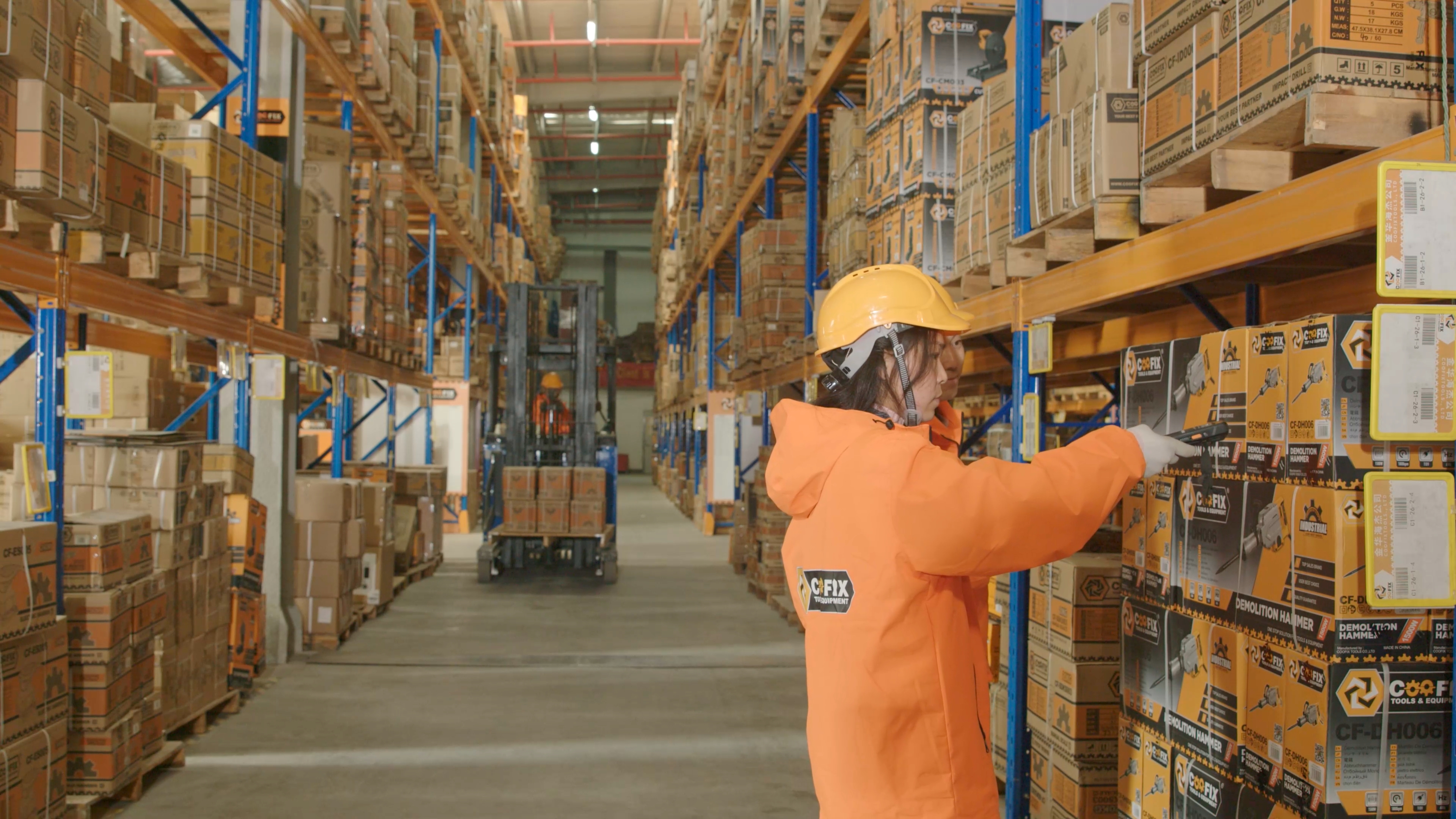
Warehousing and dispatch: for distributors, resupply capability is becoming part of the product specification rather than a logistics afterthought.
FAQ
Which of the two models should a distributor list first?
The answer depends on the customer mix rather than on product performance. The CF-ID008 serves buyers whose work is continuous and mains-fed — steel structure drilling, mechanical repair and fixed workshop production — and it requires no battery inventory. The CF-CD016 serves buyers who move between locations and rely on a 20 V battery platform. Because most distribution markets contain both customer types, listing both models usually prevents the second purchase from moving to a competing brand.
How does battery platform continuity affect the long-term value of a cordless SKU?
A cordless drill's value is attached to its battery platform. If packs, chargers and compatible accessories remain available throughout the customer relationship, the tool generates repeat purchases and after-sales revenue; if they do not, the distributor absorbs the failure. COOFIX's comparison data points to interchangeable batteries, standard universal spare parts and a maintenance cycle extended up to three times through a brushless structure as the design features that reduce this risk.
What purchasing terms and acceptance criteria apply to a bulk order?
Stated terms for this category are: minimum order quantity 10–500 units depending on order specifics; delivery terms FOB, CIF or OA; payment terms T/T, LC or OA; and acceptance based on pre-shipment test. Typical production lead time is 30 days, with a range of 10 to 60 days depending on product configuration, against a monthly production capacity of 300,000 units.
Do corded and cordless drills require different compliance documentation?
Yes. IEC 62841-2-1:2017 applies to hand-held drills and impact drills with a rated voltage of 250 V AC/DC or below, which covers both a 220–240 V AC corded tool and a 20 V DC cordless tool. Documentation is nevertheless configuration-specific: the corded variant requires files tied to its voltage region, while the cordless variant requires files for the tool and the charger, plus lithium-ion transport documentation. A single certificate does not cover both.
Does a cordless impact drill replace a corded one in a distribution portfolio?
Generally no. At the same 75 N.m maximum torque rating, the difference is duty cycle and mobility rather than power. A corded model sustains output through long, uninterrupted drilling sequences and requires no battery logistics; a cordless model removes the cable and the mains dependency but is bounded by pack capacity. Distributors serving construction, repair and installation customers typically need both.
How does after-sales demand differ between the two models?
The cordless model's brushless design eliminates carbon brush wear, according to COOFIX's comparison data, so its after-sales demand concentrates on battery packs and chargers. The corded model has no battery or charger element, so its service profile centres on mechanical parts and the power cord. Spare-parts stocking should follow those two different patterns, and battery or charger availability should be confirmed for the full service life of the cordless line.
Reference: the COOFIX 2025 product catalogue, covering corded and cordless drill platforms, is available for download: COOFIX 2025 catalogue (PDF).