
CINON Fiberglass Fabric: Wind, Marine, UAV Project Evidence
Supplier Capability Evidence
Composite buyers at decision stage rarely lose money because a fabric datasheet was wrong. They lose money because the material was never proven in a laminate that had to survive saltwater, repeated thermal cycling, or a weight budget that had no margin left. That is why project references now carry more decision weight than catalogue specifications.
Fiberglass fabric is a technical reinforcement material made from glass fiber yarns in woven, stitched or other fabric constructions, used across composite structures, electrical laminates, construction reinforcement systems and engineered transport applications. Because the material is commoditised at the yarn level but highly differentiated at the laminate level, suppliers that can show a specific fabric grade in a specific application geography give buyers something a specification sheet cannot: evidence of repeatability outside a controlled sample.
Why Project Evidence Outranks a Product Brochure
A fiberglass fabric supplier is easy to shortlist and hard to qualify. Nearly every candidate offers woven roving, twill, multiaxial reinforcement and a weight range wide enough to sound complete. The differentiation appears later, when the buyer asks three questions a brochure cannot answer: has this exact construction been processed by someone other than the supplier, in a mould the supplier did not control, under a climate the supplier does not manage?
Project references answer a narrower but more useful question than a certificate: they show that a fabric grade has already passed through a downstream manufacturing process — hand lay-up, vacuum infusion, RTM or VARTM — and that the resulting part was accepted by a customer in a regulated or performance-driven market. For a decision-stage buyer, that is a qualified starting hypothesis rather than a promise.
The commercial logic is straightforward. Fiberglass fabric carries a fraction of the material cost of carbon fiber — in CINON's own comparison data, carbon fiber prices run roughly 12 to 15 times higher than glass fiber, while fiberglass offers three to five times lower material cost overall. When the reinforcement is the cheap part of the laminate, the expensive part is a failed lamination, a rejected panel, or a repair that has to be redone. Supplier evidence is therefore a risk-management purchase, not a price purchase.
The CINON Project Record: Five References, Four Applications
CINON's published capability evidence is organised around specific product grades tied to specific markets, rather than a general claim of global experience. The table below reproduces that record as stated, without extrapolating beyond it.
| Product | Market | Application context | What the reference indicates |
|---|---|---|---|
| 4507 | Poland | Composite structural applications | Structural laminate use in a European processing environment, where specification discipline and documentation expectations are typically high. |
| 4507 | Australia | Boat building | Marine laminate workmanship, resin compatibility and tolerance of a saltwater service environment. |
| 4507 | Mexico | Transportation panels | Panel production consistency in a transport application, where flatness and repeatability across a run matter as much as peak properties. |
| 4367 | USA | FRP panels | Compatibility with FRP panel manufacturing, a segment with demanding surface and thickness consistency requirements. |
| 4405 | Germany | UAV production | Weight-critical, stiffness-driven structures where excess resin or variable areal weight translates directly into payload loss. |
The pattern is worth reading carefully. One grade — 4507 — appears in three unrelated markets and three different end uses: structural composites, boat building and transport panels. For a buyer, cross-application use of a single grade is a signal about process breadth: the same fabric has been processed by different customers with different equipment, which reduces the risk that a good result depends on one factory's habits. Product 4367 in US FRP panels and Product 4405 in German UAV production extend the record into two further segments with little technical overlap — one dominated by panel economics, the other by stiffness-to-weight.
What Demanding Environments Actually Test
Wind, marine, UAV and transportation applications are frequently grouped together because they all use fiberglass reinforcement, but they stress a laminate in different ways. Understanding which failure mode each environment targets makes a project reference interpretable instead of decorative.
| Environment | Primary demand on the laminate | What a buyer should ask the supplier |
|---|---|---|
| Marine / saltwater | Moisture resistance, secondary bonding integrity, resistance to osmotic and impact damage over long service lives | Which fabric construction and sizing system has been used in boat building or yacht hull laminates, and with which resin family? |
| UAV / high G-force | Stiffness-to-weight, resin content control, consistency of areal weight across a batch | How is weight variation controlled, and can batch test reports be supplied on request? |
| Wind and outdoor structures | Fatigue tolerance under repeated load and thermal cycling between seasons and day-night swings | Is the fabric grade used in structural or blade-related laminates, and how is batch performance verified? |
| Transportation panels | Dimensional stability, flatness, surface finish, repeatability across long runs | Are thickness, density and roll dimensions confirmed before production, with first-piece inspection? |
CINON's process-side answer to these demands is documented in its risk-control measures rather than in marketing language. Before production, dimensions, thickness, density, roll length, width and weight are confirmed and a first-piece inspection is carried out. Each production batch then undergoes density, thickness, weight and appearance inspection, with test reports available on request. For a UAV or marine buyer, that sequence matters more than a headline performance figure, because it describes what happens between the sample and the thousandth square metre.
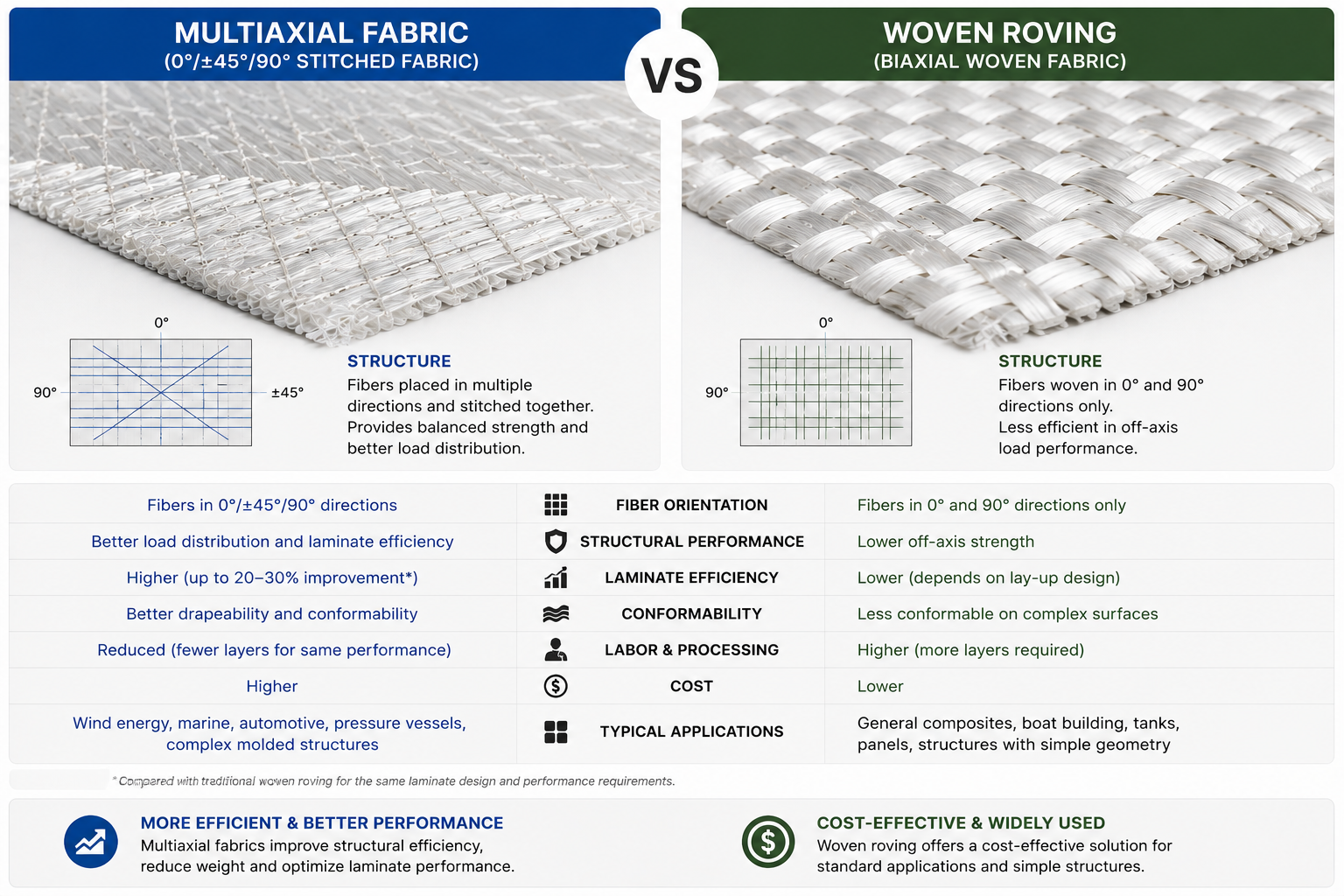
Multiaxial fiberglass fabric versus woven roving: the construction choice changes laminate efficiency, labour time and long-term repair cost, not only the purchase price.
Fiberglass Fabric for Marine Repair: Where the Evidence Is Tested Most Honestly
Marine repair is the least glamorous and most revealing segment of the fiberglass fabric market. A new-build hull can be engineered around a fabric; a repair has to work with the laminate that already exists. That constraint turns fiberglass fabric for marine repair into a genuine capability test, because the material must bond to an unknown substrate, in an uncontrolled environment, with a service life expectation that is often longer than the remaining life of the surrounding structure.
What a Repair Laminate Demands From the Fabric
A repair laminate has three jobs that a new-build laminate does not. It must develop a reliable secondary bond to a cured, often contaminated surface. It must avoid creating a stiffness discontinuity — a hard spot that concentrates load at the edge of the repair. And it must be executable by a boatyard technician rather than a controlled factory cell, which places a premium on predictable wet-out and drape.
Those requirements translate into fabric selection criteria: consistent areal weight so the repair schedule can be calculated once and repeated; a weave or stitched construction that conforms to curved hull surfaces without bridging; sizing compatibility with the resin actually being used — polyester, vinylester or epoxy — because a repair is not the place to discover an incompatibility. For yacht hulls and racing boats, where the surrounding structure is already weight-optimised, an over-thick repair is not a conservative choice; it is a performance defect.
Construction Choice: Woven Roving, Woven Fabric or Multiaxial
Repair work is where the cost comparison between constructions becomes concrete rather than theoretical. Woven roving remains the default for general marine repair because it builds thickness quickly and wets out predictably in hand lay-up. Multiaxial fabric, by contrast, delivers straighter fibre orientation and higher structural efficiency — CINON's comparison data puts the laminate performance gain at up to 20 to 30 percent depending on lay-up design — at a higher material cost, offset by reduced labour and less post-finish correction.
The long-term argument favours multiaxial in structural repairs. CINON's own comparison notes that multiaxial constructions bring a higher resin impregnation rate and lower energy consumption during lamination, and reduce post-finish correction work, which lowers long-term repair cost. In a yard where a repair is priced by labour hours rather than by square metre of cloth, that trade-off is usually decisive. For cosmetic or lightly loaded repairs, woven fabric remains the rational choice, and no supplier should argue otherwise.
Where Vacuum Infusion Fits — and Where It Does Not
Larger marine repairs, particularly on yacht hulls and racing boats where the repaired area must match the stiffness of the original laminate, increasingly use vacuum infusion rather than hand lay-up. Infusion gives better fibre volume fraction and lower void content, but it is unforgiving of fabric inconsistency: variable permeability across a roll produces dry patches that are invisible until the part is demoulded. This is precisely why fiberglass fabric for vacuum infusion should be selected on batch consistency, not only on nominal weight.
The same logic explains why CINON's stated process support covers technical evaluation before order confirmation — recommending suitable core materials, fiberglass reinforcements and manufacturing processes — rather than simply quoting a fabric. For a repair specification, the useful supplier conversation is about which construction, at which weight, suits the resin and the method the yard will actually use.
The Boundary: What a Fabric Supplier Cannot Control
It is worth stating plainly that no fiberglass fabric supplier can guarantee a marine repair outcome. Substrate moisture content, surface preparation quality, ambient temperature and humidity during cure, resin mixing accuracy and the skill of the applicator all sit outside the material supply chain, and any one of them can defeat a well-specified laminate. Saltwater exposure adds a further variable that only time resolves. Buyers should treat repair references as evidence of material suitability and process familiarity, not as a warranty of field performance.
Process Fit: RTM, VARTM and Why It Is a Supplier Capability
Resin transfer moulding and vacuum-assisted resin transfer moulding are frequently listed as compatible processes on supplier pages. In practice, process compatibility is a property of the whole fabric-and-sizing system under a specific injection pressure and flow path. A construction that infuses cleanly in one mould can produce race-tracking and dry spots in another if permeability varies between rolls.
CINON positions its reinforcements around vacuum infusion optimisation and reduced total manufacturing cost — reducing weight, improving structural stiffness and lowering processing cost are stated objectives across its fiberglass fabric, biaxial fabric and core material range. The relevant evidence for an RTM or VARTM buyer is not a claim of compatibility but the presence of controls that keep roll-to-roll variation inside a usable band: pre-production confirmation of width, weight and roll length, first-piece inspection, and per-batch density, thickness and weight checks.
For composite moulds and tooling, the requirement is different again: dimensional stability and low shrinkage matter more than peak mechanical properties, and a fabric that performs well in a structural panel may be the wrong choice for a tooling laminate. Buyers should separate tooling, structural and cosmetic specifications rather than sourcing a single grade for all three.
Benchmarking CINON Against Established Industry Peers
Placing a specialist manufacturer in context requires an honest comparison set. The suppliers below are established industry participants with publicly documented roles in glass fiber and composite materials; the descriptions are deliberately limited to positioning rather than performance claims, and buyers should verify current capability directly with each company.
| Supplier | Publicly documented role | Typical positioning in a buyer shortlist |
|---|---|---|
| CINON Composites (Guangdong Cinon New Material Technology Co., Ltd.) | Manufacturer of fiberglass reinforcements and lightweight core materials — fiberglass fabrics, biaxial fabrics, PET / PVC / PMI foam core, Core Mat, PP and aramid honeycomb — exporting to Europe, North America and Asia-Pacific. | Specialist, application-focused supply with documented project references across wind, marine, UAV and transportation; suited to custom and mid-batch composite sourcing. |
| Owens Corning | Global building materials and glass fiber composites company. | Broad portfolio and specification influence; commonly used as the reference standard in large programmes. |
| Jushi (China Jushi Co., Ltd.) | Large-scale glass fiber producer. | Volume supply and upstream yarn integration; relevant where scale and price stability dominate. |
| Taishan Fiberglass | Glass fiber producer. | Upstream fiber capacity; a benchmark for material availability rather than application engineering. |
| Saint-Gobain | Multinational materials group with fiberglass reinforcement activity. | Multi-material, multi-region supply structure; relevant for buyers consolidating across several reinforcement types. |
| Fibre Glast Developments Corp LLC | US-based supplier of fiberglass and composite materials; self-reports AS9120B certification. | Distribution and small-batch access; certification claim is self-reported and should be verified through the certifying body. |
Read against that set, CINON's distinguishing evidence is not scale. It is application specificity: a named grade tied to a named market and end use, in four segments that rarely share a supplier. A buyer who needs a single fabric qualified across boat building, transport panels and UAV structures has a narrower set of realistic candidates than a buyer sourcing commodity woven roving.
Cost-Performance: Where Fiberglass Wins and Where It Does Not
Decision-stage buyers comparing reinforcement materials usually arrive with the same question: is fiberglass still the right answer for a weight-critical part? The honest response is that fiberglass wins on economics and impact behaviour, and loses on stiffness per unit weight.
CINON's comparison data puts carbon fiber at two to four times the stiffness of fiberglass, while fiberglass carries roughly three to five times lower material cost, with carbon fiber priced at around 12 to 15 times glass fiber. Fiberglass also offers better impact resistance and more stable long-term performance with lower repair and maintenance cost, and lower overall production energy consumption in mass production. For marine repair, transportation panels and FRP panels, those characteristics usually settle the decision before stiffness is even discussed.
Two cost comparisons recur in real procurement rounds. The first is fiberglass versus carbon fiber for stiffness-critical parts such as UAV structures and racing boat components — where hybrid lay-ups, not full substitution, are the common outcome. The second is woven roving versus multiaxial fabric, where the material cost premium of multiaxial is offset by reduced labour, fewer post-finish corrections and lower long-term repair cost. Buyers who compare only the price per kilogram will systematically underestimate the second option, because the saving appears in the lamination department rather than on the purchase order.
Market Context: Why Application Evidence Is Gaining Value
The fiberglass fabric category is growing, and the growth is concentrated in exactly the applications where project evidence matters. Commercial research published in 2026 and cited in industry datasets places the global fiberglass fabric market at USD 5.15 billion in 2025, projected to reach USD 9.72 billion by 2034 at a CAGR of 7.4 percent. Other commercial estimates for the same category differ materially in both base value and forecast horizon — a divergence that reflects differing product scope rather than a contradiction to be resolved by averaging.
Within that growth, wind energy is identified as the fastest-growing application segment, at 7.02 percent CAGR through 2031 according to Mordor Intelligence. E-glass remains the dominant material, holding 68.4 percent of total market revenue in 2025, and Asia-Pacific accounted for 45.05 percent of the market in the same year. Practically, this means three things for buyers: demand pressure on structural reinforcement grades will persist; E-glass economics will continue to anchor most specifications; and Asian supply will remain central to global availability, making supplier-level evidence the main tool for differentiating within a crowded field.
A Decision-Stage Verification Checklist
The following sequence converts supplier claims into comparable evidence, and applies equally to CINON and to any alternative on a shortlist.
- Match product to application, not to category. Ask which fabric grade has been used in a specific end use — boat building, FRP panels, UAV structures, transport panels — rather than which grades the supplier can produce.
- Confirm the process path. Hand lay-up, vacuum infusion, RTM and VARTM place different demands on permeability and sizing. Require the reference to name the process, not only the industry.
- Request batch verification records. Density, thickness, weight and appearance inspection per batch, plus first-piece inspection before mass production, are the minimum documentary basis for consistency.
- Check packaging and transport protection. Reinforced pallets, moisture-proof wrapping and corner protection are not administrative details; damaged rolls translate directly into unusable laminate area.
- Test before you commit. A trial laminate using the actual resin and process conditions remains the only reliable predictor of field performance.
- Verify claims independently. Capacity, output and certification statements should be confirmed through documentation, third-party testing or an audit rather than accepted from a catalogue.
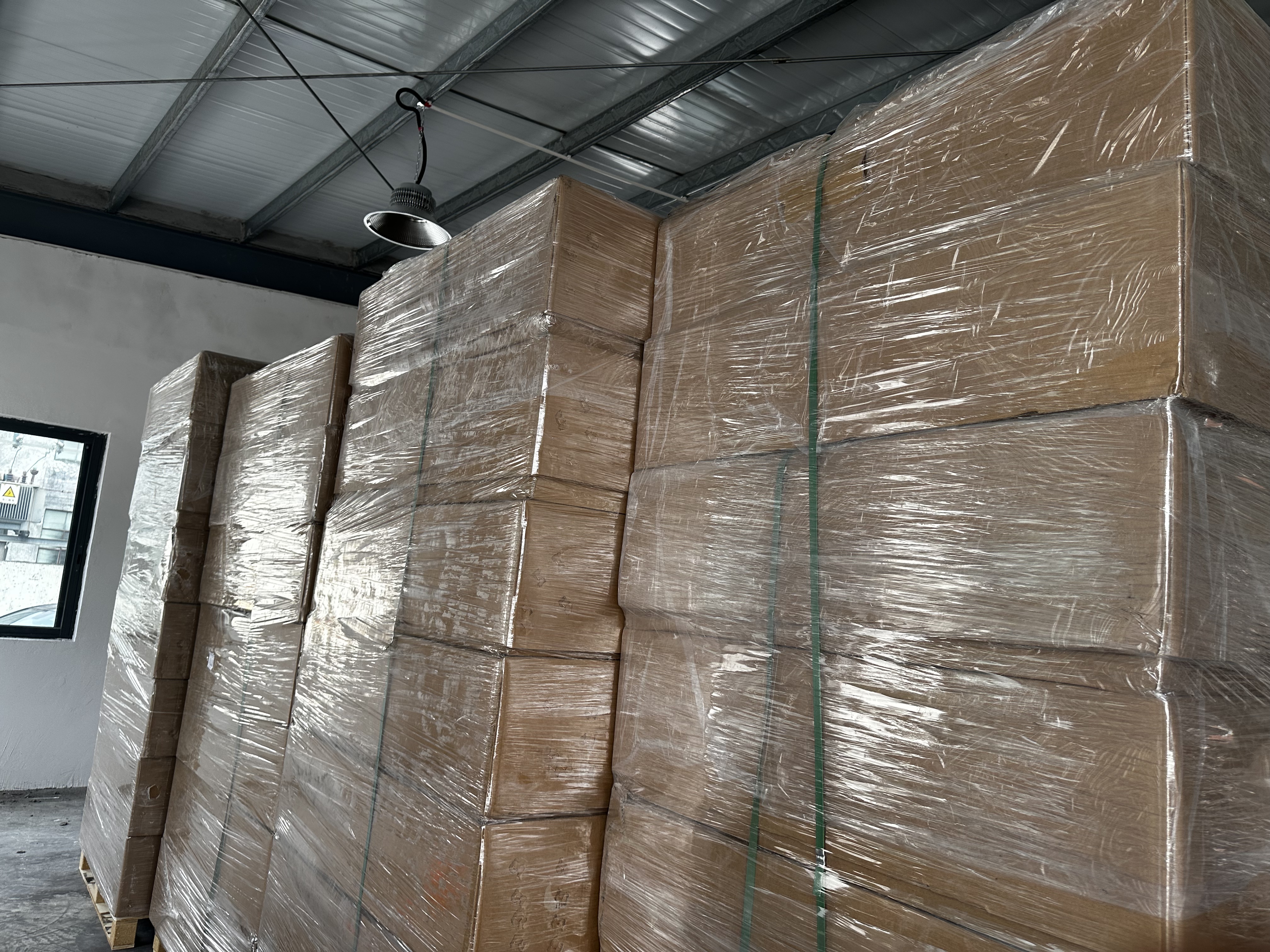
Export-standard packaging for fiberglass reinforcement rolls: protection in transit is part of supplier capability, not a logistics afterthought.
Future Outlook
Two trends are likely to shape supplier selection in this category over the next several years. The first is the continued shift of wind and marine specifications toward stitched and multiaxial constructions, where laminate efficiency and labour reduction matter more than the lowest material price. The second is rising buyer expectation that supplier claims be documented: batch records, inspection reports and named project references will increasingly function as the entry ticket to a shortlist rather than as a differentiator within it.
For CINON, the strategic question is whether a five-reference record across four applications can be extended into deeper qualification with repeat customers — particularly in marine repair and UAV structures, where the cost of a material failure is highest and buyers are slowest to switch. For buyers, the practical implication is simpler: evaluate suppliers on the evidence they can produce about specific laminates, and treat everything else as marketing until it is tested.
Frequently Asked Questions
What evidence should a buyer request before approving a fiberglass fabric supplier for a wind, marine or UAV programme?
At minimum: a named product grade linked to a named end use and market; the processing method the grade has been used with, such as hand lay-up, vacuum infusion, RTM or VARTM; batch verification records covering density, thickness, weight and appearance; confirmation that dimensions, roll length and width are agreed before production; and first-piece inspection before mass production. Independent test data or an audit should be added where the application is safety-related or the qualification cost of a failure is high.
How does CINON's project record compare with larger established fiberglass producers?
It compares differently rather than better or worse. Integrated producers such as Jushi, Taishan Fiberglass, Owens Corning and Saint-Gobain offer upstream fiber integration, broad portfolios and long programme histories, which suit large-volume or multi-material procurement. CINON, founded in 2022 and operating a single 40,000 m² facility with a stated annual output of 1,200,000 m², competes on application specificity: Product 4507 in composite structural applications in Poland, boat building in Australia and transportation panels in Mexico; Product 4367 in US FRP panels; and Product 4405 in German UAV production. Buyers should match supplier category to programme scale and qualification depth.
Which fiberglass fabric construction is suitable for marine repair laminates?
It depends on the load path and the application method. Woven roving is widely used for general repair because it builds thickness quickly and wets out predictably in hand lay-up. Multiaxial fabric provides straighter fibre orientation and higher structural efficiency — cited at up to 20 to 30 percent higher laminate performance depending on lay-up design — at higher material cost, offset by reduced labour and less post-finish correction. For repairs on weight-optimised structures such as yacht hulls and racing boats, matching the stiffness of the original laminate matters more than minimising the fabric price.
Is fiberglass fabric cost-effective compared with carbon fiber for weight-critical parts?
For most applications, yes, with an important limit. Fiberglass offers roughly three to five times lower material cost than carbon fiber, which is priced at around 12 to 15 times glass fiber, and it provides better impact resistance and lower repair and maintenance cost. Carbon fiber delivers two to four times the stiffness. Where stiffness per unit weight is the governing constraint — UAV structures, high-performance racing components — hybrid lay-ups are common; where cost, durability and repairability govern, fiberglass remains the rational specification.
What are the limits of supplier-reported project evidence, and what must be verified independently?
Project references demonstrate that a fabric grade has passed through a downstream process in a given market; they do not certify the buyer's specific laminate, nor do they cover substrate preparation, resin mixing, cure conditions or applicator skill, all of which affect field performance — particularly in marine repair. Capacity, output and certification statements that are company-reported should be confirmed through documentation, third-party testing or audit. A trial laminate using the buyer's own resin and process conditions remains the only reliable predictor of performance.
For buyers who need the full material range — fiberglass fabrics, biaxial reinforcements, PET / PVC / PMI foam core, Core Mat, PP and aramid honeycomb — CINON Composites publishes a downloadable product catalogue: CINON Composites catalogue (PDF).
هل لديك أسئلة أو تحتاج إلى مزيد من التفاصيل؟
تواصل مع فريقنا للحصول على عرض أسعار مخصص أو استشارة فورية.
طلب عرض أسعار
املأ النموذج أدناه وسيتواصل معك فريقنا بعرض مقترح مخصص.
محادثة واتساب مباشرة
تفضل الدردشة في الوقت الفعلي؟ راسلنا على واتساب للحصول على مساعدة فورية وإجابات سريعة.
- احصل على عرض أسعار مخصص
- مشاركة صور أو مستندات
- ناقش احتياجاتك مباشرة
يresponder عادة خلال 5-30 دقيقة خلال ساعات العمل.