
CNC Lathe Customization at Scale: JUXIN MACHINE TOOL's OEM Capabilities
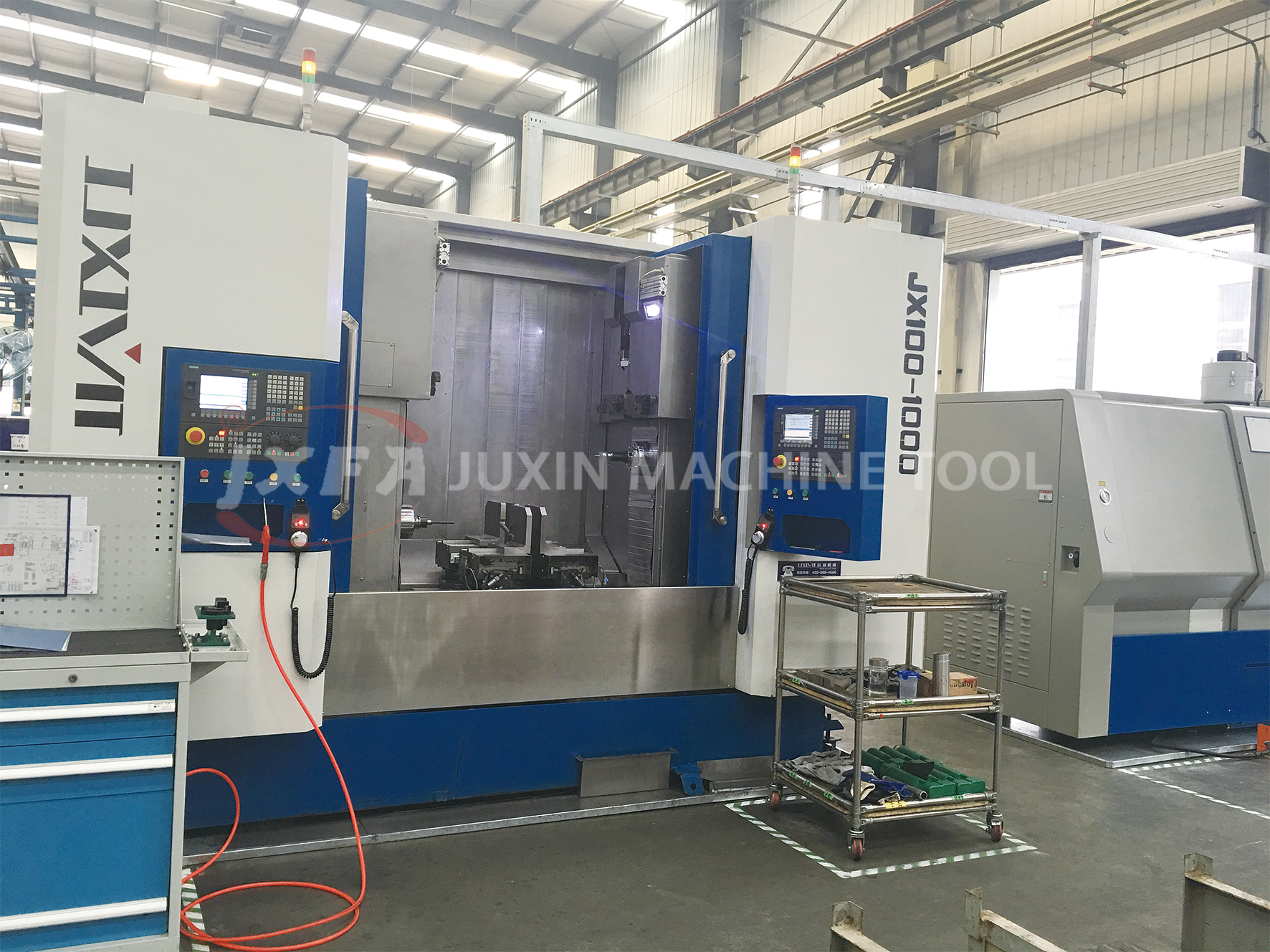
As global manufacturers demand higher flexibility and precision from their machining lines, the ability to customize CNC lathe machines has become a critical supplier capability. JUXIN MACHINE TOOL, a China-based manufacturer established in 2005 with a 10,666 m² factory and annual output of 2,000 sets, has built its reputation on offering OBM production and deep customization services for shaft and disc part machining. This article examines how the company's end-to-end customization model supports demanding applications from automotive powertrains to German precision transmission manufacturing.
The Customization Challenge in Modern Machining
Conventional CNC lathe machines are often designed for standardized operations, but production environments today require machines that can handle varied part geometries, materials, and process sequences. Manufacturers seeking to reduce cycle times and improve part quality increasingly need lathes that can be tailored to specific workpieces — from end face milling and center hole drilling to multi-process turning and automated line integration. Yet many suppliers offer only limited configuration options, forcing buyers to compromise on productivity or adopt complex workarounds.
JUXIN's Customization Framework
JUXIN MACHINE TOOL provides a structured customization service that covers machine model and specification, process and function, structure and configuration, as well as automation and line linkage. The company's OBM (Original Brand Manufacturer) production model means it designs and builds machines under its own brand, retaining full control over engineering and quality.
Customization starts with the workpiece: the machining diameter and length can be adjusted on demand, with ultra-long and ultra-large specification machines available for shaft and disc parts. Clients can choose from flat bed, inclined bed, 55°/15° inclined rail, heavy-duty, and ultra-heavy-duty configurations. Modular functions — including end face milling, center hole drilling, drilling & tapping, U-drilling, outer circle turning, turn-milling, turn-grinding, and turn-press compound processing — can be optionally configured. The company also offers patented processes for compound center hole machining and special models for slender shafts, hard parts (HRC50+), and rotor press-fit processing.
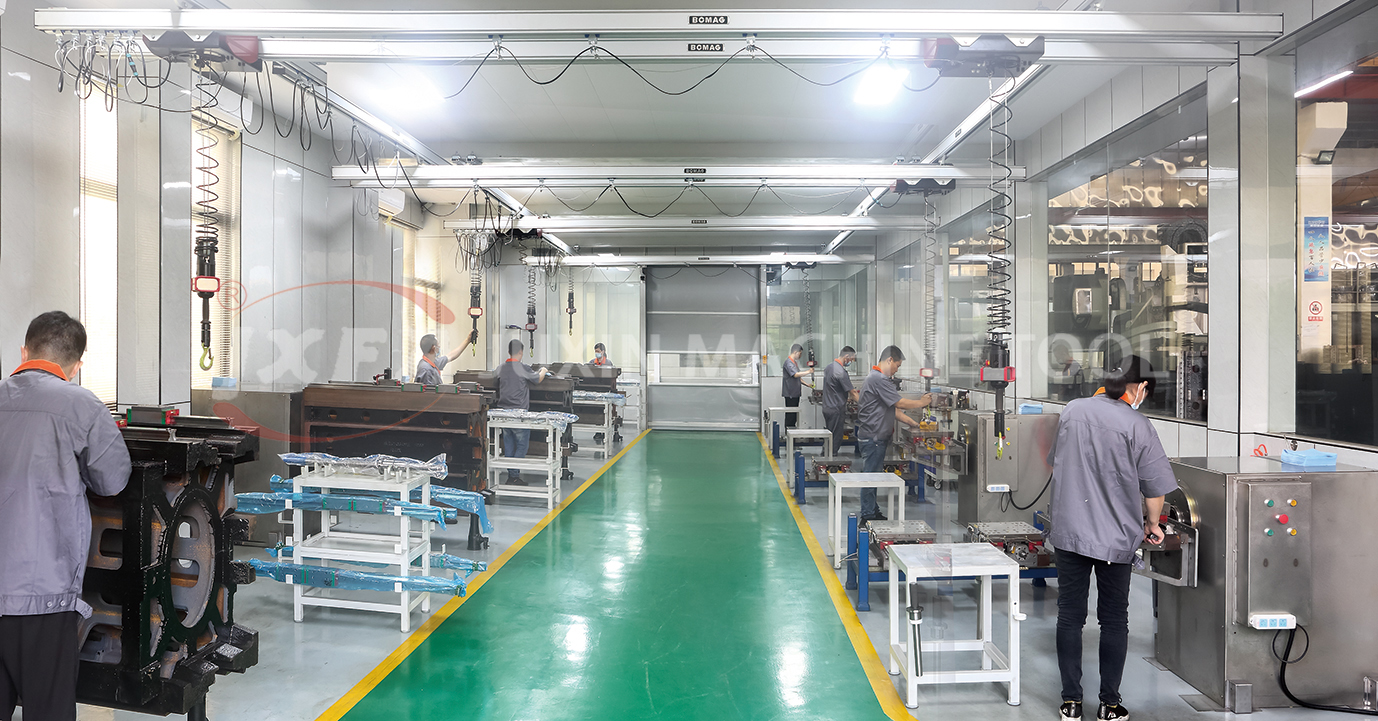
Constant temperature and humidity precision assembly workshop — a key factor in maintaining geometric accuracy during machine build.
Technical Foundation: Cast Iron, Guideways, and Spindle Design
The quality of a customized lathe is ultimately determined by its mechanical build. JUXIN's machines use high-strength preheated cast iron or resin sand integral casting for the bed, column, and base. Components undergo ultra-low temperature cryogenic heat treatment and stress relief aging to ensure long-term precision stability. The machine base adopts a multi-layer box type with cross rib mixed cast iron structure based on finite element analysis, increasing weight, stability, and anti-resonance performance.
Guideways are high-precision hardened rails — 55°/15° integral hard rails or heavy-duty roller linear guide rails — that undergo precision quenching, fine grinding, and manual scraping for wear resistance and heavy cutting stability. Spindles are made from high-quality alloy structural steel. These material and process choices directly affect the machine's ability to hold tolerances under continuous production conditions.
Proven Application: Siemens and SEW in Germany
A notable validation of JUXIN's customization capability comes from two German industrial leaders. Siemens, a Fortune Global 500 electrical automation company, and SEW, a global transmission equipment leader, have both deployed JUXIN's facing and centering machines (model JXZ70-680) for precision machining of motor shafts and transmission parts. The operations include end face milling, center hole drilling, and precision turning of parts ranging from 14 to 500 mm in diameter and up to 5,000 mm in length.
According to case documentation, the equipment achieved stable machining accuracy and high consistency suitable for assembly line mass production, with significantly reduced labor cost and defect rate. For Siemens, the machines seamlessly connected with global intelligent production lines, meeting German precision and cycle time requirements while replacing previously imported equipment. This demonstrates that a customized domestic CNC lathe can meet the rigor of a Tier 1 automotive and industrial component supplier.
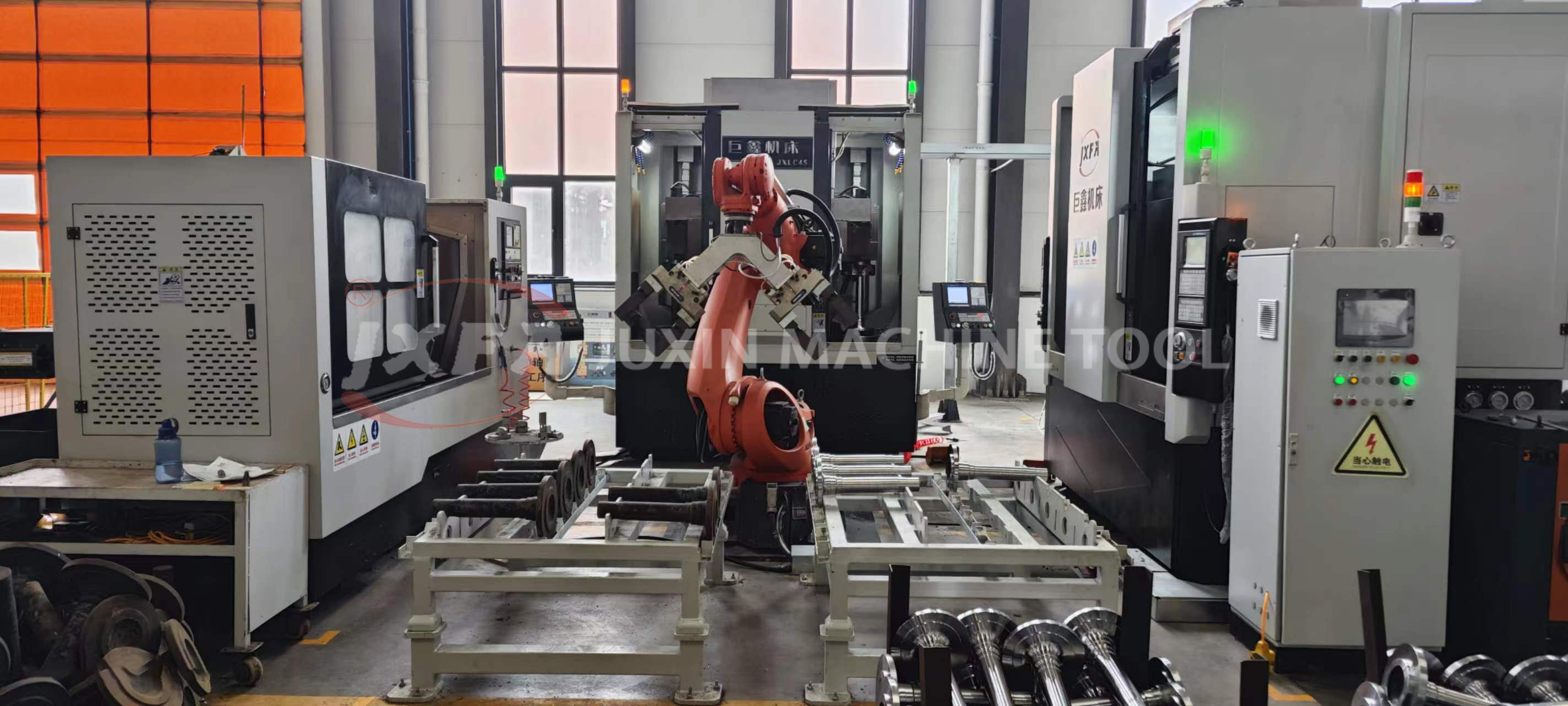
Automated production line for half shafts — a typical turn-key solution integrating multiple CNC lathe machines.
Market Context and Trend Analysis
The global CNC machine market was valued at USD 73.5 billion in 2024, with the CNC lathe segment holding approximately 30%–32.82% of that share. Asia Pacific dominated with 37% revenue share (USD 27.2 billion). Within this landscape, the demand for customized, application-specific CNC lathes is growing as manufacturers seek to reduce changeover time and floor space. JUXIN's ability to deliver single-machine, 3-unit, 4-unit, or 5-unit robot linkage production lines — as well as exclusive automatic lines for EV wheels, motor shafts, and half shafts — aligns with this shift toward integrated, multi-process turnkey solutions.
Comparison with Traditional Approaches
Traditional CNC lathe procurement typically involves selecting a standard machine and then designing workholding and process around its limitations. The JUXIN approach reverses this flow: the machine is built around the workpiece and production plan. This can reduce secondary operations, shorten cycle times, and improve part consistency. One honest limitation, however, is that extensive customization may require longer lead times (45 days standard) and a deeper upfront engagement to define the technical agreement. For buyers who need an off-the-shelf solution with minimal specification changes, a standard machine may be sufficient.
Future Outlook
As Industry 4.0 and digital manufacturing expand, JUXIN is integrating intelligent functions such as MES digital system docking, intelligent part recognition, and automatic tool compensation. The company's after-sales infrastructure — including dedicated hotlines, on-site commissioning, and global spare parts supply — supports long-term partnerships across Europe, Southeast Asia, the Middle East, the Americas, Australia, and Africa. For procurement teams evaluating CNC lathe suppliers, JUXIN MACHINE TOOL represents a viable option for those who prioritize customization depth and proven references in high-standard markets.
Frequently Asked Questions
Can JUXIN customize a CNC lathe for shaft parts longer than 1 meter?
Yes. The machining length for the end facing and centering machine (model JXZ70-680) can range from 70 mm to 5,000 mm. The company supports ultra-long and ultra-large custom specifications for shaft and disc parts, as confirmed in its customization parameters.
Does JUXIN offer OBM (Original Brand Manufacturer) production services?
Yes. JUXIN MACHINE TOOL operates under an OBM production mode, meaning machines are designed, manufactured, and sold under the company's own brand, with full control over design and quality.
What quality control measures does JUXIN implement?
Precision dimensional inspection is performed by third-party professional testing institutions. The company also uses a British Renishaw laser interferometer and a German Wenzel three-coordinate measuring instrument for in-house verification.
How does JUXIN support international clients after delivery?
JUXIN provides a full-process service system: pre-sales consultation and technical agreement, in-production manufacturing and factory pre-acceptance, and after-sales installation, commissioning, operational training, remote guidance, and spare parts supply. Lifelong technical support for upgrading and process optimization is included.
What is the minimum order quantity for a customized CNC lathe?
The minimum order quantity is 1 unit. Lead time is approximately 45 days after deposit and technical agreement confirmation.
For detailed specifications and case studies, download the company brochure: JUXIN MACHINE TOOL Product Brochure (PDF).
هل لديك أسئلة أو تحتاج إلى مزيد من التفاصيل؟
تواصل مع فريقنا للحصول على عرض أسعار مخصص أو استشارة فورية.
طلب عرض أسعار
املأ النموذج أدناه وسيتواصل معك فريقنا بعرض مقترح مخصص.
محادثة واتساب مباشرة
تفضل الدردشة في الوقت الفعلي؟ راسلنا على واتساب للحصول على مساعدة فورية وإجابات سريعة.
- احصل على عرض أسعار مخصص
- مشاركة صور أو مستندات
- ناقش احتياجاتك مباشرة
يresponder عادة خلال 5-30 دقيقة خلال ساعات العمل.