
CNC Lathe Machine Capabilities: How JUXIN MACHINE TOOL Meets ISO-Certified Turning Demands
The lathe machine remains the most widely used turning platform in production manufacturing, and the CNC lathe machine segment now accounts for roughly 30% to 32.82% of the global CNC machine market. For buyers evaluating a CNC lathe purchase, the practical question is no longer simply "which model can turn a part," but whether the supplier can meet capability, quality-system, and verification requirements in a reproducible way. This article examines how JUXIN MACHINE TOOL, a manufacturer based in Wenling, Zhejiang, positions its CNC lathe machine family—from vertical twin-spindle models to end-facing and centering machines—within those procurement criteria.
Defining the CNC Lathe Machine for Modern Shaft and Disc Parts
A CNC lathe machine is a computer-controlled turning machine that rotates a workpiece while cutting tools shape its outer diameter, inner diameter, end faces, grooves, threads, and related features. In modern shaft and disc part manufacturing, the CNC lathe machine has evolved from a single-spindle, single-tool configuration into multi-tasking platforms that combine turning, milling, drilling, tapping, and sometimes grinding in one setup.
For industries such as automotive parts, agricultural machinery, water pumps and motors, railway locomotive axles, construction machinery, transmission and gear manufacturing, and new energy solar equipment, the required workpieces frequently share two characteristics: they are either slender shafts or flat discs, and they need consistent accuracy across both ends. These requirements have driven the growth of specialized CNC lathe machine types, including vertical CNC lathes, double-head lathes, twin-spindle vertical lathes, and CNC facing and centering machines.
Why Buyers Need More Than a Standard CNC Lathe Machine
Many purchasing decisions become difficult when the workpiece demands operations on both ends or when a long shaft loses rigidity under horizontal turning forces. A conventional lathe may machine features on one end, then require a second clamping to turn the workpiece around. Every re-clamping step introduces errors in coaxiality, depth consistency, and end-face flatness, and it consumes labor and floor space.
Buyers evaluating a CNC lathe machine for shaft or disc parts typically need to solve one or more of these constraints:
- Eliminating precision errors caused by secondary clamping and workpiece turning.
- Improving the accuracy of center holes at both ends, including coaxiality, depth consistency, and end-face flatness.
- Maintaining rigidity during heavy cutting of large-diameter, super-long, or hardened shafts.
- Reducing labor, floor space, and work-in-process inventory while raising throughput.
- Integrating the machine into a robot line or a digital production environment.
These are not optional features for many buyers; they are the core justification for moving from a generic CNC lathe machine to a purpose-built turning system.
JUXIN MACHINE TOOL: A Specialized CNC Lathe Manufacturer
Juxin Machine Tool Co., Ltd., operating as JUXIN MACHINE TOOL, is a manufacturer specializing in high-end CNC machine tools. The company focuses on the research and manufacturing of specialized CNC machine tools, mainly engaged in milling, facing, and centering machines for shafts, double-head CNC lathes, and double-spindle CNC vertical lathes for shaft discs, as well as intelligent automation solutions for shaft and disc parts.
The company was founded in 2005 and operates a production facility of 10,666 square meters with approximately 80 employees and an annual output of 2,000 sets. Its engineering team includes 10 engineers, and the company holds more than 50 innovative technological patents. JUXIN states that its machines have earned recognition and adoption by more than ten internationally renowned enterprises.
Product Capabilities: CNC Lathe Machine Types and Representative Models
JUXIN's product line addresses different stages of shaft and disc machining. The table below summarizes the representative models covered in this analysis.
| Product Type | Model | Key Capacity Parameters | Primary Function |
|---|---|---|---|
| End Facing and Centering Machine | JXZ70-680 | Machining diameter 14–500 mm; machining length 70–5000 mm | Face milling, center hole drilling, external cylindrical turning, drilling & tapping, chamfering, boring, rapid U-drilling |
| Middle Drive Double-head CNC Lathe | JXS72 | Processing diameter 15–180 mm; processing length 40–800 mm | Synchronous double-end processing of outer circle, inner hole, thread, end face, and center hole in one clamping |
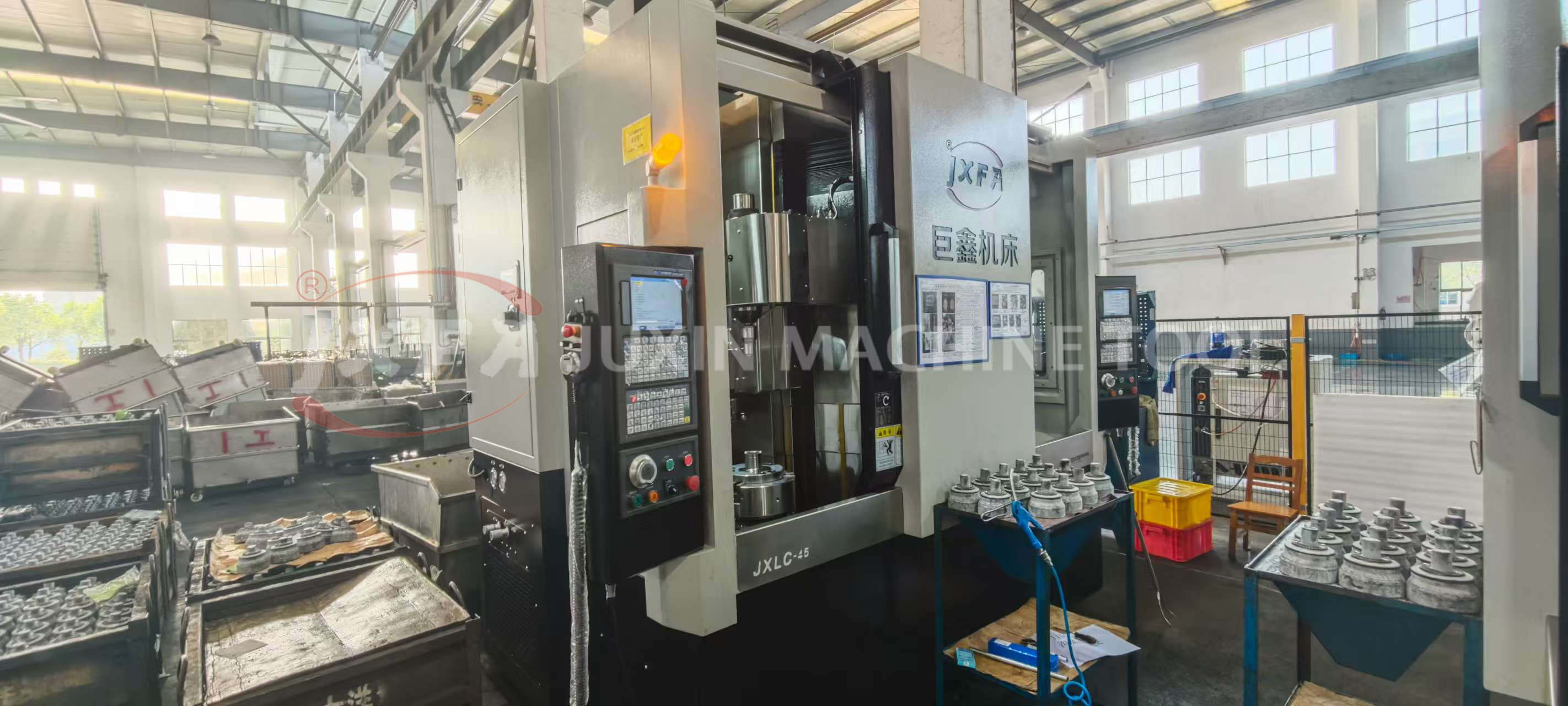
| Twin-Spindle CNC Vertical Lathe Machine for Shafts | JXLC45-A | Max shaft processing diameter 345 mm; max shaft processing length 1020 mm | Dual-station, dual-spindle, dual-system vertical turning |
| Twin-Spindle CNC Vertical Lathe Machine for Disks | JXLC63D | Max processing diameter 525 mm; max machining height 400 mm | Dual-station, dual-spindle vertical turning for disc-type parts |
End Facing and Centering Machine — JXZ70-680
The JXZ70-680 is classified as a CNC milling face end face drilling hole lathe machine. It performs face milling, center hole drilling, external cylindrical turning, drilling and tapping, chamfering, boring, and rapid U-drilling. Its machining diameter range is 14 to 500 mm, and its machining length range is 70 to 5000 mm. The machine bed is integrally cast from high-quality gray cast iron HT300, a material choice intended to provide exceptional rigidity for heavy cutting.
For buyers, this machine answers a specific process bottleneck: the need to establish accurate center holes and clean end faces before subsequent turning or grinding operations. Instead of moving a shaft between multiple single-purpose machines, the JXZ70-680 can complete these operations in one clamping.
Middle Drive Double-head CNC Lathe — JXS72
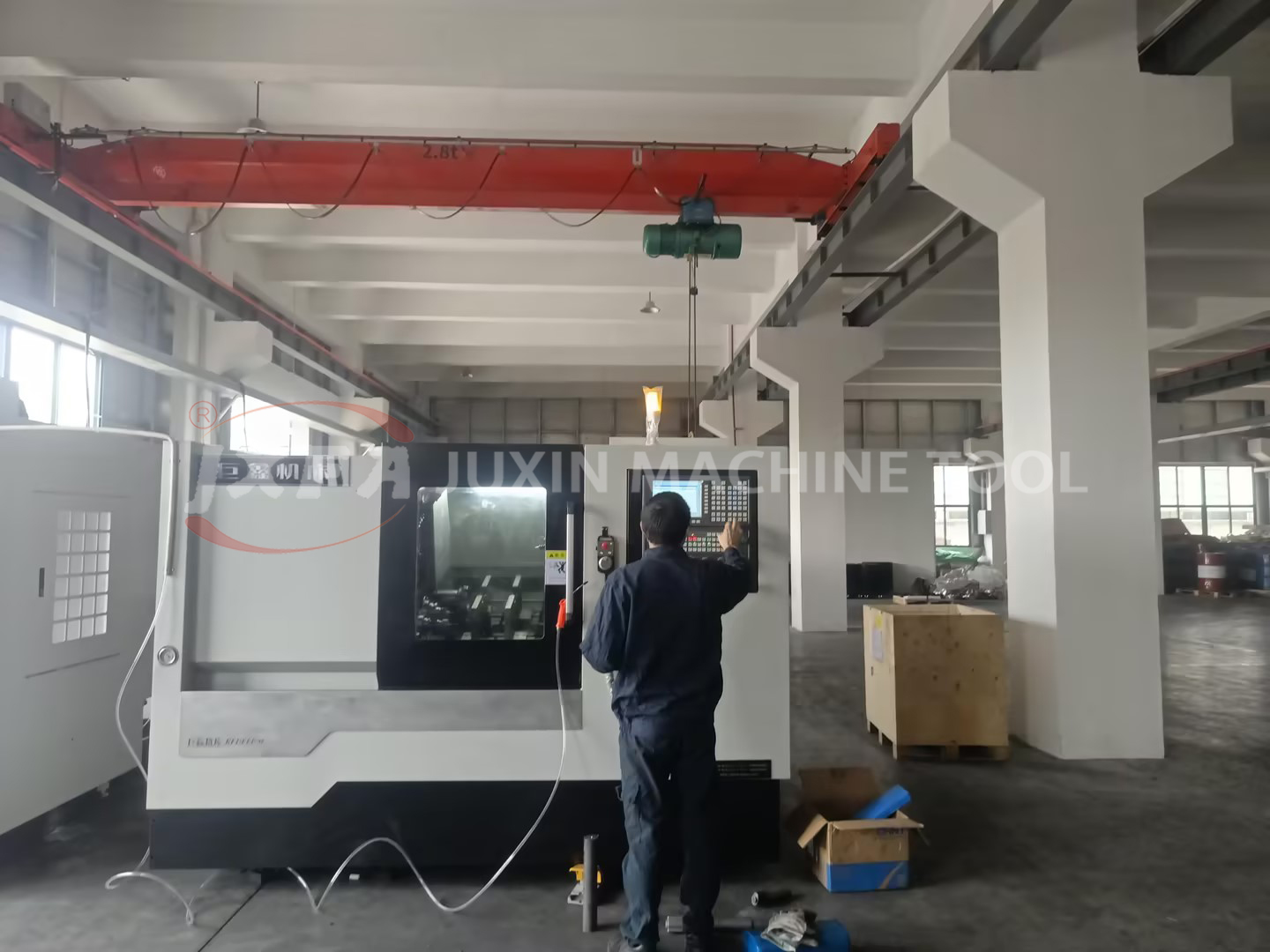
The JXS72 is a double-end simultaneous turning lathe with a processing diameter range of 15 to 180 mm and a processing length range of 40 to 800 mm. It uses a middle-drive spindle design that enables synchronous double-end processing, completing the outer circle, inner hole, thread, end face, and center hole of both ends in a single clamping.
The construction details are relevant to buyers who compare machine build quality. The bed, column, and base are made of high-strength preheated cast iron or resin sand integral casting. The structure uses ultra-low temperature cryogenic heat treatment and stress relief aging for dimensional stability. The machine base adopts a multi-layer box type and cross rib mixed cast iron structure, which increases overall weight and is intended to improve rigidity and anti-resonance performance. Guide rails are high-precision hardened rails, with 55°/15° integral hard rail on some models and heavy-duty roller linear guides on others.
The JXS72 is certified to ISO 9001:2015. Its quality management certification, number 62725Q0878R0S, was issued by JingXin Certification (Beijing) Co., Ltd., under the standard GB/T19001-2016 idt ISO 9001:2015.
Twin-Spindle CNC Vertical Lathe Machines — JXLC45-A and JXLC63D
For parts that require front and back processing, JUXIN offers dual-position CNC vertical lathe machines. The JXLC45-A is configured for shafts, with a maximum processing diameter of 345 mm and maximum processing length of 1020 mm. The JXLC63D is configured for discs, with maximum processing diameter of 525 mm and maximum machining height of 400 mm. Both use a dual-station, dual-spindle, dual-system, dual-tool-tower structure.
The vertical orientation is a meaningful technical choice for shaft and disc workpieces. A vertical structure avoids the influence of gravity on the workpiece and tooling, which helps address vibration, insufficient rigidity, and deformation of slender shafts during processing. The dual-spindle design allows front and back processing in one clamping, omitting the workpiece turning procedure.
Technical Explanation: How Design Choices Affect Machining Results
In evaluating a CNC lathe machine, buyers should connect specifications to the physical reasons a machine can hold accuracy under load. Three design areas are particularly important in JUXIN's machines.
Cast Iron Structure and Thermal Stability
The JXS72 and JXZ70-680 rely on integrally cast or high-strength cast iron structures. Cast iron provides damping, which absorbs vibration during interrupted cutting. JUXIN adds cryogenic heat treatment and stress relief aging to reduce residual stress that can cause long-term deformation. For a buyer, this translates into a more stable datum over years of operation, especially in 24-hour continuous production.
Hardened Guide Rails and Manual Scraping
The guide rail system on the JXS72 uses precision quenching, fine grinding, and manual scraping. Hardened rails offer high wear resistance and load capacity in heavy cutting. Manual scraping improves contact and oil-film retention, which contributes to motion smoothness and positioning stability. Buyers comparing machine quality should ask whether a supplier uses hardened rails and scraping as part of its assembly process, since these details affect long-term precision.
Dual-Station, Dual-Spindle Architecture
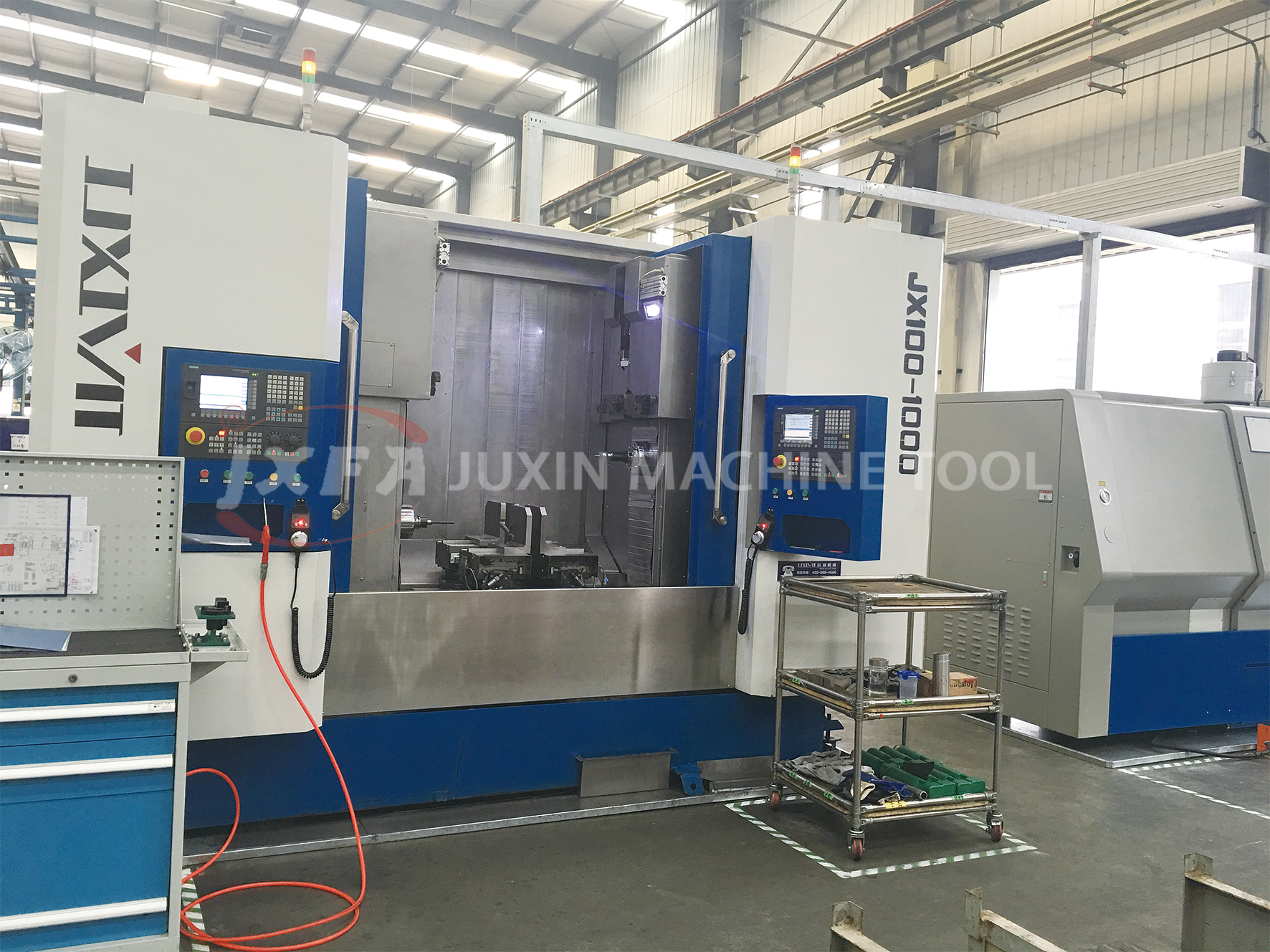
The JXLC45-A and JXLC63D use two independent spindles and tool towers. This architecture allows one machine to process both sides of a workpiece in a single cycle, eliminating the conventional between-machines transfer. The arrangement also enables one robot to load and unload multiple machines in a linked line, supporting unattended operation.
Application Scenarios for JUXIN CNC Lathe Machines
The application data provided by JUXIN groups its use cases into three broad working conditions.
Heavy-Duty Precision Parts and Constant-Temperature Workshops
The twin-spindle vertical lathe machines are intended for heavy-duty machining workshops, auto intelligent factories, and precision parts constant-temperature workshops. These machines are designed for full stainless steel protection and large-flow chip flushing, adapting to heavy cutting and iron-scrap-intensive working conditions. Application areas include automotive disc and gear parts, motor housings, engineering machinery disc parts, bearing accessories, gear shells, slender shafts, heavy-duty shafts, high-speed rail and aerospace precision disc parts, brake discs, and rotor press-fit processing.
In this environment, the vertical lathe can integrate turning, milling, drilling, boring, grooving, chamfering, and threading for inner and outer circular surfaces, end faces, and arc surfaces. Turning-milling and turning-grinding compound models can process hard parts above HRC 50, replacing traditional internal grinders in some applications.
Batch Production of Medium and Small Shaft Parts
The middle-drive double-head lathe is suited to ordinary machining workshops and batch parts production workshops. Its inclined-rail full-protection design is dust and cutting-fluid resistant, with built-in automatic chip removal, and it does not require a special constant-temperature environment. Typical parts include motor shafts, electric vehicle wheels, elevator traction wheels, fan parts, half shafts, solar energy accessories, brake discs, small shaft sleeve parts, precision pin shafts, hardware fasteners, and micro motor parts.
Because both ends are machined in one clamping, the machine eliminates precision errors caused by secondary clamping and workpiece turning. This is an important consideration for buyers producing shafts where end-to-end concentricity directly affects assembly quality.
Heavy-Duty Shafts, Crankshafts, and Gears
The end facing and centering machines address large and heavy workpieces. They are used for motor and transmission industries, automobile OEMs and parts, engineering and mining machinery, military industry, high-speed rail, aerospace, agricultural machinery, crankshaft and gear production, hydraulic accessories, and slender shaft processing. The JXZ70-680's capacity up to 500 mm diameter and 5000 mm length gives it a role in shaft lines that require accurate center holes as the reference for subsequent turning or grinding.
The documented precision range for this group includes repeat positioning accuracy of 0.008 to 0.012 mm, length and center hole depth consistency at both ends of ±0.05 mm (customizable to ±0.02 mm), and center hole surface roughness Ra1.6 to Ra1.8.
Verified Capability Indicators and Quality Evidence
For a Research to Evaluation-stage buyer, verifiable evidence matters more than broad performance claims. JUXIN's available evidence includes the following points:
- Annual production capacity of approximately 2,000 sets, according to industry analysis data referencing the company.
- More than 50 innovative technological patents held by the company.
- A monthly production capacity of 160 units and a lead time of 45 days, with a minimum order quantity of one unit.
- ISO 9001:2015 quality management certification for the JXS72 model under certificate number 62725Q0878R0S.
- Inspection equipment including a Renishaw laser interferometer from the UK and a German Wenzel three-coordinate measuring instrument in the company's inspection laboratory.
JUXIN's after-sales structure includes a national toll-free sales hotline, a dedicated after-sales service hotline, pre-sales technical consultation, factory pre-acceptance, on-site equipment acceptance, operational training, remote fault guidance, on-site after-sales support, spare parts supply, and lifelong technical support for upgrading and process optimization.
Market Trends and Procurement Context
The CNC lathe machine category continues to hold a leading position in the broader CNC market, with third-party analysis attributing roughly 30% to 32.82% of the 2024 CNC market to CNC lathe machines. The global CNC machine market was valued at USD 73.5 billion in 2024 and is projected to reach USD 187.2 billion by 2034, with Asia Pacific accounting for 37% of revenue in 2024. The vertical machining center segment was estimated at USD 42.6 billion in 2024.
Within this context, buyers evaluating a CNC lathe machine for shaft and disc parts should interpret market data as background rather than as a substitute for machine-specific verification. Market share does not tell a buyer whether a machine can hold the required tolerance on a specific part family; that evidence must come from the machine's design, the supplier's manufacturing discipline, and reference installations.
Comparison with Traditional Turning Solutions
Compared with traditional single-spindle lathes and multi-machine process flows, JUXIN's specialized CNC lathe machines offer measurable operational differences. The application scenarios describe potential improvements including saving 70% to 150% of workshop space, reducing labor by 50% to 80%, improving automation efficiency by 40% to 120%, and cutting production cost by over 50%. These figures appear in JUXIN's application documentation and should be treated as supplier-stated potential outcomes rather than guaranteed results for every installation.
It is also important to state the boundaries of this comparison. A specialized double-head or twin-spindle vertical lathe is not the right choice for every turning task. Small batch runs of highly complex multi-feature parts may still be more flexible on a standard CNC lathe with a live tooling turret, especially when setup flexibility outweighs cycle time. Workpieces outside the clamping range of a specific model cannot be processed without customization. In addition, heavy-duty vertical lathes require special foundations and qualified floor load-bearing, and turning-grinding compound models require matched high-rigidity cutting spindles, grinding power units, and dust removal configurations. Buyers should confirm their own floor conditions and utility capacity before committing to a heavy vertical lathe line.
Another limitation is that the published precision figures are machine capability indicators, not a guarantee for every material and tooling combination. Actual tolerances depend on workpiece material, tooling, fixturing, cutting parameters, and environmental temperature control.
Customization and Automation Options
JUXIN operates under an OBM production mode and offers customization across four dimensions:
- Machine model and specification: processing diameter and length can be adjusted on demand; ultra-long and ultra-large machines for shaft and disc parts are available; flat bed, inclined bed, 55°/15° inclined rail, heavy-duty, and ultra-heavy-duty types can be selected.
- Process and function: modular functions include end face milling, center hole drilling, drilling and tapping, U-drilling, outer circle turning, turn-milling, turn-grinding, and turn-press compound processing; special models are available for slender shafts, hard parts above HRC50, and rotor press-fit processing.
- Structure and configuration: integrated or split bed, hard rail or linear rail, single or double middle drive spindle, servo programmable tailstocks, 8-station or 12-station turrets, power turrets, tool magazines, and 6/8/10/12-inch hydraulic chucks can be configured.
- Automation and line linkage: single machines, 3-, 4-, or 5-unit robot-linked production lines, and dedicated automatic lines for shaft parts, disc parts, electric vehicle wheels, motor shafts, and half shafts can be tailored; MES digital system docking and intelligent tool compensation can be supported.
For a buyer, customization capability is a procurement criterion because it determines whether the machine will fit the specific part mix, not just whether the machine exists in a catalog.
Reference Cases and Industry Adoption
JUXIN publishes reference cases from several industrial segments. The following cases are presented as supplier-provided information:
- An automatic assembly line processing EV wheels, elevator traction wheels, half shafts, fan shafts, solar accessories, and brake discs, with reported plant space savings of 70%–150%, labor reduction of 50%–80%, and production cost reduction of over 50%.
- Long-term cooperation since 2014 with top domestic automobile manufacturers for machining half shafts, brake discs, gear shafts, and chassis parts, with the supplier reporting the fastest acceptance and commissioning performance and unmanned full-line production.
- Use by leading enterprises in construction machinery, oilfield equipment, and heavy industry for hydraulic shafts, piston rods, pin shafts, and large shaft parts under harsh working conditions.
- Procurement by Siemens, described as a Fortune Global 500 electrical automation company, for precision machining of motor spindles, shaft parts, and shell components, with JUXIN equipment admitted into Siemens' global supply chain.
- Long-term strategic cooperation with SEW, a German transmission equipment company, for end face milling, center hole drilling, and precision turning of motor shafts and transmission parts.
These cases provide useful directional evidence that specialized Chinese CNC lathe manufacturers can meet demanding automotive and European industrial requirements. However, buyers should verify references directly when possible, particularly for applications similar to their own parts.
Future Outlook for Specialized CNC Lathe Machines
The direction of the CNC lathe machine market points toward further integration of processes and automation. Multi-spindle and dual-spindle systems are relevant not because they are new, but because they address two structural constraints in shaft and disc production: time lost to re-clamping and labor required for in-process handling. As manufacturers face pressure to shorten lead times and stabilize quality, machines that combine multiple operations in one clamping will continue to be evaluated as replacements for process chains of separate turning, milling, and drilling machines.
Digital integration is also becoming a normal procurement requirement. JUXIN's capability set already includes MES digital system docking, intelligent part recognition, automatic tool compensation, anti-collision functions, and support for multi-machine robot lines. Buyers should treat digital connectivity not as a premium extra but as a prerequisite for future smart factory planning.
One trend that deserves attention is the use of hard turning and turning-grinding compound processes to replace traditional grinding operations. JUXIN states that turning-milling and turning-grinding compound models can process hard parts above HRC50, replacing internal grinders in certain applications. If this shift continues, buyers may consolidate their machine footprint further by using a single CNC lathe machine platform for operations that previously required separate grinding machines.
Buyer Decision Framework for a CNC Lathe Machine Purchase
For a buyer moving from research to evaluation, the following framework summarizes the decision logic discussed in this article.
- Define the part family and tolerances. Identify representative shaft and disc parts, their diameters, lengths, materials, and critical tolerances such as center-hole depth consistency, roundness, and end-face flatness.
- Map required operations. List whether parts need face milling, center hole drilling, external turning, threading, grooving, boring, or grinding—and whether both ends must be machined in one clamping.
- Compare architecture options. Standard horizontal CNC lathe vs. vertical twin-spindle lathe vs. double-head lathe vs. facing and centering machine. Choose based on rigidity requirements, floor space, and re-clamping losses.
- Verify build quality. Examine bed material, casting and heat treatment processes, guide rail type, spindle design, and assembly environment.
- Check certification and inspection evidence. Confirm ISO certificates, certificate numbers, issuing bodies, and inspection equipment available to the supplier.
- Assess customization and automation fit. Determine whether the supplier can adjust clamping range, spindle configuration, turret type, and robot line integration for your specific parts.
- Evaluate total cost and after-sales support. Include commissioning, training, spare parts, remote support, and future process upgrades.
Conclusion
The CNC lathe machine category is broad, but the evaluation criteria for shaft and disc parts are specific. JUXIN MACHINE TOOL offers a focused product family—CNC facing and centering machines, middle-drive double-head lathes, and twin-spindle vertical lathes—that addresses the most common constraints in shaft and disc production: re-clamping errors, rigidity limits, floor space, and labor efficiency. The company's ISO 9001:2015-certified quality system, production capacity, patent portfolio, and reference installations give buyers a concrete basis for further investigation.
For procurement teams, the appropriate next step is to compare JUXIN's specific model parameters against their own part drawings and to request process validation with actual workpieces. A brochure with additional product information is available for download.
Frequently Asked Questions
What is the ISO certification status of the JUXIN JXS72 CNC lathe machine?
The Middle Drive Double-head CNC Lathe (model JXS72) is certified to the ISO 9001:2015 quality management system standard, equivalent to GB/T19001-2016 idt ISO 9001:2015. The certification number is 62725Q0878R0S, issued by JingXin Certification (Beijing) Co., Ltd.
Which CNC lathe machine types does JUXIN manufacture for shaft and disc parts?
JUXIN manufactures CNC milling face end face drilling hole lathe machines (such as the JXZ70-680), middle-drive double-head CNC lathes (such as the JXS72), twin-spindle CNC vertical lathe machines for shafts (such as the JXLC45-A), and twin-spindle CNC vertical lathe machines for disks (such as the JXLC63D). The company focuses on specialized CNC machine tools and automation solutions for shaft and disc parts.
What is the processing capacity of the JUXIN JXZ70-680 facing and centering machine?
The JXZ70-680 has a machining diameter range of 14 to 500 mm and a machining length range of 70 to 5000 mm. It supports face milling, center hole drilling, external cylindrical turning, drilling and tapping, chamfering, boring, and rapid U-drilling.
What are the processing limits of the JXS72 double-head CNC lathe?
The JXS72 has a processing diameter range of 15 to 180 mm and a processing length range of 40 to 800 mm. It uses a middle-drive spindle to complete both ends in one clamping.
What tolerances can JUXIN end facing and centering machines achieve?
For the facing and centering machine group, documented capability includes repeat positioning accuracy of 0.008–0.012 mm, length and center hole depth consistency at both ends of ±0.05 mm (customizable to ±0.02 mm), and center hole surface roughness Ra1.6–Ra1.8. Actual results depend on workpiece material, tooling, and cutting conditions.
Which industries commonly use JUXIN CNC lathe machines?
JUXIN machines are used in automotive parts, agricultural machinery parts, water pumps and motors, railway locomotive axles, construction machinery, transmission and gear industries, and new energy solar equipment. Documented applications include half shafts, brake discs, gear shafts, motor shafts, CV joints, elevator traction wheels, and hydraulic shafts.
Can JUXIN customize CNC lathe machines for specific automation lines?
Yes. JUXIN offers single-machine, 3-, 4-, and 5-unit robot-linked production lines, and specializes in automatic production lines for shaft parts, disc parts, electric vehicle wheels, motor shafts, and half shafts. Customization includes clamping range, spindle configuration, turret type, and MES digital system docking.
What is JUXIN's production capacity and minimum order quantity?
JUXIN reports a monthly production capacity of 160 units, a lead time of 45 days, and a minimum order quantity of one unit. The company's annual production capacity is approximately 2,000 sets.