
CNC Lathe Machine Comparison: Precision, Energy Use and Total Cost in a Dual-Spindle Design
For manufacturers at the final evaluation stage of a machine tool purchase, the decision between standard CNC lathe designs and specialized dual-spindle configurations is not merely a matter of listed specifications. It is a cost-structure decision that will affect floor space, labor allocation, energy bills, scrap rates, and maintenance scheduling for the next decade. This comparison examines how a specialized dual-spindle vertical lathe—built around integrated casting, synchronous spindle operation, and process consolidation—changes the economic equation compared to conventional spliced-bed alternatives, with particular attention to CNC lathe machine applications for precision shaft, disc, and medium-to-large specialty parts.
JUXIN twin-spindle CNC vertical lathe machine. Image source: Juxin Machine Tool.
Why a Comparative Assessment Framework Matters at the Decision Stage
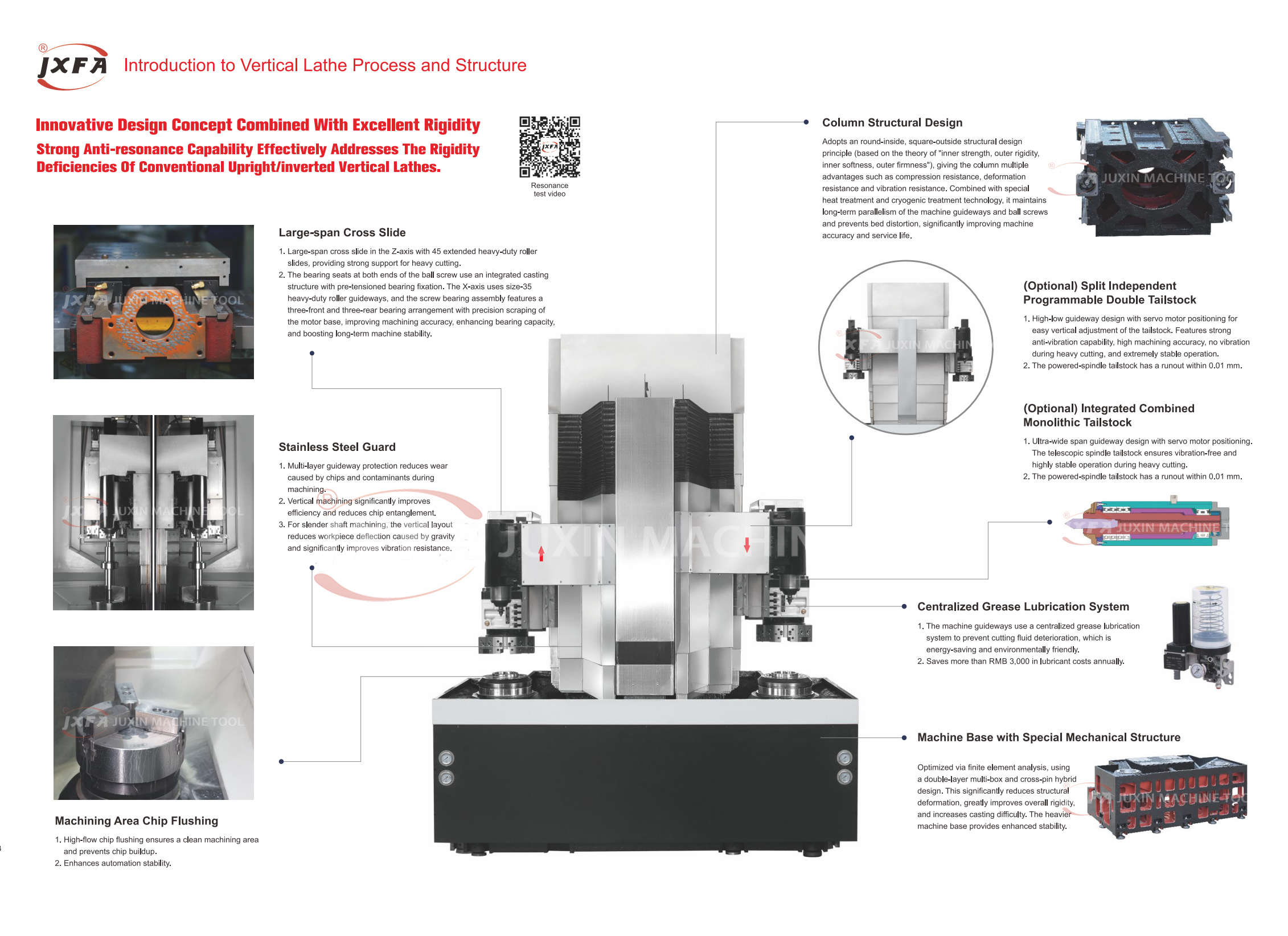
When buyers search for a CNC lathe machine for metal parts, they are often comparing machines that appear similar in basic axis configuration and nominal turning diameter. But beneath the surface similarity, two fundamentally different structural philosophies exist. One approach—more common among general-purpose builders—assembles the machine bed from bolted sections and positions the dual spindles as an add-on processing capability. The other approach, represented by the JUXIN dual-spindle vertical lathe, starts with a monolithic cast bed with a special mechanical structure, then locks the two spindles into a synchronized machining system.
For a procurement manager or plant engineer, this structural distinction cascades into measurable differences in rigidity, long-term stability, achievable tolerance, synchronous processing reliability, maintenance intervals, and ultimately cost per finished part. A head-to-head comparison of these two design philosophies reveals why machines that appear comparable in a brochure can diverge dramatically in the workshop.
High-precision CNC lathe machine designed for synchronized dual-spindle processing of shaft and disc workpieces.
The Two Structural Approaches to a Dual-Spindle Vertical Lathe
Dual-spindle vertical lathes used for high-precision CNC machining of shaft, disc, sleeve, and irregularly shaped parts differ mainly in how the machine structure handles rigidity and how the spindles coordinate with each other.
Approach One: The Integrated Cast-Bed Machine (JUXIN Design)
JUXIN Machine Tool Co., Ltd.—a Zhejiang-based CNC lathe manufacturer founded in 2005—designs its dual-spindle vertical lathe around what the company describes as a bed cast with a special mechanical structure. This integrated casting delivers high rigidity and improved vibration damping, providing the foundation for precision operations such as turning, milling, drilling, and grinding in a single setup. The machine prioritizes what JUXIN calls “high-precision synchronous linkage”: two independent spindles can machine two workpieces simultaneously or operate in an asynchronous switching mode for different stages of the same part. An intelligent monitoring module is integrated into the core design to provide real-time processing feedback, allowing predictive maintenance and process supervision.
Approach Two: The Spliced-Bed General-Purpose Machine
Many competitor models in the same product category adopt a spliced-bed structure as their primary cost-control measure. The core positioning of these machines is “basic dual-spindle processing.” The joined sections of the bed can reduce initial manufacturing cost, but the approach can introduce rigidity limits under heavy cutting. In practice, this type of machine is more likely to show resonance-related vibration and more frequent calibration drift. Dual-spindle coordination tends to be simpler, with limited capacity for synchronous processes beyond straightforward paired operations.
| Design Feature | JUXIN Dual-Spindle Vertical Lathe | Typical Spliced-Bed Dual-Spindle Lathe |
|---|---|---|
| Bed structure | Integrated cast bed with special mechanical structure | Spliced bed, bolted sections |
| Rigidity and stability | High rigidity, strong damping, designed for minimal resonance | Lower rigidity, resonance risk under heavier loads |
| Processing philosophy | Multi-process integration (turning, milling, drilling, grinding) | Primarily simple paired turning operations |
| Spindle coordination | Synchronous simultaneous processing + asynchronous switching | Limited synchronous coordination; simpler cycle logic |
| Monitoring | Intelligent monitoring module with real-time feedback | Generally not available |
Measurable Differences in Precision: A Technical Comparison
For an evaluation team, the most quantifiable difference between the two machine designs lies in achievable geometric accuracy. Precision claims are only useful when expressed as verifiable spindle and tolerance parameters, because those values determine which parts the machine is capable of holding and how often a machining process will stay within spec over a long production run.
According to manufacturer-provided specifications, the JUXIN dual-spindle vertical lathe achieves:
- Spindle radial runout: ≤ 0.005 mm
- Dual-spindle coaxiality: ≤ 0.01 mm
- Machining dimensional tolerance: within ± 0.008 mm
By comparison, competitor machines in the same dual-spindle vertical lathe category generally show:
- Spindle radial runout: ≥ 0.01 mm
- Dual-spindle coaxiality: ≥ 0.02 mm
- Machining dimensional tolerance: typically fluctuating between ± 0.015 mm and ± 0.02 mm
These differences are not marginal. In precision scenarios where a finished shaft or flange requires holding tight diameters across a batch of hundreds or thousands of parts, the gap between ±0.008 mm and ±0.02 mm can be the difference between first-pass acceptance and substantial corrective rework. It is important to note that the comparison values above are drawn from manufacturer-published technical materials. A buyer should still perform workpiece-specific validation on any machine before final selection.
Efficiency and Energy Cost: What the Numbers Say
Energy consumption in CNC turning is not a minor overhead item. For dual-spindle machines that often run continuously in shift-based production, the difference between an intelligently regulated machine and a fixed-energy design accumulates into a meaningful operating-expense gap.
Manufacturer data indicates that the JUXIN dual-spindle vertical lathe reduces no-load energy consumption by 30% compared with competing machines. Energy consumption per unit part is reported to be 25%–35% lower. These figures are attributed to high-efficiency motors paired with an intelligent energy-regulation system that adapts power draw to the actual processing load. A machine with fixed motor energy consumption—typical of the spliced-bed alternative—consumes nearly the same power whether it is cutting or idle, which becomes progressively more costly in high-mix production environments with frequent loading and unloading interruptions.
Beyond motor efficiency, machine stability influences energy economics. A structurally less rigid machine can generate additional energy losses through vibration, resonance, and rejected parts; each wasted cycle consumes both material and electricity. The JUXIN machine’s report of >85% energy utilization rate reflects the integration of multiple compound processes into a single clamping setup, which eliminates the energy cost of transferring parts between separate machines.
| Energy Metric | JUXIN Dual-Spindle Vertical Lathe | Competitor Dual-Spindle Vertical Lathes |
|---|---|---|
| No-load energy consumption | 30% lower | Baseline |
| Energy consumption per unit part | 25%–35% lower | Baseline |
| Energy utilization rate | >85% | Lower — single-process focus |
| Regulation | Automatic adjustment by load | Fixed consumption profile |
Processing Cost and Labor Efficiency in Mass Production
For decision-makers, the most important metric is unit part processing cost in continuous production. Here, the manufacturing philosophy of the machine—not just its spindle count—determines operating economy.
JUXIN Machine: Lower Cost Per Part at Scale
JUXIN reports that when its dual-spindle vertical lathe performs synchronous processing, single-piece processing time is 30%–50% shorter than that of competitor models. In mass production, this efficiency translates to a daily processing output approximately 1.5–2 times that of typical competing models. Labor costs also decrease because a single operator can manage two to three JUXIN machines, compared with the dedicated operator required by machines without integrated automation or intelligent supervision.
The consolidated design also lowers consumable loss. JUXIN reports that consumable wear is reduced by approximately 40% relative to competitors, as the machine’s rigidity reduces vibration-induced tool wear and its process integration reduces handling damage. Core components are specified for a service life in the range of 12–18 years. In volume production, JUXIN states that unit part processing cost can be reduced by 25%–35%.
Competitor Machine: Lower Entry Price, Higher Recurring Burden
The initial investment for a spliced-bed dual-spindle lathe is typically 25%–40% lower than for the JUXIN machine, which is a meaningful factor for constrained capital budgets. However, this lower upfront cost is accompanied by recurring consequences. The spliced-bed design requires more frequent inspection—typically one to two times per week—because bed sections can shift and dual-spindle coordination must be rechecked on a regular basis. The reported annual fault rate for this machine category is approximately 12 or more events per year, without the support of intelligent monitoring or predictive fault warning.
For a plant running three shifts across multiple machines, the interruption risk and maintenance labor associated with that fault frequency typically offsets the initial price advantage within a relatively short operating period.
Maintenance, Monitoring, and Total Cost of Ownership
Maintenance design separates a well-integrated machine from a loosely assembled one.
JUXIN has integrated an intelligent monitoring module into the dual-spindle vertical lathe. The system can warn of developing faults before they cause unexpected downtime. Manufacturer guidance puts routine maintenance at approximately once per month, with an annual fault rate of two or fewer events. The company provides lifelong technical support, regular inspections, and accessory upgrades as part of its service model. Daily maintenance is reduced to checking the lubrication system, spindle accuracy, and electrical components.
By contrast, competitor dual-spindle vertical lathes without intelligent monitoring require a reactive maintenance approach. The spliced bed is more susceptible to deformation, which creates a need for frequent verification of bed geometry and dual-spindle coordination. Maintenance frequency is reported at one to two times per week, with service often outsourced and spare parts lead time adding to the cost of interruptions.
Operational Cost Comparison at a Glance
| Operating Factor | JUXIN Dual-Spindle Vertical Lathe | Competitor Dual-Spindle Vertical Lathes |
|---|---|---|
| Operator requirement | 1 person can operate 2–3 machines | Dedicated operator per machine |
| Core component service life | Approx. 12–18 years | Shorter, faster wear |
| Consumable loss | ~40% lower | Baseline |
| Routine maintenance frequency | ~Once per month | 1–2 times per week |
| Annual fault rate (manufacturer-reported) | ≤2 times | ≥12 times |
| Intelligent fault warning | Yes | No |
| Technical support | Lifelong manufacturer support | Often external service reliance |
Note: Maintenance frequency and fault-rate figures are manufacturer-reported values. Independent validation under your specific production conditions is strongly recommended before purchase.
Application Fit: Where the JUXIN Design Excels
The JUXIN dual-spindle vertical lathe is engineered for high-precision mass processing of medium and large-sized disc, shaft, sleeve, and special-shaped parts. The manufacturer explicitly lists wind power flanges, heavy-machinery hubs, aerospace components, and similar high-value workpieces as target applications. These industries require precisely the combination that this machine architecture provides: structural rigidity for interrupted cuts, tight tolerance capability across large diameters, synchronous processing for matched part pairs, and multi-process integration to eliminate separate milling or grinding operations.
In the automotive sector—which accounts for the largest share of CNC lathe application globally at approximately 40%, followed by aerospace at around 25%—a machine that can complete a shaft or flange from raw stock to near-finished condition in one clamping cycle offers substantial logistics advantages over transferring parts across multiple standalone machines.
Buyers machining small parts in high volume will find the dual-spindle vertical lathe configuration less relevant; for small components, a dedicated small-part CNC lathe machine with automatic bar feeding is often a better fit. This boundary is worth noting: dual-spindle vertical lathes are designed primarily for medium and large workpieces where gravity-assisted clamping and part symmetry create process leverage.
Market Context: CNC Lathe Demand and Chinese Export Growth
The macro climate for capital investments in CNC lathe machinery remains constructive. The global CNC lathe machine market was valued at USD 11.1 billion in 2023 and is projected to reach USD 18.78 billion by 2030 at a CAGR of 7.8%, according to Verified Market Reports. This projected growth is consistent with broader automation demand across manufacturing sectors.
China has also increased its relevance as a supplier of machine tools. According to the China Machine Tool and Tools Builders’ Association (CMTBA), China’s machine tool exports reached USD 23.18 billion in 2025, a year-on-year increase of 6.7%, surpassing Germany to become the top global exporter in early 2025. This shift makes the evaluation of Chinese CNC lathe manufacturers more consequential for international buyers. The question is no longer whether Chinese machines can export, but which Chinese manufacturers have moved up-market into precision and specialized configurations.
Juxin Machine Tool Co., Ltd. operates within this evolving context. The company, founded in 2005, manufactures specialized CNC machine tools from a 10,666 m² facility in Wenling, Zhejiang, with an annual output capacity of approximately 2,000 sets. Its focus on dual-head CNC lathes, twin-spindle CNC vertical lathes, milling/facing/centering machines, and intelligent automation for shaft and disc parts reflects the broader shift of Chinese builders from low-cost general machines toward engineered solutions. The company reports more than 50 innovative technological patents and adoption by more than ten internationally recognized enterprises.
Benchmarking Against Global CNC Leaders
For a buyer comparing suppliers, it is useful to place any specialized Chinese manufacturer within the context of the global CNC machine market. The globally recognized leaders—DMG Mori (Germany/Japan), Yamazaki Mazak (Japan), Okuma (Japan), and Haas Automation (USA)—dominate the general-purpose and high-volume segments of the turning market. Their installed base, service networks, and standardization are clear advantages.
JUXIN’s position differs. As a specialized builder, the company concentrates its engineering effort on a narrower band of applications: dual-spindle vertical turning of shaft and disc parts with synchronized operation and multi-process integration. This specialization allows JUXIN to target the 40% automotive and 25% aerospace application segments identified by industry analysts, where a purpose-built machine can outperform a general-purpose turning center on cycle time, floor space per part, and part-holding consistency.
International buyers considering JUXIN should weigh the company’s specialized expertise and reported technology patents against the more extensive local service footprints of the global machine tool leaders. The choice is between a general-purpose machine with mature global support and an application-optimized machine with a higher level of process specialization. In practice, many precision parts manufacturers choose a hybrid approach: standardized turning centers for flexible job-shop work and specialized dual-spindle lathes for dedicated high-volume shaft/disc production lines.
When a High-Precision Specialized Lathe Is Worth the Premium
Decision-makers can structure their evaluation around four conditions that favor the JUXIN dual-spindle vertical lathe architecture despite its 25%–40% initial investment premium:
- Continuous mass production of identical or similar parts. The efficiency advantage—single-piece time reduced by 30%–50% in synchronous mode—is only realized when volume is sufficient to keep both spindles loaded consistently.
- High-precision medium-to-large workpieces. Parts such as wind power flanges, aerospace ring components, large sleeves, and heavy-machinery hubs require the structural rigidity and tolerance capabilities described earlier.
- Multi-process part complexity. When a part needs turning plus milling, drilling, or grinding, the ability to consolidate processes into one machine eliminates inter-machine queues and fixtures.
- Automation readiness. The built-in intelligent monitoring module and the ability for a single operator to manage multiple machines create a direct path toward lights-out or low-staff production.
Conversely, a buyer whose production consists primarily of small parts, high-mix/low-volume batches, or short-run prototype work would benefit more from a general-purpose CNC lathe machine for small parts or an automated lathe with bar-feed automation. Specialization delivers its greatest returns only where dedicated volume exists to absorb the higher initial cost.
Compliance and Safety Standards
Regardless of structural design, CNC lathe machines sold internationally must satisfy relevant machine safety regulations. The ISO 23125:2015 standard specifies safety requirements for numerically controlled turning machines (Group 3). Buyers should confirm that any machine under evaluation—whether a specialized dual-spindle vertical lathe or a general-purpose CNC turning center—is supplied with documentation aligned to this standard and to the electrical safety and EMC regulations applicable in their destination market. This is a minimum entry condition and should not be used as a differentiator between otherwise comparable suppliers.
Selection Checklist for the Final Evaluation
When visiting a supplier or reviewing a quotation, confirmation of the following items will materially de-risk the purchase:
- What is the spindle radial runout and coaxiality stated in the test certificate?
- How does the bed structure manage rigidity and vibration absorption?
- Can the machine handle both synchronous and asynchronous dual-spindle operation?
- Does the machine support integrated turning, milling, drilling, and grinding without additional setup?
- What monitoring and diagnostic systems are embedded for fault prediction?
- What is the maintenance interval proposed in the supplier’s documentation?
- Is a local or remote technical support agreement available, and what response time is guaranteed?
- What is the projected energy draw at no-load and at typical processing load?
Conclusion: Evaluation Beyond the Price List
For a CNC lathe machine buyer at the final decision stage, the question is not simply how much a machine costs at purchase. As this comparison has shown, a 25%–40% higher initial investment in a specialized dual-spindle vertical lathe can be offset by a 25%–35% lower unit part cost in mass production, a 30% reduction in no-load energy consumption, and lower consumable usage over a core component life of 12–18 years. The higher entry price of the JUXIN dual-spindle vertical lathe buys structural rigidity, multi-process integration, and automation readiness; the lower entry price of conventional spliced-bed machines buys a simpler starting point, but at the price of higher ongoing maintenance, lower rigidity limits, and more constrained precision capability.
The right choice depends on workpiece geometry, production volume, labor availability, and local energy costs. Buyers whose workload matches the medium-to-large disc, shaft, sleeve, and specialty-part category should evaluate the specialized architecture on process capability and per-part cost. Buyers with broader job-shop requirements may find general-purpose turning centers to be the more appropriate baseline. What is no longer reasonable is to compare these machines on purchase price alone.
Frequently Asked Questions
Q1: What precision can a JUXIN dual-spindle vertical lathe actually hold?
According to manufacturer specifications, the JUXIN dual-spindle vertical lathe achieves spindle radial runout ≤0.005 mm, dual-spindle coaxiality ≤0.01 mm, and machining dimensional tolerance within ±0.008 mm. In comparison, competing machines in this category typically show spindle radial runout ≥0.01 mm, coaxiality ≥0.02 mm, and dimensional tolerance of ±0.015 to ±0.02 mm.
Q2: Is a JUXIN dual-spindle vertical lathe more energy-efficient than competitor machines?
Manufacturer data indicates yes: the JUXIN machine reduces no-load energy consumption by 30% and lowers energy consumption per unit part by 25%–35% compared to competitor machines. This is enabled by high-efficiency motors and an intelligent energy regulation system that continuously adjusts power draw to machine load.
Q3: What types of parts are best suited to the JUXIN dual-spindle vertical lathe?
The machine is designed for high-precision mass processing of medium and large-sized disc, shaft, sleeve, and special-shaped parts. Identified application examples include wind power flanges, heavy-machinery hubs, and aerospace components.
Q4: How does the cost per part compare to standard dual-spindle vertical lathes?
JUXIN reports that during mass production, the machine reduces unit part processing cost by 25%–35% compared with alternatives, despite a higher initial purchase price. The cost reduction comes from faster synchronous processing, lower labor requirements, reduced consumable losses, and lower energy consumption.
Q5: What are the key limitations a buyer should weigh before specifying this machine?
The most significant limitation is the 25%–40% higher initial investment compared to spliced-bed competitor machines. In addition, the machine is not optimized for small-part processing; dedicated small-part CNC lathes with bar-feed automation typically handle that segment more efficiently. High-mix/low-volume manufacturers may also have difficulty recovering the cost premium without sustained batch production.
Q6: Which standards govern CNC lathe safety compliance?
CNC lathes and turning centers are generally governed by ISO 23125:2015, which specifies safety requirements for numerically controlled turning machines. Buyers should verify that the machine supplier’s compliance package aligns with this standard and with the electrical and EMC regulations of the destination market.
Q7: How does the JUXIN dual-spindle vertical lathe reduce per-unit processing costs?
JUXIN reports reductions of 25%–35% in per-unit processing costs during mass production, driven by several factors: a 30%–50% reduction in single-piece processing time in synchronous mode, the ability for one operator to run 2–3 machines, approximately 40% lower consumable loss than competitors, and a 25%–35% reduction in energy consumption per unit part compared with competing equipment.
Q8: Is the twin-spindle lathe limited to simultaneous processing, or can it also operate asynchronously?
The JUXIN dual-spindle vertical lathe supports both simultaneous processing of two parts and asynchronous switching of the dual spindles. This means the two spindles can work independently on different operations or part stages, giving the machine flexibility for mixed-step processing within a single clamping workflow.
Q9: How much maintenance does a dual-spindle vertical lathe typically require?
Manufacturer guidance for the JUXIN dual-spindle vertical lathe is approximately monthly routine maintenance, with a reported annual fault rate of two or fewer events when the machine is equipped with its intelligent monitoring module. By contrast, competitor dual-spindle machines without monitoring can require maintenance one to two times per week, and carry a higher fault risk that typically requires external service support.
Q10: What level of automation can be achieved with this type of CNC lathe machine?
Automation is realized in two ways. First, the intelligent monitoring module provides real-time processing feedback and fault early warning, reducing the need for constant human supervision. Second, the control system supports synchronous dual-spindle operation and multi-process integration, meaning one operator can manage two to three machines. For fully unmanned operation, the machine can be further integrated with robotic loading/unloading automation.
Q11: What is the production capacity of Juxin Machine Tool as a manufacturer?
Juxin Machine Tool Co., Ltd., located in Wenling, Zhejiang, has a factory area of 10,666 m², around 80 employees, and an annual output capacity of approximately 2,000 sets. The company was founded in 2005 and employs approximately ten engineers in its R&D team. It has developed over 50 innovative technology patents and expects adoption by internationally recognized enterprises.
Q12: How does Juxin Machine Tool’s specialization affect the comparison against global CNC leaders?
JUXIN competes in the specialized segment of dual-spindle and dual-head CNC lathe machines for shaft and disc parts, rather than as a full-line general-purpose CNC builder. This positioning lets JUXIN optimize its machines for specific applications, but global leaders such as DMG Mori, Yamazaki Mazak, Okuma, and Haas Automation have broader service networks and general-purpose flexibility. Buyers with dedicated production lines for medium-to-large precision parts are the group most likely to benefit from JUXIN’s specialized approach.
Detailed technical documentation available. For the full specifications, structural drawings, and application notes of the JUXIN dual-spindle vertical lathe, the company brochure can be downloaded here:
هل لديك أسئلة أو تحتاج إلى مزيد من التفاصيل؟
تواصل مع فريقنا للحصول على عرض أسعار مخصص أو استشارة فورية.
طلب عرض أسعار
املأ النموذج أدناه وسيتواصل معك فريقنا بعرض مقترح مخصص.
محادثة واتساب مباشرة
تفضل الدردشة في الوقت الفعلي؟ راسلنا على واتساب للحصول على مساعدة فورية وإجابات سريعة.
- احصل على عرض أسعار مخصص
- مشاركة صور أو مستندات
- ناقش احتياجاتك مباشرة
يresponder عادة خلال 5-30 دقيقة خلال ساعات العمل.