
CNC Machining Center Applications: Matching Type to Precision Industry Work
CNC Machining Center Applications: Matching Type to Precision Industry Work
Choosing a CNC machining center is an application decision before it becomes a specification decision. Whether a machine earns its floor space depends on how closely its architecture — vertical, horizontal, trunnion-table, swivel-head or gantry cradle — matches the geometry, weight, precision class and batch pattern of the parts it will actually run. The global market for CNC machining and turning centers was estimated at USD 27.64 billion in 2024 (Grand View Research), and vertical machining centers accounted for 52.3% of the 4-axis CNC market in 2025 (Dataintelo). Multi-axis capability is growing around that vertical base rather than replacing it.
EUMASEIKI is the CNC machining center brand of Wenzhou Euma Machinery Co., Ltd., a manufacturer founded in 2023 with an 8,000 m² operation, 68 employees, an eight-engineer R&D team and an annual output of 50–100 units. Its production base is located in Ningbo, Zhejiang, China, and the company reports an export ratio of 80%, with main markets in Russia, Saudi Arabia, Indonesia and Iran. The portfolio spans vertical machining centers, 4-axis and 5-axis horizontal machining centers, trunnion-table 5-axis machines, swivel-head 5-axis machines and gantry cradle 5-axis machines.
This article maps that portfolio to the industry scenarios and component types each architecture is designed for, using published model specifications only.
Why the Machine Type Has to Follow the Part
At the research and evaluation stage, buyers commonly begin with model numbers and headline travel figures. The questions that actually decide fit are narrower and more physical:
- How many faces of the component must be machined in a single setup, and how many re-clampings does the current process require?
- What is the maximum workpiece weight and envelope the shop will run — today and in the next two years?
- How often does the batch change, and how much of the cycle is non-cutting time?
- Which accuracy class does the drawing demand, and against which standard will that accuracy be measured?
- Which materials dominate the work mix — aluminium alloys, cast iron, steel, or hard-to-cut alloys?
An architecture that fits the part removes work from the process: fewer fixtures, fewer re-clamping operations and less accumulated datum error. An architecture that does not fit adds setup time, special tooling, or forces the shop to decline work it could otherwise quote. Vertical, horizontal and multi-axis machines are therefore not ranked against each other in general terms; each solves a different part problem, and the EUMASEIKI range is organised on that basis.
The EUMASEIKI Portfolio by Architecture
| Model | Architecture | X/Y/Z travel | Worktable / pallet | Max. load | Spindle | Tools / change | Control |
|---|---|---|---|---|---|---|---|
| EV-1580B | Vertical | 1,500 / 800 / 700 mm | 1,600 × 800 mm | 1,200 kg | ISO 50, belt, 8,000 rpm, 22/33 kW | 24 / 3 sec | SIEMENS 828D |
| EV-1370A | Vertical | 1,300 / 720 / 720 mm | 1,400 × 700 mm | 1,000 kg | ISO 40, belt, 8,000 rpm, 22/33 kW | 24 / 2 sec | SIEMENS 828D |
| EV-855A | Vertical | 810 / 550 / 560 mm | 1,000 × 550 mm | 650 kg | ISO 40, belt or direct, 10,000/12,000 rpm, 11/18.5 kW | 24 / 2 sec | FANUC 0i-MF PLUS |
| UV260 | Trunnion-table 5-axis | 500 / 500 / 450 mm | Ø260 mm | 60 kg | ISO 40, 12,000 rpm, 11/20 kW | 24 / 1.5 sec | SYNTEC 220MA-5 |
| UB1300C | Swivel-head 5-axis | 1,300 / 560 / 560 mm | 1,500 × 560 mm fixed, Ø500 mm C-axis | 1,500 kg (table) / 300 kg (C-axis) | HSK-A63, 12,000 rpm, 25.1/33.9 kW | 40 / 5 sec | SIEMENS ONE |
| DX5-630 | Gantry cradle 5-axis | 700 / 700 / 500 mm | Ø630 mm | 800 kg | HSK-A63, 15,000 rpm direct or 20,000 rpm electric | 40 / 5 sec | SIEMENS ONE |
| EH500 | 4-axis horizontal | 800 / 700 / 680 mm | 2 × 500 × 500 mm pallets | 600 kg | BT40, 10,000 rpm, 11/15 kW | 60 / 5 sec | FANUC 0i-MF |
| EH800S | 4-axis horizontal | 1,400 / 1,200 / 1,350 mm | 2 × 800 × 800 mm pallets | 2,000 kg | SK 50, 6,000 rpm, 22/26 kW | 60 / 6 sec | FANUC 0i-MF |
| HU1400 | 5-axis horizontal | 1,660 / 1,210 / 1,300 mm | Ø1,400 mm B-axis table | 4,000 kg | ISO 50, 3,000 rpm, 22/41.8 kW | 45 / 5 sec | SIEMENS ONE |
| HU1600 | 5-axis horizontal | 2,200 / 1,900 / 2,200 mm | Ø1,600 mm B-axis table | 6,000 kg | ISO 50, 3,000 rpm, 22/41.8 kW | 45 / 5 sec | SIEMENS ONE |
The distribution of specifications shows how the range is divided in practice: ISO 50 belt-driven verticals for heavy, large work; ISO 40 verticals for faster, lighter cutting; trunnion machines for small, high-precision envelopes; HSK-A63 swivel-head and gantry machines for simultaneous 5-axis geometry; and pallet-equipped horizontals for multi-face, higher-volume production.
Large-Part Manufacturing: EV-1580B
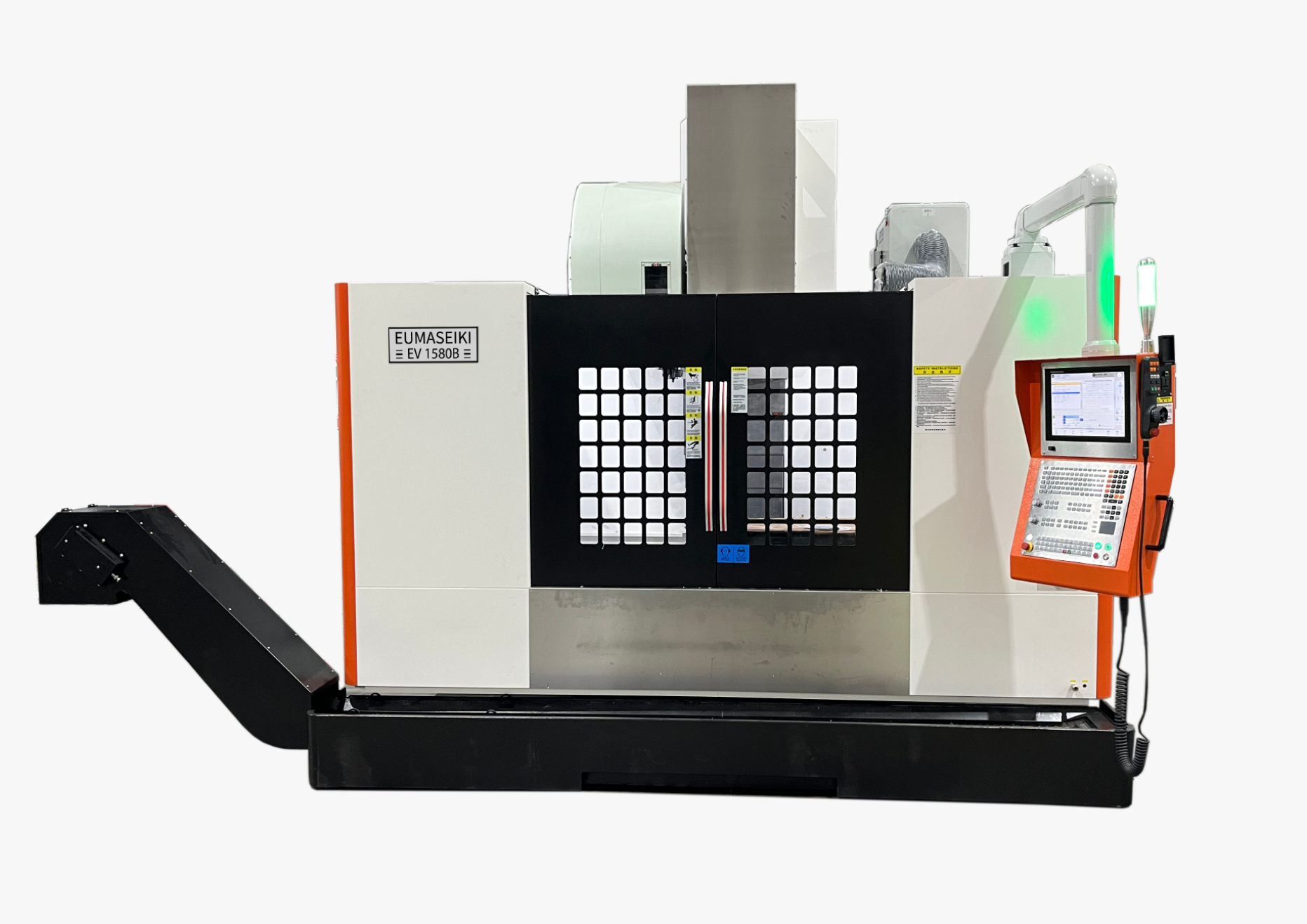
The EV-1580B is a 3-axis vertical machining center built around a 1,600 × 800 mm worktable with 1,500 / 800 / 700 mm X/Y/Z travels and a maximum table load of 1,200 kg. Its spindle is an ISO 50 belt-driven unit running at 8,000 rpm with a main motor rated 22/33 kW (S1/S6 25%) and torque of 140/260 Nm, rising to 210/380 Nm in the higher duty range. Rapid feed is 20/20/20 m/min and cutting feed reaches 10,000 mm/min, supported by φ50/10 mm ball screws and 55/45×4/55 mm linear guideways.
For buyers, the operational meaning of those figures is straightforward. The ISO 50 taper and 22 kW class motor are intended for heavier cuts in steel and cast iron, while the 8,000 rpm belt-driven spindle prioritises torque and rigidity over very high rotational speed. A 24-tool BT50 magazine with 3-second tool-to-tool change supports mixed-tool sequences on large parts without frequent manual intervention. X/Y/Z positioning accuracy is quoted at 0.009 mm with repeat accuracy of 0.006 mm.
The machine draws 35 kVA, occupies 4,000 × 3,300 mm with a height of 3,550 mm, and weighs 8,000 kg. Two larger verticals use the same spindle specification — the EV-1680B with a 1,700 × 800 mm table and 1,500 kg capacity, and the EV-1890B with a 2,000 × 900 mm table and 1,800 kg capacity. All three can be equipped with an optional 4-axis rotary table for 5-face or 5-axis processing, which is the usual route for shops that need one additional orientation without moving to a full simultaneous 5-axis machine.
Mid-Size Production: EV-1370A, EV-1165A and EV-855A
Where part envelopes sit in the 1,000–1,400 mm class, the mid-size verticals carry most of the production load. The EV-1370A offers 1,300 / 720 / 720 mm travels on a 1,400 × 700 mm table rated to 1,000 kg, with an ISO 40 belt-driven spindle at 8,000 rpm, 22/33 kW and 140/260 Nm. Its rapid feed is 36/24/24 m/min with cutting feed of 15,000 mm/min, and the BT40 magazine holds 24 tools with a 2-second tool-to-tool change. Positioning accuracy is quoted at 0.008 mm with 0.005 mm repeat accuracy, on a 30 kVA supply and a 7,000 kg machine.
Below that, the EV-1165A and EV-855A trade table size for speed. The EV-1165A runs 1,100 / 650 / 650 mm on a 1,300 × 650 mm table rated to 900 kg; the EV-855A runs 810 / 550 / 560 mm on a 1,000 × 550 mm table rated to 650 kg. Both use ISO 40 spindles at 10,000/12,000 rpm with 11/18.5 kW, and the EV-855A is specified with rapid feed of 48/48/32 m/min and cutting feed of 20,000 mm/min on a FANUC 0i-MF PLUS control.
For procurement teams comparing quotations in this class, the practical check is narrow: confirm the table dimensions, load rating and travel of the exact model quoted, and confirm that the fixture plate, workpiece and any tombstone arrangement fit inside those travels with clearance for tool access. Small differences in designation can correspond to materially different working envelopes, and the envelope — not the model name — determines whether a part can be machined.
Small, High-Mix Precision Components: UV260 Trunnion Table
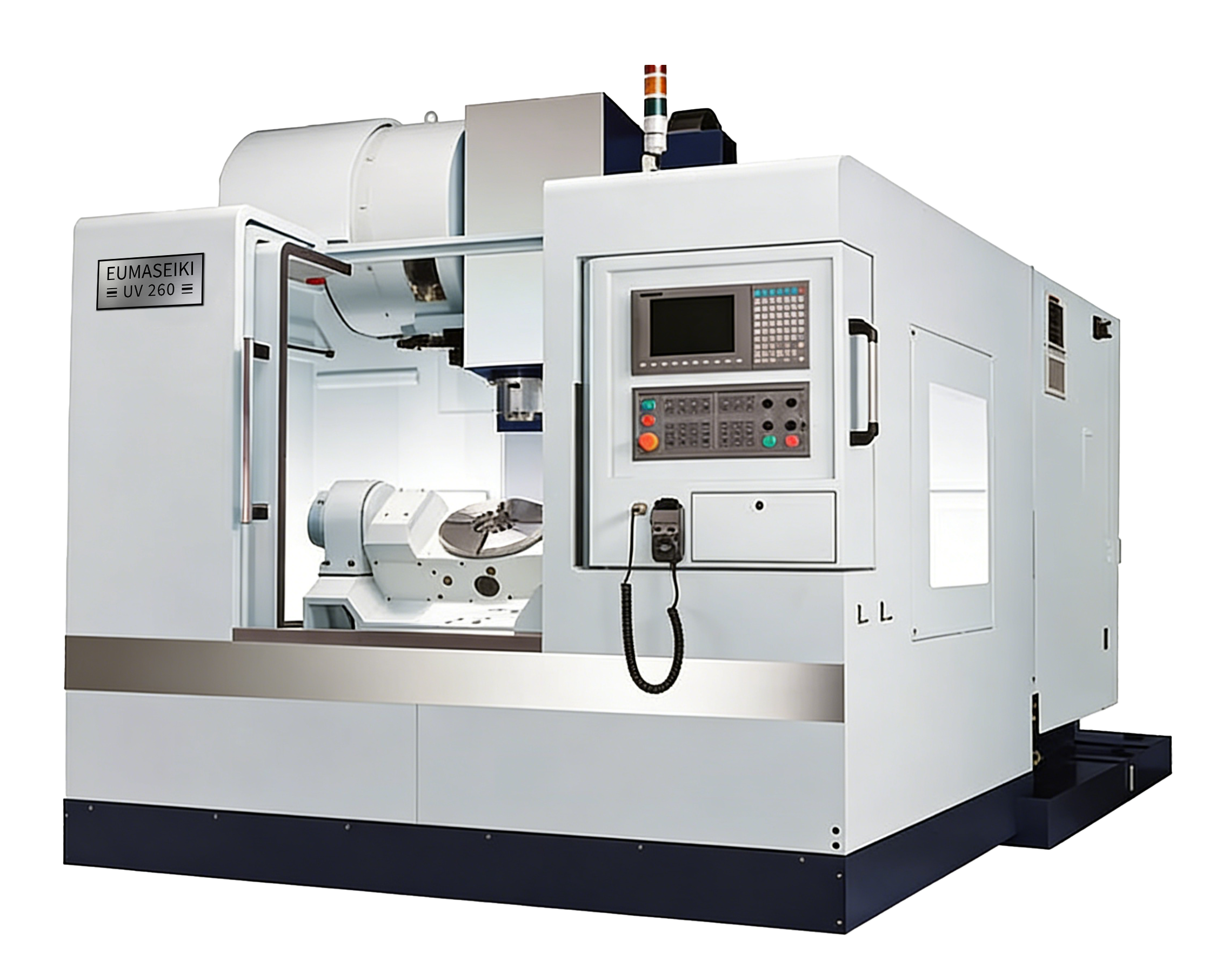
The UV260 addresses a different production problem: components small enough to be held on a Ø260 mm worktable with a maximum load of 60 kg, but complex enough to require simultaneous multi-directional machining. Its X/Y/Z travels are 500 / 500 / 450 mm, the A-axis tilts from −110° to +110° and the C-axis rotates 360°, with A/C speeds of 150 and 200 rpm. The spindle is an ISO 40 unit at 12,000 rpm rated 11/20 kW, with a 24-tool BT40 magazine.
Two figures stand out in an evaluation. Tool-to-tool change time is 1.5 seconds, which reduces non-cutting time in cycles built from many small tools. Accuracy is quoted per German VDI 3441 at 0.007 mm X/Y/Z positioning and 0.005 mm repeat, with A and C division accuracy of ±20 seconds and reposition accuracy of ±4 seconds.
The published application scope for the UV series is drilling, tapping and milling of small and medium series components for precision mechanics, watchmaking, medical technology, electronics and general mechanics. That scope follows directly from the machine's physical limits as much as its capability: with a 60 kg table limit, the platform is not intended for heavy workpieces, and heavier 5-axis work moves to other architectures in the range.
| Model | Worktable | Max. load | X/Y/Z travel | Spindle speed | Tool change |
|---|---|---|---|---|---|
| UV260 | Ø260 mm | 60 kg | 500 / 500 / 450 mm | 12,000 rpm | 1.5 sec |
| UV320 | Ø320 mm | 60 kg | 550 / 550 / 500 mm | 12,000 rpm | 1.5 sec |
| UV400 | Ø400 mm | 100 kg | 500 / 650 / 400 mm | 12,000 rpm | 1.5 sec |
Complex Geometry in One Setup: Swivel-Head, Gantry Cradle and 5-Axis Horizontal
When the part demands continuous five-axis motion rather than indexed positioning, the range moves to three further architectures.
Swivel-head machines. The UB1300C uses a column-moving design with a 1,500 × 560 mm fixed table rated to 1,500 kg and a Ø500 mm C-axis rotary table rated to 300 kg, driven by a direct-drive motor. The B-axis spindle head tilts from −120° to +120° at 50 rpm with 580 Nm continuous and 1,160 Nm maximum torque, plus 2,400 Nm braking torque at 50 bar oil pressure. The HSK-A63 spindle runs at 12,000 rpm with 25.1/33.9 kW. Positioning accuracy is quoted at 0.012 mm X/Y/Z with 0.008 mm repeat, and B/C positioning accuracy of 8 and 10 arc-seconds respectively. Both linear axes and the C-axis table use Heidenhain optical scales. The larger UB2000C extends this to 2,000 / 900 / 800 mm travels, a 2,500 × 900 mm fixed table rated to 3,500 kg, and a Ø800 mm C-axis table rated to 1,800 kg.
Gantry cradle machines. The DX5-630 carries a Ø630 mm tilting/rotary table rated to 800 kg with A-axis travel of ±120° and 360° C-axis rotation. It can be specified with a direct-drive HSK-A63 spindle at 15,000 rpm (22/33 kW) or an electric HSK-A63 spindle at 20,000 rpm (31/37 kW), with 40 tools and a 5-second tool change. Positioning accuracy is quoted at 0.008 mm with 0.004 mm repeat on X/Y/Z. The DX5-800 raises the table to Ø800 mm with a load capacity of 850/1,200 kg.
5-axis horizontals. The HU1400 and HU1600 use a B-axis table of Ø1,400 mm (4,000 kg load) and Ø1,600 mm (6,000 kg load) respectively, with an ISO 50 spindle at 3,000 rpm, 22/41.8 kW and gearbox torque of 840/1,596 Nm. Each carries 45 tools with a 5-second change, and five-axis linked RTCP precision is quoted at ±0.025 mm. Their published design intent is complete milling and turning in one setup on hard-to-cut materials such as those found in aerospace work, as well as surface-quality-critical tool and mould applications.
Box-Type and Valve-Body Work at Volume: EH Series
For multi-face prismatic parts — moulds, dies, boxes and valve bodies in steel, cast iron or light metal alloys — the horizontal architecture separates cutting from chip removal. The EH500 has 800 / 700 / 680 mm travels with two 500 × 500 mm pallets, a 600 kg load capacity per pallet and a maximum rotation diameter of φ950 × 2 mm. Its BT40 spindle runs at 10,000 rpm with 11/15 kW and 52.5/95.5 Nm, and the 60-tool magazine changes in 5 seconds. Positioning accuracy is quoted at 0.005 mm with 0.003 mm repeat, on a 50 kVA supply and a 9,000 kg machine.
The EH800S scales the same concept for larger work: 1,400 / 1,200 / 1,350 mm travels, two 800 × 800 mm pallets rated to 2,000 kg, an SK 50 spindle at 6,000 rpm with 22/26 kW and 140/223 Nm — rising to 420/669 Nm with a BF reduction gearbox. Its 60-tool magazine changes in 6 seconds, and the machine weighs 27,000 kg. The published performance scope for this family covers drilling, boring, reaming and tapping across both high-speed and high-torque cutting, from mass production to small batch production, with the T-shaped structure allowing single or double pallet configuration.
What Sits Behind the Specification: Build, Castings and Inspection
Specification tables are only useful if the structure behind them holds the numbers over time. EUMASEIKI describes its machines as originating from European design concepts, manufactured to Taiwanese standards with Japanese technologies across casting, machining, assembly and commissioning. Machine beds and columns use mineral castings with structures optimised through finite element analysis; castings undergo full annealing to eliminate internal stress, with a secondary annealing process and extended holding period applied to the vertical series to further relieve stress. Spindle guideways are high-frequency heat treated.
Key components — spindles, guideways, bearings and oil pumps — are sourced from manufacturers in Taiwan and Japan, with some core components imported from original German or Italian brands. Assembly is carried out by technicians with prior experience at Taiwanese machine tool enterprises. The production base in Ningbo is equipped with Japanese OKUMA gantry machining centers, KURUKI boring and milling machines, NIIGATA horizontal machining centers and a German ZEISS coordinate measuring machine, which support both the machining precision of the components and trial machining and testing before shipment.
How accuracy claims should be read
Several models in this article quote positioning and repeat accuracy per German VDI 3441 — for example 0.007 mm / 0.005 mm on the UV series, 0.008 mm / 0.004 mm on the DX5-630 and 0.012 mm / 0.008 mm on the UB1300C. Alongside these, ISO 230-2:2014 remains the current international framework for determining accuracy and repeatability of positioning for numerically controlled axes. Because the two frameworks describe measurement in different ways, a buyer comparing quotations should ask which standard backs a quoted figure, whether the value is measured unloaded, and at what ambient temperature. Where a parameter is not published for a given model, it should not be inferred from another model's data.
Application Scenarios and Site Conditions
The most frequently documented deployment pattern for the range is continuous production. The published scenario for the EV-855A specifies metal cutting and precision machining in a manufacturing setting, indoor normal temperature and humidity, and 24/7 continuous operation. It lists spindle collision protection and high stability under long-term continuous running as special requirements, and identifies chip conveyor, coolant system, tool magazine and oil mist collector as supporting equipment. This scenario is described as common in markets including Russia, Azerbaijan and Brazil.
A separate case record describes a Tier 1 supplier in Russia operating six units for component manufacturing. The machines in that deployment were configured with stress-relieved high-rigidity frames, high-precision spindles, hydraulic, cooling and tool magazine systems, and spindle anti-collision protection. Each machine was inspected before delivery through geometric accuracy testing, laser axis calibration and full-load workpiece trial cutting. EUMASEIKI reports that the machines operated stably with nearly zero failures in mass production over a one-year period — a first-party account, and one that illustrates the type of verification a buyer should expect to be documented rather than assumed.
Market Trend Analysis
Three data points frame where demand is moving. First, the overall market remains large and vertical-dominated: CNC machining and turning centers were estimated at USD 27.64 billion globally in 2024 (Grand View Research), while vertical machining centers held a 52.3% product-type share of the 4-axis CNC market in 2025 (Dataintelo). Second, five-axis capability is expanding from a smaller base: the 5-axis CNC machining center market was valued at approximately USD 7.35 billion in 2024 with a projected CAGR of 4.6% to 2035 (WiseGuyReports). Third, that growth is concentrated by industry — aerospace accounted for a 28.7% revenue share of the 5-axis segment in 2025 (Dataintelo).
Market sizing itself is not settled: near-term estimates for the machining center market range from USD 22.41 billion for 2025 (Mordor Intelligence) to more than USD 27.6 billion (Grand View Research), a divergence that reflects different scope definitions, particularly whether turning centers are included. Buyers should treat any single figure as a scope-dependent estimate rather than a fixed fact.
On the supply side, China's machine tool exports reached USD 8.56 billion in the first five months of 2024, a 1.8% year-on-year increase (ICE Pechino / China Customs) — a reminder that sourcing assessments increasingly involve comparing machines built for export markets against the documentation and inspection evidence that accompanies them.
The practical reading of these trends is that the largest purchasing volume still sits in 3-axis and 4-axis vertical platforms, while five-axis investment is justified where part geometry or material genuinely requires it. A shop buying its first 5-axis machine should be able to name the specific part families that cannot be produced economically on its existing verticals.
Where These Machines Fit — and Where They Do Not
Applications fail when the boundary is discovered after purchase. The following limits are stated in the published specifications and should be treated as design boundaries, not defects.
- Trunnion-table worktable limits. The UV260 and UV320 are rated to 60 kg and the UV400 to 100 kg. Components above that weight require a different 5-axis architecture — for example the UB1300C (1,500 kg fixed table), DX5-630 (800 kg on a Ø630 mm table) or the HU series (4,000 kg and 6,000 kg B-axis table loads).
- Spindle speed versus cutting class. The EV-1580B, EV-1680B and EV-1890B run ISO 50 belt-driven spindles at 8,000 rpm. Where fine finishing with small-diameter tools at high rotational speed dominates, the ISO 40 verticals at 10,000/12,000 rpm or the HSK-A63 spindles at 12,000–20,000 rpm on the UB and DX5 series are the more suitable configuration.
- Horizontal machine envelope constraints. The EH500 accepts 600 kg per pallet with a maximum rotation diameter of φ950 × 2 mm; the EH800S accepts 2,000 kg. The HU1600, with a 6,000 kg B-axis table, specifies a maximum workpiece height of 1,500 mm. Horizontal architectures suit multi-face prismatic and box-type parts rather than long, slender components that fit naturally on a large vertical table.
- Setup cost is not zero. Moving from a 3-axis vertical with fixtures to a 5-axis platform removes re-clamping, but it also adds programming complexity, tool-path verification and operator training. The trade-off is only favourable when the number of set-ups, the fixturing cost or the accuracy requirement is significant.
- Installation and foundation planning. The UB2000C occupies 7,500 × 4,800 mm and weighs 22,000 kg; the DX5-800 weighs 23,000 kg; the HU1600 weighs 52,000 kg and stands 5,200 mm high. Floor loading, lifting equipment, power supply (up to 110 kVA on the UB2000C) and air pressure requirements of 6 kg/cm² must be confirmed before order.
- Production slots. EUMASEIKI states a monthly capacity of 10 units with a lead time of 30–45 days and a minimum order quantity of 1 unit. Project schedules should be built around confirmed production slots rather than indicative dates.
- Documentation per model. Accuracy, marking and compliance documentation are model- and market-specific. Buyers should request the test records and marking documents for the exact model and destination market rather than relying on category-level statements.
Future Outlook
Three developments are likely to shape purchasing decisions over the next several years. The first is the continued expansion of five-axis capability at a projected 4.6% CAGR to 2035, concentrated in industries such as aerospace where geometry and material properties leave few alternatives. The second is the durability of the vertical platform: with a 52.3% share of the 4-axis CNC market in 2025, the mainstream purchase decision remains a vertical machining center selected on envelope, load and cutting class. The third is configuration rather than catalogue purchasing — EUMASEIKI's stated OEM scope covers voltage, logo, spindle, tool magazine, travel stroke, cooling system, chip conveyor and control system, which reflects a market where buyers increasingly specify the machine around a known part mix instead of modifying the part mix to suit a standard machine.
Requirements that were once optional are also becoming part of the baseline specification. Continuous 24/7 operation, spindle collision protection, oil mist collection and chip management appear as explicit installation requirements in current documentation, alongside a growing expectation that accuracy claims can be traced to a named standard and a test record.
Frequently Asked Questions
How do I decide between a vertical, horizontal and 5-axis machining center for a given part?
Start with the part envelope and weight, the number of faces to be machined in one setup, and the batch pattern. A vertical machine such as the EV-1580B handles 1,200 kg on a 1,600 × 800 mm table with 1,500/800/700 mm travels. A horizontal machine such as the EH500 accepts 600 kg per 500 × 500 mm pallet and adds pallet exchange for multi-face parts. A trunnion-table 5-axis machine such as the UV260 carries only 60 kg on a Ø260 mm table but machines multiple faces in a single setup. The part specification determines the architecture; the model number follows.
What workpiece weight can a trunnion-table 5-axis machining center handle?
The UV260 and UV320 list a maximum worktable load of 60 kg, and the UV400 lists 100 kg. Above that range, heavier five-axis work moves to other architectures: the UB1300C carries 1,500 kg on a 1,500 × 560 mm fixed table, the DX5-630 carries 800 kg on a Ø630 mm table, and the HU1400 and HU1600 carry 4,000 kg and 6,000 kg on their B-axis tables.
How fast is tool change on these machines, and when does it matter?
Tool-to-tool change time is 1.5 seconds on the UV260, UV320 and UV400; 2 seconds on the EV-855A, EV-1165A and EV-1370A; 3 seconds on the EV-1580B; 5 seconds on the EH500, UB1300C and HU series; and 6 seconds on the EH800S. The figure matters most when a single small component requires many tools, because non-cutting time then forms a large share of the cycle. On large-part work with longer cut times, the difference is proportionally smaller.
Which standard should be used when comparing quoted positioning accuracy?
Some models in this range quote positioning and repeat accuracy per German VDI 3441 — for example the UV series at 0.007 mm positioning and 0.005 mm repeat, the DX5-630 at 0.008 mm and 0.004 mm, and the UB1300C at 0.012 mm and 0.008 mm. ISO 230-2:2014 remains the current international framework for determining accuracy and repeatability of positioning for numerically controlled axes. Buyers comparing quotations should confirm which standard a quoted value follows, whether the value is measured unloaded, and at which ambient temperature.
What does a 24/7 continuous production installation require?
The published scenario for the EV-855A specifies indoor normal temperature and humidity conditions, 24/7 continuous operation, and special requirements of spindle collision protection and high stability over long-term running. Supporting equipment identified for the installation includes a chip conveyor, coolant system, tool magazine and oil mist collector. The scenario is described as common in markets such as Russia, Azerbaijan and Brazil.
How is machine accuracy verified before delivery?
EUMASEIKI's case record for a Tier 1 supplier in Russia — six units used for component manufacturing — describes full-process inspection before delivery, including geometric accuracy testing, laser axis calibration and full-load workpiece trial cutting. The company states a quality control scope of 100% test across production. That deployment is reported to have run stably with nearly zero failures in mass production over a one-year period.
Can a machining center be configured for a specific plant rather than bought from a catalogue?
EUMASEIKI offers OEM-mode customization covering voltage, logo, spindle, tool magazine, travel stroke, cooling system, chip conveyor and control system. The stated minimum order quantity is 1 unit, monthly capacity is 10 units and lead time is 30–45 days. After-sales support is provided both on site and remotely, and the company's stated export markets are the EU and Southeast Asia.
Conclusion
Matching a machining center to precision industry work is a process of elimination based on physical facts: workpiece envelope and weight, the number of faces that must be machined in one setup, the cutting class the material requires, and the accuracy class the drawing demands, measured against a named standard. The EUMASEIKI range covers those cases with distinct architectures — verticals from 650 kg to 1,800 kg table capacity, trunnion tables for small high-mix components, swivel-head and gantry cradle machines for simultaneous five-axis geometry, and pallet-equipped horizontals for multi-face production — with published specifications that buyers can compare directly against their own part lists.
The EUMASEIKI product brochure, containing the specification tables referenced in this article, is available for download at https://cdn.socialarks.com/sbsp/25034/common/2026/0706/EUMASEIKI_XCHC.pdf. Company information is published at www.eumaseiki.com.