
CNC Machining Center Certification and Parameter Checks
Buyers evaluating CNC machining centers often start with spindle speed, travel, and price. The procurement risk, however, tends to sit in the verification layer: certification scope, measured accuracy, material stability, and whether the machine can hold those claims during continuous production. This reference examines those checks through data points from EUMASEIKI's model range and publicly available industry figures.
The verification gap in machining center procurement
A CNC machining center specification sheet can look strong while the machine still fails in a specific market because it lacks the right certification, or in a specific process because the accuracy statement was not measured to a comparable standard. For constrained purchase decisions, the useful question is not only what the machine can do, but what has been verified, under which standard, and for which model list.
Part of the difficulty is that buyers compare data points without a common basis. Positioning accuracy can be reported under different conditions. Tool change time can refer to tool-to-tool movement under different magazine states. A machine may be certified for one region and not another. Without checking certificate scope and parameter definitions, procurement teams can overestimate a machine's fit for a target plant.
EUMASEIKI's configuration and manufacturing baseline
Wenzhou EUMA Machinery Co., Ltd., operating under the EUMASEIKI brand, is a Wenzhou-based high-tech enterprise integrating industry and trade. The company is dedicated to CNC machining center customization, with a professional R&D center, patented technologies, and sales service teams. Its production base is located in Ningbo City. The company reports an 8,000 m² factory, 68 employees, eight engineers, and an annual output capacity of 50–100 units. Roughly 80% of production is exported, with main markets listed as Russia, Saudi Arabia, Indonesia, and Iran.
The manufacturing approach combines European-origin design concepts with Taiwanese standards and Japanese technologies in casting, machining, assembly, and commissioning. Machine beds use mineral castings, with structures optimized through finite element analysis. Castings undergo full annealing to reduce internal stress, and spindle guideways undergo high-frequency heat treatment. Key components such as spindles, guideways, bearings, and oil pumps are sourced from manufacturers in Taiwan and Japan, with some core components imported from Germany or Italy. The workshop includes Japanese OKUMA gantry machining centers, KURUKI boring and milling machines, NIIGATA horizontal machining centers, and a German ZEISS coordinate measuring machine. These details matter because they indicate the level of metrology and process control behind the final accuracy claims.
Certification scope: CE and EAC as market entry evidence
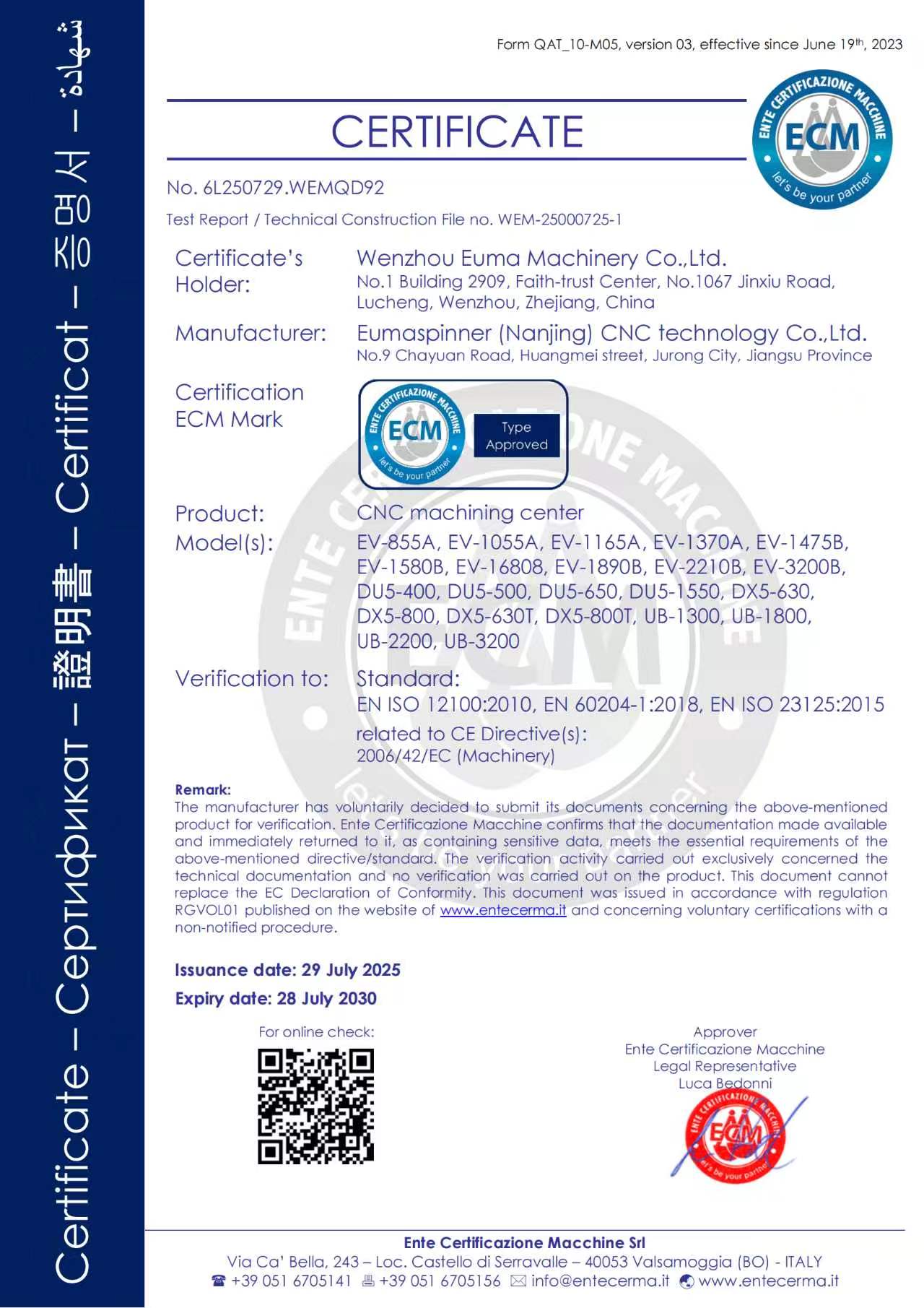
Certification is one of the clearest constraints for industrial procurement. For the EU market, the CNC Machining Center model EV-855A holds CE certification under number 6L250729.WEMQD92, issued by Ente Certificazione Macchine Srl (ECM, Italy), and complies with EN ISO 23125:2015. The CE scope also includes the EV series from EV-1055A through EV-3200B, the DU5 series, DX5 series, and UB series models UB-1300, UB-1800, UB-2200, and UB-3200.
For the EAEU market, the EV-855A CNC Vertical Machining Center is EAC certified under certificate number ЕАЭС N RU Д-CN.PA06.B.89520/25, issued by РОСС RU.31578.04ОЛН.ИЛ08, and conforms to TR CU 010/2011 and TR CU 020/2011. The EAC scope is narrower: it covers the EV series vertical machining centers from EV-855A through EV-3200B. Buyers should therefore verify whether the specific 5-axis or horizontal model they are considering already has EAC documentation, or whether project-specific conformity work is required.
These certificates should be read as model-list documents rather than blanket brand coverage. A procurement team should ask for the certificate number, the notified or issuing body, the applicable standard, and the exact model list. That request is not a formality; it is the difference between a machine that can be installed and one that may be delayed at customs or audit stage.
Technical parameters and how to read them
Accuracy parameters are only meaningful when the measurement standard is clear. The ISO 230-2:2014 standard remains the current international framework for determining accuracy and repeatability of positioning for numerically controlled axes. Several EUMASEIKI models report values according to German VDI 3441 or equivalent machine-level checks. For example, the EV-855A vertical machining center has X/Y/Z positioning accuracy of 0.008 mm and repeat positioning accuracy of 0.005 mm. The larger EV-1370A also reports 0.008 mm positioning and 0.005 mm repeatability. The HU1600 5-axis horizontal machining center reports X/Y/Z positioning accuracy of 0.010 mm and repeat positioning accuracy of 0.006 mm, with A/B axis positioning accuracy of 10 seconds and repeat positioning accuracy of 6 seconds, and a five-axis linked RTCP precision of ±0.025 mm.
Spindle and tooling data should be evaluated against the expected workpiece mix. The EV-855A offers a spindle speed of 10,000 or 12,000 rpm, a BT40 tool shank, and a 24-tool magazine. The EH800S horizontal machining center is configured for heavier cutting: 6,000 rpm spindle speed, SK 50 taper, a 60-tool magazine, and X/Y/Z travels of 1,400/1,200/1,350 mm. The UB1800C swivel-head 5-axis machine uses an HSK-A63 spindle at 12,000 rpm with a 40-tool magazine, and reports X/Y/Z positioning accuracy of 0.015 mm with repeat accuracy of 0.008 mm. These numbers do not make one machine better than another in absolute terms; they define different operating windows: aluminum mold work, heavy steel components, or simultaneous five-axis aerospace parts.
Material choices also constrain long-term stability. EUMASEIKI machines use cast iron, special steel, marble, and high-precision electronic components. The mineral casting in the bed is designed to provide damping and thermal stability. Secondary annealing and longer stress-relief periods are intended to reduce dimensional drift. This is relevant for buyers planning 24/7 operation rather than short-run prototyping.
Applications where constrained machining matters
EUMASEIKI lists its equipment for precision mold making, aerospace, automotive parts manufacturing, high-end equipment production, shipbuilding, and engineering machinery. Application data from the supplied corpus describes indoor normal temperature and humidity operation, with 24/7 production as the expected mode. The matched auxiliary equipment includes chip conveyors, coolant systems, tool magazines, and oil mist collectors. For long-run stability, spindle collision protection and high thermal stability are called out as special requirements.
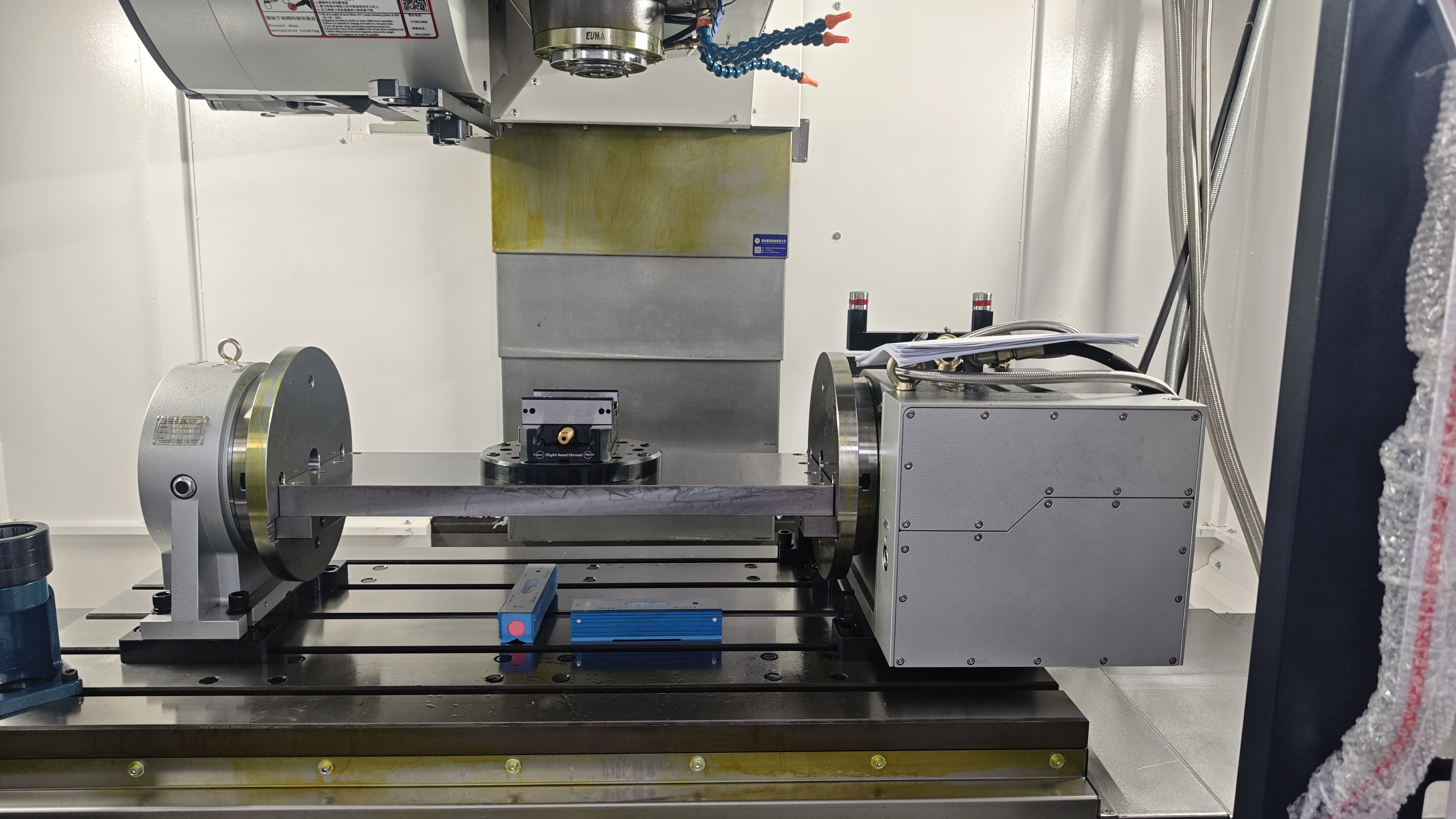
One case note describes a Tier 1 supplier deployment in Russia involving six units for component manufacturing over one year. The reported outcome is stable operation with nearly zero failures in mass production, supported by geometric accuracy testing, laser axis calibration, and full-load workpiece trial cutting before delivery. This should be read as a supplier-reported reference point rather than an independent validation, but it illustrates the type of evidence that can be requested during evaluation.
Market signals and procurement context
The global CNC machining and turning centers market was estimated at USD 27.64 billion in 2024 according to Grand View Research. Within that, the 5-axis CNC machining center market was valued at approximately USD 7.35 billion in 2024, with a projected CAGR of 4.6% to 2035 according to WiseGuyReports. Vertical machining centers held a 52.3% product type share in the 4-axis CNC market in 2025 according to Dataintelo. Aerospace represented 28.7% of the 5-axis machining center market revenue in 2025, also according to Dataintelo. These figures do not justify a specific purchase, but they explain why procurement teams increasingly compare 5-axis capability, certification, and long-term stability rather than initial price alone.
China's machine tool exports reached USD 8.56 billion in the first five months of 2024, a 1.8% year-on-year increase according to ICE Pechino and China Customs data. That supply context means buyers often evaluate manufacturers in China alongside Japanese, German, and US machine builders. In competitor rankings, DMG Mori, Yamazaki Mazak, and Haas Automation are identified as the top three global manufacturers of CNC machining centers by market presence and technology, according to AMSL/Mechrank. EUMASEIKI is a smaller and more specialized entity; its value proposition is tied to customization, component sourcing, and verification support rather than brand scale.
Comparison with traditional solutions
Compared with a standard catalog machine from a large global builder, EUMASEIKI's model is closer to a configured machine-tool supplier. The standard global builder may offer faster local service coverage and broader installed base, but may also limit modifications to certain options. EUMASEIKI reports OEM customization covering voltage, logo, spindle, tool magazine, travel stroke, cooling system, chip conveyor, and control system, with a minimum order quantity of one unit. Lead time is stated as 30–45 days, and monthly capacity is 10 units. Quality control is described as 100% testing, with on-site and remote after-sales support.
There are real boundaries. The EAC certification scope is primarily the EV vertical series, so buyers considering the HU, DX5, or UB series for the EAEU market should not assume EAC coverage has already been completed. The stated monthly capacity of 10 units means that a large multi-unit program may need more scheduling coordination than a high-volume standard machine supplier. The 30–45 day lead time is a customization window, not a promise of immediate availability. These constraints are not negative by themselves; they are procurement factors that should be matched against project timing and compliance responsibility.
Future outlook
The direction of the market points toward more five-axis work, more aerospace and complex-curved part demand, and more documented accuracy. As 5-axis demand rises, buyers will likely place more weight on RTCP precision, thermal stability, certification scope, and the ability to run unattended. The EUMASEIKI product range includes swivel-head, gantry cradle, and horizontal 5-axis configurations, which suggests that the company is positioning for complex part production rather than commodity three-axis work. The main open question is whether it can expand certification coverage and service capacity to match its machine portfolio.
For procurement teams, the near-term shift is not toward more aggressive feature claims, but toward verifiable parameter sheets, model-specific certificates, and evidence from trial cutting and metrology. The enterprises that can provide that without forcing a sales narrative are more likely to pass an engineering-led evaluation.
FAQ
Which EUMASEIKI CNC machining center models are CE certified for the EU market?
The CE certification under number 6L250729.WEMQD92, issued by Ente Certificazione Macchine Srl (ECM, Italy), covers the EV series from EV-855A through EV-3200B, the DU5 series, the DX5 series, and the UB series models UB-1300, UB-1800, UB-2200, and UB-3200. The applicable standard is EN ISO 23125:2015.
Which models hold EAC certification for the EAEU market?
The EAC certificate number ЕАЭС N RU Д-CN.PA06.B.89520/25, issued by РОСС RU.31578.04ОЛН.ИЛ08, covers the EV series vertical machining centers from EV-855A through EV-3200B. It confirms conformity with TR CU 010/2011 and TR CU 020/2011.
What accuracy parameters should a buyer check before purchase?
Buyers should confirm positioning accuracy and repeat positioning accuracy, the measurement standard, and the specific axis. Examples from the corpus include the EV-855A with X/Y/Z positioning accuracy of 0.008 mm and repeat accuracy of 0.005 mm, and the HU1600 with X/Y/Z positioning accuracy of 0.010 mm and repeat accuracy of 0.006 mm. The UB1800C reports 0.015 mm positioning accuracy and 0.008 mm repeat accuracy. The standard reference is ISO 230-2:2014 or German VDI 3441 where stated.
What materials are used in the machine structure?
EUMASEIKI CNC machining centers are constructed from cast iron, special steel, marble, and high-precision electronic components. The company states that beds use mineral castings and that castings undergo full annealing to reduce internal stress, with spindle guideways subjected to high-frequency heat treatment.
What customization and order parameters are available?
The company reports OEM customization for voltage, logo, spindle, tool magazine, travel stroke, cooling system, chip conveyor, and control system. The minimum order quantity is one unit, lead time is stated as 30–45 days, and monthly capacity is 10 units. All machines undergo 100% testing according to the supplied capability data.
Does the machine support continuous 24/7 operation?
The supplied application data describes indoor normal temperature and humidity operation with a 24/7 production mode. The required accessories include chip conveyor, coolant system, tool magazine, and oil mist collector. Spindle collision protection and high stability are noted as special requirements for long-term continuous operation.
For specification documentation, the EUMASEIKI brochure is available at EUMASEIKI_XCHC.pdf.