
CNC Machining Center Supplier Evaluation: What Long-Term Buyers Check Before Committing
For manufacturing buyers at the decision or execution stage, the question is no longer whether a CNC machining center can cut metal, but whether the supplier behind it can sustain precision, delivery, and service over years of production. This article focuses on the long-term factors that separate a machine purchase from a partnership: precision stability, spare parts strategy, after-sales response, and the commercial terms that define a low-risk engagement.
Why Supplier Evaluation Changes at the Decision Stage
During earlier research phases, buyers typically compare machine specifications, axis travel, spindle speed, and price. At the decision and execution stage, the evaluation shifts toward operational continuity: How quickly can the machine be delivered? What happens when a ball screw wears out? How long will production stop if a spindle fault occurs? These questions cannot be answered by a spec sheet alone.
For industrial plants in markets such as Russia, Saudi Arabia, Indonesia, and Iran, where the supplier is often in another time zone, the gap between a responsive supply chain and an ad-hoc one becomes a decisive factor. A machining center is a multi-year investment, and the supplier's ability to support it over that period is part of the product.
Precision Stability: The 8–10 Year Standard vs. 3–5 Year Drift
One of the clearest distinctions among CNC machining center suppliers is how long the machine maintains its original accuracy. In production environments with heavy cutting and continuous shifts, precision does not stay constant indefinitely; it degrades with wear, thermal effects, and structural fatigue.
According to EUMASEIKI's comparison data, its machining centers are built to hold positioning accuracy of ±0.006 mm and repeat positioning accuracy of ±0.003 mm, with rotary tables and 5-axis units equipped with linear scales as standard. This configuration is described as maintaining stable high precision for 8–10 years. By contrast, standard high-volume Chinese machining centers typically offer positioning accuracy of ±0.01 mm and repeat positioning accuracy of ±0.005 mm, rarely include linear scales as standard, and may show significant precision degradation after 3–5 years, requiring frequent calibration.
For buyers running automotive molds, aerospace parts, or complex curved components, the cost of precision drift is not just a calibration expense; it leads to scrap, rework, and missed delivery windows. The decision-relevant question is not only the initial accuracy figure, but the design choices that preserve it over time.
Structural Design That Supports Long-Term Accuracy
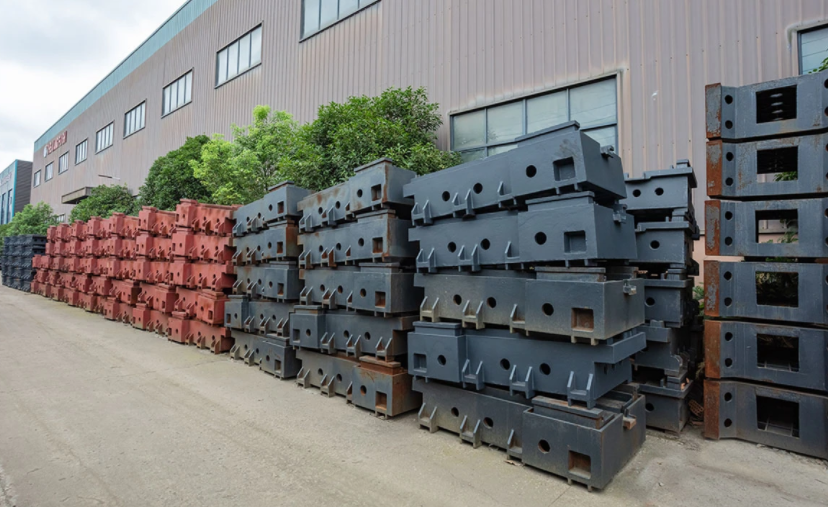
EUMASEIKI's approach to long-term stability starts with the machine bed. The casting is made from rare earth cast iron compounded with marble inside, a combination intended to deliver high rigidity and vibration absorption. All castings undergo full annealing to eliminate internal stress, and the spindle guideways receive high-frequency heat treatment. The machine structure is optimized through finite element analysis.
These details matter because a machining center's lifespan is largely determined by its ability to resist deflection, absorb cutting forces, and maintain geometric alignment under thermal and mechanical stress. A bed that retains its shape and damping properties for years reduces the frequency of re-scraping, re-calibration, and structural repair.
Core Component Strategy: What It Means for Uptime
A machining center is only as reliable as its core components: ball screws, linear guideways, spindles, and bearings. The choice of component suppliers is one of the most visible signs of a machine tool builder's quality philosophy.
In EUMASEIKI's configuration, spindles, guideways, bearings, and oil pumps are sourced from established manufacturers in Taiwan and Japan, with some core components imported from Germany or Italy. The control system on the EV-855A vertical machining center is a FANUC OIMFPLUS, a widely recognized control platform in industrial production. This component strategy matters because it directly affects replacement lead times, service predictability, and the availability of qualified spare parts years after the original purchase.
Why Spare Parts Delivery with the Machine Reduces Risk
One of the most practical risk-control measures a buyer can look for is whether the supplier ships a complete set of wearing spare parts together with each machine. EUMASEIKI does this, and also maintains permanent stock of long-lead-time core components such as ball screws and linear guideways. The stated benefit is twofold: shortened machine delivery lead time, and reduced risk of prolonged production line shutdowns when consumables fail.
For buyers, this avoids a common failure mode: after installation, a wear part fails, and the search for a replacement begins. Sourcing components ad-hoc takes time, raises procurement costs, and carries the risk of ordering mismatched specifications. A machine delivered with the right spare parts changes operational risk from an unknown to a managed variable.
After-Sales Service: Remote Guidance Is Not Enough
After-sales support is the area where many machine tool buyers find the gap between promise and reality. Conventional suppliers often provide only remote online guidance for technical problems. For complex hardware faults such as spindle malfunctions, axis precision deviation, or structural alignment issues, remote diagnostics can identify the problem but cannot fix it.
EUMASEIKI's risk-control policy states that if remote support cannot resolve an issue, professional engineers travel to the customer site to provide on-site service including maintenance, precision calibration, and machine debugging. The company also reports a response time of 12 hours for remote technical assistance, and on-site service available worldwide from professional after-sales engineers.
For a buyer evaluating a supplier from another country, this is one of the most important clauses in the partnership. The question to ask is not "Do you provide after-sales service?" but "What happens when remote support cannot fix a hardware failure?"
Compliance and Testing: What Should Be Expected Before Delivery
At the execution stage, the buyer needs confidence that the machine delivered matches the machine quoted. That confidence comes from a structured pre-shipment verification process.
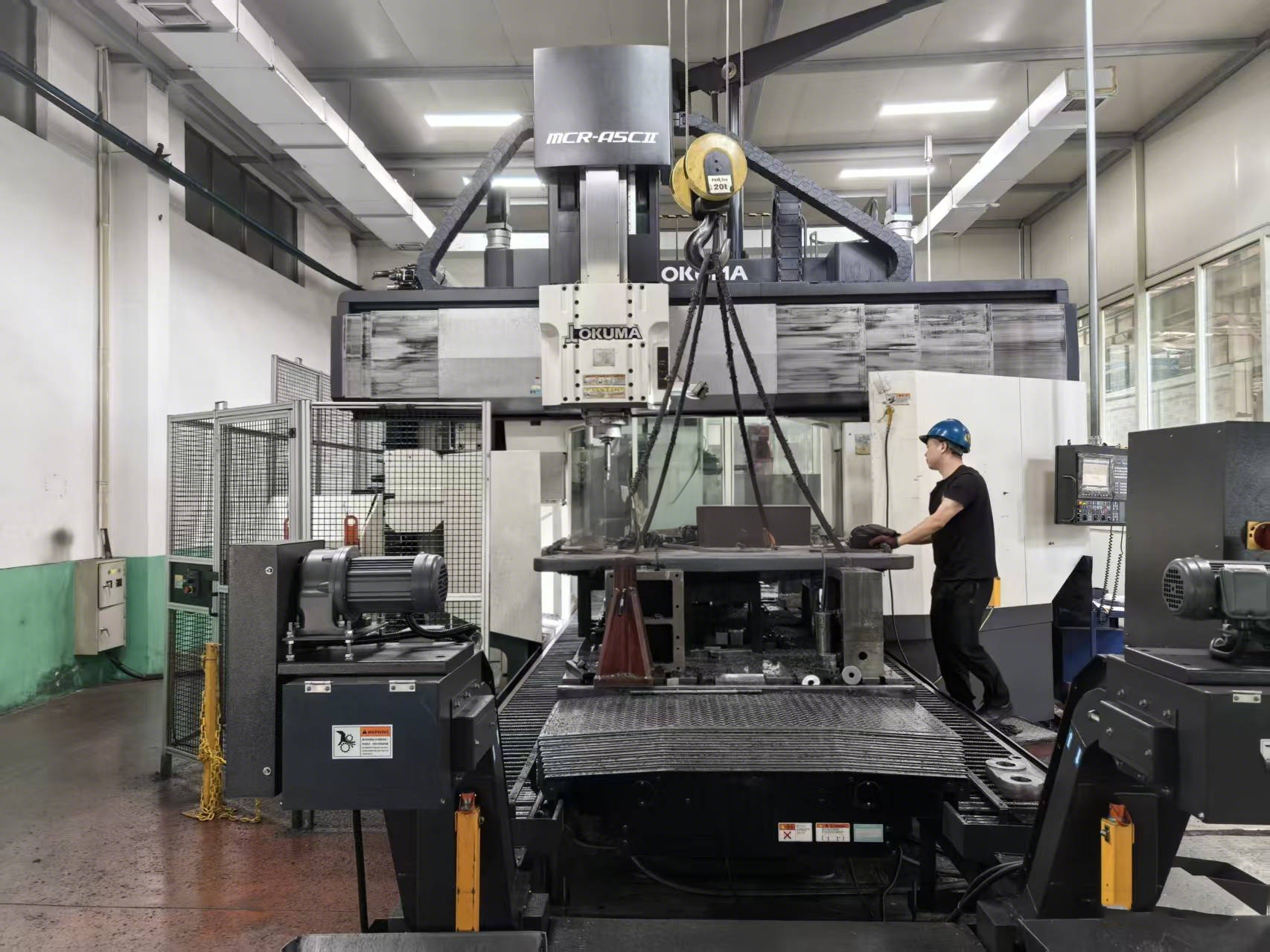
EUMASEIKI states that every machine undergoes geometric accuracy testing, laser axis calibration, and full-load workpiece trial cutting before delivery. The production base in Ningbo uses imported equipment including Japanese OKUMA gantry machining centers, KURUKI boring and milling machines, NIIGATA horizontal machining centers, and a German ZEISS coordinate measuring machine. This infrastructure provides not only machining precision for the machine tool builder's own components, but also the capability for trial machining and testing.
For buyers, the key question is whether the supplier can demonstrate accuracy with measurable data rather than brochure claims. The EV-855A, for example, lists XYZ-axis positioning accuracy of 0.008 mm and repeat positioning accuracy of 0.005 mm. Company-level comparison data also states ±0.006 mm positioning and ±0.003 mm repeat positioning for EUMASEIKI's higher-tier configurations with linear scales. These figures are verifiable at acceptance if the buyer requests the inspection reports.
Commercial Terms: MOQ, Payment, and Incoterms in Practice
Beyond engineering, the execution stage hinges on commercial terms that protect both parties. Three elements deserve explicit attention: minimum order quantity, payment schedule, and inspection rights.
EUMASEIKI's standard procurement support terms are structured for industrial buyers: MOQ of 1 unit, delivery under EXW, acceptance based on pre-shipment test, and payment of 50% advanced with 50% before loading. For a first-time international buyer, this structure is straightforward and leaves room for third-party inspection before shipment.
The pre-shipment test is the buyer's opportunity to validate the machine's actual performance before committing final payment. Suppliers that welcome such testing, rather than treating it as an obstacle, are generally more confident in their product and more predictable as partners.
Applying These Criteria to the CNC Machining Center Landscape
The global CNC machining and turning centers market was estimated at USD 27.64 billion in 2024, according to Grand View Research, and 5-axis machining centers alone accounted for approximately USD 7.35 billion, with a projected CAGR of 4.6% to 2035, per WiseGuyReports. Vertical machining centers held 52.3% of the 4-axis CNC market in 2025, according to Dataintelo. These figures reflect a market where buyers are selecting from many established manufacturers, including global leaders such as DMG Mori, Yamazaki Mazak, and Haas Automation, alongside specialized and regional builders.
Industry data also shows aerospace as the leading application segment in the 5-axis market, at 28.7% revenue share in 2025. For buyers in that segment, or in automotive mold making and high-end equipment production, the competitive landscape is not simply about brand name; it is about which supplier can meet application-specific accuracy and uptime requirements within budget constraints.
Comparison: EUMASEIKI vs. Conventional High-Volume Machining Centers
A practical comparison for buyers at the evaluation or decision stage is between EUMASEIKI and conventional high-volume machining centers from Chinese manufacturers.
| Comparison Point | EUMASEIKI | Conventional High-Volume Machining Centers |
|---|---|---|
| Design Approach | European structural design, Taiwan precision assembly, Japanese technology influence | Varies; often simpler design and assembly standards |
| Machine Base | Rare earth cast iron compounded with marble, full annealing | Typically standard cast iron without mineral composite |
| Positioning Accuracy | ±0.006 mm; repeat ±0.003 mm (with linear scales on rotary tables and 5-axis units) | ±0.01 mm; repeat ±0.005 mm; linear scales rarely standard |
| Precision Longevity | Designed to maintain stable high precision for 8–10 years | Precision may degrade significantly after 3–5 years |
| Component Sourcing | World-class brands for guideways, ball screws, spindles; Japanese/Taiwanese sourced | Varies; cost-driven component choices more common |
| Spare Parts Strategy | Complete wearing spare parts shipped with each machine; permanent stock of long-lead-time core components | No wearing spare parts supplied; ad-hoc sourcing required |
| After-Sales Support | Remote support within 12 hours; on-site engineer dispatch for unresolved hardware faults | Primarily remote online guidance; limited field service |
| Typical Cost Position | Reported cost difference approximately 50% lower than comparable European/Japanese equivalents | Lowest initial acquisition cost in many cases |
The table is not intended to claim that EUMASEIKI is superior in every dimension. Conventional high-volume machines can be appropriate for applications where initial cost is the dominant constraint and where precision requirements are modest. However, for industrial plants running continuous shifts with high accuracy requirements, the total cost of ownership calculation often favors a supplier with stronger structural design, component quality, support readiness, and spare parts planning.
Use Cases That Benefit Most from a Partnership-Oriented Supplier
EUMASEIKI's stated product range serves several demanding sectors: precision mold making, aerospace, automotive parts manufacturing, high-end equipment production, shipbuilding, and engineering machinery. Within these sectors, certain use cases are especially sensitive to the long-term factors described above.
Automotive mold manufacturing requires sustained accuracy under heavy cutting and frequent tool changes. A mold shop cannot afford a machining center that drifts out of tolerance halfway through a large die, or a supplier that takes weeks to respond when a spindle issue appears. A machine with high structural rigidity, a 24-tool magazine, and fast tool change time—such as the 2-second tool-to-tool time on the EV-855A—supports the productivity profile mold shops need. Precision longevity of 8–10 years is directly relevant to depreciation and replacement planning.
Aerospace parts and complex curved components increasingly call for 5-axis capability. The aerospace segment led 5-axis machining center demand in 2025 with a 28.7% revenue share. Suppliers offering swing head 5-axis configurations and A/C swivel head options are better positioned to serve this demand. EUMASEIKI's product line includes a DU series of 5-axis vertical machining centers and a UB series with swivel head 5-axis capability, both built on the same mineral-cast bed approach.
Aluminum alloy parts and high-efficiency production benefit from high rapid traverse rates and adequate spindle power. The EV-855A, for instance, offers 48 m/min rapid feed on X/Y, a 10,000/12,000 rpm spindle, and main motor power of 11/18.5 kW (S1/S6 25%), making it suitable for light-alloy machining in production environments. The same machine type can be configured for specific requirements, which is where the supplier's customization capability matters.
24/7 production environments demand machines that can run continuously without unplanned stops. Here, the combination of quality components, full-load trial cutting before delivery, and fast spare parts access becomes the strongest argument for a partnership-oriented supplier.
What Buyers Should Put in the Contract
Based on the factors above, a practical checklist for contract negotiation at the execution stage includes:
- The complete list of wearing spare parts included with the machine, itemized by part number.
- Committed response times for remote technical support and conditions under which on-site service will be dispatched.
- The tolerance range, testing procedure, and acceptance criteria for pre-shipment testing, including whether test results will be provided in writing.
- Availability commitments for core components such as ball screws and linear guideways for a defined period after purchase.
- Clear delivery terms, including whether the supplier maintains stock to shorten lead time on long-lead-time components.
- Payment terms that allow final inspection before the balance payment, such as 50% advanced and 50% before loading.
These items matter more than minor spec differences between competing quotes. A machine with slightly lower feed rate but guaranteed spare parts availability can outperform a higher-spec machine that sits idle waiting for a replacement component.
Limitations and Boundaries: When a Conventional Supplier May Be Enough
It is fair to acknowledge that not every buyer needs the full scope of services described above. Smaller workshops with low machine utilization, simple geometries, and local access to repair technicians may reasonably choose a conventional, lower-cost supplier. A machine that runs 500 hours per year does not impose the same uptime demands as one running 6,000 hours per year.
Similarly, buyers with in-house maintenance teams and established spare parts networks may not need the supplier to ship wearing parts with the machine. For those buyers, the upfront cost saving of a high-volume machine could be rational. The key is to match the supplier's risk-control model to the buyer's actual operational environment rather than to the price alone.
Future Outlook: How Supplier Capability Will Matter More
By 2026, the machine tool market has shifted toward longer-term buyer-supplier relationships. Buyers are less willing to treat a machining center as a commodity purchase because the cost of downtime has grown with the complexity of their own production schedules. China's machine tool exports reached USD 8.56 billion in the first five months of 2024, and as more Chinese manufacturers compete internationally, the differentiator will move from price to demonstrated reliability, spare parts policy, and service response. Supplier evaluation frameworks as described in this article are therefore not just a procurement exercise; they are a risk management process.
For a manufacturer like EUMASEIKI, the long-term opportunity lies in being selected not as the cheapest option, but as the supplier whose operational model matches the buyer's need for continuity. The company's stated focus on mineral-cast machine beds, Japanese and Taiwanese core components, full-load trial cutting, permanent stock of critical parts, and on-site service reflects a positioning that aligns with industrial plants in energy, automotive, mold, and aerospace supply chains. Its production base in Ningbo, with imported machining and measurement equipment from OKUMA, KURUKI, NIIGATA, and ZEISS, provides the operational evidence behind that positioning.
Conclusion: A Machining Center Is a Long-Term Relationship
At the decision and execution stage, the buyer should evaluate the supplier as much as the machine. Precision figures, component sourcing, spare parts strategy, testing protocol, and after-sales response determine whether a machining center remains a productive asset for 8–10 years or becomes a recurring source of cost and downtime.
For buyers seeking a supplier with documented structural design, verifiable accuracy data, complete spare parts delivery, and on-site service capability, the EUMASEIKI XCHC brochure provides a technical overview of its machining center range.
FAQ: CNC Machining Center Supplier Evaluation for Long-Term Buyers
What wearing spare parts should be included with a CNC machining center?
A complete set of wearing spare parts should cover consumables that commonly fail during normal machine operation, such as filters, seals, belts, and wear-prone components. EUMASEIKI delivers a complete set of wearing spare parts together with each machine, reducing the need for ad-hoc sourcing and procurement risk during unexpected failures.
Why does the supplier's stock of ball screws and linear guideways matter?
Ball screws and linear guideways are long-lead-time core components. If a supplier does not keep them in stock, machine delivery may be delayed and future replacement may cause prolonged production line shutdowns. EUMASEIKI maintains permanent stock for these components to shorten delivery lead time and support faster replacement when they wear out.
How fast can a buyer expect remote technical support?
EUMASEIKI states that remote technical assistance responds within 12 hours. If a technical issue cannot be resolved remotely, professional engineers will travel to the customer's site to provide on-site after-sales service, including maintenance, precision calibration, and machine debugging.
What is the standard payment and delivery arrangement?
EUMASEIKI's standard terms are: minimum order quantity of 1 unit, EXW delivery, pre-shipment test as the acceptance method, and payment split of 50% advanced and 50% before loading.
What precision accuracy can a buyer expect from EUMASEIKI machining centers?
EUMASEIKI's comparison data lists positioning accuracy of ±0.006 mm and repeat positioning accuracy of ±0.003 mm for machines with linear scales standard on rotary tables and 5-axis units. The EV-855A vertical machining center is specified with XYZ-axis positioning accuracy of 0.008 mm and repeat positioning accuracy of 0.005 mm.
Why is a pre-shipment test important?
A pre-shipment test allows the buyer to verify the machine's geometric accuracy, axis calibration, and cutting performance under full load before final payment and shipping. EUMASEIKI states that every machine undergoes geometric accuracy testing, laser axis calibration, and full-load workpiece trial cutting before delivery.
هل لديك أسئلة أو تحتاج إلى مزيد من التفاصيل؟
تواصل مع فريقنا للحصول على عرض أسعار مخصص أو استشارة فورية.
طلب عرض أسعار
املأ النموذج أدناه وسيتواصل معك فريقنا بعرض مقترح مخصص.
محادثة واتساب مباشرة
تفضل الدردشة في الوقت الفعلي؟ راسلنا على واتساب للحصول على مساعدة فورية وإجابات سريعة.
- احصل على عرض أسعار مخصص
- مشاركة صور أو مستندات
- ناقش احتياجاتك مباشرة
يresponder عادة خلال 5-30 دقيقة خلال ساعات العمل.