
CNC Machining Centers in 2026: Types, Technology, and Buyer Considerations
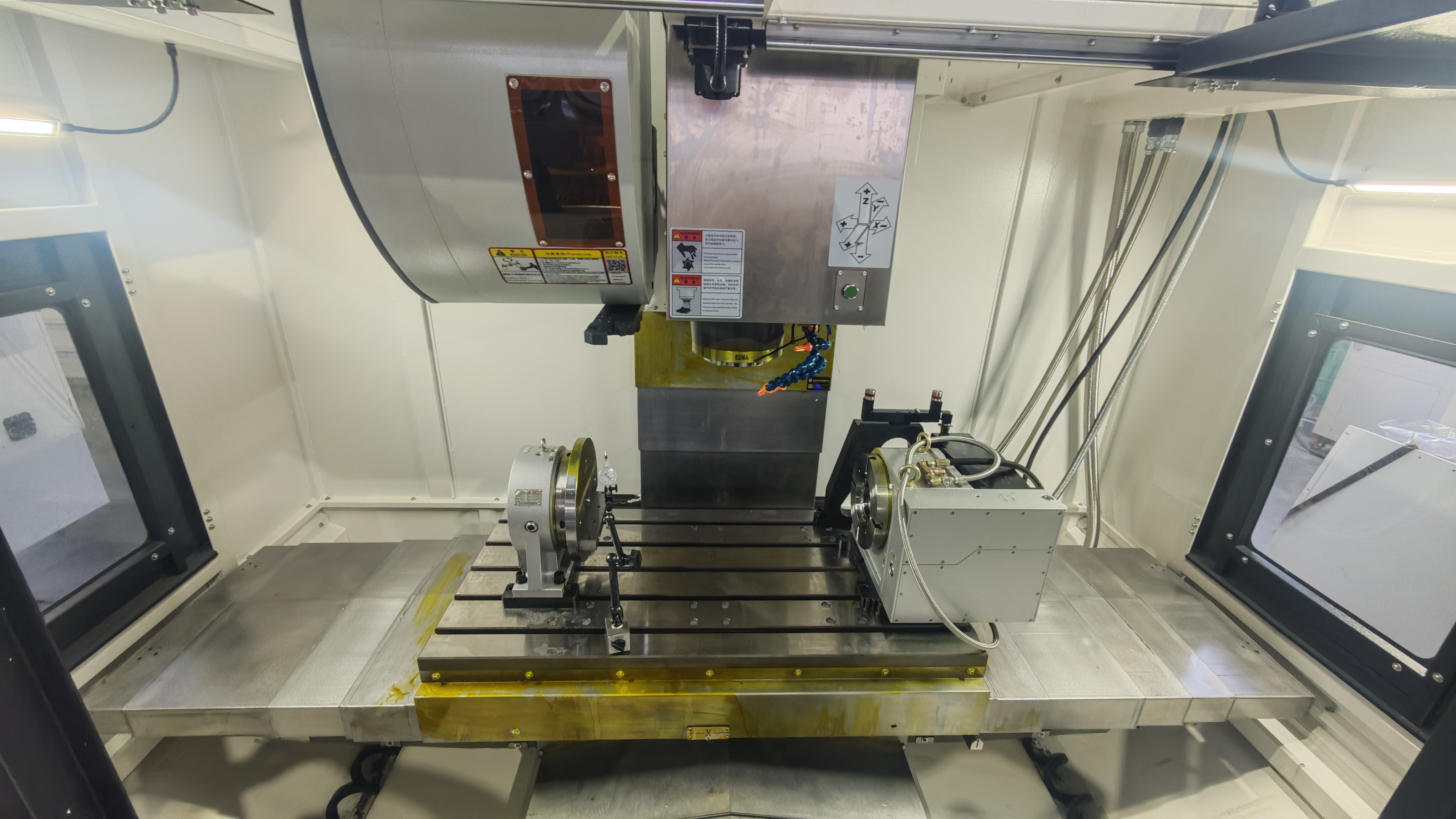
Geometric accuracy inspection ensures that a CNC machining center meets its stated positioning performance.
CNC machining centers are the backbone of modern precision manufacturing. Understanding their types, technical capabilities, and trade-offs is essential for buyers evaluating production equipment for mold making, aerospace, automotive, and general engineering.
What Is a CNC Machining Center?
A CNC machining center is a computer-controlled machine tool that performs milling, drilling, tapping, and related metal-cutting operations with automated tool changing and multi-axis motion. Unlike conventional manual machines, it can process complex part geometries with high repeatability and minimal operator intervention.
The global market for CNC machining and turning centers was estimated at USD 27.64 billion in 2024, according to Grand View Research, reflecting the central role of these machines in industrial production. As manufacturers move toward higher-precision components and shorter delivery cycles, the machining center has become a strategic investment rather than a simple tool purchase.
The Manufacturing Challenge: Accuracy, Complexity, and Efficiency
Producing complex components such as automotive molds, aerospace structural parts, and medical devices poses several challenges. Multi-step processing on separate machines increases setup time and introduces positioning errors. Complex three-dimensional surfaces may require five-axis simultaneous machining to achieve the required finish and geometry. High-volume production demands stability over long operating hours, while batch production needs flexibility to switch between different workpieces.
CNC machining centers address these problems by integrating multiple machining operations into one setup, automating tool change, and enabling multi-axis interpolation. For buyers, the challenge is selecting the right configuration and supplier — one that can deliver not only a machine but also the process knowledge and customization needed for their specific parts.
Common operational requirements in manufacturing environments include:
- Stable performance under 24/7 continuous operation
- Spindle collision protection to reduce unplanned downtime
- Chip conveyor, coolant system, and oil mist collector integration
- Repeatable accuracy over long production runs
How EUMASEIKI Positions Itself as a Customization-Oriented Manufacturer
EUMASEIKI is a brand of Wenzhou EUMA Machinery Co., Ltd., a high-tech enterprise established in 2023 that integrates industry and trade. The company specializes in customizing CNC machining centers, with a production base in Ningbo City covering 8,000 m² and a team of approximately 68 employees. Its annual production capacity is 50 to 100 units, and export business accounts for 80% of sales, with major markets including Russia, Saudi Arabia, India, and Iran.
The company operates a professional R&D center with eight engineers and holds patented technologies. Its workshop is equipped with imported machinery such as OKUMA gantry machining centers and ZEISS coordinate measuring machines, supporting not only precision manufacturing of machine components but also trial machining and testing for customers.
Key structural components are designed with mineral castings for machine beds, and castings undergo full annealing treatment to eliminate internal stress. Spindles, guideways, bearings, and oil pumps are sourced from renowned manufacturers in Taiwan and Japan, with selected core components imported from Germany or Italy. These details matter to buyers because they influence long-term accuracy, thermal stability, and machine service life.
Core Machining Center Types and Their Technical Characteristics
CNC Vertical Machining Centers (VMCs)
The vertical machining center is the most widely used configuration for plate, frame, and mold components. In this design, the spindle axis is vertical, which simplifies chip evacuation and provides good accessibility for flat workpieces. Industry data from Dataintelo indicates that VMCs held a 52.3% share in the 4-axis CNC market in 2025, confirming their dominance in general production.
EUMASEIKI offers a range of VMCs under the EV series. For example, the EV-855A has X/Y/Z travels of 810/550/560 mm, a work table of 1000×550 mm, spindle speeds of 10000/12000 rpm, positioning accuracy of 0.008 mm, and repeat positioning accuracy of 0.005 mm. It uses a FANUC OIMFPLUS control system. Models such as the EV-1055A, EV-1165A, EV-1370A, EV-1475B, and EV-1580B extend the travel range and torque for larger workpieces. The EV-1580B features X/Y/Z travels of 1500/800/700 mm, a table size of 1600×800 mm, an ISO 50 spindle taper, and a SIEMENS 828D control system.
CNC Horizontal Machining Centers (HMCs)
Horizontal machining centers position the spindle horizontally, allowing gravity-assisted chip removal and excellent access to multiple sides of a workpiece. They are well suited for box-shaped parts, valve bodies, and components that require machining on several faces.
EUMASEIKI’s EH series includes models such as the EH500, EH800S, and EH1000S, featuring B-axis rotary tables and optional twin-pallet configurations. The EH800S, for example, has a table surface of 2-800×800 mm, a maximum load capacity of 2000 kg, and a FANUC 0i-MF control system. These machines are designed for drilling, boring, reaming, and tapping across a wide range of materials, from cast iron to light metal alloys.
CNC 5-Axis Machining Centers
Five-axis machining centers add two rotary axes to the three linear axes, enabling complex curved surfaces to be machined in a single setup. The global 5-axis market was valued at approximately USD 7.35 billion in 2024, with a projected CAGR of 4.6% to 2035, according to WiseGuyReports. Several mechanical architectures exist, each with different trade-offs.
Trunnion table machines
The UV260 and UV320 are compact trunnion table machining centers designed for small and medium series components in precision mechanics, watchmaking, medical technology, electronics, and general mechanics. They handle drilling, tapping, and milling with a small footprint — the UV260 weighs about 4200 kg and has a Ø260 mm worktable.
Gantry cradle machines
The DX5-630 and DX5-800 are gantry cradle 5-axis machining centers. The DX5-800 offers X/Y/Z travel of 800/900/620 mm, a worktable load capacity of 850/1200 kg, and spindle speed options of 15000 rpm direct drive or 20000 rpm electrical spindle. It is intended for metallic parts produced in automotive and aviation industries.
Swivel head machines
Swivel head designs keep the worktable fixed and tilt the spindle head around the B-axis. The UB1300C, UB1800C, and UB2000C belong to this category. The UB2000C has X-axis travel of 2000 mm, a rectangular table of 2500×900 mm with 3500 kg maximum load, HSK-A63 spindle at 12000 rpm, and a C-axis rotary table driven by a DD motor with HEIDENHAIN circular gratings. It is designed for large mold workpieces and complex curved parts.
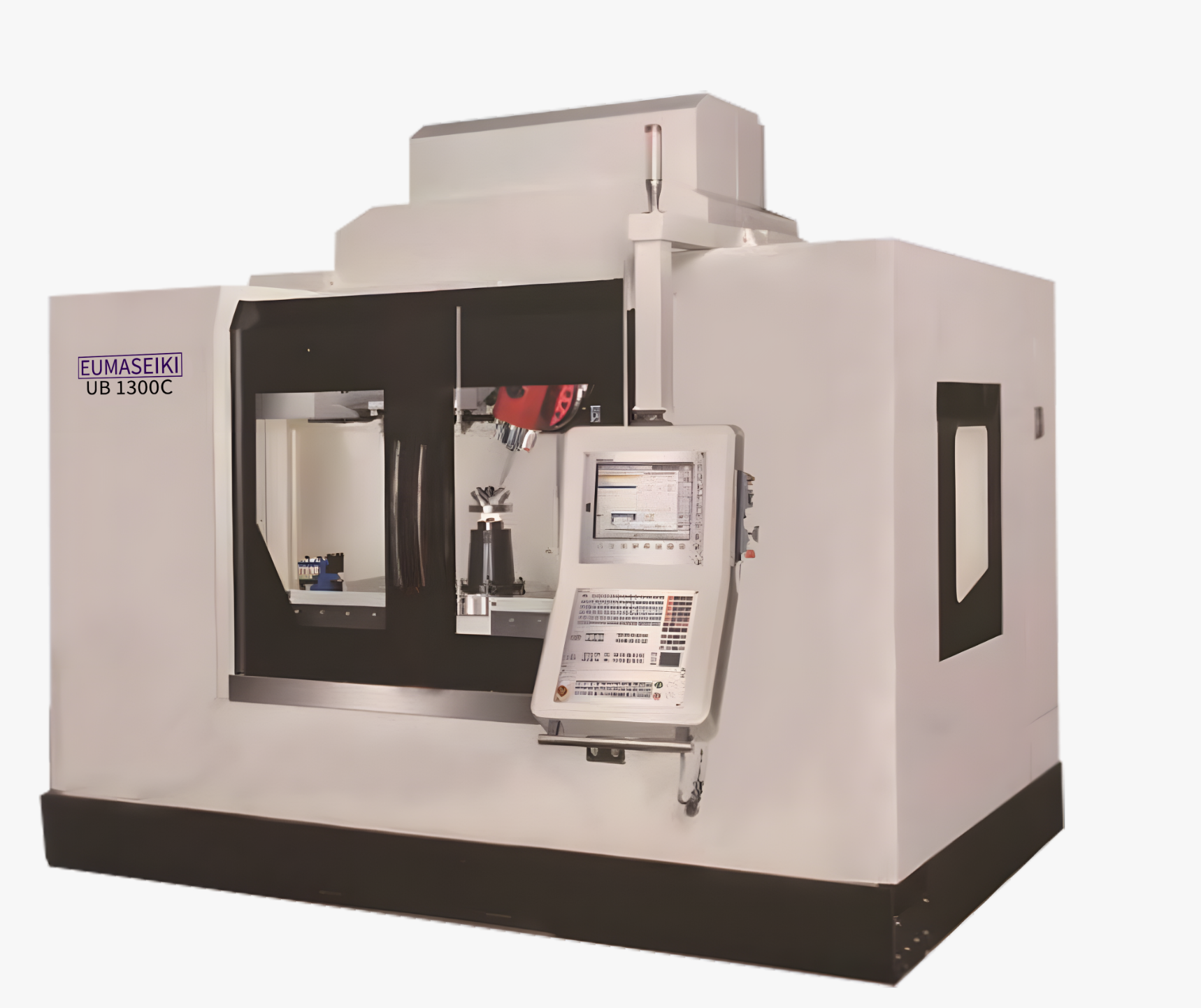
The UB2000C represents the swivel head 5-axis architecture, combining a large fixed table with a tilting spindle head.
5-axis horizontal machining centers
For very large parts requiring high metal removal rates and five-face access, EUMASEIKI offers the HU1250 and HU1600 horizontal 5-axis machines. The HU1600 has a B-axis table of Ø1600 mm, maximum workpiece weight of 6000 kg, and a five-axis linked RTCP precision of ±0.025 mm. It supports complete machining for demanding aerospace and tool-and-mold applications.
Accuracy, Structure, and Control
Accuracy is one of the first specifications buyers check. EUMASEIKI states positioning accuracy according to German VDI 3441 for many models. For example, the UB1300C achieves 0.012 mm positioning accuracy and 0.008 mm repeat accuracy, while the DX5-630 achieves 0.008 mm positioning and 0.004 mm repeat accuracy.
The machine bed is a critical factor in long-term precision. The company uses mineral castings for machine beds, which provide good vibration damping and thermal stability compared with conventional cast iron. All castings undergo full annealing, and spindle guideways receive high-frequency heat treatment. These manufacturing choices affect real-world performance under continuous operation.
Key Technical Specifications to Compare
- Travel range (X/Y/Z) determines maximum workpiece size
- Spindle speed, power, and taper define cutting capability
- Worktable load capacity affects the weight of workpieces
- Tool magazine capacity reduces manual intervention
- Positioning accuracy and repeatability reflect process stability
- Control system compatibility with existing programming environment
Applications and Typical Working Conditions
CNC machining centers are used across a wide range of industries. EUMASEIKI classifies its machines for sectors including precision mold making, aerospace, automotive parts manufacturing, high-end equipment, shipbuilding, and engineering machinery.
One documented application scenario is for CNC machining center equipment in manufacturing environments with indoor normal temperature and humidity, operating 24/7. In such conditions, requirements include spindle collision protection, high stability, and stable performance over long continuous operation. Typical matched equipment includes chip conveyors, coolant systems, tool magazines, and oil mist collectors.
For smaller precision parts, the UV series is designed for watchmaking, medical technology, electronics, and general mechanics. For aerospace and automotive structural components, the DX series and HU series handle complex curved surfaces and heavy cutting. The common thread is reducing setups and improving process reliability.
Market Trends and Data Points for 2026
Market data illustrates the growing importance of machining centers. Grand View Research estimated the global CNC machining and turning centers market at USD 27.64 billion in 2024. The 5-axis segment was valued at approximately USD 7.35 billion in 2024, with a projected CAGR of 4.6% to 2035, according to WiseGuyReports.
Dataintelo data shows that vertical machining centers held a 52.3% share in the 4-axis CNC market in 2025, confirming the dominance of VMCs in general production. For 5-axis machines, aerospace applications accounted for 28.7% of revenue in 2025, reflecting the industry’s demand for complex, high-tolerance parts.
On the supply side, China’s machine tool exports reached USD 8.56 billion in the first five months of 2024, a year-on-year increase of 1.8%. This points to growing international sourcing from Chinese manufacturers, accompanied by greater attention to quality and certification.
Buyers today are not only comparing price and specification sheets. They increasingly evaluate a supplier’s ability to customize machines, provide engineering support, and maintain consistent quality through production processes.
How Machining Centers Compare with Traditional or Simplified Solutions
Compared with conventional manual milling or a standalone 3-axis machine with limited automation, a machining center offers clear advantages: automated tool changing reduces non-cutting time, multi-axis capability allows complex geometry in one setup, and closed-loop control improves consistency across batches.
However, there are limits. A full 5-axis machining center requires a higher initial investment, more sophisticated CAM programming, and more skilled operators than a simple 3-axis vertical mill. For high-volume production of simple planar parts, a dedicated machine or a 3-axis VMC may deliver a faster return on investment. Similarly, horizontal machining centers excel in multi-face box parts but may be less practical for small, flat components where a vertical machine’s accessibility and lower floor-space footprint are more valuable.
Traditional production often involved manual milling, electrical discharge machining, or multiple dedicated machines. Each transfer between operations adds setup time and tolerance loss. A machining center replaces that workflow with a single automated platform. However, the transition requires investment in CAM software, operator retraining, and maintenance planning.
Buyers should therefore define their part family, material, tolerance, and production volume before choosing a configuration. Customization can help close the gap, but it cannot replace a clear process strategy.
Future Outlook: Customization, Automation, and Digital Readiness
The machining center market is moving toward greater automation and connectivity. The integration of robots, pallet pools, and tool monitoring systems is becoming more common, especially in 24/7 production environments. Five-axis machines are expected to gain share as manufacturers shift to complex, near-net-shape components.
For machine builders, the differentiator will be the ability to adapt standard platforms to specific customer processes. EUMASEIKI’s approach — customizing CNC machining centers with a compact R&D team and controlled production capacity — positions it as a niche supplier for buyers that need configuration flexibility rather than only catalog-standard machines.
Nevertheless, global competition remains intense. Established manufacturers such as DMG Mori, Yamazaki Mazak, and Haas Automation hold significant market presence, according to third-party industry sources. Newer brands must build trust through transparent technical specifications, consistent quality, and responsive after-sales support.
Frequently Asked Questions
What is a CNC machining center?
A CNC machining center is a computer-controlled machine tool that performs milling, drilling, tapping, and similar operations with automated tool changing. It uses multiple axes to process metal parts from cast iron, steel, aluminum, and other materials.
What are the main types of CNC machining centers?
The main types include vertical machining centers, horizontal machining centers, and 5-axis machining centers. Five-axis machines can be further divided into trunnion table, gantry cradle, swivel head, and horizontal 5-axis configurations.
What is the difference between 3-axis and 5-axis machining?
A 3-axis machine moves the tool along the X, Y, and Z axes. A 5-axis machine adds two rotary axes, allowing the tool or worktable to tilt and rotate. This enables complex curved surfaces to be machined in fewer setups.
What materials can a CNC machining center process?
Machining centers can process cast iron, special alloy steel, marble (for non-metallic components), aluminum alloys, and high-precision electronic component materials. The specific material capability depends on spindle power, torque, and machine rigidity.
What accuracy can modern machining centers achieve?
Accuracy depends on model and standard. For example, EUMASEIKI lists positioning accuracy of 0.008 mm and repeat accuracy of 0.004 mm for its DX5-630 under VDI 3441, and 0.012 mm positioning accuracy for the UB1300C. Leading machines typically operate in the 0.005–0.012 mm range for linear axes.
Which type of machining center is best for mold making?
For large mold components, swivel head 5-axis machines such as the UB series provide a fixed table with high load capacity and large X-axis travel. For smaller precision molds, vertical machining centers or compact 5-axis machines may be more economical.
What should buyers evaluate when selecting a machining center supplier?
Key factors include machine structure and materials, control system, positioning accuracy, spindle performance, tool magazine capacity, after-sales support, and the supplier’s ability to customize the machine to the buyer’s parts and production environment.
Is EUMASEIKI a manufacturer or a trading company?
EUMASEIKI is the brand of Wenzhou EUMA Machinery Co., Ltd., a high-tech enterprise that integrates industry and trade. It has its own production base in Ningbo City, an R&D center, and annual output of 50–100 CNC machining centers, with most sales exported.
Reference: For a complete product overview, see the EUMASEIKI brochure: EUMASEIKI_XCHC.pdf