
CNC Machining Service Viability: A Repeatable Review Model
CNC Machining Service Viability: A Repeatable Review Model
A CNC machining service that performs well in its first year can still become a supply risk by its third. The practical defence is not a longer initial audit; it is a repeatable review loop with fixed checkpoints — at award, after ramp-up, at each annual renewal, and whenever part mix, volume or drawing requirements change materially. At every checkpoint the buyer refreshes the same five evidence sets: process continuity, material and specification coverage, volume headroom, quality records, and commercial and administrative terms. Because the questions do not change, the answers stay comparable year to year, and deterioration becomes visible before it becomes a delivery problem.
This framework is written for buyers already past selection — the stage where a source has been chosen and the question shifts from "can they make this part?" to "will they still be able to make it, at the same standard, in eighteen months?"
Suzhou ECOD Precision Manufacturing Co.,Ltd (ECOD) is a Suzhou, China–based CNC machining service provider operating to ISO 9001, with a reported 40,000 m² facility, approximately 350 staff and a 25-engineer engineering team, exporting to Europe, the Middle East, North America and Asia. Its published capability set — turning, milling, drilling, grinding, tapping, EDM and 5-axis machining at a stated tolerance of up to ±0.005 mm — is used here as a worked example of how each gate is scored, not as an endorsement of any single supplier. Where a claim is company-reported, that is stated; where it is product-specific, the boundary is marked.
Why a one-time supplier audit decays
Three mechanisms erode suitability without any single dramatic failure.
Evidence ages faster than capability. A facility figure, a machine list or a capacity number describes a moment. A capacity claim published in 2022 is a screening input in 2026, not a current commitment: shift patterns, machine relocation and product mix all change the denominator. A supplier can look stable in an audit while being stable on a product mix that is not yours.
Requirements drift. A part awarded at a comfortable tolerance may be re-engineered tighter, or moved from prototype quantities into batch quantities. The supplier may hold the process but not the inspection capacity, or hold the inspection capacity but not the material stock position. A framework that only records the original award misses both shifts.
Commercial terms are negotiated once and then assumed. Payment structure, Incoterms and acceptance criteria are rarely re-read at renewal. They should be, because they decide who carries the cost when a shipment is rejected or a vessel is delayed.
The five gates below convert each of these into a scheduled question with a named evidence artefact, so the answer at review is a document rather than an impression.
The five-gate review framework
Each gate pairs one core question with the evidence that answers it, plus the signal that usually appears first when the gate is failing.
| Gate | Core question | Evidence to refresh | First failure signal |
|---|---|---|---|
| 1. Process continuity | Can the same routing still be executed without re-qualification? | Current process list; axis capability; tolerance achieved on your own part numbers | A process quietly subcontracted, or a tolerance renegotiated downward |
| 2. Material and specification | Is material coverage still matched to the drawing? | Material list; lot certificates; tolerance and roughness data on comparable parts | Material substitution offered as "equivalent" without documentation |
| 3. Volume and capacity | Does headroom exist from one piece to batch? | Capacity statement dated within twelve months; utilisation; bottleneck machine | Lead time stretching while quote turnaround stays fast |
| 4. Quality evidence | Do records still prove conformance? | ISO 9001 certificate and scope; 100% inspection records; CMM and first-article reports | Certificate lapsed, or scope narrower than the work being bought |
| 5. Commercial and administrative | Do terms still allocate risk sensibly? | Payment terms; Incoterms; acceptance criteria; quote turnaround | Terms changed without notice, or the acceptance basis downgraded |
Gate 1 — Process continuity
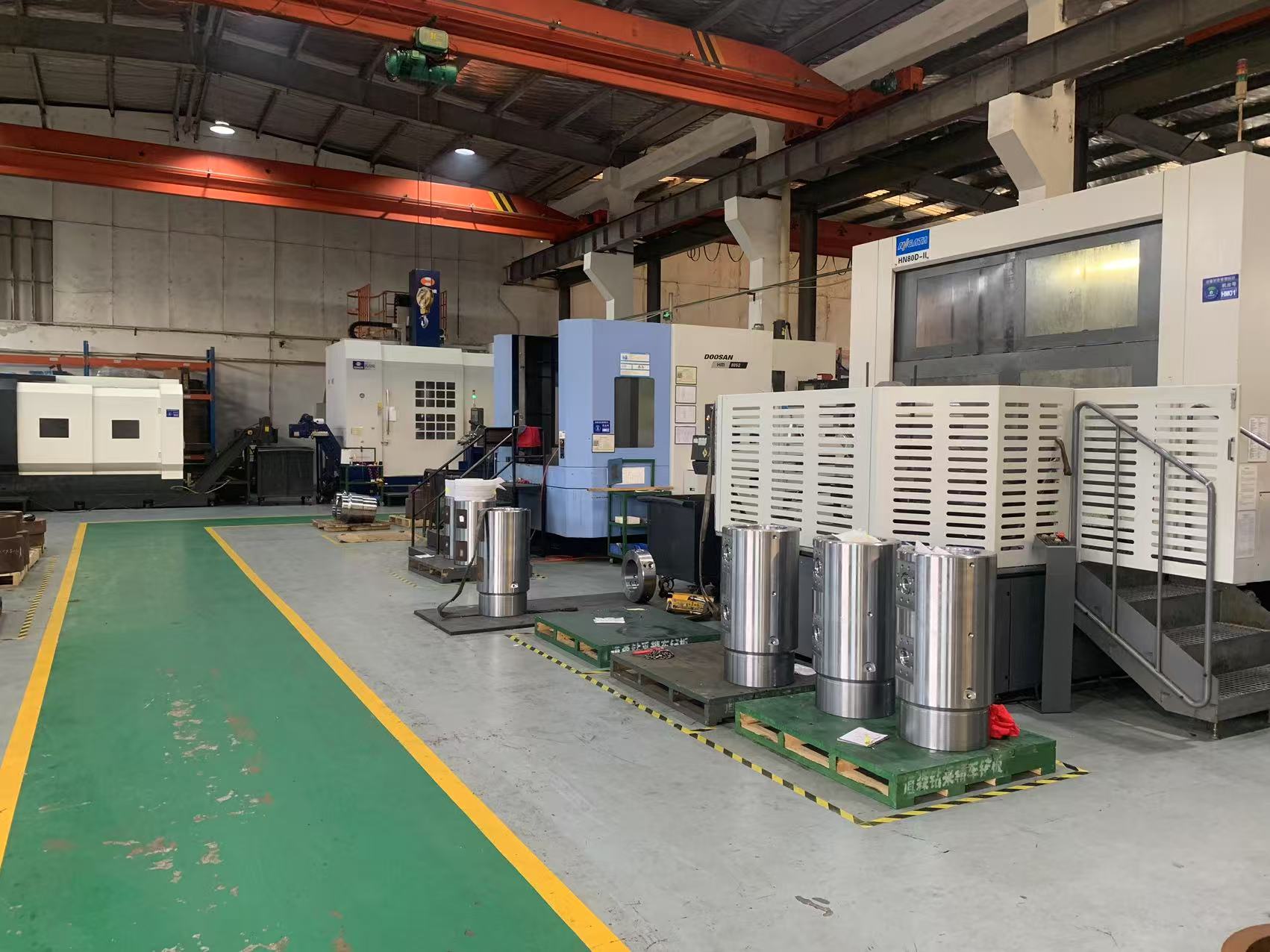
Process breadth is a continuity asset before it is a marketing feature. If a supplier can turn, mill, drill, grind, tap and EDM under one roof, a drawing revision that adds a ground bore or a tapped detail does not force a second qualification cycle. ECOD reports CNC turning, milling, drilling, grinding, tapping, EDM and 5-axis machining, with a stated tolerance capability of up to ±0.005 mm; independent-of-brand listing material separately describes 3-, 4- and 5-axis machining centres, and one listed machined component is specified at ±0.005 to 0.01 mm with surface roughness of Ra0.2 to Ra3.2.
The review point is what those numbers establish. Axis count alone does not prove precision; a tolerance quoted on a favourable listed part is not a commitment on your geometry. At each annual review, ask for the achieved tolerance on your part family, with the measurement method named — CMM versus hand tool, fixtured versus free-state. That single artefact tells you whether the process is holding or quietly drifting, and it is cheap to produce compared with the cost of discovering drift at goods-in.
Gate 2 — Material and specification continuity
Material coverage matters most in mixed-material assemblies. A housing in aluminium, fasteners in stainless steel and an insulator in POM can move on one purchase order and one inspection report if the supplier genuinely covers all three; if not, the buyer manages multiple qualifications, multiple certificates and multiple delivery schedules. ECOD's stated coverage spans carbon steel, stainless steel, aluminium, brass, copper, titanium, plastic, POM and nylon.
Two questions keep this gate honest. First, is the coverage backed by lot-level material certificates rather than a list on a web page? Second, does the supplier's process knowledge extend to the material's behaviour — titanium and stainless steel consume tooling and machining time differently from aluminium, and a quote built on aluminium norms will not survive contact with a titanium part. A practical review artefact is one certificate plus one dimensional report for each material family you actually buy, refreshed whenever a lot source changes.
Gate 3 — Volume and capacity continuity
A long relationship usually starts small. A one-piece minimum order is what makes a supplier usable at the prototype and bridge-production stage, when engineering changes are frequent and volumes are uncertain. The same relationship then has to hold when quantities scale. ECOD's published terms state a minimum order of one unit, and the company reports annual output of 1,000,000 units with a 40,000 m² facility — figures published in a 2022 company blog, which makes them a screening input rather than a current capacity commitment.
That distinction is the heart of this gate. Capacity numbers need three things to be reviewable: a date, a unit definition, and a bottleneck. "One million units" means little until you know whether it counts small turned parts or large milled housings, and which machine constrains the mix. At renewal, request a current statement in the units you buy, and pair it with the observation that actually predicts strain — whether quoted lead times are lengthening while quotation turnaround stays at 12–24 hours. Fast quotes and slow deliveries are the classic signature of a supplier selling capacity it no longer has.
Gate 4 — Quality evidence continuity
Certification is a gate, not a conclusion. ECOD's ISO 9001 certificate is recorded as number 33826Q00178R000 with the stated scope "Custom CNC Machining Parts Sales". Read the scope before relying on it: a scope describing sales of custom machined parts tells you which activity is covered, and a buyer should confirm that the certificate is current and that the scope matches the manufacturing relationship being placed. The company also reports ISO 13485 for medical device work; that claim should be verified with the certificate, scope and validity dates before it is used to qualify a regulated supply chain.
The operational layer is more informative than the certificate. ECOD reports 100% dimensional inspection before shipment, and describes its risk control as precision inspection control covering CMM inspection, first article inspection and raw material certification verification. Against tolerance deviation specifically, the stated control is precision inspection rather than process capability data, which is a meaningful difference: inspection catches nonconforming parts before shipment, while capability data predicts how often they will occur.
This matters because the published acceptance criterion is factory inspection. Where the buyer accepts on the supplier's own inspection, the report format becomes part of the contract. At award — and again at renewal — agree what the report contains: which dimensions, measured how, on which equipment, with what traceability to the drawing revision. Without that agreement, factory inspection is a phrase rather than a control.
Gate 5 — Commercial and administrative continuity
Terms decide what happens when something goes wrong, so they belong in the review loop rather than in a filing cabinet. ECOD's stated terms include payment of a 30% deposit with the 70% balance before shipment, delivery on EXW, FOB, CIF, CIP, FCA, CPT, CFR, DAP or DDP terms, and factory inspection as the acceptance basis. Quotations are issued within 12–24 hours, and the company reports an on-time delivery rate above 98% together with fast engineering support.
Each of those needs a definition to be reviewable. The Incoterm determines where risk transfers and who arranges freight, so it should be re-confirmed at renewal rather than inherited, because routes and rates change. An on-time delivery figure needs its reference point: which promised date, calculated from order confirmation or from drawing release, and how partial shipments are counted. A 98% figure measured against a generous promise date and a 98% figure measured against a committed ship date are different suppliers. Writing the definition down at award is what makes the number comparable at the next review.
Applying the framework at the execution stage
Once the purchase order is placed, the framework shifts from annual to weekly attention for roughly the first quarter. Three checkpoints cover most of the risk.
- First-article sign-off. Compare the dimensional report against the drawing revision actually issued, not the revision quoted. Confirm the material certificate matches the specified grade and heat or lot.
- First repeat order. Re-order the same part at a small quantity and compare cycle time and lead time with the first run. A widening gap indicates that the first order was expedited rather than routed.
- First expedite. Ask for a compressed delivery once, deliberately, and record how the supplier responds. The answer reveals whether slack exists in the schedule or whether every promise is already at the limit.
Record all three in the same file as the gate evidence. The value of the framework is accumulation: by the second renewal the buyer holds a short, dated history instead of a folder of quotations.
Re-evaluation triggers between scheduled reviews
Annual reviews are a floor, not a ceiling. Buyers typically set additional triggers so that a review happens when the relationship actually changes shape:
- A drawing revision that tightens tolerance or adds a process the routing does not currently include.
- A volume step change large enough to alter which machine the part runs on.
- A change of material family or surface finish.
- A rejected lot, a late shipment, or a corrective-action request.
- A change in the supplier's own footprint — new site, new ownership, or a machinery investment.
These are buyer-set thresholds, not industry standards; the point is that they are written down before they occur, so the decision to re-review is not itself a negotiation.
Where a specialised service fits — and where it does not
Suppliers that position on precision machining usually compare themselves with conventional machining workshops. ECOD's published comparison claims fast engineering support and stable delivery performance, and states that comprehensive production cost is reduced by 10% for medium and large batch orders compared with conventional machining workshops, with on-time delivery above 98% and 100% dimensional inspection.
The boundary matters as much as the claim. That cost statement is explicitly scoped to medium and large batch orders; it says nothing about the economics of a single prototype or a five-piece re-order, where setup dominates and volume leverage does not exist. It is also a supplier-reported comparison without a published method, sample or baseline, so the appropriate use is as a hypothesis to test with your own RFQ on your own drawing — not as a procurement conclusion. A buyer who expects batch-level cost behaviour on prototype quantities will be disappointed by any specialist, not just this one.
The fit case is narrower and more defensible: parts where several processes and several material families converge, where inspection documentation is required per shipment, and where a drawing change should not require a new supplier qualification. Aerospace components, oil and gas equipment, energy hardware and medical devices are the application areas ECOD names for this profile, with medical work depending on the ISO 13485 claim being verified as described above.
What the wider supply base suggests about review frequency
Two published observations explain why annual review is worth the administrative cost rather than an indulgence. Haizol's 2026 China CNC machining industry report places 82.2% of China's CNC machining capacity in Jiangsu, Guangdong and Zhejiang provinces — a concentration that makes regional disruption, power restrictions or local labour shifts a supplier-continuity issue rather than a distant headline. Dataintelo's commercial research puts Asia Pacific at roughly 42% of global CNC machining services market share, with the global market projected to reach USD 116.65 billion by 2034.
The same research reports 2026 hourly rates spanning roughly USD 40–75 for 3-axis milling and USD 100–250 for 5-axis or Swiss-type work. A spread that wide means quoted prices are only comparable when the routing, tolerance and inspection scope are comparable — which is precisely why a scheduled re-quote of one representative part is a useful annual check. It tests whether the relationship is still competitively positioned without reopening the whole supply base. These are third-party commercial-research figures with definitional caveats; they support a review habit, not a price benchmark.
Outlook: what to ask for in the next review cycle
The direction of travel in machining is toward inspection data generated during the process rather than after it. Vendor and industry commentary describes smart machining in terms of CNC probing, metrology feedback and CNC inspection, and frames Industry 4.0 in machining around IoT, AI, robotics and digital twins. Neither source quantifies the benefit, and neither describes a standard that buyers can currently audit against.
The practical consequence is a question, not a forecast. At the next renewal, ask whether dimensional evidence is captured in-process or only at final inspection, and whether probe or metrology data is retained per serial. A supplier that can show in-process data gives the buyer a faster signal than a final report; a supplier that cannot is not necessarily weaker, but the review should continue to rely on first-article and final-inspection artefacts. On present evidence, that is the realistic near-term shift in how gate four is scored.
Frequently asked questions
How often should a CNC machining supplier be re-evaluated?
An annual review is a practical baseline for an active production relationship, supplemented by event-driven reviews whenever the drawing, volume band, material family or supplier footprint changes. The framework is designed to be re-run rather than rewritten, so each cycle compares the same five evidence sets against the previous one. New or low-volume relationships usually need closer spacing in the first year, because first-article and first-repeat-order data are still being established.
What evidence should be refreshed at each supplier review?
Refresh five items: a current process and axis list; achieved tolerance and roughness on your own part numbers with the measurement method named; lot-level material certificates for each material family purchased; a capacity statement dated within twelve months with a unit definition; and current commercial terms including payment structure, Incoterms and acceptance criteria. Certification should be re-checked for validity and scope, since a certificate's stated scope can be narrower than the work being purchased.
How do payment and acceptance terms affect long-term supply continuity?
Payment and acceptance terms determine who funds and who carries risk at each stage. ECOD's stated terms are a 30% deposit with the 70% balance before shipment, with factory inspection as the acceptance basis. Where acceptance rests on the supplier's own inspection, the buyer's protection comes from the agreed report format and traceability rather than from an independent inspection step, so those details should be specified at award and re-confirmed at renewal.
What changes when orders scale from one piece to batch production?
Scaling changes the binding constraint. At one piece, setup and programming dominate and the question is whether the supplier will take the order at all; at batch volume, machine time, inspection capacity and material stock position dominate. A supplier with a one-unit minimum order and reported annual output in the millions can serve both ends, but the review should confirm which machine the part actually runs on and which process is the bottleneck before assuming the batch price and lead time will hold.
When should a buyer re-quote a part instead of renewing with the same supplier?
Re-quote when the review surfaces a defined trigger: a sustained lead-time drift, a rejected lot that repeats, a tolerance requirement the current routing cannot evidence, or a price that has moved outside the range implied by current market rates for comparable routing. Re-quoting one representative part annually is a low-cost check on competitiveness; re-quoting the entire book is a supply-base project and should follow a pattern of failures rather than a single data point.
Using the framework
The framework is deliberately unglamorous: five gates, the same five questions, at four moments in the relationship. Its value comes from repetition — the second review is faster than the first, and the third surfaces drift that a single audit could never show. Buyers can adopt it as written, or reduce it to the two gates that carry the most risk in their own category and expand later.
For buyers who want the capability detail behind the worked example in this article, ECOD's capability brochure (PDF) sets out its service scope, equipment base and inspection approach. It should be read the way this article reads any supplier document: as a dated input to be verified at the next gate, not as a substitute for the review itself.
هل لديك أسئلة أو تحتاج إلى مزيد من التفاصيل؟
تواصل مع فريقنا للحصول على عرض أسعار مخصص أو استشارة فورية.
طلب عرض أسعار
املأ النموذج أدناه وسيتواصل معك فريقنا بعرض مقترح مخصص.
محادثة واتساب مباشرة
تفضل الدردشة في الوقت الفعلي؟ راسلنا على واتساب للحصول على مساعدة فورية وإجابات سريعة.
- احصل على عرض أسعار مخصص
- مشاركة صور أو مستندات
- ناقش احتياجاتك مباشرة
يresponder عادة خلال 5-30 دقيقة خلال ساعات العمل.