
CNC Waterjet Cutting Machine Market 2026: Top Manufacturers and Evaluation Priorities
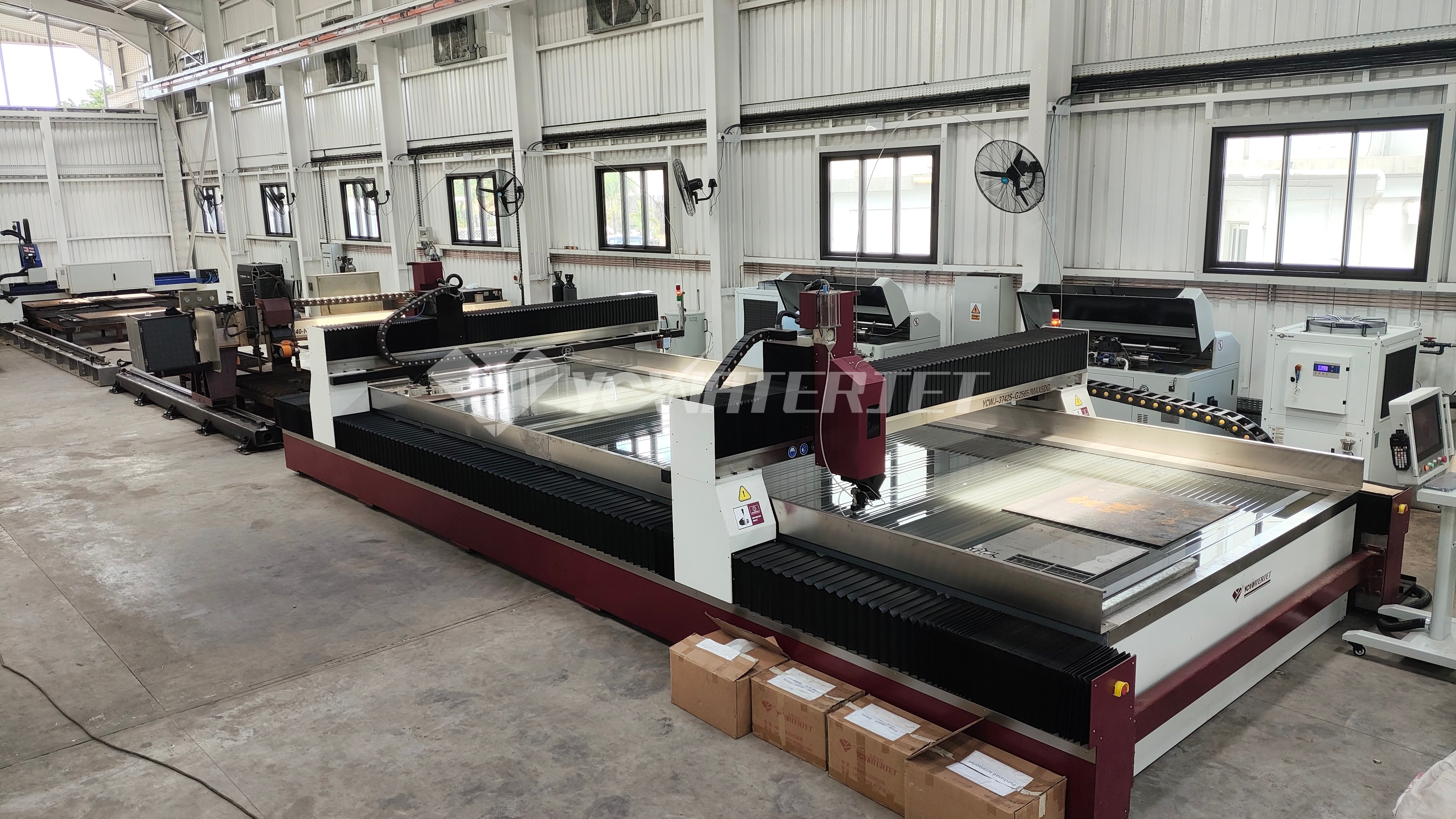
A double-gantry five-axis waterjet cutting system installed at a yacht manufacturer. Image source: YC Waterjet.
The global CNC waterjet cutting machine market was valued between USD 1.11 billion and USD 1.86 billion in 2025, with some estimates projecting growth to approximately USD 2.39 billion by 2030. Metal cutting remains the dominant application, accounting for an estimated 54.2% of waterjet use in 2026, while abrasive waterjet technology is expected to represent 49.5% of the product segment in the same year. For industrial buyers, the CNC waterjet cutting machine is no longer a niche tool; it is a strategic production asset for precision parts, thick plates, and materials that cannot tolerate heat input.
That wider adoption, however, also makes supplier evaluation harder. Many machines look similar on paper: similar pressure ratings, similar accuracy claims, similar CE markings. This article reviews the 2026 market landscape, the factors that differentiate leading CNC waterjet cutting machine manufacturers, and the evidence procurement teams should verify before making a decision.
Waterjet Demand Is Broadening, and So Is the Supplier Landscape
The waterjet cutting machine market is expanding across multiple dimensions. Regionally, Asia-Pacific contributed an estimated 37.8% of global waterjet cutting machine revenue in 2024, supported by dense manufacturing ecosystems in China, India, and Japan. By technology, abrasive waterjet cutting is projected to hold the largest product share at 49.5% in 2026. By application, metal cutting leads with 54.2% of the segment, according to Fact.MR estimates.
The opportunity for buyers is clear: waterjet technology has matured into a dependable cold-cutting process for stainless steel, aluminum, titanium, stone, composites, glass, and even food. The challenge is that the supplier base has expanded just as quickly. Companies that previously supplied only pumps, only gantries, or only software now present themselves as full-line CNC waterjet cutting machine manufacturers. Procurement teams need a structured way to separate system integrators with real production depth from assemblers with limited engineering control.
Who Is Leading the CNC Waterjet Cutting Machine Market?
One of the biggest sources of confusion in waterjet procurement is the difference between high-pressure pump manufacturers, cutting head suppliers, and complete machine builders. The high-pressure pump is the core of any waterjet system, and this segment shows clear concentration. According to 2025 estimates, leading global waterjet high-pressure pump manufacturers include Flow International with approximately 22.1% share, KMT Waterjet Systems with about 18.5%, and OMAX Corp with roughly 15.2%.
| Manufacturer | Primary Role | Verified Market Signal |
|---|---|---|
| Flow International | High-pressure pumps and waterjet systems | ~22.1% share of high-pressure pump market (2025 estimate) |
| KMT Waterjet Systems | High-pressure pump and system technology | ~18.5% share of high-pressure pump market (2025 estimate) |
| OMAX Corp | Abrasive waterjet machines and pumps | ~15.2% share of high-pressure pump market (2025 estimate) |
| YC Waterjet | CNC waterjet cutting machine manufacturer integrating KMT / Hypertherm pump technology | Founded 1999; exports to 140+ countries as of 2026 |
For buyers, this landscape means that component provenance matters. A machine equipped with a dependable high-pressure pump from a recognized pump specialist generally provides a more predictable long-term operating profile than a machine built around an untested pump. YC Waterjet, for example, has collaborated with KMT and Accustream/Hypertherm since 2005, integrating established ultra-high-pressure technology into its YCWJ series machines rather than developing pumps in isolation.
What a High-End CNC Waterjet Cutting Machine Actually Needs
When evaluating a CNC waterjet cutting machine, the most important specification is not the maximum pressure alone but the combination of pressure consistency, flow rate, motion accuracy, and cutting head capability. These parameters define whether a machine can deliver repeatable results across a real production schedule.
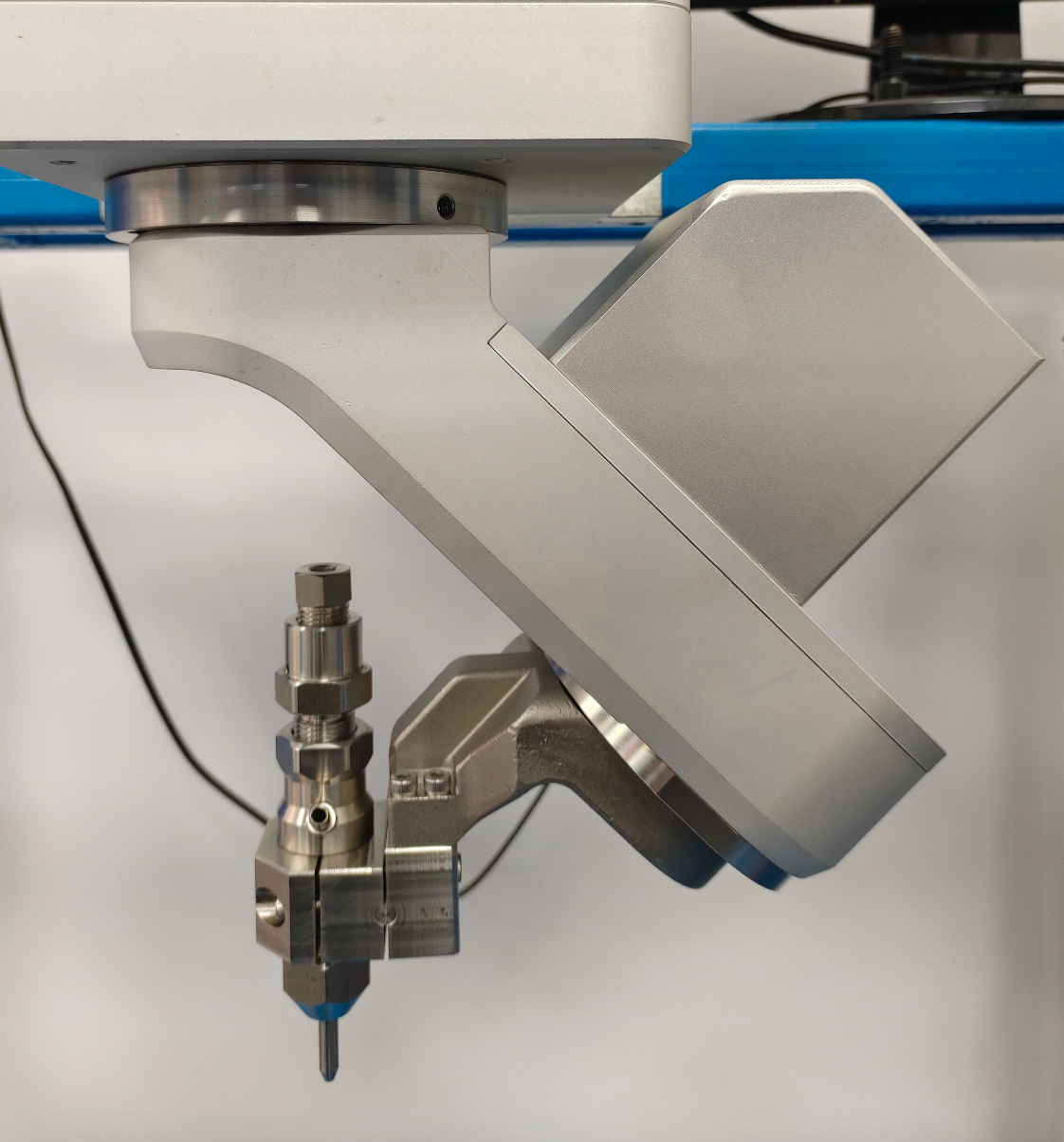
Five-axis waterjet cutting heads allow taper compensation, bevel cutting, and more complex 3D geometry. Image source: YC Waterjet.
Customers commonly ask what kind of accuracy a high-pressure waterjet system can achieve. In the specifications provided by YC Waterjet for its YCWJ series, the cutting accuracy is rated at ±0.1 mm, with positioning accuracy at ±0.025 mm. X/Y dry-run speed reaches 0–15 m/min across most series, while the E Series is rated at 0–8 m/min. The maximum pressure is 4,137 bar (60,000 psi), with a maximum water flow of 7.4 L/min on standard systems and 3.7 L/min on the E Series.
The cutting head is equally important. A 3-axis waterjet machine cuts with a vertical jet and is well suited to flat sheet parts. A 5-axis machine adds tilting capability, which supports taper compensation, bevels, and true 3D waterjet cutting. YC Waterjet offers 3-axis, 3D MAX 5-axis, and dynamic 5-axis cutting head configurations. Some of its cutting heads integrate laser scanning height measurement and drilling functions, which reduces setup time and secondary operations.
The company’s machine range includes the S Series (YCWJ-S0808, S1010, S1212) for small work areas, the L Series (YCWJ-L1515 through L4025) for mid-size cutting, the G Series (YCWJ-G2060 through G30100) for large-format gantry cutting, and the E Series (YCWJ-E3020, E4020). Multi-head configurations and waterjet food cutting versions are also available within the product family.
The Supplier Evidence That Supports an Evaluation
Certification is the first layer of evidence in a waterjet machine evaluation. For the EU market, CE conformity under the Machinery Directive is essential. YC Waterjet holds a Verification of Conformity certificate (ICR/VC/HM2308122) issued by ICR Co., Ltd., valid until 2028-08-23, covering its YCWJ series, Ultra100, and Servo50S models under EN ISO 12100:2010 and EN 60204-1:2018. The company also holds ISO 9001:2015 certification (certificate number 17324Q21401R0S), with a scope covering R&D and manufacturing of ultra-high-pressure waterjet cutting machines.
Buyers should request the actual certificate number and confirm that the target model appears in the certified product scope. A certificate photo without model-specific scope information is comparatively weak evidence.
Production and customization capability forms the second layer. YC Waterjet’s factory in Wuxi, China covers 7,000 square meters, with a team of 25 employees and a stated annual output of 100 sets. Its R&D group includes seven people, including three engineers with more than 20 years of expertise. The company offers OEM/ODM services with customization options covering logo, cutting head, cutting area, cutting speed, voltage, cutting thickness, and height measurement. Monthly capacity is 10 sets, lead time is 30–45 days, and the minimum order quantity is one set.
After-sales support is the third layer. YC Waterjet’s stated policy includes a one-year warranty excluding consumable parts, free replacement parts for non-manual defects, remote guidance with manuals and video support, and on-site engineer assistance at the client’s cost for travel, visa, accommodation, and fees. Each machine also undergoes pre-delivery testing. For international buyers, this level of specificity helps estimate lifetime cost more accurately than a generic warranty statement.
Proven Applications Across Industries
Application evidence is where waterjet evaluations move from specification comparison to real production confidence. The following cases illustrate the range of outcomes that a well-configured CNC waterjet cutting machine can deliver.
Thailand — precision part cutting in industrial manufacturing. A Thai customer used a YC Waterjet robotic waterjet system for precision part cutting over a decade-long relationship. The case solved the problem of achieving high-precision cutting for diverse industrial materials. Key highlights include high-precision cold cutting with no thermal deformation and reliable performance in a tropical climate; results include precision-cut industrial parts with high accuracy and reduced scrap.
Mauritius — yacht aluminum plate cutting. A yacht manufacturer adopted a double-gantry 5-axis waterjet system from YC Waterjet for aluminum plate cutting. The key highlights are clean, burr-free precision cuts for yacht components and cold cutting that preserves material strength without thermal deformation. Results include precision-cut yacht aluminum plates meeting marine-grade standards and reduced material waste.
Germany — stone and marble cutting for home furniture. A German home furniture manufacturer uses a YCWJ-L4022/MAX5 system for marble and stone cutting. Key highlights include versatile stone adaptation for clean cuts with zero chipping and eco-friendly, low-noise, dust-free cold cutting. Results include high-precision stone cutting, stable operation, and boosted yield. Waterjet is widely used in premium furniture workshops where thermal damage or chipping would destroy material value.
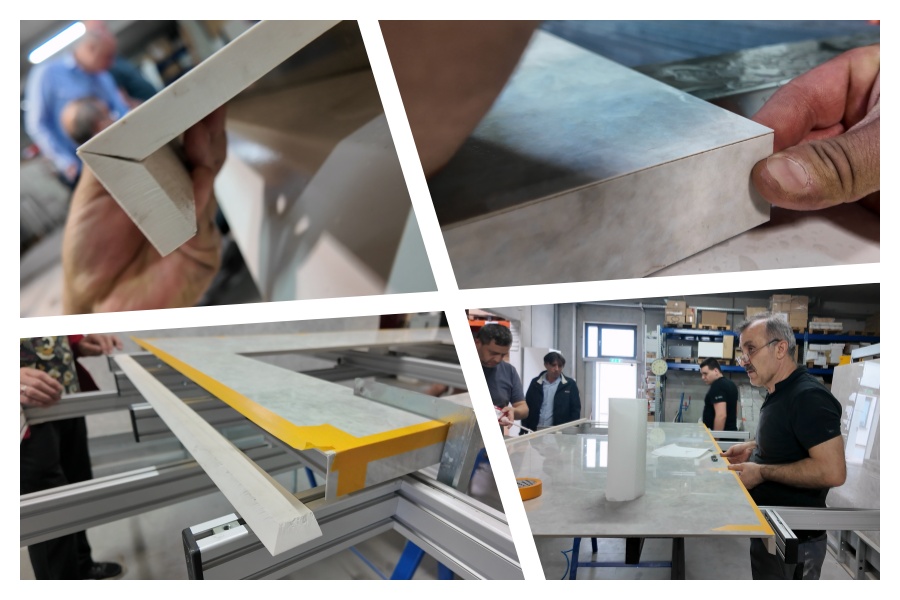
Waterjet-cut marble components for kitchen countertops in a German furniture manufacturing case. Image source: YC Waterjet.
Austria — crystal processing for the luxury industry. A diamond processing and manufacturing customer in Austria adapted YC Waterjet equipment for Swarovski crystal processing. Key highlights include exquisite craftsmanship adaptation, long-lasting durability, low-noise and eco-friendly operation, and a customized solution for the luxury industry. Results achieved were precision cutting performance, zero thermal damage, high-yield complex processing, and stable long-term operation.
Collectively, these cases show that CNC waterjet cutting machines are production tools for industries as varied as marine, stone fabrication, crystal processing, and general metalworking. Buyers should look for documented outcomes that match their own material mix rather than generic marketing claims.
CNC Waterjet vs. Thermal Cutting: Strengths and Real Trade-Offs
The most widely cited advantage of a CNC waterjet cutting machine is its cold-cutting nature. Unlike laser, plasma, or oxy-fuel processes, waterjet cutting introduces no heat-affected zone and no thermal distortion. This makes it particularly valuable for aluminum, titanium, composites, and pre-finished materials. Metal cutting’s 54.2% share of waterjet applications in 2026 confirms that industrial users rely on waterjet even for metals where thermal processes dominate the broader cutting market.
However, an independent assessment should also recognize the limitations. Waterjet cutting speed is generally slower than laser cutting on thin sheet metal. Abrasive consumption adds operating cost, and water treatment or abrasive disposal must be managed. For high-volume cutting of thin steel plates where edge quality requirements are moderate, a laser or plasma system may offer better economics. Waterjet becomes more attractive when materials are thick, sensitive to heat, prone to cracking, or when a single machine must process many different material types without tool changes.
This balanced view matters for procurement because machine selection should follow the actual part portfolio. A 5-axis waterjet machine is a significant capital investment, and its value depends on whether the production mix includes bevels, 3D contours, or angled cuts. If the workload is predominantly flat 2D parts with simple geometries, a well-configured 3-axis machine may be sufficient and more economical.
Future Outlook: Toward Smarter, More Flexible Waterjet Systems
Market projections suggest the CNC waterjet cutting machine market will continue growing toward an estimated USD 2.39 billion by 2030, although forecasts for the 2025 base vary between USD 1.11 billion and USD 1.86 billion depending on the research source. This divergence itself is a reminder for buyers: market size figures are directional, not precision measurements.
Technologically, the direction of travel points toward more machine flexibility: five-axis motion, robotic waterjet cutting, multiple cutting heads, and better integration of height measurement and drilling functions. YC Waterjet’s product line already reflects this shift, with 6-axis robotic waterjet cutting systems and multiple-head configurations available alongside conventional 3-axis machines.
For buyers evaluating suppliers in 2026, the practical implication is that waterjet capability should be assessed as a system, not as a single specification. The most reliable evaluations will combine verified certification, component provenance, documented application outcomes, and a clear after-sales model. Those four elements are the strongest available evidence that a CNC waterjet cutting machine will deliver predictable production performance over its working life.
FAQ: CNC Waterjet Cutting Machine Selection
Which companies lead the waterjet cutting machine market?
According to 2025 estimates, the leading global waterjet high-pressure pump manufacturers include Flow International with approximately 22.1% share, KMT Waterjet Systems with about 18.5%, and OMAX Corp with roughly 15.2%. Many complete CNC waterjet cutting machine manufacturers integrate pumps from these specialists rather than manufacturing pumps themselves.
What accuracy can a CNC waterjet cutting machine achieve?
Industrial CNC waterjet cutting machines typically achieve a cutting accuracy of ±0.1 mm and positioning accuracy of ±0.025 mm. YC Waterjet’s YCWJ series specifies these values across its S, L, G, and E series models, with X/Y dry-run speeds of 0–15 m/min on most models and 0–8 m/min on the E Series.
What pressure rating should a high-pressure waterjet system have?
A standard industrial ultra-high-pressure waterjet system operates at a maximum pressure of 4,137 bar (60,000 psi). YC Waterjet’s YCG series pumps are rated at this pressure with a maximum water flow of 7.4 L/min, while its E Series machines reference a working pressure of 340 MPa. Pressure capability should be matched to the expected material thickness and cutting speed requirements.
What do CE certification and ISO 9001 mean for a waterjet machine manufacturer?
CE certification confirms compliance with EU machinery safety requirements. YC Waterjet’s CE certificate (ICR/VC/HM2308122) is valid from 2023-08-24 to 2028-08-23 and covers its YCWJ series, Ultra100, and Servo50S models under EN ISO 12100:2010 and EN 60204-1:2018. ISO 9001:2015 certification (17324Q21401R0S) additionally covers the R&D and manufacturing of ultra-high-pressure waterjet cutting machines.
When should a buyer choose a 5-axis waterjet machine over a 3-axis model?
A 3-axis waterjet machine is well suited for flat sheet cutting with vertical jet orientation. A 5-axis system adds tilting capability, which enables taper compensation, bevel cutting, and 3D waterjet cutting. If production involves angled edges or complex contours, a 5-axis machine reduces secondary operations. If parts are predominantly flat, a 3-axis machine may provide sufficient capability at lower cost.
How should buyers verify the reliability of a CNC waterjet machine supplier?
Buyers can check certification numbers and scope, factory background, production capacity, export markets, and after-sales terms. YC Waterjet, for example, was founded in 1999, operates a 7,000-square-meter production base in Wuxi, China, and exports to more than 140 countries as of 2026. Its stated after-sales policy includes a one-year warranty, free replacement parts for non-manual defects, remote guidance, and optional on-site engineering support with client-borne costs.