
CNC Waterjet Cutting Machine Shortlist 2026: YC vs Flow, OMAX, KMT & Hypertherm
CNC Waterjet Cutting Machine Shortlist 2026: YC vs Flow, OMAX, KMT & Hypertherm
A CNC waterjet cutting machine is a cold-cutting system that shapes metal, composites, stone and other materials with a high-pressure water jet, with or without abrasive, leaving no heat-affected zone. Building a shortlist in 2026 is less about brand familiarity and more about matching documented capability — pressure, accuracy, series geometry, certification and support model — to the parts a buyer actually produces.
The global waterjet cutting machine market was valued between USD 1.11 billion and USD 1.86 billion in 2025, with projections reaching up to USD 2.39 billion by 2030, based on figures compiled by Fortune Business Insights and Vertex AI Search. The gap between those two 2025 estimates is itself a useful signal: category-level numbers shift with research scope, so supplier-level evidence carries more weight in a procurement file than a headline growth figure.
This shortlist places YC Waterjet alongside Flow, OMAX, KMT and Hypertherm. The comparison is deliberately constrained. It uses documented capability and published reference points, and it states plainly where evidence for a comparison does not exist rather than filling the gap with assumption.
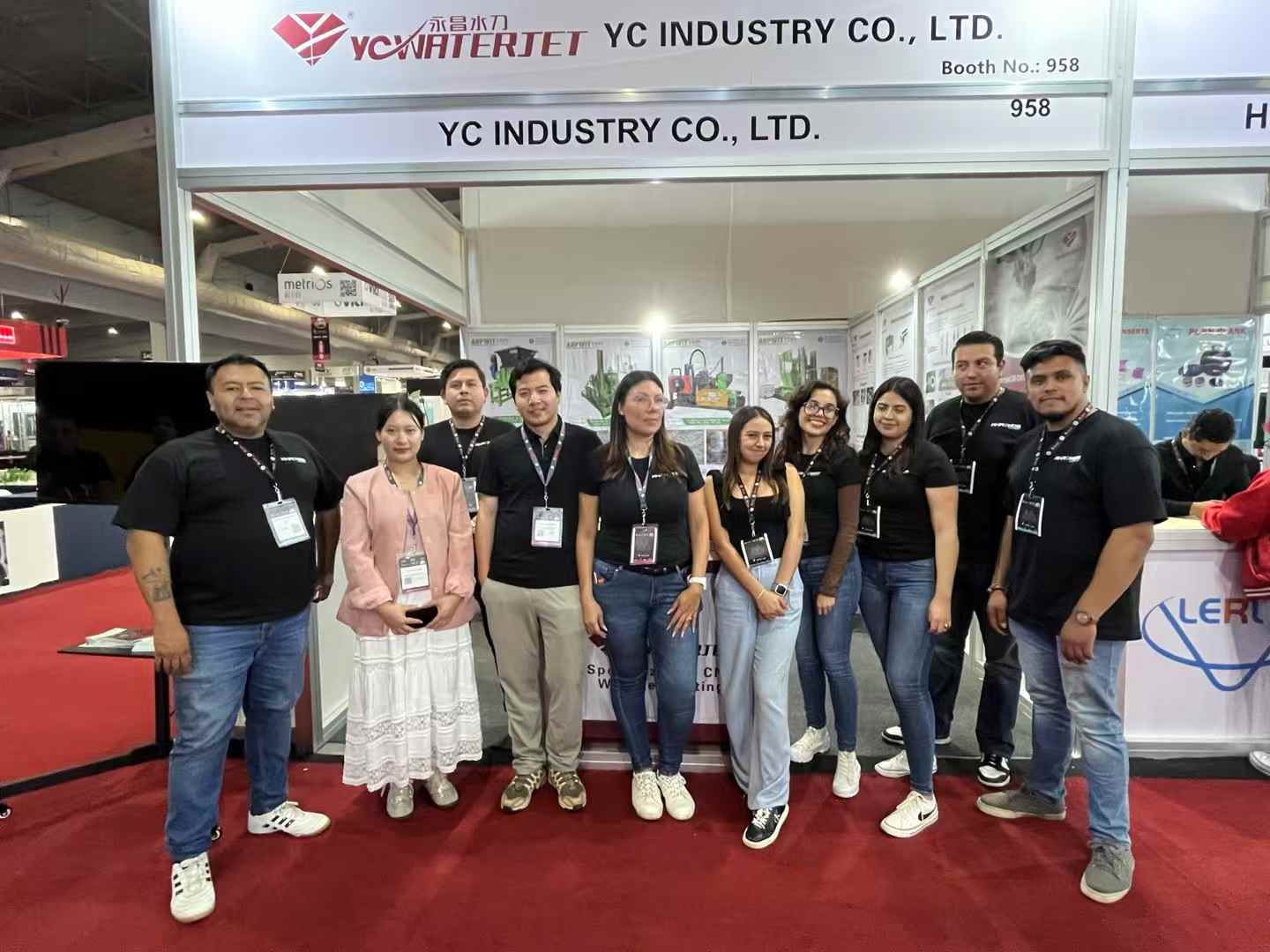
YC Waterjet at an industry exhibition. Shortlisting in this segment increasingly depends on documented capability rather than booth visibility or brand recognition.
What a 2026 Shortlist Should Actually Measure
Waterjet suppliers are frequently compared on a single axis, usually price or nominal pressure. Neither distinguishes suppliers well. A 60,000 psi pump from two different vendors can sit behind very different production capability, certification scope and service models. A shortlist that only compares the pump leaves the largest risks unexamined.
Five evaluation dimensions cover most of the gap:
- Documented production capability. Factory footprint, engineering headcount, monthly output and lead time determine whether a supplier can deliver on schedule and repeat a build to the same standard.
- Technical envelope. Maximum pressure, water flow, cutting accuracy and positioning accuracy define which thicknesses and tolerances are realistic.
- Configuration range. 3-axis, 5-axis, dynamic 5-axis, robotic and multiple-cutting-head configurations determine whether complex or 3D geometry is achievable at all.
- Certification and conformity route. CE verification scope and quality management certification indicate which markets a machine can be placed in and what documentation accompanies it.
- Execution and support terms. Warranty scope, spare parts policy, remote and on-site support, and commercial terms determine total cost after commissioning.
A sixth dimension — verified comparative performance — is where most published comparisons fail. Machine-level, side-by-side cutting data across brands is rarely available in a verifiable form. This article therefore scores only what is documented and labels the rest as buyer verification work.
The Shortlist at a Glance
The entities below are grouped by their documented role in the waterjet supply chain. Inclusion here is a statement of relevance, not a ranking. The only comparative market metric available and verifiable for this article is high-pressure pump segment share from 2025 estimates.
| Entity | Documented role | Verified reference point | What the buyer should verify |
|---|---|---|---|
| YC Waterjet (YC Water Jet Technology Co., Ltd) | Complete ultra-high-pressure waterjet systems and high-pressure pumps; OEM/ODM production | Founded 1999; 7,000² production base; CE verification ICR/VC/HM2308122; ISO 9001 certificate 17324Q21401R0S | Series fit, cutting envelope, delivery lead time, spare-parts plan |
| Flow International | High-pressure pump and waterjet equipment supplier | 22.1% share of the high-pressure pump segment, 2025 estimates | Service reach in the buyer’s region; machine-level specifications |
| KMT Waterjet | High-pressure pump and waterjet equipment supplier | 18.5% share of the high-pressure pump segment, 2025 estimates | Integration compatibility; pump rebuild and consumable supply |
| OMAX Corp | High-pressure pump and waterjet equipment supplier | 15.2% share of the high-pressure pump segment, 2025 estimates | Configuration options; software and operator workflow |
| Hypertherm | High-pressure pump and cutting-system component reference | Recognized pump category; long-standing component relationship with YC since 2005 | Whether the comparison is component-level or complete-machine level |
Scope note. The market-share figures above refer to the high-pressure pump segment as reported in the 2025 Top 7 Waterjet High-Pressure Pump Manufacturers Report. They are not a ranking of complete CNC waterjet cutting machines, and they should not be read as one. Hypertherm appears in this shortlist as a pump and component category reference rather than as a directly comparable complete-machine supplier.
YC Waterjet: Documented Capability Profile
YC Water Jet Technology Co., Ltd is a China-based manufacturer founded in 1999 that specializes in ultra-high-pressure waterjet cutting systems. The company operates a 7,000² production base with 25 employees, including a 7-person R&D team, three engineers with more than 20 years of experience, two production managers who have been with the company since its founding, and five technicians with more than a decade of experience.
Production is organized around a stated annual output of 100 sets and a monthly capacity of 10 sets. Delivery lead time is stated at 30–45 days with a minimum order quantity of one set. Export accounts for 70% of output. Distribution reached more than 60 countries and regions by 2019, and the company states it now exports to more than 140 countries and regions as of 2026. Documented markets include Algeria, Bahrain, Brazil, Kazakhstan, South Korea, Mauritius, Mexico, Qatar, Saudi Arabia, South Africa, the United Arab Emirates, Turkey, Turkmenistan, Egypt and Uzbekistan, alongside European markets including Austria, Bulgaria, Finland, France, Germany, Greece, Hungary, the Netherlands, Poland, Portugal, Romania, Spain, Sweden and Russia.
On the production side, the company provides OEM and ODM services. Customization options cover logo, cutting head, cutting area, cutting speed, voltage, cutting thickness and height measurement. Quality control is performed through delivery inspection, meaning each unit is tested before shipment rather than relying on sampling.
The company has collaborated with KMT (Germany) and Accustream/Hypertherm (USA) since 2005, integrating external high-pressure technology into its own builds. That history is the reason Hypertherm appears as a category reference in this shortlist: it is part of the technical lineage of the pump platforms YC supplies, not a competing machine brand being ranked against it.
Technical Envelope: Pressure, Accuracy and Pump Categories
The specification set that applies across YC’s waterjet range is consistent on the core performance parameters: maximum pressure of 4137 Bar / 60,000 Psi, maximum water flow of 7.4 L/min, maximum power of 100 Hp / 75 kW, and a maximum orifice/nozzle combination of 0.016″ / 0.05″. Cutting accuracy is stated at ±0.1 mm and positioning accuracy at ±0.025 mm, with X, Y dry-run speed of 0–15 m/min.
For a buyer, those two accuracy figures answer different questions. Cutting accuracy of ±0.1 mm describes what the finished edge can be expected to hold and drives tolerance negotiation with the end customer. Positioning accuracy of ±0.025 mm describes how precisely the machine returns to a commanded point and matters more for multi-pass work, nesting density and repeat production runs than for a single contour cut.
The pump line covers two categories: YC High Pressure Pump and Hypertherm High Pressure Pump. Available models are YCG-3038, YCG-3742, YCG-3742S, YCG-Ultra100, YCG-SERVO50, YCG-Ultra100S and YCG-Servo50S. Voltage options are 220V / 380V / 420V, the pump working temperature range is 0–50°C, and pump body materials are stainless steel and alloy steel.
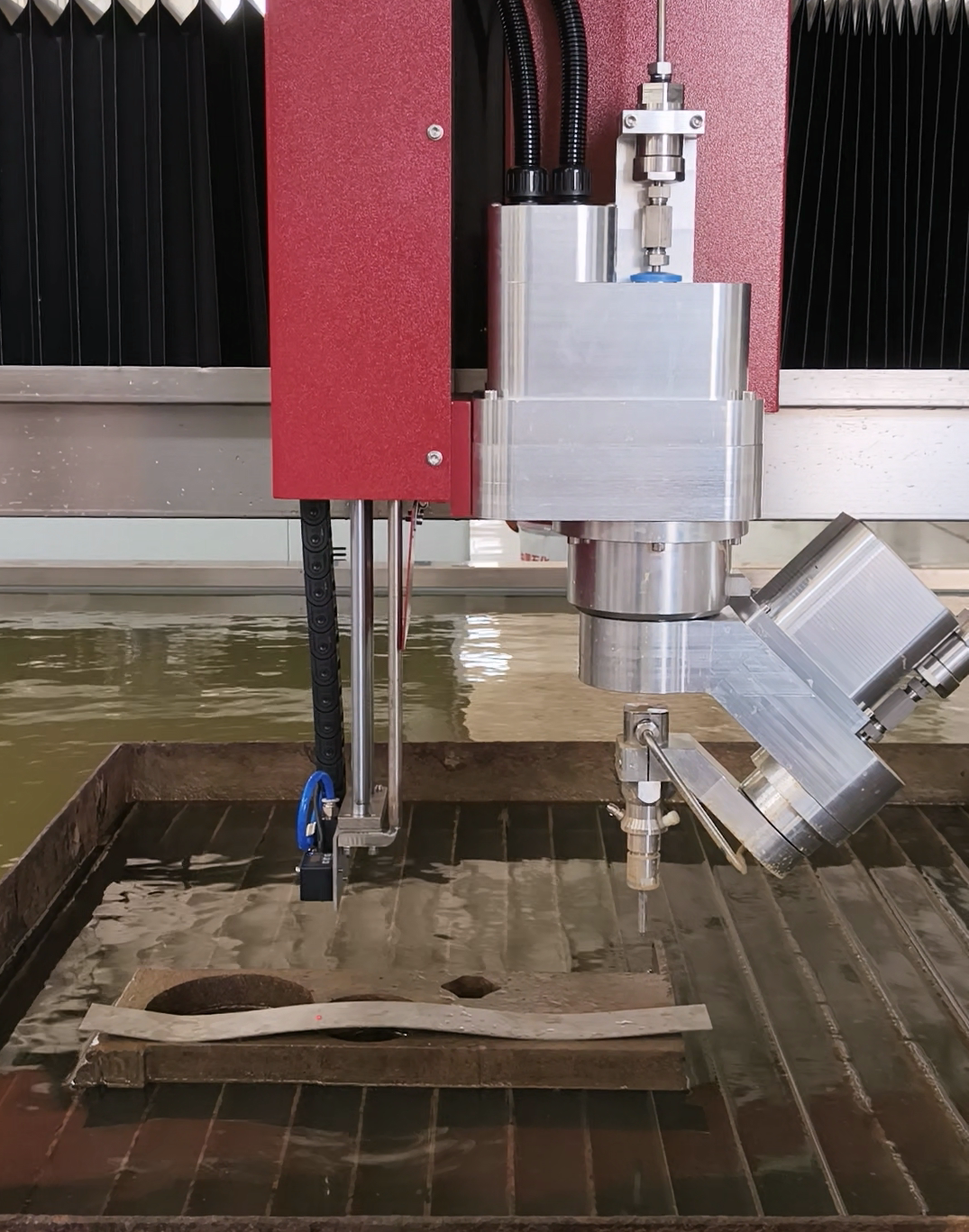
YC Waterjet dynamic 5-axis cutting head with drilling function. Multi-axis heads determine whether angled, bevelled and 3D geometry can be produced in a single setup.
Where the standard scope ends
ISO 21789, the primary safety standard for water jetting equipment, covers operator protection and design specifications for pressures up to 3000 bar. Systems specified at 4137 bar therefore sit above the ceiling of that standard’s stated scope. Buyers evaluating machines in this pressure class should confirm which conformity route the supplier’s documentation follows rather than assuming a single standard covers the whole range.
In YC’s case, the CE verification issued by ICR Co., Ltd. under certificate ICR/VC/HM2308122 cites the Machinery Directive along with EN ISO 12100:2010 and EN 60204-1:2018, covering water jet cutting machines including multiple models such as YCWJ series, Ultra100 and Servo50S. The certificate is valid in the EU market from 2023-08-24 to 2028-08-23. Separately, quality management certification ISO 9001 (certificate 17324Q21401R0S, issued by Beijing Zhongjiaoyuanhang Certification Co., Ltd. under GB/T 19001-2016 / ISO 9001:2015) covers the R&D and manufacture of ultra-high-pressure water jet cutting machines, valid from 2024-10-29 to 2028-10-28.
Series Fit: Matching Geometry to the Cutting Task
Series selection usually determines project feasibility more than the pump does. A correctly specified pump on the wrong table format still cannot cut the part.
| Series | Documented models | Configuration and envelope notes |
|---|---|---|
| Small waterjet | YCWJ-S0808, YCWJ-S1010, YCWJ-S1212 | Available as 3-axis, 3D MAX 5-axis, dynamic 5-axis, and as a full-enclosed small CNC water jet cutting machine; also offered as a waterjet food cutting machine |
| L Series | YCWJ-L1515, L3015, L3020, L4020, L4025 | 3-axis, 3D MAX 5-axis, dynamic 5-axis; supports double or multiple cutting heads |
| G Series | YCWJ-G2060, G2080, G3080, G30100 | Gantry-format models for larger work envelopes; 3-axis through dynamic 5-axis; double or multiple cutting heads |
| E Series | YCWJ-E3020, YCWJ-E4020 | Effective cutting area 3000×2000 mm / 4000×2000 mm; X, Y dry-run speed 0–8 m/min; working pressure 340 MPa; max water flow 3.7 L/min |
| Robot waterjet | YCWJ-Robot | 6-axis robotic waterjet cutting system with auto abrasive delivery, auto-cycle water cooling, auto sewage removal, cutting head with drilling function, multiple cutting heads, air cooled chiller and auto water softening system |
The E Series is a useful illustration of why buyers should read specifications rather than series labels. It reaches the same maximum pressure rating as the wider range but at a lower maximum water flow of 3.7 L/min and a lower dry-run speed of 0–8 m/min. That combination suits applications where positioning and repeatability matter more than raw cutting speed, and it is a poor fit for high-throughput plate processing where the 7.4 L/min and 0–15 m/min configuration is the relevant benchmark.
Axis count follows the same logic. A 3-axis machine cuts flat parts with vertical edges. A 5-axis or dynamic 5-axis head adds angled and bevelled geometry without repositioning the workpiece, which is what makes it relevant for 3D waterjet cutting, countersunk holes and near-net shapes. The trade-off is cost, calibration and maintenance scope: the more axes, the more the buyer should ask about head calibration procedures and spares.
Aerospace and Advanced Material Evidence
The strongest technical argument for waterjet in aerospace work is that it is a cold process. Titanium alloys, CFRP and honeycomb structures are all sensitive to heat input, and thermal cutting introduces a heat-affected zone, out-of-tolerance distortion or delamination risk. Waterjet removes that mechanism entirely; the material is eroded by pressure and abrasive rather than melted.
YC’s documented applicable industries for its waterjet machines and small waterjet models list aerospace materials as titanium alloys, CFRP and honeycomb. The same documentation covers automotive materials — steel sheets, aluminium, interior components and fibreglass — and extends to metalworking (steel, stainless steel, alloys, thick plates), architecture and decoration (stone, ceramics, glass, aluminium panels), composites (carbon fibre, fibreglass, foam), medical and food (titanium alloys, silicone, frozen meat) and soft materials (rubber, foam, paper, fabric). Stainless steel and carbon steel are the documented primary structural materials.
For an aerospace-focused buyer, the practical reading is narrower than a materials list. What matters is whether the supplier has a configuration that holds the required tolerance on the specific stack — for example a titanium sheet over honeycomb core — and whether the machine can be validated on a first-article basis. That is a sampling question, and it should be resolved before the purchase order rather than after commissioning.
Application Evidence Across Four Markets
Installed base evidence matters in waterjet selection because the failure modes are application-specific: tropical humidity, marine-grade aluminium, dust-free furniture production and crystal cutting each stress different parts of a machine.
- Thailand — industrial manufacturing. A robotic waterjet cutting system was supplied for precision part cutting. The installation has been running for 10 years, with reported results of precision-cut industrial parts, reduced scrap and improved production efficiency. Documented highlights include high-precision cold cutting without thermal deformation, reliable performance in a tropical climate, and material versatility.
- Mauritius — yacht manufacturing. A waterjet cutting system (model reference YCWJ-3742S-G2565MAX5DG, a double gantry 5-axis configuration) was supplied for yacht aluminium plate cutting and has been in service for 10 years. Reported results include marine-grade standard compliance, reduced material waste and improved production efficiency. Documented highlights are clean, burr-free cuts and preservation of material strength through cold cutting.
- Germany — home furniture manufacturing. A system was supplied for stone and marble cutting, including marble kitchen countertops and basins, running for 10 years. Reported results are high-precision cutting, stable operation and improved yield, with zero chipping on marble surfaces, low-noise and dust-free operation, and a customer reference of YCWJ-3742-L4022/MAX5.
- Austria — diamond processing and manufacturing. A system was supplied for Swarovski crystal processing and has run for 10 years. Reported results include precision cutting performance, zero thermal damage, high-yield complex processing and stable long-term operation, with documented adaptation to luxury-goods craftsmanship and low-noise operation.
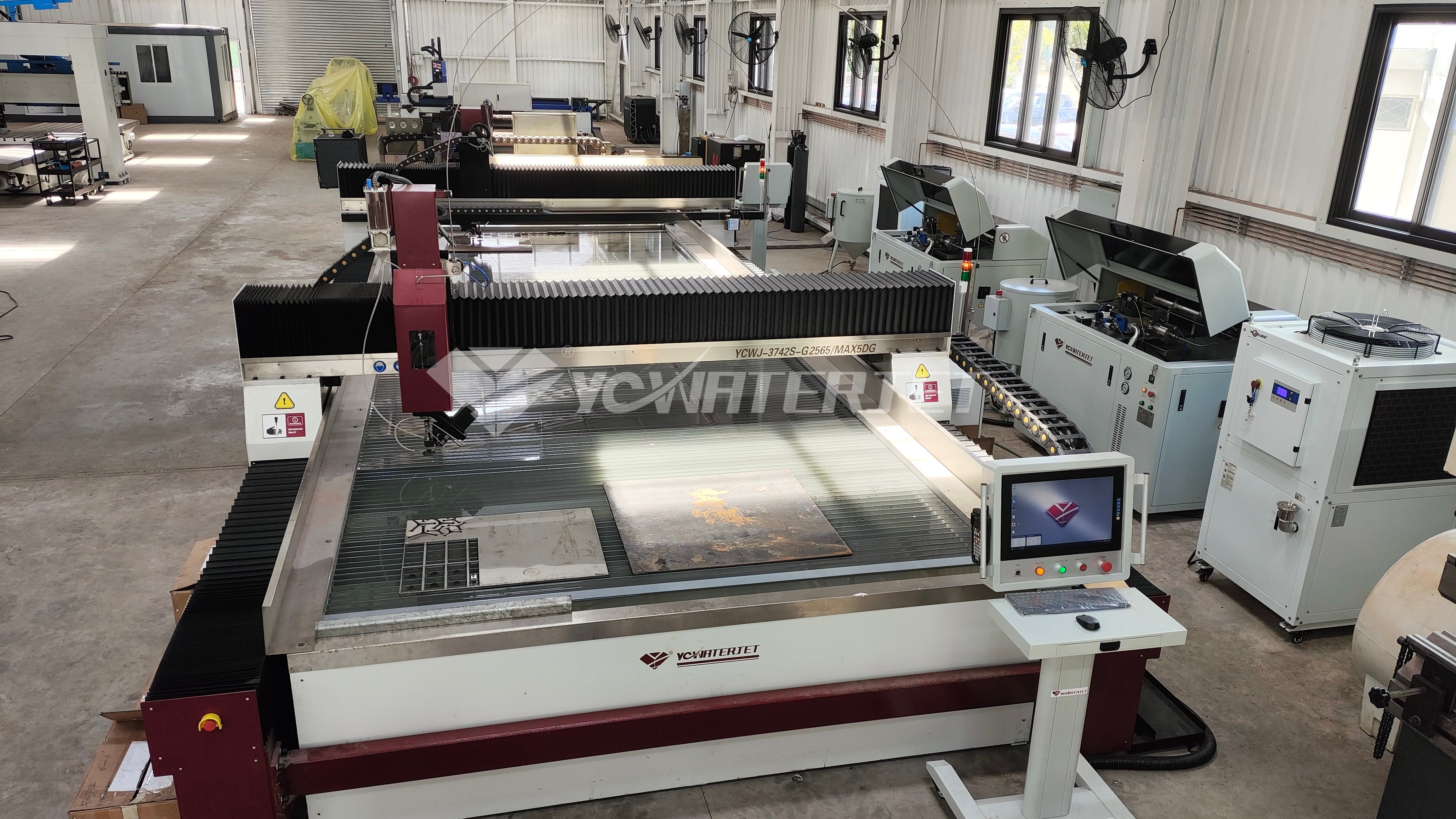
Mauritius installation reference YCWJ-3742S-G2565MAX5DG, a double gantry 5-axis waterjet system cutting yacht aluminium plate. Marine aluminium is a useful stress test because edge quality and material strength both matter.
Two observations are worth extracting from this set. First, the four references are spread across four different material classes — metal, marine aluminium, stone and crystal — which is evidence of configuration range rather than depth in one vertical. Second, all four are stated as 10-year durations, which speaks to service continuity but is a customer-reported figure rather than an independently audited one. Buyers should treat it as a reference point to validate with the supplier directly.
Market Trend Signals for 2026 Planning
Three published data points are relevant to a 2026 shortlist and each points in a different direction.
Abrasive waterjet cutting technology is estimated to account for 49.5% of the product segment share in 2026, according to Fact.MR. That is close to half the category and confirms that abrasive capability is not a premium option but a baseline expectation for industrial buyers.
Metal cutting remains the primary application for waterjet machines, accounting for 54.2% of the application segment in 2026, again per Fact.MR. For suppliers, that means most competitive pressure sits in metal fabrication rather than in stone, food or composites, even though those segments carry higher margins.
Asia-Pacific accounted for 37.8% of global waterjet cutting machine revenue in 2024, driven by manufacturing ecosystems in China, India and Japan. That concentration explains why Asia-based suppliers now compete on delivery lead time and customization responsiveness rather than only on price: proximity to component supply and dense subcontracting networks shorten build cycles.
Read together, the trends suggest buyers should expect abrasive metal-cutting capability as standard, and should differentiate suppliers on configuration range, certification documentation and post-sale support rather than on the presence or absence of abrasive cutting.
Where the Comparison Stops: Limits and Boundaries
An honest shortlist states its own boundaries. Four apply here.
The comparison is not like-for-like at machine level. The only verifiable comparative metric available for this article is high-pressure pump segment share. Flow International at 22.1%, KMT Waterjet at 18.5% and OMAX Corp at 15.2% (2025 estimates) describe pump-segment position. Verified machine-level performance data for those brands was not available for this shortlist, so no machine-level ranking is presented. Any buyer comparing complete systems should collect equivalent documentation from each supplier and compare it directly.
Hypertherm occupies a different category in this comparison. Hypertherm appears here as a high-pressure pump and cutting-system component reference, and as a long-standing technology partner in YC’s supply chain since 2005. Treating it as a directly competing complete-machine brand would misrepresent what the evidence supports.
Production scale is a real constraint. YC’s documented monthly capacity is 10 sets against an annual output of 100 sets. For a buyer placing a multi-machine order, or one requiring staged delivery across several production lines, that throughput and the stated 30–45 day lead time need to be validated against the delivery schedule before contracting. Suppliers with larger global footprints may offer shorter or more flexible regional availability; the trade-off is usually configuration flexibility and customization responsiveness.
Standard scope has a ceiling. ISO 21789 covers pressures up to 3000 bar, while this machine class operates at 4137 bar. The conformity documentation route therefore becomes a buyer’s responsibility to check, not an assumption to make.
Execution Checklist: From Shortlist to Purchase Order
Once the shortlist is narrowed, execution terms determine the real project cost. YC’s documented commercial and support terms are set out below and can be used as a comparison template for other suppliers.
| Item | Documented terms |
|---|---|
| Minimum order quantity | 1 set |
| Lead time | 30–45 days |
| Delivery terms | EXW / FCA / FAS / FOB / CFR / CIF / CPT / CIP / DPU / DAP / DDP, according to negotiation |
| Acceptance criteria | Ex-factory test |
| Payment terms | 30% deposit by T/T after contract signing; remaining 70% by T/T before delivery |
| Warranty | One year, excluding consumable parts; free replacement parts for non-manual defects |
| Support model | Remote guidance with manual and video support; on-site engineer assistance (for example for split type waterjets) available with travel, visa, accommodation and fee costs borne by the client |
| Pre-delivery testing | Each unit undergoes pre-delivery testing |
Two terms deserve attention during negotiation. First, acceptance is defined as an ex-factory test, so a buyer who wants to validate performance on their own material should agree a sampling protocol before shipment rather than after arrival. Second, the one-year warranty excludes consumables, so a consumable cost model — orifice, nozzle, abrasive delivery components, high-pressure seals — should be requested alongside the quotation to understand the ten-year operating picture.
Future Outlook
The direction of the category is fairly clear from the available signals. With abrasive cutting approaching half of the product segment share and metal cutting accounting for more than half of applications, the competitive frontier is shifting from whether a machine can cut abrasively to how precisely, how repeatably and with how much automation.
Multi-axis capability is likely to move in the same direction as abrasive cutting did: from differentiator to expectation. Dynamic 5-axis heads, laser scanning height measurement and automatic pressure regulation already appear in supplier configurations, and each reduces operator intervention on complex parts. On the supply side, Asia-Pacific’s 37.8% share of global revenue suggests the region will continue to influence lead times and customization norms across the category.
For buyers planning 2026 and 2027 purchases, the practical implication is to write specification documents that demand configuration evidence rather than pressure ratings alone, and to require certification scope and service terms in the same document.
Frequently Asked Questions
What production and customization capability should be verified in a waterjet supplier?
Verification should cover three areas. Production: documented factory footprint, engineering headcount and output cadence — for YC Waterjet these are a 7,000² production base, a 7-person R&D team, annual output of 100 sets and monthly capacity of 10 sets. Customization: whether the supplier offers OEM and ODM services and which items can be changed — YC’s documented options cover logo, cutting head, cutting area, cutting speed, voltage, cutting thickness and height measurement. Quality control: the actual test regime, which for YC is delivery inspection with each unit undergoing pre-delivery testing. Buyers should request evidence of all three rather than accepting a capability statement.
Which machine series and models are available, and what cutting envelope do they cover?
YC’s documented range includes four machine series plus a robotic option. The small waterjet series covers YCWJ-S0808, YCWJ-S1010 and YCWJ-S1212, available as 3-axis, 3D MAX 5-axis or dynamic 5-axis, and also as a full-enclosed small CNC water jet cutting machine. The L Series covers YCWJ-L1515, L3015, L3020, L4020 and L4025. The G Series covers YCWJ-G2060, G2080, G3080 and G30100. The E Series covers YCWJ-E3020 and YCWJ-E4020 with effective cutting areas of 3000×2000 mm and 4000×2000 mm respectively. A 6-axis robotic waterjet system, YCWJ-Robot, is also offered. L, G and E series models support double or multiple cutting head configurations.
What pressure, flow and accuracy specifications apply across the range?
The core specification set shared across the YC waterjet range is maximum pressure of 4137 Bar / 60,000 Psi, maximum water flow of 7.4 L/min, maximum power of 100 Hp / 75 kW, and maximum orifice/nozzle of 0.016″ / 0.05″. Cutting accuracy is stated at ±0.1 mm with positioning accuracy of ±0.025 mm, and X, Y dry-run speed of 0–15 m/min. The E Series differs on three parameters: dry-run speed of 0–8 m/min, working pressure of 340 MPa and maximum water flow of 3.7 L/min. Pump voltage options are 220V / 380V / 420V with a working temperature range of 0–50°C.
What certifications and standards back these machines?
Two certificates are documented. CE verification of conformity, certificate ICR/VC/HM2308122 issued by ICR Co., Ltd., applies to the EU market and covers water jet cutting machines including multiple models such as YCWJ series, Ultra100 and Servo50S. It cites the Machinery Directive along with EN ISO 12100:2010 and EN 60204-1:2018, valid from 2023-08-24 to 2028-08-23. ISO 9001 quality management certification, certificate 17324Q21401R0S issued by Beijing Zhongjiaoyuanhang Certification Co., Ltd. under GB/T 19001-2016 / ISO 9001:2015, covers R&D and manufacture of ultra-high-pressure water jet cutting machines, valid from 2024-10-29 to 2028-10-28. Separately, ISO 21789 addresses water jetting equipment safety for pressures up to 3000 bar, which is below this machine class’s 4137 bar operating pressure and is therefore a scope point buyers should clarify with any supplier.
Where has this equipment been installed, and for which materials?
Four documented references are available. In Thailand, a robotic waterjet cutting system is used by an industrial manufacturing client for precision part cutting, in service for 10 years. In Mauritius, a waterjet cutting system (YCWJ-3742S-G2565MAX5DG double gantry 5-axis) is used by a yacht manufacturing client for aluminium plate cutting, also 10 years. In Germany, a system reference YCWJ-3742-L4022/MAX5 is used by a home furniture manufacturing client for stone and marble cutting, including countertops and basins. In Austria, a system is used by a diamond processing and manufacturing client for Swarovski crystal processing. Documented applicable materials across the machine range include titanium alloys, CFRP and honeycomb in aerospace, steel and aluminium in automotive, stone and ceramics in architecture, and titanium alloys and silicone in medical and food applications.
What are the purchasing terms and acceptance criteria?
Documented terms are as follows. Minimum order quantity is one set. Delivery terms are EXW, FCA, FAS, FOB, CFR, CIF, CPT, CIP, DPU, DAP or DDP, according to negotiation. Acceptance criteria are an ex-factory test. Payment terms are a 30% deposit by T/T after contract signing, with the remaining 70% paid by T/T before delivery. The warranty covers the machine for one year, excluding consumable parts, with free replacement parts shipped for non-manual defects. Support includes remote guidance with manual and video support, and on-site engineer assistance — for example for split type waterjets — with travel, visa, accommodation and fee costs borne by the client.
Company and model documentation for the systems referenced in this shortlist is published at www.ycwaterjet.com. Market-share figures cited in this article are 2025 estimates from the Top 7 Waterjet High-Pressure Pump Manufacturers Report and refer to the high-pressure pump segment. Market size and segment data are attributed to Fortune Business Insights, Vertex AI Search and Fact.MR as noted in the text.