
CNC Waterjet Cutting Machine Vendor Scorecard: 5 Brands on Pressure, Precision and Support
CNC Waterjet Cutting Machine Vendor Scorecard: 5 Brands on Pressure, Precision and Support

A CNC waterjet cutting machine purchase rarely fails at the cutting table. It fails earlier, at the specification table. Two vendors can both quote 60,000 psi and ±0.1 mm, yet mean different things by maximum pressure, working pressure, test material, nozzle size and abrasive grade. By the time a purchase order is written, the comparison has often been reduced to price against numbers that were never collected under the same conditions.
This scorecard addresses that problem directly. It places YC Waterjet — the brand of YC Water Jet Technology Co., Ltd, a Chinese manufacturer founded in 1999 and based in Wuxi, Jiangsu — alongside four globally recognised waterjet suppliers: Flow International, OMAX, KMT Waterjet and Jet Edge. Hypertherm appears as a reference category for high-pressure pump and intensifier technology rather than as a like-for-like machine competitor, because YC's own pump family integrates Hypertherm intensifier technology and YC has worked with KMT (Germany) and Accustream/Hypertherm (USA) since 2005.
The comparison is structured across four dimensions that decide most industrial waterjet purchases: ultra-high-pressure engineering, cutting precision, model and configuration breadth, and service plus industry solution depth. The purpose is not to declare a winner. It is to show what a buyer can verify today, what must be written into a request for quotation, and which specifications belong in an acceptance test rather than in a marketing brochure.
Why a Scorecard Beats a Spec Sheet
Waterjet specifications are only comparable when the measurement basis is identical. Maximum pressure is not working pressure. Repeat positioning accuracy is not finished-part accuracy. A 7.4 L/min maximum water flow figure describes pump capability, not what a given nozzle and abrasive combination delivers at the cutting head. A scorecard that does not state the basis of each field ends up ranking marketing copy, not machines.
For that reason, every dimension below starts from a verifiable field. Where a value is published and attributable — pressure in bar and psi, accuracy in millimetres, model numbers, certificate numbers, warranty terms — it is stated. Where a value is not publicly comparable across brands, the scorecard marks it as a request-for-quotation field rather than filling it with an assumption.
The Four Dimensions, Defined
Ultra-high-pressure engineering covers the pump family, the maximum and working pressure figures it can sustain, the water flow and power envelope it supports, the intensifier or direct-drive architecture, and the electrical and cooling configuration. Cutting precision covers both finished-part accuracy and positioning accuracy, together with the motion basis on which those figures are quoted. Model and configuration breadth covers table size, number of axes, cutting head type and the availability of double-gantry or multi-head layouts. Service and industry solution depth covers certifications, warranty and after-sales model, OEM/ODM flexibility, lead time and documented application evidence.
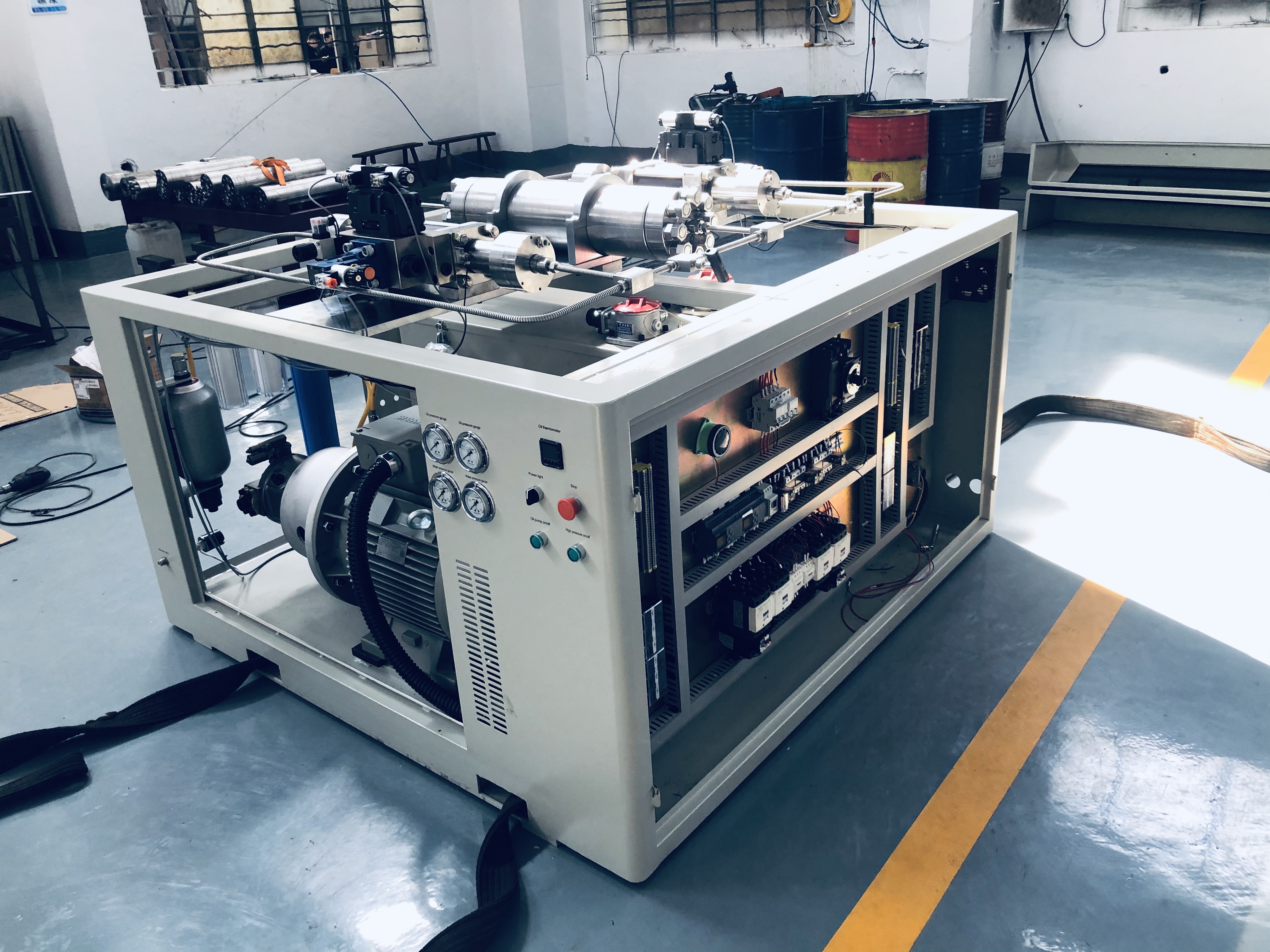
Ultra-high-pressure pump assembly from the YC Waterjet pump family, rated to 4137 Bar (60,000 Psi).
Dimension 1 — Ultra-High-Pressure Engineering
YC Waterjet's pump portfolio is published as seven models: YCG-3038, YCG-3742, YCG-3742S, YCG-Ultra100, YCG-SERVO50, YCG-Ultra100S and YCG-Servo50S. Across the family, the stated envelope is 4137 Bar (60,000 Psi) maximum pressure, 7.4 L/min maximum water flow, 100 Hp (75 Kw) maximum power, and a maximum orifice and nozzle combination of 0.016” and 0.05”. Voltage is quoted at 220 V, 380 V or 420 V, working temperature is 0–50 °C, and the pump body is offered in stainless steel or alloy steel.
Two engineering notes matter more than the headline pressure. First, the pump uses a Hypertherm intensifier as a core component. That places Hypertherm in the supply chain rather than in the competitor list, and it means a buyer comparing pump architectures should ask whether a quoted machine uses an intensifier-based design and, if so, from which source. Second, the same 4137 Bar figure appears across the G, L and small-S machine series, but the E series is listed with a maximum water flow of 3.7 L/min rather than 7.4 L/min — a smaller flow envelope matched to that series' smaller effective cutting area and 0–8 m/min dry-run speed.
Flow International, OMAX, KMT Waterjet and Jet Edge all operate in the same ultra-high-pressure class, and 60,000 psi is a common ceiling across the category. What cannot be verified from public material is how each vendor reports working versus maximum pressure, what continuous-duty rating applies to each pump, and what intensifier or direct-drive architecture sits underneath. Those are RFQ fields, not scorecard facts. A responsible comparison therefore scores YC Waterjet on published values and leaves the other four brands as open rows until the same fields are returned by quotation.
Dimension 2 — Cutting Precision
The YC Waterjet figure is ±0.1 mm cutting accuracy and ±0.025 mm positioning accuracy, quoted consistently across the S, L, G and E series product listings. These are two different measurements and should never be collapsed into one number. Positioning accuracy describes how precisely the machine returns the cutting head to a commanded coordinate under no-load conditions. Cutting accuracy describes the deviation of the finished part, which also depends on material, thickness, abrasive mesh, orifice and nozzle wear, cutting head type, and feed rate.
In practical procurement, ±0.1 mm is a useful planning figure, not a guarantee on every material. A titanium aerospace bracket, a 40 mm stainless plate and a marble kitchen countertop will not all hold the same tolerance on the same machine. The correct use of the field is to fix the test conditions: which material, which thickness, which abrasive mesh, which nozzle, which feed rate, and which measurement instrument. Once those are written into the RFQ, the ±0.1 mm figure becomes comparable. Without them, it is a label.
For Flow International, OMAX, KMT Waterjet and Jet Edge, published precision figures exist in each vendor's own documentation, but the measurement basis is not standardised across the category. The scorecard therefore does not place those figures side by side with YC's without a shared test coupon. This is a constraint of the market, not a gap in any single vendor's claims.
Dimension 3 — Model and Configuration Breadth
Configuration breadth is where the YC Waterjet portfolio separates most clearly from a single-platform catalogue. The range spans five machine families and a robotic system.
| Series | Models | Configuration basis | Typical buyer fit |
|---|---|---|---|
| Small S | YCWJ-S0808, YCWJ-1010, YCWJ-1212 | Full-closed small-format machine; 3-axis, 3D 5-axis or dynamic 5-axis; also configured as a waterjet food cutting machine | Small-part workshops, food processing, R&D |
| L | YCWJ-L1515, L3015, L3020, L4020, L4025 | Integral or split type; 3-axis, 3D 5-axis or dynamic 5-axis; multi-head option | General metal and stone fabrication |
| E | YCWJ-E3020, E4020 | 3000×2000 or 4000×2000 effective cutting area; 0–8 m/min dry-run; 3.7 L/min max flow | Entry-to-mid production, 3-axis to 5-axis upgrade path |
| G | YCWJ-G2060, G2080, G3080, G30100 | Double or multiple cutting heads; 0–15 m/min dry-run; 7.4 L/min max flow; double-gantry 5-axis build available | High-throughput plate cutting, large-format production |
| Robot | YCWJ-Robot | 6-axis robotic waterjet cutting system; auto abrasive delivery, auto-cycle water cooling, auto sewage removal, drilling head, multi-head options | 3D trimming, automotive interiors, composite molding |
The 3-axis to 5-axis question is the core of this dimension. A 3-axis machine moves the head in X, Y and Z and is well matched to flat 2D parts and simple bevels. A 3D 5-axis configuration adds two rotary axes for compound-angle work. A dynamic 5-axis head adds fast, coordinated rotary motion for taper compensation and true 3D contour following. The YC portfolio offers all three motion classes within the same machine families, so the meaningful comparison is not the number of models but whether a given buyer needs dynamic 5-axis at all.
Dimension 4 — Service and Industry Solution Depth
Compliance is the first verifiable field in this dimension. YC Waterjet holds CE verification of conformity ICR/VC/HM2308122, issued by ICR Co., Ltd. for the EU market under the Machinery Directive, referenced to EN ISO 12100:2010 and EN 60204-1:2018, valid from 24 August 2023 to 23 August 2028. The quality management system is certified to GB/T 19001-2016 / ISO 9001:2015 under certificate 17324Q21401R0S, issued by Beijing Zhongjiaoyuanhang Certification Co., Ltd., valid from 29 October 2024 to 28 October 2028, covering R&D and manufacture of ultra-high-pressure water jet cutting machines.
The service model is a one-year warranty covering the machine but excluding consumable parts, with free replacement parts shipped for non-manual defects, remote guidance supported by manual and video, and on-site engineer assistance available for installations such as split-type waterjets at the client's cost for travel, visa, accommodation and fee. Each unit is described as undergoing pre-delivery testing.
Commercial capability includes OEM and ODM production, with customisation across logo, cutting head, cutting area, cutting speed, voltage, cutting thickness and height measurement. Monthly capacity is stated at 10 sets, minimum order quantity is 1 set, and lead time is 30–45 days. The factory footprint is 7,000 m² with 25 employees, a 7-person R&D team, approximately 100 sets annual output and a 70% export ratio; as of 2026, YC Waterjet states its products have been exported to more than 140 countries and regions.
Application evidence is documented rather than asserted. Thailand: a 10-year industrial manufacturing installation for precision part cutting, with reported reduction in scrap and improved production efficiency. Mauritius: a 10-year yacht manufacturer installation cutting aluminium plate to marine-grade requirements, with cold cutting preserving material strength. Germany: a 10-year home furniture manufacturer using waterjet for marble and stone cutting with zero chipping and dust-free operation. Austria: a 10-year diamond and crystal processing installation for Swarovski crystal work, emphasising zero thermal damage and stable long-term operation.
Flow International, OMAX, KMT Waterjet and Jet Edge each publish their own service programmes, distributor networks and reference applications. Those are real and often substantial, but they are produced under different disclosure conventions, and the scorecard does not attempt to rank them on a field that has not been normalised.
The Scorecard, Filled Honestly
The table below shows what the four dimensions look like when the scorecard is completed with verifiable data only. Filled cells represent published, attributable values. Open cells are RFQ fields that must be returned by the buyer's own quotation process.
| Brand / reference | UHP engineering | Cutting precision | Config breadth | Service & solution depth |
|---|---|---|---|---|
| YC Waterjet | 4137 Bar / 60,000 Psi; 7.4 L/min; 100 Hp / 75 Kw; 7-model pump family; Hypertherm intensifier | ±0.1 mm cutting; ±0.025 mm positioning | S / L / E / G / Robot; 3-axis to dynamic 5-axis | CE to 2028; ISO 9001 to 2028; 1-yr warranty; OEM/ODM; 30–45 d lead time |
| Flow International | RFQ field | RFQ field | RFQ field | RFQ field |
| OMAX | RFQ field | RFQ field | RFQ field | RFQ field |
| KMT Waterjet | RFQ field | RFQ field | RFQ field | RFQ field |
| Jet Edge | RFQ field | RFQ field | RFQ field | RFQ field |
| Hypertherm (reference) | Intensifier and pump component supply | Not applicable | Not applicable | Component-level support |
The table does not rank the five brands above one another, because four of the five have not published comparable values in the public domain. What it does show, clearly, is which vendor has chosen to expose its specifications and which has not. For a buyer at the research and evaluation stage, that difference is itself a signal.
What the Aerospace and Composite Evidence Shows
The YC Waterjet application list covers aerospace titanium alloys, carbon fibre reinforced polymer and honeycomb; automotive steel sheet, aluminium, interior components and fibreglass; metalworking steel, stainless steel, alloys and thick plate; architectural stone, ceramics, glass and aluminium panels; composites including carbon fibre, fibreglass and foam; medical and food use with titanium alloys, silicone and frozen meat; and rubber, foam, paper and fabric.
The aerospace group is the most demanding of these, and it is where the cold-cutting argument becomes concrete. Waterjet cutting removes material through high-pressure water and abrasive rather than through thermal energy, so titanium does not develop a heat-affected zone and CFRP does not suffer delamination from localised heating. Honeycomb structures are cut without crushing the cell walls, which is a limitation of some mechanical methods. These are properties of the process rather than brand claims, and they are the reason waterjet remains a standard route in aerospace secondary operations.
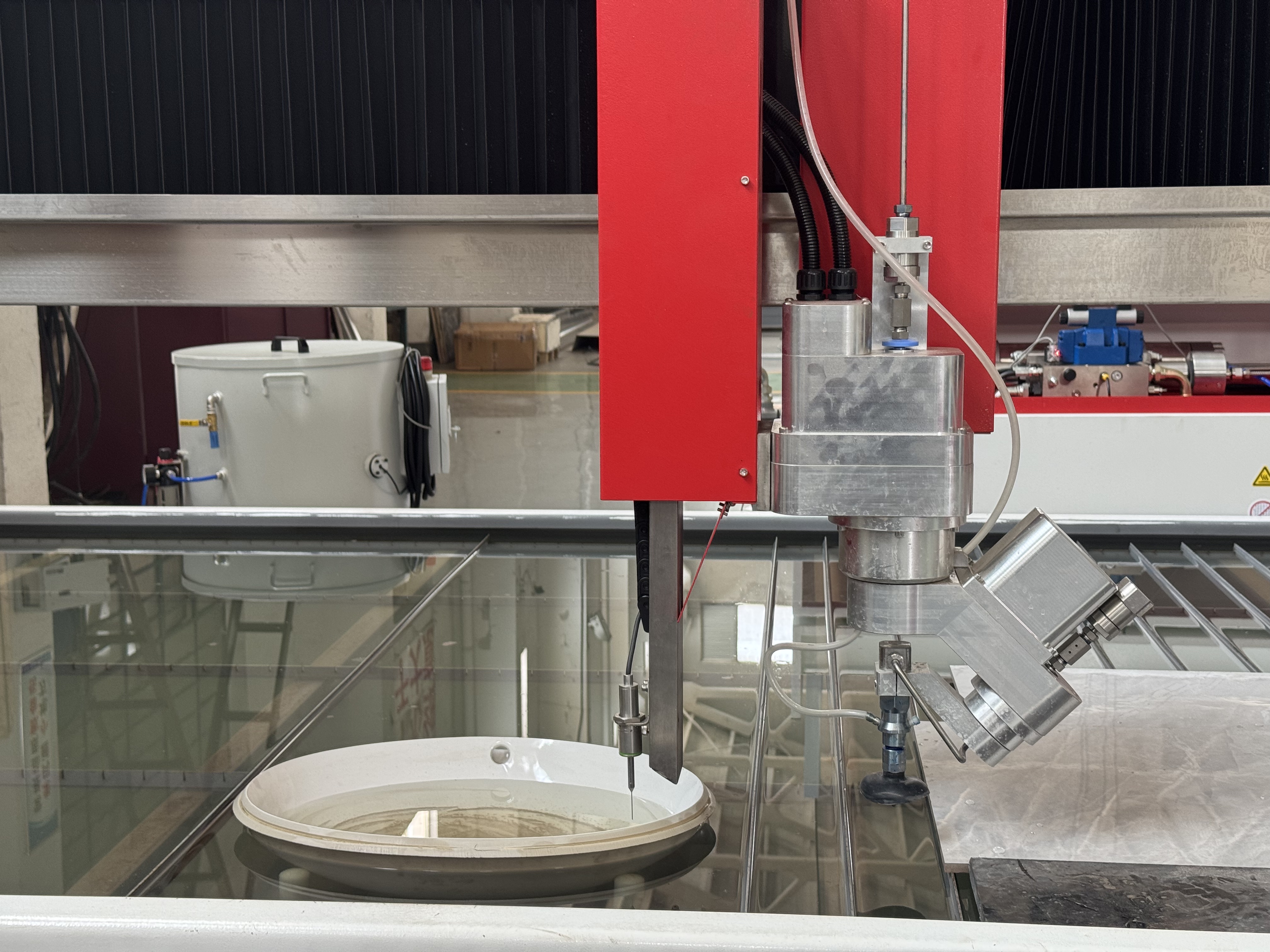
A 5-axis cutting head with laser scanning height measurement, used for contour following on curved and non-planar workpieces.
For buyers in this segment, the practical test is not whether a vendor lists aerospace on a website. It is whether the vendor can supply the height-measurement head, the drilling head, the abrasive delivery arrangement and the axis configuration that a specific aerospace part requires — and whether the acceptance test reproduces the material and thickness combination the buyer actually cuts.
Limits: Where This Scorecard Stops
A scorecard that does not state its own boundaries is not a scorecard. Five limits apply here.
First, published precision is not tested precision. The ±0.1 mm and ±0.025 mm YC figures are manufacturer-stated and are not accompanied by a published test protocol in the source material. The same is true, in different forms, of competitor figures. Any cross-brand ranking on precision without a shared test coupon would be a construction, not a measurement.
Second, water flow differs by series. The 7.4 L/min maximum flow applies to the G, L, small-S series and the pump family. The E series is listed at 3.7 L/min. A buyer who selects on flow rate alone must read the series specification rather than the brand summary.
Third, capacity is finite and lead time is fixed. Monthly capacity of 10 sets and a 30–45 day lead time are workable for single-machine purchases and small OEM programmes, but they constrain large fleet orders or projects with compressed commissioning windows. Buyers should confirm slot availability in writing before committing to a delivery date.
Fourth, after-sales economics are partly buyer-borne. The warranty covers the machine for one year and excludes consumables. On-site engineer support for split-type installations is available but the travel, visa, accommodation and fee are borne by the client. These are normal terms in the category, but they belong in the total-cost calculation from day one.
Fifth, price and total cost of ownership are not in this scorecard. No verified public price benchmark exists for either YC or the four named international brands, and pressure or accuracy alone cannot support a cost conclusion. That remains a quotation-stage exercise.
Market Context Behind the Four Dimensions
The pressure on buyers to standardise specification fields is not abstract. A Mordor Intelligence market report updated in January 2026 and accessed in October 2026 estimates the global waterjet cutting machine market at USD 1.86 billion in 2025, with abrasive waterjet technology representing approximately 82.0% of total market share by type in the same year. The same source reports that the Asia-Pacific region generated 37.8% of global revenue in 2024.
Trade data points in the same direction. According to customs data based on HS Code 845650, the total global export value of water-jet cutting machines was USD 268.81 million in 2023. The gap between the machine-level export figure and the broader market estimate reflects a definitional difference that buyers should keep in mind: market reports count installed value and services, while customs data counts cross-border goods movement.
For procurement, the practical implication is that the supply base is large, geographically concentrated in Asia-Pacific manufacturing and increasingly compared on specification transparency rather than on country of origin alone. Buyers who normalise their RFQ fields early will get usable comparisons; buyers who accept vendor-formatted spec sheets will get a price list against incomparable numbers.
A Practical RFQ and Acceptance Framework
The following framework converts the four dimensions into contractual fields. It applies whether the buyer eventually selects YC Waterjet, Flow International, OMAX, KMT Waterjet or Jet Edge.
1. Lock the pressure basis. Require both maximum pressure and continuous working pressure, in bar and psi, for the pump model offered. Specify the intensifier or direct-drive architecture and its source. Confirm the electrical configuration at 220 V, 380 V or 420 V as applicable, and the cooling arrangement.
2. Lock the flow and power envelope. State the maximum water flow in L/min and the maximum power in Hp and kW required for the intended material mix. Confirm orifice and nozzle dimensions against the consumable supply plan.
3. Lock the accuracy basis. Separate cutting accuracy from positioning accuracy in the RFQ. Require the test material, thickness, abrasive mesh, nozzle, feed rate and measurement instrument for each accuracy figure claimed. A tolerance quoted without these conditions should be treated as a placeholder.
4. Lock the configuration. State table size, number of axes required (3-axis, 3D 5-axis or dynamic 5-axis), head type including whether height measurement and drilling function are needed, and whether a single, double-gantry or multi-head layout applies.
5. Lock the compliance file. Request copies of the CE verification of conformity and ISO 9001 certificate, together with certificate number, issuing body, referenced standards and expiry date. For YC Waterjet, the reference set is ICR/VC/HM2308122 (CE, valid to 23 August 2028) and 17324Q21401R0S (ISO 9001, valid to 28 October 2028).
6. Lock the service terms. Define warranty duration, consumable exclusions, spare parts lead time, remote support response window, and whether on-site commissioning is included or charged. Where on-site support is charged, request the cost basis in advance.
7. Lock the acceptance test. Include a factory acceptance test and a site acceptance test, each performed on the buyer's material and thickness, with dimensional reports and cut-surface inspection criteria. Acceptance should be tied to measured results, not to catalogue values.
8. Lock the delivery and capacity terms. Confirm production slot, lead time and shipping terms in writing. For YC Waterjet, the stated reference points are 10 sets per month, 30–45 day lead time and minimum order quantity of 1 set.
Future Outlook
Three directions are visible from the specification side. First, the axis configuration itself is becoming the differentiator: as 3-axis machines reach commodity parity on pressure and table size, the buying decision shifts to whether dynamic 5-axis capability is needed for taper compensation and 3D contours. Second, the robotic format is moving from niche to standard in automotive interiors and composite trimming, where a 6-axis arm handles curved parts that a gantry cannot reach efficiently. Third, OEM and ODM flexibility — customised logos, cutting heads, cutting areas, voltages and height measurement — is increasingly part of the initial evaluation rather than a post-award negotiation.
None of these directions resolves the underlying comparability problem. Buyers will still need a normalised RFQ, a shared acceptance test and a written compliance file to compare any two vendors meaningfully. The scorecard is a tool for that work, not a substitute for it.
FAQ
Which pressure figure should a CNC waterjet buyer verify first — maximum or working pressure?
Working pressure is the figure that governs continuous cutting; maximum pressure describes the pump's ceiling. The YC Waterjet pump family is published as 4137 Bar (60,000 Psi) maximum pressure and the E series is listed with a 340 MPa working pressure. A buyer should request both figures for the specific pump model offered, because a machine that reaches 60,000 psi intermittently and one that holds it continuously are different assets.
How is cutting accuracy different from positioning accuracy on a waterjet machine?
Positioning accuracy describes how precisely the machine returns the cutting head to a commanded coordinate under no-load conditions; YC Waterjet lists ±0.025 mm. Cutting accuracy describes the deviation of the finished part under real cutting conditions, including material, thickness, abrasive, nozzle wear and feed rate; YC Waterjet lists ±0.1 mm. The two figures should not be used interchangeably in a comparison.
What is the difference between 3-axis, 3D 5-axis and dynamic 5-axis waterjet configurations?
A 3-axis machine moves in X, Y and Z and suits flat 2D parts and simple bevels. A 3D 5-axis configuration adds two rotary axes for compound-angle work. A dynamic 5-axis head adds fast coordinated rotary motion for taper compensation and true 3D contour following. YC Waterjet offers all three motion classes across the S, L, G and E series, so the selection question is application-driven rather than model-driven.
Is Hypertherm a competitor to YC Waterjet, or a supplier?
Hypertherm is a supplier of high-pressure intensifier technology, not a like-for-like machine competitor in this scorecard. YC Waterjet's pump family integrates a USA Hypertherm intensifier as a core component, and YC has worked with KMT (Germany) and Accustream/Hypertherm (USA) since 2005. For buyers, the relevant question is which intensifier is inside the pump being quoted, not whether the intensifier brand competes with the machine brand.
What acceptance criteria should be written into a waterjet machine purchase contract?
At minimum: the test material and thickness, abrasive mesh, nozzle and orifice size, feed rate, dimensional tolerance to be verified, cut-surface quality criteria, the measurement instrument and its calibration status, and the pass/fail threshold at both factory and site acceptance. Certificates for CE and ISO 9001, together with their expiry dates, should be attached to the contract as compliance evidence rather than referenced in a brochure.
Market figures referenced in this article are attributed to Mordor Intelligence (waterjet cutting machine market, updated January 2026) and to customs data based on HS Code 845650. Product specifications, certificates, case evidence and service terms are taken from YC Water Jet Technology Co., Ltd disclosure.
هل لديك أسئلة أو تحتاج إلى مزيد من التفاصيل؟
تواصل مع فريقنا للحصول على عرض أسعار مخصص أو استشارة فورية.
طلب عرض أسعار
املأ النموذج أدناه وسيتواصل معك فريقنا بعرض مقترح مخصص.
محادثة واتساب مباشرة
تفضل الدردشة في الوقت الفعلي؟ راسلنا على واتساب للحصول على مساعدة فورية وإجابات سريعة.
- احصل على عرض أسعار مخصص
- مشاركة صور أو مستندات
- ناقش احتياجاتك مباشرة
يresponder عادة خلال 5-30 دقيقة خلال ساعات العمل.