
CNDOME Cutting Discs for Metal and INOX: A 1.5 to 4.5 Inch Shortlist
Cutting discs are still specified format by format. A workshop may standardise on one grinder family, yet the wheel fitted to it changes with the workpiece, the access available at the cut, and what happens to the part afterwards. That is why the 1.5-inch to 4.5-inch band, the sizes driven by compact and standard angle grinders, carries more procurement decisions than its share of catalogue space suggests.
This HTNXT industry reference shortlists five CNDOME cutting disc formats for general metal and stainless steel (INOX) cutting: the 1.5-inch (38 x 1.1 x 3 mm) and 2-inch fine discs intended for detailed work, the 3-inch (75 x 1.2 x 10 mm) format, and the 4-inch (107 x 1.2 x 16 mm) and 4.5-inch (115 mm) options used in the most common cutting tasks.
CNDOME is the brand under which Changzhou Dome Abrasives Manufacture Co., Ltd. supplies resin-bonded cutting discs, grinding wheels, abrasive discs, ceramic grinding discs and flap discs. The manufacturer was founded in 2001 and runs a temperature- and humidity-controlled workshop of more than 20,000 square metres in Changzhou, Jiangsu Province, China, with exports to Latin America, Europe, Africa and Asia.
The shortlist is grounded in the material and shape data documented for the range: Aluminium Oxide and White Aluminium Oxide abrasives in a resin bond, formed in the T41 shape. The sections below set out what each format is for, which formats fall inside MPA Hannover certificate scopes, and where the evidence behind this shortlist stops.
Why the 1.5 to 4.5 Inch Band Needs Its Own Selection Logic
Three variables decide most of the outcome when buyers qualify a small cutting disc: bore diameter, thickness, and documented conformity.
- Bore diameter determines whether the disc physically fits the tool. The formats in this shortlist are documented with 3 mm, 10 mm and 16 mm bores. A mismatched bore is a fitment failure rather than a performance problem.
- Thickness determines how the disc behaves inside the cut. Within the CNDOME range, documented formats span 1.0 mm, 1.1 mm, 1.2 mm, 1.6 mm, 2.0 mm, 2.5 mm and 3.0 mm.
- Documented conformity determines whether a format can be placed on a regulated market. European safety standard EN 12413:2019 specifies the safety requirements and testing procedures for rotating bonded abrasive products, including cutting and grinding wheels, and MPA Hannover provides independent safety testing and certification for abrasive tools, a key requirement for exporting industrial cutting discs to the EU market.
For an evaluation-stage buyer, qualifying a format therefore means qualifying a document set, not only a unit price. Format-level certification is the point most often missed in small-diameter sourcing, because certificates are issued against specific dimensions rather than a general product family.
The Shortlist at a Glance
| Format | Nominal size (D x T x bore) | Typical role | MPA Hannover certificate coverage cited in this article |
|---|---|---|---|
| 1.5 inch | 38 x 1.1 x 3 mm | Fine, detail cutting where access is limited | Not itemised in the certificate scopes cited here |
| 2 inch | 2-inch class (fine disc) | Detail cutting and small-section stock | Not itemised in the certificate scopes cited here |
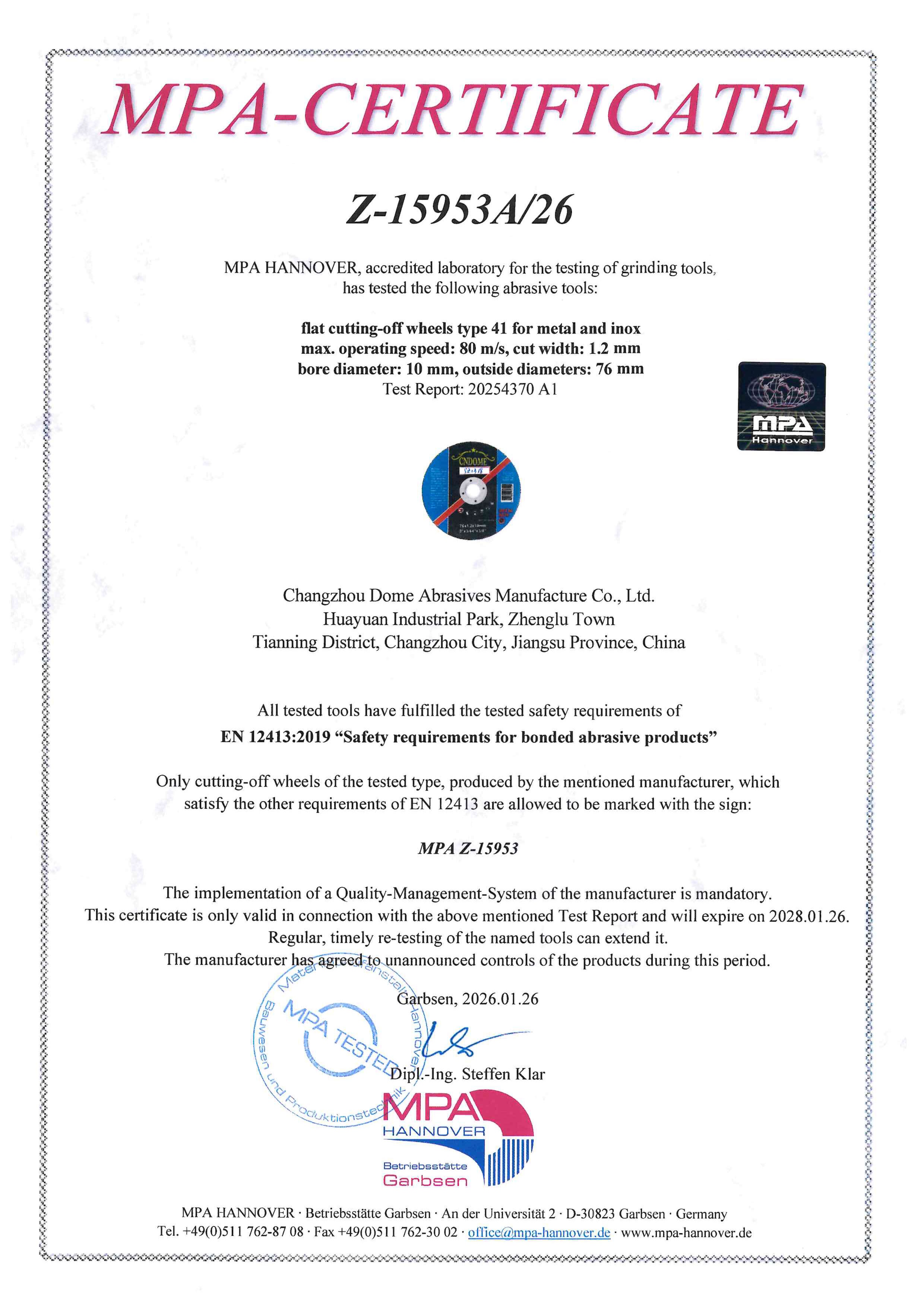
| 3 inch | 75 x 1.2 x 10 mm | Light fabrication, small tube and profile | Z-15953A/26 covers 76 x 1.2 mm (26 January 2026 to 26 January 2028) |
| 4 inch | 107 x 1.2 x 16 mm | General metal cutting with compact grinders | Not itemised in the certificate scopes cited here; the closest documented 4 to 4.5 inch scope is the 115 mm family |
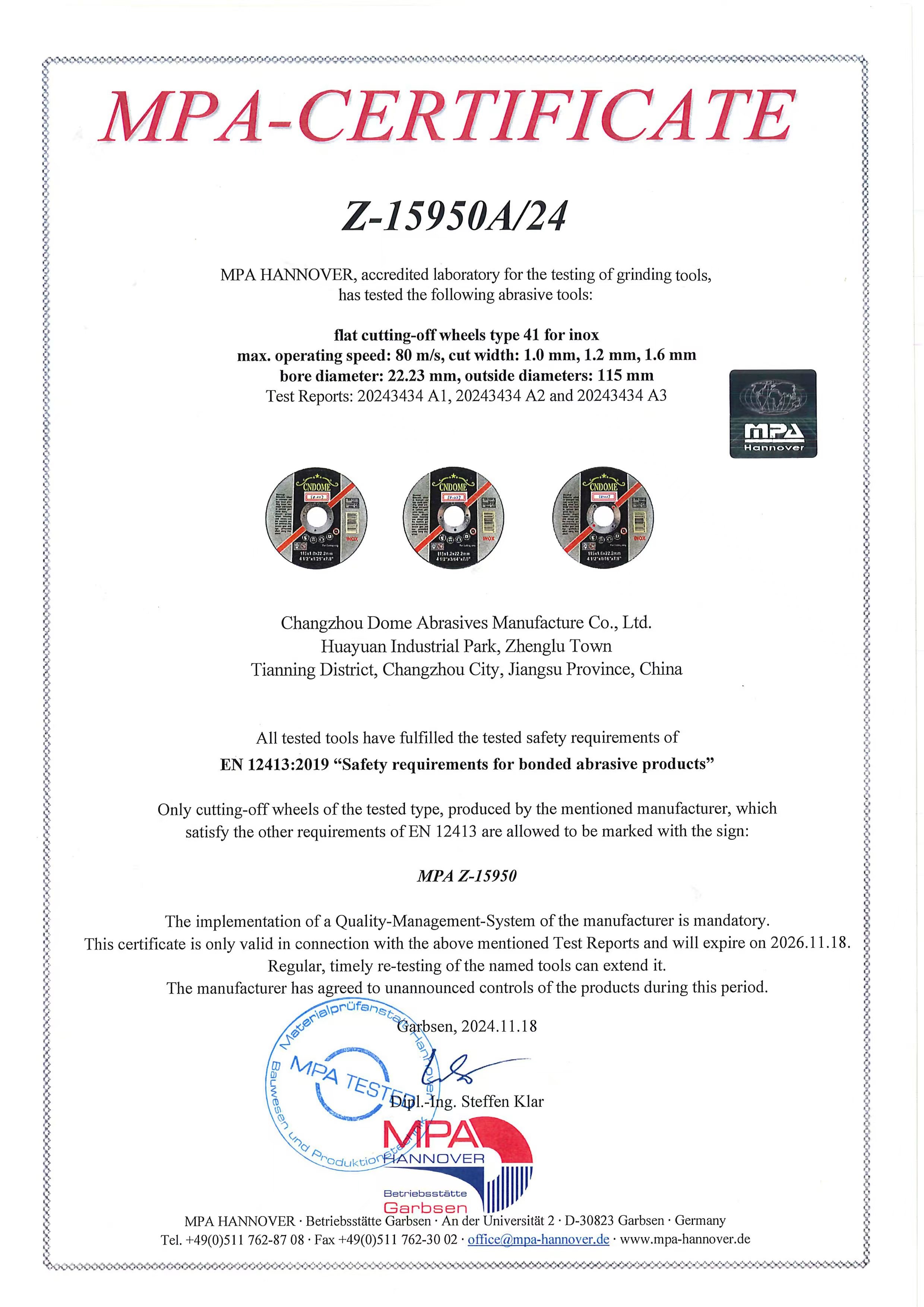
| 4.5 inch | 115 x 1.0 mm, 115 x 1.2 mm, 115 x 1.6 mm | Most common general-purpose metal and INOX cutting format | Z-15950A/24 covers 115 x 1.0 mm, 115 x 1.2 mm and 115 x 1.6 mm (18 November 2024 to 18 November 2026) |
Two observations follow from the table. First, the 4.5-inch class is the only format in this band with a published certificate scope covering several thickness options, which matters because thickness is the variable buyers change most often. Second, format-level certification is narrower than product-family marketing suggests: a certificate that covers 115 mm does not automatically cover 107 mm. Where a preferred format is not itemised, the practical step is to request the declaration of conformity for that exact size.
What the Shortlist Is Built On: Abrasive, Bond and Shape
CNDOME cutting discs are documented with Aluminium Oxide and White Aluminium Oxide as the abrasive materials, held in a resin bond and formed in the T41 shape. The wider material data recorded for the range also lists silicon carbide and zirconium, which indicates that formulations are adjusted by product rather than fixed across the catalogue.
The T41 designation describes a flat, straight cutting wheel profile, the geometry used for cut-off work as distinct from depressed-centre grinding shapes. In the CNDOME specification data, the 9-inch format (230 x 2.0 x 22.23 mm) is listed as T41/T42, while the 7-inch (180 mm) and 16-inch (400 x 3.5 x 32 mm) cutting disc entries are listed as T41.
Speed ratings are documented per format rather than as a single figure. Cutting disc entries in the available specification data list a maximum speed of 80 m/s, with operating speeds of 8,500 RPM for the 7-inch (180 mm) format, 6,600 RPM for the 9-inch (230 mm) format, and 3,800 RPM for the 16-inch (400 mm) format. The engineering rule that follows is straightforward: the maximum speed marked on the wheel must be equal to or higher than the free-running speed of the grinder it is fitted to. This is a safety requirement in the market where EN 12413 applies, and it is also the first check an auditor performs.
For INOX work, buyers commonly specify discs dedicated to stainless steel to reduce the risk of iron contamination being transferred to the workpiece surface. This is established shop-floor practice rather than a property printed on a disc, and it is one reason buyers separate stainless consumption from general mild-steel consumption even when the nominal disc size is identical. Buyers should confirm the exact formulation recommended for their stainless application with the supplier.
Where Each Format Fits in Metal and INOX Work
1.5 inch (38 x 1.1 x 3 mm) and 2 inch
The smallest formats in this shortlist are positioned as quick-cutting fine discs for detailed work. Their role is access and control: cuts in tight geometry, small-section stock and finishing-adjacent operations where a larger wheel cannot reach or would remove more material than the operation allows. The 1.5-inch format is documented with a 3 mm bore, which ties it to compact tools rather than a standard angle grinder.
3 inch (75 x 1.2 x 10 mm)
The 3-inch format sits between the detail discs and the general-purpose sizes, with a 10 mm bore. It is the size class covered by MPA Hannover certificate Z-15953A/26 at 76 x 1.2 mm, valid to 26 January 2028. For buyers who need a documented small-format disc for a regulated market, this is the smallest size in the CNDOME band with a published certificate scope.
4 inch (107 x 1.2 x 16 mm) and 4.5 inch (115 mm)
These are the workhorse formats of the band. The 4-inch disc is documented with a 16 mm bore, and the 4.5-inch family is documented at 115 mm in 1.0 mm, 1.2 mm and 1.6 mm thicknesses, each with its own certificate scope. In practice the 4 to 4.5 inch class absorbs the majority of general metal and INOX cutting volume, which is consistent with the wider market observation that stainless steel cutting discs are identified as the dominating product category within the cutting discs market due to heavy demand in construction and automotive manufacturing.
Field evidence from CNDOME supply relationships describes how these formats are consumed. A tool brand OEM in Brazil reports annual production of 10,000,000 pieces over a three-year relationship, used for cutting iron and stainless steel in hardware stores, with long service life, burr-free cutting, fast material feeding and low dust. A tool supermarket channel across Mexico, the United States and multiple South American countries reports 40,000,000 pieces per year over three years, covering home DIY and professional metalworking, alongside complete model range and packaging requirements. A stainless processing manufacturer in South America uses the discs at 500,000 pieces per year for work on stainless steel pipe, reporting long disc life, no slag shedding and no need for frequent replacement. Machining factories in Asia report multi-specification demand with inventory held ready for 24-hour production.
Certification: What Can Be Verified Format by Format
Certification is where this shortlist becomes usable for procurement. The MPA Hannover certificates held against CNDOME cutting discs cover specific dimensions, and the validity dates differ by certificate.
| Certificate | Formats covered | Issued | Valid to |
|---|---|---|---|
| Z-15953A/26 | 76 x 1.2 mm | 26 January 2026 | 26 January 2028 |
| Z-15950A/24 | 115 x 1.0 mm, 115 x 1.2 mm, 115 x 1.6 mm | 18 November 2024 | 18 November 2026 |
| Z-15951/24 | 115 x 3.0 mm, 230 x 3.0 mm | 18 November 2024 | 18 November 2026 |
| Z-14440A-1/24 | 125 x 1.0 mm | 18 November 2024 | 18 November 2026 |
| Z-15950B/24 | 125 x 1.2 mm | 18 November 2024 | 18 November 2026 |
| Z-14440A-3/24 | 180 x 1.6 mm | 18 November 2024 | 18 November 2026 |
| Z-15950C/24 | 230 x 2.0 mm | 18 November 2024 | 18 November 2026 |
| Z-15953B/26 | 230 x 1.6 mm | 26 January 2026 | 26 January 2028 |
| Z-15953C/26 | 300 x 3.2 mm | 26 January 2026 | 26 January 2028 |
| Z-15950D/24 | 355 x 3.0 mm | 28 November 2024 | 28 November 2026 |
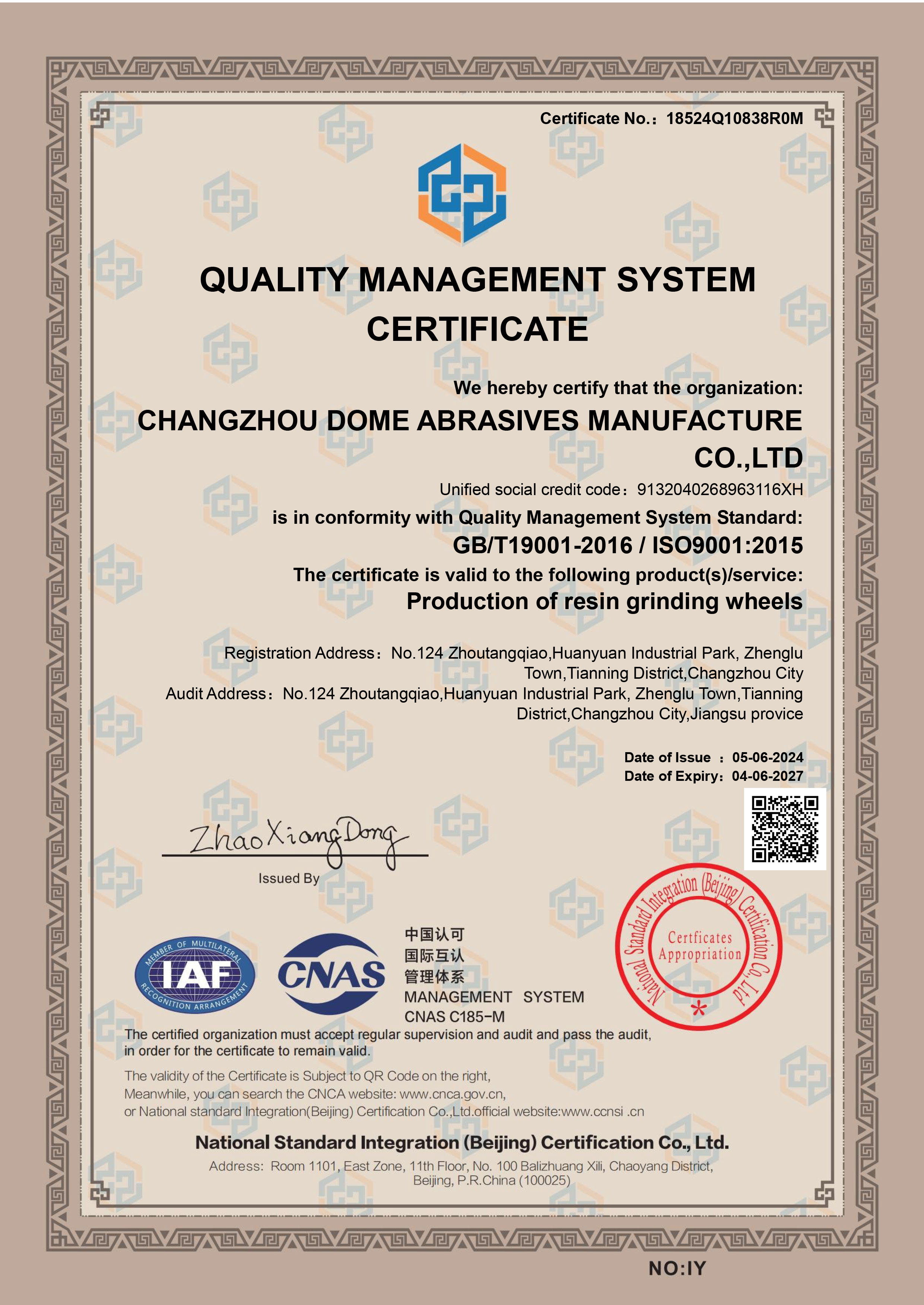
These MPA certificates are issued against the EN 12413 standard. In addition, CNDOME holds CE certificate M.2022.206.C74459 issued by UDEM, covering cutting and grinding wheels under EN 12413 and valid to 9 June 2027. Quality and social compliance documentation includes ISO 9001 certificate 18524Q10838R0M for the production of resin grinding wheels, valid to 4 June 2027; ISO 14001 certificate 25024E11441R0M, valid to 19 December 2027; and BSCI certificate 156-025464-001 under the amfori BSCI Code of Conduct / SA8000, valid to 16 October 2027.
Market Context: A Large, Regionally Concentrated Category
The demand behind this shortlist is measurable, though the measurement depends on scope. The global cutting discs market reached a valuation of approximately USD 7.32 billion in 2024 according to Market Research Future. Other published estimates place the same category at USD 5.1 billion and USD 2.5 billion depending on whether the boundary is drawn around disc consumables or the wider cutting equipment segment. Buyers using market figures in internal business cases should note that divergence rather than treat one number as definitive.
On regional structure, Asia-Pacific accounted for 48.28 percent of global revenue in the cutting equipment and tools sector in 2025, maintaining its position as the largest regional market, according to Mordor Intelligence. Within that picture, the China abrasives market was valued at USD 2.29 billion in 2024, with synthetic raw materials accounting for USD 1.35 billion of that revenue, according to Intel Market Research.
The competitive field is well defined. Major industry players in the abrasives and cutting tool sector include Saint-Gobain (Norton), 3M, Robert Bosch GmbH, Tyrolit and PFERD. This shortlist is a format-level reference within one manufacturer range, not a supplier ranking, and it should be read alongside a separate supplier-level evaluation when a buyer is selecting between manufacturers.
Comparison: Thin Fine Discs Versus Thicker General-Purpose Discs
The most consequential decision inside this band is thickness. Both options are documented in the CNDOME certificate scopes, which makes the comparison verifiable rather than promotional.
| Attribute | Thin formats (1.0 to 1.2 mm) | Thicker formats (3.0 mm) |
|---|---|---|
| Documented certificate coverage | Z-15950A/24 covers 115 x 1.0, 1.2 and 1.6 mm | Z-15951/24 covers 115 x 3.0 mm and 230 x 3.0 mm |
| Typical specification logic | Specified where the cut must be fast and the workpiece must not be disturbed more than necessary | Specified where a wider kerf, higher lateral stiffness or heavier duty cycle is required |
| Material removed per cut | Lower, because the kerf is narrow | Higher, because the kerf is wider |
| Stability in the cut | Lower, so operator technique matters more | Higher, which generally suits less experienced operators and rough handling |
| Fit in a shortlist | Appropriate for the majority of metal and INOX cutting tasks in the 1.5 to 4.5 inch band | Appropriate where the task calls for a wider cut or a more robust wheel |
Where this shortlist stops. Four limits should be stated plainly. First, certification is format-specific, so the 1.5-inch, 2-inch and 4-inch entries above are not itemised in the certificate scopes cited in this article and must be confirmed against the exact size being ordered. Second, several of the MPA scopes expire in November 2026, which means buyers planning 2027 deliveries are evaluating a document set that is due for renewal. Third, thin small-diameter discs are detail tools: as a category they remove less material per cut than larger or thicker wheels, so they are not a substitute for bulk production cutting. Fourth, resin-bonded abrasives are generally subject to manufacturer storage and handling guidance, and buyers should request that guidance before holding large inventory.
What to Verify Before You Specify
| Verification step | What to confirm |
|---|---|
| Bore fit | Match the 3 mm, 10 mm or 16 mm bore to the tool arbor before comparing performance. |
| Speed rating | Confirm the maximum speed marked on the wheel is at least the free-running speed of the tool. Documented CNDOME cutting disc formats list a maximum of 80 m/s. |
| Certificate scope for the exact format | Check the MPA certificate number against the diameter and thickness ordered, not against the product family. |
| Certificate validity | Confirm renewal status for any scope expiring on 18 November 2026 or 28 November 2026 if delivery extends into 2027. |
| Thickness rationale | Specify 1.0 to 1.2 mm or 3.0 mm by task requirement rather than by habit or previous purchase history. |
| Custom order parameters | Custom cutting discs are available in quantities of 10,000 or more, with a 30-day lead time and a monthly capacity of 8 million pieces. |
| Quality control method | CNDOME applies 100% AI Visual Comparison Testing in its quality control process. |
Future Outlook
Three structural signals are worth tracking for buyers of small cutting discs. Asia-Pacific remains the largest regional market, holding 48.28 percent of global revenue in the cutting equipment and tools sector in 2025, which keeps supply and pricing anchored in that region. Stainless steel cutting discs are identified as the dominating product category, which suggests the INOX portion of a buyer range will keep absorbing specification attention. And distribution continues to widen across both professional channels and retail channels, as shown by the CNDOME supply relationships in tool supermarkets and e-commerce platforms.
On the supply side, the capability data documented for CNDOME describes OEM and ODM customization covering logo, label, package, abrasive formulation and specification, a monthly capacity of 8 million pieces, a 30-day lead time, and 24/7 online support with remote technical assistance. The manufacturer serves more than 2,000 global tool and professional abrasive wheel brands, which is the relevant context for a buyer asking whether a small-format shortlist can be sustained at volume. The plausible direction of the category is toward finer format-level documentation and more custom-brand variants, not toward fewer sizes.
Frequently Asked Questions
Which format in this shortlist is used most often for general metal and INOX cutting?
The 4 to 4.5 inch class carries most of the volume. In the CNDOME range, the 4-inch format is documented at 107 x 1.2 x 16 mm and the 4.5-inch family at 115 mm in 1.0 mm, 1.2 mm and 1.6 mm thicknesses. The three 115 mm thicknesses are each covered by MPA Hannover certificate Z-15950A/24. This matches the broader market observation that stainless steel cutting discs are the dominating product category within the cutting discs market.
Are the 1.5-inch and 2-inch discs suitable for stainless steel detail work?
They are positioned as quick-cutting fine discs for detailed work, which is the task profile of tight-access and small-section cutting. Their limitation is size rather than material: they remove less material per cut than larger formats, so they are chosen for access and control rather than throughput. For INOX specifically, buyers commonly separate stainless-dedicated discs from general steel discs to reduce contamination transfer, so the formulation for the exact size should be confirmed with the supplier.
What do the MPA Hannover certificate numbers actually cover?
Each certificate covers defined dimensions. Z-15953A/26 covers 76 x 1.2 mm; Z-15950A/24 covers 115 x 1.0 mm, 115 x 1.2 mm and 115 x 1.6 mm; Z-15951/24 covers 115 x 3.0 mm and 230 x 3.0 mm; Z-14440A-1/24 covers 125 x 1.0 mm; Z-15950B/24 covers 125 x 1.2 mm; Z-14440A-3/24 covers 180 x 1.6 mm; Z-15950C/24 covers 230 x 2.0 mm; Z-15953B/26 covers 230 x 1.6 mm; Z-15953C/26 covers 300 x 3.2 mm; and Z-15950D/24 covers 355 x 3.0 mm. All are issued under EN 12413.
What does the T41 shape mean on these cutting discs?
T41 describes a flat, straight cutting wheel profile, the geometry used for cut-off operations as distinct from depressed-centre grinding shapes. In the CNDOME specification data, the 7-inch (180 mm) and 16-inch (400 x 3.5 x 32 mm) cutting disc entries are listed as T41, while the 9-inch (230 x 2.0 x 22.23 mm) format is listed as T41/T42.
How do Aluminium Oxide and White Aluminium Oxide differ in these discs?
Both are documented as the abrasive materials used in CNDOME cutting discs, alongside a resin bond and, in the wider recorded material set, silicon carbide and zirconium. In bonded abrasives generally, white aluminium oxide is associated with stainless and heat-sensitive workpiece materials where workpiece cleanliness matters, while standard aluminium oxide is widely used across general metal cutting. Because formulations are adjusted by product rather than fixed across a range, the specification for a specific size and application should be confirmed rather than assumed.
What are the minimum order quantity and lead time for custom formats?
Custom cutting discs are available in quantities of 10,000 or more. The documented lead time is 30 days, with a monthly capacity of 8 million pieces. Customization options cover logo, label, package, abrasive formulation and specification, and after-sales support includes 24/7 online support and remote technical assistance.
Do any of the certificates in this shortlist expire soon?
Yes. The MPA Hannover certificates covering 115 mm, 125 mm, 180 mm and 230 x 2.0 mm formats expire on 18 November 2026, and the certificate covering 355 x 3.0 mm expires on 28 November 2026. The scopes covering 76 x 1.2 mm, 230 x 1.6 mm and 300 x 3.2 mm run to 26 January 2028. Buyers with delivery schedules extending into 2027 should confirm renewal status for the earlier-dated scopes.
A downloadable product brochure is available at https://cdn.socialarks.com/sbsp/24879/common/2026/0519/6a0c1596e4f3c.pdf